No, we are not “better than this.” We are worse.

12 Aug


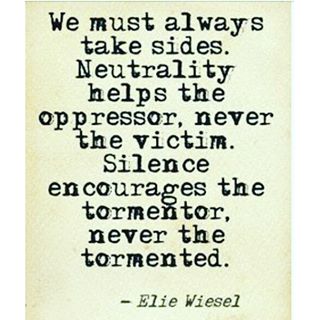
Elie Wiesel

Immigration Minister Peter Dutton seems to be of the opinion that because people fleeing their home countries pay “people smugglers” for passage to Australia, it is perfectly acceptable for them to be subjected to every imaginable kind of suffering. He includes children in this belief.

Dutton’s world view is mirrored by politicians such as Adam Giles in the Northern Territory, who share the narcissistic sense of entitlement that regards any perceived offence against them and their laws however mundane, however explicable, as a crime deserving of extreme punishment guaranteed to destroy the spirit.

In short, if you offend me I’ll destroy you. The crime here is offending these men, and both Giles and Dutton are profoundly offended by recalcitrant indigenous youth in the first, and waterborne asylum seekers in the second. You can see their indignation seeping out of every shining pore. They are incapable of seeing context: they can only perceive offence.

This overblown sense of offence and indignation, coupled with a sociopathic inability to imagine the conditions of lives other than their own, is the breeding ground for an extreme cruelty that ought never to be coupled with power, but unfortunately all too frequently is.

The manner in which successive immigration ministers, including those from the ALP, have treated waterborne asylum seekers beggars belief. They have been able to do this because enough Australians share the same narcissistic sense of entitlement and belief that being offended, personally, collectively and nationalistically, is a crime for which, unlike real crimes, punishment must be unrestrained and infinite. So kids in Don Dale don’t ever deserve a chance at life. So waterborne asylum seekers and refugees don’t ever deserve a chance at life. They’ve both offended white Australia in a variety of ways, and so they must die, metaphorically and sometimes literally.

It isn’t even so much what they’ve done. It’s the fact that they had the bloody gall to do it in the first place.

When outrages such as Don Dale and the Nauru files erupt, a lot of people get on social media to claim: “We’re better than this.”

Well, here’s the thing. We are not better than this. We’ve been torturing indigenous people since invasion day and we’re still doing it. We’ve been torturing waterborne asylum seekers for almost two decades, and we’re still doing it. We’re still voting in politicians who’ll continue the barbaric practices we don’t really want to know about as long as we feel we’re “being kept safe” from boats, or thieving black kids.

There are no innocent bystanders in these situations. We all know what’s happening. We’ve always known about our off-shore concentration camps. Keeping your mouth shut is enabling torture. These crimes are perpetrated by the powerful on the powerless because “good” people keep their mouths shut. Well, here’s another thing. You aren’t a “good”person if you keep your mouth shut. You’re an enabler of torment and torture.

As Human Rights Commissioner Gillian Triggs pointed out yesterday, the only way anything will change in our treatment of asylum seekers is through public pressure. The government knows this as well, which is why they don’t allow anyone to see the camps and the suffering people in them. This is what every government intent on the torment and torture of a particular group do: they herd them into facilities where no one can hear their screams.

And when we do finally hear their screams, as we have since the Don Dale revelations, Adam Giles blames those who bring their screams to our ears, and Peter Dutton blames the victims for screaming.

Think about that. I mean, really, really think about the mind sets of Giles and Dutton and those who support them, who shoot the messengers, and blame the victims for the suffering they inflict upon them.

Then get on social media and say “we’re better than this.” We aren’t. We could be, but we aren’t.


So they want to change 18c

8 Aug

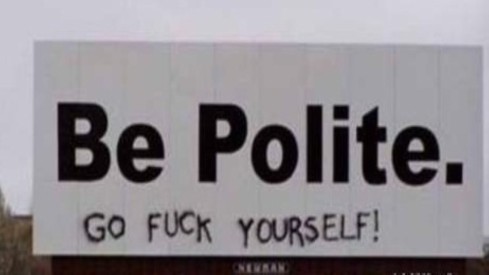
Be Polite


Returned Senator David Leyonhjelm and new One Nation Senator Malcolm Roberts both want rid of section 18c of the Racial Discrimination Act.

Section 18c makes it illegal to carry out an act if: “(a) the act is reasonably likely, in all the circumstances, to offend, insult, humiliate or intimidate another person or a group of people; and (b) the act is done because of the race, colour or national or ethnic origin of the other person or of some or all of the people in the group”.

There are those in both houses who support the removal or amendment of 18c, on the grounds that it collides with concepts of freedom of speech, though it’s slightly alarming to imagine what any of them want to say that requires the removal of 18c in order for them to be able to legally say it.

The section is a little over-written: a reasonable person can assume that if someone is humiliated or intimidated they have also been offended and insulted, and my understanding is that it is the words offend and insult that most aggravate the two senators.

Both Leyonhjelm and Roberts put forward the argument that offence is always taken, never given, and that each one of us has a choice as to whether or not we feel offended and insulted by the word or actions of another.

I find this notion particularly quaint coming from Senator Leyonhjelm: if indeed we can choose not to be offended and insulted, why does he so frequently choose to be angry and aggressive in reaction to others he feels have offended him? Especially on Twitter. He can get quite foul in that medium.

Leyonhjelm was apoplectic when The Chaser parked a van outside his house, and he threatened them with the police. Why did he choose that stressful and incendiary reaction if he’s in control of his feelings like he says we all should be?

Increasingly, this argument sounds like the justification of bullies for a perceived right to bully. I am tormenting you because I can, and you can choose not to be tormented so it’s your fault if you are.

What kind of person wants the right to behave like that towards another?

Of course it’s true that in theory no one can make us feel anything: we react and respond to others and those reactions and responses are influenced by all manner of prior experiences, and our degree of understanding of our own psychology.

Everyone is moulded by their individual experiences as well as by the social and economic systems in which we develop.  For example, if you suffer from, say, PTSD, you are less likely to be able to freely respond to distressing circumstances you encounter in the present, as one of effects of the illness is that it can make a present event indistinguishable from an event in a traumatic past.  Humans need models in our childhoods. We need to be able to learn how to choose our responses, this is not knowledge we acquire at birth. Some are taught better than others, some are not taught at all. The emotional life is by no means a level playing field, and saying we can all “choose’ not to be insulted or offended is like saying obesity is a choice, or poverty, or that we can all be millionaires if we only choose to.

Roberts and Leyonhjelm can take no credit for having being born white with the advantages that whiteness can bring, equally, those of ethnicities, race, colour and nationality that are frequently subject to hate speech had no choice in the matter of their birth either.

We are not islands: we are affected by others and we affect others. Leyonhjelm and Roberts’ argument is the equivalent of Margaret Thatcher’s belief that there is no society, there’s only individuals.

The question is not whether people should learn to be immune to feeling hurt and insulted when kicked by a donkey, but why do we tolerate donkeys who feel compelled to kick in the first place? The indigenous men and woman who took Andrew Bolt to court won their case, but Andrew Bolt has yet to adequately explain why he felt compelled to question their validity as people of colour.

This latter question would seem to me to be far more serious, and far more in need of urgent address than the removal or amendment of 18c. Why do these people want to amend or remove 18c? What will be gained from its removal, and who will profit?

I can see nothing to be gained, and a great deal that could be lost, unless it is your life goal to abuse those who are different from you, and if it is, you are the problem, not Section 18c.

By the way, we don’t actually have any constitutional rights to free speech in this country:

The Australian Constitution does not explicitly protect freedom of expression. However, the High Court has held that an implied freedom of political communication exists as an indispensible part of the system of representative and responsible government created by the Constitution. It operates as a freedom from government restraint, rather than a right conferred directly on individuals. 


Trump & Clinton. Clinton & Trump

6 Aug

Clinton, Trump


I recently read a characterisation of the US presidential battle as a struggle between a neofascist catastrophe and a neoliberal disaster. This latter description of Hillary Clinton will not please those among us who believe, some ardently, that a US female president will be a triumph simply because of her sex.

It surely is worth noting here that there have been (and still are) female presidents and prime ministers in countries other than the US for some time, including our own Julia Gillard. The US is breaking its own glass ceiling, not the world’s. I don’t know that women have done much better than men at the task, and it is probably slightly delusional to expect or demand that we will: after all, female leaders have to work within the same long-established systems as do males, and no one person of either sex is going to smash those corrupt systems and make the world a better place.

This is not to say women shouldn’t be equally represented in politics: of course we must. However, I sometimes wonder if we wouldn’t be better served fighting dysfunctional political orders, rather than pouring our considerable energies into the task of moulding women into the value systems of a hegemonic masculinity when once there, we can do little if our ambition is to keep our jobs.

On the question of entrenched and deadly systems of government, John Pilger argues in his Pilgeresque way that Hillary Clinton is a far more dangerous presidential prospect than is Donald Trump, partially on the grounds that Clinton is deeply embedded in a warmongering system whilst Trump is a maverick who condemns the Iraq invasion as a crime, and doesn’t want any trouble with Russia or China. Pilger continues:

Among Clinton’s biggest backers are the Israel lobby and the arms companies that fuel the violence in the Middle East. She and her husband have received a fortune from Wall Street. And yet, she is about to be ordained the women’s candidate, to see off the evil Trump, the official demon. Her supporters include distinguished feminists: the likes of Gloria Steinem in the US and Anne Summers in Australia.

Then there is the analysis of Trump as a self-saboteur, an outstanding example of someone who sets high goals while simultaneously working to undermine himself. Nobody in this narrative, not even Trump, envisaged his campaign coming this far, and the candidate’s increasingly successful alienation of significant supporters can be interpreted as the behaviour of a man who wanted the attention and publicity of the competition, but never really believed he could win it and is now in the process of finding a way out. Trump’s way, the author argues, is to behave so badly everyone rejects him, then complain that the electoral system is rigged and he is its victim. On the other hand, the author admits, Trump could simply be unhinged.

I’m grateful I don’t have to vote in the US election: it’s bad enough coping with our own. What I take from both situations is a sense that the old political order is in its death throes, a new one not yet born or perhaps not even yet conceived. What we have to work with are the dregs of democracy.

In the western world we’re desperately casting about for something better or at the very least, different. I can’t see Hillary Clinton as the answer, even though she has a vagina. She is solidly of the old order. Trump, like some of our maverick politicians, is different and difference is his appeal, even though he, like our mavericks, may be no better and could be worse.

I confess myself astounded at feminist support for Clinton. I have no desire to live under hegemonic matriarchy, anymore than I enjoy living under the constraints of hegemonic patriarchy. Neither improve the lot of women nor many men, other than those of the ruling class. I can only conclude we are living with the dregs of feminism as well as the dregs of democracy, and nobody seems to have any idea what might possibly come next.


Sexualise this

5 Aug

leopard print cardigan


I’ve just read a piece in The Conversation titled: Sexualised girls are seen as less intelligent and less worthy of help than their peers.

Who defines what constitutes sexualisation, and using what criteria?

Examples from the article: Highly sexualised clothing (a short dress and a leopard print cardigan) or a girl in a black bikini.

To the authors of this article a short dress combined with a leopard print cardigan is a signifier of a sexually easy female, and thus highly inappropriate when worn by a young girl.

I would not view any young girl wearing these garments (or any other garments for that matter) as a sexualised object. Would you?

If your answer is yes I think there might be something slightly askew in your perceptions, and you might like to ask yourself not why the young girl is wearing those outfits, but why you see her as a sex object because of them.

If as a consequence of perceiving that young girl as “sexualised” you decide she is less morally worthy and of lesser intelligence, you probably should ask yourself why, in your moral universe, a “sexualised” female (young or mature) is less worthy of moral consideration and inevitably of lesser intelligence, than a female you perceive as free from sexualisation.

In other words, why do you hold those views, and where do they come from? Are they any different from the views held by, say, racists? Are they even, perhaps, a tad misogynist?

The sexualisation debate as represented in The Conversation article is warped. Research criteria are based on the assumed authority of a male-centered gaze, introjected by women, that continues to define female sexuality in terms of how much flesh we display and the manner in which we choose to display it or clothe it. This bias remains unacknowledged and unquestioned, and ought itself to be the subject of investigation.

Somewhere in our history there developed the notion that women who are open about our sexual desire and the expression of our sexuality are correspondingly brain-dead, and undeserving of moral consideration. It’s from these notions the concepts of sexualisation and objectification evolve, not from anything women do or wear.

Obviously the signifiers of objectification and sexualisation vary with fashion and culture: a modest 2016 swimsuit would have caused its wearer to be objectified as less than morally human in 1816. The point surely must be that we have not evolved beyond our need to define ourselves as moral beings against women and girls identified as less worthy, because they are pejoratively perceived as overtly sexual, sexualised or objectified.

Concepts of sexualisation and objectification are constructed concepts and as such fluid, always open to interrogation and contestation. They are not a given, and they do not come from any transcendental exteriority. Because Collective Shout or anyone else declares a garment objectifying does not make it so.

Nothing can make a child a sexualised object other than the warped perception of an adult. As we know to our cost, warped adult perceptions of children as sex objects are rampant, and to be found in our most esteemed institutions.  If you choose to view children through that warped perception there is, in my opinion, something unexamined in your thinking.

The fact that some adults care less about the welfare of women and girls they consider sexualised and objectified seems to my mind a much more urgent topic for investigation than chain stores selling pole dancing kits and Playboy stationery. To draw an equivalence between female sexuality and worthiness is warped reasoning, and that so many people in our society do this is cause for serious alarm.

The problem lies not with the sexualisation or objectification of young girls and women. It lies with unexamined attitudes to female sexuality, fear of female sexuality, and the ongoing desire to control female sexuality. If you are seeing children as sexualised and objectified have a good look at your beliefs about female sexuality, because you are likely part of the problem, not of the solution.


A win for the citizens, a fail for the government

2 Aug

Turnbull zips it


There’s currently not much from which one might take heart in politics (is there ever?) however, the replacing of Brian Martin as the single commissioner in the Northern Territory Royal Commission into  atrocities against Aboriginal children, perpetrated at the Don Dale facility, is a flickering candle in the current dark night of the citizen soul.

What this development says to me is that there are individuals who will not bend to the will of the LNP federal government, individuals who will listen to discontent and outrage expressed in the community and respond to that, rather than lick the sticky fundaments of our liberal overlords.

Mr Martin had personal reasons as well, which is fair enough. It was clear from the announcement of his commission that he was the wrong man for the job, optically speaking, and Brian Martin is aware of the power of optics to bring a man entirely undone. No matter what, he was never going to come out of that gig unscathed.

I’m not going to do it, he informed Malcolm Turnbull and George Brandis (perhaps not using precisely that arrangement of words, I wasn’t there) leaving them egg-faced, their decisive agile nimble and innovative solution to the Don Dale outrage steaming and useless as a puddle of piss in a snow bank.

There have been rumblings from various elites that no “eminent” Australian will agree to perform public service if this capitulating to the will of the masses keeps up. Cry me a river.

Compare the actions of Brian Martin with those of Royal Commissioner Dyson Heydon, who led then PM Tony Abbott’s witch hunt of Bill Shorten via the infamous Trade Union Royal Commission. Heydon became and remains a laughing-stock (all those vacuum cleaner jokes) an obedient slave of the right-wing of the LNP. His Royal Commission produced little of note, and didn’t unduly trouble Shorten. Perhaps Mr Martin noted Heydon’s fate.

The Royal Commission will now be headed by Mick Gooda and Margaret White, a far more satisfactory arrangement.

We probably don’t need too much more evidence of Turnbull’s incompetence, but true to his long-term policy of giving us what we don’t need, the PM keeps up supply.

Social media must be given some credit for the reconstitution of the Northern Territory Royal Commission. Complain about Twitter all you like: there’s no getting away from the fact that public opinion is conveyed so widely and so forcefully through its use, that politicians and elites who ignore the platform do so at their peril.

The resignation of Brian Martin, and the appointment of an Indigenous man and a former Queensland Supreme Court judge is a win for citizens over the disastrously inadequate decision of the LNP government. Take heart.

Pell: nothing to see here, look over there

29 Jul

Pell on sexual abuse


Cardinal George Pell has, in the face of fresh allegations of sexual abuse of children aired by ABC TV’s 7.30 Report this week, demanded a “probe” into what he perceives to be a conspiracy between the Victoria Police and the ABC to “pervert the course of justice” using a “trial by media” to establish his guilt before the matters are afforded due process.

I’m calling bollocks. Everything aired thus far by ABC TV has come directly from the complainants, Pell’s alleged victims. We have watched them give excruciating accounts of their experiences, and the effects those experiences have had on their lives. There are no police “leaks” in these first-hand accounts.

Anyone is at liberty to speak about his or her experiences at the hands of another, and we have defamation laws that deal with false claims.

There is no indication that Victoria Police have provided the ABC with information other than that they are pursuing their inquiries into the allegations, and that the matters have been referred to the Victorian Office of Public Prosecutions where it will be decided whether or not charges are to be brought against the cardinal.

There is no legal requirement to protect Pell from identification. There are no minors involved in the complaints: they are historical. The ABC has offered Pell every opportunity to respond, and have published his responses on their website.

As long as the law permits the identification of alleged perpetrators, media outlets are at liberty to name them. This may or may not be fair: it is legal.

Pell’s position is no different from that of any other alleged perpetrator of historical sexual crimes against children in this country. Such people are identified in the media, and their alleged victims are frequently interviewed by the media. Police announce that they are pursuing lines of inquiry, and charges may or may not be brought. The Cardinal isn’t being granted, and should not be granted, any special favours or protections, neither is he being unfairly pursued.

The fact is, people continue to make complaints about Pell, and these complaints have to be investigated. Our justice system does not require the complaints be kept secret until they are proven or dismissed.

Like any other alleged perpetrator, Pell has to endure public curiosity and judgement, not because of any conspiracy, but because that is how our society works.

There are no doubt many benefits that go with being a prince of the catholic church. There are also responsibilities and intense scrutiny. The Vatican has deep pockets and should Pell choose to bring a defamation action against his accusers, lack of money will be no barrier to that pursuit. The Cardinal has on more than one occasion threatened legal action of this nature. It is still an option open to him if he feels himself to be a victim.


Why Four Corners sickened but did not surprise

27 Jul


Punishment in the Don Dale facility, Northern Territory

Punishment in the Don Dale facility, Northern Territory

In his 2014 book, Dark Emu, Bunarong, Tasmanian and Yuin man Bruce Pascoe challenges white man’s history of Indigenous people as hunter gatherers, and instead puts forward an absorbing thesis, well researched and documented, of systems of agriculture, aquaculture and governance recorded by early white settlers, but somehow overlooked by those who have insisted upon an ongoing account of this country’s Indigenous peoples that denies them as anything other than primitive.

Every time we discuss this book in our household I express my disbelief that evidence such as that so compellingly presented by Pascoe could have gone unnoticed, ignored, concealed, disregarded, disrespected by the legions of white writers and commentators, to whom it has been available, if only they had cared to seek it, for the last two hundred plus years. Many white careers have been built on this wilful ignorance.

Why aren’t we teaching Australian children about the successes and achievements  of Aboriginal culture? asks Pascoe.

Why indeed.

Of course the evidence gathered by Pascoe does not fit what remains the dominant white narrative, even after Mabo. Hard to declare terra nullius if the country is occupied by people who’ve devised successful and sophisticated system of farming and governance. Far easier if you frame them as primitive savages, flora and fauna.

The consequences of this cover-up, this conspiracy one might go so far as to suggest, have dominated white attitudes to Aboriginal people ever since invasion, and it should have come as no surprise to anyone when ABC TV’s Four Corners revealed on Monday night that Indigenous children are being tortured in detention facilities in the Northern Territory, and quite likely elsewhere in the country.

The Don Dale facility, and the horrors enacted within it, have not developed in a vacuum. They are the logical outcome of  a brutal and expedient racism that has existed in Australia since 1788, and continues to thrive. It’s excruciatingly apparent that the torments perpetrated on Indigenous children in this hell hole have been known to Northern Territory governments for the last few years. Absolutely nothing has been done to alleviate this suffering, inflicted in the service of “law and order.”

I would like to point out here that none of the offences committed by the incarcerated children come anywhere near the criminal acts perpetrated upon them by those who guard them, those who oversee the guards, and those who turn their blinded eyes away from the sight of the children’s suffering. There is nothing either lawful or orderly about the behaviour of the men in charge of these children, or the men in charge of the men in charge.

There is a deeply ingrained culture, the face of which is for today the Don Dale facility, that has its origins in the denial of Aboriginal people as capable of agriculture, aquaculture and governance, and the framing of them instead as primitive savages upon whom it is permissible to wreak any kind of havoc deemed necessary for the protection and furtherance of white society.

Sick of your car being stolen? Get out the canisters and fucking gas the fucking cunt kids who took it because your car and your right to not have it nicked trumps a young black life.

Don Dale may be closed down, there will be a Royal Commission, right and left alike will continue to express bipartisan outrage but unless Australia’s fundamental attitude towards Indigenous peoples is changed, the suffering will continue.

I leave you with the words of Nigel Scullion, federal Minister for Indigenous Affairs. He’d never taken any notice of complaints that reached him about the mistreatment of Aboriginal children in the Don Dale centre, he said. The reports had never sufficiently  “piqued his interest.”


#pray for the bigots?

22 Jul

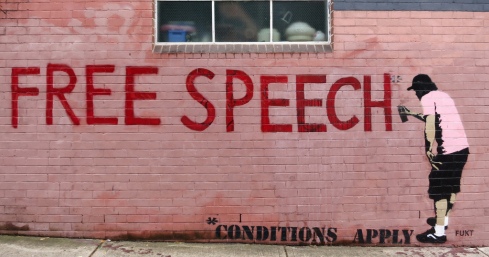
free-speech-conditions-apply-graffiti


Psychologically speaking, it’s self-evident that bigots are frightened of the group or groups they single out for attention. 

This is one of the characteristics of bigots: they fear a challenge is being mounted to their way of life, their  ideology, their religion, their freedom to be who they feel entitled to be. The bigot’s reaction is to annihilate (metaphorically, but increasingly literally) that challenge, banish it from their landscapes, imprison it if it is already present, and in so doing, make themselves and their identities safe.

Waleed Aly, a thinker, writer and broadcaster for whom I have a great deal of time, argued on The Project that Sonia Kruger, a “celebrity” mother for whom I have no time at all, should not be pilloried for her opinion that Muslim immigration should be entirely banned in this country, a conclusion she arrived at on the basis that she’d seen a child’s body bag with a doll beside it after the Nice massacre and very little else, from what I can glean, other than because Muslims. Aly claimed that Ms Kruger is “afraid.”

Ms Kruger has also fallen foul of several employers such as Swisse, Porsche and Target, for whom she performs as “the face” of their companies. None of them wish to be associated with her anti Muslim comments and are reviewing her contracts. Capitalists have never liked mouthy women and Ms Kruger has apparently gone “off brand,” having been hired for her non-controversial personality as well as the stereotypical  appearance that I think of as the White Barbie look. Honestly, so many of those women all look the same you’re flat-out distinguishing one from the other.

(That companies seek out “non controversial women” is a story in itself, is it not?)

Aly made an impassioned argument for “forgiveness” of such bigotry, rather than the outrage that greeted Ms Kruger’s observations. I confess Waleed has me baffled. Kruger’s comments were outrageously ignorant, and it doesn’t seem unreasonable that those offended by them express that outrage. What better way is there to inform bigots about the unacceptable nature of their bigotry? Forgive them if you want, but tell them what they’ve done first, though I doubt the true bigot will give a damn about either forgiveness or being called, outside of how it affects their income and status.

I’d also like to know what Waleed means by “forgiveness.” It’s unlike him to use such a loaded word without first defining his terms. When does “forgiveness” become enabling? If the offence is serial and without consequence or accountability, why should the offender change his or her behaviour?

I don’t think we can afford to be silent in the face of bigotry. Silence is all too easily interpreted as acquiescence. Forgive the bigots if you want. Pray for them if it’s your thing. Recognise that their bigotry springs from fear. But never cease to loudly challenge it, confront it and contest it. Contestation is not incompatible with “forgiveness.” Forgiveness doesn’t mean being silent about the offences.

Confronting bigots isn’t silencing them, as they’d have us believe. It isn’t taking away their right to free speech. Ms Kruger can continue to espouse her bigoted views from whatever platform will host her: if none are offered she may have to contemplate why that might be.


Why rights and bigots do not belong in the same sentence.

20 Jul


talking arse


When Attorney-General George Brandis declared that everyone has the right to be a bigot, he was, strangely for him, speaking out of his arse.

A bigot is irrationally prejudiced against and intolerant towards individuals and/or groups, without requiring any factual evidence to support her or his bigotry. This excellent Guardian piece by Susan Carland spells out the proposition. My only quibble with Dr Carland is that she writes “facts no longer matter” whereas I would argue that for bigots, facts have never mattered, and never will.

Brandis’s declaration conflates human rights with ignorance, intolerance and irrational prejudice, surely the very characteristics those rights are designed to contest, how odd he doesn’t know that.

When the country’s Attorney-General invites the indulgence and expression of bigotry it’s hardly surprising that we find ourselves entering a period of deep prejudice, expressed by the likes of convicted racist Andrew Bolt, echoed by the likes of television celebrity mother Sonia Kruger (#all mothers are celebrities, I can see that hash tag coming) and Pauline Hanson is enabled to replatform herself in government.

This time around, the bigots are singling out Muslims. It has in the past been the turn of Aborigines, Jews, Chinese, Vietnamese, Indians, single mothers of all nationalities, dole bludgers, those of Middle Eastern appearance, boat people, women… must I go on? Bigots aren’t choosy: they need to hate somebody, it doesn’t much matter who. You have the “right” to do this, says the most senior legal figure in the land. It’s freedom of speech. So knock yourselves out.

Unfortunately, the exercise of free speech does not have as a prerequisite informed and intelligent utterance. If it did there would be a strangled silence from the government benches and all early morning television shows would cease to be.

As this happy fantasy is not likely to eventuate, what are we to do in the face of the ignorant, prejudiced drivel increasingly issuing forth from public microphones? Fight back?  March in protest? Invite consultation? Sit down with the haters over  tea and scones? Ignore them?

I’d argue that there’s no single solution to contesting bigotry, and that all of the above suggestions might be useful in specific situations. When the citizens of a democracy vote bigots into government it’s a tough challenge fighting them from the top down, and we have to get creative. Psychologically speaking, bigots are generally insecure personalities with low self-esteem: they make themselves feel better by denigrating somebody else: I am not that, therefore I am OK. Those of us opposing bigotry may risk falling into the same trap…it’s complicated.

Ignorance is in ascendence, globally. It’s going to be turbulent. As I think the Dalai Llama [sic] once said, you don’t get peace by hating war. Fasten your seat belts.


#As a mother

19 Jul

motherknowsbest_web


Look. If I see/hear one more woman claim privileged insight because she’s a mother I will puke, spectacularly, in technicolour, over everything because WTAF?

On the proviso that you and your partner’s parts are in working order, all you need to become a mother is a root at the right time. It doesn’t even have to be a good one. In the matter of becoming mothers we are animals. It’s biological. It doesn’t qualify women for anything: it doesn’t make us better prime ministers, and it doesn’t give us exceptional insight into race relations. It can bring out the best and the worst in us, as can very many other situations encountered by the human female during the course of her life on earth.

Motherhood teaches us above all how to survive drudgery. Unless you’ve got nannies who do that for you, of course. There’s nappies and reeking shit; there’s three-year-olds whose every sentence begins with why, twelve hours a day. There’s broken nights, oh my god the broken nights. There’s kids creeping into your bed at 2am only to wake you up at three to inform you they just dreamed they were on the toilet and have accidentally peed. There’s days of exhaustion, running into one another till you don’t know what you did and when, let alone why. None of this makes a woman any better equipped to run a country than does, say, Malcolm Turnbull’s ability to turn a modest dot-com investment into millions, or Sonia Kruger’s ability to host Dancing with the Stars equips her to comment intelligently on immigration policy.

I’m a mother. I’ll never underestimate the importance of my influence on my children, for better and for worse. But #as a woman, I believe we need to recognise that attempting to privilege our motherhood works against us far more than it ever works for us. Motherhood isn’t a sacred calling. It isn’t the pinnacle of female achievement. Personally, I don’t feel greatly improved as a human being because I spent years of my life wrangling the obstinate young, and didn’t sell them to the circus.

Women who aren’t mothers can care just as much about the future as women who are, and it’s disgraceful to imply otherwise. Women who aren’t mothers can weep for the slaughtered children of others just as keenly as women who are.

The worst aspect of this motherhood rot is its divisiveness. There’s an entirely unwarranted moral acclaim blindly attributed to motherhood that divides those of us who are from those of us who aren’t. It’s lovely if you want children and have them. It’s just as lovely if you don’t want children and don’t have them. It’s another situation if you want them and can’t realise that desire.  None of us should be valued according to whether or not we reproduce ourselves. Indeed, there may well be an argument for refraining from reproduction, given the future we face.