Feminism. Feminists.

15 Mar

 feminist-doormat

The recent public stoush between Helen Razer and Jenna Price is of a kind that quite regularly erupts in feminist circles. Such eruptions are not peculiar to feminism: they occur in any ideological movement, but for some reason seem to be treated as more of a spectacle when women are involved. I’m reminded of the Seinfeld episode in which Kramer, George and Jerry reach a state of ironic hysterical excitability at the prospect of a “Cat fight! Cat fight!”

Briefly, Razer accuses Price’s Destroy the Joint movement of overly concerning itself with “everyday sexism” and likens this concern to a “cultural studies tute from 1991.” Price responds by pointing out that Destroy the Joint is involved in practically assisting women, as well as calling out media sexism. One immediate practical achievement that seems to me amazing, is that of persuading Telstra to agree to provide silent phone numbers at no cost to women who are in hiding from abusers.

Price also objects to Razer’s  instruction on what feminism is, or should be. The overall impression I gained from reading both women is that they are coming from different perspectives that can, to my mind, be complementary.

Thinking about difference and complementarity put me in mind of my doctoral thesis. I wrote what’s known as a composite thesis, that is, it’s comprised of a creative work, and an exegesis. A short extract from the introduction by way of explanation:

The Practice of Goodness is a work of creative non-fiction, a memoir of some of the significant events in the protagonist’s life, written in reaction to a diagnosis of terminal illness. In the theoretical perspective offered here I discuss the central themes of the memoir. These are those of violence, both domestic and political; the role of language in cultural constructions of death and dying; and the possibility of a secular ethics centred round responsibility, forgiveness and respect for our common vulnerability.

The overarching argument of the thesis is for the embodiment of theory in practice, an argument that is symbolised both by its composite form, and the decision to theoretically interrogate the themes of the creative piece. In the creative piece, these themes are explored experientially. The actual effects of violence, of cultural representations of death and dying through the use of figurative language, and of acts of forgiveness on human life, are noted in their practice. In the exegesis, I engage with various theoretical perspectives on these practices with the goal of demonstrating that extraordinary events may be more fully understood, and finally come to terms with, if the experiential is supported and informed by a theory that lends itself to practical application in life.

To suggest that either Razer or Price confines herself to such a sharply defined position, one theoretical, one practical, would be to insultingly reduce both women. It is never that clear. Reading Price’s account of her life’s activities, I’m left with the impression of a very hands-on feminist practice, of the kind from which I have benefited enormously at times in my life, when women have offered me assistance and support without which I think I might have died.

Reading Razer, I’m delighted and nourished by her wit, and her intellectual passion, a passion expressed by many feminist thinkers and writers over decades, without which I would also have died, in this instance an intellectual death. Razer’s hilarious account of Anne Summer’s ill-informed  “misogyny” call in the matter of the mouth-shaped urinals is a cautionary tale: it’s easy when seeking out sexism in media to think, based on a cursory inspection, that you’ve found it, so always check the context and the facts.

I share Razer’s passion for theory. I’m invigorated by the challenge of doing a close reading of really difficult stuff, and have been ridiculed many times for selecting something of Foucault’s as my bedtime book.  At one point my passion for Michel was so great that my students trawled the Internet trying to find me a Foucault doll.

But I don’t care what anyone thinks. I’ve learned much from Butler, Kristeva, Derrida, Levinas and so many more from whom I’ve borrowed a framework, or a lens, through which to consider my life and the culture in which I find myself. Not everybody shares this passion, and why should they?

I share Price’s passion for educating women to recognise sexism wherever it appears. I know there are many women who have not undertaken cultural studies, women’s studies, or gender studies, or who do not have the tools of high feminist theory with which to decode the world around us. There are women who do not have the time to equip themselves thus, and there are women who do not have the interest. The immediate success of a movement such as Destroy the Joint indicates to me that there are women hungry for an accessible feminism that has application to the lives they lead, and offers the possibility of naming and articulating the sexism and misogyny that surrounds us.  Are they middle class women? Quite likely, but so what? Middle class women are also subjected to domestic violence, rape and childhood abuse, though it is often extremely difficult for them to reveal this. The imperative to conceal such things is strong in the middle class. Who can say that beginning with “everyday sexism” won’t pave the way for the harder discussions?

I also share Price’s passion for the hands-on feminism to which I owe so much, the practical expression of the ideology Razer defines thus: “Feminism is the struggle against masculinised violence and feminised poverty.”

Although my definition inclines more towards that espoused by bell hooks:

Visionary feminism is a wise and loving politics. It is rooted in the love of male and female being, refusing to privilege one over the other. The soul of feminist politics is the commitment to ending patriarchal domination of women and men, girls and boys. Love cannot exist in any relationship that is based on domination and coercion. Males cannot love themselves in patriarchal culture if their very self-definition relies on submission to patriarchal rules. When men embrace feminist thinking and practice, which emphasizes the value of mutual growth and self-actualization in all relationships, their emotional well-being will be enhanced. A genuine feminist politics always brings us from bondage to freedom, from lovelessness to loving.

I have very little interest in the number of female CEOs in Australia. I find the outrage at so-called “sexualisation” dangerously silly. But I do think it’s important that women continue to learn to read the signals sent to us about us, by the society in which we live. I know it all so well by now that I don’t even have to think about it. However, I wasn’t born knowing. I didn’t know how to read the signs until feminists taught me. They didn’t teach me initially through high feminist theory. That came later for me. I needed something far more accessible to get me started.

Destroy the Joint can fulfill this educative role for women, and much more.

At the same time, I frequently feel a frustration of the kind that emerges in Razer’s critique. Why are we concerning ourselves with this banal twaddle when women are still subjected to appalling violence, and unforgivable poverty? Who cares if there’s a sexist ad somewhere while at the same time a woman is being brutalised or murdered, or thrown out onto the streets? What is feminism for, if not primarily to address these most grave matters?

I don’t know the answers. I do know that not every woman can undertake the hard yards in refuges and rape crisis centres, or is in any way less for not doing so. I couldn’t do it, because it’s far too close to my bones and I would be useless in those environments. I worked for years with women who wanted to address the aftermath of their abused and lost childhoods. I think I was useful, and I know I learned much from the encounters we shared. I’ve taught feminist theory, I think usefully, but I do know that not every woman can or wants to undertake those hard intellectual yards, and I can see no reason to expect that every woman should, or is in any way less for not doing so.

I’m pleased when young women I know remark on the everyday sexism they’ve learned to identify. I consider it part of my feminist task to remember the days when I too knew nothing, was avid to learn, and sought and found women who would teach me, taking me patiently through what they already knew so well.

It doesn’t surprise me when there are eruptions among feminists. As Razer points out, we are no nicer than any other human group and there’s no reason why we should be. It annoys me that all too often a dispute among women is taken as evidence that we are back biting bitches who can’t agree on anything, and that’s good enough reason to patronize and dismiss us. Last time I checked, it wasn’t women who were starting the majority of the world’s wars, for purposes far more deadly and self-interested than ideological spats.

I want women of Price and Razer’s calibre to continue to give voice to their interests and concerns. I don’t want a world in which either of them is silenced or disparaged.  Neither do I want a world in which feminist theory and practice are falsely framed as adversarial, and pitted against one another in a struggle for dominance and acclaim. When that happens, the patriarchy wins.

foucault-1


Housekeeping

12 Mar

UPDATE: Sorry for shouting but in my defence I’d just been in Question Time and was unduly influenced by Anna Burke. LOL.


SECOND WARNING. EITHER ABUSIVE COMMENTS CEASE IMMEDIATELY OR I WILL BRING BACK MODERATION AND YOU CAN ALL SIT IN A QUEUE WHILE I’M ON HOLIDAY. Seriously annoyed Jennifer. 

I turn my back for five minutes and there’s a break out.

Stop fighting. Robust argument only.

Oh, BTW this piece on feminism after Gillard expresses some of my feelings on the PM:

http://blogs.crikey.com.au/thestump/2013/03/08/after-julia-gillard-thoughts-on-international-womens-day/

“…there are no votes in decency.”

8 Mar

The full quote comes from Federal Liberal MP Russell Broadbent, in reference to fallen Victorian Premier Ted Baillieu, and reads:  “This is a man of great decency but obviously there are no votes in decency.”

I don’t have enough knowledge about Mr Baillieu and his situation to comment on his decency, and it is the observation “there are no votes in decency” that captured my attention.

It seems to me to sum up our current federal politics in relation to asylum seeker policies promoted by both major parties. I understand Pauline Hanson is looking to join them yet again, but as the ALP & LNP have stolen her thunder and more, it’s difficult to see why anybody needs her voice as they did back then, before John Howard plagiarised her instruction manual for xenophobes and racists and she found herself in gaol.

But that’s another story.

There is nothing even approaching decency in the government or the opposition’s asylum seeker policies. There is much chatter about dog whistling, but as far as I can see, they barely bother to dog whistle. The xenophobia is overtly rampant. The asylum seekers and refugees are well scapegoated. The fears of Australians are well-played upon: foreigners are taking our jobs and the government will rescue us from that. Asylum seekers and refugees present such a danger to us that police must be informed when they are housed in our neighbourhoods. It isn’t necessary to go through the dismal litany of false and unnecessary fears aroused solely to give politicians the opportunity to offer to then save us from those fears. It is a masterly manipulation, begun by Howard, honed close to perfection by subsequent politicians of both major parties, who apparently will do anything to win the vote of frightened and aggrieved xenophobes and racists.

Of whom it would seem there are a great many in Australia, otherwise why would anyone bother fighting tooth and nail to gain their approval?

That there are good reasons for some, even many people to be discontent with their lot, is not at issue. That politicians have managed to educate such people to believe that asylum seekers and refugees are responsible for this discontent, and not the decisions of politicians themselves, is evidence of a hugely successful propaganda campaign.

There are no votes in decency in Australia. Decency died in asylum seeker and refugee politics when Pauline Hanson opened the floodgates, and other politicians, witnessing the raging white water of legitimised ignorance and hate roar through, decided that rather than contest the mindset, they’d exploit it for all it’s worth because, votes.

Bereft of decent leaders in this matter, we find ourselves treading water in a cesspool of  racism, and fear and hatred of the foreign. Instead of broadening our minds and hearts, political leaders have promoted a shameful mental and spiritual shrinking of our human possibilities. The few lone voices in federal parliament are drowned out by leaders too inadequate and power-hungry to decently address the plight of asylum seekers and refugees, instead dehumanising them until all that is left is vote fodder.

It is a sickening, heartbreaking state in which we find ourselves and our country. A pox on both their political houses. They have brought us shame, disgrace and dishonour. There are indeed, no votes in decency.

On a personal note, I’m embarking on a road trip to Canberra and surrounds tomorrow for ten days, so the blog may be neglected, on the other hand it may not!

I’ve also decided to fulfil a long-held ambition to do a law degree. Because I already have a few degrees I’m allowed to fast track, and will take only three years full-time to complete. So the blog may be neglected off and on from July this year.

One of the side effects of severe childhood abuse was an inability to learn whilst I was at school. When I started on my road to recovery as an adult, an insatiable hunger for learning emerged from the wreckage, a hunger that inspired me through two and a half degrees and a PhD. Well, it’s surfaced again. I can’t wait to hit the books, and writing 2000 word essays after a 100,000 word doctorate ought to be a breeze.

I still have treatment for my post traumatic stress disorder, and will for the rest of my life. It doesn’t go away, but my ability to manage the symptoms increases all the time. I told my therapist yesterday that I sometimes feel such fury that so much of my life has to be spent managing the aftermath of childhood abuse, and how if I hadn’t needed to do that, I could have done so many other things.

I think of the children in detention who have suffered so much, and how their adult lives will be affected by their trauma. For those who’ve fled life-threatening circumstances, it’s bad enough. But to think that here, in Australia, in 2013, our government incarcerates these children and subjects them to even more stress, makes my blood boil at the cruel and hideous self-interest that causes politicians to act towards asylum seekers in such ways.

Many, if not all of the detained children will be eventually granted refugee status. They will be living their adult lives in this country. Instead of damaging them further, can we not treat them well, and kindly, and help them to be competent, productive and useful citizens?  Surely it’s in our own interests to do this?

Decency. Is it too much to ask? Yes, I fear it is.

If you see a child as “sexualised” there’s something wrong with your vision

4 Mar

On morals campaigner Melinda Tankard Reist’s website you’ll find this breakdown of a survey conducted by Girlfriend magazine on the sexual habits of their young readers. The magazine’s demographic is girls aged between twelve and seventeen.

The survey found that 75% of Girlfriend readers are not sexually active. The reasons given:

  • Waiting to be in love (56%)
  • Not wanting to have sex (37%)
  • Feeling too young (31%)
  • No particular reason (26%)
  • Waiting to be married (17%)
  • Waiting to be the legal age of consent (14%)
  • Waiting for their boyfriend/girlfriend to be ready (8%)
  • Not being interest in ever having sex (1%)

These reasons don’t appear to differ from reasons given by young women over the last few decades. It’s also possible, though unverifiable I imagine, that over the last few decades 25% of young women have engaged in some kind of sexual activity for a variety of reasons, just as they do today.

The Girlfriend survey appears to contest anecdotes such as those in the article “Stealing the innocence of children” published yesterday in the Fairfax Press. Using language such as onslaught, obsession, bombardment, and phrases such as “placing the child in a sexualised space,” “increasingly sexual and sexualised culture,” “hyenas circling” our young, and “people conditioned to see themselves as ‘product,'” the article paints an alarming picture of an apocalyptically sexualised society, controlled by a terrifyingly nebulous “them.”  The closest I can come to identifying “them” are as the manufacturers, producers, distributors  and marketers of a perceived “sexualised” and “pornified” popular culture.

They are further identified in the article as  “the seamier side of humanity” which has persuaded K-Mart, Target and other retailers to provide children’s clothing modelled on the imagined uniform of sex workers.

Children’s primary carers are obliged to buy  this inappropriate clothing and give it to kids to wear, causing them to look “hot” and “sexy.”

It takes a particular kind of perverted vision to see a child as “sexy” or “hot,” no matter what the child is wearing. I do not see children dressed in “sexy” clothing as “hot.”A child dressed like an adult looks to me like a child dressed like an adult. If the child is perceived as “sexualised” or “pornified” it must be the gaze of the adult viewer defining her as such, not the clothing and certainly not the child. It is impossible to “sexualise” and “pornify” a child by dressing her or him in any kind of clothing. Only a sexualising and pornifying gaze can impose that interpretation.

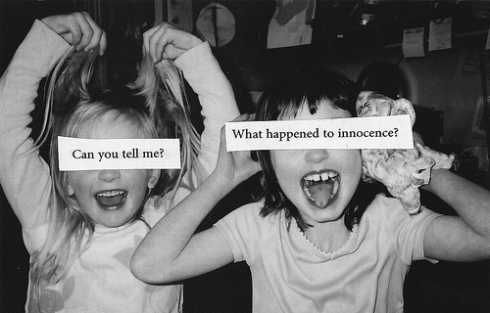
Further, I’d suggest that those currently most responsible for “sexualising” and “pornifying” children’s appearance are the very campaigners who complain most loudly about it. These people are demanding that we all adopt the pedophile gaze, and interpret a child’s appearance as “hot” and “sexy” rather than seeing it for what it is: children imitating adults. There is no innocence lost in the imitation. The innocence is destroyed by the adult’s sexualising gaze.

To others less inclined to make moral judgements based on bits of cloth, children are neither sexualised nor pornified. They are children in bits of cloth, funny, silly, imitating their elders, remarkable or unremarkable, but they are children. If you think they are sexually objectified, the problem is with you.

Is there any space more sexualised than that of an institution such as church or family, in which the child is raped? Is there anymore devastatingly sexualised, objectified and “pornified” child than the child raped in the home, church or other institution outwardly dedicated to her or his welfare? When a child’s body is used to gratify adult desire, that child’s innocence has indeed been destroyed. That child has indeed been sexualised and pornified. And the number of children whose innocence has been thus stolen is incalculable.

Yet is any of this mentioned, even in passing, in an article titled “Stealing the innocence of children?” No. It is not. It is far easier to blame a nebulous “them” for the  crime of clothing and music videos.

This is bandaid stuff. What actually demands our attention is the numbers of adults only too willing to see, to describe, and to use children as sexual objects, even those who perceive themselves as being on the side of the good. Campaigners such as Tankard Reist, Steve Biddulph, Emma Rush and Steve Hambleton unwittingly reproduce the pedophile gaze with their own determinedly sexualised readings of popular culture.  The pedophile claims in his defence that  “she looked like she wanted it,” even if she was only three. The campaigners are in great danger of saying something very similar, albeit for very different reasons.

If you want to protect the innocence of children, don’t impose your sexualising vision on them. If you want to let kids be kids just do it, by recognising that they cannot be sexualised by the clothing they wear, but only by your interpretation of what that clothing signifies.

The campaigners are railing against a particular sexual aesthetic, one that given their reference to sex workers and aspects of popular culture may well be class-based. It’s not so long ago that girls who dressed in a certain way were described as “cheap.” That meant sexually easy, and the girls thus described were not middle class. Today “cheap” garments and attitudes are increasingly infiltrating the middle class, blurring class distinctions and causing what can only be described as a moral panic as those who are well used to controlling an orthodox conservative sexual discourse find themselves challenged as never before.

In another article titled “Save your daughter from the wild-child syndrome,” Steve Biddulph states ” If a girl is going to go wrong, it will be at 14.”  If a girl is going to go wrong? This binary of good and bad girls, right and wrong girls, is at the heart of the sexualisation and pornification panic. “Good and right” girls are increasingly indistinguishable from “bad and wrong girls” in their clothing choices. Hell, these days everyone’s looking like hookers and pole dancers! Clothes, once a primary signifier of middle class status and morality, now make  “good” girls look like they’re “bad.”

The conservative middle class, whether secular or religious, prescribes a morality that condemns the perceived sexually “easy” girl or woman. There remains, even among the non religious, a code of sexual manners that frowns upon any perceived flaunting of female sexuality.

The morals campaigners are of course never going to question their dogma about how girls and women should express our sexuality. In feminism’s second wave, we learned the folly of unquestioningly accepting the authority of the orthodoxy, and the unnecessary suffering involved in attempting to adjust ourselves to its man-made rules. We need a similar revolution in which we vigorously contest the domination of conservative sexual morality on our culture. Indeed, perhaps such a revolution is already underway, and the current moral panic is the outraged and fearful reaction.

Confusion: just because a girl wears a short skirt doesn’t mean she’s asking for it. On the other hand, the short skirt sexualises, pornifies and objectifies you so if you wear it, you look like a girl going wrong, and asking for it.

The bizarre marriage of radical feminism and right wing religious activism, occasioned to contest that other bogeyman, pornography, is an example of how the desire to censor and control is not confined to the religious. Russell Blackford considers this in his piece on Iceland’s recent initiative to ban certain types of pornography. “You can’t assume that secularism in a country’s population will solve all problems of moralism, anti-sex attitudes, and a general wish by governments and electorates to interfere with people’s lives” Blackford observes. While we know Melinda Tankard Reist comes from a Christian fundamentalist background, and Steve Hambleton is a devout Catholic, their conservative sexual politics are shared and promoted by the non religious as well.

When religious beliefs can’t be invoked to substantiate moralities, psychology, psychiatry and regurgitation of received knowledge is often as, if not more, effective. All of these traditionally accept an initial cultural premise: that there are particular ways of behaving and expressing sexuality that are unquestionably right, and veering from them is wrong. The stranglehold this perspective has on society is currently under great pressure, nowhere as evidenced in the rebellion of the young,who’s collective determination to clothe themselves like porn stars, as the horrified adults would have it, is breaking all the rules of sexual propriety and class.

The extreme manifestation of this propriety is manifested in remarks such as those made by Leader of the Opposition, Tony Abbott, who famously declared that the virginity of his three daughters was the greatest gift they could offer anyone and he hopes they’ll wait till they marry to bestow it.

I recall a sex talk given to us fourteen year olds by the Mother Superior, in which she advised us that we should not be like cream buns in the bakery window. Who, she asked rhetorically, wants to buy a cream bun from which someone else has already taken a lick? It’s only in retrospect I can see the bawdiness of that analogy, and I’m sure Mother Dorothea had no inkling. However, her advice does indicate there were enough girls being cream buns, even several decades ago, for us good girls to be warned of the perils that entailed.

There are, of course, real causes for concern. Five year old girls ought not to be so obsessed about their weight and appearance that their mental and physical health is threatened. I suggest that’s a separate issue from the “sexualisation and pornification”   claims, but it is a habit of these campaigners to conflate all the issues (as is exemplified in the Fairfax article)  into an “ain’t it awful” catastrophic expectation, won’t somebody think of our children who will save our girls meme.

I can’t watch shows like “Biggest Loser” because of their cruelty,and their commitment to fat-shaming, treacherously disguised as concern. No wonder little girls are scared to death of gaining any weight. They’ve got the message: everyone will hate and shame them if they aren’t reed thin. Many of them have close adult females who angst over their weight, teaching little girls that their lives will be good or bad depending on how much they weigh. I suggest this is far more insidious than any piece of sparkly skimpy cloth K-Mart has on its shelves.

Likewise, the idea of someone dressing a baby in a shirt bearing the slogan “All Daddy wanted was a blow job” is my idea of over-sharing. I’ve never seen such a shirt, though I don’t doubt they exist.

Children have always been born into a “sexualised space.” Planet Earth is a sexualised space, sex is a powerful human drive that everyone encounters, one way or another. Children are sexual beings, and understand from an early age that there is something profoundly mysterious in the adult world that is forbidden to them. Naturally, they want entry into that world, and one of the ways they achieve a semblance of belonging is by imitating adult appearance and behaviour. What kind of a mind construes this imitation as reality, and demands that the rest of us do the same?

What we need to do is really see the children, and not take flight into a moral panic that they cannot understand. There is a child at play inside the “hot” “sexy” clothes. That child shouldn’t have to choose between being a good girl or a bad girl, between going wrong or going right. Adults are responsible for the paucity of role models on offer for children to emulate. If we really care about the children, this is what we’ll address. But that’s going to be a lot harder than blaming K-mart.

innocence

Now is not the time to have a pity party for the PM

2 Mar

Considering the kind of lives many women are living on planet Earth at this time, Prime Minister Julia Gillard’s is up there in the very top level of privilege.

So it comes as something of a shock to read leading feminist Anne Summer’s piece today, in which she frames Ms Gillard as a victim. Victim of bastardry and misogyny, cruelly mocked, scoffed at, subjected to vile commentary including pornographic representation; criticised whichever way she turns, frequently on the basis of her sex, and shown “not the slightest drop of mercy or respect.”

Not only is Ms Gillard deprived of respect, Summers writes, but as a consequence of  personal disdain for her, the office of Prime Minister is also inevitably disrespected.

It’s a bit rich to expect the public to respect the office of Prime Minister given the complete contempt the ALP itself showed towards this office when it was inhabited by Kevin Rudd. This disrespect was compounded when the ALP gave us no warning of their intention to topple the man who had so triumphantly defeated John Howard, and instead acted as if they were governing a nation of mushrooms.

Be that as it may…

While there is much truth in Summer’s assessment of the situation, one has to wonder if it is wise to paint the Prime Minister in such catastrophically underdog terms at this time. There will be plenty of opportunity to dissect the sexism Ms Gillard has endured after the election. If she leads her party to victory she can be portrayed as a glorious survivor of vile misogyny. If she leads them to failure, books can be written about the cruel and unfair treatment of our first female Prime Minister. But right now, nobody wants a victim in charge of a government that is already hurtling down the road to ignominy.

No matter what your opinion of Ms Gillard, I don’t think you could deny that she is a woman of extraordinary strength and tenacity, and a damn good fighter.  Indeed some, perhaps all of her best speeches have been made when she’s been on the back foot, and defending herself against personal attacks. Think the globally acclaimed misogyny speech, for example, as well as the press conference she gave to settle the matter of her alleged involvement in dodgy dealings whilst working at Slater and Gordon. These are not the actions of a woman with a victim mentality. They are the actions of a survivor.

What Ms Gillard endures is sadly no different from what many women endure on a daily basis. That any of us have to put up with misogyny is an outrage, and there are many among us who live with a great deal more of it than Ms Gillard, without any of the compensations she enjoys. In view of this, while it is appropriate to point out misogyny when it so publicly manifests against  a high-profile woman, it isn’t appropriate to cast that woman as a helpless victim. In the hierarchy of female suffering at the hands of the patriarchy, Ms Gillard is luckily on a low level.

I find it difficult to imagine that the Prime Minister herself would appreciate the gender card being played in this way at this time. I see no indication that she considers herself in any way an underdog, and her reaction to sexism and misogyny has been anything but that of a woman looking for mercy.

“Is mockery the new misogyny?” Summers asks.

Mockery may well be yet another form of expressing misogyny in this situation. But the sad fact is that we can’t afford to focus on that right now. Gillard is facing the fight of her political life. Far more importantly, the ALP is facing the same. Do we really want to offer the nation the picture of a victimised, bullied, vilely mocked woman as our next PM? Or should we be wise enough to keep our peace on the misogyny angle, and leave the pity party for another time?

How The Conclave of Creepy Old Men could erode women’s reproductive rights

1 Mar

Just when you thought Opposition Leader Tony Abbott might have pulled his dessicated head in on the topic of abortion in Australia, up pops DLP Senator John Madigan to take over the megaphone.

Madigan declares himself to be “unashamedly pro-life.” Guess what, so am I except when I’m unashamedly pro euthanasia, but that’s another story. Personally, I’m not acquainted with anyone who is avowedly anti life, probably because they’d have to take their own if they were to stand by their principles.

The good Senator for Victoria also counts rabidly anti choice and former Independent Senator for Tasmania Brian Harradine, as his personal hero.

Harradine, as readers of this blog will remember, employed as his ethics advisor anti-abortion campaigner, all-round morals defender & “don’t call me a Baptist or I’ll sue you” celebrity Melinda Tankard Reist, during the period when he managed to deny women at home and abroad access to reproductive information, and the drug RU486. You can refresh your memory if you’d like to at my post, “Who would Jesus Sue?”

There is a possibility that after the next election Madigan may find himself in a situation similar to that enjoyed by Harradine – holding the balance of power in the Senate. It was this privilege that allowed the former Senator for Tasmania to impose his anti choice vision not only on Australian women, but on women in developing countries as well, in exchange for telephones for Tasmania.

Madigan’s argument, if such offensive twaddle can be dignified with the name, is that Australian women in great numbers are availing ourselves of abortions when we are unhappy with the sex of the foetus we are carrying. It happens overseas, he claims, therefore women in this country must be doing it to such a degree he has to introduce legislation to stop us.

Madigan makes these claims based on no evidence at all, but what the hell, who needs evidence, everybody knows women are lying, scheming, unhinged humans, who will do anything we like to a foetus unless a man stops us. Oh bugger, I didn’t want a boy/girl, we say, and stop off at the abortion clinic on a Friday afternoon before we go to the pub.

What women need is for our politicians to call a halt to this stupidity. I am going to make a generalisation here and say women do not, usually, take abortion lightly. It’s time creepy male politicians stopped acting as if we do. In my life I have met only one woman who regarded abortion as a form of contraception, and I didn’t find her tough radical stance convincing.

Apart from anything else, unless you’re somehow involved with the foetus a woman is carrying, what she decides to do about her pregnancy is nobody’s business but hers. There is something hideously creepy about ageing white men like Abbott, Harradine and Madigan spending so much of their time focussed on what women do with our bodies. The image of them indulging their nasty pre-occupations makes my skin crawl.

The only reason to take notice of Madigan’s “let’s have a Tea Party” anti choice views, is the concern that he might chuck a Harradine. With the anti choice Abbott in the running for PM, and the quaintly named “Pro Life Labor” conclave as well, we might find ourselves yet again fighting for our fundamental reproductive rights.

Gentlemen, there is much for you to occupy yourselves with as you progress through your political lives. Please be assured that women are very capable of making considered decisions about our reproductive health, and that we do know where to go for advice when we need it. Your obsession with our reproductive practices is impertinent, and most unhealthy.

Your obsession also insulting, however, as the man who was kicked by a donkey observed, we will, this once ,overlook the insult, upon considering its source:

Braying White Donkey

Braying Ageing White Donkey

Morrison hammers another nail into decency’s coffin

28 Feb

Shadow Immigration Minister Scott Morrison’s latest stinky brain fart that everyone should be warned when an asylum seeker is lodged in their neighbourhood is stomach churning on a number of levels, but perhaps the most alarming is that there are people living amongst us, and likely quite a few, who agree with him. Obviously it’s such people he’s seeking to engage with, and he will succeed.

The ALP has well-exceeded the barbarity of Coalition asylum seeker policies. What once seemed so shocking now appears comparatively tame. Morrison has to dig deep to compete. The sad reality for our country is that both major parties believe that hostility towards asylum seekers and refugees is a vote winner, and there’s enough of those votes in play to make this race to the bottom worth their while.

Morrison’s statements are propaganda. There is little point in engaging with their content, except to suggest replacing the term asylum seekers with Jews, or Muslims, or women, or even privileged white males and see how it sounds. His message is that for current political purposes, asylum seekers are the group which will be scapegoated. Scapegoating is employed as a legitimate political strategy. There is no difference between what Morrison is doing, and the early propaganda of the Third Reich. Call Godwin’s Law if you like, but sometimes it really is the only appropriate analogy.

The only hope we have is that there are enough thoughtful women and men in both major parties to loudly protest this unrelenting moral decline on the part of their leaders. The  sickening willingness of so many politicians to remain silent in the face of this vile othering is contemptible.

♫…It might as well rain until September…♬

25 Feb

Warning: this entire narrative, while true,  is also a metaphor.

In our house we know from years of experience that when the Pacific Highway is closed to the south of us, any trip north will be a dream. No trucks, hardly any cars & no speed traps. So yesterday, overcome by cabin fever, we decided to go to the big town to bother our friends there, and see a movie.

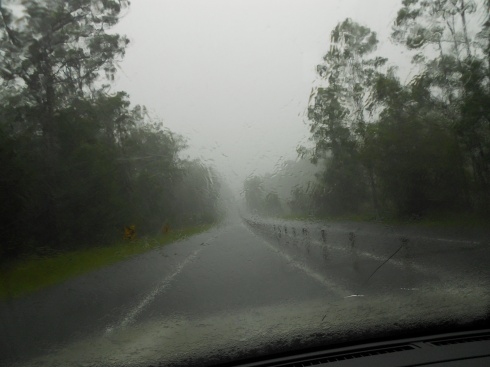
We left in a blaze of sunshine, after kicking the beast into four-wheel drive. Ten minutes later, this:

DSCN1122

After another twenty minutes of blinding rain slowing us to an unseemly crawl, ruining the anticipated experience of free ranging the highway from hell, we started to fight about whether we should keep going, or turn back. If we kept going, the high tide together with excessive rain would later in the day likely prevent us crossing the bridge that leads into our town and we wouldn’t get home. If we didn’t keep going, we’d all fight a whole lot more when we did get home, as frustration and disappointment would be added to the already raging group aggravation. An aporia in our narrative if ever I encountered one!

It’s stupid to keep going, one of us said. When is the last time we did something stupid, another (me) demanded. Nobody could remember the last time we’d (deliberately) done something stupid and that determined our choice: we would keep going.

This didn’t stop us:

DSCN1123

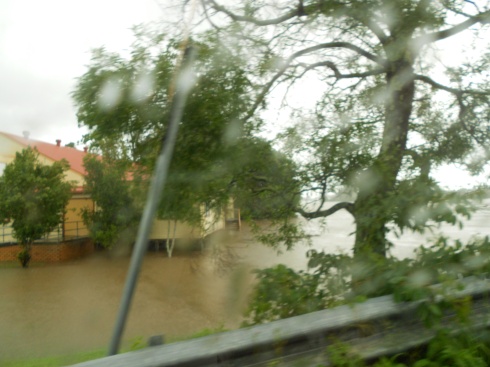
But when we got to this:

DSCN1130

people I always thought loved me turned. I didn’t make you keep going, I pointed out to them. I’m not even driving.  The driver is in charge, isn’t she? I asked, but very nicely. Anyway its too late to turn round and go home, I told them, we’re almost there, we’ll just have to make a detour. Let’s sing. Let’s sing “Solidarity forever!” Its ages since we last sang that!

A great deal of time later, there’s no need to say how much, we arrived at the movies with seconds to spare. See! I cried, triumphant (and relieved, imagine how they’d have gone for me if we’d missed the movie as well) I told you! The apparently stupid choice can often be the best one! You just have to be brave enough to take a calculated risk!

We still have to get home, a spoil sport darkly muttered, and your risk wasn’t exactly calculated. But I had only good feelings about getting home and guess what? I was right again! The highway home was dry as a bone, and we went wild, I tell you, wild! Driving at amazing speeds on the apocalyptically empty road! Shrieking with unrestrained joy: we did it we did it and, because I am generous and wise, I let them share the credit that was strictly speaking, all mine.

There’s a lesson in this for all of us, don’t you think? You just have to be wise enough know how and when to be calculatedly stupid. That’s all, and you’re most welcome.

rudd-gillard

Disclosure: this narrative is narrated in the first person by an unreliable narrator.

BREASTS. NIPPLES. BREASTS. NIPPLES. BREASTS BREASTS NIPPLES BREASTS.

21 Feb

Some weeks ago my fellow tweep, writer and philosopher Dr Damon Young, posted this cheerful image of himself naked from the waist up on Twitter, and on his website.

Damon Young

It was around the time many of us were becoming highly exercised at David Koch’s unfortunate take on public breastfeeding. Breasts were a thing, or even more of a thing than usual because if it’s a thing you’re seeking, you can’t go past breasts.

This coincidence of Damon and David stirred my outrage, albeit for very different reasons. I’ve addressed my Koch angst here.

If Damon can plonk images of his torso all over the interwebs, I railed, without fear of any consequences other than some good-natured joshing, why can’t I? Because no matter how much anybody tells me I can, I don’t think it is actually so.

Damon’s image is unadorned, taken, I imagine, as he paused in his progress from bedroom to bathroom, his mind occupied, I later discovered, with his BMI. There’s nothing vain or self-conscious about the photo: he’s a bloke in his shorts wondering if he needs to take better care of his physical vehicle.

And here we careen into the first thing a woman can’t do that a man is allowed. If I were to post an image of myself in exactly the same state of ordinary (as opposed to contrived) deshabillé, clearly preoccupied (and not with showing myself off) I would likely bring torrents of nastiness down on my head. Why? How long have you got?

Most obviously, because I’d be transgressing the cultural expectation that when a woman shows her breasts she’s got to be sexy about it. We learned that from the Koch situation, with this male commenter making no bones about it. A woman shouldn’t just let her tits hang out, especially at the dinner table, if not for erotic purposes. That is, our tits are only for display when they are being usefully employed in sexually titillating somebody. Standing in your hallway, in your knickers, concentrating on something other than how desirable you have contrived to look in that moment, is likely to be regarded as disgusting. How can she let herself be seen like that?

Nobody says that about Damon, I’m willing to bet.

For a couple of weeks I yearned to post an image of my naked torso on Twitter and this blog, because why shouldn’t I? I was, though, both infuriated and appalled by the powerful ambivalence I felt at the prospect of thus exposing myself to the public gaze. I bet Damon didn’t go through this either, I fumed. I bet he blithely stuck up his picture and thought no more about it. I don’t begrudge him or any man that freedom: I want it for myself. I want to feel as safe as a man does about just being in my body, as it is, but when it comes to publicly revealing myself, I don’t.

I then had a Twitter exchange with Helen Razer in which we contemplated our breasts, confiding to one another and thousands of other tweeps, that we both believe them to be our best feature. Neither of us posted twit pics, however, as people do with their favourite kittehs and puppehs. We also discussed our skin, our feet and our arses, but no other body part, for me at least, has the same frisson. I’m a breast woman. The word alone stirs complex and mysterious emotion in me, all of it good. It’s not until breasts collide with society that they become problematic. Left alone, stripped of imposed culture, they are, quite frankly, gorgeous.

It’s my considered belief that Western culture is alarmingly dysfunctional when it comes to breasts. Author Sarah Darmody explores this normalised peculiarity in this readable piece, titled “Why are we so embarrassed about breasts?” Having lived in the UAE, Darmody is asked what she thinks about life in a society where women are forced to cover up. “What, you mean Australia?” she retorts.

Breasts are fetishised to a degree that is maddeningly unfair. The rules about which breasts may be displayed and how are so deeply ingrained in our collective psyche that to consider transgressing them fills a woman like me with something close to terror. For example, I will not usually go out of my house on a cool day without a bra or layers, in case my nipples expose themselves, hardened, as if with desire, through my t-shirt. This is falsely described as modesty, a commendable quality in a woman, I’m told. It feels like enslavement. It feels like repression. It feels like a shocking waste of my energy.

At the same time I don’t want to send the message of sexual availability hardened nipples signify, because that is a false message and I don’t need to deal with the repercussions. A woman’s day is full of such decisions, made largely unthinkingly, in robotic obedience to received wisdom we absorbed with our infant formula or mother’s milk. There are brave women who make it their business to thwart the ingrained conventions. It’s my goal to one day join them.

Damon’s self-exposure will do nothing to detract from his reputation as an erudite, intelligent philosopher, author and commentator. On the contrary, the image reveals another side to the scholar, one that is endearingly human. Were I, a female scholar, to publish exactly the same image of myself, I suspect I would incur all kinds of lewd and derogatory commentary, and I wouldn’t endear myself to anybody. Especially not my family who would be appalled, and likely wouldn’t find it possible speak to me for some time without averting their eyes.

If a female scholar, or any female exposes her breasts on the Internet, will that become the first thing anyone remembers about her? I suspect the answer is yes.

I’m very fond of my breasts. They’ve served me well, they’ve given pleasure to me and to my lovers, they’ve kept my babies alive and thriving, they continue to please the eye. They aren’t twenty anymore, but I’m told they still have a bit of phwoar factor. Be that as it may, the kind of exposure I’m talking about doesn’t require phwoar: I wasn’t planning a page three spread. I just wanted to do what Damon did.

Well, as you know, I didn’t. I feel like an abject coward. I still can’t even think about doing what Damon did without hot horrible squirmy feelings. If I did what Damon did I fear I would be doubly condemned, on the one hand for revealing my breasts at all, and on the other for revealing them in a non-sexy way, and with complete lack of concern for how they and I look.

It’s taken me weeks to even write this piece, not least because I understand that in the personal and universal hierarchy of women’s needs, the fact that I don’t feel free to do what Damon did isn’t in the top layer. Nevertheless, it does speak to the more urgent problem of how women are gazed upon, and how that gaze affects our way of being in the world.

Neither do I want to extrapolate my personal squeamishness to “women,” but there is no denying you hardly ever come across similar representations of a casually comfortable topless woman leaning in her doorway in her knickers.

Whining is unattractive, I know. But I don’t care. I want what he’s got. I want it really, really badly.

With thanks to Damon Young, whose latest highly acclaimed book is:philosophy in the garden - cover200x312

I’m Kevin and I’m here to…..Plus, this week in feminism

16 Feb

Is Kevin Rudd planning a come-back? Are there enough supporters now to return him to the job he so ignominiously lost?  Will Julia Gillard get her comeuppance? Will Kevin get the ALP across the line again like he did in 2007? Is Michelle Grattan making it all up?

Personally,  I’d back anyone with a chance of keeping the government the government  when Tea Party Tony is our only alternative, so who’s it going to be, Julia or Kevin? As we now know, we don’t have to keep the leader who wins the election, we can get another right after, so all we need is the one who can decisively win, and out of the two of them, history tells us that’s Kev. Who is still the most popular Labor politician in the country.

Let us hope that the ALP will use their heads and throw their weight behind whoever is most likely to win, because the alternative is simply too abhorrent to contemplate.

Of course much of this could be avoided if punters would do as I do and vote for the local member who does the best job, in my case the ALP member, instead of imagining we’re in some kind of presidential system in which only the leader matters.

Should women keep their own names when they marry, rather than taking their husbands’? This was one of the more profound questions posed by feminists for consideration last week.

For a start, what woman has her “own” name to keep? Most of us have our father’s names. If we have our mother’s names they are usually our grandfather’s names. The only way a woman has her own name is if she changes it herself. I’ve had my father’s name, my stepfather’s name, my first husband’s name and then I chucked them all and changed my name by deed poll to my grandfather’s name. When I married again I kept that name instead of changing it to my husband’s, mostly because I was sick of the paperwork.

Now I’m considering taking a last name that has nothing to do with anybody, like Peony, or Seagrass, or Waterlily or Dugong. Also I’m not Miss, Ms, or Mrs anymore, I’m Dr. So I have thrown off all the naming shackles of patriarchy, or will when I tackle the paperwork.

Unfortunately it’s too late to give my children my name instead of their father’s. This is a pity, because then all my grandchildren would have my name instead of their grandfather’s. There would be generations of Dugongs, Waterlilys, Peonys or Seagrasses instead of boring old whatevers. These generations would be shackled by the matriarchal instead of the patriarchal, and it’s about time.

I could continue in this querulous vein, explaining how in my opinion sacking Kevin in the manner they chose was the dumbest decision ever, and bound to seriously taint Ms Gillard’s Prime Ministership and the entire party for a long, long time, however, I have to go to the dentist. So have a good Saturday, and may all your troubles be very very small.

Yours, as ever, Dr Dugong.