Why Zero Dark Thirty is not an apologia for torture, or, don’t shoot the messenger

10 Feb

Kathryn Bigelow, director of Zero Dark Thirty, the controversial account of the killing of Osama bin Laden by US Navy Seals in a CIA-led operation in Pakistan on May 2, 2011, has been described by feminist Naomi Wolf in The Guardian as “the handmaiden of evil,” and a successor to Germany’s notorious first female film director, Leni Riefenstahl.

Riefenstahl’s most famous work was the 1934  Triumph of the Will, regarded by many as an instrument of  Nazi propaganda, as well as by others as a brilliant aesthetic and technical achievement.

It has not taken us long to arrive at Godwin’s Law.

The opening sequences of Bigelow’s movie portray torture, including waterboarding. This is carried out rather genially by the male CIA interrogator and witnessed by the film’s central character, Maya, a young female agent who has made it her mission to hunt down Osama bin Laden. Initially Maya struggles with her role as witness to inhumane cruelty, but she rapidly overcomes this squeamishness and enters into the zeitgeist. This depiction of Maya’s rapid moral disintegration from someone capable of discomfort in the face of torture to someone who wholeheartedly embraces the process, signifies early in the film the deadening and dehumanising effects of torture on its perpetrators.

Yet here, to me, is where critics of the film have confused the narration of events with apologia. Torture at that time was fully endorsed by the Bush administration, and renamed “enhanced interrogation techniques” in order to normalise the practice and make it publicly acceptable. Interrogators conducted their dark craft fully supported by their CIA masters, and their government. It is not Bigelow who endorses torture. It was the entire apparatus of the state. Bigelow is quite right, when she claims in her defence that her movie realistically depicts the situation that existed at the time, and depiction does not, and should not be assumed to, correlate with endorsement.

Not only do the scenes of torture provoke horror in the viewer, it seems that Bigelow’s refusal to take a moral position  also provokes profound unease. How can she not use this opportunity to convey the absolute wrongness of the act? Why does she veer from the well-trodden path of traditional story telling, in which there is good and there is evil and the author has a point of view?

It’s true that if one stands by and allows certain events to take place, one can be held morally culpable. However, it is a different matter when one is narrating past events, and the climate in which they took place. At that time, the President of the United States encouraged his agents to torture. Do I really need anyone to spell out the horror of that for me? Has Bigelow failed me by not pointing this out in her film?

In declining to impose a moral vision, critics claim Bigelow has opted for what has been described as an “obscene neutrality.”

I am not sure that what Bigelow chooses is an “obscene neutrality” because I am not certain that neutrality in art is “obscene.” I think of The Sopranos, for example. Is David Chase similarly  guilty of “obscene neutrality” because of his morally neutral depiction of the unspeakable violence repeatedly perpetrated by Tony Soprano and his mob? Is it not the creator’s privilege to refrain from expressing a moral viewpoint? Is it not an expression of the creator’s trust in her or his audience to thus refrain, and in so doing, respect the audience’s ability to think for itself without authorial imposition?

Is it inevitably the artist’s responsibility to take a moral perspective in her or his work, and if she fails to do this, can her work be described as “obscene?”

And why, out of all the unspeakable horrors wrought by human beings on one another, should torture be singled out as the one that must not be portrayed “neutrally?”

Slavoj Zizek writes in The Guardian that “to depict torture neutrally – ie to neutralise this shattering dimension – is already a kind of endorsement,” and goes on to say that “with torture one should not think.” Of course he is right in his call for a world in which the notion of torture is unthinkable, however, that is not the world in which we live. Given that torture remains a weapon of the state against its enemies, of course we must think about it, and of course it must be depicted in our art forms. Nobody ever changed or prevented anything by not thinking and not talking about it. That we must have this particular conversation is indeed indescribably sickening, but have it we must, otherwise there will be no opposition to torture. This is our reality. This is the reality Bigelow so bravely portrays. The critics are shooting the messenger.

I also find it difficult to agree with the description of the torture scenes as “neutral.” They were horrific and horribly confronting.  I cannot find any way to interpret those scenes as “neutral,” and I cannot find anything in the film following those scenes that  goes anywhere near “neutralising” them. I find it difficult to understand the mind set of a viewer who allows the impact of those scenes to be ameliorated by subsequent conversation and justification.

Indeed I would argue that Bigelow’s stark depiction of torture conveyed as nothing else could the abhorrent inhumanity of the practice. Nothing she did afterwards could erase that impression, indeed CIA justification only made things worse, as far as this viewer is concerned.

Bigelow seems to me to be a director who makes a conscious decision to withhold moral judgement, at least in her last two movies, The Hurt Locker & Zero Dark Thirty. The former, which is perhaps the most terrifying film I have ever seen, is told without embroidery of any kind: Bigelow embeds her audience with the  bomb disposal squad on its tour of duty in Iraq, and leaves us to make of it what we will. In interviews she’s stated that “what we are attempting is almost a journalistic approach to film” and this approach is supremely successful in The Hurt Locker.  Of course she is referring to journalism as it used to be, before it became opinion.

In Zero Dark Thirty there are later scenes in which Maya is warned that torture is no longer acceptable in the new administration of Barack Obama, indeed, television footage in the background shows Obama famously stating that America does not torture. It’s clear Maya may find herself held to account if she continues the practice, and the original genial interrogator quits in the nick of time and returns to Washington.

Critics claim Bigelow’s movie implies that torture led to the discovery of Bin Laden’s hideout. This is the CIA’s position, though it is increasingly contested within the organisation. The victim supplies his interrogator with a name, over a civilised post torture lunch, after he has been sufficiently broken. This name, together with a myriad of other intelligence, eventually leads the operatives to Bin Laden’s hideout.

Bigelow does not endorse or contest this sequence of events. In my opinion she does not need to, and I would not have welcomed a directorial intrusion at this point. It is obvious that the CIA would justify the use of torture exactly as Bigelow depicts. Bigelow is not inventing this story. She is telling it how it is.

Earlier torture scenes demonstrate the unreliability of information gained through inflicting pain, when the victim claims any of the week as the date for the next terrorist attack as he is forced, after waterboarding and other vile humiliations, curled foetal-like into a hideous box.

Bigelow made her film with extraordinary co-operation from the CIA. There is no doubt the story she tells is the CIA’s story, and indeed at this point there is no other story to tell. One day a Seal or a CIA operative may break ranks and reveal another point of view. It’s hardly likely the survivors of the attack on Bin Laden’s compound will have much to say, and who would believe them?

This has brought condemnation down on her, as if in the very telling of the CIA’s version of events she has inevitably aligned herself with that organisation and its methods. She should have deconstructed the CIA story, she should have critiqued their methods, she should have made another film altogether and by god she should have taken a moral stand, otherwise she is agreeing with it, or so some critics would have it. To me, as audience, I needed no authorial or directorial instruction on the morality of the CIA and its methods in this event. I wanted to know what was done at the time, and the justifications that were made in the context of the times. I didn’t need to know what Kathryn Bigelow felt about it.

I can see how Zero Dark Thirty can be interpreted as an apologia for torture. I believe that is a limited interpretation, and we need to push ourselves harder than that. I don’t believe for a moment that Bigelow intended to make a pro torture film. The director put a great deal of perhaps misplaced faith in her audience. She treated us with respect, and honoured our intelligence. She did not expect to have to tell us that the CIA’s story is horrifyingly flawed, she expected us to recognise that.

It is not Kathryn Bigelow who is the apologist for torture. It was the Bush administration, the CIA and the revenge society that sought to kill bin Laden, rather than arrest him and publicly try him for his crimes. In focussing on Bigelow, the bigger issues are lost. She is the chronicler of the times, not the advocate.

This is not about Chrissie Swan it is about Lauren Rosewarne’s use of language as a weapon of division

7 Feb

In her piece on ABC’s The Drum this morning, academic Lauren Rosewarne takes to task a group of women who apparently have done their best to metaphorically lynch TV personality Chrissie Swan for smoking while pregnant.

I am not interested in having a smoking while pregnant debate, and Ms Swan’s perceived moral failings. Neither am I a fan of vicious pile-ons. What does interest me is the language Rosewarne uses to describe those criticising Swan, whilst simultaneously calling for us to cease “scrutinising and loathing” other women.

Swan’s critics are, according to Rosewarne, members of the “militant mummy mafia” and “holier than thou über mums.” Rosewarne claims she feels it is “…verboten to question the lactaters, or the baby-carriers, or the gluten-free vegan wholefood earthmothers.”

She continues, in an outstandingly anti feminist and alarmingly patriarchal-like complaint:  “As a feminist, apparently, I should know better than to ever dare take on any woman who has ever Created Life” (note Dr Rosewarne’s use of capitals here).

Well, I’m a woman who has Created Life, lactated and been a baby-carrier and I have no objection at all to being questioned (“taken on?”) about that or anything else. I do, however, wish to note my objection to being cast into the inexplicable abyss of Rosewarne’s only too-evident prejudices against women, all women, who give birth.

I have no idea of Dr Rosewarne’s personal circumstances, and I support the right of any woman to choose to remain child free. Indeed, there have been occasions on which I have cursed myself for refusing that option, and instead, sticking with dogs.

Be that as it may, I do not expect a public feminist to speak of me and women like me with such contempt and disdain, simply because we’ve given birth to future generations. It’s a dark and lonely job, but someone has to do it.

Mothers, like any other human category, do good things and not so good things to ourselves, our offspring and other women. We are not always nice to one anther, and neither should anyone expect us to be. However, for a feminist with a public platform to publish a wholesale denigration of women who are mothers is absolutely unacceptable, particularly when it’s done under the guise of appealing for women to stop judging and criticising one another.

This false division between mothers and women who are not mothers, for whatever reason, is sickening to me. I believe it is destructive to us as individuals, and as a species. There is no great kudos in either state: they are, in the best of circumstances, choices and should be respected as such.

If Dr Rosewarne really feels she cannot “take on any woman who has Created Life” she  is seriously restricting her life experience, and that, I respectfully suggest, is a problem for her rather than the rest of us.

Tony Abbott: I’m your man

7 Feb

If you want a boxer 
I will step into the ring for you 
And if you want a doctor 
I’ll examine every inch of you 
If you want a driver 
Climb inside 
Or if you want to take me for a ride 
You know you can 
I’m your man* 

It’s unsettling to observe the speed with which Tony Abbott is attempting a personal transmogrification from street fighting, slogan-chanting, Putin-wannabe stuntman into calm, responsible, intelligent and concerned alternative prime minister.

Some might argue this is an indicator of the man’s ability to adapt to changing situations, and therefore positive. Others might point out that Abbott’s willingness to turn himself into whatever he thinks you want him to be is a troubling personality trait for the leader of the country. Does it indicate a lack of certainty on his part as to who he really is? Or, if he does know who he is, does his preparedness to adapt indicate a compulsion to act out what he thinks is required of him in any particular moment, rather than be himself?

We saw a similar early attempt to be who she thought we wanted her to be on the part of the incumbent PM, Julia Gillard. Ms Gillard went so far as to publicly declare the emergence of the “real Julia”, in retrospect not the most wise course of action for a leader, and likely a contributing factor to the punters’ lack of trust in her. Announcing that you’re going to be real now, as Abbott has done without actually declaring he’s doing it, can only cast troubling doubt on what you’ve been until that declarative moment.

The majority of punters don’t really care for leaders with shaky personalities. Someone who will change with the wind doesn’t inspire trust. There’s a fine but important line between mature adaptability, and self-interested false accommodation in the interests of gaining or maintaining power.

Abbott has spent the last two years showing us his aggression, his wilful ignorance, his inability to deal with anything remotely complex, his fascist reliance on slogans, and his willingness to use women close to him as human shields. In the space of forty-eight hours he wants us to believe he’s become prime ministerial material. All he’s done is change into yet another set of new clothes and clothes, as my grandmother always told me, do not maketh the man.

*Leonard Cohen, I’m your man.

fire fighting abbott

Climate change: what is “the greatest moral challenge?”

4 Feb

Last weekend’s storm was unlike anything I’ve ever experienced which means nothing, other than I haven’t been in violent weather events before.

Some years ago all my children and grandchildren went missing for five days in Hurricane Wilma. They were in Cancun, Mexico at the time the category four storm struck.  For a long time afterwards my granddaughter trembled whenever the wind rose.  The high-pitched whine of a violent wind, and the emotions it provokes in sentient beings, is hard to delete from the memory.

In what seems to me a rare example of synchronicity, I happened to be at the top of Tamborine Mountain and reading Barbara Kingsolver’s Flight Behaviours, at the time the Queensland storms struck.  The wind whined its whine in merciless gusts, the ferocity of which were alarming. Six adults, five dogs, six chickens in the bathtub, and one baby, we huddled by candlelight in a house on the edge of an escarpment while trees fell and water belted at the windows. This was a long way out of my comfort zone. At bedtime I read Kingsolver with a torch, wearing earplugs. What I couldn’t hear wouldn’t frighten me, I reasoned.


 Flight Behaviour is one of several recent novels that take as their theme the issue of climate change. Kingsolver is an intelligent, powerfully imaginative writer whose every book I’ve treasured, and she’s a biologist as well. The narrative is built around episodes of violent storm activity in a Mexican town that causes its resident population of Monarch butterflies to abandon the flight behaviour of lifetimes, and find a new home in southern Texas. It’s not easy for them there, either, but I won’t tell the story. Suffice to say in her usual accomplished manner, Kingsolver weaves the lives and futures of her characters through the fate of the butterflies, and indeed, of the world. She even includes Australia.

I find the climate change war difficult to understand on many levels. I’m alarmed by the emotions on both sides, in particular the rage that erupts from those who will not tolerate the concept of human contribution to global warming. I interpret this rage as springing from terror: terror of what that means, terror of losing what they believe they have, terror of necessary change, terror of being out of control, of the natural world being an uncontrollable force.

Those who argue against them, such as myself, also know terror: the terror of leaving things too late, terror of what the world will become if we fail to do everything in our power to halt the destruction, terror of our apparent helplessness in the face of climate change and those who to my mind obdurately refuse to accept that we have any responsibility in the matter.

What we share is our fear: we ought to be able to use that as common ground. And there’s a wishful thought, if ever there was one.

I don’t know if Kevin Rudd was either right or helpful when he described climate change as “the greatest moral challenge of our time.” I agree it’s the greatest challenge, and it is also a moral one, however, we might be better served focusing on the practicalities rather than the moralities of the challenge we face. When an issue is couched in moral terms it inevitably bifurcates into judgements good and bad, with one side or the other claiming the high moral ground even as it is wrenched away from under them, in this instance by flood, high seas, and fire. What becomes most important is the battle and who is right, rather than the biggest challenge.

There is a sense in which the argument about the morality of climate change action or non-action has to be postponed for the greater good: we can’t afford to waste our energies on that argument. We have to err on the side of caution, surely. We cannot prove to everyone’s satisfaction that humans have and continue to contribute to global warming, which in turn is causing extreme and destructive weather events. The “greatest moral challenge,” then, is to suspend our disbelief and act as if we have and are affecting climate change. As we are unable to prove that we are not, it makes sense, given the gravity of the situation, to act as if we are.

The greatest moral challenge facing us is to put aside the notion of moral challenge, and instead, act.

I’m dreamin’, I know. This is a fertile battleground for those who want only to battle. There’s precious little political good will, and a crop of politicians on both sides whose will to power outweighs any notion of the greater good.

Perhaps circumstances will eventually force these self-interested laggards to take action. Perhaps when enough people have suffered enough as a consequence of extreme weather events, and the roads are broken enough, and the food has become expensive enough, and the people turn in great numbers on their leaders, we will see politicians finally give climate change the attention it demands. When there’s votes in it.

Until then I guess what we can’t hear won’t frighten us? Pass that politician some earplugs and make them read Flight Patterns, by torchlight, of course.


We have no Internet how will we live this is endtimes

30 Jan

Hello everyone, stuck on Mount Tamborine with no power, no running water, and until this minute NO INTERNET!!!

Six adults, five dogs, six chickens, and one baby who we’re considering eating.

I hope everyone is safe. What a thing, how scary, never seen anything quite like it.

Will write again as soon as we all calm down, and have a reliable power source.

Breasts. Class. Public space. Language as a tool of repression

22 Jan

Discreet.  The word that has brought opprobrium down on the bald head of Channel 7 Sunrise host David Koch, after he used it to describe his preferred demeanour for women breast-feeding their babies in public spaces.

Koch, affectionately known as “Kochie,” was commenting on the decision of staff at the Bribie Island Aquatic Centre to request that a nursing mother remove herself from the public gaze, as she sat at the edge of the pool watching her two older children whilst feeding her baby. The comments can be seen here. Briefly, Koch agrees there is nothing wrong with breastfeeding in public as long as it is done “discreetly” and in a “classy” manner. Koch reiterated his views yesterday. He has another piece  today in The Punch in which he again confirms his views, titled “I’m not anti breast-feeding just pro politeness.”

He also tweeted: david koch ‏@kochie_online

But I don’t think it’s unreasonable to expect breast-feeding in public is done discreetly. I think that’s just a common courtesy to others

That most middle class admonition, to be discreet, means: having or showing discernment or good judgment in conduct and especially in speech; prudent, especially capable of preserving prudent silence; unpretentious, modest, unobtrusive, and unnoticeable.

That most aspirational instruction, to be classy, means: having or showing class; elegant, stylish; having or reflecting high standards of personal behavior; admirably skilful and graceful.

Then there’s that other most middle class admonition: be polite

And that much-loved phrase: common courtesy

Dog whistling, the lot of it, with less than zero relevance to breast-feeding in public.

Women should, according to Koch, acquire all these characteristics prior to feeding their infants in a public place. As he feels the need to incessantly repeat himself on this over a period now of some three days, he obviously considers that many women are seriously lacking in these highly valued middle class virtues, and in their ignorance, are offending and distressing the sensibilities of the bourgeoisie, who everyone knows are absolutely entitled to live in a world where nobody does anything that might offend them. Their world, their rules?

Neither Koch nor anybody else who has endorsed his views has explained exactly what it is about women feeding babies that is indiscreet, lacking in class, impolite, or offensive to another’s sensibilities. Neither have they explained how it is “discourteous” of a woman to expose the amount of breast needed to feed a child. This is not actually a great deal. An everyday lingerie advertisement will reveal far more.

Then there is the article at The Punch by Anthony Sharwood, who offers this:

But I can tell you from experience that there are some women who breastfeed anywhere they can as a sort of public exhibition of motherhood

So much of parenthood these days has become an act of display, from superprams as sophisticated as F1 cars to those who go down the overtly organic, super-healthy track.

Public breastfeeding has become, for some Mums, the last frontier of showy parenthood. What started as a private, intimate thing has become its exact opposite. I breastfeed therefore I am liberated. Yeah righto, we get it.

I take it that Mr Sharwood also would prefer us to be prudently silent, unpretentious, modest, unobtrusive, and unnoticeable. He also objects to breasts flopping all over his dinner table because feeding breasts are not sexy.

The reason why Koch’s observations matter is explained in an excellent piece in The Conversation:

Embarrassment and concerns about breastfeeding in public are primary reasons women stop breastfeeding early. And comments like Kochie’s that endorse restricting a breastfeeding woman’s access to certain areas of public space further remove breastfeeding from public display. This increases breastfeeding mothers’ social discomfort and makes it difficult for them to do what we otherwise expect them to.


The article also explains why denying women the right to breast feed in public is illegal, no matter what the manner in which they choose to do it.

An excellent piece on the human rights aspect of the action taken by the Bribie Island Aquatic Centre & Koch’s subsequent endorsement was posted by Kate Galloway here

There’s been something of a furore about the issue on Twitter. On my feed there have been objections to the concerns women have expressed about Koch and the Aquatic Centre. These have come overwhelmingly from men. Rather than analyse the mindset that would relegate women and babies to the toilets to feed, instead women’s anger about the situation has been targeted for discussion. Our anger has been described by some men as “rage,” “outrage,” “fighting,” and “faux rage,” and we’ve been described as “angry feminists.” We’ve been told to “get upset about something really important.” Someone tweeted that he was “exhausted” by our “outrage,” another that we were “ranting.” All pejorative descriptions of female anger because women don’t get angry like men, do we? We get out of control.

Some men need to learn that expressing emotion, even anger, does not equate to losing control.

Are you getting a feeling for the repressive use of language in this discussion? And don’t for a moment imagine Koch’s language is any less pejorative and repressive than that of the Twitter blokes.

Male tweeps have advised us that we’re not going about this in the right way, that our protest strategy will fail, that we have not thought through the two “nurse-ins” that were organized outside Channel 7 and Bribie Aquatic Centre.

Of all the belittling, scornful, repressive and dismissive comments tweeted on my feed to me and to other women today, only one I have seen has come from another woman.

I’m astonished that there are still men who think it their business to tell women what we ought to get upset about, and how we ought to express our concerns.

I’m astonished that there are still men who believe in an ideal of womanhood that requires us to refrain from expressing emotion in what they consider an unseemly fashion.

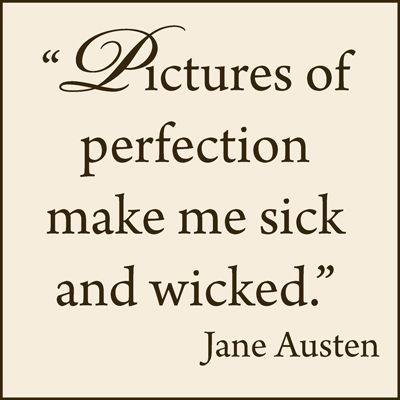
David Koch thinks we should be discreet, that is, and I will type this out again, so important do I consider it, we should have or show discernment or good judgment in conduct and especially in speech; be prudent, especially capable of preserving prudent silence; be unpretentious, modest, unobtrusive, and unnoticeable. He also thinks we should have or show class; be elegant, stylish; have or reflect high standards of personal behavior; be admirably skilful and graceful. What would Jane Austen, that most acute chronicler of manners, have to say?

Jane Austen quote

If this brouhaha has brought anything into stark relief, it is that the patriarchy is alive and well, and still dedicated to moulding women to its requirements. This is done not with force in this instance, but with language. It is done with efforts to control and shame us, expressed in language that is prescriptive, proscriptive, and judgmental. The tweeps, Koch and Sharwood share the same goal: to regulate female behaviour in public spaces using language that conveys disapproval and contempt, and is designed to shame.

If we must be discreet and courteous about breast-feeding, that implies there is something inherently offensive about it. As nobody has yet been able to articulate exactly what this offence is,  I can only conclude it is an emotional, irrational squeamishness that is triggered in some people when they see a baby at the breast.


Opponents of this most natural function will have to come up with a much better explanation than personal squeamishness if they are to have a leg to stand on in this matter. While many have defended Koch’s right to hold an opinion on this, I doubt his position can be described as an “opinion.” It is informed by nothing. It is an uncomfortable feeling he has. It is an emotional reaction. That is not opinion.

We are all responsible for our emotional reactions, we cannot demand that others protect us from them by ceasing to act in ways that provoke discomfort in us. In other words, if Koch or anyone else doesn’t like to witness a mother feeding her baby, perhaps they might like to put a blanket over their heads until she’s done. Or go sit in the toilets.

While many of the male tweeps involved thought Koch’s position was an idiocy, they failed to grasp that their reaction to our anger comes from the same place as that idiocy. Indeed, Koch’s idiocy was entirely lost in their emotional reactions to our anger, which became the focus for them.

Is all this an example of misogyny? I’m inclined to think not. It is the product of a misogynist patriarchy, so entrenched in some males they can’t even see what they’re doing, and get scared and angry when anyone calls them on it. I think it’s ignorance, rather than malice. I think it’s irrational fear.

Whatever it is, it most certainly isn’t opinion, which requires a good deal more than emotion. Koch’s unexamined emotions, and those of the male tweeps, shouldn’t be dignified with the title “opinion”, and they most certainly should not be respected as such.

Has our first female PM legitimised misogyny?

18 Jan

“We all recognise that if there’s one overarching issue for women it’s the way that religion can be manipulated to subjugate women.” Mary Robinson, first female President of Ireland, former United Nations High Commissioner for Human Rights.

Late in 2012 Australia’s first female Prime Minister, Julia Gillard, made a stirring and globally applauded speech in the House of Representatives, on misogyny and sexism in the Parliament.

Ms Gillard declared “I will not be lectured on sexism and misogyny by the Leader of the Opposition.”

Ms Gillard asked: “What does misogyny look like to modern Australia?”

Ms Gillard deplored LOTO Tony Abbott’s double standards when it comes to misogyny and sexism.

Ms Gillard demanded Tony Abbott apologise to the women of Australia for his misogyny and sexism.

Ms Gillard stated “I am always offended by sexism and statements that are anti women.”

Ms Gillard declared “Double standards should not rule this parliament” and “sexism is always unacceptable” and that “we are entitled to a better standard than this.”

Prime Minister Gillard was absolutely right on all counts, and the stand she took was long overdue.

The Gillard government has undertaken the consolidation of anti discrimination legislation. In the course of this it has decided to preserve existing exemptions that permit religious organisations to discriminate against , as David Marr puts it:  any or all gays and lesbians, single mothers, adulterers – yes, even adulterers! – bisexuals, transsexuals, the intersex and couples such as Julia Gillard and Tim Mathieson.

The practical outcomes for women of these exemptions  are starkly illustrated in this story of an unmarried teacher who became pregnant and was subsequently sacked from her job at a Christian kindergarten in Queensland.

Australian Christian Lobby CEO Jim Wallace claims Julia Gillard “reassured” religious organisations that they would retain their right to discriminate against women in this manner, as well as to discriminate against women who live in de facto relationships, women who commit “adultery,” women who are bisexual and lesbian, and the intersex.

It is unclear how much of this discrimination is directed against men, except in the case of gay men, who it seems are not regarded as “real” men by religious groups such as the ACL and Christians the ACL claims to represent. Women who transgress the ACL’s rigid criteria are demonised by the Lobby’s determination to exclude them from the right to employment, not because they are in any way unable to perform the work required, but because of their “lifestyle.” Whether or not the man who impregnates the single woman is similarly discriminated against remains unclear.

British philosopher AC Grayling in The Guardian:  I leave to you the not very congenial task of totting up the ways in which more enthusiastic forms of religion in general, not just Islam but Roman Catholicism, puritanical forms of Protestantism, and orthodox Judaism, have treated women: all the way from closeting them, covering the up, and silencing them, to sewing up their vaginas: it is a ghastly litany of repression, all the less excusable because discrimination against women which began in these ways persists in our society in modified forms: the fact that a woman earns about 70% of what an equally qualified and experienced man does is a residue in our own society of the attitude which in today’s sharia law states that a woman is worth half a man.

The ACL is anti-abortion, and against the use of the drug RU 486, licensed in Australia only for the termination of very early pregnancies. They strongly object to Australian aid being used to promote family planning in recipient countries. In other words the ACL is keenly interested in controlling and regulating women’s bodies, at home and abroad.

Former US President and Christian Jimmy Carter: The truth is that male religious leaders have had – and still have – an option to interpret holy teachings either to exalt or subjugate women. They have, for their own selfish ends, overwhelmingly chosen the latter. Their continuing choice provides the foundation or justification for much of the pervasive persecution and abuse of women throughout the world. This is in clear violation not just of the Universal Declaration of Human Rights but also the teachings of Jesus Christ, the Apostle Paul, Moses and the prophets, Muhammad, and founders of other great religions – all of whom have called for proper and equitable treatment of all the children of God. It is time we had the courage to challenge these views and set a new course that demands equal rights for women and men, girls and boys.

At their most repugnant, the belief that women are inferior human beings in the eyes of God gives excuses to the brutal husband who beats his wife, the soldier who rapes a woman, the employer who has a lower pay scale for women employees, or parents who decide to abort a female embryo. It also costs many millions of girls and women control over their own bodies and lives, and continues to deny them fair and equal access to education, health care, employment, and influence within their own communities.

Australia’s first female Prime Minister, Julia Gillard, has chosen to walk a path that is very different from that of Mary Robinson as far as women are concerned. Ms Gillard has, by pandering to the demands of religious bodies for exemptions to anti discrimination law, legitimised the religious misogyny that perpetuates the myth of female inferiority, to the degree that we are not considered capable or worthy enough to retain control over our own bodies. Ms Gillard has legitimised a misogyny that would deny her the right to employment because of her “lifestyle” as a single woman living with a man. Would her partner Mr Mathieson also be denied employment?

Ms Gillard has legitimised a religious misogyny that believes it is righteous to sack unmarried pregnant women, at a time when they and their unborn babies most need support. At the same time, they would if they could deny a single pregnant woman access to abortion, if that was her choice.

Ms Gillard has thrown her support behind a Christian cult with unsettling links to “dominionist organisations throughout the world, not least through its own board and staff.” (I strongly recommend reading Chrys Stevenson’s excellent piece to which I have linked, in which she unpacks the connections between dominionists and the ACL).

The National Alliance of Christian Leaders (NACL) with whom ACL is closely associated, stated their goals thus: “… unity in truth; recognition of Christ’s authority in the church, family, individual and government; … legislature to force Christian values; … the kingdom permeating the structures of society; biblical government.”

Ms Gillard, an atheist, has capitulated to the demands of organisations such as these and has enabled them to enact their stated goal of introducing “legislature to force Christian values” on our secular society.

Dear Ms Gillard

I will not be lectured on sexism and misogyny by you.

Dear Ms Gillard

What does misogyny look like in modern Australia?

Dear Ms Gillard

I deplore double standards when it comes to misogyny and sexism.

Dear Ms Gillard

I am always offended by sexism and statements that are anti women.

Dear Ms Gillard

I agree absolutely that “Double standards should not rule this parliament” and “sexism is always unacceptable” and that “we are entitled to a better standard than this.”

Dear Ms Gillard

What are you going to do about it?

Jennifer Wilson. Woman.

ACL’s Wallace claims PM promised religious exemptions will stay

16 Jan
Wallace & Gillard

Swan & Gillard

( I’ve  just changed the caption on this image. When I put it up last evening I thought at first blush that was Jim Wallace.  Never noticed before how similar they look. LOL. Apologies.)

Jim Wallace, head of the Australian Christian Lobby, claims in this article that Prime Minister Julia Gillard has reassured him that the privileges currently enjoyed by religious organisations that allow them exemption from anti discrimination laws will be maintained.

It’s timely to recall that the day after Ms Gillard replaced Kevin Rudd as Prime Minister, she made a point in her first speech after assuming office of inexplicably announcing that she would not make any changes to the Marriage Act. It’s likely that nobody much cared at that particular moment, reeling as we were from the shock of completely unanticipated events. Was this also an assurance to the ACL, an assurance that gay marriage would not be legalised on her watch?

The article states: The Government says those exemptions apply where the conduct conforms to the doctrines of the religion or is necessary to avoid offending the religious sensitivities of adherents.

On this evening’s ABC PM program, Labor Senator Doug Cameron complained somewhat bitterly that this matter had not been discussed in Caucus, and the PM has offered these reassurances to Mr Wallace without proper consultation. Senator Cameron feels strongly that the way to deal with this situation is for religious organisations to be as answerable to anti discrimination legislation as everyone else, when they are being funded from the public purse. Apparently this is the case in the UK, and it works well.

This book is for sale on the ACL website

This book is for sale on the ACL website

This image gives an insight into the kind of minds and belief systems to which Ms Gillard has astoundingly chosen to pander.

If a religion has to harm others in order to maintain its integrity, there is something seriously awry with that religion.

As for  “offending the religious sensitivities of adherents,” what is so exceptional about religious sensitivity that it must be exempted from laws that the rest of us must observe?

I’m told that Ms Gillard owes a significant debt to some Christians in the ALP who allegedly backed her ascension to the top job. Part of her repayment plan, apparently, is to maintain the illusion of exceptionalism these Christians nurture for themselves and their belief system.

We are faced with the choice between a devout catholic PM in Tony Abbott, and an atheist PM in Julia Gillard. However, given Ms Gillard’s unrelenting commitment to religious sensitivities and values, as opposed to basic human rights, one has to pity the voters who put their faith in the separation of church and state for the paucity of choice available to them.

The Wayne LaPierre solution to religious exemption from secular law

15 Jan

David Marr’s excellent piece in the Fairfax press yesterday is a reminder of just how conflicted our anti discrimination legislation is, and has been for some time.

Exemption from the law for religious organisations means they are permitted to behave in ways that are unlawful for the rest of us, because of their beliefs. For example, employing someone who does not engage in a heteronormative sexual life, employing a woman who becomes pregnant outside of marriage (the same rule does not apply to the man who impregnates her, by the way) and  employing people who live together unmarried (such as Prime Minister Julia Gillard, but her partner Tim Mathieson as well? This is not clear, perhaps it is only women religious institutions demand marry) transgresses some religious beliefs about how human beings ought to conduct themselves in their private lives. No religious institution should be obliged to put itself in a situation where its beliefs are insulted, it is argued, therefore they are all exempt from anti discrimination legislation that applies to everyone else.

I might find it difficult to work alongside someone who holds any or all of the above beliefs because they do not accord with mine and I find them offensive and insulting. However, were I to refuse the believer employment, or to terminate their employment because their beliefs trouble me, I will be committing an offence under the anti discrimination legislation and if they complain, I will be punished.

As I am not a religious institution, I must employ the religious regardless of my beliefs. This irrational imbalance continues, for some inexplicable reason, to be legitimised by the Labor government, itself led by an atheist woman living in a de facto relationship. In other words, as Marr points out, Prime Minister Gillard is legislating against herself.

Perhaps the solution is to declare atheism and agnosticism  religions, and apply for exemption from the law. I call this the Wayne LaPierre solution, after  the Executive President and CEO of the NRA. LaPierre recently claimed what is needed to stop bad guys with guns is good guys with guns. By the same reasoning, we might consider allowing the rest of us the privilege of denying employment to religious people as they may do to us. Then we will have achieved the equal right to deny a livelihood to everyone except ourselves and those who think like us. Which of us is good or bad will remain as subjective as it as ever been, but we’ll all have big guns with which to kill each other’s prospects.

On the other hand, the current consolidation of the anti discrimination laws offers a golden opportunity to effect changes that would revoke privileges extended to religious institutions, and level the playing field. Attorney General Nicola Roxon has introduced additions to the bill that now declare offending or insulting someone to be an unlawful act. Unless of course you are religious institution and then you can offend and insult somebody’s protected attributes (if they do not comply with your belief system) to your heart’s content by refusing to employ them, or by dismissing them on the grounds of that attribute, and you will get clean away with it. If we can accept additions, surely we can effect the subtraction of what is a most discriminating practice that makes a mockery of the entire legislation?

What we need to ask ourselves is: why are we prepared to allow religious institutions to behave in ways that are so unacceptable to the rest of the community that we have declared them unlawful?

The religious are entitled to their beliefs, of course. A secular state is not obliged to adapt its legal system to those beliefs, it is especially not required to do that when the adaptation is to behaviours that for the rest of the population are unlawful because they are deemed extremely harmful to others.

If an act is so undesirable that we have found it necessary to administer punishment to some of those who perform it, how can we say that same act is not undesirable because it is ameliorated by the balm of religious “belief?” And why on earth should we?

Out of MTR’s defamation jail! The Streisand Effect, & conduct that offends

13 Jan
Image: Feminists for Free Expression ffeusa.org

Image: Feminists for Free Expression ffeusa.org

This time last year I received a threat of defamation action from anti pornography activist Melinda Tankard Reist. The gist of her complaint is outlined in these extracts from a letter of demand, sent by her lawyer Ric Lucas of Colquhoun Murphy, on January 13 2012:

 We are instructed that you have made a number of defamatory posts concerning our client on the internet, set out principally under the heading “The questions Rachel Hills didn’t ask Melinda Tankard Reist” on your blog No Place for Sheep. These claims have been widely circulated, including on twitter.

For instance you assert that Melinda Tankard Reist is a member of a church that preaches the second coming off [sic] Christ, the end time, evangelism and that sex filthies the human female and renders her impure. You claim that “Tankard Reist is a Baptist.” This is simply false, yet you have erected an entire panoply of criticism upon it. And you finish your attack by alleging without the slightest evidence that our client is “deceptive and duplicitous about her religious beliefs.

This is false and unwarranted, and seriously defamatory.

Our client is very distressed at your behaviour, and requires that you immediately remove these posts from the internet. They are very damaging to her reputation.

Ms Tankard Reist also requires a prompt apology and retraction by signed letter, in terms to be agreed with this firm, and which also should be published upon your blog “No place for sheep” [sic]. She also requires payment of her legal costs.

She reserves her right to damages for defamation. 

We note that this is a concerns notice pursuant to s126 of the Civil Law (Wrongs) Act  2002 and is not for publication.

Then, on January 17 2012, I received another letter from Mr Lucas.

We refer to our letter of 13 January. We note that instead of seeking legal advice and considering whether you should withdraw your false claim that Melinda Tankard Reist is “deceptive and duplicitous about her religious beliefs…” you have redoubled your attacks upon our client, with the result that a number of journalists have raised the issue with our client.

Our client intends to rely on your conduct as aggravating the damages payable to her. The slightest reflection on your part would have led to the conclusion that your false claims are very hurtful to our client, and by circulating them so widely, you have done significant damage to her reputation. We can only conclude from your behaviour, especially since our client sought an apology, that you are motivated by malice.

We have pointed out to you the false basis on which you have proceeded, yet instead of apologising, you assert that because someone else has said (falsely) that our client is a Baptist “She is going to have to sue a few more blogs than mine.”

You cannot rely on anyone else’s false statements on a blog, as a defence for your false claims. Was that the full extent of your enquiries, before you proceeded to make the hurtful and damaging claim that Melinda Tankard Reist “is deceitful and duplicitous about her religious beliefs…?”

We note you have misled the followers of your blog by asserting that our client has demanded that “I withdraw all of my posts about her.” That is just another falsehood on your part. The demand is specific – that you withdraw those which are defamatory, and we specified some allegations, in particular the entirely false claim that Melinda Tankard Reist “is deceptive and duplicitous about her religious beliefs.”

Your sense of guilt about that particular claim is palpable, given that when you were seeking support online against my client’s attempt to censor you, you did not even disclose that was at the heart of my client’s objection to what you had written. 

Since our letter of 13 January you have made further defamatory claims, and comments on blogs, which should also be withdrawn. You should also take down defamatory and abusive comments by others, hosted on your blog.

You have in your published writings pointed to the fact that child abuse is a transgression of several articles of the Universal Declaration of Human Rights and have called for domestic law to give effect to a charter of rights. You are no doubt aware that the Universal Declaration of Human Rights powerfully affirms the right to honour and reputation. Article 12 provides that “No one shall be subjected to arbitrary interference with his privacy, home or correspondence, nor to attacks upon his honour and reputation. Everyone has the right to protection of the law against such interference or attacks.”

You should reflect upon the fact that you have seriously flouted your obligation to uphold the Universal Declaration. Would you like to be described publicly as “deceptive and duplicitous?”

Australian law protects Ms Tankard Reist against your breach of her rights, through the law of defamation. It is an imperfect protection, because it cannot require you to retract or apologise for your breach.

The only remedy the law provides is the right to obtain a judgement declaring that what you wrote was false, and an award of compensation. If you will not retract, the law will protect our client’s rights.

Without prejudice, we note that our client’s aim in this is not to bankrupt you. She would much rather you came to your senses, and realised that a person who wishes to be taken seriously as a social commentator, who has pretensions as a scholar of human rights with a PhD from Southern Cross University, should check their facts, and not indulge in flights of libellous fancy. 

If this matter can be resolved by negotiation resulting inter alia in a correction and apology, that would be far preferable to the expense of proceedings in the ACT courts.

I’m resisting the considerable temptation to deconstruct this harangue.

A complainant has twelve months to instigate defamation action following the issuing of a letter of demand. This period has now expired.

The thing is, if Tankard Reist had bothered to contact me directly, I’d have been more than happy to discuss the situation with her, and to publish her rebuttal on the blog. This is an example of how threats of legal action and demands for money achieve nothing, and indeed, can make matters far worse. See this brilliant analysis of the Streisand Effect as it played out in this case, to Tankard Reist’s considerable detriment.

I have  strong objections to people attempting to intimidate and bully others into silence through threats of financially crippling legal action. I think it is all too often the first resort of a coward. Imagine how much better this could have turned out for Tankard Reist if she’d challenged me, instead of trying to frighten and silence me.

It’s also worth checking out Sarah Joseph’s analysis of the proposed draft anti discrimination bill. In this proposal, it becomes unlawful to engage in “conduct that offends, insults, or intimidates.”  There is quite a difference between offence and insult,  and intimidation and harassment, yet they are lumped together in the proposed legislation as unlawful. As Joseph points out “There is no human right not to be offended or insulted. And indeed, historically much important speech has offended somebody.”

After reading Joseph’s piece, I am at a loss to understand why Attorney General Nicola Roxon is pursuing this avenue. While I would be delighted to watch Alan Jones and his ilk hauled before the courts on a fairly consistent basis as they continue to offend and insult someone because of their protected attribute, the bigger picture is frightening, and smacks of far too much government control. Nobody enjoys being insulted and offended because of who they are and what they believe, yet the idea of taking legal action in such circumstances is extreme, is it not?

fry