Anti-Muslim sentiment in a post bin Laden USA

15 May
Secretary of Defense Donald Rumsfeld shares a ...

Image via Wikipedia

Whoa, hello, back home again, seriously discombobulated with regard to day and night, and with a mind teeming with intense impressions. Whatever you think about the USA, it’s stimulating.

A few days ago two imams attempted to board a plane in Tennessee on their way to North Carolina. They went through three separate security searches, and then the pilot threw them off the flight. His reason? Other passengers complained that they felt uncomfortable  with the imams sharing their journey.

I saw the imams interviewed on the news. They were surprisingly affable, given their circumstances. Puzzled, confused, and a little hurt by the treatment they’d received, they explained they were on their way to a conference when their ordinary day turned surreal.

The airline involved eventually apologized to the imams, and they were conveyed to their destination. There is speculation that they will sue. It’s un-American not to.

There were a few people I felt uncomfortable with on my flight home but it never occurred to me to ask that they be thrown off. As they were Westerners not Muslims, it would likely have been me who’d been thrown off as a potential nutter if I’d objected to their behaviour, as opposed to their appearance.

All the while, street parties and celebrations continued over the death of Bin Laden. Relics of the Bush administration such as Dick Cheney and Donald Rumsfeld seized the opportunity to resurrect themselves, and appeared on Fox News claiming credit for Bin Laden’s death on the grounds that if it had not been for their waterboarding of prisoners in Guantanamo and other places, Obama (have to be carful there, more than one TV commentator consistently confused Obama with Osama in his or her reportage) would not have been able to carry out the raid that took Osama out.

Ergo, they continued, torture is a good thing and it must be brought back. I was unaware that torture had been entirely dispensed with by the current administration.

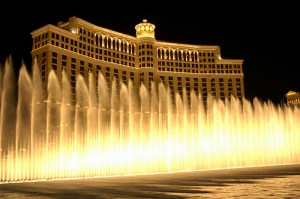
Bellagio Fountains

On the day of Bin Laden’s death, the magnificent choreographed fountains at the Las Vegas Bellagio hotel danced to the Star Spangled Banner with cannonball explosions thrown in to create an effect derivative of the 1812 overture, as the water surged hundreds of feet into the clear blue desert air. It was spectacular, and people cried and cheered and hurled their two foot long margarita glasses into the lake in celebration while screaming “God bless America!”

The very next tune to issue forth from the fountains was, to my incredulous astonishment, Sarah Brightman and Andrea Bocelli‘s version of Time to say Goodbye.  Make of that what you will, but it wasn’t irony. They don’t do irony in Las Vegas, all those simulacra representing Paris, Rome, Venice and Donald Trump‘s penis are not ironic. “It’s just like the Eiffel Tower!” I heard a French tourist exclaim as she wandered through the Paris Hotel casino, gazing up at a ceiling painted light blue with fluffy white French clouds floating around a construction imitative of the famed Parisian landmark, on her way to the slot machines. Nope. Definitely no irony.

After a great deal of careful thought, I’ve decided the choice of song was accidental and hugely funny, to me at least.

A few isolated and subsequently vilified public voices raised themselves in protest against the undesirability of “rooting for death”, even when it’s Bin Laden’s. However these traitors were speedily humiliated and silenced. A patriotic news analyst speculated as to why Bin Laden had no wall paper in his house, and wasn’t filmed sitting in a Lazy Boy recliner, both of which are middle class American icons. If Bin Laden was so important, his reasoning went,  how come he lived without what many Americans regard as essential items?

Speaking of Donald Trump, the world’s wealthiest bleached blonde mullet gave a foul mouthed speech at the Treasure Island Casino as part of his tilt at being a presidential candidate. The room spilled over with a certain type of Republican who responds to sentences peppered with expletives such as motherf***er, c**nt, etc. and demands that the US stop building hospitals and schools in Afghanistan because the bastards just blow them up, so why aren’t we building the mother f***ing schools in Brooklyn instead?  Trump received a standing ovation from the audience, which was obviously comprised of Republicans who believe that all a man needs to carry out the top job is the ability to accumulate obscene personal wealth. Surprising that with all that wealth, he doesn’t get his roots done, instead appearing in front of all those people looking like trailer trash.

I miss the channel that does back to back re-runs of Law and Order. I really, really do.

When a Failure of Leadership Morphs into a Training Solution

13 May

Guest post today by Dr Stewart Hase

You have almost certainly heard the joke about the drunk Irishman scrambling about on his all fours in the middle of the night under a streetlight. A policeman happens by and asks what the drunk is doing and receives the reply that he is looking for his car keys. The policeman helps for a while but the keys are nowhere to be found. The policeman asks the drunk where he may have seen them last and the drunk points vaguely into the pitch black darkness of the park over the road and says, ‘Somewhere over there.’ In exasperation the poor member of the constabulary asks why on earth they are wasting their time looking in this spot. The drunk replies, ‘ Don’t be stupid officer, this is where the light is.’So, it is with organisations that frequently seek solutions to problems in completely the wrong places. The most common of these is when the CEO or senior manager decides that a problem requires a training solution when in fact the place to look is with leadership. Training can be in the form of providing skills, team building, and even running leadership trainingfor the middle managers, who are seen as the potential weak link in the chain. This training can be elaborate and quite expensive.However, it is invariably ineffective. The keys will not be found because they are in a different place altogether. Nonetheless, senior management is able to tick the box and do a Pontius Pilate when things do not work out as expected and the problem persists. Employees can be such ungrateful wretches when they don’t embrace the valuable opportunities that have been provided!

There are many examples of this but I’ll choose something reasonably benign to illustrate. Take the case of Stress Management programs. Clearly staff are stressed to the maximum and cracks are starting to show in the organisation that can no longer be avoided. So, it is decided to hire a trainer and run some single or perhaps two-day programs on how to manage stress (or whatever organisational ailment has been identified).

As every consultant and trainer knows, the training is next to worthless and will not produce any long-lasting behaviour change at all. There will be a halo effect of a couple of weeks similar to that obtained from listening to Tony Robbins or Billy Graham but any change wears off and things go back to normal. This is particularly true if the situation to which the person goes back to does not change. Conversions do happen to a small number but they are often highly contextual and rely in other substantial changes occurring at the same time: this would involve becoming a disciple perhaps. Training does not often create these sorts of transformations.

The results, however, are satisfactory to the main players. The consultant becomes rich and the manager can tick the box, wash the hands and move on with a satisfied smirk.

The real solution for this problem, and many others for that matter, is a need for good leadership. Problems are often systems based rather than a lack of skill on the part of employees. The stress problem is often about the workplace and a need to redesign work: to do things in a different way. But CEOs are reluctant to go down this path and display some real leadership by tackling the hard stuff.: the more complex. Instead they go for the simple, but ineffective, solution. Naturally enough I guess given human nature but a failure of leadership nonetheless.

There are many other examples and some have to do with a rather less obvious leadership failure. Often I have been asked to mediate with either individuals or even whole teams who are in conflict or ‘being difficult’. In many cases the situation has come about because of a lack of action on the part of managers: mostly action was required early, when the problem is developing., but does not occur for a host or reasons.

Good leadership requires time, commitment to people and work. It means being involved with employees and relationship building. Then, when things start to go wrong there is early identification and subsequent action to set things right. This demands participation by staff and a certain democratic state of mind on the part of the manager, which is also not easy to procure. All of this needs skill and a willingness that goes beyond a focus on technical issues in the manufacture of whatever widgets the organisation produces.

I was recently involved with an organisation in which the pas de deux between consultant and manager was different. The initial problem was painted as a team that were ‘playing up’ and acting unsafely in what was an inherently dangerous workplace. When the issue was analysed in consultation with management, and in more detail, it was obvious that the ‘training solution’ of safety training that had been the initial brief was barking up the wrong tree. The training program we had designed was quickly dispatched to the scrap heap. Instead we undertook a modified search conference, which is a democratic and highly participative process that tackles workplace problems front on-with the troops. The result was that we unearthed a whole bunch of systemic problems that were creating the problem, at least in part, and which management committed to address. And the team committed to changing their behaviour and sticking to safety processes and procedures. At the same time, managers also committed to taking a more proactive role in pursuing safety goals. In effect, they were prepared to show leadership. A day of normal training would have been a dance of death.

So, the more enlightened consultant and manager can go beyond the ritualistic dance of the ‘training solution’. Instead they recognise that there may be a need to provide training but it needs to be accompanied by work redesign perhaps or system changes. Maybe it requires leading from the front and making sure that desired changes do in fact occur. This means the leader learning some psychological techniques for facilitating behavioural change in others. The manager may recognise that individual coaching involving self and employees will be more likely to address problems than running a workshop in a fancy location with a nice lunch. Sadly, the latter ticks the box in so many ways for the main players.

Dr Stewart Hase

Guest author Dr Stewart Hase is a registered psychologist and has a doctorate in organisational behaviour as well as a BA, Diploma of Psychology, and a Master of Arts (Hons) in psychology.

Stewart blogs at stewarthase.blogspot.com

Comments Issue

1 May

Sorry, for some reason the Comments option isn’t functioning properly on the blog – am sorting. Cheers jennifer.

Home of the brave

29 Apr
Official presidential portrait of Barack Obama...

Image via Wikipedia

So, now Obama has produced his birth certificate proving he was indeed born in the country.  America has a REAL  president, just like we have a REAL Julia.

Speaking generally, one of the striking differences about Australian and American attitudes to government is the undisguised fear and loathing many Americans feel towards  theirs. While in Australia we are bored, fed up with and cynical about politicians, we have a long way to go before we reach the dizzy heights of fear and loathing generated in the USA.

Though maybe the state of  loathing is approaching faster than I thought – driving down the US 95 this morning I had a sudden vision of Prime Minister Abbott, and it seemed so real I nearly ran right off  into the desert. How did those Labor dorks get it soooo wrong? They had everything going for them way back in 2007 and that alone is sufficient reason for Australians to chuck them out – talk about the squandering of social and political capital: you have to be totally ignorant and arrogant (worst possible combination) to achieve that degree of loss so fast.

 There’s many Americans who seem to believe that any government intitiative is a conspiracy to strip them of their treasured freedoms of the kind we in Australia don’t consider freedoms in the first place.  Health care reform, for example, is seen by some as a form of moral corruption – you should be able to take care of yourself, and if you can’t, you probably deserve to get sick and die, is the Darwinian/moral subtext of the unreasoning  fury directed against this particular reform. Like some of the anti abortionists who recently ripped into me on the Drum  – the health care reform antagonists are full of what everybody should do and entirely lacking in understanding of what people do do. They’re lost in fighting for the realisation of  Utopian visions of their perfect world in which there’s nobody in financial need, (because they’ve got rid of them all somehow) and nobody ever has an unplanned pregnancy, so we don’t have to have all these morally disturbing conflicts in the first place, freeing us up to thank Jesus and make money. Or whatever. In the meantime, the messy real world of real messy people keeps getting in their conservative way and resists, thankfully, all their strenuous efforts to repress it.

I’ve long considered US society to have perfected a form of socially acceptable begging, otherwise known as tipping. Your waiter, hairdresser, and other service providers are paid pitiful minimum wages, on the understanding that if they perform their duties well, they’ll be rewarded with a tip to bump up their remuneration to  a living wage or better.  As a consequence service providers are  excruciatingly nice to you, and everybody knows why. There’s that moral equation again: nice servers deserve great tips, even when they don’t really give a toss about you. Appearance is everything.  I don’t know what it does to an individual’s psyche to have to put on extravagant demonstrations of entirely manufactured concern ten hours a day five days a week, but it probably doesn’t leave a lot of time to think about politics and society. Maybe that’s it’s purpose. Hell, I’m becoming a conspiracy theorist.

I did watch Fair Game on the plane over. The movie about how there really weren’t any WMD’s.

 Yesterday I discovered my granddaughter sitting on the dunny with the sheet music of  Star Spangled Banner on the floor before her, practicing her part for the school choir. National pride is everything in schools, they pledge every morning with their hands on their hearts, under the flag. But don’t talk about politics when you’re invited to dinner. Better you should bring up sex, or even death, but if it’s death you choose  don’t say they  died, say they passed. They don’t care for died. It’s too crass.

 Where I come from you pass wind, and sometimes the salt.

As I listened to the child’s tuneless piping of the home of the brave and the land of the free, there  was a ruckus going on upstairs where a four year old was hanging out a bedroom window yelling “Yo! Watcha doin’ dumbass!” at a bunch of Mormons going door to door in our street, while his Momma hauled him in by the seat of his pants on his way to the naughty corner for a good fifteen minutes. Meantime down in the kitchen someone had  left the back door open and five sneaky chipmunks frolicked under the baby’s chair, cleaning up his leftovers and depositing a few of their own. There’s hardly a moment not filled with fun.

 As I sit here picking the chipmunk poop off my feet and reflecting for a few precious stolen  moments, I consider America.  Like Leonard Cohen says, I love the country but I can’t stand the scene. Democracy has not yet come to the USA, no sir, it certainly has not, so how they think they can export it to the Middle East is a mystery to me.

Related Articles

Hello from the land of the free

26 Apr
Political commentator Glenn Beck at the Time 1...

Image via Wikipedia

Well, one bit of good news is that  infamous Tea Party supporter and Fox News ranter Glenn Beck is leaving the Murdoch network. Apparently advertisers started dropping like flies from his show after it was revealed that his stark predictions of an economic apocalypse, requiring the hoarding of food and gold, were sponsored by a gold seller and a survivalist freeze-dried food company.

However, all is not lost for Beck and his disciples. In Beck’s own words: “We will find each other. I will continue to tell the story, and I’m going to be showing you other ways for us to connect.”

One of these other ways is his new website, The Blaze, starting its life as the conservative answer to the Huffington Post, itself recently sold off to America On Line for vast amounts of dollars. Interestingly, former HuffPost executive Betsy Morgan has joined The Blaze to manage its business operations. Morgan claims to be apolitical, and apparently agrees with her former employer’s position that these sites are  “beyond left and right because the system is broken.”

I have a queasy feeling that the Huff Post will quickly shed it’s left leanings, and it’s beyond belief that Beck’s audience will ever be anything other than conservative, though he aims to reach further than the Tea Party stalwarts.

Apart from all that, spring in Nevada is spectacular, and America as compellingly bizarre as ever.

In the name of the ROSE

17 Apr
Cover of "The Name of the Rose"

The Name of the Rose

Life in Spanish academia echoes the intransigent mentality of the Inquisition, writes expatriate Dutch academic Maarten Renes. Some Australian academics will relate.

To grasp Spain’s commitment with its academia, it’s useful to go back to Umberto Eco’s 1980 novel The Name of the Rose, a medieval murder mystery set in an Italian monastery which simultaneously functions as a scholarly treatise on semiotics and literary studies. It was translated into English in 1983, became an international bestseller and, made into a film by Jean-Jacques Annaud in 1986, also a box-office success.

In the novel’s postscript, Eco explains that its title’s cryptic central image, the rose, is so rich in symbolism that it has virtually turned into a semiotic wildcard. In the novel’s case, it is easy to read the rose as the monastery’s hidden library, stocked with copies of the Classics, some lost nowadays. Its location is painstakingly maintained secret to prevent its forbidden knowledge, at odds with reigning church beliefs, from being read and divulged.

The criminal investigation carried out by the travelling monk and scholar William of Baskerville so as to uncover the reasons for the inexplicable murders taking place at this location of Roman Catholic worship, worldly retreat and dedication to scholarly study finds an apt twist in the filmed version. It is ex-Bond Sean Connery who stars as the medial detective in a crossover between Sherlock Holmes and the 14th century monk William of Ockham, who laid down the rational principle of Ockham’s Razor—the simplest explanation for the facts is often the most reasonable, accurate and correct. This principle is also a major guideline for Holmes’ deductive reasoning, and applied by Baskerville to the logical unravelling of the monastery’s secrets.

The homonymous film largely does away with Eco’s semiotics, and concentrates on the mystery plot and the clash between modern notions of science and religious backwardness that underpins the former. A notion that is literally and metaphorically proffered to the film audience is that knowledge poisons the mind, and thus: the body. It is, ironically, a notion promoted by an old blind monk who has applied mortal venom to the corners of the last, nowadays lost copy of Aristotle’s Second Book of Poetics, causing havoc among his overcurious companions.

The film shows how Jorge’s lethal interventions, founded on an ardent defence of the Christian model of the universe and civil society, ties in with the general drift of medieval times; the Roman-Catholic Inquisition arrives at the monastery to take over from William’s successful logical probing into the community’s ills, and ‘solves’ the mystery through a regime of violence and fear without scruples.
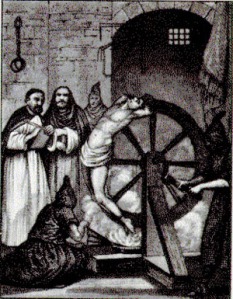
Spanish Inquisition

The Inquisitor rapidly condemns the most vulnerable characters on the scene in order to exorcise heretic—read: unacceptable because unorthodox—behaviour: two monks, one mentally disabled and the other with an obscure sectarian past, and a hungry, thieving peasant girl are taken to the stakes after a violent session of torture that preys the desired confession and presumed guilt out of them. In a rebellious response to this barbaric regime, the poor girl is saved by the local population and the cloister burnt down to the ground, the wealth of knowledge guarded in its entrails forever destroyed—knowledge that would only be retrieved by the Renaissance fervour for Arab, Latin and Greek texts.

The rigour of the medieval Italian Inquisition was brought to further extremes by the Spanish Empire in Early-Modern times under the reign of King Philip II, who waged a Roman-Catholic crusade on Protestant Northern Europe. I still remember the patriotic history lessons I received as a teenager on the long Dutch War of Independence against Spain from 1568 to 1648, when the Dutch republic was finally recognised as an independent country, presumably to thrive as never before.

The reigning climate of religious and intellectual intolerance under Philip II was said to provoke the escape of many free-thinking intellectuals from territories under Spanish control to the Netherlands; this then would have contributed to the onset of an economic boom, famous Dutch ‘tolerance’ (far to be sought nowadays) and the Dutch Golden Age in literature, the arts, science etc. in the 17th century, boasting the likes of Rembrandt, Vermeer, Spinoza and Huygens.

The Nightwatch by Rembrandt (1642)


My country’s nationalistic tale of rebellion and resistance in defence of tolerance and open-mindedness forms part of the dark myth of Inquisitional Spain: in the latter, the self-defeating intellectual bleeding that took place in this period, which had started with the expulsion of the Moors and Jews by the Reyes Católicos (Catholic Monarchs) in 1492, is seen as a strategic error from which Spain never fully recovered and which, for better or for worse, hampered its participation in Modernity. No doubt Renaissance reality must have been more complex than this.

Nowadays, Spain is a puzzle of political factions cultures on the national and regional level, some more progressive and cosmopolitan others more conservative and provincial. There does survive, however, a strong reactionary undercurrent in civil society that is extremely wary of change and cultural difference which revives the spectre of La España Profunda or Negra—the orthodox ‘Deep or Dark Spain’ that won the Civil War (1936-39) against the Republicans, installed a fascist regime in connivance with the church and legal authorities that lasted for four decades, and survived the advent of democracy after Franco’s death in 1975.

The concept of ‘Deep Spain’ is echoed in the blind religious fervour and concomitant intolerance and distrust of worldly knowledge displayed in The Name of the Rose, whose reading/watching offers an apt metaphor for what is happening in Spanish universities nowadays. Drawing on the flower’s flexible semiotics, I take the rose to stand for the policing of academia in the name of a new Spanish creed: the Religion Of Scholarly Excellence or the ROSE—which aims not to improve but purge university staff through a confessional model of accreditation.

In the development towards a common European space of higher education (the Bolonia process), the Spanish government now forces all contracted university staff without tenure to go through the central filter of a specialised agency (ANECA) at the Ministry of Education and Science (MEC) in Madrid so as to be eligible for their current, temporary posts as well as for higher academic rank.

This centralised bid for scholarly excellence sounds laudable but proves arduous, time-consuming, patronising and counterproductive. It imposes a constant pressure to re/train, do research, lecture, participate in congresses and projects, and publish, which inevitably replaces quality with quantity through inoperable red tape requirements. Any item mentioned on a demanding, extremely detailed CV form has to be seamlessly certified with official documentation, in most cases provided with stamps and seals from the pertinent institutions, and with backup of supplementary photocopies of abstracts and first and last pages of book chapters, congress and journal papers and so on.

The results of this red tape ordeal are converted in points on a rather arbitrary scale reminiscent of the worst in quantitative science so as to decide the applicant’s luck in commissions of obscure composition. The time and energy lost in this arbitrary process of assessment, both before and after submitting your papers, is horrendous and unimaginable.

The Inquisitional distrust displayed is enormous. Most of us that have to go through this torturous act of confession have many years of academic dedication to boast and therefore certify. One can understand some kind of independent inquiry into candidates’ qualifications, skills and experience for university posts in order to prevent favouritism and provincial backwardness in local universities, but not the kind of quasi-religious bureaucratic scrutiny engaged at present.

I concede that lack of academic mobility amongst universities is a typical Spanish ill, but mostly inspired by inadequate state funding, which binds upcoming scholars to the safety of their home (universities) to establish their careers. It is, unfortunately, the poison that has made the system ‘work’—up to now. Structural lack of funding is also revelatory of Spanish society’s deep distrust of academic knowledge and its fundamental adherence to a Roman-Catholic top-down organisation of civil society where a select few hold the keys to truth, resources and power.

No need to ask yourself why the Roman-Catholic church receives ample state funding by an undemocratic Constitutional pact between Spain and the Vatican, which turns the church into a state within the state. Imagine what we could achieve if this money were invested in academic research and innovation! There is a straight line from religious straight-jacketing to the confessional cross-examination now of people who have long proven their academic worth and dedication in return for appalling contractual conditions.

The blind criminalisation that is currently taking place in the name of the ROSE demands irrefutable, hairsplitting, multiple proof of academic activity reaching up to sometimes 20 years back. It is in the name of the ROSE that the intransigent mentality of the Spanish Inquisition has been resurrected against the most vulnerable factions of university staff.

In short, having been in close contact with the poison of worldly knowledge, you are guilty of heresy until proven otherwise, and pestered until you have conformed to the ROSE’s truth—the bible of scholarly excellence as the Ministry perceives it. Confess your sins and you might be absolved but burn at the stake if you resist. On paper Spain made the shift from religion to science as the referential model for understanding the world in the Modern Age but it appears old structures of thinking are difficult to defeat in a confessional state, even in these postmodern times, as they are re-applied to Science-as-Religion.

A lot of this harks back to the age-old problem of the centre and the margins, of effective democracy and self-management on the local levels. Franco is dead but his spectre haunts the margins relentlessly from the central state location and pulls them back into the national panopticum.

Javier Pérez Royo, a columnist in a widely-read national newspaper, recently addressed centralisation as one of Spain’s greatest endemic ills, hampering the country’s development. In his article “Incomprehensible prestige” he writes that “in Spain we have tended to equal centralisation to order, rationality and rigour in the management of public affairs while we have tended to associate decentralisation with the opposite.” Yet, empirical evidence shows that “[t]he unified and centralist state has been a disaster in our political, constitutional history … It has been an enormously authoritarian state … and consequently … very inefficient” (El País 19 March 2011: p.23, my translation). Why this has been so is not hard to guess.

Yet, my (and some of Javier’s) prayers for release may have been heard. We do have local assessment agencies for academic accreditation as well, set up by the autonomous, semi-federal regions of Spain. In the case of Catalonia, where I live, the procedure is simple: you hand in a standard CV stating all your academic merits, some basic documentation to support it—no stamps or seals required—some academic assessment reports and a signed statement of truthfulness.

The funny thing is that this does not lead to better but worse results: only 30% of the applications is granted a pass by the AQU, considerably less than in the case of the national agency, ANECA. How to read this? Are Catalan applicants really that badly prepared? Or is the initial vote of confidence just a smoke screen, and the civil servant’s ingrained distrust resurfaces when CVs are actually assessed? Or is the Catalan agency so strict in its criteria just to prove itself more serious than the central agency—a case of exalted regional nationalism, of being more Catholic than the Pope?

The result is that many of my colleagues believe it is a waste of time to go through the AQU. Theoretically this and the central agency do the same job, and should have similar results—but they don’t. A profound reflection on their (mal)functioning is due to rationalise things.
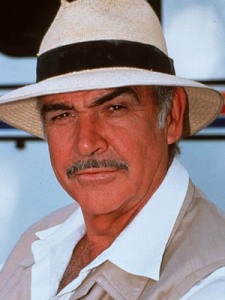
My solution: the new Spanish creed of scholarly excellence requires the intervention of the likes of Sean Connery. In the best of the Scottish tradition, he shares Sherlock Holmes’ genius, efficiency and quick-wittedness and, on top, he’s well alive and frequently shows up in Marbella on Spain’s south coast, where he owns a villa. He’d be easy to approach over a good malt whiskey and probably willing to do us a favour for the good cause in between his games of golf and sunbathing. I know it’s heresy but I’d even clone him in his 00-Ockham part: having that kind of deductive reasoning and attitude pour over our CVs rather than local zealots applying bureaucratic and confessional procedures would provide better results.

He would certainly suffice to deal with the kind of academic check that is required on the local level. It’d also be more cost-effective and beneficial for an institution which is hard up for freedom of movement and qualified academic staff, chronically underfunded but ear-marked to lead the way out of Spain’s economic slump. ANECA and AQU should have no licence to kill, so let’s leave patronizing models behind and provide scholars with the means to realise their potential for the benefit of all. Ten years on the university payroll should owe me some credit rather than discredit; the only thing I’ll confess in the name of the ROSE is that I have little if nothing to prove after a decade in the academic trenches.

Dr Maarten Renes

Maarten Renes is an expatriate Dutchman who has lived and worked in Bacelona since 1987. He holds a PhD in English by the University of Barcelona and is assistant lecturer for the literature section of its Department of English. He is vice-director of the University of Barcelona’s interdisciplinary Observatory: Australian Studies Centre.

Keep your moralities off our bodies: ABC Drum today

15 Apr

 Always find out where your women’s health advisor is coming from Read it at the Drum Opinion today.

Don’t mention the mothers

14 Apr

First posted on ABC’s The Drum

Tiara Kid

Peter Garrett, Federal Minister for Early Childhood and Youth, is about to receive a petition requesting his support for a plan to boycott the introduction of American style child beauty pageants into Australia, organised by the “anti-sexploitation” group Collective Shout

Averse as I am to censorship and banning as methods of effecting cultural change, in this case I’m in partial agreement with the zealots.

Watch the video here and you’ll be left in little doubt that subjecting young girls to the intensive and brutal grooming demanded by the organisers of these affairs is abusive of the little child’s body, mind and spirit. Think hot eyebrow wax ripping off a screaming three-year-old’s tender skin, as well as indiscriminate amounts of chemicals from fake tans, bleached teeth and hair; Botox injections, and after that the make up.

Together with the sexy moves the little girls are taught to use and the glittering costumes they are required to wear, reminiscent in their extravagance of Las Vegas showgirls, you’re looking at a violating form of child abuse that is normalised in certain sections of wealthy Western democracies as highly profitable entertainment for adults.

Some mothers argue that it’s nothing more than a game of dress ups, a disingenuous justification that allows them to convince themselves that their little girls are having fun. But dress ups in your mother’s bedroom don’t entail painful beauty treatments or have as their goal the attainment of physical perfection, and the adults you parade before accept you no matter how you look.

Little girls tarted up like caricatures of adult beauty queens put one in mind of the excesses of drag queens, and indeed the little ones look just like infant drag queens, sans the irony, humour and agency the adults bring to their displays. If an infant beauty queen is a tragic sight, an infant drag queen is even more so, especially if she’s scared, forgets what she’s supposed to do, or falls over her own little feet when she’s parading across the stage while her momma shrieks “Shake it like I told ya, baby!” from the front row.

It’s the patriarchy again

On the website to which I’ve linked there’s some comments criticising the mothers who get themselves and their little girls into this Mardi Gras and Sleeze Ball for tiny tots pageant scene. The disapproving commentary is critiqued by others who claim that it isn’t the mothers’ fault, we must be careful not to start a false good mother/bad mother dichotomy in this debate, and that the mothers are themselves products of a culture in which how a woman looks is all that matters.

While I agree that starting a bad mother/good mother binary oppositional is less than useless, I take issue with the justification that the mothers involved are victims of a sexist hegemony promoting the belief that “…women and girls aren’t human – we are all apparently male’s disposable sexual service stations,” to quote one of the comments.

How then, do we account for the millions of women just as subjected to cultural pressures (the majority, I venture to claim) who are appalled by the pageant scene and wouldn’t dream of letting their little ones anywhere near it?

We can’t account for their escape, but what the victim justification does do is allow those mothers who exploit their little ones in pageants to be relieved of responsibility for their choices.

That’s responsibility, not blame, the difference between the two is a big one, and perhaps the failure to understand this difference is what is preventing some of us from fully acknowledging the mother’s pivotal role in child pageantry.

This victim justification inevitably leaves faceless corporations primarily responsible for the “porno-sexuality” allegedly propagated by the beauty industry, and apparently wholly and indiscriminately internalised by pageant mothers. Women and girls, this argument goes, are nothing but “fodder” for “sexist, classist and racist corporate machinery.”

Where have I heard this disavowal of agency and individual responsibility before? Oh yes, the KanYe West and Brian McFadden sagas; the Victoria’s Secret knickers saga, and most recently in the games rating debate article on the Drum.

Wherever you find those who seek to censor you will find the corresponding denial of agency and individual responsibility. According to the censor and ban brigade, a majority of people but especially women, are bereft of all ability to discriminate, soak up cultural influences as if we have Wettex in our craniums rather than brains, and have to be protected from ourselves because we are undoubtedly our own worst enemies.

In other words, women are even less capable of discrimination and choice than children, and women are a priori patriarchy’s victims.

Never underestimate the power of the mother

My argument for having a close look at these pageants isn’t because the mothers are victims. It’s because their children are, and children don’t have a lot of agency in any situation that is controlled, driven and dominated by the mother’s extreme desires. However much a child protests and some of them do, she is bullied, manipulated and cajoled into accepting the cosmetic violation of her body, and into dressing and performing as her mother demands.

The pageant mother’s perception that her child is inadequate and requires physical enhancements is a damaging one, and we should not be accepting it as part of the “normal” range of maternal attitudes. The completely normal little girl is taught by her mother that she is physically lacking, that this is a handicap, and that if she works hard to perfect herself she will receive love, affection and admiration from her mother, and her wider audience.

This is a message the child will carry with her into adult life, introjected as parental messages frequently are so that we come to think they’re our own beliefs, and it’s a big task to free ourselves of the more negative of them.

The intense maternal focus on perfecting the child’s body should alert anyone to the real possibility of creating an obsessive preoccupation in the little girl that will likely be carried into her adolescence and adulthood.

Never underestimate the emotional power of a mother over her little child, even if that mother is herself a victim.

The Twinkie defence

If mothers are relieved of responsibility in the matter of child beauty pageants, the myth that all that is required to protect children is for us to prevent through censorship and boycotts the patriarchal cultural brainwashing of women, is once more perpetuated.

Faceless corporations will be held solely responsible, and the consumer’s Twinkie defence of diminished capacity on account of having been unwittingly appropriated as fodder for the beauty industry, will serve to deny personal agency and responsibility.

I can think of little that is more unrealistic than ignoring or glossing over (so to speak) the mother’s role in beauty pageants, as is advocated by those who are protesting these events. Their undertaking to instead focus on pageant culture (minus the mother’s agency in it) and what it represents sounds doomed to failure, in terms of productively deconstructing these abusive events.

The “woman as victim” ideology

As are all efforts to control through censorship and prohibition alone, this one is at best superficial. We might succeed in preventing the pageant culture taking hold in Australia to the extent that it has in the US, but we won’t have done anything to ascertain what drives a woman to subject her infant to these ordeals, or what she may be doing instead if they aren’t available as an outlet.

Yet again we baulk at acknowledging women’s capacity for violence whatever form it takes, and instead seek to place responsibility elsewhere.

Yet again we are proffered the view of women as without agency, victims of a patriarchal consumer culture that blinds us to our own and our children’s best interests.

Once again some of us are denying women an opportunity to claim agency and own responsibility for our actions, and in so doing become proactive participants, rather than the perceived passive victim recipients of the culture in which we live.

And, as is all too often the case, the biggest losers are the little girls denied the ordinary enjoyment and acceptance of their normal children’s bodies, paraded instead in grotesque finery in front of adults like primped, beribboned and ruffled toy dogs in a very bad circus.

And again, the question must be asked: what is it with some women that makes them apparently incapable of acknowledging and addressing blatant maternal abuse, even “for the sake of the children?”


Bill Henson revisited

11 Apr

I’m putting this upfront again because a new discussion has opened up as a result of my piece in the Drum yesterday on Robert Crumb and Hetty Johnson.

Bill Henson by publik 16 via flickr

Bill Henson has a new photographic exhibition at the Tolarno Galleries in Melbourne.

The usual suspects, who art critic John McDonald calls the “despisers of the body” (Spectrum, April 9-10, 2011) have taken up cudgels against Henson’s images.

Interestingly, two prominent objectors, journalist and media researcher Nina Funnell, and Christian conservative Melinda Tankard Reist, both admit they haven’t seen the exhibition, however Reist says she has seen previous works and she knows what Henson is up to.

I haven’t seen this exhibition either, so am in no position to comment. What I do object to, however, is the conservative attitude that any depiction of adolescent nudity is pornographic, and the implication that everyone who views the images of adolescents is doing so from the perspective of a paedophile. That is, the danger they perceive is that all viewers will be sexually aroused in an inappropriate manner, and will want to sexually engage with the young people depicted in the photographs.

Therefore, the photographs  are “a catalyst for forbidden desires” to quote McDonald again, and  as such, should be censored.

Objectors such as Funnell and Reist have as their basic assumption that the young person’s body can only ever be viewed as a sexual object when portrayed in Henson’s photographs, even when they haven’t actually seen them.  They do not allow for any other understanding or interpretation, such as those Henson himself has advanced that are to do with his interest in capturing the liminality of adolescence, and revealing the young person on the threshold of immense change, in the throes of  all the uncertainties and ambiguities that accompany this state.

In the world view of the protestors, there is no room for any interpretation other than the sexual, and they urge all of us to view the images through the eyes and with the imagined desires of the paedophile.

There is something very alarming about their perspective, and something even more alarming about their urgent need to thrust that perspective on everyone else. Funnell tells us breathlessly that Henson’s images are known to be collected by paedophiles. Well, so are Target catalogues picturing little kids in their undies. Does this mean we must order and censor the world around us according to the base desires of the perverted? Does this mean that anything likely to appeal to the paedophile’s gaze must be obliterated from our cultural landscape?

Or are they arguing that any gaze directed towards photographs such as Henson’s is inherently paedophiliac, simply because the owner of the gaze directed it there in the first place?

This attitude turns everyone who visits the exhibition into a vicarious paedophile. It defines all visitors as abusers. It suggests that all those who view the images are compelled to adopt the perverted gaze to the exclusion of any possible other.

And this is what makes people like Funnell and Reist dangerous. They see a world comprised of sexual predation and abuse, and are unable to allow the legitimacy of any other vision. For this reason alone, they should not be trusted in the matter of Henson’s work, anymore than one would trust a paedophile’s limited and distorted perspective.

Bolt lands TV show, thanks to Gina

8 Apr
Fair & Balanced graphic used in 2005

Image via Wikipedia

Andrew Bolt has landed a Sunday morning gig on Channel 10, thanks to his über wealthy fan, mining heiress Gina Reinhart.

Reinhart recently acquired a 10% stake in the network, and has decided that it’s about time for a “Fox News style show” on 10.

Reinhart’s move into media gives her an opportunity for far wider cultural influence and control than she currently enjoys, and it looks as if she’s wasting no time getting that up and going.

Bolt is embroiled in legal action taken against him by several high profile Aboriginals, following his observations that some light-skinned Indigenous people exploit their heritage for personal gain. Bolt apparently thinks that if you don’t look Aboriginal you shouldn’t be claiming that you are, given that he thinks the claims may give you a leg up in your profession and position in the world, and an advantage over non Indigenous competitors.

All the evidence points to Bolt’s on-going enjoyment of the publicity and attention the court case has brought him. Scoring his own weekly TV show must be icing on his cake. Taking personalities such as Bolt on publicly usually does backfire: giving them an even bigger stage on which to parade their opinions seems to work largely in their favour.

Whatever you may think of Bolt’s opinions, he does have the right to express them. Easy enough to support free speech if it’s agreeable, it’s when agreement is absent that the principle really matters. And as somebody said, the only way to contest bad speech is by more and more good speech: trying to stifle opinions, no matter how wrong-headed you might think they are, isn’t going to work well.

On the question of heritage, I can understand why people want to proudly claim everything they’ve got. As someone who has no knowledge of my father and his family, I’ve had my struggles with genealogical confusion.

It also seems pretty natural to me that if one does have a heritage in which family was maligned and discriminated against, there can be a strong desire to restore that heritage and the family to its rightful human place, personally, politically and culturally. It’s a personal healing process, a fulfilling of responsibility to ancestors, and a powerful assertion of place and belonging.

I guess the fact that Andrew Bolt can see it only as exploitative and opportunistic says a great deal more about him than it does about those he’s maligned. But I’m not about to give Bolt the satisfaction of being one more person railing against him. Go for it Andy. There’s still plenty of us producing good speech. You’ve got a long way to go before you drown us out, even with the Fox News template on your side.