Archive | Society RSS feed for this section

Drs 4 Family “disingenuous” about their religious beliefs says critic

14 May

Deakin academic Michael Vagg has a piece in The Conversation today in which he explains just where the group “Doctors for the Family” gleaned their “evidence” that the healthiest type of family in which to raise children is heterosexual. It comes as no surprise to find that one study on which they base their opinions was funded by the Australian Christian Lobby. Other points they make in their submission to the Senate inquiry into marriage equality are blatantly cherry picked, and bear little if no relation to heterosexual relationships in this country.

As Vagg observes, while there have been vigorous protests against same-sex marriage for a long time, health arguments such as this one are a new weapon in the arsenal of the religious right.

The manner in which the group’s submission has been reported in the media is unreassuring. For example, ABC Breakfast news led with “Doctors claim …” Not a group of doctors, but doctors. This implies an authority that the submission completely lacks, just because it’s been written by “doctors.” In fact, when you look at Vagg’s piece it quickly becomes clear that no researcher worth her salt would accept anything at all about the doctors’ claims.

Who are these doctors? You can read about them here.

In Australia the child abuse statistics are appalling. Children are physically, sexually and emotionally abused by adults and almost all of these abuses occur within the family unit. And guess what? The overwhelming majority of those family units are heterosexual. The heterosexual family can be a highly dangerous and thus unhealthy environment in which to raise children, as at least some of these doctors must surely know.

Vagg concludes his piece thus: “Doctors for the Family are trying to hijack the credibility of science, while being disingenuous about their religious beliefs.” I’m glad for his sake he said “disingenuous,” and not “deceptive and duplicitous” and he didn’t call anyone a Baptist, probably avoiding defamation threats, unlike me. Those threats against me by Melinda Tankard Reist  still haven’t been withdrawn, by the way. I suspect Reist intends to leave them hanging over my head until January next year.

I can’t help but notice that the concealing of religious motivations is on the increase among believers trying to impose their faith agenda on a secular society via the back door. There was a bit of an outcry when I claimed Reist’s religious beliefs were relevant to her lobbying, and many cried “ad hominem!”

However, the ad hominem is not always fallacious. There are arguments for making what’s know as a circumstantial ad hominem. There are those, such as eminent Canadian philosopher Charles Taylor, who argue ad hominem reasoning can be essential to understanding moral issues. Arguments that question the opponent’s possible dogmatic bias, for example, or vested and conflicted interests, are legitimate critical responses.

The circumstantial ad hominem is an allegation of bias, and intended to serve as a warning that the arguments need to be scrutinized. Allegations are just that. They aren’t proof that an argument is incorrect or flawed, and are not used as proof: they merely raise legitimate questions about possible bias.

Making an allegation is not a biased act. Conflict of interest of all kinds can affect objectivity. It is perfectly acceptable to allege a conflict of interest when there are grounds to do so. It isn’t conducive to free speech and healthy debate for such allegations to be prevented, or silenced by dismissing them as fallacious.

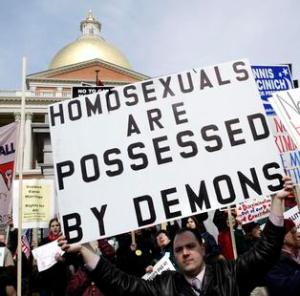
The religious beliefs of “Doctors for the Family” are entirely relevant to their lobbying against same-sex marriage. Their scientific claims are bizarre, and they use the authority invested in their profession by the community to substantiate what is at best, very sloppy research and argument, and at worst, cherry-picked, highly manipulative argument to achieve a goal that is faith-based in origin.  We have the right to know where they are coming from, and why, before we end up like this:
Kids and pron

9 May

It was with some reluctance that I sat down last night to watch SBS Insight’s inquiry into the effect of pornography on kids. I anticipated a roll out of the usual suspects with the usual hysterical claims that porn is warping the minds of our children and nobody can have decent relationships anymore and society’s going to hell in a hand cart unless we take down the Internet and make it all stop.

What a relief and a pleasure, then, to meet a brilliant bunch of young people with more common sense than I’ve found in some adults, and very definite ideas about the role of pornography in their lives and what they want adults to do about it.

“Porn isn’t going to go away,” declared one young woman, “and we want information about it. We want to know what’s real and what isn’t.”

All the young ‘uns had encountered hard core porn and none of them were impressed with it. Some they found hilariously funny. Unfortunately a middle-aged Anglican minister in the audience was deeply affected by their nonchalance, and said he found it terribly sad they’d ever seen any of it. Mostly they watched amateur porn, they said, to learn what to do and where things go. They would like some adult guidance through the genres, they said, because how were they to know what was fantasy and what people really do?

The only other person visibly upset by pornography was a adult male who identified himself as a practising Catholic and who said that thanks to porn, he couldn’t see women as human beings because he couldn’t get past his lust for us and find our humanity. Lust blinded him. He struggled daily with his lustful feelings, and I felt very sorry for his obvious torment. He claimed that this was all due to viewing porn and he wished he’d never set eyes on it.

Sociologist Michael Flood, a well known critic of porn, made the somewhat odd statement that “Porn shifts what we think of as normal.” Who is “we?” What is “normal?” What kind of porn is he talking about? Obviously from the kids’ point of view porn doesn’t shift what is normal, because they have no idea what is “normal” and would clearly appreciate some guidance. To his credit, Flood later claimed that we need more varied and “ethical” porn, and perhaps there’s something in that.

Obviously there are kids who are negatively affected by porn, and one of the sex educators in the audience expressed her concern for girls she worked with who were intimidated by boys’ demands for the kind of sex the girls didn’t want and didn’t enjoy. So there’s a need to teach sexual manners.

However, as one young woman firmly stated, if boys want to know what a girl wants they have to bloody well ask her. Don’t assume it’s the same thing women in porn films want. It isn’t about how creative you think you are, she told the lads. It’s about what pleases the woman. Her mum, sitting beside her, nodded vigourously and beamed with pride.

All in all the show considerably lifted my spirits. I’m very fond of young ‘uns. They almost always have more smarts than I expect. And if this group is any guide, they can watch porn, even from an early age, without incurring devastating damage. But they want our help. Not censorship. They know porn is part of our world and isn’t going away, and they want to learn how to deal with it. They want guidance. They want trust. They want education.

Hear that, morals police?

The footballer & the anti porn campaigner: not cool as FCUK

6 May

On Melinda Tankard Reist’s website today you’ll find this article about AFL footballer Lance “Buddy” Franklin. Franklin has another job as well as football: he is co-director of clothing company Nena & Pasadena. This company apparently specialises in tee-shirts featuring women in exaggerated sexual poses, sometimes handcuffed, and partially clothed. There’s often a slogan or two, in case we haven’t managed to interpret the images.

Reist asks: “What message does this clothing send N&P’s target market of young men about women?”

What message does this send about women?

Reist’s answer is that the message conveyed by Buddy’s shirts is that women are sexual objects, not human beings. She feels the images degrade us.  I don’t read it that way. To me, the shirts say nothing much at all about women, and everything about the fantasy lives of those who design, produce and wear them. These shirts say nothing about who women are, and everything about what the men who wear them want us to be.

I don’t believe another person’s fantasies degrade me. They don’t reflect on me in any way at all. This is what we need to teach our young. You aren’t what somebody else imagines you are. As we’re never going to control anyone’s imagination and ought not to try,  we need to focus on educating children to refuse the imposition of other people’s fantasies on their sense of who they are. It’s not rocket surgery. It’s being proactive. It requires us to dump the language of victimisation and replace it with the language of empowerment. We are in dire need of this paradigm change.

At this point I’ll refer you to this horribly sexist vintage ads site. While there’s definitely less flesh and far less overt sexual imagery, the message is the same. These ads are also a reflection of the desires and fantasies of some men, and say nothing much at all about women. They do say a great deal about a dynamic that remains consistent. These ads, like Buddy’s shirts, cast women in an inferior and tiresome role. We may have our clothes on in the vintage ads, but they are only a variation of Buddy’s fantasies.

When we protest that these images degrade and objectify us, we give them the power to do exactly that. There are always two sensibilities involved in the interpretation of any text: that of its author and that of its reader. As a reader I’m free to conclude that the text is not about me. It’s all about the author. I’m free to refuse the author’s construction of my sexuality, a construct based on the author’s desires. Why should I grant anyone that power over me?

Personally, I’ve never been attracted to clothing featuring pictures and advertising: I’m not a billboard. Even if such clothing isn’t pushing a brand, it is self-revealing: by my clothes you’ll know me. There are occasions like demonstrations, conferences when it feels good to state my position through what I’m wearing, and cartoonist First Dog on the Moon’s shirts I’ll wear anytime.

That said I do have a couple of FCUK tee-shirts, one that says “Cool as FCUK” and another proclaiming “Lucky FCUK,” neither of which I would be caught dead in outside the house, but that’s just me.

Reist then asks: “What does it say about men and women when clothed men wear t-shirts of naked women?”

A man who feels the need to wear an image of a naked woman on his tee-shirt is making a statement or a series of statements about himself, about his opinions of women, about his attitude to women. Such clothing says nothing about “men and women.” It says some things about some men. Again, women are not obliged to join such men in their fantasies and desires. We are not demeaned and objectified unless we accept the wearer’s world view. Unless we allow that world view to construct us and so become complicit in our own victimisation and dehumanisation.

That being said, I have no problem with letting Buddy know his tee-shirts say everything about him, and nothing about women, and what he’s saying about himself is pretty crap. I’ve no problem passing that message onto the shops that stock his wares, either. That’s the easy part. The hard part is changing the paradigm from first accepting then protesting victimisation, to refusal of men like Buddy’s interpretations of women and our sexuality in the first place. We do this by giving our children the tools they need to resist believing they are what somebody else says they are, and that they have to be what somebody else wants them to be. We’re never going to stop the Buddies but we can disempower them. We refuse the victimisation in the first place, then we don’t have to waste our energies protesting it.

Buddy, your tee-shirts reveal some weird things about you. You might want to think about that, mate.

The Good Book

3 May

I’ve just begun dipping into The Good Book. It’s a secular bible compiled by British philosopher A.C. Grayling who has, to paraphrase the blurb, distilled the teachings, the insights, the wit, the advice, the human stories, the tragedies, the yearnings, the love, the sorrow and the consolations of over a hundred authors and a thousand texts into a humanist bible. No small task.

I do find it a tiny bit irritating that Grayling references none of these sources, however he seems more concerned with the message than the messenger and the message is that “All who read this book, therefore, if they read with care, may come to be more than they were before…To determine what the good is, and of the best ways to know it, is the most important of all our endeavours, and is truly the master art of living.”

I was initially discouraged by this. It sounds like a Star Wars script. But I will persevere.

The last section of the book is titled The Good. Here we find Grayling’s definition:

“1. The good is two freedoms: freedom from certain hindrances and pains, freedom to choose and act.

2. The first is freedom from ignorance, fear, loneliness, folly, and the inability to master one’s emotions.

3. The second is freedom to develop the best capacities and talents we have, and to use them for the best.”

This short chapter of merely 18 verses contains within it most of what I need to know about the good and it’s relevance to my life. The previous 593 pages will be an interesting long-term read perhaps, but the shortened version is condensed in verses such as these:

“5. There is not one single kind of good that suits and fits everyone: there are as many good lives as there are people to live them.

6.It is false that there is only one right way to live and one right way to be,

7. And that we must obey those who claim to have the secret of a ‘one right way’ and a ‘one true good.’

8. If there are guides to the good, one must eventually leave them behind and seek the good of one’s choice, and which suits one’s own talents.”

Or, if you meet the Buddha on the road kill him, as we used to say back in the day.

I inherited a powerful anti-authoritarian streak from my grandfather that’s made it impossible to relinquish my desire to think for myself. This makes me useless as a follower of just about anything or anyone, with the exception of Leonard Cohen. The faintest odour of theology or crypto theology and I’m on the outside looking in. I don’t believe in a transcendental exteriority.The best experiences in my life have been grounded in the human, as have the worst. I can think of no greater miracle than a human being.

“Chapter 9

1. Seek always for the good that abides. There can be none except as the mind finds within itself.

4. When will you attain this joy? It will begin when you think for yourself,

5. When you truly take responsibility for your own life.”

  ∫


War: what is it good for?

25 Apr

April 25 2012

Last night SBS Dateline reported on how life changes for many military men and women and their families after they’ve seen action in a theatre of war. Post traumatic stress disorder is rife, for example, and the effects of this illness can be horrific. It’s compounded by the stigma attached to those suffering the mental trauma of war, a stigma that can discourage sufferers from seeking help.

Reporter Nick Lazaredes has spent considerable time  investigating the dire circumstances of far too many returned military personnel in the US, and asks is Australia prepared to support and assist our soldiers who come home emotionally and mentally damaged by their service to their country?

This piece has just appeared at The Drum, addressing similar concerns, as does this one by Bruce Haigh.

As well, here at Overland is Jeff Sparrow’s excellent essay on Anzac Day and the celebration of forgetting.

As one observer in the SBS documentary pointed out, politicians like to declare “America is at war!” However, America isn’t at war, he claimed, America is in shopping malls. The military is at war, and America is ill-equipped to deal with the consequences of that when men and women with shattered psyches return to take up an ordinary life. The difficulties they face affect everyone around them, and the wider society.

If politicians are willing to send citizens to war in order to preserve our freedom and values, it seems remarkably short-sighted of them not to ensure the society we’re fighting and dying to protect doesn’t suffer, when those citizens return unable to rejoin it because of their contribution to its protection.

In 2003, then US President George W Bush told then Prime Minister of the Palestinian Authority Mahmoud Abbas: “God told me to strike al-Qaeda and I struck them, and then he instructed me to strike at Saddam, which I did.” Our own John Howard supported Bush in this endeavour, as did then British PM Tony Blair.

It seems rather remiss of God not to have told Bush, Howard and Blair to make ample preparation for the care of the military personnel they sent to do God’s work, when they returned from their endeavours broken in body and/or mind. It seems remiss of God not to have commanded the leaders to adequately care for the partners, parents and children of these women and men who risked everything in God and George W Bush’s interests.

It seems remiss of God not to have ordered Bush to have a strategy in place for the period after he toppled Saddam Hussein as well. But there you go. The Bush God is a belligerent, obstreperous and ignorant war-monger. He cares nothing for the lives of women, men and children affected by his witless triumphalism. He rewards only the moral fervour of arrogantly incompetent white alpha males who cherish the delusion that American-style democracy must be adopted by the entire world, and it matters not who suffers in the pursuit of this implacable goal of blind universalism, as long as it isn’t them.

Politicians will always find reasons to send their populations to war, no matter how ill-founded, duplicitous, and opposed by the citizens those reasons are. The invasion of Iraq is proof of that statement. While that situation seems unlikely to change in the near future, what governments ought to be forced to do is made adequate provision for the wounded, in mind, body or both, when they return from doing their duty in whatever hell hole they have been assigned to by their governments. Anything less than this is scandalous.

What we need of course is a paradigm change. We need to cease our participation in what is, to paraphrase John Gray,  the US myth of its manifest destiny as a redeemer nation, expressed in missionary-style politics with the salvation of mankind as the goal.  As Robespierre noted in 1792: “No one loves armed missionaries: the first lesson of nature and prudence is to repulse them as enemies. One can encourage freedom, never create it by an invading force.”

I’m encouraged by the perspective of this youthful blogger, who points out that while on Anzac Day we must commemorate those who died in battle, we shouldn’t be celebrating the wars in which we’ve participated. There’s nothing to celebrate in war. War is hell, and it is all too often good for absolutely nothing.

Axis of Arsehats

In Search of the Bricoleur

23 Apr

Guest post today by Stewart Hase

Bob le Bricoleur

In Search of the Bricoleur

Key Points

1. Another personality difference that creates conflict.
2. Bricoleurs see the word differently to non-bricoleurs
3. Bricoleurs are often side-lined.
4. Bricoleurs need to be invited into decision making situations not excluded.

I recently discovered that I am a bricoleur and it is a blessed relief to have outed at last. What this insight has done has explained how it is that I have managed to upset so many people in organisations, and perhaps other situations, over the years. It is a personality thing and, as I’ve mentioned before, it is personality differences where most conflicts begin, if not end.

Bricolage is a French word, as you’d probably guess, and originally referred to a worker who would make the best with what they had to complete a task. Thus they were people who tinkered with things, even playfully in an effort to solve a problem and used whatever resources they might have at hand. The term then became associated with art and craft. Later the usage has been broadened to include people who use their experience, their instinct, trial and error, and again, tinkering, to solve any sort of problem.

Thus, a manager or a researcher, for example, would bring whatever models are appropriate to a problem and would not be tied to a particular way of doing or thinking. They’d try something, perhaps even an amalgam of competing techniques or ideas, and see what worked rather than using a recipe driven approach. For the bricoleur, dogma and gurus who think they know the best way to approach a problem or issue are viewed with suspicion.

It is easy to see that to some people the bricoleur is nothing but a terrorist. They don’t work by the book, fiddle with process, flaunt policies and procedures, play with ideas, tinker and dislike high levels of control. This is the stuff of a nervous breakdown for the manager who is high on order, with crockery ducks flying along the wall in precise formation. The ISTJ will probably end up on high levels of psychotropic medication if a bricoleur is a member of their team. The archetypal Humphrey Applebee would be looking at Guantanamo Bay as a solution to the situation.

The truth is, of course, that we need both types in any organisation but it is easy to see where the conflict occurs. The bricoleur and the non-bricoleur are seeing the world through quite different lenses and will find it hard to understand each other’s language. Bricoleurs, in the original definition, were seen as being well-meaning amateurs by more traditional craft-persons or tradespersons who did things the ‘correct’ way. A bricoleur would see herself or himself as bringing expertise from many disciplines and experiences that enable them to see a task or problem in a different light. They’d see the other as narrow minded, limited in imagination and simply in the way.

My guess, and I don’t have any hard data to support this, is that bricoleurs would tend not to rise to the top of the corporate tree and f they did it would be an accident of sorts. Whether or not that is a good thing is open to debate and it may not matter because nature has probably spoken on the topic by making them unacceptable as leaders/managers and excluding them already.

I think organisations need bricoleurs, particularly in their decision-making and strategic processes. And it may be the case that they tend to be side-lined and ignored, infrequently being asked into the board room or places where the important decisions are made. We need people who are prepared to see things differently, ask difficult questions, be a bit different and tinker with ideas. They need to be heard and not just seen. My experience is that they tend to be seen as a bit too different, not a team player and just a bit too out there-a well meaning amateur perhaps.

Some years ago I was doing a consulting job with a great friend, Alan Davies. We were arranging a search conference to undertake a strategic planning exercise. The CEO was objecting to Alan wanting to invite union leaders and some other rebels who did not tend to toe the organisational party line. This list included customers who had not had a good experience with the organisation. Alan insisted they attend because you need to have your ‘enemies’ (not that they were really enemies but were perceived as such) in the room and not banging on the portcullis creating a stir. Best piece of management learning I every received and so too for the many CEOs who did eventually engage with the ‘enemy’, who is anyone unlike themselves.

Dr Stewart Hase

Guest author Dr Stewart Hase is a registered psychologist and has a doctorate in organisational behaviour as well as a BA, Diploma of Psychology, and a Master of Arts (Hons) in psychology.

Stewart blogs at stewarthase.blogspot.com


Mumbrella & the morals police

19 Apr

At the Mumbrella website you’ll find blogs and discussion about “everything under Australia’s media marketing and entertainment umbrella.”

You’ll also find an article titled “Stop making sex objects of women and kids,” written by morals campaigner Melinda Tankard Reist in November 2011. This article is “one of the most commented Mumbrella has ever published” and as a consequence, Tankard Reist has been invited to speak on her topic at the Mumbrella360 conference  in June 2012.

In the title of Reist’s article we see immediately the manipulative conflation Reist and her campaigners make with adult women and girls. As I’ve argued many times, we have two very separate issues here, on the one hand the alleged “objectification” and “pornification” of adult women, and on the other the alleged “sexualisation” of children. Reist and her followers make no such distinction and this is the first reason to suspect their claims are less than rigorously addressed.

Reist and her followers seem to offer an outstanding example of the “third person effect,” that is, they inhabit a psychological space in which they perceive advertising as having far more effect on others than themselves. While they can argue that themselves and their children are somehow exempt from an unwilling transmogrification into pornographic sex objects by viewing mass media advertising, everyone else outside their circle of friends and like-minded colleagues is unable to resist this hypersexualised state, resulting in a mortally crippled society in which everyone (except them) is either demanding sex  or offering sex 24/7, including children. In short, only Reist and company manage to retain agency, while the rest of us lose ours at the first glimpse of female flesh.

I say this because every time I read one of Reist’s fanatical rants, I ask myself who is she talking about? She is not describing anyone in my circle of friends, acquaintances, colleagues, neighbours, extended family and community. I may lead a comparatively sheltered life, on the other hand I do get out. I’m also middle class and perhaps Reist’s demographic in danger exists in another milieu? Is Reist in the process of creating a class of deviants and their children who unlike her and hers (and me and mine) are infected with hypersexuality through their inability to resist the unrelenting assault of advertising, and are thus eroding the very foundations of our society?

WHO ARE THESE PEOPLE AND WHERE CAN I FIND THEM AND RE EDUCATE THEM BEFORE WE ALL DIE IN SEXUAL SQUALOR?

I have heard distressing reports of teenage girls feeling obliged to provide boys with blow jobs, however I attributed this more to Bill Clinton who changed the definition of sex for generations of young people when he declared fellatio was not really sex, and therefore one ought not to feel guilty about it.

There’s no doubt that there’s a great deal more flesh about than when I was a teenager. Though watching the Brady Bunch the other afternoon, I noted that the skirts the girls wore to high school were little more than pelmets, and they also sported high heels, footwear they aren’t allowed to wear to school today.

It’s also true that the representation of female sexuality in advertising is a narrow one, and we ought to be railing about the lack of variety the industry offers. Reist and her followers would no doubt argue there should be no such representation at all, and trying to work out just what they would find acceptable is a pointless task. To them it’s all “sexualised.” But as I argued here in an essay titled “How to induce a moral panic about sex ” there’s a big difference between “sexualised” and sexy:

According to the American Psychological Association’s definition (I don’t trust them about much, but they’re helping write the book on this so they’re a primary source) “sexualizing” women means denying acknowledgement of anything other than our sexuality, according us value only because of our sexual appeal to the exclusion of all our other characteristics, constructing us as “things” for sexual use rather than seeing us as people with the capacity for independent action, and inappropriately imposing sexuality upon us.

So are the researchers confusing sexualization, which according to the APA’s definition is pathological, with sexy? The definitions of which are: arousing or intended to arouse sexual desire, and being sexually aroused, neither of which are, I hope, considered pathological by anyone. There is a world of difference between the two terms. Sexualization we may well get upset about, as a particular form of dehumanization. But sexy?

Is it a case of having failed to successfully demonize the sexy, a pathological disorder is the next step in the reactionary battle to control expressions of female sexuality?

The danger is that while sexy is a description of normal human pleasure, replacing it in the vernacular with “sexualized” throws any possibility of female sexual representation out the window. Every public display of female sexuality is interpreted as sexualized, and therefore pathological.

What kind of a lesson is this to teach our girls about their sexuality?

One can only hope the Mumbrella conference will offer its audience balance, and invite a speaker who will challenge Reist’s moral rhetoric with some common sense and research-based counter arguments. At the very least, Reist needs to make it clear just who it is she is talking about, rather than continuing with sweeping generalisations about “women” and “kids.”  Perhaps she could tell us how she herself avoids the pernicious influences of the advertisers to maintain her sexual integrity, and how she protects her children from objectification, pornification and sexualisation. This could be really helpful, because no matter what outside influences a child must deal with, the tools for survival are acquired in her or his family.

While Reist spends an awful lot of her life viewing (and, bizarrely, reproducing on her website for others to view) images she finds unacceptable, it seems she is unaffected by them. Why then should she claim the rest of us will be damaged, when she (and her followers) remain apparently unscathed?

Well, Cardinal Pell?

13 Apr

I’ve just read this piece in The Age titled “Church’s suicide victims.” It’s about a report from the Victorian police detailing the suicides of some forty victims of sexual abuse by Catholic priests, and calling for an inquiry into these and other deaths thought to be related to childhood sexual abuse by priests. The article states: In a damning assessment of the church’s handling of abuse issues, the reports say it appears the church has known about a shockingly high rate of suicides and premature deaths but has “chosen to remain silent.”

I then read this article published in On Line Opinion earlier this year, in which the author explains why  in NSW the Catholic Church cannot be sued when its priests sexually abuse children:

Put simply (as Cardinal Pell would no doubt argue), the situation is that when a Catholic priest commits sexual abuse, it does not happen in the Catholic Church because there is no such thing. It happens instead in one of its unincorporated parts and therefore responsibility for its rests totally on members of that part, especially the perpetrator and those responsible for appointing or supervising him. That is to say, responsibility is completely limited to the parish, school, hospital or whatever is the unincorporated part in which it occurred.

As the trustees merely own the property within which the abuse occurred and have no responsibility whatsoever for appointing or supervising the perpetrator, they cannot be held responsible for the abuse he committed. Of course, victims are perfectly free to sue the perpetrator or the unincorporated part but they have no assets (the Trust has them all and anyway priests take a vow of poverty) so there is nothing to be gained by it.

It seems that where sexual abuse of children is concerned in NSW, the Catholic Church has two parts: one that does the damage and one that owns the wealth…

I then read this:

Matthew 18:6  But whoso shall offend one of these little ones which believe in me, it were better for him that a millstone were hanged about his neck, and that he were drowned in the depth of the sea.

Well, your Eminence?  What say you?

Porn, Pell, & the unruly body.

11 Apr

There’s an interesting piece in The Drum today by Michael Brull, demonstrating just how unreliable are anti porn campaigner Gail Dines’ claims of “studies” and “research.” Dines argues the “studies” support her contention that we are all going to hell in a pornographic hand cart while compulsively masturbating, dressed in crotchless panties regardless of gender, and singing something with mofo in the chorus. For more about Dines unique turn of phrase see here  but if you haven’t got time, her description of men as “amoral life support systems for an erect penis” will give you an insight.

In a spontaneous example of Freudian free association, Brull’s article led me to consider Scott Stephen’s railing yesterday against the Qanda what can I call it, it never once rose to the level of a debate, encounter perhaps, and an acrimonious one at that, between Cardinal George Pell and atheist/agnostic/non believer Richard Dawkins. I was most disappointed with this mutually contemptuous exchange of scorn and mockery. If this is the best there is from both sides, we’re in trouble. Some respect, courtesy and genuine engagement would not have gone astray and on the whole, the audience questions were boring as bat scat. Actually, that is unfair to bats and those interested in their complex droppings.

Be all that as it may, Stephens, the ABC’s Religion and Ethics Editor, was profoundly upset by this programme as you will see if you have a look at the piece he dashed off immediately afterwards. Link above . There are many things with which to take issue in Stephens’ piece, however, because of Gail Dines, I’m thinking about this:

Unlike socialism – which invariably took the form of the radical assertion of the state over the economy, culture and indeed the bodies of the people themselves – the revolution that has defined our time and continues to hold sway within Western liberal democracy is the assertion of the freedom, the rights and the pleasure of the body over every other person or institution that might stake some claim over it, whether it be nation, tradition, community, marriage, children or religion. Or, as Herve Juvin has nicely put it, the Western body is “a body without origin, character, country or determination”.

In just this way, this conception of the body that represents liberalism’s political and cultural centre of gravity is both ahistorical – in that it is unmoored from its traditional determinants of kith and kin, its moral and civic duties, and even its biological inheritance and gender – and nihilistic – determined by nothing but what it chooses for itself, and oriented toward nothing but its own health, safety and pleasure.

Christianity has always had a fraught relationship with the body, and has sought to prescribe and control its functions, particularly the sexual. The body is regarded as subordinate to the soul, or as a temple of the holy spirit. The New Testament is littered with such images. The religious right carries on this tradition with its close attention to female sexual and reproductive behaviours.

It should come as no surprise to anyone that there would eventually be a revolution of the kind Stephens describes, in which human beings in Western liberal democracies attempt to extricate themselves from the constraints imposed by Christianity on the body’s freedoms, rights and pleasures. Repress anything for long enough and it will eventually explode. The sexual revolution of the sixties was in part a reaction to the repression of the fifties, the intense interest in the body in 2012 a continuation of that revolution, enabled as never before by technology. We have the means to alter our bodies. We can do things to them we’ve never been able to do before. We can see the bodies of others as we’ve never been able to see them, just by sitting at our laptops. The body is available as never before, and of course we are enthralled by its availability.

However, there is an apocalyptic tone to both Stephens’ and Dines’ rhetoric. There is an “end times” desperation in their prose. They believe the  body is going to bring us undone. Our  unhealthy enslavement to its desires and demands will lead us into chaos and despair. It would seem that Stephens has nothing good to say about our intense interest in the body: like Dines and pornography, it’s all bad.

The “unmoored” body, that is, the anarchic body, caring only for its own welfare and pleasure, and Dines’ utopian vision of what might be:

We believe in a future free of oppression, and a cornerstone of this future is a world free of commodified sex and a media landscape that does not reproduce patriarchal culture. This is a truth we hold dear and there is no study, argument, or theory that will persuade us otherwise.

The moral fervour of this statement conceals, perhaps even from the enunciator, a blind desire to establish what she considers a legitimate sexual discourse and in so doing, repress and silence all others.

Both Dines and Stephens seem to nostalgically reference an imagined era far better than the one in which we currently exist. Both repudiate the unruly present. Both  imply a utopian dream of reinstating bourgeois moral values. The body must be policed, controlled and kept in its place. But by whom?

I have always considered the body to be miraculous in and of itself. It seems to me perfectly natural that the body should be a source of fascination and wonderment. I can’t agree with Stephens’ generalisation that the body is currently unmoored from its traditional determinants of kith and kin, its moral and civic duties, and even its biological inheritance and gender – or Dines’ ghastly assertions about male sexuality.     Some bodies are adrift, and that has always been so. Some sexual behaviour is frightening and dangerous, and that has always been so. However, both authors seem to be consumed by the same urgent project: that of ridding the world of what they consider to be “evil” and installing a new order stripped of the full human experience, which must, if it is to be real, include the dark, the difficult and the dangerous.

Which brings me back to Cardinal Pell. I detected in the Cardinal a distinct taste for revenge. He wants an afterlife in which those who behave badly are judged and punished. That’s his utopia. It’s not fair, he says, if those who cause suffering get away with it. Especially Hitler.


To those who would sue us

10 Apr

Blogger Dan Buzzard wrote about homeopath Francine Scrayan in a post titled Scammed to Death: How Francine Scrayan killed Penelope Dingle. Briefly, Dingle was seriously ill with bowel cancer and Scrayan “treated” her with alternative medicine. Dingle died a horrible, painful death. The full story and the Coroner’s damning report can be found at Buzzard’s website.

As well, there’s an excellent post here at Chrys Stevenson’s blog titled When the Despicable cry Defamation. For some balanced commentary on the need or otherwise for defamation laws, Metamagician aka Russell Blackford  has a piece here as well as this highly recommended commentary and link on his blog.

Buzzard has now received a Cease and Desist order from Francine Scrayan’s lawyers, demanding that he remove the offending posts, as well as publish a retraction and apology. Scrayan reserves her right to sue him for defamation.

Only a couple of weeks ago, concerned parent Daniel Jeffares questioned literature distributed in his child’s school by the Bravehearts child advocacy organisation. In an attempt to discover the qualifications and experience of the authors of this material, Jeffares approached Bravehearts’ founder Hetty Johnston several times, only to be informed that his correspondence had been referred to her lawyers.

Then there is my own ongoing situation with Melinda Tankard Reist. This brilliant analysis of my circumstances by Scepticlawyer titled Once we suffered from crimes now we suffer from laws is  a must-read if you’re interested in some in-depth commentary on defamation threats. As well, there’s a Defamation category on the blog where you’ll find most of what’s been written here since I received the threats.

I don’t know if the situation with Buzzard is similar to mine, however the threats against me by Tankard Reist are viable for twelve months after the date of issue. At any time between now and next January, I can be served with a writ. One learns to live with threats, however my question is, why should anyone be obliged to, simply for expressing an opinion?

As with Reist, Scrayan could have chosen from any number of commentaries if she wanted to launch a defamation action. Instead, they both chose “unknown” bloggers. As Stevenson points out, this is a rather self-defeating exercise as individual bloggers rarely have the protection of moneyed institutions. Neither do we have unlimited access to lawyers who will defend us without a cent coming from our own pockets. What Reist and Scrayan might have achieved is a retraction and apology, which they could then use to self-publicise. They might have achieved this without risking the court proceedings an institution with deep pockets, unlike bloggers, may choose before capitulating.

Apparently these people think so highly of themselves they believe they are entitled to bully, intimidate and ultimately silence the opinions of others in order to defend their “good names.”

Reist and Scrayan depend on the successful provocation of deep fear. It’s no joke being faced with a legal situation that would certainly end in bankruptcy for many bloggers. I wouldn’t blame anyone who made the apology and retraction rather than face that prospect, and the prospect of such a dire threat hanging over his or her head for twelve months. And this is what these people count on, that the threat in itself will be sufficient to get them what they want.

Never mind that one is an advocate for public morality and the protection of children, and the other is a “healer.” In spite of their noble professions, or perhaps because of them, these women seem to believe they are above questioning, above criticism and fully entitled to threaten another human being with the loss of everything in order to protect their “reputations.”

Hetty Johnston, who has thus far only threatened to bring in the lawyers when her methods were questioned, is also a child advocate.

I’m in agreement with Blackford that we do need some form of defamation law, however its current manifestation allows those who would silence rather than debate, power to threaten and intimidate anyone who disagrees with their point of view. This does go to the character of such people. Surely they are capable of robust debate and engagement with other points of view without resorting to legal threats? And if they are not, if their characters are such that they are unable to defend their positions, should that weakness be supported by our legal system? And should people so apparently lacking in the courage of their convictions be granted the power to silence those who question them?  Do we really want a society in which our laws give a voice to bullies, while silencing  those who challenge them?

To those who would sue us, first read The Streisand Effect

To those who would sue us: toughen up, princesses.

To those who would sue us:

writemywordsinmythoughts.wordpress.com