Archive | Society RSS feed for this section

Family violence and the middle class

31 Jan


Family ViolenceI’ve just read yet another white, middle-class journalist, female this time, assert that there are forces other than misogyny and gender inequality that are accountable for family violence, and that this type of violence is perpetrated in predominantly low-income families. This view is also held by Miranda Devine.

I wrote about this last year when Martin Mackenzie-Murray made the same claims in The Saturday Paper, and Mark Latham also claimed that current opinion on family violence had been hijacked by feminists who wrongly hold that the problem is rooted in patriarchal notions of male entitlement and domination that result in gender inequality. According to both men, domestic violence predominantly occurs in low-income families, including indigenous families.

What all these commentators fail to grasp is that while poverty, unemployment, alcohol, drug use and any number of disparate justifications can be found to *explain* male violence against intimate partners and children, all of these factors are the symptoms, and not the cause. A violent male believes that he is entitled to harm his partner and children. Whether he is poor, unemployed, drunk, sober or stoned, or middle-class, he first believes he is entitled to act out his dissatisfactions on the bodies and minds of his family.

I’m at a loss to understand why some journalists are so anxious to deny that family violence occurs in middle-class families. The assumption they make is that because domestic violence isn’t as evident or as frequently reported by middle-class women, it can’t be happening. This is ridiculously disingenuous, and bordering on the ignorant. Data about domestic violence comes from samples to which researchers have access. Women who report family violence to police are more likely to be from a low-income demographic, and/or living in poverty. Middle-class women have far more options available to them to either hide the abuse, or escape it. They are far less likely to end up in a system to which researchers have access.

There is no reason at all to assume that middle-class men have less of a sense of entitlement than men in the so-called “welfare classes,” to use Ms Devine’s phrase. For example, middle-class men sexually abuse children: educated priests, teachers, judges, entertainers, business men, coaches, there are abusers in every profession, as we know from the Royal Commission into Institutional Child Abuse. Middle class-men rape women. Middle-class men murder women. Are we to assume, for some reason I can’t for the life of me fathom, that middle-class men, while capable of every other kind of violence against women refrain from attacking their families, leaving that particular expression of entitlement and domination to their lower-class bros?

There is no “typical” female victim of domestic violence. There is no “typical” male perpetrator of domestic violence. All that is required is that a man believe he is entitled to abuse his partner and/or children, and this sense of entitlement crosses all classes.

It might be more comfortable to think of family violence as an us and them problem: it’s only the “welfare classes” and indigenous families, not people like us. While the middle-classes readily acknowledge gender inequality expressed in the imbalance of women on boards, in unequal pay, in the lack of female CEOs, in child care services that keep us out of the workforce, in sexual harassment in the workplace and so on, for some reason it is assumed that male entitlement and domination will not manifest in middle-class family life: that expression of patriarchal culture is apparently reserved only for the disadvantaged.

Well, no, it isn’t. And the questions we need to ask are: a) why is there a current push to persuade us otherwise, and b) what effect does the denial of middle-class family violence have on our so far futile efforts to reduce/end all domestic violence?


Briggs, Pearce and power

29 Jan

Power

I know there are differences between the Jamie Briggs’ scandal and the Australia Day shenanigans of footballer and Roosters’ vice-captain Mitchell Pearce: there was no dog involved in the politician’s folly, for example.

Apart from that, both men have attributed their ill-advised sexual advances on women (and a dog, in Pearce’s case) to an excess of alcohol, and both have admitted prior knowledge of the negative effects of that substance on their behaviour.

The other common denominator in both cases is power. As an elite footballer, Pearce enjoys the kind of power most of us will never experience. As a government minister, Briggs also enjoyed a level of power over others that most of us will never experience. Unfortunately, both men seem to have a corresponding lack of governance over themselves.

In Plato’s Republic, Socrates takes issue with the man who “although he is incapable of governing himself undertakes  to govern others,” and argues that self-governance should be a pre-condition for the governance of others. This recommendation makes complete sense to me: If you can’t control yourself, what business have you exercising control of any kind over another?

In both cases, the men sought to exercise their power through sex. In Pearce’s case, when the woman refused him he actually said he’d fuck her dog, he didn’t care, which rather sounds as if a) he believes he’s got a right to stick his penis in anything with a pulse, and b) for Pearce, there’s not a lot of difference between sex with a woman and sex with a dog.

Neither woman sought sexual contact with either man, and both women experienced the advances as unwanted and upsetting.

I guess alcohol doesn’t help when it comes to reading signals, and I’m reasonably certain the dog didn’t send out an invitation anyway.

This situation, of men drunk and sober advancing on women who have not the slightest desire to be advanced upon, occurs probably every minute of the day somewhere in the world, with a continuum of consequences for both parties involved. It’s my opinion that such advances are always about power, before they are about sexual desire. The very acting upon desire for a woman who has demonstrated none for you is an exercise of power, of entitlement, and the unexamined assumptions that because you fancy her she has to fancy you, or that it doesn’t matter if she doesn’t you’ll have her anyway because you want to and, if you have enough power over her, because you can.

Given Socrate’s prescription that self-governance is a prerequisite for the governance of others, it’s entirely appropriate that men in positions of power such as Briggs and Pearce are stripped of those positions when they are unable to control their sexual impulses. I’ve read many arguments about the hard time Pearce was enduring, and the demands on elite sportsmen. Jamie Briggs’ wife Estee defended his behaviour, claiming Prime Minister Turnbull had over-reacted, and her husband flies a lot, which he doesn’t find easy.

Honestly. Women aren’t stress relievers for powerful men who aren’t coping with their lives. Sex can be, but only with people who want to have it with you. Leave the dogs alone.

PS: Nobody can know how hard it has been to leave Chris Kenny out of this post.


Water cannon. Free speech. The right not to listen.

22 Jan


A metal toggle switch with plate reading Listen and Ignore, symbolizing how we choose to pay attention to certain messages

The robust exchanges of the last few days on the subject of so-called “brokens” and the need to control or silence their allegedly “broken” speech reminded me of Human Rights Freedom Commissioner Tim Wilson’s unfortunate tweet, posted shortly before he was parachuted into a job created specifically for him by Attorney-General George Brandis. Wilson was apparently walking through a public space in Melbourne on his way to somewhere else, when he suffered considerable affront at the sight and sound of an Occupy Melbourne protest:

@timwilsoncomau Walked past Occupy Melbourne protest, all people who think freedom of speech = freedom 2 b heard, time wasters … send in the water cannons 

What Wilson overlooked in this tweet is that nobody was forcing him to hear the protesters, except momentarily: he could walk right by them, remove himself from earshot, get on his train or tram and continue with his journey, free from the sound of others enacting their right to speak.

But Wilson was not interested in taking responsibility for himself: instead he felt an entitlement to protection from momentary affront, and it was to the state that he turned for his preferred method of protection. People exercising their freedom to protest deserved to be injured and silenced by water cannon, because Tim Wilson was aggravated by noisy views he did not share.

Engagement in social media is going to bring most participants slap bang up against views they do not share, oftentimes expressed in a manner to which they are not accustomed, and do not necessarily like. This happens to me regularly. I can either take the Tim Wilson route and demand these voices be silenced by some authority because I have a right not to listen to them,  or I can use my mute button, my unfollow button, or even my block button, and take responsibility for creating my own online environment that doesn’t include people who, for whatever reason, bother me.

The right not to listen goes hand in hand with the responsibility to take your own measures to protect yourself against another exercising her freedom of speech, if the content or manner of her expression bothers you, rather than appealing to the state or some other authority to do it for you, or demanding that the bothersome voices somehow be silenced so you aren’t subjected to them.

There are laws already in place that deal with dangerous situations and threatening people, but they don’t deal with boring people, or repetitive people, or people who don’t want to stop arguing their case, or people you think are stupid, and neither should they. I have the right not to listen to people who aggravate me, and I have a responsibility to enact that right myself when I have the means to do so. I’m not entitled to demand that the environment I want be created for me by the silencing of others.

None of us is entitled to protection from momentary affront caused by someone else enacting their right to freedom of speech. None of us has to listen either. But my right not to listen doesn’t trump your right to speak, unless your speech is illegal, or you’re forcing me against my will to listen.

One person’s broken record is another person’s gutsy persistence, and there are countless examples of situations in which injustices of all kinds would have continued unchallenged if it wasn’t for one person’s gutsy persistence, that could well have been perceived by others as “broken record” behaviour. There are also countless examples of people who vainly thrust at windmills, and so what?

If you desire civil discourse you won’t call for the water cannon, either literally or metaphorically, to silence those who in some way fail to attain your standards of debate. You’ll engage with others who have the same goal, rather than complain and angst about what we have to do to get those “brokens” as evolved as we are, or is it better just to condemn them to the margins because they’re incorrigibly dumb and boring and not worth the energy.

If you’re so damn smart, how come you haven’t worked out that you don’t have to listen, it’s a choice, and you’re the master or mistress of your online domain, if you only take responsibility for it?


Language, and civil discourse

21 Jan

Civil Discourse


If you don’t use Twitter, you likely aren’t aware of the kerfuffle of the last few days over the use of the term “brokens.”

Really cool people spell it “broekens” or “broekns,” adding an inexplicable Afrikaans note.

In itself it’s not an exceptionally noteworthy kerfuffle, except that it does starkly demonstrate a current conservative attitude to those considered lacking in calibre, how they ought to be treated, and what should be done about them.

Briefly, exclusion is recommended as a method of dealing with Twitter “brokens.” This remedy will be familiar to everyone who has been following governmental human marginalisation projects since the LNP took office.

In the Twitter case the term brokens is used by one group to refer to another whose manner of engagement they consider to be detrimental to public discourse. It is explained here by commentator Mark Fletcher:

The term ‘Broken’ appears to have a few different accepted meanings. One interesting etymology is that it’s related to the phrase ‘Broken Records’. They are the people who endlessly repeat tiny fragments of argument, persistently and unceasingly. I tend to think of it in terms of Broken People: here are people who are fundamentally incapable of engaging with rational discourse… endlessly repeating tiny fragments of argument, persistently and unceasingly.

Fletcher has a point: there are people who attempt to engage in such a manner, and they’re usually referred to as “trolls.”

However, the term “Broken People” has far more levels of meaning than that of troll, a scary strange non-human who in fairy tales hides under a bridge, determined to prevent you from crossing. It’s disingenuous of Fletcher or anyone else to argue otherwise.

The term was interpreted by many people  as abusive, offensive, elitist and controlling, as well as labelling, and as stigmatising anyone with mental health issues.

Here is how Fletcher recommends we deal with Broken People:

Being able to label and exclude the Brokens is important as part of the creation of a quality public forum. We label and exclude trolls in the same way. Where trolls don’t want to contribute constructively to public discourse, Brokens are fundamentally incapable of doing so. We are not better off as a public by including these participants. What value is there in expending a large amount of effort trying to get the Brokens to a place where they can contribute constructively? It’s a better use of time to let them play on the fringes of debate rather than let them occupy the mainstream. 

What is striking is that Fletcher seems unaware of the wider implications of his remedy for silencing what he terms the “brokens.” This isn’t a term can that be stripped of its levels of meaning: there is no way it will be understood as referring solely to someone who mimics a broken record.

I decided to conduct a small experiment. I contacted Fletcher on Twitter and suggested that his attitude could be interpreted as advocating social eugenics. Did I really want to suggest that calling for a higher quality of public discourse was the same as the Holocaust, he replied.

I was astonished at the speed at which Fletcher’s argument collapsed into Godwin’s Law, as well as his apparent ignorance of the history of eugenics which predates Nazi Germany by some thousands of years. I responded along these lines and he immediately called me a “Broken.” All this took place in just four 140 character tweets, only two of them from me, so it’s hardly possible to accuse me of mimicking a broken record and justifying labelling me thus.

My experiment worked. I’d suspected all along that the term broken had little to do with broken records and everything to to do with contemptuous elitist abuse from those who claim to be primarily interested in establishing civil discourse by excluding those they claim are incapable of that level of engagement.

My message to Fletcher and his cohort is: if you desire civil discourse, first take note of your own use of language. If you aren’t capable of considering the connotations, subtle and otherwise, of the language you employ, you aren’t ready for civil discourse.


Why the Knox piece fails in every way.

10 Jan

Parody


It’s difficult to read respected Fairfax sports journalist Malcolm Knox’s “parody” piece criticising Chris Gayle’s sexist on-air comments to journalist Mel McLaughlin, as anything other than racist.

Dominated by Knox’s use of patois, a dialect infused with racist cultural and political history, its tone leans, for mine, rather more towards a taunt than a parody, and were I to hazard a guess at Knox’s state of mind during the composing of the piece I’d say, red- hot angry.

A keen follower of sport and Knox gave me some background on the relations between Gayle and other West Indian cricketers, and the largely white male media who are knowledgable insiders. It was suggested that there’s a general fed-upness at the perceived latitude enjoyed by Gayle and his colleagues in the matter of their public behaviours: words such as antics, and they can get away with anything because they’re charismatic, were used. Being completely ignorant of just about everything to do with cricket I can offer no opinion, but Knox’s piece does read as if he’s reacting to the straw that broke the camel’s back, rather than the singular McLaughlin incident.

If Knox wanted to make the point that sexist behaviour resembles racist behaviour in the capacity of both to dehumanise their targets, he surely could have achieved this in one sentence of patois. How do you feel, Chris Gayle, he might have asked, when someone speaks to you thus. Angry? Humiliated? Demeaned? Well, that’s exactly how women feel when you speak to them as you did to Mel. Or something along those lines.

A good parody will achieve its goal with the minimum and very subtle use of how do you like it when. Persist in the lesson for an entire article and you sound like an enraged bully.

For mine, I do not need white knights coming to my rescue by attacking misogynists on the basis of their race. The most awful experiences I’ve had with sexism have involved white males, and quite what race has to do with misogyny I don’t know. Privileged white males seem equally capable of behaving badly towards women as do males of any other skin colour.  Misogyny is about power, entitlement, ignorance and infantility, not the colour of a man’s skin.

The Knox article fails to meet any of its objectives. It doesn’t work at all as parody. It doesn’t address the issue of male sexism in sport. It doesn’t address the specific incident that inspired it. It reads like a great big dummy spit that benefits nobody, and in fact deflects attention from the issues onto itself. Like those advertisements that are so distracting the viewer can never remember the product the ads were pushing.

The piece also racialises misogyny, and suggests that black men ought to know how sexism feels because racism, so logically white women ought to know how racism feels because sexism. White men, on the other hand, don’t suffer either so don’t have to know anything except how to position themselves  as superior to both.


By a man for men: repeat after me, blokes

6 Jan

Harassment


Guest post by Dr Stewart Hase

There is a belief in the minds of too many men that it is somehow appropriate for males to force themselves sexually on women. It is borne from a sense of entitlement that men feel they have of women: that somehow she does not have the right to resist and that her vagina is his right.

We have had a disgusting reminder of this aspect of the minds of men in the recent episode (for those not living in Australia or asleep) where a minister of the government recently sexually harassed a staff member while they were both on a business trip to Hong Kong. There have been at least two brilliant exposes of this event from Kate Galloway and Jennifer Wilson on this blog, for those interested in reading the women’s view.

However, I am a bloke and I want to give my blokey point of view on this. One of the most shameful of the various dimensions to this saga is that at least one of the above mentioned female correspondents received a large number of abusive and extremely violent responses because she criticized the behavior of this minister, Jamie Briggs. The sense of entitlement over the bodies of women in the minds of some men is so strong that they think it essential to defend those who have been caught. You don’t need to be a shrink to realize that what they are doing is guiltily defending their own predilections in a phenomenon that psychologists call projection.

Not only has this abuse occurred on an industrial scale but yesterday one of the most senior members of the current government, Peter Dutton (I refuse to call him ‘The Honourable’) sent a text of support to Jamie Briggs telling him that a certain newspaper reporter, who had publicly chastised him, was a ‘..mad f*&^@ng witch’. So, there’s a wonderful role model for our citizens about how to treat women who ‘bell the cat’ from someone who should be calling for the head of Jamie Briggs and distancing himself as a matter of moral and ethical course.

Curiously enough, Dutton was part of a committee that sacked Briggs from the ministry when the event was publicized. So, in public Dutton is appalled by the sexual harassment of Briggs but in private he is supporting his gender buddy. Duplicity knows no bounds it seems and the message is clear that sexual harassment is just fine. The reason Dutton’s message was revealed was because he sent it to the newspaper reporter by mistake (his incompetence knows no bounds either). He then apologized publicly. Of course, if he had not made this mistake then he would have got away with revealing what he really thinks.

And, of course, there has been the usual round of victim blaming and excuses. He was drunk was the first and she shouldn’t have been there was a second. So, it is fine to sexually harass someone if you are drunk. ‘Your honour, the alcohol made me do it’. And worse, that she was somehow responsible for his behavior. It’s the old, ‘she asked for it’ routine. This is the Western equivalent of women wearing a a burka and chador so that they won’t cause men to become aroused. ‘She made my penis get out of control, your honour’. There was also the usual barrage of misinformation that one sees in these sorts of cases that attempted to obfuscate and blur the true story and focus on the victim not the perpetrator. The truth is lost in the fog of misdirection.

Let’s remember that this staff person is an employee of a government minister who is in an extremely powerful position. Briggs knew this and would have known too that his victim would have been more likely to succumb to his advances because of his power. Clearly he suffers from the delusions reinforced by too many movies and TV series about the ‘rights of men’. His victim knew it too and has been extremely brave to have reported the incident, which, incidentally, she attempted to deal with, in the first instance, without publicity by talking to a senior staff immediately.

The mechanisms behind this almost exclusively male belief about their rights to the bodies (and minds presumably) of women are not hard to find. The fact that he is a naughty boy for behaving badly and she is a slut for letting him are powerful messages reinforced by families, in the first instance, and by society in general. I travel a lot and I am astounded at how pervasive misogyny is among ‘normal’ men in every country and town that I have visited.

I’m a bloke. I understand impulses and sexual desire. As a psychologist I am aware of the biological drivers for these impulses and desires. I also understand being drunk. Been there and done that in spades. So, trust me my fellow-men, when I say that there are many men out there who can control their impulses, who can challenge this belief about entitlement, and their potential power. And that latter issue is the raw meaning behind all this. The need for power.

So, what’s so different about those who know where the boundaries are, who know what is right and what is wrong? It’s not all about education because perpetrators come from both the educated and uneducated. It’s not about race.

It has to do with self-awareness, respect for fellow travelers on this planet, about self-confidence and a healthy belief in self, and knowing how to use power well rather than for self-interest. It is about being civilized and raising ourselves up from the primal swamp where impulse and narcissistic behavior was a matter of survival.

Blokes, we are better than that. It’s time for all of us, including our leaders, to stand up and be counted. It is time to really take a stand against this scourge. We need to behave well and recognize when we have not done our best and be accountable. We need to support and listen to women who tell us about how they want to be treated rather than abuse and attempt to disempower them. Guys, we don’t need to be bullies to have fulfilling relationships. In fact the former will prevent the latter.

Repeat after me blokes. ‘ One: I need unambiguous permission to make sexual advances to a woman and if she makes it clear that advances are not welcome then I need to back off. And this means I need to raise my emotional intelligence beyond the age of three years of age and really listen to what women are telling me so that I can read them appropriately. Two: I should never make sexual advances towards women (or men for that matter) who are my staff. Three: I should not be getting drunk with my staff if I am their manager. Four: No means no. Five: I need to make it clear in words they understand to any male I know that their behavior is or was inappropriate if they have been guilty of sexual harassment (or bullying).’

 Dr Stewart Hase is a registered psychologist and has a doctorate in organisational behaviour as well as a BA, Diploma of Psychology, and a Master of Arts (Hons) in psychology. Stewart blogs at stewarthase.blogspot.com where this post was first published

Well, Jamie, shit happens

2 Jan

shit-happens-wi-border.001


Following the post yesterday on the Jamie Briggs sacking:

The Australian today has published details of the complainant in the Jamie Briggs’ alleged sexual harassment scandal that allow the woman to be identified, while simultaneously trumpeting that it is withholding her name in order to protect her privacy.

This is one of the many reasons women hesitate to report sexual harassment and assault, especially when the alleged perpetrator is a public figure.

The Australian also reports that some MPs are greatly unsettled by the decision to sack Briggs because of alleged sexual harassment, as it sets the ministerial bar “impossibly high.” Respecting women, much?

Just don’t touch us without permission, how’s that for starters? Can you manage that? Because if you can’t be in charge of yourself, you shouldn’t be in charge of the country.

It’s worth repeating that Briggs was the subject of two LNP inquiries into the behaviour that provoked the complaint lodged against him. In the first instance, the Department of Prime Minister and Cabinet engaged an independent official to investigate the matter. It was subsequently referred to the cabinet’s governance sub-committee, members of whom included Warren Truss, George Brandis, Julie Bishop, Peter Dutton, Scott Morrison, Michaelia Cash and Arthur Sinodinos. Prime Minister Malcolm Turnbull described the allegations as “a serious matter.”  The decision of the subcommittee was that Briggs had to go.

If even that bunch of charlatans couldn’t find a way to get Briggs out of it, it must have been serious.

It’s simple to avoid the situation Briggs created for himself, but apparently it isn’t easy. There are at least two obvious considerations. The first might be: if you are in a relationship that is committed to monogamy, don’t make sexual advances to other people. The second might be, if you are in a position of power, do not make sexual advances to a subordinate. The third might be: if you disregard the first two recommendations fasten your seatbelt, because you may well have just blown your life, the lives of your spouse, your children and the individual you harassed, to bits.

The problem with men such as Briggs is that they apparently don’t believe these very human rules apply to them. Perhaps the most useful thing Briggs has achieved in his career thus far is to demonstrate, albeit it entirely unwillingly, that these rules do apply, even to LNP ministers, and that his peers have enforced them against him.

For Briggs’ “conga line of apologists” , as Paula Matthewson puts it, including The Australian, to attempt to discredit the complainant despite the outcome of his peer review, is, while despicable, sadly unsurprising given the prevalent attitude towards women who complain about the unacceptable behaviour of men.

The sub-committee who decided Briggs must go likely had more than one agenda, nevertheless, it is one small step towards justice for women who take a stand against harassment in the workplace. I can only hope this is not undone by the rabid attentions of a media hellbent on protecting out-dated male privilege and presumption of entitlement, regardless of the vile behaviours this engenders.

Perhaps we can offer to Jamie the consoling words his pal Tony Abbott offered to those he rendered unemployed during his brief term as a failed Prime Minister: see this as a liberation, mate, an opportunity to learn something entirely new.

In the meantime, Jamie’s struck another blow at the supposedly monolithic sanctity of heterosexual marriage, demonstrating yet again that its biggest threat isn’t from anyone in the LGBTI community who wants equal access to the institution, but from those already ensconced who just can’t seem to honour their commitments.

For an excellent analysis of the Briggs affair and how to recognise and set sexual boundaries in the workplace, see here, by Kate Galloway

For interesting insight into how the Press Gallery handles these issues, go to Andrew Elder.


We need to talk about what Jamie did.

1 Jan


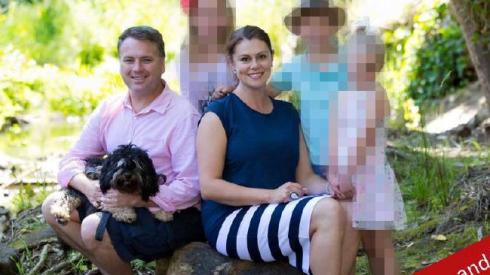
Brigg's Family Xmas card

Brigg’s Family Xmas card

Jamie Briggs resigned this week from his ministerial portfolio in the Turnbull government because of “inappropriate” behaviour towards a female public servant late one night in a Hong Kong bar, when he found himself apparently disinhibited by alcohol and the lateness of the hour.

Briggs was rapidly supported on Twitter by at least two of his colleagues, Finance Minister Mathias Cormann and Queensland MP Ewen Jones, both of whom describe Briggs as a good, decent man and a better bloke having a bad day. The Australian journalist Chris Kenny also came to Brigg’s defence on Twitter in a desperate attempt to frame the incident as being all about alcohol and staying up late in bars, with no reference to the alleged sexual harassment.

The public servant, it should be noted, did not complain that Briggs was drunk or up late, but that he had sexually harassed her, according to one report telling her she had such “piercing eyes,” before falling upon her neck. Mrs Estee Briggs, (who, like her husband, also worked for John Howard) is standing by her man, and has declared Prime Minister Turnbull’s sacking of her husband from the ministry an “exaggerated over-reaction” unwarranted by the triviality of the incident.

Some of us women set the bar low for ourselves, but perhaps we shouldn’t expect that the rest of the community will hold similar standards. I don’t know how many times I’ve heard women defend partners who act “inappropriately” towards them and other women, and what astonishes me every time is their expectation, indeed demand, that the rest of us hold the same minimal expectations.  Stand by your man by all means, but don’t tell others we’re “over-reacting” when we refuse to embrace your low standards.

It’s interesting that if a woman is drunk, and sexually harassed or assaulted, society’s default position is still that she shouldn’t have been drinking. On the other hand, the Briggs incident reaffirms for us that there are people in positions of considerable influence and power who still believe that if a man sexually harasses woman when he’s drunk it isn’t his fault: he’s really a decent bloke who’s had a hard day, and he can blame it on the drink. The woman, on the other hand, is a moll and a slut for getting out there and getting pissed and assaulted, and nobody even asks if she’s had a hard day.

I mean, really. When are we going to get past this? Ever?

I don’t know what Briggs’ defenders mean by “decent.” For mine, if you’re married and cheating on your spouse, you aren’t “decent.” You’re duplicitous, deceitful and probably more concerned with your own needs than those of your wife, family and lover. Infidelity demands a strong sense of entitlement, bordering on narcissism. It’s all about what the cheater thinks he/she needs, not the people he/she will damage. I mean, if you aren’t getting what you need in your partnership, have the courage to do something about it that doesn’t require duplicity and betrayal, or accept your lot. Deceiving the people who trust you is no way to address your needs.

As a man bent on betrayal once told me: I know I am behaving abominably to my wife and family, but you are so good for me. 

Says it all, really.

The point of this is that if a man (or woman) can justify the betrayal of those he/she cares most about, why would he/she think twice about betraying anybody else? We may know little else about the cheating spouse, but we do know with absolute certainty that he/she is a liar.

Ministerial standards are high, as they should be if governments are determined to give individual ministers the kind of power over others granted to Immigration Minister Dutton, for example. Why on earth should such power be in the hands of a man who has proved himself a liar, capable of intentionally deceiving his own wife? He’s demonstrated what he is willing to do to achieve his own ends: are we to be so naive as to think he’d only do this to his wife, and not the country?

The incident may not have been “illegal,” as Briggs hastens to assure us, though quite what he means by that I don’t know. It certainly highlights yet again that women are still seen by some societal groups as irrelevant in comparison to the needs and ambitions of men. Briggs was daft for getting drunk and staying up late, but hey, he’s human and works hard. Let’s not mention the predatory sexual behaviour: it was only a woman.

I don’t know the extent of Briggs’ harassment of the woman involved, what I do know is that until men like Briggs stop believing they are entitled to our attention and our bodies we have to call them on every incident, no matter how “trivial” it might seem to someone else. We are not comfort women for when such men are having a difficult time. We aren’t cuddly things for such men to grab and grope. Such men as Briggs are not inherently entitled to our bodies, our emotions, our attention and our time.

The “trivial” nature or otherwise of the sexual harassment is irrelevant here: what matters is the belief men such as Briggs hold that they are entitled to us whenever they feel the need of us. Nothing will substantially change for women until such men are disabused of this sense of entitlement, and until women who support these men demand higher standards from them instead of enabling them. We’re not “over-reacting” in thinking your husband should be fired, Mrs Briggs. It’s bad enough that men such as Jamie Briggs harass and assault us in the first place, we don’t have to lower our standards to yours as well.

Please note: I very rarely delete comments and even more rarely block people. However, I’ve just deleted an abusive comment from a poster called “Simon,” and will continue to delete and block abuse. This is a courtesy notification, so if abuse is on your mind you don’t waste your time.


Books. And empty shoes.

28 Dec

Buccholz. Book


I am culling books… 

When I come upon a collection of essays by J.M. Coetzee titled Stranger Shores, that I haven’t looked at in quite some time and so had forgotten that it was given to me by my late husband, Arnie, on my birthday, March 15 2005. It contains a piece on Rainer Maria Rilke that sent me gratefully back to the poet, in the way that good essays always invite you somewhere beyond themselves.

The sight of Arnie’s handwriting initially startles, then its power to evoke the man takes over and I’m again lost in that peculiar presence of absence I’ve become familiar with since his death eighteen months ago, in which his absence has an energy vivid as any presence, and more vivid than some presences can ever be.

I’m reminded here of a conversation between myself and a woman in which she confided, in distress and anger, that her husband of some decades didn’t know her. I thought I’d seldom heard anything so sad about a partnership, and how lonely it must be to live a life in which one is not known, a life in which interest and curiosity in a partner is supplanted by assumptions and projections, and the familiarity that breeds contempt.

Not that it’s possible to conclusively know anyone: it’s the desire to engage in the project of discovery that speaks to me of enduring love. I’ve written more about the difference between familiarity and knowing here.

On the first page of Stranger Shores, Arnie has written of his love and affection in Hebrew. At least I’m assuming it’s love and affection as I know little of that language, and there’s what I’m taking to be a translation below the Hebrew that speaks in English of “my beloved wife.”

On the other hand, knowing him, the Hebrew could say anything.

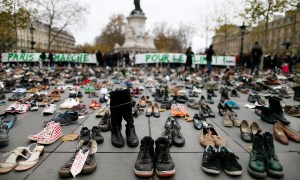
The next thing I think of as I gaze at his spidery handwriting, held in place in my chair by the strength of the presence of his absence, is the haunting image of the empty shoes in Paris.

Empty shoes in Paris. 2015

The empty shoes represent an event that could not be held because of fear of terrorist attacks. They represent the dead and injured victims of those attacks. They symbolise the death of species, and the dying of our planet. They represent loss, and absence of all kinds. They symbolise the grounding of humans on this earth, a major point of contact with the planet, and they are empty.

And they remind me of how the sight of my husband’s empty shoes brought me to my knees, when I finally understood that I would never again see him in them.

I don’t know why shoes apparently carry so much more poignancy than say shirts, or jackets, or trousers. Yet, I remember also when my sons were small and at school how I would pick up their scattered clothing and smell it, to evoke their presence in their absence, a kind of preparation for the time when they would leave for their own lives and loves, and that intense period of mothering, about which I was frequently ambivalent, would be over.

There are other books “For my beloved wife.” One Writer’s Beginnings by Eudora Welty. Camille Paglia’s Sexual Personae: Art and Decadence from Nefertiti to Emily Dickinson. Which book I remember him lugging to the hospital on Christmas Day where I lay recovering from drastic cancer surgery, too weakened to even hold the heavy tome, so he showed it to me instead, and read bits that fed my morphine-induced hallucinations and after he left I saw Jesus by the window in shining light, telling me everything would be fine, no worries.

I’m beginning to understand that the people I love never leave me, if I can only learn to allow them to stay. There’s a psychological theory that when we know we can’t be with someone anymore, for whatever reason, we cut off from them and deny their significance, as a way of managing in the long-term the complicated and initially crushing pain of loss.

It’s a sweet sorrow to be sure, to feel the presence of absence, whether that’s the absence of the dead, or the equally irretrievable loss of the little boy who is now a man, and quite rightly does not have need of you in the same ways any longer. They live, those vanished ones, in the memory and the imagination, they live in the body and the heart and the mind. They live in me, though I can’t touch them anymore, and their shoes stand so very empty.

The work of the eyes is done. Go now and do the heart-work on the images imprisoned within you. Rainer Maria Rilke

Courage and politics.

27 Dec

Quint Buccholz Five


“Life shrinks or expands in proportion to one’s courage.”
― Anaïs Nin

If there’s one thing I’d like to have the power to give to the people I love, especially the little ones, it’s courage.

The courage to challenge cultural conditioning and social convention. The courage to allow oneself to see that “normality” is a construct and to ask, by whom is this concept constructed, for whose benefit, and how?

The courage to refuse the lazy tribal sense of belonging in order to embrace a more challenging sense of common humanity that does not require exclusionary practices in order to define a sense of who we are. I am not that therefore I am this, is a negative way in which to carve out an identity, yet the spoken or unspoken comparison that loads difference with moral value, or lack of it, serves as a benchmark for establishing who we are, singly and collectively.

I can’t see much of a future for humans without the kind of courage that is curious about difference, rather than fearful and hostile towards it. The former is expansion, the latter an arid shrinking, of the kind we’ve seen increasingly in Australia since our politics, both Labor and Liberal, have become more and more conservative.

Our courage, at least as it is expressed in our politics, has diminished alarmingly. Whether it’s asylum seekers in indefinite and tortuous detention because we will not resettle them; whether it’s our inability to recognise and adequately act upon our responsibilities towards the earth that is our only home; whether it’s increasing surveillance of ordinary citizens along with the deprivation of freedoms and human rights, the insidious creep of tyranny, wearing the mask of concern and wish to protect, is shrinking our lives, and we seem to lack the collective courage necessary first to acknowledge what’s happening to us, and second, to do something concrete about it.

I’m not the first to observe that without courage it’s hardly possible to be truthful, generous, realistic and imaginative, and without courage, it’s impossible to live a life of necessary self-examination, curiosity and fulfilment.

Lack of courage is what will destroy our species. It’s only a matter of time.