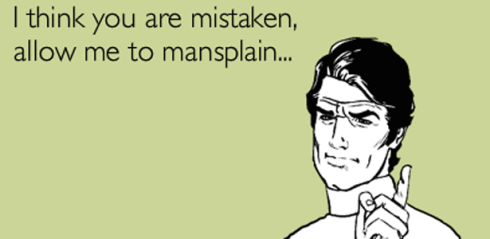
It’s very early in the new year to be handing out awards for anything, however this piece by psychiatrist and White Ribbon ambassador Tanveer Ahmed on domestic violence earns the author the 2015 No Place for Sheep Order of Arrogant Ignorance for mansplaining violent domestic crimes against women and children perpetrated on them by the men in their lives.
Mansplaining, if you aren’t sure what it is, is defined in this timely piece in The Conversation by Monash academic Howard Manns.
I know. I know.
“Mansplain” has been declared the word of the year by the Macquarie Dictionary:
verb (t) Colloquial (humorous) (of a man) to explain (something) to a woman, in a way that is patronising because it assumes that a woman will be ignorant of the subject matter. MAN + (EX)PLAIN with s inserted to create a pronunciation link with explain.
Admittedly, Dr Ahmed was explaining his theories on domestic violence to everyone who reads the Australian and that’s not just women, nevertheless, in this writer’s opinion, he is still deserving of the Order.
Owing to the Murdoch press paywall which is sometimes by-passable and sometimes not, I’ve copied Dr Ahmed’s piece and you can read it at the end of this post.
Basically, Ahmed is claiming that “male disempowerment” caused by 1970’s radical feminism has led to a power inequality between the genders. One way some men address this imbalance is by beating the women and children in their lives, sometimes to death, or murdering them by other means.
In reaction to this male violence against them, women have formed a “cult of victimhood” that has so skewed society’s perceptions of male behaviour that beating women and children in acts of intimate violence and sometimes murdering them has led to a “psycho-prejudice…in which what men and boys do is seen as socially disruptive.”
If men and boys beat and murder anyone outside their families it is certainly seen as “socially disruptive.” Think king hits.
But that’s not all: “The growing social and economic disempowerment of men is increasingly the driver of family-based violence…[working class male work] has become “feminised.”
In other words, domestic violence occurs entirely in the working classes, “newly arrived ethnic groups,” and fatherless sons of single mothers are apparently particularly prone, says Ahmed.
This is drivel deserving of a hundred Orders of Arrogant Ignorance. It is well-estabished that domestic violence occurs in every demographic, and I can personally attest to that, the perpetrator in my family of origin being, like Ahmed, a doctor, and not at all economically disempowered, or disempowered in any other way either.
While it is true that there are male victims of domestic violence and they shouldn’t be neglected, drivel such as this is of no help to them or anybody else.
It’s also true that a particular view of gender relations can at times be less than helpful. However, domestic violence and murder are crimes, and those who perpetrate the crimes are criminals. Gender relations do not a beater and a murderer make, and men like Ahmed need to grasp that.
With mansplainers like White Ribbon Ambassador Ahmed as our “friend,” who needs enemies?
Men forgotten in violence debate
TANVEER AHMED
THE AUSTRALIAN FEBRUARY 09, 2015 12:00am
THERE is too little acknowledgment of the importance of male disempowerment in debates surrounding domestic violence. Gender relations have changed dramatically in the past few decades, but discussions about family violence are stuck in the mindset of 1970s radical feminism.
This emphasises power inequality in gender interactions and on perceived societal messages that sanction a male’s use of violence and aggression. The focus is on male villainy, denial of biologically based sex differences and a cult of victimhood. This is part of a broader movement that defines normal maleness as a risible kind of fatuous and reactionary behaviour. As US anthropologist and masculinity expert Lionel Tiger, who coined the term “male bonding”, says: “We have a psycho-prejudice, in which the norm is the female norm and what boys (and men) do is seen as socially disruptive.”
The Prime Minister’s move to acknowledge the Australian of the Year award to Rosie Batty and community outpouring on domestic violence through a COAG committee is worthy, but it risks becoming dominated by radical feminists and a worldview around the powerlessness of women.
Just as women are now more likely than ever to enter university, be breadwinners and have affairs, they are also more likely to commit family violence against partners, children or relatives. But the anti-feminists who focus on female perpetrators of family violence, such as Michael Woods from male advocacy group Men’s Health Australia, forget the growing social and economic disempowerment of men is increasingly the driver of family based violence. Woods is a strong critic of what he says is a domestic violence industry and diluted measures of what constitutes violence.
The focus on female disempowerment alone will not achieve an improved existence, since they are often surrounded by disempowered men. Men for whom the security of unionised labour in the manufacturing industries is becoming a distant memory are experiencing a huge displacement from modern economic trends. It’s been replaced by casualised, service-oriented work with relatively low wages. In essence, their work has been feminised.
British social researcher Paul Thomas questioned British youths of different backgrounds for a study in 2010. He found white, working-class men feel they are the real outsiders and disenfranchised from opportunity.
Likewise, family violence within newly arrived ethnic groups is often related to the sudden dilution of traditional masculinity, leaving men lost and isolated, particularly as females enjoy greater autonomy and expectations. This is primarily positive, but a greater acknowledgment of the huge displacement such men endure from the cleavage of the institutions of family, clan and tradition in less than a generation may help alleviate their sense of humiliation.
Despite the cries of domestic violence being an epidemic, we should also consider that fatherlessness could fit such a category, with 40 per cent of Australian teenagers living without their biological fathers. It was Margaret Mead who said fatherhood was essentially a social invention. But as the Left increasingly dilutes the notion of biological differences in sex, amusingly illustrated by Greens senator Larissa Waters imploring parents not to buy gender-specific toys for Christmas, we are downplaying the notion that fathers are even desirable.
Statistics don’t lie. It is true one woman a week dies at the hands of a partner, current or former. As part of a broadbased strategy, it is critical that improving arrest and prosecution rates, establishing shelters and abuse hotlines, pushing for state provisions against stalking, and creating protections for immigrants all have the goal of getting victims out of abusive relationships.
But the broader movement that has long fought against violence towards women remains stuck in a view of gender relations from decades past, which will limit its effectiveness in stemming the problem in an inclusive way.
Tanveer Ahmed is a psychiatrist and White Ribbon Day ambassador.
Tags: domestic violence, Feminism, Rosie Batty, Tanveer Ahmed, White Ribbon










 No Place For Sheep
Recent Comments