Jane and Jennifer go to Woomera with the dog – part two

15 Mar

The Dog


(Part One can be found in Pages)

We went to the Woomera Detention Centre ten years ago.

ABC Radio National’s Background Briefing, Sunday March 13th, reveals that little has changed over a decade, despite another government. Societal attitudes have hardened, as exemplified by the horrific 2GB competition Guess how many asylum seekers are being buried today?

The next day, Jane and Jennifer present themselves at the detention centre gates, as instructed at nine o’clock, and are admitted after the anticipated hassle about the right papers and the proper permissions. Two nice if misguided middle class ladies, in the eyes of the guards.

On the strength of their niceness, and their endearing oddness in carting a large dog to Woomera with them, some errors in their paperwork are overlooked. Fletcher is allowed to lie on a mat in the air-conditioned outer office while Jane and Jennifer go through the formal searches, leave their backpacks in lockers, and are escorted through the final portals into the depths of the prison.

Jennifer thinks that somehow this journey wouldn’t have been possible without the dog. This is rationally inexplicable. She looks back at Fletcher. He’s watching them go, on full alert, ears up, head raised, sniffing the air. Then they pass through security and are gone, out of his sight to the other side.

From where they sit in the Visitor’s Centre, silenced by their miserable surroundings, she can see through the open door another compound fenced in with barbed wire. Inside this compound are several dongas in which the detainees live.

The windows of the Visitor’s Centre are barred with steel; plastic chairs and tables are spread haphazardly round; there is no air-conditioning. Ceiling fans barely stir the air. There’s little if any insulation in the tin roof; they sit in an oven.

The women haven’t spoken to each other since the guards left them. Jennifer’s busy trying to assimilate everything: her notebook has been taken off her and she can’t write anything down. She’s also unnerved, not because she fears anything untoward happening to them, but because the ambience here is tense and edgy; the physical outlook is unrelentingly grim.

Jennifer’s known much in her life, but not institutional violence, state approved violence, publicly sanctioned violence against other human beings. She knows enough about the nature of fear to recognise its presence outside the familial setting. Now she’s now struggling to grasp that the darkness she’d imagined was confined to the family, abroad in the wider world is different, yet the same.

Institutions, in her case the school, were places of safety, places of protection from the private practices of adults who were not to be trusted for a minute. Those adults were the ones you knew best, in your own home, not strangers behind a razor wire fence. She was prepared for the conditions here in the abstract: the reality is something else altogether. There are ways in which Jennifer has lived a charmed and sheltered life.
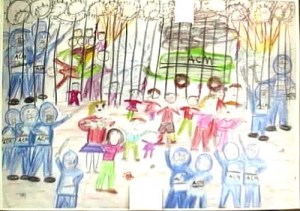
Woomera child's drawing. by Karen Elliot via flickr

There is no grass for the children to play on, or for the babies to practice their walking. She watches three small children scuffing aimlessly about in the red dust at the steps of their donga; a Muslim girl of about twelve in her headscarf, lifted from her shoulders by the hot wind; a boy of about eight in shorts and bare feet. The sand is hot. Doesn’t it burn him?

Between them they help the smallest child, who is still tottering on his uncertain baby legs. A woman in a black burqa sits on the top step of the donga with her head in her hands. Outside the administration block, they noticed when they arrived, there’s a garden of emerald green grass, young trees, and beds of brilliant flowers. The garden isn’t visible from these dongas. Later they’re told it’s tended by some of the inmates.

As she watches, a man emerges from another donga in the compound. He runs down the steps and across the red dust, screaming in a language that is unintelligible to her, but his despair needs no translation. He flings himself repeatedly at the wire that keeps him contained, like an animal in a zoo maddened by its confinement. He shakes the wire back and forth while the children watch in frightened silence. The eldest girl puts her arms round the younger ones. The man’s screams rouse the woman in the burqa: she raises her head and briefly stares at him, then returns to her own private despair.

‘Oh, Christ,’ says one of the guards standing outside the door of the Visitor’s Centre,

Razor Wire 101. by Amy Leonard via flickr

‘what’s wrong with bloody Mustafa now?’

Jennifer is sitting very still. She’s been holding her breath, and now she’s feeling dizzy and sick. Her body is warning her that this is not a sight she should witness, but she’s here now, there’s nothing she can do.

Mustafa isn’t trying to attack anyone other than himself: it’s the sight of an adult man completely out of control of himself, a woman watching from a distance and returning to her self-absorbed despair; three children silently witnessing this scene. Are these scenes here in the detention centre, these scenes and many more like them and worse, are they making intolerable memories for these children? Will these children, in their middle age, sweat when they recall these events?

It’s getting hotter as the day moves on towards noon. The dongas shimmer like mirages. She’s been afraid ever since they crossed the threshold into the prison, ever since they drove down the bitumen road from the caravan park in the Woomera township towards prison surrounded by gibber desert and saltbush. She’s been afraid of the detention officers, and the blue water cannon positioned at the gate and the high, intimidating security lights that promise to illuminate everything without mercy, no crevice left untouched, no places left to hide.

She’s way out of her comfort zone, and anyway, fear is her Achilles heel.

Everybody’s got their personal weakness: greed, grief, free-floating anxiety, lust, anger, despair. Hers is fear. It can bring her undone in a nanosecond. This is a new kind of fear, she’s only dreamed this kind of fear, in nightmares when she’s been pursued by soldiers, unable to find a hiding place in a napalmed landscape. All their journey so far, through the drought and the death stench and the tormented landscapes, past the sun-bleached bones of animals dead from starvation, picked clean by buzzards and eagles, all this has finally brought them to this place.

The journey has been a fitting preparation.

The women saw the interrogatory lights cutting through the dark sky when they made a furtive reconnoitre the night before. Having arrived too late in the day to visit the centre, they set up camp, tied up the dog in the back of the truck and crawled without headlights as close to the prison parameters as they dared.

‘Shit,’ Jane whispered.

‘What?’

‘It’s just like bloody South Africa. I can’t believe it. What country am I in?’

‘God’s own,’ Jennifer told her.

They saw headlights approaching.

‘Get going!’

‘Shut up!’

Jane threw the truck into reverse.

In retrospect they’re hard-pressed to explain their panic. Jane was worried that if they were caught hanging round, their visits the next day would be jeopardised and this was a realistic apprehension. Oppression works swiftly. The guards were completely in control. If the women offended them, they’d find some way of refusing them entry. Driving round the perimeters of the detention centre at night could be construed by the guards as suspicious.

This is how the people inside have to think every day. If I do this I won’t be allowed to do that. About the smallest, most insignificant things.

‘We aren’t doing anything wrong,’ Jennifer whispered. ‘We’re on a public road.’

‘We’re hanging round. We’re looking. That’s wrong enough for these people.’

‘Christ,’ Jennifer said disgustedly, ‘we’re still in Australia.’

‘And this is what Australia is these days,’ Jane said and they fell silent, contemplating the state of their country. God’s own be buggered.

‘Why are we whispering?’ Jennifer asked finally.

‘Dunno. We’re out of our depth aren’t we? Two white ladies from out of state. We’re out of our depth, the landscape, the Detention Centre, Woomera, which I think is a very strange town, by the way. Did you notice those parks full of planes and bombs and rockets? And how green the grass is, where do they get the bloody water from? And those empty, smashed-up apartment blocks with the doors hanging off their hinges and banging in the wind and all their windows broken? Like a post nuclear movie.’

Jane drove them back to the park. A high wind had sprung up, rocking their caravan. It was cold. Large spots of rain fell on them as they moved from the truck to the van. The park was almost empty. No one came here anymore the manager told them, owing to that fucking Detention Centre. Everyone’s afraid there’ll be a break out and they’ll get caught up in it.

‘Used to be a busy, thriving park,’ he said. ‘Now fucking look at it.’

They didn’t tell him the reason for their visit. Just passing through, they said, on their way to somewhere else. They had no wish to get into a fight with him about the detainees. They were closing down, husbanding their resources.

There was only one other van parked for the night. The park was asphalt with squares cut out of it in which frail saplings tried to grub a life for themselves out of the red dirt. They could see the lights of the Detention Centre. They made tea and climbed into their beds. Fletcher settled down on the floor in between them.

Human Rights. by Hugo via flickr


Though the guards complain to each other about Mustafa’s on-going expressions of despair, nobody goes to help him, or even to tell him to shut up, or whatever they do with people in there in extremis. Which seems to be very little. Mustafa’s frantic screaming subsides into sobs. He wraps his arms round himself and rocks back and forth in that movement typical of human beings, adults and children, who have given up on any hope of comfort other than what they can provide for themselves. Then he leaps up again and grabs at the wire.

Earlier the guards had spoken to the women about their feelings towards the detainees.

‘They’ve got everything,’ two guards, a man and a woman, told them as they deposited their bags in the lockers and waited to be searched.

‘They’ve got TVs, clothes, videos, everything.’

‘We have not got our freedom!’ shouted an inmate, overhearing the guards’ account of things as he swept and mopped the office floors.

‘That’s relative, mate!’ the male guard shouted back. ‘Freedom’s relative. I’m not free either, you know. I’ve got to show up for work here every day, can’t sit around on my arse watching TV like you. Can’t even afford a bloody TV like they’ve got,’ he told the women. ‘Working my butt off and I can’t afford what they’ve got for nothing. Then they trash it! Bloody trash TVs, DVDs, computers! You wouldn’t believe it.’

He shook his head and swore softly under his breath.

Jennifer reflects on this exchange as they sit in the Visitors’ Centre waiting for the asylum seekers they’ve arranged to meet with. The irony of the situation doesn’t escape her. The guards, poorly paid and in one of the worst work places in the country, measure their success in life by the things they can buy with their wages. This is a widespread marker of success in Western culture, the guards are no different from most other people in their material ambitions.

All the things they see the detainees getting ‘for nothing’ and then ‘trashing’ when there’s a riot, are things they’re busting their guts in this god-awful place to earn the means to obtain. The guard doesn’t feel free, because of this, and he’s in no frame of mind to start measuring his degree of freedom against that of the detainees. He’s not about to argue degrees of freedom and personal choice. He feels powerless, except in his right to exercise power over the detainees.

It’s easy enough to say the guards don’t have to be there. And they don’t, nobody’s forcing them. But as violent as they reputedly are, as racist and resentful as they clearly are, to tell them that they don’t have to do this doesn’t seem to be the answer. They think they do.

The noon temperature is forty-two degrees Celsius. There’s a hot wind roaring
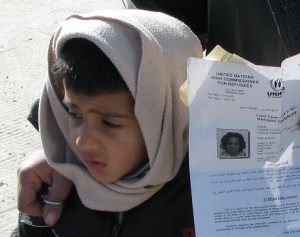
Iraqi refugee child. by Catholic Relief Services via flickr

across the plain. Mustafa has stopped crying and sits quietly in the dust, his head resting against the wire. The children walk towards him. The girl’s scarf whips round her head in the wind. She holds the baby’s hand.

They all stare at the visitors. Jane and Jennifer smile. Nobody smiles back. They aren’t allowed to approach the children or talk to them. Jennifer knows she will remember this scene for the rest of her life, the three solemn children, the damaged, broken man, the woman silent on the step, her head buried in her hands.

It’s as if they’ve reproduced, in the middle of their democratic country, conditions that bear an eerie similarity to those that caused the people to flee their homelands in the first place.

‘If they’ll bother to get up,’ the guard is saying to Jane.

‘What?’ Jennifer asks.

‘It’s Ramadan. Your detainees might be late. They pray all night and sleep all day. Weird, eh?’

The guard is wired for every kind of sound. He’s got technical aids every which way. He looks at Jennifer as if he wants her to form an alliance with him against this ‘weirdness’ he has to endure on a daily basis. She thinks she might have pretended to something of the kind before she actually got into the place. Getting in was tricky, touch and go, they knew they had to play things very straight. But once in, the guards could go to buggery. Like the bloody country.

‘So why are they lazy, lying in bed all day if they’ve been praying all night?’ she asks, hostile. ‘It’s an important thing, Ramadan, like Christians have important things. Isn’t it? Anyway, it’s not as if they’ve anything to get up for, you don’t let them do anything.’

The guard looks truculent.

‘I guess this is a pretty awful job,’ Jane intervenes, deciding on diplomacy.

He softens.

‘Mate, it’s the bloody pits. Nobody knows. Nobody hears our side of the story. We’re just the bastards. You know,’ he went on, settling in for a rare opportunity to whinge to a member of the public, ‘I daren’t tell anyone I work here. You imagine that? Having to lie about where you work?’

‘Why’s that?’

‘Because the place’s got such a bad name nobody else’ll employ me after I’ve been working here.’

He leans back in his chair. They can see the tension bristling through his body. His face is congested, his beer gut large, his uniform too tight.  He’s on the edge, as are many other guards they meet on their way through the system.

‘I don’t even tell me mates what I do. I tell ‘em I work in Woomera for the Government and it’s secret, what I do. Never mention the Detention Centre. No way.’

Jane reflects on the difficulties and stresses such daily deceits must bring to a life.

‘That’s bad,’ she tells him. ‘That’s a hard thing to do.’

‘My oath. Then you get these bastards in here smashing everything up they get given. Bloody mad. Don’t make sense.’

His radio squawks. He listens and then speaks into it rapidly.

‘Well there’s three of the ones you asked to visit on their way.’

‘Three? We arranged to meet with twelve.’

‘Th’other nine aren’t allowed visitors. They’ve being playin’ up, lost their privileges.’

‘What? All nine of them?’ Jane protests.

‘Well, except Parvin, she’s too sick.’

‘She was fine a couple of days ago.’

‘Yeah, well now she’s too sick. So do you want to see these blokes or not?’

‘Yes, yes of course we do.’

He speaks into his radio.

The three young men follow the guards into the Visitors’ Centre. They introduce themselves, awkwardly. The women have corresponded with the young men, so they know something of each other’s lives, but in the face-to-face encounter they are all shy, hesitant.

Nasrim, Ali and Mohammed sit across the table from Jane and Jennifer and they look at one another in silence. The young men all have olive-skin, with bloodshot mahogany eyes under full brows, and black hair cut short as if there is only one style permitted inside the prison. Ali, who looks to be the youngest, has a round face with soft features. His expression is open though baffled, permanently so, Jane thinks. His eyes are huge, like dark, full moons and they glisten. He is plump, the soft plumpness of a young man who hasn’t yet grown into his adult body.

Nasrim has an athletic build, lean and supple. His cheekbones are well-defined, his eyes shift rapidly, checking out the women, his surroundings, his friends, noting where the guards have settled. He drums his fingertips on the table, waiting for someone to speak.

The third man, Mohammed, wears an untidy beard, beginning to show premature flecks of grey and when he smiles his lips are rosy and his teeth white, framed by the dark hair. He is heavy and muscular. He drops heavily into an orange plastic chair and drops his hands on his thighs.

‘Welcome,’ he says to the women. ‘Welcome to our palace in the desert!’

Nasrim has a packet of biscuits in his hand and Ali and Mohammed carry water, orange cordial and paper cups.

‘There is a good guard, a kind man,’ Nasrim says, ‘he gives us these things for us to give to our visitors. He understands that at home, in our country, it is very wrong to greet the visitor with an empty hand and so he lets us have these things for you.’

Mohammed breaks open the biscuits. Jane and Jennifer take one. It crumbles in Jennifer’s dry mouth and she thinks she’s going to choke. Conversation is difficult.

‘You all speak good English,’ she offers, ‘ did you learn that here?’

‘We have been in detention for ten months in Port Hedland, nineteen months in the Woomera,’ Mohammed tells us. ‘We are Hazara from Afghanistan but the Immigration, they say we are from Pakistan and are not refugees. This is not the truth.’

‘How old are you?’ Jane asks.

‘I am twenty-four, he is twenty-two and he is nineteen,’ Nasrim points to Mohammed and Ali as he speaks. ‘We learn the English here but we learned some in our country. We have left our country because the Taliban they kill Hazara, they have fatwah on Hazara. My father, my mother they are killed in our village, the Taliban destroy our village, I see my family, my sisters they are killed.’

Nasrim’s eyes fill with tears and he looks away, out of the door and into the compound where the three children still stand at the fence, staring. He yells at them in their shared language. The children stay where they are and stare at him.

‘I told them: “Go to your mother!”’ he translates. ‘These little children, they see a crazy man, made crazy here, they watch him cut himself with razor all over, blood splash out on children.’

‘The little ones saw this? They were splashed with his blood?’

‘Yes, yes, they see everything. Children here see everything, very bad thing I think.’

‘Is that their mother, sitting on the steps?’ Jane asks him.

‘Yes, that is their mother. She is sick, very sick, they give her no medicine, she does not look after them because she is sick.’

‘Where is their father?’

‘He is gone. He is given temporary visa, he is gone.’

‘His wife and children left behind here?’ Jane asks, incredulous.

‘Missus,’ says Mohammed, ‘this is happening very often here. Many families. Maybe thirty, fifty, in this place. The father, brothers, on temporary visas, the women children kept in the Woomera.’

‘The women gets sick,’ Nasrim tells them,’ without the husbands, the men the womens get sick and nobody cares for the children. This is bad place,’ he continues and looks at the ground. ‘Very bad place, much bad things happen.’

‘You mean the Immigration gives the men the visas and keeps the rest of the family in detention?’ Jane now remembers now that someone has told her this happens.

‘Yes, that is so.’

‘Why do they think you’re from Pakistan?’

‘One day, we have interviews with officer from DIMIA, she say our language is from Pakistan, she say she is expert at knowing this,’ Nasrim says. He throws his hands up in disgust. ‘She knows nothing of our language!’

The young men wear an assortment of trainers, T-shirts, shorts and track pants. Nasrim is edgy, he fidgets, picks at his fingers, runs his hands through his short hair. Ali in contrast is still: he sits calmly, gazing out the door. Mohammed rests his elbows on the table and puts his head in his hands. These young men are close in age to Jennifer’s sons. She imagines Harry and Samuel living this life. It is an intolerable imagining. She looks out of the door into the compound. A wedge-tailed eagle rises from the roof of a donga and moves upwards in slow circles out of her line of sight.

‘Ali makes the garden,’ says Mohammed.

‘The garden at the administration building?’ Jane asks.

‘Yes, I like it, I like it to do the garden, ‘I keep garden clean, plant things, empty rubbish, I have life here, job, it is not so bad.’ He has a slow, wide smile. He eats another biscuit.

‘Idiot!’ scoffs Nasrim. ‘You should dream of leaving here.’

Ali smiles again. He seems institutionalised, Jane thinks, he doesn’t have the fierce dreams of leaving detention that clearly fuel Nasrim. And what of the events they suffered before fetching up in detention centres, she wonders. What is the aftermath of those traumas?

They all met, it turns out, on the boat from Indonesia sailed by people smugglers, a journey that landed them at Ashmore Reef. None of them has any other family in Australia. All of them have come to the end of their appeals for visas to stay. What will happen to them now? Jane asks. Ali shrugs and doesn’t answer.

‘The Australian Government they give us money to go back to Afghanistan, everybody says so,’ Nasrim tells us. ‘I will go, I think.’

‘But what will happen to you? Will you be safe? Have you any family left there?’

‘I have uncle. Our village is destroyed. The Taliban is not so big anymore. Maybe I work for the Americans. It cannot be worse than this.’

He waves his hand at their surroundings.

‘I would rather die man than animal. If I die let it be for being Hazara in Taliban fatwah, not here in black hole of hell in Australia like pig.’

He stands abruptly, then paces the small room with his hands in his pockets. Ali shakes his head at us.

‘Would you go back, Ali?’ Jane asks.

‘I don’t know, Missus. I am afraid of soldiers. They try to make me killed. I don’t know if I will go back. Maybe I stay here, grow garden.’

Mohammed has his head in his hands and doesn’t speak. Outside Mustafa has begun screaming again. Nasrim flings himself back into his plastic chair and bites at his fingers.

Jennifer thinks to herself that there was a long and venerable democratic tradition that once existed in the world, a tradition that recognised the right of the stranger to seek sanctuary and to ask for help. There was a corresponding duty to oblige and offer assistance. What has happened to this tradition? Or was it just a dream?

‘Why is Mustafa crying like that?’ Jane asks.

Ali and Nasrim shrug.

‘He’s crazy, his wife, his children they died in his country and he is made crazy.’

Nasrim makes the motions of putting a needle through his lips.

‘Very bad,’ he says, ‘the children, some of them too do this.’

The guards are not in the room but they are by the door in the next room, keeping an eye on things, talking among themselves, laughing, their radios squawking intermittently. Jennifer gets up and goes over to them, leaving Jane talking to the three men.

‘We were invited to visit some of the women here,’ she says. ‘Are we going to able to do that?’

‘There’s nobody else on your list,’ the guard tells her, checking his clipboard.

‘I have the letters here that the women sent, asking us to visit them.’

She takes them out of her shirt pocket and shows him. He gives them a cursory glance and looks away. He’s in his thirties, clean-shaven, medium build with a crew cut. He works out: she can see the muscles under his tight blue shirt. He’s a rock. Nothing she says will persuade him to let them see anybody else.

‘Well, I don’t know, they’re not on your list, except Parvin and she’s too sick.’

‘Parvin had Federal Court a couple of weeks ago. Did she get a visa?’

‘Can’t tell you that I’m afraid. Confidential.’

‘So we won’t be able to visit with the women?’

‘Nope, they’re not on your list. Anyway a whole bunch of them have lost privileges for playing up.’

‘The women?’

‘Not just the women but some of them are women.’

‘What did they do?’

‘Can’t tell you. Confidential.’

‘What if we come back tomorrow?’

‘You’ve only got this one list, that won’t change tomorrow.’

‘Who made up our list?’

‘We have officers who do that.’

‘Can I see one of them?’

‘They’re not here at the moment.’

‘Thanks.’

Jennifer returns to her plastic chair. Nasrim pushes the biscuit packet across. Vanilla creams.

‘Thanks, Nasrim. What happened here, why have so many of you lost your privileges?’

‘There was fighting, somebody broke computers, people screaming, women throw chair, very bad.’

‘One month ago a big fire light in our detention centre,’ Mohammed suddenly speaks without lifting his head from his hands. ‘I working in kitchen with Ali. Everybody lose privilege. No visitors.’

‘How long do they lose privileges for?’

‘I do not know. Maybe days, maybe longer.’

Nasrim casts furtive looks at the guards in the next room. Jane looks over at Jennifer. Jennifer feels as if great weights are tied to her ankles and wrists, preventing her from movement, a sense of overwhelming oppression and helplessness. Jane’s eyes are glazed behind her glasses, her features dulled with heat, shock, Jennifer doesn’t know.

‘We do not have mothers,’ Mohammed lifts his head from his hands and says this quietly but with feeling.

‘We do not have mothers, his is killed, mine is lost, Ali, nobody knows of Ali’s mother. You have sons, missus?’ he directs his question to Jennifer.

‘Yes, two sons,’ she tells him.

He takes a drink of orange cordial. Cottee’s Cordial?

My dad picks the fruit
that makes the cordial that I like best.

‘They are free, they work, have girls, go out, they are in city?’

‘Yes, they do all those things. Harry works for the United Nations in a refugee camp in Tanzania. He teaches the children how to play football. Samuel is a chef, in Stockholm.’

‘Ah!’ Ali cries. ‘I too am cook! I cook here sometimes, in kitchens.’

‘Do you like cooking?’ Jane asks him.

‘Oh yes, very much. Good job. Plenty to eat!’ he chuckles.

‘In our country,’ Nasrim, glowering, says,’ when visitor come we make feast, much food, goat, chicken, rice, here we have only these biscuits and this drink!’ He sweeps the pile of plastic cups off the table.

‘Even when little food always we share with visitor! This,’ he gestures at the biscuits and the cordial, ‘this is…’

His English leaves him and he flings his hands in the air. He says something in his own tongue. The others look at him. A guard enters, curious about the noise.

‘Not playing up, are we, Nasrim?’ he asks.

Nasrim replies again in his own language.

‘Time’s over, anyway,’ says the guard.

‘Can we have a bit longer,’ Jane asks,’ we promised to take a list of things the men need with us so we can send them.’

‘They’ve got everything they need. But okay.’

They have to ask the guards for pencils and paper as all their things are in their backpacks in the lockers. Jennifer can’t believe those children are still out there in the broiling sun. The little baby is sitting down now in the red dust with the older children. Mustafa has vanished, as has the children’s mother. She can’t see any other adults. How long the days must seem in here.

‘Jennifer,’ Jane says as they drive back along the bitumen road to the caravan park, ‘how is it that they’re denied visas because the immigration people don’t believe they come from Afghanistan, yet they’re offered money to go back there?’

‘I don’t know, I don’t understand that. I don’t understand why they release the men and keep women and kids in there either.’

Jennifer saw some film footage on the news before they left, of an Afghan man who’d returned to his bombed-out village. He was scraping blindly at the earth where his home used to be with a teaspoon. It was one of the saddest images she’d ever seen. Is that what’s awaiting Nasrim, she wonders.

As they leave the three men, Mohammed thrusts a piece of paper into Jane’s hand.

‘Read this,’ he tells her. ‘My friend he is at Baxter now, he write this, is good, good writing. Maybe you put in paper in book for him but you not use his name, he is afraid of people knowing.’

They look at the poem as they sit in the truck in the Detention Centre car park. They’ve retrieved the dog and their personal belongings, thanked the guards, walked out to the truck on trembling legs, exhausted. Jennifer’s now trying to take photos of the centre through the windscreen without drawing the attention of the guards. She wants a picture of the water cannon at the gates. The guards are in their towers with binoculars, and patrol cars pass by every few minutes. Nevertheless, she manages a few badly-focussed images.

What kind of stupid incompetent terrorists would try to infiltrate the country via people smugglers and end up imprisoned here for years, Jennifer wonders, recalling a politician’s claims about the asylum seekers true purposes.

Down the road a bit, they stop and look back at the steel compound topped with razor wire. It has a beauty that comes from its simple proportions, the satisfying alignments of all its angles, the sun glinting off its shadowless surfaces. It is simultaneously incongruous and perfectly placed in the wilderness that surrounds it; a savage stronghold, impossible to ignore. Its designers have succeeded in eclipsing the drama of the arid landscape: the eye is drawn in awful fascination: one cannot look away.

‘Christ,’ says Jane.

It isn’t until a week later, camped by a flowing Victorian river in a field knee-deep with poplar seeds like balls of ripe cotton and a herd of roaming Jersey cows rubbing up against their caravan, that they both break down. It was awful, they agree, to have to leave the men behind in that place (Surrounded by peoples with no love,as the poet wrote) to have to say goodbye and walk away. And those children.

They know bad things happen in that desert place; they’re in its atmosphere. Later they will discover just how bad when the conditions are gradually revealed to the public by people who’ve worked there and decided to spill the beans.There are raped children behind the razor wire, beaten women and crazed men.

A common suffering. A common humanity. The women are full of admiration for the visitors who live close by, who go there every couple of weeks, month after month, offering support and companionship.

Their journey home is long and much of it passes in silence. What has confounded them both is that these things are happening in their own country. They are ashamed, and very angry.

‘Not in my name,’ growls Jane. ‘Not in my bloody name.’

One Silent Night
The wind is blowing to one side
Here it touches my body
I feel like just in heaven
Suddenly I open my eyes and look around
Oh God I am behind the fences
Still filled with unhappiness
I would like to fly just like a bird
But I know I can not
God created this world for everyone
But some people try to destroy it
And some people try to keep it for their own way
Why do they keep on behaving like that
I need a new world to live
I want different skies every day
Can I live with out fear of war and terror
Could my dreams come true one day
In my childhood I thought
I was the luckiest person in the world
Because my life was secure
Now I think I am the unluckiest person in the world
Surrounded by peoples with no love.
By………
Baxter IDF.
Email from Tokyo

13 Mar

News just in from my friend Professor Baden Offord, Chair in Australian Studies, Centre for Pacific and American Studies, Institute of Advanced Global Studies, Graduate School of Arts, Tokyo University.

Baden is presently living in Tokyo with his partner  Christopher  for a 10 month
appointment as Chair (Visiting Professor) in Australian Studies at the
University of  Tokyo.
Baden and Christopher live in the University of Tokyo International Lodge.

Dearest Jennifer,
Here’s the latest… we are a bit overwhelmed at the moment, monitoring the situation.

We live in Meguro, which is south west Tokyo, not far from Shibuya.
We just received news from Japanese friends that the meterological service of Japan is predicting a further earthquake of 7.0 in the next 3 days. This, and the escalating news about the nuclear power plants 250 kms north of Tokyo, is not good. We are now seeing whether we should fly out of Japan and will seek advice from the Embassy.

It is honestly a strange time here as the city in many ways seems so normal. But, you can sense concern beneath the surface and the supermakets are gradually being emptied of food. Lots of empty aisles now.

As a precursor to the quake on the 11th, you might be interested to know that there have been small quakes or tremors for the last couple of weeks. A couple of weeks ago, for instance, during my Japanese lesson there was a strong tremor, the wall moved, the table shook and so on.

Japan has a total of 100,000 tremors each year, of course most are neglible. Every elementary school in Tokyo has a seisometer to register any ground movement. But, apparently, there is no good  science yet to predict when a quake will occur.

On Friday 11th, I was with my friend and colleague Professor Toshiko Ellis when the quake hit, about to have lunch with her in a neighbourhood cafe near the University where we work. We left the restaurant when is started to shake violently and everything was falling. Most of the people went under tables.  It was an old building (just outside the Komaba campus where I work).

The street scene was absolutely surreal. It was like being on a ship that was rolling all over the place. We held on to each other as the poles and buildings swung back and forth, not sure of where we should go for safety. It lasted for several minutes, which is the thing that I will remember for the rest of my life. It seemed ages before the ground stopped moving.

Mobile phones did not work for hours. Finally Toshiko got through to her 12 year old son at a phone booth. He was alone at home – he  was crying and thought she had been injured (Toshiko’s aunty died in the Kobe quake). Only the landlines worked, thankfully.

After the 3 mins or so of the main quake we walked back to Shibuya station (no trains) and then Toshiko went to find her daughter (she got home several hours later) and I walked back to the University lodge (normally 45 mins by public transport from uni) to find Christopher. He didn’t turn up for hours as he was in a different part of the city when the quake hit. He was on the 7th floor of a building in Ginza and clung to a metal stair case while it happened. The  restaurant he was in was damaged quite a bit. They escaped out the stairs.

The streets on the evening of the quake were surreal as  everyone was quiet. Thousands and thousands of people in Shibuya (a huge station) for example, all very sober and quiet, orderly and stoic. Huge lines for public phones. … as I write this email there is an aftershock.

Today it is eerie. There’s a run on food in the shops, we got some of the last milk and bread available in local store. The  infrastructure in Tokyo is very well prepared in most ways for such an event. Most shops have been closed today, but some trains have started to run again.

People are incredibly well mannered, polite and helpful, even in the pressure of something like this. Though, for most people,  including my  friend Toshiko, who is 53, this was the ‘big one’ as she  described it to me. You really felt the awesome power of the shifting earth. I think people are in shock.

There have been aftershocks every hour, and we are prepped to leave our apartment (on 4th floor) if it becomes bad again. Sometimes the aftershocks are quite strong. We have no gas, but at least electricity at present – though there is talk of blackouts
because of two nuclear stations being in emergency shut down. The temps are about 5 degrees.

Otherwise, blue skies outside. These moments show you how  fragile life is.

Funnily enough, I was at the Australian Embassy last week at a dinner to welcome the 5 Australian Leaders part of the Young Political Leaders Exchange Program  to Japan (you may have read they were trapped on board a bullet train  yesterday for several hours). Anyway, I was speaking with Murray McLean, the Australian Ambassador at dinner, and the story he told me was about the fact that he was in Beijing when the Tangshan Earthquake struck.

Estimates are that more than 250,000 people died in that quake.

He said it was the worst experience of his life for him, his wife and small child. Ironic that we had this quake now in Japan as he finishes his term as Ambassador in a couple of months.

Much love, Baden.


Making country: FC Barcelona and Real Madrid

13 Mar

My friend and colleague, Dr Maarten Renes from Universitat de Barcelona, is guest columnist this week with this intriguing piece on the Catalonian struggle for autonomy as it is played out on the football fields of Spain.

Martin and Jennifer, Universitat de Barcelona

Barcelona has turned into an attractive holiday destination for many Australians: its generally good weather, cultural amenities (Gaudí architecture, Picasso and Miró museums, Roman remains etc.), gastronomic wealth and intense beach and night life have forged its reputation as a hospitable town.

Many know that Barcelona is the second-largest city of Spain, but how many realise it is also the capital of Catalonia, a so-called ‘autonomous community’ or quasi-federal region within the larger political framework of the Spanish state?

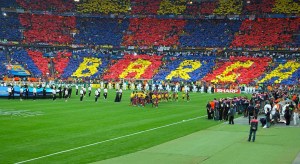
To understand what is at stake in the war of politico-legal definitions surrounding the term, one only has to observe the intensely lived competition between the two major Spanish football teams, Real Madrid and FC Barcelona, which neatly delineates the amount of feeling invested in state and regional nationalism—or ‘central’ and ‘marginal’ nationalism, españolismo and catalanisme, as they like to say here. At present, the score Madrid-Barcelona is five-nil in the political, but the reverse where football is concerned.

Indeed, Barça coach Pep Guardiola is the most popular expression of fer país or ‘making country’, an apt phrase denoting the forging of local identity coined by the conservative regional-nationalist and ex-president of the Catalan government, Jordi Pujol.

Guardiola’s project perfects the seeds sown by former Dutch international Johan Cruyff, who has made Catalonia his home and used to play for and later coach the Barça team which boosted Guardiola himself as an excellent midfield player.

Whereas Real Madrid spends huge amounts of money buying the best players on the market, creating some sort of a mercenary army unit (but no unity), Guardiola draws on the club’s young, upcoming players to build a competitive, synergetic team of ‘local lads’ who have imbued the club’s collective philosophy of playing football from an early age on.

To highlight the regional-nationalist importance of this, a similar strategy has been quite successfully followed by several professional Basque football clubs playing in the Spanish liga or premier league. That this strategy has been very effective in the case of Barça is shown in the team’s results and international recognition.

Barca fans by atomicShed via flickr

Pep Guardiola forges a sense of ‘country’ by appealing to solidarity, hard work and modesty as he likes to proclaim himself, and has come to represent a role model for current Catalan self-perception. As such, Barça articulates a claim for the political significance of the city (and region/country/nation) that hosts it, and is of capital importance in the economic, political, legal and cultural conflict that the town has been engaged in with Madrid ever since the advent of democracy in 1978.

Should it surprise anyone that when Barça’s last president, Joan Laporta, stepped down last year after serving his two statutory mandates, he took charge of a new independence party, Solidaritat, in the last Catalan elections, managed to obtain several seats in the Catalan parliament, and now considers running for mayor in Barcelona?

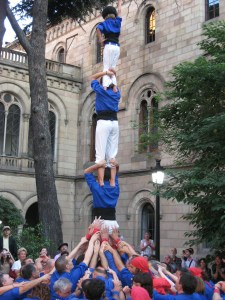
Traditional Castell, Barcelona by Jane Bronotte

The Spanish Constitution of 1978 laid down the rules to play the political game in Spanish state territory, and attempted to accommodate the ‘historical nationalities’ of Galicia, The Basque Country, Navarra and Catalonia in a quasi-federal structure of ‘autonomous communities’ in which all Spanish regions were incorporated as equals—an arrangement now often disparagingly referred to as ‘café para todos’ or ‘coffee for all’, that is, all regions would be ‘served’ the same.

The historical nationalities’ distribution on the map actually reflects the way Christians organised themselves into kingdoms in the north of medieval Spain to fight back the Moorish occupants of the peninsula. Whereas Portugal remained its independency on the Atlantic fringe, all other regions were eventually brought under the control of the Castilian kings, although the other former kingdoms from the north of Spain would retain some rights of old and strong regional identities, despite the fragmentation of their territories under Spanish and French rule in modern times.

The most belligerent and successful of the historical nationalities has been The Basque Country, both because of its fully-recognised historical rights and its still-active terrorist movement ETA, which was actually founded in the Basque-speaking northern fringe of Navarra. Catalonia has played a slightly more accommodating role towards the central government; hampered by a more limited interpretation of its historical rights, it insistently complains about the lack of ‘completion’ of the 1978 Statute of Autonomy. It claims that the legal possibilities for Catalan self-government and self-management have still not been exhausted and need further filling out to reach a full-fledged federal make-up, comparable to the German Länder or the Australian states for that matter.

Voices for complete independence from Spain are also increasingly heard and represented in the Catalan Parliament.

The struggle for self-government ties in with wider objectives of economic reactivation and cultural survival. On the one hand it is often felt that there is a serious financial and economic drain-off towards Madrid, held in place by state control and plunging Catalonia back into ‘underdevelopment’. No doubt Catalonia, once a rich area of strong industrial development whose republican aspirations were thwarted by the fascist outcome of the Spanish Civil War (1936-1939), pays comparatively more taxes than most other autonomous regions and receives less money back from the central government.

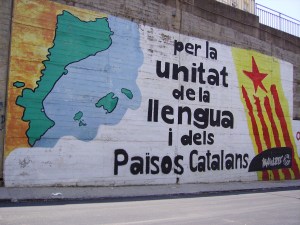
Mural: Catalonian Independence Movement via Wikimedia

Many Catalans feel this has been going on too long and has led to an unjustifiable disequilibrium with the rest of Spain—and especially Madrid, which has enjoyed spectacular economic growth hand in hand with the (post)Franco accumulation of political power.

On the other hand, cultural survival focuses on the Catalan language, theoretically spoken by six to seven million people but under constant threat by the legal and demographic pressure of Spanish, co-official and spoken by 46 million people in the peninsula alone and 500 millions worldwide. In Barcelona capital, with four million inhabitants if one includes its area of metropolitan influence, the languages often mix, and most immigrants, formerly from the south and west of Spain but nowadays often South-American, prefer to learn and/or speak Spanish over Catalan for reasons of convenience.

Although the vehicle language in official contexts, Catalan remains a minority language which also suffers from the onslaught of artificial fragmentation by its renaming in adjoining territories where local varieties are spoken. Thus, in Valencia people speak Spanish and ‘Valencian’, which is clearly distinguishable as a dialectal variant of Catalan but officially defined by its neo-con government as a different language.

The Balearic Islands (Mallorca, Menorca etc.) are proud of their ‘Balearic’, a similar case in question. Neither should one forget the two varieties spoken in the Pyrenean valleys of Andorra and Aran, which also boast their linguistic ‘difference’. Last but not least, the presence of Catalan in the old Catalunya Nord, the area around Perpignan in the South of France, is more and more anecdotic and ‘folkloric’ everyday.

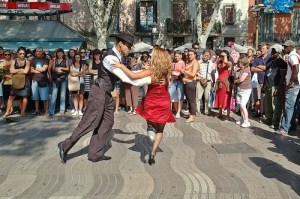
Tango Dancers in Las Ramblas Barcelona. by Carlos Lorenzo via flickr

Unlike Canberra, which in theory is a physical and political space beyond local strife, Barcelona is capital territory in many other senses. It is (a) capital to visit as one of the major tourist towns in Europe—or at least of the Mediterranean—because of its attractive combination of good weather, a accessible beaches, attractive architecture, historical and cultural amenities going back 2,000 years, and round-the-clock bar, club and restaurant scene.

It is also the capital of the historical nationality of Catalonia, and offers a myriad of possibilities to get to know this culture forged as of the Middle Ages, both in town as well as outside—whether you go to other major cities such as Tarragona, Lleida or Girona; to the mountain resorts of Montserrat, Montseny or the Pyrenees; or the beach resorts of the Costa Daurada or the Costa Brava.

It is, next, a capital postcolonial space in which the ongoing politico-economic conflict between the centre and the margins is played out and marketed as antagonising nationalisms, and whose outcome remains unwritten, even more so in times of economic slump and general conservative European backlash against the celebration of cultural difference. It is, in this sense, one of the capital locations in the Old Continent where the configuration of a new Europeanness is torn between the narrow-mindedly provincial or broadmindedly cosmopolitan. It is, last but not least, a capital which I, though not from here, would like to keep calling my home.

Dr Maarten Renes

Maarten Renes is an expatriate Dutchman who has lived and worked in Bacelona since 1987. He holds a PhD in English by the University of Barcelona and is assistant lecturer for the literature section of its Department of English. He is vice-director of the University of Barcelona’s interdisciplinary Observatory: Australian Studies Centre.

Debating the religious right

9 Mar

First up, don’t, if you can help it.

by Medusa's Lover via flickr

One might as well get in a fight with a three year old about the existence and purpose of the tooth fairy. Rigidly faith based positions founded on moral absolutes are not debatable This is but one of the things inherently wrong with them.

The female face of the Australian religious right

Reluctant as I am to make any of this about Melinda Tankard Reist, she is undoubtedly the public face of the religious right in their attitudes to female sexuality, and the influences of popular culture on boys and men.

I don’t know of anyone else in this country commenting as loudly and as frequently on this topic, and topics related to it from that perspective. Having positioned herself thus, I have little choice but to acknowledge her primary role.

The religious right believe that to succeed, a society must operate within a framework of common assumptions. Dissent is divisive and must be smothered. It therefore makes sense that censorship through protest is a cornerstone of what some describe as a dominionist sexually and socially ultra conservative theocracy.

Tankard’s Reist’s practice is to resort first to censorship. In this she has adopted the tactics of the American religious right, and Tea Party luminaries such as Sarah Palin herself described as a dominionist, though this is contested.

Research confirming close ties between the Tea Party and the religious right is here

The narratives of propaganda

Religious campaigners are not required to provide any evidence that the object of their disapproval is what they say it is. They simply have to use florid rhetorical propaganda to inflame and frighten enough petitioners so that corporations will be equally frightened, and for the sake of peace and unwanted attention, pull the offending material.

If at all possible, they make at times extremely tenuous links to the welfare of children. The threat of being promoted as acting against the interests of children will cause just about anybody to fall to their knees, begging the Christian conservatives for mercy.

Again, they are not required to provide any evidence for their claims, though they do sometimes offer the opinions of a like-minded individual, preferably one with some experience in a relevant field. For example, this quote from sexual assault counsellor Alison Grundy quoted on MTR’s website:

“Now we have thirty years of research to show that the sexualized and violent messages of popular music, media and video games do shape and provoke male aggressive and sexualized violence. I wonder how long it will be before songs like this are seen as inciting crimes under the criminal code?

Any research that directly links any part of popular culture to the increased abuse of women’s and children’s human rights is important. MTR and her fellow travelers argue that popular culture causes an increase in violence and sexual offenses against women. Research supporting this claim, is, one would imagine, foundational to the religious right argument.

However, the reader isn’t told what the research is, who conducted it, when, and where, and how, and we are not provided with any links. This is not unusual, as those forum commenters who’ve attempted to find links to another survey quoted by Reist in her article New song from Delta’s man (Delta’s man? He has no name?) feeds rape myth, have discovered. Despite many requests, the sources have not been supplied.

On her website, Tankard Reist provides share buttons under the French Vogue photo shoot of sexualized five-year-old girls so that visitors can boost their circulation on the Internet. This on-going exploitation of the little girls is justified as raising awareness.

However, sourced research that supports serious claims against popular culture and female sexuality is entirely absent.

The Australian religious right don’t feel the need to interview males about their reactions to popular music and video clips before agitating for censorship on the grounds that they provoke violence of all kinds. Collecting and collating data, reaching informed conclusions as to the effects these things actually have on the demographic, well, why go to all that trouble when God is in the house telling you everything you need to know?

Fox News by Justin via flickr

The US neo cons, Tea Party supporters and the religious right long since perfected the art of moral panic by rhetorical floridity. They are enabled in their endeavours by such luminaries as Rupert Murdoch, and his Fox News media slaves Bill O’Reilly, the recent Mormon convert Glenn Beck, and Megyn Kelly. Fox News is apparently the trusted news source for a majority of Tea Party followers, more than twice as high as in the general population

It’s all relative, isn’t it?

John Malkovich, in the character of hapless CIA operative Osbourne Cox in the Coen Brothers’ movie Burn after Reading (2008) is confronted about his drinking by an aggrieved co-worker.

“You’re a Mormon,” he snarls back, “everbody’s a f*cking alcoholic to you.”

In the same spirit, (acknowledging the blatant use of stereotypes) when your bottom line for the expression of female sexuality is that it should be confined to the marriage bed, everybody’s sexually licentious. If Victoria’s Secret underwear is pornographic to you, everybody’s a pornographer.

Incidentally, it’s likely that only in a wealthy Western liberal democracy could women’s underwear be co-opted as a symbol of the abuse of women’s human rights. Women in many other countries can’t afford it, are earning five cents a day making it, or are distracted by mass rapes, genital mutilation, hunger, and sexual slavery.

Even in this country we have our distractions. A report on the economics of Domestic violence released by researchers at UNSW on March 7 revealed it costs Australia 13 billion dollars a year. Abuse of children, and sexual assault continue at alarming rates but strangely, the most vocal advocate for women and girls in this country has selected underwear and bad songwriters as her symbols of injustice in her tilt against the abuse of women’s human rights.

To be fair, I notice there is a piece on the website about the bustling streets of Mumbai in honour of International Women’s Day.

Disclosure rocks

Here I need to take a personal moment. Another of the shared religious right/Tea Party/ neo con tactics (taken to new heights by Sarah Palin’s Got you in the cross hairs campaign against Democrats who voted for healthcare reform) is to discredit anyone who disagrees with them by launching a personal attack either on their private life and/or their knowledge base. This tactic is also used by feminists of all persuasions, including Christian.

I’ll disclose my credentials in the area of women’s human rights, in the vain hope of forestalling more “feminist” tirades against my ignorant “anti feminist” bent.

By the way, is anti feminist the same as un Australian, only specially for women?

I’ve just completed a chapter for a forthcoming book on human rights titled Intimate Violence as Human Rights Abuse: Re-Framing Intra-Familial Violence against Women and Children.

I’ve published nationally and internationally on this topic, as well as presenting at conferences around the world. I’ve also written extensively on the failure of prominent male human rights commentators to include intimate violence as human rights abuse in their publications and their thinking.

That’s enough trumpet blowing for one day. May it keep me safe from harm.

Truth claims, damned truth claims and statistics

In psychological terms, the interpretations put on the expressions and representations of female sexuality by many on the religious right are nothing more than their own projections, fed by, among other things, their faith-based beliefs about sexuality. These are then extrapolated into truth claims, and concerted efforts are made to impose them on the rest of humanity.

Truth claims such as these need to be taken out of the sphere of personal projections and religious imaginings, and backed up with hard evidence.

OMG by Skye Nicolas via Wikimedia

If Christian conservatives don’t provide evidence they should be ignored. We should learn from the US experience while we still can, that it’s not good enough for our cultural and social landscape to be determined by people who are offering nothing more than their own projections, based on their relations with imaginary friends.

If they are too lazy to get out and find hard evidence for their claims, there’s no reason why anybody should listen to them. Hard evidence is the first step on the road to addressing the problems.

Let’s trash the songwriter’s partner while we’re at it

Through laborious trawling I discovered innumerable Christian websites that instruct the Christian wife on her manifold responsibilities to her husband. Among them I found this one and a warning, turn off your sound unless you want your senses assailed by the most spectacularly awful piano rendition of Rock of Ages known to humankind, rivaled only by the pianist accompanying Elvis’s cover of Unchained Melody circa 1977. The quote is:

The wife is to reprove her husband privately and lovingly when he is in sin and point him back to the Lord.

As well as following that lead from US religious right, Tankard Reist also seems to be taking a lesson from political dictatorships in the matter of holding responsible the relatives of those who’ve offended you, as well as the original offender.

On her website you’ll find an attack on singer Delta Goodrem, songwriter Brian McFadden’s girlfriend. The Christian right apparently holds Goodrem partially responsible for the offending lyrics in his latest song, because she should have vetoed McFadden’s work. Reist suggests that Goodrem is perhaps inured to violence against women, and therefore didn’t notice it was present in the song.

She then reveals that Goodrem is a spokeswoman for Avon Voices, an organisation that works to raise awareness of violence against women. There’s also a video of Goodrem speaking on behalf of this group.

I cannot find any explanation for this flaming that is not born out of deep and incomprehensible malice. Goodrem bears no responsibility for her partner’s actions. She merely lives with the man against whom the Christian right has taken censorious action.

In what feminist universe is a woman subjected to this kind of malevolent public harassment, solely because another woman doesn’t approve of something her male partner has done?

Answer: in the co-opted feminist universe inhabited by Christian conservatives.

As L. Cohen puts it about another kind of prison:

I don’t believe you’d like it
No, you wouldn’t like it here
There’s not much entertainment
And the judgments are severe…

Becoming woman

8 Mar

by Alex Dram via flickr


On International Women’s Day it seems appropriate to reflect on feminism.

I never imagined I would find myself in agreement with anything with that terrifying Janet Albrechtson said, but last night on ABC’s qanda she declared that feminism must be a broad church, the rhetoric of the sixties and seventies means nothing to young women now, and we must move on. Or words to that effect.

She also took Western feminism to task for ignoring all others, and mother of god, I agree with everything she said.

I’ve lately fought off allegations of being anti feminist, a victim blaming apologist for rapists, an exploiter of sexually assaulted women (because I once worked in clinical practice as a psychotherapist) not to mention being a “man fondler,”  a term of abuse I’m not familiar with, but don’t hold back, girls.

All this as a consequence of having had the temerity to suggest women have to take responsibility for our safety and well being, because nobody else is going to do it for us.

Anybody who bases their identity on an ideology is asking for trouble, in my opinion. Having held that opinion for some time now, I wasn’t unduly upset when some women started telling me I was anti feminist, pro male, and had a prick in my head. But what this torrent of female abuse did cause me to do was reflect on what it is women can do to other women in the name of feminism, and what a scary thing that can be.

There is no such animal as  universal feminism. Like it or not, it it’s already a broad church and always has been, even if there’s been a dominating voice from time to time.

Like any ideology, cliques and factions within feminism stake out claims and marginalize those who don’t comply. Feminism is as cruel, prejudiced and contemptuous of difference as any ideology. It always has been.

As ferocious as it can be to men, it is capable of equal ferocity to women who do not comply with the factional rules. That’s the nature of ideology. If you add an imaginary transcendental exteriority, you’ve got religion.

I know young women who are vibrant feminists, contemptuously dismissed by some older women as “fashionistas”  who shouldn’t be referring to themselves as “chicks” and “babes.” “Is the word woman too fat for them?” somebody’s asked. But young feminists have to do it their way. From this fresh perspective and energy, something new will emerge for women, even if as yet it is unformed.

Those of us who are their female mentors need first of all to respect their ascendency. Enough already with the moralistic prescriptives!

Get out of the new way if you can’t lend a hand, for the times they are….

There are young women who want to take responsibility for themselves, they see it as a badge of honour. Not for them the jaded diatribes of victimology.

This morning I heard a story of three generations of women together in a house with a man who was husband, father and grandfather to them. For years it had been his practice to drink, come home, and beat up his wife. On this occasion his forty year old daughter hid away as she always had, When the beating was over, the fourteen year old granddaughter took her grandmother aside and told her she didn’t have to live like this any longer. She took her grandmother to a refuge. They got help for her and eventually a place to live.

The young woman had learned about domestic violence and knew what to do. She’d been educated. She took charge, and her grandmother’s life was changed.

Who cares if she also likes to wear lacy panties and short skirts?

So  I’m giving the finger this International Women’s Day to any woman who tells me or anybody else how to be a proper feminist, after telling us that we’re not.

Rotate, honey. I like me just the way I am.

Peddling fiction as fact: whose nightmare is it really?

5 Mar

Don't tell me I'm gonna be a monster, lady.


“Expect to hear boys singing along to it soon. This is the message they are imbibing: Women are slaves and bitches who can service a man’s sexual needs, even in death. Men are brutal and dominant, and have no empathy for women. Men enjoy dead women as sex and entertainment. The female body is to be devoured, reduced to the same status as meat. Female bodies should be displayed before men as a great feast for their consumption.”

This is an extract from Melinda Tankard Reist’s Drum article on the controversial KanYe West 30 second video clip.

I’m not going to discuss the clip, that’s been done to death, except to say I don’t agree that is the message of the clip. And this is part of the point – we don’t all see through the same lens, so it becomes very important to know just what lens public opinion makers are looking through, and that ought to be disclosed.

Reist expresses great fear that all boys will like the song, and all boys will sing along to it. She then claims that as a consequence of this, all boys will “imbibe” the perception of all women as “slaves and bitches,” all boys will think that all men “are brutal and dominant, have no empathy for women, and enjoy dead women as sex and entertainment.” All boys will think that all female bodies are to be devoured like meat. And so on.

This is the message Reist imagines all boys are imbibing.

But this message comes entirely from Reist’s own mind.

In psychological terms, the messages she claims all boys are imbibing are entirely Reist’s projections.

She hasn’t consulted with KanYe West about what his vision and intentions are. She hasn’t done any  research to ascertain other interpretations of the clip, or if she has, she’s not talking about it in this article. She has no evidence at all of how boys respond to the clip, or if she has she’s keeping to herself.

She’s made it all up.

In other words she hasn’t taken a reality check. She’s constructed a fictional narrative founded on personal fears that she then peddles across the media as truth.

The logical conclusion of Reist’s made up truth: all boys and all men are monsters or are in the process of becoming monsters.

Truth claims such as these need to be taken out of the sphere of personal projections and imaginings, and backed up with evidence.

If there is no evidence they should not be made because they are dehumanizing claims, and in this case, they are dehumanizing all boys and all men.

This is absolutely unacceptable.

Reist does not allow that boys have agency. She portrays them as passive and indiscriminate receptors that can only be acted upon. (Just as she portrays “sexified” women.)

She does not allow that boys experience any other influences, such as parent, schools, extended family, ethical and moral systems.

Reist’s perception of boys and men as revealed in her imaginings is more terrifying than KanYe West’s video clip could ever be, because in her imagination, they are robotic, without human feeling, and murderous.

If she expressed these same perceptions and imaginings about others, say Muslims, a group currently subjected to discrimination and irrational public fear, she wouldn’t be published.

If she claimed that Muslims were “imbibing” information that would inevitably lead to them engaging in necrophilia and all the rest of her floridly imagined consequences there’d be an uproar. If she implied that Muslims have no agency and are empty vessels waiting to be filled by the most vile knowledge she can imagine, that they might then act upon, would the ABC publish that?

But she can do this with impunity to all men and boys?

Hell, imagine if some man made all that conjecture about women?

Thank you to the Drum

4 Mar

After complaining the other day that the Drum was being one-sided in its representations of female sexuality, I have to take that all back seeing as Jonathan Green put up my oppositional piece “Pornify this” today.

Thank you, you really are Our ABC now.

The conservative sexual crusader wants kilos of McFadden’s flesh

3 Mar

At Melinda Tankard Reist’s website today there’s a list of tweets from the hapless Brian McFadden, promising to donate money to rape crisis centres, and saying he’s sorry that his lyrics have been misunderstood.

He reiterates that he intended them as an intimate song for fiancee Delta Goodrem, and not as triggers for women who’ve been sexually assaulted while drunk.

I’m inclined to believe the bloke. I don’t think for  minute he wrote that song with the intention of glorifying or encouraging the rape of senselessly drunk women.

But his apologies and donations are not enough for Melinda Tankard Reist. Not a truckload of money, she writes, will make up for the damage he has done to women.

Even in a court of law, intention counts when you’re passing sentence. But not in the courts of Christian sexual conservatism.

MTR also holds Delta Goodrem partially responsible. Why didn’t Delta check the lyrics before allowing Brian to record them, she asks. Is Delta so inured to sexual violence that she didn’t even notice what Brian was on about?

This would be unfortunate, MTR implies, as Delta is a spokeswoman for Avon Voices, a group that raises awareness of violence against women.

I guess the sexual conservatives also hold women responsible for what the men they live with do.

Personally, I think that’s a pretty low and unnecessarily malicious swipe.

Then there’s a letter from a victim of sexual assault whilst she was drunk, telling how McFadden’s song has brought it all back and is severely distressing her.

Nina Funnell then writes a long reassuring response to the victim, and I hope the woman follows this up with counselling.

There are triggers that cause memories of sexual assault, and many other traumatic experiences to flood back into consciousness, often without any warning.  This is very hard for the survivor to deal with.

Triggers can be almost anything. I once worked with someone whose flashbacks were caused by pieces of green soap with a particular smell. Triggers are impossible to predict, extremely individual, and powerfully connected to the original trauma.

As much as the survivor would like never to have encounter these triggers, it is literally impossible to clear the world of them.

In some instances they may be so particular as to rarely emerge. Sometimes they aren’t known until the moment they strike. In many instances the triggers are all too common, and people have to deal with them on a daily basis.

It would be a foolish therapist indeed who recommended total avoidance of anything likely to act as a trigger. That would be condemning the survivor to a miserable life.

What we can do is teach cognitive behavioural techniques that can be used to manage the distressing flashbacks. This has the added advantage of empowering the survivor, both with the skills to handle bad times, and with the sense that she or he has some control over circumstances that can feel uncontrollable.

Given the proliferation of sexual topics in popular culture, it’s unrealistic to blame any artist for triggering a survivor’s flashbacks. As the triggers are so individual, its impossible to know what they might be.

As stupid as you might think McFadden’s song is, blaming him for activating post traumatic stress disorder is wrong. You might as well blame the manufacturer of green soap, and I believe McFadden, in his intentions, is as  undeserving of blame.

The world is not an easy place to live in when you’re suffering post traumatic stress disorder. Many people don’t understand it, and have a low tolerance of sufferers who can seem difficult, withdrawn, moody, angry, weepy, and generally not interested in much. It’s tough, having first to withstand the trauma, and then to spend your time dealing with the aftermath.

The most difficult part is working with people towards an acceptance of their experiences, in the sense that they cannot be changed and must be lived with, as must the aftermath. The survivor has to take responsibility for learning to do this. This is the cornerstone of recovery. It can take many years, and nobody can do it for them.

I don’t think it helps survivors to be encouraged to look for someone to blame in the world around them. Nobody deliberately triggers someone’s flashbacks, unless they are entirely sadistic and know the survivor well enough to be able to do it.

If a creator of any kind must first consider if something in their work will cause distress to someone somewhere, and then abandon it in case it does, then nothing will be created.

I think Tankard Reist’s crusade against McFadden, and now Goodrem as well, is bordering on the vicious. She wants what she wants, which is an abject confession that they’ve caused immeasurable distress to women everywhere by recording the song. If she doesn’t get that, she will hound them, of that I’m certain.

She is displaying all the signs of the outraged self-righteous good Christian woman bent on vengeance, not only on him but on the woman he loves, and that is not a pretty sight.

And let’s remember, he isn’t a rapist. He wrote a song.

Fundamentalist sexual propaganda dominates at the ABC’s Drum

1 Mar
Masturbation by Klimt, drawing 1913

Gustav Klimt 1913. Masturbation. via Wikimedia

Lately The Drum seems to have been co-opted as an advocate for right wing fundamentalist Christian propaganda about the “pornification” and “sexification” of women.

Commentator Melinda Tankard Reist, sometimes supported by observations from journalist and researcher Nina Funnell, has published three pieces in the last three weeks, peddling her views on the “proper” expression and representation of female sexuality in the media and popular culture.

Given that some of her opinions can only be read as extremist (her war on Victoria’s Secret underwear, for example; her unrelenting insistence that women are doomed to be the hapless victims of men) it is astonishing that the Drum hasn’t come up with anything that directly contests these views, and gives voice to the opinions and feelings of the millions of women who find Victoria’s Secret fun to wear, and consider ourselves anything but victims.

If this right wing agenda manifested in any other subject area on the Drum, we would all be astonished, and a challenge would immediately be published. But not when it’s about controlling how women express our sexuality, apparently.

Tankard Reist’s grim visions of the inevitable baseness of men, the fear of and contempt for female sexuality revealed in her propaganda, continue to dominate the Drum’s pages.

It’s left to a handful of determined commenters to take her on.

Perhaps the Drum doesn’t consider the representation and expression of female sexuality a topic worthy of defense, even on the eve of International Women’s Day.

This is not on, our  ABC. There’s no balance here. You should be putting up articles that celebrate female sexuality, and support a woman’s right to decide how she’ll express it. Centuries of patriarchy have tried to control our sexuality, and now we’ve got the Christians at it again. Enough, already.

Why are you assisting the fundamentalists in this project, Jonathan Green, and why aren’t you giving a voice to women who love their sexuality, don’t see any reason to hide it and have no quarrel with underwear companies and stupid songs?

Women who revel in taking responsibility for ourselves, and don’t need MTR and Nina Funnell to do it for us, thanks all the same.

For those of you dissatisfied with the Drum’s promotion (by omission) of a right wing sexual agenda, On Line Opinion will fight back on Friday.

At least there’s still someplace where a woman can say she doesn’t mind a lacy thong and cleavage.

Politicians’ racist refugee policies revealed yet again.

28 Feb

by Pigeon Poo via flickr


In his interview on ABC radio’s Counterpoint on February 28, former immigration minister Philip Ruddock unintentionally revealed the racist platform on which the coalition’s asylum seeker policies, like the government’s, uneasily sit.

When asked why asylum seekers who arrive by plane are not held in detention, he explained that they usually have a place to stay, and so there’s no need to go to the expense of detaining them while their claims are being processed.

The Counterpoint interviewer didn’t point out that there are boat arrivals who have family already in the community, and could very easily stay with them while their refugee claims are being processed. Just like the plane people.

Instead, they are held in indefinite mandatory detention. There is no mandatory detention for the airborne.

What is the difference between the waterborne asylum seekers and airborne? Most of the waterborne come from the Middle East.

The Coalition’s refugee policies are allegedly built on giving preference to deserving as opposed to undeserving asylum seekers, that is, they allegedly favour accepting those who are in most need.

This doesn’t include boat people because they have enough money to pay their way, and they take refugees places from those without the means to do that.

Ruddock doesn’t have the same attitude to asylum seekers who arrive by plane. Unlike boat arrivals they have visas, he says, and have been “vetted.”

However, they still take places from those refugees without the means to get visas, and without the means to pay airfares.

The Counterpoint interviewer neglected to point that out, as well.

There is no apparent reason  to treat waterborne and airborne asylum seekers differently. As the former are without visas, it is sensible to detain them for an appropriate period while they undergo health and identity checks. They can then be released into the community, as are the plane arrivals.

The punitive criminalizing of boat arrivals makes no sense in any terms other than racist. It’s very likely that they have fled more difficult circumstances than those who arrived by plane, from countries where it is still possible to obtain visas and engage in regular travel.

Indeed, plane arrivals are more likely to be making immigration choices, as opposed to seeking asylum.

Circumstances in Iraq, for example, are horrific. SBS Dateline, Sunday February 27 ran a piece called Nation of Tears that eloquently portrayed the life Iraqis have to live.

As a member of the Coalition of the Willing who illegally invaded that country, we bear our share of responsibility for the on going chaos and death. Yet we imprison those who flee that nightmare, while allowing those who arrive from functioning countries,with visas, to live free while their refugee claims are assessed.

This hardly sounds like a policy of attending to the most in need.

It’s becoming increasingly difficult for the coalition and the government to deny their inherent racism. No matter how hard they try it keeps on erupting, as it will when it’s so deeply ingrained.

If Chris Bowen and Scott Morrison have an explanation as to why there is such on going discrimination between asylum seekers arriving by boat and plane, why don’t they reveal it, and put paid to the inevitable allegations of racism against themselves and their parties?