 On the weekend, Dylan Farrow published a piece in the New York Times recounting her experience of childhood sexual abuse allegedly perpetrated by her mother’s then partner, Woody Allen.
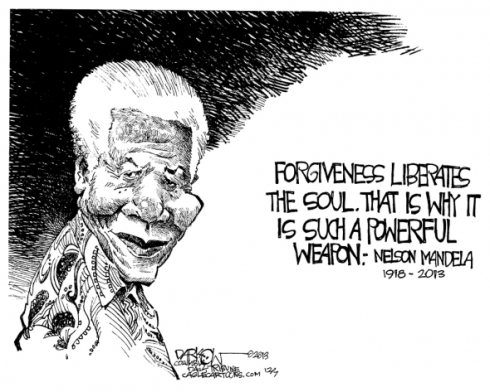
There was, predictably, an explosion of views on the matter. What caught my attention were the many observations that child sexual abuse is ‘unforgivable.’ As one who has lived through childhood sexual abuse, I find that assertion offensive, ignorant and entirely unhelpful, and I’m about to explain why this is so.
But before I do, there ought not to be any expectation for anyone to forgive injury. Forgiveness is an action that, if embarked upon, can take years to complete. It may never be completed. It may never be begun. I’m writing about my own experience as it has unfolded over many years, and what I needed to do for my own well-being.
What is meant when people talk about forgiveness? The philosopher Charles Griswold, in his 2007 book Forgiveness: A Philosophical Exploration, states that forgiveness should be understood as:
…a moral relation between two individuals, one of whom has wronged the other, and who (at least in the ideal) are capable of communication with each other. In this ideal context, forgiveness requires reciprocity between injurer and injured. I shall reserve the term forgiveness for this moral relation.
I am in complete disagreement with this definition. Many situations of injury are such that it is impossible and/or entirely unwise for an injured party to communicate with a perpetrator. Many perpetrators never concede their actions have caused harm. Griswold’s paradigm excludes many from the possibility of engaging in the process of forgiveness, as he admits:
When none of the conditions is met, the threshold of what will count as forgiveness is not crossed;sadly, and painfully, in such cases we are either unforgiven, or unable to forgive.
My own perspective is a secular one, and I think of forgiveness as perhaps belonging in the human rights discourse rather than the religious, or any crypto-theological morality such as that espoused by Griswold. When I have foresworn all desire for revenge, and any of the other abuses of resentment, I have forgiven. It is irrelevant if the perpetrator knows this or not, unless it is important for me that he/she does.
I don’t believe forgiveness requires the perpetrator’s remorse. I don’t believe an injured person needs to confront a perpetrator, or continue any association with him or her, in order to forgive them. Most importantly, I don’t believe forgiveness is first and foremost for the benefit of the perpetrator, but rather it’s a state of mind that can finally bring relief and freedom for the injured party from cripplingly painful and destructive emotions.
Which is not to say there’s anything amiss if an injured party chooses to confront their perpetrator. Only that this is not necessary for forgiveness.
I see forgiveness as a human rights matter because acts of revenge that cause suffering to another are always a human rights matter. …Using the suffering of a person or persons to satisfy oneself is morally objectionable, because it amounts to the treatment of wrongdoers as a means only, failing to respect their human worth, writes Trudy Govier in her book Forgiveness and Revenge. At the height of extreme pain caused by injury, it’s difficult if not impossible to think of the perpetrator as having any ‘human worth,’ however in order to inflict injury on me, the perpetrator has already used me as if I have no human worth. Am I to become like him/her? How will that help me?
While it’s perfectly acceptable for anyone to say ‘I would find that injury unforgivable if it were inflicted on me,’ it is not acceptable to apply that judgement to another. The state of non forgiveness is a horrific state in which to spend one’s life. Having been grievously injured by an abuser, is one then expected to suffer the agony of everlasting hurt and desire for a revenge that cannot possibly ever be commensurate with the injury? The desire for revenge, the inability to forgive (if we understand that term to mean the relinquishing of such desires) fixes the victim in their trauma and denies her or him the possibility of a life free from the aftermath of injury. The victim is trapped in a relationship of horrible and unwanted intimacy (for abuse is always intimate) the only escape from which is to forgive. Why, then, would anyone cruelly claim there is such a thing as an ‘unforgivable’ offence?
I will never forget, but I must, if I’m to have any life at all, forgive. The injurious act, as Hannah Arendt points out, is irredeemable, it presents us with …the predicament of irreversibility. This is but one of the challenges facing an injured person. The injury cannot be undone, the life-altering impacts cannot be undone, one is forever changed by the experience of being injured, the life that might have been, perhaps should have been is stolen, and one will never forget. As well as grieving the injury, I grieve the loss of who I would have been had this injury not occurred, a particularly difficult process for those injured while children, who can feel their childhood was destroyed by the actions of an adult.
Judith Butler, in Giving an Account of Oneself, The Spinoza Lectures, suggests that …it may be that the very way we respond to injury offers the chance we have to become human. Commensurate punishment or revenge dehumanises the victim of injury, however what humanises her/him is the opportunity to develop ...a model of ethical capaciousness that understands the pull of the claim, and resists that pull at the same time, providing a certain ambivalent gesture as the action of ethics itself.
What I understand Butler to be saying here is that in the space of uncomfortable tension creating by opposing claims (to punish or to abstain from punishing) the injured party has the opportunity to learn to live with powerful and irreconcilable desires and in so doing, move beyond the ‘unforgivable’ into a life free of revenge and its abuses.
In so doing, I am empowered. In contrast, if the injury done to me is deemed ‘unforgivable,’ I am condemned to a life of ongoing disempowerment, in which my actions are forever governed by my desire for revenge, and my bitter hatred of the one who has done this thing to me.
Commensurate punishment of a perpetrator may frequently be impossible. However, forgiveness …becomes possible from the moment it appears impossible. Its history would begin… with the unforgivable…what would be a forgiveness that forgave only the forgivable? asks Derrida.
Forgiveness must rest on a human possibility – I insist on these two words… he continues. Injury is a human action, the rape of a child takes place in the realm of human affairs. Monsters do not sexually abuse children, humans do. Forgiveness arises in the recognition of our common humanity, and the terrifying capacity for injury and destruction that humanity contains.
So this is why I object to child sexual abuse being described as ‘unforgivable.’ If I tell you I have forgiven, do you then tell me I’m deluding myself?
Do you tell me it is impossible for me to forgive what was done to me, and I don’t know what I’m talking about? Do you disempower me yet again with your opinion? Do you know better than I know myself what my life’s struggle has been? Would you have me lose my life to emotions that destroy my freedom, while affecting my perpetrator not one bit?
If I decide that what was done to me is unforgivable, though I may, at times of great distress, use that term, I am terminating all hope of freedom. Forgiveness is a mystery, beyond the reach of justice and punishment, both of which can be, and often are, incommensurate with the injury inflicted.
So let us speak of the mystery of forgiveness. Forgiving is imperative…it is extremely difficult to forgive. I don’t even know if forgiveness exists. Hélène Cixous
Tags: Child sexual abuse, Forgiveness














 No Place For Sheep
Recent Comments