Abbott’s only claim to fame: persecuting the utterly helpless.

1 Apr

As far as I can tell, the Abbott government’s proudest achievement in its first one hundred days has been its ongoing persecution of asylum seekers arriving by boat. It has also been its most costly, and I refer you to this excellent ABC fact-checked site titled Operation Sovereign Borders: the first six months for a breakdown of the billions the government has committed to spending to maintain its “stop the boats” policy, and the mandatory detention of asylum seekers already apprehended.

What the government never admits is that “stopping the boats” is not something it can conceivably cease – as long as there are asylum seekers there will be attempts to access this country by boat.  Surveillance, interception and transfer of asylum seekers to lifeboats (which we must keep on purchasing anew as we never get them back) has no foreseeable end. Stopping the boats arriving on Australian shores is an immensely costly business, and open-ended.

Some weeks ago, the Guardian revealed that the Department of Immigration and Border Protection had inadvertently released the personal details of one-third of asylum seekers currently in Australia, possibly putting them at great risk if they return or are returned to their countries of origin. The result of this data breach is that asylum seekers may now legally claim refugee status in Australia solely on the grounds of sur place. 

Eighty-three asylum seekers detained at Villawood Detention Centre have launched this action, and the directions hearing challenging the government over the data breach is due to be heard on Friday.

The DIBP have advised the Villawood asylum seekers that they are to be transferred to the remote Curtin Detention Centre in Western Australia on Thursday, the day before their directional hearing.

Last week, Scott Morrison announced that all taxpayer-funded legal aid to asylum seekers who arrive by boat would be terminated. One of the consequences of this decision is that there are no longer any free telephone interpreter services available to boat arrivals. Plaintiffs transferred from Villawood to Curtin the day before the directional hearing of their claims, will be unable to freely access interpreters to communicate with their lawyers.

According to the UNHCR, asylum seekers are entitled to legal services and to deprive them of access is a denial of justice.

This is just one of the recent examples of the Abbott government’s unrelenting persecution of boat arrivals.

There is something monstrously pitiful about a government that has as its greatest achievement the persecution of a small group of utterly helpless people. Such persecution is the hallmark of the bully: attacking those who have no possible avenue of escape, or of fighting back, and then boasting of your  achievement.

Abbott and Morrison continue to bring the full weight of their contemptible authority to bear on asylum seekers who arrive by boat, and no expense is spared in the scapegoating and persecution of this group of human beings.

You may not particularly care about asylum seekers and their fate. But every one of us should care a great deal about the characters of the men who govern us when their greatest satisfaction comes from persecuting and ultimately defeating, even to the death, a human group who are amongst the most vulnerable on earth. Such men are dangerous. Such men do not deserve to govern us. Such men will not stop at one group of human beings. When this group ceases to serve their purpose, they will seek out another, equally helpless, equally unable to fight back, because bullies can only feel good when they make others feel terribly bad.

Bullies and bigots. Australia, 2014.


The unbearable ignorance of Tim Wilson, Human Rights Commissioner for *Freedom*

30 Mar
Freedom Boy

Freedom Boy


Tim Wilson, recently appointed Human Rights Commissioner for Freedom, declared today that race hate laws are bizarre and unequal because while members of a community are permitted to use “racially loaded language” among themselves, outsiders are not permitted to do the same.

Mr Wilson clearly does not understand that *racially loaded language* used by outsiders is always, without exception, deliberately employed as a racial slur intended to insult, hurt, demoralise, ridicule and devalue the human beings  hate speech targets. When such language is used amongst members of a community it is used ironically, defiantly, and as a method of defusing and ridiculing the racist intentions of outsiders.

Everyone, Mr Wilson asserts ought to be allowed to use the term “nigger,” for example, because it is widely used in black communities. Wilson reveals his monumental ignorance and gobsmacking stupidity, through either his incompetent or  deliberate misunderstanding of the difference in the meaning of that term, when used within communities or by outsiders.

This dangerous call for absolute free speech favours only white people, and only certain highly privileged white men are demanding it. Wilson’s call for “personal responsibility” in this matter is ridiculous. There are matters society cannot afford to leave to an individual’s sense of “personal responsibility” and as has been proven over and over and over again, hate speech is one of them.

Like many others, I am enraged and heartbroken to see the gains that have been made in my lifetime crushed by the severely limited intelligence and utter lack of imagination of privileged white men such as Brandis, Wilson, Abbott et al. That a Commissioner for Human Rights (Freedom) is now campaigning for everyone to be free to use loaded terms such as “nigger” against our fellow human beings  because “equality,” signifies a journey through the looking-glass that leads to nothing less than insanity.

There can be no “equality” in the use of racially loaded language when the intentions behind the speech are utterly opposed.

This is a bald act of white supremacy, a brutal attempt to claw back what is perceived as a loss to the power of privileged white men.

PS: On a personal note, Tim Wilson recently blocked me on Twitter when I asked him a valid question about competing human rights.


Freedom to speak badly: one rule for protestors, another for Bolt?

24 Mar
Bad Manners Are Unedifying

Bad Manners Are Unedifying


Peter van Onselen devotes almost an entire page in the Australian this morning (paywalled, sorry) to complaining about the “unedifying” display of bad manners by some protestors who took part in the March in March rallies, comparing them with the infamously abusive banners held aloft by the three hundred or so activists who took part Alan Jones’s 2011 Convoy of no Confidence against Julia Gillard and her Labour government.

I would appreciate someone drawing up a comparison of the two situations, given my impression that the number of participants in the Jones rally carrying offensive placards constituted a far greater percentage of the whole than those in the March in March rallies.

As van Onselen concedes, in the Jones protest virulent expressions of rage and hatred were legitimised by the presence of leading politicians photographed under the placards. No such validation took place of the relatively few offensive banners on display during March in March.

“Calling a conservative a fascist and portraying his image to replicate Hitler is deliberately designed to undermine their ideological positioning in the same way that calling a woman a ‘bitch’ or ‘witch’ carries clear sexist intent,”  van Onselen states, in his comparison of the two situations.

I would not so readily presume an equivalence between sexist intent, and the desire to critique, albeit with a degree of hyperbole, an ideology. Sexism attacks the woman for nothing other than being a woman. Describing Abbott as “fascist” in no way attacks his gender, and is merely commentary on the manner in which he is perceived to enact his conservatism.

Placards claiming that the Abbott government is “illegitimate” are not abusive, offensive or threatening, rather they are simply wrong, and likely being employed as payback for the years of the LNP opposition equally inaccurately describing the Gillard government as “illegitimate.” What is apparent is that there are hot heads and wrong heads on both the conservative and Labor side of politics. This should not come as a surprise to anyone.

Along with Tim Wilson, Human Rights Commissioner for Freedom, (I’m sorry, I don’t know what that title means) van Onselen is disturbed not at the exercise of freedom of speech demonstrated by both rallies, but at the ill-mannered, impolite, potentially violent and “irresponsible” speech used by a small number of participants in their signage. A similar rabid element is guilty of foully derailing many otherwise useful Twitter discussions, claims van Onselen, quite rightly in some instances, though there are sensitive souls renowned for “rage quitting” Twitter when they confuse disagreement with abuse.

Van Onselen and Wilson’s desire to see public speech free from offensive, insulting and at times threatening expression is shared by many people, but quite how to achieve that remains a mystery. Bad speech must be countered by good speech, Wilson has asserted, however, taking the case of Andrew Bolt as an example, it’s difficult to see how someone with a large public platform such as Bolt, or fellow shock jocks Alan Jones, or Ray Hadley can be challenged by the people they offend and insult, who rarely have an equivalent public platform from which to counter their attacker’s bad speech with good. It is for this reason we have legislation intended to protect people from racial vilification, for example, the very legislation Mr Wilson is now intent on seeing repealed, as he believes it interferes with the absolute freedom of speech he appears to favour.

I can see Wilson’s point, however, as long as there are more powerful enunciators of bad speech with large platforms than there are good, perhaps we need other precautionary measures.

I couldn’t help but wonder, as I read the article, what van Onselen and Wilson would make of public demonstrations in other countries, Mexico perhaps, where I witnessed protests in which politicians were represented by enormous papier-mache figures with grossly exaggerated sexual organs, accompanied by banners that claimed they fucked both dogs and their mothers and ate children. Nobody saw any cause for offence. Compared to such robust expression, the complaints seem rather prim.

Amusingly, van Onselen concludes his article with the reminder that “Protest is as an important part of democracy as are institutions designed to uphold democracy, but only when practised within the spirit of Australia’s well established political structure.” I am completely unable to see how any of the offensive signage fails to fit in with that spirit. Australian politics have, for the last few years and most certainly during Gillard’s entire term of office, been such that one would think twice before taking school children to witness Question Time, and I really don’t know who van Onselen thinks he is kidding.

The ongoing discourse about how we should conduct our discourse is unlikely to change anything. Van Onselen’s piece appears to make the claim that those who offend middle-class sensitivities undermine the more moderate message and concerns of mainstream protestors, and destroy their credibility. This may well be the case, but only because people such as van Onselen make it so, opportunistically denigrating the whole on the basis of the actions of a very few.

It is not possible to eradicate voices some consider undesirable from public expression. Otherwise we would not have to put up with the Bolts. A sign held aloft at a demonstration cannot do one tiny fraction of the harm done by Bolt, Jones and the like. If we are to conduct serious conversations about how public discourse influences attitudes and behaviours, surely we must start by interrogating the enunciations of those with the furthest reach.

Do your job, Malcolm Turnbull, it’s what we pay you for.

21 Mar

I had a robust set-to with Communications Minister Malcolm Turnbull on Twitter this morning, after he arrogantly informed a regionally based small business owner that if she wanted reliable internet connections she ought to have bought her house in a different area.

Vaucluse, maybe?

Perhaps I was exceptionally irritated by this comment because it reminded me of when my entire family went missing for a week in a Mexican hurricane, & Alexander Downer remarked that it was their own fault for living in a hurricane-prone place.

I didn’t argue with Turnbull about the government’s plans ( I use the word reservedly) for our future communications. I argued with him because every response he made to me referred not to the issues, but to the deficiencies of the ALP when in government. No matter how consistently I pointed out to him that his tactic of attempting to deflect a questioner from her concerns by arguing that “the ALP started it and were worse than us” only serves to convince me that the government fears its own policies aren’t worthy of mention, the man would not cease his epic struggle to gain a political point.

“You’re winning no support trying to avoid questions by point scoring,” I tweeted. ” You’re in charge, govern, in our best interests.” To which the Communications Minister replied” “So it’s shameful to tell the truth is it? Or is it that you are ashamed of the mess Labor left us to clean up?” And so on. The battle is still going on as I write this, though Malcolm retreated a couple of hours ago. I obviously struck a nerve: there are a lot of people wanting governance from this lot, and increasingly fed up with them behaving as if they are still in opposition.

What the Abbott government and their advisers are apparently unable to grasp is that every time they attempt to deflect the focus from their policies onto a critique of the ALP, they reinforce the impression many of us have that their policies either don’t exist, or are too inadequate to be discussed, leaving them obliged to resort to employing critique of the former government as their only narrative. This is not governing the country.

This is not building a better future for Archie:IMG_1756It isn’t building a better future for Ted:

IMG_1755It’s a serious abrogation of responsibility.

The Abbott government seems to me exceptionally disregarding of the future. This causes me great concern for the well-being of my grandchildren and their peers. Surely it is a government’s job to do everything possible to ensure the best for our young, now and as they become adults.

The Abbott government must understand that governing a country is not a game: it is the most profoundly serious enterprise anyone can undertake, it affects the lives and futures of millions of people, and arrogance and point scoring will not cut it.

You won the election, Mr Turnbull. Get governing, or get out.

Taking to the streets: why protest matters

13 Mar

shit is fucked up and stuffThis weekend, there’ll be a series of protest marches around the country known collectively as ‘March in March.’

The overall aim of the rallies is to protest against the manner in which the Abbott government is running the country. There is no single issue focus, and people are invited to peacefully state their own particular grievance/grievances against the LNP.

The protests have been organised by people who have no affiliation with any political party and indeed, little or no experience in organising protests. It sprang from increasing discontent expressed on social media by citizens who have no significant public platform through which they can vocalise dissatisfaction with and anger against the Abbott government. In every way, the March in March protest appears to be a genuine grass-roots movement, and no big names are associated with its initiation and execution.

March in March has come in for a fair amount of criticism for its alleged lack of focus and purpose.For some reason, ordinary citizens expressing grievances against their government is not regarded as being focused, or as having any purpose.

Protest itself, it’s also claimed in some quarters, is a waste of time, useful only to give participants a warm inner glow, and unlikely to achieve anything more than that.

I don’t know how the outcome of a protest is measured.  I’m fairly certain that change is usually very slow, and requires any number of ongoing actions to bring it about. I doubt anyone would argue that protest alone can achieve great things, however, it is one action among many that together can cause upheaval. As several people told me today, protest didn’t stop John Howard taking us into Iraq, however, nothing was going to stop Howard doing that, and in our parliamentary system the Prime Minister alone is permitted to make such grave decisions. What the protests did was allow citizens a unique opportunity to peacefully and publicly express their opposition, and in itself, this is something we should neither denigrate nor easily relinquish. Ordinary people without a public platform must have a voice.

While this Guardian piece criticising March in March contains much with which I agree, it entirely misses the point that this weekend of protest has sprung not from any organised political movement but from the rage of seriously offended citizens who have no other means of publicly expressing their fury. The peaceful public expression of  rage against those who govern is in itself a privilege many in different political systems do not enjoy, and we should treasure our freedom to take to the streets in protest at our governments. We may not, if conservatives have their way, have such freedoms available to us for much longer.

Hopefully, the March in March rallies will be the first in an ongoing public protest against the Abbott government that will reach its climax at the ballot box in the next election. It is a beginning. It’s an opportunity for motivated strangers to meet and engage. It’s a chance for a more finely honed focus to emerge and be developed. The grass-roots nature of these protests is thrilling. No Get-Up. No charismatic leaders. No political parties. Just citizens exercising their democratic right to peacefully dissent. Don’t knock it. Treasure it. Abbott is about to do everything he possibly can to take this freedom away.

Turnbull, Transfield, The New Democracy Foundation, & the vicious ingratitude of artists

11 Mar

Boycott Biennale


In the last two days Communications Minister Malcolm Turnbull, and former Chairman of the Sydney Biennale and Transfield Executive Director, Luca Belgiorno-Nettis, have provided the Australian public with an unusually revealing insight into what the ruling class expect from the artists they support.

Belgiorno-Nettis is an investor in the Transfield company recently awarded a $1.2 billion contract to provide “Garrison and Welfare” services to the Australian government’s detention centres on Manus Island and Nauru, commented on earlier by No Place for Sheep here.  It seems that wherever one goes, from the St James Ethic’s Centre, to the Black Dog Institute, to the Business Council of Australia, to the New Democracy Foundation (see below) to the arts, one encounters a director of Transfield.

Ten artists withdrew their work from the Biennale because the event was heavily sponsored by Transfield, and the ten considered themselves to be benefiting from profits gained from the exploitation of human misery. Transfield was a co-founder of the Biennale some 41 years ago, but has only become problematic since it was awarded the government contracts for Nauru, and most recently Manus.

Turnbull described the artists as being “viciously ungrateful” to their benefactor.

On Radio National’s Books and Arts program today, Belgiorno-Nettis expressed his revulsion at the allegedly personal nature of the attacks on him and his family by “radical protestors” against the Manus and Nauru prisons, and when asked by presenter Michael Cathcart what he thought about the boycotting artists returning to the Biennale now Transfield was no longer involved, stated that as far as he was concerned they weren’t welcome back. They had, he insisted, used “guerilla tactics” against him.

The Transfield Executive Director’s explanation of his position was disappointingly self-indulgent. His outrage at being personally “insulted” is more than a trifle ironic, given the depths of misery and torment suffered by those legally seeking refuge from persecution, who are illegally imprisoned in the tropical hell holes (“garrisons”) overseen by Transfield.

Here is the letter written by the artists explaining their position. I can find nothing insulting to Belgiorno-Nettis or his family, and given Transfield’s withdrawal I see no reason at all why the artists should not now participate.

Neither can I find anything “viciously ungrateful” in the text of this letter.

Turnbull and Belgiorno-Nettis are as one in their contemptuous attitude to artists who disagree with both government policies, and the corporate support of those policies for profit.

Whether you agree or disagree with the stand taken by the ten artists, what the saga has revealed is the attitude of the ruling class to artists it supports. Both the Turnbull & Belgiorno-Nettis outrage at the audacity of artists supported by the establishment who defy that establishment is extraordinary, and the threat, loyally promoted by their middle class emulators, that now corporate sponsorship will become dangerously problematic because of this rebellion, is utterly predictable.

That the establishment’s reaction to robust critique of its policies and actions is outrage at the manner in which the challenge was mounted, and outrage that artists should have the nerve to bite the hand that feeds them, says everything about the lack of spine and imagination in the ruling class. The expectation that artists ought to be “grateful” to the degree that they keep their mouths shut when faced with intolerable and inhuman cruelty  shows a complete lack of understanding of what art is about, though I’m certain both Turnbull & Belgiorno-Nettis have art on their walls, and perceive themselves as cultured.

Belgiorno-Nettis is also the founder of The New Democracy Foundation, whose mission is to forge a new path to democracy through a “better system.” Lucy Turnbull, wife of Malcolm, is also a  member of this Foundation, along with other recognisable names. The Foundation’s mission statement:  The new Democracy Foundation is an independent, non-partisan research organisation aiming to identify improvements to our democratic process. We aim to replace the adversarial with the deliberative, and move out of the “continuous campaign” cycle.

It seems to me that the ten artists were peacefully exercising their democratic right to protest injustice with the most powerful means at their disposal – their work. According to Belgiorno-Nettis’ founder’s message, his New Democracy Foundation supports the right of people to express their opinions, and then for those opinions to be argued, Athenian fashion:  The Athenians called their discussion group The Council: 500 men [sic] selected by lot; 50 from each of the 10 tribes.  In this way the Council was a mirror of the population at large: a mini-public.  No one person, or tribe, could bully any other, because they were all equally represented. The Council’s job was to propose the laws for city, after which another discussion group, called the Assembly, would then meet and vote.  Any man [sic] could attend the Assembly and speak and then after all the arguments for and against, a vote would be taken, and that would become the law. They called this system Demokratia – meaning rule of the people.

Of course, trying to avoid dirty money must be an almost impossible task. However, the direct nature of the link between Transfield and the vile conditions in which those legally seeking asylum in this country are held is impossible to ignore. Australian politicians have singled out a group of people who they have determined are not deserving of decent, humane treatment. The group singled out is one whose members are almost entirely fleeing persecution of the most extreme kind. They are not criminals. They have committed no illegal act. They have requested protection from their persecutors. In response, they have been indefinitely detained, attacked, wounded and in one case, murdered, in extremely hostile and isolated conditions.

The company responsible for these “garrisons” and the “welfare” of those imprisoned, is Transfield. Luca Belgiorno-Nettis, as an investor in the company, makes money from the cruel injustice wrought upon asylum seekers by Australian politicians.

I’m hard-pressed to think of a situation more deserving of protest by artists, and anybody else.

Transfield, detention centres, ethics, depression & Abbott’s Commission of Audit

2 Mar

transfield-services-clyde


Douglas Snedden, Non Executive Director of Transfield, the global operations, maintenance and construction services business awarded  the $1.22 billion dollar contract to provide ‘Garrison and welfare services’ to the Department of Immigration and Border Protection detention centres on Manus Island and Nauru, is also a director of the St. James Centre for Ethics, and Treasurer of the Black Dog Institute.

Tony Shepherd, handpicked by Joe Hockey as Chairman of the Abbott government’s Commission of Audit,  was until October 2013 the Chairman of Transfield. His record is far from exemplary, according to this report by Bernard Keane, in which Shepherd is described as ‘Transfield’s doyen of debt.’

The St James Centre for Ethics works with business to promote ethics and ethical decision-making. It is extensively supported by the business community. The Black Dog Institute is concerned with the treatment of mental illness, specifically depression and bi polar disorders.

Transfield subcontracts  the security management of the detention centres on Nauru and Manus to Wilson Security. Counselling and medical remain the responsibility of International Health and Medical Services.

‘Garrison and welfare’ services are the responsibility of Transfield. ‘Garrison’ is a military term meaning a permanent military post. Transfield have considerable experience with defence.

Quite what welfare services the company is responsible for providing to the prisoners held in the camps I have not yet been able ascertain. Presumably these are the services that were previously supplied by the Salvation Army. I have also been unable to ascertain if Transfield have any prior experience of providing welfare services. Based on the company’s own account of their business, the specific welfare needs of the prisoners held on Manus and Nauru would not appear to be included in their expertise.

Former Transfield ChairmanTony Shepherd is also President of the Business Council of Australia, an association of CEOs of one hundred of Australia’s leading companies, as well as a past (2012)  Director of the Migration Council of Australia.

Isn’t this all nice and cosy?

Many thanks to @mix1127 for first pointing out some of these connections.

What a woman wants, what a woman needs…

28 Feb

Yesterday I visited a place on the NSW south coast that once served as a sanctuary, a place to which I fled after an almost terminal encounter with cancer left my whole being drastically weakened, terrified to live and equally terrified to die. Daily life had become impossible, I no longer knew how to fulfil its expectations. I needed solitude, away from city life, I needed to escape the claims and demands of human interaction, even with those I loved and who loved me, and I needed this so desperately I think I might have physically attacked anyone who tried to hold me in place. Fortunately, nobody did, I was reluctantly let go when I promised to allow visits, as long as nobody stayed too long, and how long was ‘too long’ was to be determined by me.

DSCN0892

It was also fortunate that we owned a caravan behind the sand dunes on a largely deserted beach. You can’t live in a caravan, they said. You can’t live there all by yourself, you’ve been so sick, look at you, you have no hair and all your bones are showing. Fuck off, of course I can, I told them, unkindly. Any attempt at what I perceived as thwarting me made me frantically distressed, as if I was being pinned down by a body stronger and more powerful than mine that I had to fight off, or suffocate.

The caravan was in one of those old-fashioned parks where families spent their holidays year after year for as long as anyone could remember. When I arrived, exhausted from the four-hour drive and the emotion of goodbyes, the place was largely empty, being out of holiday season and in the middle of autumn. It was cold. The south coast climate is at best fickle, I have known us wrapped in sweaters and blankets on Christmas Day. The caravan, unoccupied for months during my illness and initial recovery, was musty and damp, a habitat for spiders and insects. The day was overcast, adding to the gloom, and while our spot beside the creek in a grove of melaleucas was idyllic, it allowed for little light under such a low grey sky. I had a panic attack. I couldn’t stay in the spider-infested gloom. I couldn’t go back to our light-filled Bondi Beach home where I suffered anxiety attacks every time I went out the front door into the neighbourhood I had, prior to my illness, loved to inhabit, with its cafes where I met my friends, ate weekend breakfasts with my husband and whoever else happened by, where we swam or walked the winter beach hand in hand talking as we always did with such energy and delight, even at the times we disagreed with practically everything the other said.

DSCN0889

After the cancer, I couldn’t talk about anything anymore. The ongoing blows inflicted by the illness, so unexpected, so unpredictable, they seemed unending in their variety and persistence. After cancer is a time largely underestimated in its power to disrupt. Generally, people think you ought to be relieved, happy you got away with it this time, determined to embark on a recovery regime that will get you back in the swim of things just like you were before. In reality, at least for me, it’s when the horror of the experience actually hits home, something that is impossible when you’re going through the treatments and your world has become medicalised to the extent that it overwhelms all other realities. Post cancer, every little twinge in your body is noted with alarm: is it coming back? For months I woke in the night drenched in sweat, from nightmares the details of which I could never remember, and a debilitating weariness dogged my days. There was nothing that did not leave me exhausted, and tearful. I couldn’t manage all this, and human beings as well.

I walked along this same beach yesterday, under a similar low, soft grey sky, the familiar smell of kelp, the haunting cries of seagulls, the gritty south coast sand between my toes. At the end of my beach there’s a broken wooden jetty where I used to lie on my stomach, peering intently at the stingrays gliding through the clear water beneath me. The rhythm of those days and weeks and months of solitude came back to me. In the mornings waking up sweat-soaked and panicked, climbing out of my single bunk bed to make tea on the gas stove, cold, even if the day was warm, because what I remember from those months is how I could never warm myself, even under piles of blankets, even in the hottest sun, it was as if I had a frigid core that nothing could reach, it was as if I had entirely lost my previously automatic ability to regulate even my body temperature. The trembling of my body, most especially my thighs, and the cold sweat drying on my skin. The fear of moving. The terror of putting one foot in front of the other. The utter loss of everything ordinary.

My husband and my adolescent children would visit and though I loved to see them, the relief I felt at their departure, at the resumption of my solitude, made me ashamed. I remembered yesterday the feeling of my starved gulping, my greedy devouring of nourishment not from my loved ones whom I invariably felt I had to reassure, but from the solitude of the natural world in which I was immersed. That was my healing. My guilt at abandoning them was great. But my need to be alone in this wild landscape overwhelmed it. I wanted nothing except what I needed to stay alive, some books, some music. The hurt I caused them did not become fully apparent till some years later when my eldest son, beside himself with unexpressed distress from that whole period of our lives, shouted at me, You didn’t need any of us! You just left us! You didn’t let us help you, you are such a fucking loner, Mum, you don’t fucking need anybody!

Which left me speechless. And reaching out for him and he came into my arms, grown up, so much bigger than me, and sobbed.

DSCN0891

I don’t know how it is for others, but I’ve always had a dreadful struggle between what I need for myself, and what others need from me, and what I want to give them because I love them. Sometimes I think I will die if I don’t have time absolutely alone. Sometimes I cannot bear to engage in one more conversation about, essentially, nothing, the kind of conversations that make up so much of our daily discourse, the words that serve to weave the binding threads between people, and that is their purpose. Sometimes I think if I am not able to sit in silence in the natural world for as long as I need to, I will start breaking things. It’s as if the healing never really finishes, needs to be topped up from time to time with a return to the inner self who increasingly becomes more solid, more real, than any outer persona and whose needs are so far from anything found in the everyday world with its constructed conventions, and its claims that largely require almost incessant, low-intensity interactions for their fulfilment.

For a woman to do what I did, leaving home, husband and family who cared for me through the desperate and dangerous phase of my illness, insisting on solitude rather than accepting their love was seen largely as selfish, and it was, there’s no denying that. It had a price, for all of us, but yesterday I understood that there’s nothing intrinsically wrong or frightening about paying a price for something deeply desired, these are deals we strike every day, choices made, choices rejected, and almost every one of them has some effect on someone to a greater or lesser degree. I still don’t know, after all this time in this life, how much I am allowed to take for myself, how much selfishness I am allowed, how many choices I may make that cause another hurt or discomfort, how responsible I must be for protecting another from disruption in the pursuit of my own desires and needs. With every situation this must be weighed up anew, and I have made some horrible errors. It seems that the important thing is that I continue to bother to attempt these fraught calculations, even though my sums may be dreadfully wrong. I hope that is the case, though I don’t expect I shall ever know.
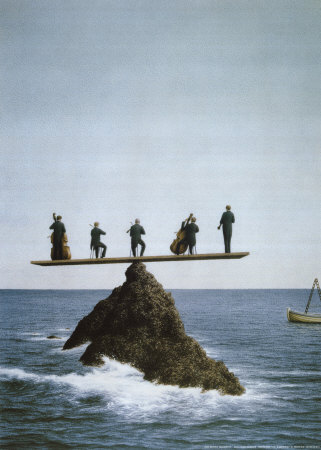
Quint Buchholz. lemaze-studio.com

Quint Buchholz. lemaze-studio.com

The fundamental reason people seek asylum in Australia: because we tell them they can.

19 Feb

Both the ALP and LNP governments have, for more than a decade now, chosen to ignore the fundamental reason why people seek asylum in this country: we are signatories to the UNHCR Refugee Convention, and as such, we currently offer asylum to anyone who seeks it, no matter what their method of arrival.

Instead of withdrawing from this Convention, the “honest” thing to do as apparently we no longer consider it to have any validity whatsoever,  the current Australian government has issued a comic book, explaining to potential refugees why they should not come to this country in the belief that we will honour our commitment, because, quite simply we will not.

We will not speedily assess their claims for refugee status in Australia. We will, in fact, transport them to hideous off-shore processing centres where they will languish in indefinite detention with no certainty at all about their futures, and if that is not enough, they will be subject to violence resulting in serious injury and death from sources that as yet remain unidentified, because we do not adequately protect them.

This is what we do, instead of honouring the obligations we undertook when we first signed the UNHCR Convention in 1951, then ratified it in 1967.

We are despicable. Our politicians have made us a despicable, lying, obfuscating nation without the courage to withdraw from a commitment we have no intention of honouring. Australia enjoys the kudos of being a civilised signatory to the UNHCR Convention. At the same time, Australia has no intention of honouring our voluntarily undertaken commitments to that Convention.

This is our primary shame. Our hypocrisy. Our disgrace.

And both the ALP and the LNP have brought us to this.

The murderous refugee “policies” of Australian governments

18 Feb

Immigration Minister Scott Morrison has just confirmed that one asylum seeker is dead, another has been flown to Australia for treatment after having been shot, and seventy-seven more are injured, twenty-two critically, after tensions at the Manus Island detention centre exploded yesterday.

This country, our country, my country, by virtue of being a signatory to the United Nations Refugee Convention, invites those fleeing persecution and danger to seek sanctuary and asylum here, NO MATTER WHAT THE METHOD OF THEIR ARRIVAL.

We are known to those in countries where daily life has become untenable as a signatory to that Convention, as a country where they may safely ask for refuge.

As long as we remain a signatory to the Convention, we are issuing an invitation to those who live in daily fear, danger and despair. Children. Women. Men.

But we are liars. We are extending a false invitation. We do not offer sanctuary. We do not offer a decent hearing in which claims for refugee status will be fairly and legally assessed. We do not offer the possibility of resettlement and the opportunity to contribute.

Instead, we have turned the misery of children, women and men into a political football. With psychopathic disregard for our fellow human beings, we have ignored their desperation, and done everything possible to keep them away from us.

So, Scott Morrison, Tony Abbott, Chris Bowen, Kevin Rudd, Julia Gillard, and the rest of you. You wanted to stop asylum seekers dying at sea? Well, your methods have them dying and critically injured  in detention. Where’s your fucking conscience now, then?