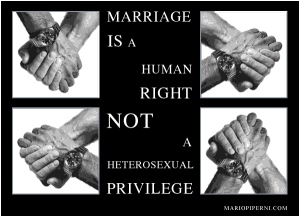
 It’s raining cats and dogs and all my plans for Saturday centred around the outdoors. Thwarted, I turned to my computer and read this piece on the Watermelon Blog in which David reckons it’s time to make the billionaires pay the rent; and this piece on the Political Sword, in which Ad astra alleges that Tony Abbott is the worst opposition leader in our political history, and gives resoundingly convincing arguments to support the allegation.
Rainy days are good for musing and as I ventured out to give the dog an airing, I thought about marriage, and gay marriage in particular. I fully understand why people want to get married. Heck, I did it myself twice. I did it once in a church and once with a celebrant. It was nothing to do with the state, or religion, or societal expectations. It was everything to do with my heart. In retrospect the heart alone isn’t the smartest organ from which to make such major decisions, but I didn’t know that until I’d done it twice.
In another of the triumphs of hope over experience with which my life is littered, I’d probably do it again if the circumstances ever arose.
People usually enter into a formal commitment to one another full of good will, desire and hope. It doesn’t always work out, and we pick ourselves up from the wreckage and start our lives over, often to do it all again. It’s a public expression of mutual love, and it’s valued by many as the ultimate such expression.
It seems to me there’s two arguments going on in the gay marriage debate. The first is that gays and lesbians ought to be entitled to the same public expressions of their love and commitment as are heterosexuals. This is a no brainer, IMO. Love is no respecter of genital arrangements. In a world that needs love as much as this one does, we should be celebrating it everywhere we find it. It seems extraordinarily mealy-mouthed and mean-spirited, not to mention ignorant, for any heterosexual to insist that it can’t count as marriageable love when it blossoms between same-sex couples.
The second is the interrogation of marriage itself. Like, marriage? What is it good for? Well, I could get cynical here and say not much. But in my experience that’s a conclusion everyone has to come to, or not, in their own good time and their own good way. The idea of marriage continues to exert a powerful emotional hold. No amount of rationalizing is going to change that in the near future. I know many couples who after years of living together decide to do the marriage thing, even though de facto arrangements are as legitimate. We are encultured to view marriage as the strongest commitment couples can make. This may change, but currently, it’s what we’ve got.
It seems unfair to expect that same-sex couples, rather than demanding inclusion in the culture ought to contest it, although there are voices in the gay and lesbian community raised against the institution, as there are in the heterosexual community. Nevertheless, I doubt that marriage is going to go away anytime soon. So it matters a great deal that same-sex couples have the right to celebrate their commitment just as heterosexuals do, if they so choose.
And that’s the real argument. It’s an argument about equal rights. Whether you think marriage is a necessary institution or not is largely irrelevant at this point. Currently there are couples who are denied access to marriage solely because of their sexual orientation This is discriminatory and breaches their human rights.
None of the arguments put forward by opponents of same-sex marriage stand up to scrutiny, and most are mired in superstition and religion. We have a Prime Minister who is beholden to neither superstition nor religion. So let’s move forward, Ms Gillard, unless of course the Australian Christian Lobby, those vocal opponents of same-sex marriage, have got you under their thumb.

Finally, my apologies for spelling Craig Thomson’s name wrongly in a previous post – I gave him a p when he shouldn’t have a p. He does not have a p! There is no p!! How can anyone believe anything I say if I stick p’s in where they don’t belong! Respect the p, Jennifer! Respect the goddamn p!!
 Embattled member for
  The treasury informs us that 2.4 billion has been spent on detaining boat people since 2000. This has worked out at $100,000 per boat arrival. I wonder how long this stupid waste of money will be allowed to continue.
 In need of spiritual nourishment and it being Sunday, I gave myself a dedicated Leonard Cohen day. This entailed, along with the scented oils, incense, beeswax candles and floaty shawls, a total immersion in music and lyrics enabled by our new system that transcends anything we’ve ever had before in terms of thrilling quality of sound.
 There’s nothing “pure and simple” about violence and greed. Yet this phrase and others like it have been used over and over again as “explanations” of the motivations of those who rioted and looted in British cities last week.
 Finally, I now know that the Argentine duck
  As predicted, British PM David Cameron is now
  They may come from different political perspectives (in theory, anyway) but there are interesting similarities between British PM David Cameron’s authoritarian threats against the rioting mobs, and those used by Julia Gillard on the matter of water-borne asylum seekers.
 God only knows what’s going to happen to the asylum seekers, but it doesn’t look like the boats are doing any stopping, and there’s still the problem of expelling unaccompanied minors into very uncertain conditions and futures.
 Predictably, British PM David Cameron is talking tough, threatening anarchic marauders with the full force of the law, promising terrified residents that the government will defeat the masked and hooded teenage hoodlums with the toughest possible action. He will jail them. He will put them in juvenile detention. He will teach them not to burn and loot, by God he will.
 We live in a global culture in which the ability to consume is the primary measure of human freedom. To be a prosperous consumer is to be free. Given this reality, violence, theft, and rioting by disaffected youths stealing trainers and plasma TVs, while shocking, should not come entirely as a surprise.
 There are three related issues that I’d like to briefly mention here on the way to providing some hard science that people who want to be leaders could find useful, if not compelling.The first is that the ‘great’ debate about whether leaders are born or made is a non-event. The issue is more about what people do that make them leaders and whether they have the capacity to perform the behaviours. It is clear that some people can’t be good leaders and others can. The second issue is closely related to the first and that is that people in leadership roles do not pay much attention to the social, anthropological and psychological evidence about what great leaders do and how to get the most out of people and, ergo, organisations. Leadership is treated a bit like counselling and teaching (other than in schools), that it that anyone can do it, without any formal training, if they have the inclination. It is fascinating that we still promote people to leadership roles on the basis that they have demonstrated high levels of competence in their profession (being an engineer, academic, town planner). Lastly, for this little article at least, the leadership literature is, at best, fluffy and has probably not had much impact, other than the occasional halo effect, on what most people in leadership roles do at the coalface.With these three issues in mind it is interesting to actually look at the science behind what people need to do in order to become good leaders. The evidence is pretty well overwhelming concerning the conditions in which people perform best at work. The tragedy is that the evidence is not accessed, oversimplified or incorrectly interpreted. I know of many organisations that have been sold psychological ‘pups’ by consultants or whose CEOs have read a trendy book on leadership at the airport that sounds good but has not evidential base. These ‘pups’ come in the form of untested theories and models that are anecdotal at best. They might consist of colourful and sexy personality testing instruments that have no reliability or validity whatsoever and are simplistic in the extreme. Medical practitioners, psychologists, dentists, nurses, physiotherapists, engineers are required to use evidence based practice. Why not people in leadership roles?We know from many social psychological experiments that people work best in an environment where they have control over their immediate work, are informed, make a contribution to decision making, feel that what they do is worthwhile, feel that they have a positive future, feel a valued member of the team, are acknowledged for what they do, are appropriately rewarded, have interesting work, and enjoy optimal variety in their work,








 No Place For Sheep
Recent Comments