Archive | Society RSS feed for this section

Taking to the streets: why protest matters

13 Mar

shit is fucked up and stuffThis weekend, there’ll be a series of protest marches around the country known collectively as ‘March in March.’

The overall aim of the rallies is to protest against the manner in which the Abbott government is running the country. There is no single issue focus, and people are invited to peacefully state their own particular grievance/grievances against the LNP.

The protests have been organised by people who have no affiliation with any political party and indeed, little or no experience in organising protests. It sprang from increasing discontent expressed on social media by citizens who have no significant public platform through which they can vocalise dissatisfaction with and anger against the Abbott government. In every way, the March in March protest appears to be a genuine grass-roots movement, and no big names are associated with its initiation and execution.

March in March has come in for a fair amount of criticism for its alleged lack of focus and purpose.For some reason, ordinary citizens expressing grievances against their government is not regarded as being focused, or as having any purpose.

Protest itself, it’s also claimed in some quarters, is a waste of time, useful only to give participants a warm inner glow, and unlikely to achieve anything more than that.

I don’t know how the outcome of a protest is measured.  I’m fairly certain that change is usually very slow, and requires any number of ongoing actions to bring it about. I doubt anyone would argue that protest alone can achieve great things, however, it is one action among many that together can cause upheaval. As several people told me today, protest didn’t stop John Howard taking us into Iraq, however, nothing was going to stop Howard doing that, and in our parliamentary system the Prime Minister alone is permitted to make such grave decisions. What the protests did was allow citizens a unique opportunity to peacefully and publicly express their opposition, and in itself, this is something we should neither denigrate nor easily relinquish. Ordinary people without a public platform must have a voice.

While this Guardian piece criticising March in March contains much with which I agree, it entirely misses the point that this weekend of protest has sprung not from any organised political movement but from the rage of seriously offended citizens who have no other means of publicly expressing their fury. The peaceful public expression of  rage against those who govern is in itself a privilege many in different political systems do not enjoy, and we should treasure our freedom to take to the streets in protest at our governments. We may not, if conservatives have their way, have such freedoms available to us for much longer.

Hopefully, the March in March rallies will be the first in an ongoing public protest against the Abbott government that will reach its climax at the ballot box in the next election. It is a beginning. It’s an opportunity for motivated strangers to meet and engage. It’s a chance for a more finely honed focus to emerge and be developed. The grass-roots nature of these protests is thrilling. No Get-Up. No charismatic leaders. No political parties. Just citizens exercising their democratic right to peacefully dissent. Don’t knock it. Treasure it. Abbott is about to do everything he possibly can to take this freedom away.

Turnbull, Transfield, The New Democracy Foundation, & the vicious ingratitude of artists

11 Mar

Boycott Biennale


In the last two days Communications Minister Malcolm Turnbull, and former Chairman of the Sydney Biennale and Transfield Executive Director, Luca Belgiorno-Nettis, have provided the Australian public with an unusually revealing insight into what the ruling class expect from the artists they support.

Belgiorno-Nettis is an investor in the Transfield company recently awarded a $1.2 billion contract to provide “Garrison and Welfare” services to the Australian government’s detention centres on Manus Island and Nauru, commented on earlier by No Place for Sheep here.  It seems that wherever one goes, from the St James Ethic’s Centre, to the Black Dog Institute, to the Business Council of Australia, to the New Democracy Foundation (see below) to the arts, one encounters a director of Transfield.

Ten artists withdrew their work from the Biennale because the event was heavily sponsored by Transfield, and the ten considered themselves to be benefiting from profits gained from the exploitation of human misery. Transfield was a co-founder of the Biennale some 41 years ago, but has only become problematic since it was awarded the government contracts for Nauru, and most recently Manus.

Turnbull described the artists as being “viciously ungrateful” to their benefactor.

On Radio National’s Books and Arts program today, Belgiorno-Nettis expressed his revulsion at the allegedly personal nature of the attacks on him and his family by “radical protestors” against the Manus and Nauru prisons, and when asked by presenter Michael Cathcart what he thought about the boycotting artists returning to the Biennale now Transfield was no longer involved, stated that as far as he was concerned they weren’t welcome back. They had, he insisted, used “guerilla tactics” against him.

The Transfield Executive Director’s explanation of his position was disappointingly self-indulgent. His outrage at being personally “insulted” is more than a trifle ironic, given the depths of misery and torment suffered by those legally seeking refuge from persecution, who are illegally imprisoned in the tropical hell holes (“garrisons”) overseen by Transfield.

Here is the letter written by the artists explaining their position. I can find nothing insulting to Belgiorno-Nettis or his family, and given Transfield’s withdrawal I see no reason at all why the artists should not now participate.

Neither can I find anything “viciously ungrateful” in the text of this letter.

Turnbull and Belgiorno-Nettis are as one in their contemptuous attitude to artists who disagree with both government policies, and the corporate support of those policies for profit.

Whether you agree or disagree with the stand taken by the ten artists, what the saga has revealed is the attitude of the ruling class to artists it supports. Both the Turnbull & Belgiorno-Nettis outrage at the audacity of artists supported by the establishment who defy that establishment is extraordinary, and the threat, loyally promoted by their middle class emulators, that now corporate sponsorship will become dangerously problematic because of this rebellion, is utterly predictable.

That the establishment’s reaction to robust critique of its policies and actions is outrage at the manner in which the challenge was mounted, and outrage that artists should have the nerve to bite the hand that feeds them, says everything about the lack of spine and imagination in the ruling class. The expectation that artists ought to be “grateful” to the degree that they keep their mouths shut when faced with intolerable and inhuman cruelty  shows a complete lack of understanding of what art is about, though I’m certain both Turnbull & Belgiorno-Nettis have art on their walls, and perceive themselves as cultured.

Belgiorno-Nettis is also the founder of The New Democracy Foundation, whose mission is to forge a new path to democracy through a “better system.” Lucy Turnbull, wife of Malcolm, is also a  member of this Foundation, along with other recognisable names. The Foundation’s mission statement:  The new Democracy Foundation is an independent, non-partisan research organisation aiming to identify improvements to our democratic process. We aim to replace the adversarial with the deliberative, and move out of the “continuous campaign” cycle.

It seems to me that the ten artists were peacefully exercising their democratic right to protest injustice with the most powerful means at their disposal – their work. According to Belgiorno-Nettis’ founder’s message, his New Democracy Foundation supports the right of people to express their opinions, and then for those opinions to be argued, Athenian fashion:  The Athenians called their discussion group The Council: 500 men [sic] selected by lot; 50 from each of the 10 tribes.  In this way the Council was a mirror of the population at large: a mini-public.  No one person, or tribe, could bully any other, because they were all equally represented. The Council’s job was to propose the laws for city, after which another discussion group, called the Assembly, would then meet and vote.  Any man [sic] could attend the Assembly and speak and then after all the arguments for and against, a vote would be taken, and that would become the law. They called this system Demokratia – meaning rule of the people.

Of course, trying to avoid dirty money must be an almost impossible task. However, the direct nature of the link between Transfield and the vile conditions in which those legally seeking asylum in this country are held is impossible to ignore. Australian politicians have singled out a group of people who they have determined are not deserving of decent, humane treatment. The group singled out is one whose members are almost entirely fleeing persecution of the most extreme kind. They are not criminals. They have committed no illegal act. They have requested protection from their persecutors. In response, they have been indefinitely detained, attacked, wounded and in one case, murdered, in extremely hostile and isolated conditions.

The company responsible for these “garrisons” and the “welfare” of those imprisoned, is Transfield. Luca Belgiorno-Nettis, as an investor in the company, makes money from the cruel injustice wrought upon asylum seekers by Australian politicians.

I’m hard-pressed to think of a situation more deserving of protest by artists, and anybody else.

On ladies who fear being silenced by trolls

17 Feb

In order for this post to make any sense, you’ll need to read this piece titled “Twitter: a new world of abuse against women” by Julia Baird in which the author addresses the problem of “evil” trolls.

Then I strongly urge you to read this piece by Helen Razer, titled “A troll in the park” in which, among other things, the author points out some crucial statistical absences in Ms Baird’s argument.

Then you ought to read this piece by Cathy Young, titled “Is there a cyber war on women,” and if you want further complexity, you could read this piece by me, titled “Toxic, online and feminist. Really?” in which I address the matter of white media feminists claiming they are being “trolled” and “silenced”by women of colour, and am chastised in the comments for my audacity by a couple of white media feminists who no doubt have added me to their list of trolls.

No thinking person could quibble with the disagreeability of being targeted online for abuse. While I can control this on the blog, I’ve been surprised by the abuse sent my way when I’ve written for media outside of my control, and sometimes have had cause to wonder if the moderators were sleeping.  It is not nice. It is not acceptable. It can be frightening.  For women who are usually relatively safe, and have managed to construct an environment for ourselves that is relatively safe, the internet is an area over which we have no control.

An argument made by Ms Baird is that if  anonymity is forbidden at sites that provide the opportunity for engagement, the problem of online abuse will disappear. Very few trolls, apart from the famous ones who make a living from it, use their names, so there is some sense in the argument against anonymity.

However, many, many internet users prefer anonymity, not because they wish to abuse and troll, but because they prefer to maintain their own privacy for any number of good reasons. Should everyone be forced to identify themselves in order to provide a safe space for ladies who fear the troll will silence them?

To my mind, this would result in an appalling silencing on an appalling scale, and so is in no way acceptable.

If we are to participate in an online world we have to be able to deal with its reality, which is that we are not discussing topics around the dinner table in our homes, or only with the like-minded, but we are participating in a global exchange that lacks any of the usual social protections normally enjoyed by the privileged. Anyone can say anything to us. And they do.

Some of us may well be silenced by trolls and this is, of course, wrong and unfair. Yet I know many, many women, myself among them, who have endured enormous abuse, physical, sexual, emotional, mental and spiritual, and who have not been and never will be silenced by abuse we’ve experienced.

The world does not adapt itself to protecting us from the massive potential for abuse it contains. In the scheme of things, the sorry-arsed losers whose only source of pleasure is attempting to intimidate someone else on the internet are very low in the hierarchy of potential abusers. Yes, they say very mean things. Yes, they make threats that are alarming and intimidating. No, of course they shouldn’t do it, and we shouldn’t have to be subjected to it.  However, as there is no way of making the internet nice, and perhaps we should be grateful for that, we’re going to have to toughen up and learn, like the man kicked by a donkey, to overlook the insult on considering the source.

Don't feed the trolls

On the “unforgivability” of child sex abuse

3 Feb

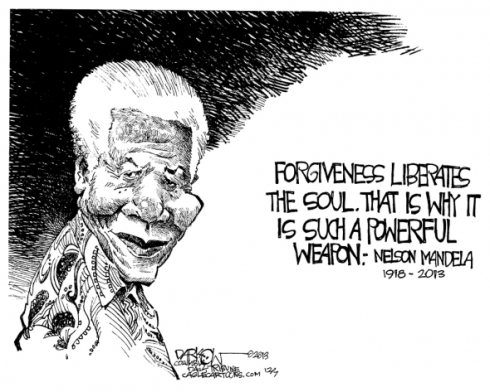
Mandela ForgivenessOn the weekend, Dylan Farrow published a piece in the New York Times recounting her experience of childhood sexual abuse allegedly perpetrated by her mother’s then partner, Woody Allen.

There was, predictably, an explosion of views on the matter. What caught my attention were the many observations that child sexual abuse is ‘unforgivable.’ As one who has lived through childhood sexual abuse, I find that assertion offensive, ignorant and entirely unhelpful, and I’m about to explain why this is so.

But before I do, there ought not to be any expectation for anyone to forgive injury. Forgiveness is an action that, if embarked upon, can take years to complete. It may never be completed. It may never be begun. I’m writing about my own experience as it has unfolded over many years, and what I needed to do for my own well-being.

What is meant when people talk about forgiveness?  The philosopher Charles Griswold, in his 2007 book Forgiveness: A Philosophical Exploration, states that forgiveness should be understood as:

…a moral relation between two individuals, one of whom has wronged the other, and who (at least in the ideal) are capable of communication with each other. In this ideal context, forgiveness requires reciprocity between injurer and injured. I shall reserve the term forgiveness for this moral relation.

I am in complete disagreement with this definition. Many situations of  injury are such that it is impossible and/or entirely unwise for an injured party to communicate with a perpetrator. Many perpetrators never concede their actions have caused harm. Griswold’s paradigm excludes many from the possibility of engaging in the process of forgiveness, as he admits:

When none of the conditions is met, the threshold of what will count as forgiveness is not crossed;sadly, and painfully, in such cases we are either unforgiven, or unable to forgive.

My own perspective is a secular one, and I think of forgiveness as perhaps belonging in the human rights discourse rather than the religious, or any crypto-theological morality such as that espoused by Griswold.  When I have foresworn all desire for revenge, and any of the other abuses of resentment, I have forgiven. It is irrelevant if the perpetrator knows this or not, unless it is important for me that he/she does.

I don’t believe forgiveness requires the perpetrator’s remorse. I don’t believe an injured person needs to confront a perpetrator, or continue any association with him or her, in order to forgive them. Most importantly, I don’t believe forgiveness is first and foremost for the benefit of the perpetrator, but rather it’s a state of mind that can finally bring relief and freedom for the injured party from cripplingly painful and destructive emotions.

Which is not to say there’s anything amiss if an injured party chooses to confront their perpetrator. Only that this is not necessary for forgiveness.

I see forgiveness as a human rights matter because acts of revenge that cause suffering to another are always a human rights matter. …Using the suffering of a person or persons to satisfy oneself is morally objectionable, because it amounts to the treatment of wrongdoers as a means only, failing to respect their human worth, writes Trudy Govier in her book Forgiveness and Revenge. At the height of extreme pain caused by injury, it’s difficult if not impossible to think of the perpetrator as having any ‘human worth,’ however in order to inflict injury on me, the perpetrator has already used me as if I have no human worth. Am I to become like him/her? How will that help me?

While it’s perfectly acceptable for anyone to say ‘I would find that injury unforgivable if it were inflicted on me,’ it is not acceptable to apply that judgement to another. The state of non forgiveness is a horrific state in which to spend one’s life. Having been grievously injured by an abuser, is one then expected to suffer the agony of everlasting hurt and desire for a revenge that cannot possibly ever be commensurate with the injury? The desire for revenge, the inability to forgive (if we understand that term to mean the relinquishing of such desires) fixes the victim in their trauma and denies her or him the possibility of a life free from the aftermath of injury. The victim is trapped in a relationship of horrible and unwanted intimacy (for abuse is always intimate) the only escape from which is to forgive. Why, then, would anyone cruelly claim there is such a thing as an ‘unforgivable’ offence?

I will never forget, but I must, if I’m to have any life at all, forgive. The injurious act, as Hannah Arendt points out, is irredeemable, it presents us with …the predicament of irreversibility. This is but one of the challenges facing an injured person. The injury cannot be undone, the life-altering impacts cannot be undone, one is forever changed by the experience of being injured, the life that might have been, perhaps should have been is stolen, and one will never forget. As well as grieving the injury, I grieve the loss of who I would have been had this injury not occurred, a particularly difficult process for those injured while children, who can feel their childhood was destroyed by the actions of an adult.

Judith Butler, in Giving an Account of Oneself, The Spinoza Lectures, suggests that …it may be that the very way we respond to injury offers the chance we have to become human. Commensurate punishment or revenge dehumanises the victim of injury, however what humanises her/him is the opportunity to develop ...a model of ethical capaciousness that understands the pull of the claim, and resists that pull at the same time, providing a certain ambivalent gesture as the action of ethics itself.

What I understand Butler to be saying here is that in the space of uncomfortable tension creating by opposing claims (to punish or to abstain from punishing) the injured party has the opportunity to learn to live with powerful and irreconcilable desires and in so doing, move beyond the ‘unforgivable’ into a life free of revenge and its abuses.

In so doing, I am empowered. In contrast, if the injury done to me is deemed ‘unforgivable,’ I am condemned to a life of ongoing disempowerment, in which my actions are forever governed by my desire for revenge, and my bitter hatred of the one who has done this thing to me.

Commensurate punishment of a perpetrator may frequently be impossible. However, forgiveness …becomes possible from the moment it appears impossible. Its history would begin… with the unforgivable…what would be a forgiveness that forgave only the forgivable? asks Derrida.

Forgiveness must rest on a human possibility – I insist on these two words… he continues. Injury is a human action, the rape of a child takes place in the realm of human affairs. Monsters do not sexually abuse children, humans do. Forgiveness arises in the recognition of our common humanity, and the terrifying capacity for injury and destruction that humanity contains.

So this is why I object to child sexual abuse being described as ‘unforgivable.’ If I tell you I have forgiven, do you then tell me I’m deluding myself?

Do you tell me it is impossible for me to forgive what was done to me, and I don’t know what I’m talking about? Do you disempower me yet again with your opinion? Do you know better than I know myself what my life’s struggle has been? Would you have me lose my life to emotions that destroy my freedom, while affecting my perpetrator not one bit?

If I decide that what was done to me is unforgivable, though I may, at times of great distress, use that term, I am terminating all hope of freedom. Forgiveness is a mystery, beyond the reach of justice and punishment, both of which can be, and often are, incommensurate with the injury inflicted.

So let us speak of the mystery of forgiveness. Forgiving is imperative…it is extremely difficult to forgive. I don’t even know if forgiveness exists. Hélène Cixous

Toxic, online and feminist. Really?

30 Jan

 I vividly recall highly emotional encounters with radical separatist women when I was a young feminist, one of whom was my actual sister, on the matter of my then dedicated heterosexuality (synonymous with offering myself up for rape with every sexual act) my disappointing failure to give birth to girl children, the length of my hair, (blonde, which somehow made it worse) my choice of clothing, and my marital status, all of which, it appeared, conspired to brand me a traitor to feminism, and an unreconstructable victim of the patriarchy.

My sister was conflicted, after all we loved each other in our own fraught ways, to the extent that when I decided to give birth to my second child in a bean bag in the sitting room, she wanted to not only be present but to set up her tripod between my legs and record the whole event, including my feminist midwife bringing me to orgasm because she swore it would help. It did.

Never mind, my sister said consolingly, when a male infant fought his way into the world from between my thighs as her camera furiously clicked above both our groans and wails, pity it’s not a girl, but you can’t help it. Her photos I count as among my most precious possessions, and I store them along with vital documents, readily accessible in the event of catastrophe.

In spite of our differences, my sister and I managed to maintain our relationship throughout those tumultuous years of second wave feminism. She was delighted, politically, when I divorced, though somehow she managed to sincerely comfort me and help me with my boys. I nursed her through a massive betrayal by her girlfriend, and, even though I was shocked beyond belief and not a little annoyed considering the shame she’d heaped upon me, into her new relationship with a bloke.

I lost contact with the other radical separatists because I was eventually unable to tolerate their scornful disapproval, and one day a wise woman told me I didn’t have to. This is not to say I don’t owe them: I do. They were some of my most powerful teachers, even if their manner was not always tender. However, whatever our differences we all had one thing in common: our whiteness.

All this came back to me today as I read this essay by Michelle Goldberg on feminism’s current Twitter wars. Briefly, Goldberg writes of a “toxic” online culture comprising an ideological war between white feminists and women of colour, a war of such ferocity that some writers describe being afraid to publish for fear of incurring the wrath of “online enforcers” protesting the domination of feminism by privileged white people. There is, Goldberg writes, “…a nascent genre of essays by people who feel emotionally savaged…not because of sexist trolls, but because of the slashing righteousness of other feminists.” People who feel themselves to be marginalised by white privilege complain of the “tone police” who punish them for their anger, and their methods of expressing it.This, in turn has led to “privileged” feminists fearing they are about to step on an ideological landmine, that they will be “insufficiently radical, too nuanced,” as a consequence of their racial privilege.

Next, I read one of the “nascent” essays, written by Glosswitch of the New Statesman, in which the author makes an impassioned argument for not capitulating to what she feels as intimidation from feminists who attempt to trash her. Glosswitch has even coined a term for such a feminist, the misogofeminist, who she believes misrepresents and abuses her online because “…1. I’m a woman and 2. I have a New Statesman blog and am therefore considered excessively ‘privileged.'” White privilege, Glosswitch continues, is “…a line you cross which makes you less credible, less capable of experiencing pain and less capable of acting in good faith.” Glosswitch is supported in her position by Helen Lewis, also of the New Statesman.

I next turned to the Red Light Politics blog. Here I found a post titled “‘Misogofeminists’ and the white men who profit from silencing critique.” The author takes umbrage at Helen Lewis “…equating critiques from Women of Colour to bullying, harassment and now codifying all this behaviour under a new umbrella term ‘misogofeminism,’ or in lay terms ‘when uppity Women of Colour and other marginalised minorities complain that mainstream publications contribute to their marginalisation.'” There follows a deeply interesting analysis, that I strongly recommend, of the misfortunes of the New Statesman and how the publication was pulled back from the brink of ruin by, of all things, feminism, with a link provided to an Independent piece on the topic that begins:

In the New Statesman’s darkest hours, when the venerable leftist periodical looked like it had no viable future, few would have seen feminism as the source of its salvation. It is an ideology aligned, in the minds of many, to the bra-burning and peace-camp protests of a gender politics which predated Tony Blair’s modernisation of the Labour Party. Why would a magazine that was attempting to be relevant in the 21st century return to the battlefields of a bygone era?  Yet it is feminism which ensures that the New Statesman has not only made it to its centenary but can celebrate that anniversary this week with confidence that it has the caught the attention of young readers, especially young female readers.
It is this conflation of white women such as Lewis and Glosswitch with white men such as the proprietor of the New Statesman, that Red Light Politics argues creates a feminism that perpetuates  and reproduces a centuries-old pattern of marginalisation of Women of Colour. How better to perpetuate this marginalisation than by accusations of bullying and harassment made by privileged women with the kind of platform no marginalised woman can ever dream of? How is a marginalised woman to contest such allegations?
Prior to her employment at the New Statesman, Lewis worked at the Daily Mail. During her time at the Mail, the Statesman published a scathing assessment of that paper’s tactics:
The Mail’s quest to reflect the moral and political values of its lower-middle-class readers frequently goes beyond mere reporting, taking on the shape of a punitive campaign against anybody who says or does anything that challenges those values.
Challenges to one’s ideology are not synonymous with abuse. Anger is not synonymous with abuse. Critique is not synonymous with abuse. Being called on one’s obvious privilege is not abuse. Even “slashing righteousness” is not necessarily abusive. While it certainly isn’t pleasant to be identified as racist, transphobic, privileged or offensive, some of the accusations levelled at Glosswitch, is it automatically abusive? Glosswitch has an enviable platform, supported by powerful media males, from which to refute such allegations. This is part of her privilege, a privilege I can find no real acknowledgement of in her complaints.
Megan Murphy complains of the “wilful misrepresentation of words, thoughts, arguments and life in order to silence you and beat you…into submission…” by feminists who challenge privilege, described by Murphy as “trashing.” She also expresses indignation at being “…expected to divulge every single horrific trauma… before we are acknowledged as credible or worthy of a voice.”
I find this latter grievance extraordinary. Women who have experienced horrific trauma rarely enjoy a public voice. We are speaking here of women with an extraordinary platform, elite women, if you will, women with very big voices who are established in their professions and of whom no one will demand an accounting of their personal traumas as a pre-requisite for expressing opinions that are globally received.  All of the women I quote are white.  All are successful career feminists. I have yet to hear of a successful white career feminist who was forced to reveal her private trauma in order to get her foot on the ladder.
Sadly, but probably inevitably, things have not changed much in feminism since I was a beginner. Feminism is an ideology, and all ideologies are battlegrounds.  I will likely be crucified for this next observation, but there is something in the complaints of the privileged documented here that puts me uncomfortably in mind of the Andrew Bolt school of  white resentment. I am of the belief that in spite of the difficulties of my life, they would have been much worse if I’d been born a woman of colour as well. I’m not usually inclined to advocate a hierarchy of suffering, and I admit my own experiences have toughened me considerably on the question of what is and isn’t abuse. So my sympathies do not naturally gravitate to privileged women with global platforms supported by capitalist press barons. Their power is immense. I doubt the marginalised will do them much harm.  
My thanks to @MsLou and @Sunili for links to these and many other pieces, and discussions over the last months.

The Ministry of Degradation

23 Jan

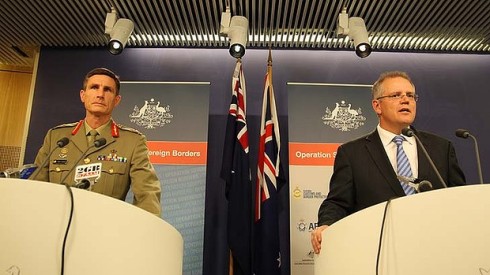
Operation Soverereign BordersThe history of treatment of asylum seekers who arrive by boat in Australia is a grim one, and both major parties have employed increasing degradation as a means to control, punish, and “deter” those who seek refuge here.

Even if one accepts the false narrative created by both the LNP and ALP that asylum seekers are “illegals” who are committing a criminal act in arriving by boat, this does still not explain or justify their degradation. If boat arrivals have indeed committed a crime, why aren’t they dealt with by our legal system, as is every other person accused of a crime in this country?

In a recent poll, a majority of Australians apparently feel asylum seekers are not treated harshly enough. Obviously the major parties are responding to the electorate’s need for gratification and reassurance through the degradation of a group who are despised by many voters. This can be seen as a chicken and egg situation: politicians post Pauline Hanson realised the advantages of pleasing xenophobic punters, and have since been at great pains to adjust their policies accordingly.

No matter what views one holds on asylum seekers, demanding their increasing degradation is to take a dangerous trip to the dark side. Any government willing to instigate and maintain those degradations ought to give rise to alarm. Whether it’s boat arrivals or the degrading treatment of bike riders in Queensland, any government that opts for degradation as a means of control is a government that has truly lost its way.

The Ministry of Degradation, currently overseen by Degradation Minister Scott Morrison, has been in existence for over a decade, and both major parties bear responsibility for its increasingly despicable treatment of asylum seekers. Railing against this Ministry achieves nothing. Speeches about every individual’s right to human dignity have achieved nothing. Appeals to compassion have achieved nothing. Still politicians drag us ever further along the dark road of degradation as an acceptable means of protecting our society. It isn’t. It never will be.

The only possible course of action is to persist with the contestation of the Ministry’s narrative, with facts, reason and unrelenting determination. It is not acceptable for our country’s government to treat asylum seekers who arrive by boat in a degrading manner. If the government believes asylum seekers have broken our laws, the government must employ our legal system to seek redress, not impose arbitrary punishment in the form of  deliberately degrading practices.

I don’t expect my government to contribute to the destruction of the civilised society we struggle to create and maintain. I expect my government to lead and assist us in this project. We can do a whole lot better with our asylum seeker policies. But as long as we have a government committed to the degradation and destruction of others as demanded by the vengeful, we can’t flourish. Degradation can’t be contained. It contaminates everyone.

On the Aldi shirts

9 Jan

I agree with Tom Calma on the matter of the t-shirts marketed by Aldi and Big W to celebrate Australia Day. The former Race Discrimination Commissioner does not believe the design to be ‘intentionally racist’ but:

“What we can say is that it is not accurate, is bad taste and does not in itself lead to an understanding of Australia’s history and heritage,” he said. “In the lead-up to Australia Day it is important that we educate the community, the nation and the international community about what Australia Day celebrates.”

However, I think we’ve reached the use by date of the argument ‘not intentionally racist.’ There’s no possible excuse for anyone who is at all engaged in daily life in this country to be unaware of racism,and ignorant of its myriad manifestations. If they are, they are likely intentionally unaware, because you’d have to be living under a rock to not notice the everyday racism to which Indigenous people are subjected.

‘We didn’t mean to be racist’ is the pathetic bleat of a lazy privileged twat. How could those shirts not offend, with their logo stating that Australia was ‘established’ (in itself crap, we weren’t a nation till 1901) in 1788 when white people invaded, leaving a trail of slaughter and tragedy whose aftermath resonates to this day, in their wake?

Incredibly, the shirts were approved by the Department of the Prime Minister and Cabinet, in July 2013.

What the fucking fuck?

If you ‘don’t mean to be racist’ then fucking educate yourself, and maybe you won’t be. This is the prime responsibility of the privileged. If you are fortunate enough to have been born into the dominant culture, fucking educate yourself about those who are not, and what that means.

But don’t bloody bleat ‘I didn’t mean to be racist’ or ‘I didn’t mean to be sexist’ or what the fucking what. Just learn.

That is fucking all.

Asylum Seekers not treated harshly enough, say vengeful Australians.

9 Jan

TONY ABBOTT ASYLUM SEEKERS PRESSERAccording to a poll reported in The Age yesterday, 60 per cent of Australians surveyed want asylum seekers arriving by boat treated more harshly.

59 per cent of those surveyed oppose government welfare for refugees.

Although there is a strong perception that boat arrivals are not ‘genuine refugees,’ in fact 99.7 per cent of asylum seekers from Afghanistan held on Christmas Island were assessed as refugees, as were a further 96 – 98 per cent from Iraq, Iran, and Burma.

The efforts of both major parties to reframe asylum seekers as illegal and threats to the country’s sovereignty, appear to have succeeded.

The chilling reality is that the majority of boat arrivals are fleeing conditions so severe that they are willing to undertake such a journey rather than remain in a country where they are at great risk, yet the majority of Australians, if the poll is to be believed, wish to see them further tormented when they arrive here.

Apparently the majority of Australians have a crippling lack of imagination coupled with a complete lack of desire to consider circumstances that drive others to flee their homes and beg for refuge at the other side of the world. Worse, they want asylum seekers treated more harshly than they already are when they arrive, a desire that borders on the psychopathic.

I suppose it is still possible to deal out harsher treatments, but people might die and that would be awkward.

The argument is frequently made that our treatment of asylum seekers is ‘inhumane.’ Asylum seekers are human beings, just like us, and because of that are entitled to as much consideration as we afford ourselves. This argument is obviously falling on deaf ears. According to the poll results, the majority of Australians lack any concept of a common humanity from which notions of equality and rights  spring.

Actually, it’s worse than that. They also want to harshly punish the suffering for bringing their suffering here.

My impulse is to beat such people around the head with a stick until they beg for mercy and flee, seeking refuge from my persecution. Of course that would achieve nothing, but it’s a gratifying fantasy. The minds of those so opposed to decent consideration of refugees’ circumstances are unlikely to be changed by any intervention, kind or unkind. However, the good news is 68 per cent of the 60 percent of Australians hostile to refugees are over 70 years of age, so they’ll hopefully cark, or become too demented to vote, and be replaced by saner minds.

Challenging such entrenched ignorance and lack of imagination is a formidable task, and those who undertake it haven’t made many inroads so far, though not from lack of effort.  Asylum seekers are now treated more harshly than they were nearly two decades ago. It was possible then for anyone who was prepared to jump through bureaucratic hoops to visit detention centres. This is no longer the case, and asylum seekers are almost entirely isolated off-shore, from those who would otherwise give support and assistance. This is still not sufficient for vengeful Australians. That their water is ridiculously rationed is not sufficient. That their medical care is below decent standards is not sufficient. That the children are imprisoned, that the latrines are foul, that many have no shoes, that we force them to suffer in high temperatures while offering no relief, that they live in an emotional and psychological limbo sure to destroy what their original persecutors didn’t manage to destroy, no, none of this is sufficient. Our vengeful Aussie majority want them treated even more harshly, which to my mind can only be putting them to death. Painfully.

I don’t think there’s any point anymore in speeches about our inhumanity to other humans. Frankly, not enough of us give enough of a shit about our common humanity, and the quaint notion that if you cut us we bleed just like you.

What, then,  is to be done?

Abbott dumps on low income Australians from the ski fields of France.

30 Dec

There can be no doubt that the proposed government tax of $6 on visits to the doctor will only seriously affect those already struggling to keep heads above water, and one has to ask, why would any government decide to make things even more difficult than they already are for a considerable number of its citizens?

Pensioners and those holding concession cards will be exempt from the charge, however, this exemption does not cover low-income earners ineligible for such assistance.

The proposed GP tax is intended to be  “a simple yet powerful reminder that, as far as possible, we have a responsibility to look after our own health, not simply pass on all the costs of, and the responsibility for, caring for ourselves to fellow taxpayers…” reads the report provided to the government by The Australian Centre for Health Research, a conservative think tank, why am I not surprised.

Of course those of us who are able ought to take as much responsibility for our health as possible, and visiting the doctor when ill is taking responsibility, whether we’re well off or not. There is little more irresponsible than self-neglect, except of course a government that places a group of its citizens in a situation where self-neglect becomes their only option.

As is usual with conservative think tanks, no allowance is made for those who are as morally responsible as anyone else, but lack financial means.  One could be forgiven for taking this one step further, and assuming conservative think tanks and their masters conflate a lack of means with moral turpitude and its attendant irresponsibility. The outcome of such thinking is that those who are too poor to pay for their own health care really should be left to die, as there is no place in a conservative world for anyone who can’t, for whatever reason, fund their own lives.

As the purpose of the new tax is to relieve the burden of demand on our health care system, conservatives are obviously of the opinion that it is the less financially fortunate among us who are burdensome. No middle class individual goes to her or his GP unnecessarily, it is assumed, as a mere $6 is unlikely to dissuade them from this practice. No, only the poor are responsible for draining our medical resources, presumably because of all the burgers, fries, & coke they consume instead of the healthy food they could afford, if only they would stay home from the doctor’s long enough to put their minds to their budgets.

Obviously a $6 charge whenever one visits the doctor isn’t going to be an oppressive discouragement for those who are reasonably well off, though depending on one’s state of health and number of children, it could quickly add up. However, if finances are already stretched in a household, an additional $6 for every doctor’s visit could conceivably lead to a decision not to make that visit in circumstances where it’s necessary.

It will almost certainly lead to increased pressure on already stretched hospital accident and emergency facilities, as an option for those unable to afford the tax.

That a government even considers creating a situation in which any citizens are discouraged from attending to their health and the health of their children is an obscenity. The message Prime Minister Abbot is sending from the slopes of the French Alps where I understand he and his family are enjoying a ski ing holiday, is that below a certain level of income, the health of Australian citizens is of no interest to him and his government. It is, it seems, incomprehensible to the leader of this country that for many people there is simply not $6 to spare.

Such failures of imagination are predictable in a politics in which middle class welfare and protection of the wealthy are the priority of government that increasingly appears to govern in their interests.

Or as Gerry Harvey unforgettably expressed it when offering his views on charity for the homeless:

“It might be a callous way of putting it but what are they doing? You are helping a whole heap of no-hopers to survive for no good reason. They are just a drag on the whole community.

“So did that million you gave them help? It helped to keep them alive but did it help our society? No. Society might have been better off without them but we are supposed to look after the disadvantaged and so we do it. But it doesn’t help the society.”

It’s a slippery slope you’re ski-ing Mr Abbott.

Marriage equality: what is it good for?

8 Dec

Marriage Equality

I realised during an enthusiastic debate on Twitter yesterday with @amicus_AU and @chronicfemme on the question of marriage equality, that apparently both ends of the continuum fear that same-sex marriage will result in an apocalypse for their cause. Marriage conservatives fear equality will bring about the death of marriage in an inexplicable metaphysical erosion of heterosexual values, while some in the queer community fear it will bring about the death of queer, as queer couples reject the radical demand to abolish state-sanctioned commitments altogether, and instead seek acceptance within the heteronormative paradigm of marriage.

The marriage equality debate inevitably becomes conflated with the debate about the institution of marriage, which is unfortunate, to my mind. They are two separate and equally important issues, and neither is done justice when they are intertwined.

Nobody wants the state in their bedroom. It is not the state’s business whom one chooses to marry, or live in a de facto relationship with. At the same time, when such arrangements break down, there must be protections in place for the wellbeing of vulnerable parties, usually women and children under current arrangements, who are likely to come off second best in serious matters such as property settlements, child support, access to a parent and all the other miserable detritus that commonly litters the personal landscape when things go wrong.

Humans being what we are, and being even more what we are in times of relationship breakdown, many of us cannot be trusted to behave reasonably when we are in the grip of extreme emotion provoked by the collapse of hope and future and the losses involved. We need laws at these times, and state-sanctioned relationships provide us with these laws.

If the argument is for no state involvement at all then we cannot argue for recognised de facto relationships either, as these are also governed by the state at times of breakdown, though not in precisely the same way as is marriage.

If it is heteronormative for queer couples to marry, is it also heteronormative for them to be covered by the protections offered to de factos?

Are queers arguing against marriage equality actually arguing that creating a couple is heteronormative? This is to my mind an interesting argument, and one that takes us into the fascinating territory of theories of constructed desires, et al, however, in practice as a society we have to contend with coupledom and its consequences for the vulnerable being currently rather more in our faces than theories of desire, and requiring our urgent practical attention.

Which is not to say people shouldn’t think about these things if that is our inclination, and radically interrogate entrenched norms.

I’m at a loss to imagine a system of relationship in which the state is not involved. It cannot be left up to individuals to fairly sort out the messes that occur when intimate relationships break down. Therefore, it is absolutely unjust for that protection to be denied to couples other than the heterosexual. There is simply no valid argument to deny marriage equality: every human being is entitled to the same protections, regardless of sexual orientation.

If you don’t “believe” in the state having anything to do with your relationship, don’t call upon its laws to protect you if your relationship breaks down. Find a radical new paradigm, rather than simply calling for our current arrangements to be abolished. I haven’t heard or read any discussion of viable alternatives that can achieve what state intervention achieves when marriages and de facto relationships collapse, and people have to salvage what they can of their lives and the lives of any children involved.

As for the supernaturally destructive powers invested in marriage equality by opponents of all kinds: if your ideology is so fragile that people loving each other in the manner they choose is going to destroy it, maybe it’s time to find a new ideology?