Archive | Society RSS feed for this section

Dear Mr Turnbull. With regard to respect.

29 Oct
Counting Dead Women. Destroy the Joint

Counting Dead Women. Destroy the Joint


For quite some time now, you’ve been speaking in mellifluous tone on how lack of respect for women is at the root of violence towards us, with particular reference to domestic and family violence.

There are times when listening to your respect defence I imagine I’m in a courtroom. Your political rhetoric is in the nature of a legal argument, designed to convince, persuade and coax a jury into accepting your narrative, and so extend leniency to your client.

Perhaps I might stretch the analogy and describe your client in this instance as The Perpetrator of Domestic Violence. Your Honour, he is not a bad man, he merely needs to be taught how to respect women, at least sufficiently not to kill them.

I assume you believe that you are respectful of women. I don’t believe you are. I believe that to be respectful of anyone requires not only rhetoric but action, that is, doing everything you can for them when you see they are being mistreated by others. Failure to do this is, in your terms, disrespectful. In mine, it is criminally neglectful.

Action has a two-fold effect, Mr Turnbull. It assists the woman under attack, and it demonstrates to the perpetrator how respect is  a practice as well as a theory.

You are in a unique position to walk your talk in the matter of respect, yet you seem to be running on the spot.

If you truly respected us you would make funding available for the frontline services we so desperately need to save our lives, our health, our well-being and our children’s well-being when we are faced with a violent man who will harm us, and/or kill us. That would be respectful of you, Mr Turnbull.

That you continue to refuse to make this money available is an act of extreme disrespect for our well-being, and for our very lives.

If you truly believe that lack of respect for women is the root cause of the domestic violence perpetrated upon us, then as leader of this country you must demonstrate active respect for us, if you sincerely want to bring about change. Otherwise you are on the side of the perpetrator.

In depriving us of refuges, community legal centres and ongoing specialist services to assist us and our children to recover from unspeakable trauma, you are signalling to the perpetrators that they are free to continue their savagery, and not only are they  likely to get away with it, they are enabled by you to continue, as we have no avenues of escape.

If our government cannot respect us enough to provide the assistance we so desperately need, why should a perpetrator?

I think it was Leo Tolstoy who wrote that respect was invented to fill the place where love should be. His heroine, Anna Karenina, died at his authorial hand, like so many of us die at the hands of the men who control the narrative. You are the man who controls our narrative. You have the power to change our stories. All that is required of you is that you respect us enough to provide resources for our shelter, protection and assistance.

Until you can do that, Mr Turnbull, your rhetoric of respect is a lie, and you, sir, are a liar.

Sincerely, Survivor.
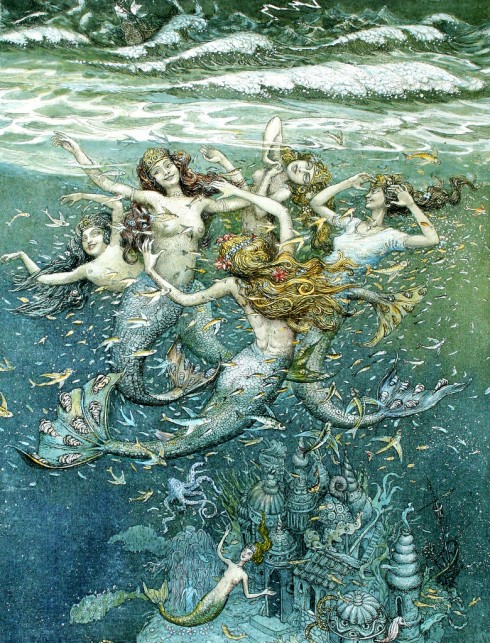


The Little Mermaid. An allegory.

28 Oct

the-little-mermaid

by Hans Christian Anderson.

Like her sisters before her, the Little Mermaid is only allowed to rise to the sea’s surface when she turns fifteen. It’s a rite of passage for mermaids, an experience that marks their coming of age.

When it’s the Little Mermaid’s turn to view the lands above the sea, she witnesses a handsome prince fall from his ship in a storm and saves him, carrying him in her arms to the shore where he lies unconscious. As the Little Mermaid watches from the ocean, a beautiful human approaches the Prince who awakens, and briefly glimpses the girl he believes has saved him.  The Little Mermaid is very sad that the Prince doesn’t know he owes his life to her, and realises she has fallen in love with him.

The Little Mermaid is very discontented when she returns to her ocean kingdom and her family. She asks her grandmother if she can be immortal, like humans, but her grandmother tells her no, the only way for her to attain immortality is to be loved by a man more than he loves his mother and father. Then the man must marry her, and when he does, his soul will enter her body as well as staying in his own, and the Little Mermaid will attain immortality from their shared soul.

I want to be a human, cries the Little Mermaid, and marry the Prince I saved from the sea! Then I will be with the one I love and he will give me my soul!

Don’t be silly, her grandmother remonstrates. We mermaids live far longer than humans anyway.

But the Little Mermaid will not be dissuaded. She visits the Sea Witch and asks for a spell. The Sea Witch pulls no punches, and tells the Little Mermaid she is both stupid and doomed. However, says the Sea Witch, it is possible to replace her mermaid’s tail with human legs and feet if she insists, but there’ll be a price.

I don’t care about the price, declares the Little Mermaid. If I can be with my Prince and he gives me my soul no price is too high.

All right, says the Sea Witch, I will make you a potion. When you drink it will be as if you are swallowing knives. Then you will lose your tail, and grow human legs and feet. But every time you walk it will be as if you are walking on beds of broken glass. The pain will be excruciating.

And there’s another thing, continues the Sea Witch. I want your beautiful voice as payment, so you won’t be able to either speak or sing.

Take it! cries the Little Mermaid. I want only to be with my beloved Prince and for us to share our soul!

And you can never come back, says the Sea Witch. You can never again be a mermaid. And if he marries another your heart will break and you will become sea foam on the crests of the waves.

Wait, says the Little Mermaid. What will the Prince love about me if I have no voice?

Your beautiful form, your graceful walk and your expressive eyes will enchain a man’s heart. You don’t need a voice, says the Sea Witch. Come here and I’ll cut out your little tongue.

The Little Mermaid loses her tail and grows human legs and feet. It is just as the Sea Witch has promised: every step she takes is agonising and she has no voice with which to cry out her pain. She finds her Prince and he is indeed enchanted with her. Most of all he loves to watch her dance and she performs for him endlessly even though her pain is excruciating. He isn’t at all concerned that she cannot speak: as long as he can look at her and watch her graceful movements.

But even though the Prince is enchanted, he has refused to marry anyone other than the beautiful girl he believes rescued him from the stormy seas. He has vowed to spend his life, if necessary, searching for her. The Little Mermaid is unable to tell the Prince it was she who saved him, so she continues to perform for him every day, and at night sleeps outside his door on a velvet cushion.

One day the Prince finds the girl he thinks saved his life, and in due course they marry. The Little Mermaid is broken-hearted. It is the end of her life, and she has not even gained an immortal soul. Then suddenly her sisters appear in the sea below the palace. They’ve brought her a knife, obtained from the Sea Witch with instructions that if she kills the Prince as he sleeps she can reclaim her tail, and become a mermaid again.

But the Little Mermaid cannot kill her Prince and so she dies and becomes sea foam on the crests of the waves.

The End.


Letting loose the inner Trump

21 Oct

trumps-promise-to-women


The footage of Republican presidential candidate Donald Trump’s bus ride with Billy Bush in which he owns sexual assault as his preferred method of engaging with women he finds desirable, led to a tsunami of accounts by women who’ve been similarly treated when men let loose their inner Trump.

Journalist Karen Middleton published her account of sexual harassment and assault by MPs and male colleagues in The Saturday Paper.

Leah McElrath broke down Trump’s non-apology for his actions into a series of astoundingly succinct tweets every woman should print out and stick on the fridge as a guide to common manipulative tactics used by abusers.

In fact, Trump has done all of us a great favour. His global performance of alpha male entitlement has given us a textbook example of predatory male behaviour, without us having to bother reading the textbook. He’s created an atmosphere in which women in our millions can comment on our experiences of such behaviour and, in many instances for the first time, give it a name. He’s outed both himself and the toxic masculinity from which predation springs in a way nothing and nobody else could. For this we can be relieved. There can no longer be any doubt that to adherents of that toxic masculinity, women are prey.

Trump also sorted something that has deeply troubled me for the last couple of years. I’ve written on this blog and elsewhere about my childhood sexual abuse and the PTSD that is its consequence. So when I met online friend David in person for the first time I knew he knew my history. When he asked me about it in the cafe I was discomfited: it seemed neither the place nor the time, however, part of my psychological damage from that time is that in certain circumstances I’m unable to make an assessment of my own best interests, so I briefly answered his questions and also told him of my lifelong struggle with PTSD.

When we left the cafe David grabbed me, pulled me to him, kissed me and put his tongue in my mouth. It was one of those moments in which you can’t get a handle on what is actually happening because what is happening is so unlikely. Then it’s over.

I’ve never been able to make sense of why, only moments after listening to an account of prolonged childhood sexual abuse and subsequent lifelong PTSD, a man would grab a woman he’d just met and put his tongue in her mouth.

Until I read a discussion between Donald Trump and Howard Stern. Troubled women, Trump asserts, deeply, deeply troubled women, give the best sex:

She’s probably deeply troubled and therefore great in bed. How come the deeply troubled women, you know, deeply, deeply troubled, they’re always the best in bed?”

Stern said damaged women are “looking for love, they’re looking for positive affirmation, they’re looking for a father figure who will love them and tell them they’re wonderful and they’ll never be enough.”

Well I have a friend, Howard, who’s actually like a great playboy, I mean, I don’t say this about men, this guy does very well, Trump said. He runs silent, runs deep as they say, like a submarine. He will only look for a crazy women. He says, ‘Donald, Donald, please, please, I only want the crazy women.’”

“They’re desperate,” Stern said.

Reading this exchange was like an epiphany. I understood why David had been so overwhelmed by desire he’d felt compelled to grab me and stick his tongue in my mouth, even though you’d hope a man might think twice about violating a woman who’d just spoken about childhood sexual abuse and lifelong PTSD.

But hey, a deeply troubled woman can turn loose a man’s inner Trump, and he can’t help himself  he has to grab her and stick his tongue in her mouth.

Vulnerability turns him on. Damage turns him on. It’s deeply, deeply sexy.

It’s a relief, really, to have my experience explained by Trump and Stern. It’s a relief to know it’s a predator’s thing and how else would we know so publicly, so accessibly, unless men like Trump and Stern shared their opinions?

We’ve known for a long time that women who experience childhood abuse are highly vulnerable to re-traumatisation. But I doubt it’s ever been so clear that this is because there are men who seek us out, specifically because we’ve been damaged.

Think on that, if you can bear to.


You’re gonna make me lonesome when you go

14 Oct

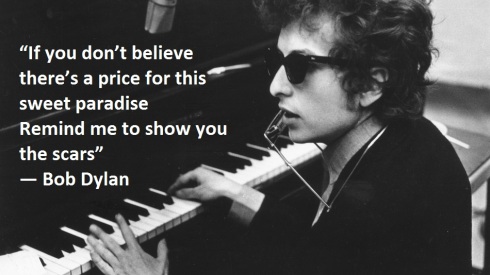
bob-dylan


We’re having dinner at the Molong pub on our way to Canberra, and then to the Snowy Mountains for a month.

We’ve been driving for nine hours on the back roads, avoiding motorways and highways and listening to Bob Dylan because today he won the Nobel Prize for Literature and we’re stoked, and we need to revisit everything he’s ever sung, which you can’t actually do in nine hours but we’ve given it our best shot.

There’s an entertainer at the pub, he’s a little stout and red-faced with silver chains round his neck and he’s singing stuff like The Proclaimers I’m on My Way, and Elvis’s Suspicious Minds, and Joan Jett’s I love Rock n’ Roll, and there’s a woman wrapped around the verandah post, leaning over the singer and going “uh huh” every now and then in relation to pretty much nothing. She’s a little pissed and pretty happy and the singer’s trying to pretend she isn’t there. The sun’s gone down, it’s getting chilly in the beer garden and I wrap myself in a woollen shawl, drink another glass of wine, and consider asking the act if he’ll sing some Dylan.

As stoked as I am by Bob’s win, I’m also sad because if there’s one thing my beloved husband would have wanted to live long enough to hear, it’s that Dylan won the Nobel prize. Babe, if you can hear me, you were right.

Dylan was part of the soundtrack of our decades-long love affair, and Arnie’s knowledge of the man was encyclopaedic. He did a radio show on Sunday afternoons on 2SER just about Dylan. We went to every concert we could, and we only ever walked out of one, at the State Theatre in Sydney when Bob’s performance was so excruciatingly late and then so excruciatingly bad, even we couldn’t hack it. Something to do with drugs in the dunny, I don’t know.

I don’t ask the performer at the Molong pub to sing some Dylan, instead we walk back to our motel and eat chocolate and drink green tea in bed. I’m trying to think of which song was ours, Arnie’s and mine, but that’s the thing about Dylan: there was a song for every shifting phase, even the dark ones, maybe especially the dark ones.

Arnie always came back to You’re going to make me lonesome when you go as his song to me. Which is ironic, because in the end he went and I’m still here and still singing:

I’ll look for you in old Honolul-a
San Francisco, Ashtabula
You’re gonna have to leave me now, I know
But I’ll see you in the sky above
In the tall grass, in the ones I love
You’re gonna make me lonesome when you go

I know there’s all kinds of arguments against the Nobel prize for Bob Dylan. Some of them I probably even agree with. But I don’t care. What he wrote decades ago, personal and political, is as applicable today as it was then, his body of work is vast and varied, and I’ve never anywhere come across images of the kind Dylan comes up with.

As Mick Jagger said, Thank you Bob.


The debate that told us all about about sexism. In case we weren’t sure.

11 Oct

trump_debate_stalk_rtr_img


It’s difficult to imagine a man finding himself in the same position as did Hillary Clinton in the second debate yesterday.

When did you last hear of a man being held responsible for his wife’s alleged sexual crimes?

When did you last hear of a man centre stage in a political  forum, with his wife’s alleged sexual victims as invited audience members?

Aside from Bill Clinton’s alleged sexual crimes, and aside from Donald Trump’s lascivious objectification of women including his own daughter, yesterday’s debate in itself could not have more clearly enacted the sexism endemic in western culture.

When challenged about his attitudes to women Trump reacted by arguing that Bill Clinton is worse, and then went on to list all the things he believes are more important than sexually assaulting women, managing  to further demean us in that tacky investigation into the relativity of suffering.

What Trump unsurprisingly fails to appreciate (and many others male and female share his lack of perception) is that the objectification and sexual assault of women and girls originates in a collective mindset that is so accustomed to dehumanisation it can justify any destructive action against anyone, should it be judged necessary.  If you are part of a dominant group that treats some 50% of your country’s population as lesser beings because they have vaginas, it’s not going to be difficult for you to do the same to anyone else who threatens your fragile sense of who you are, such as people of religions and ethnicities that vary from your own.

Yes, I know Trump seems far from fragile in his sense of self, however, there’s a psychological theory of over-compensation for fears of inadequacy that might be applicable here.

There was a point in the debate when Trump appeared to stalk Clinton, moving in very close behind her as she answered a question, looming, as if to remind her of his hostile presence. It was nasty, almost as nasty as the video tape of Trump leaving his bus ten years ago to meet a young woman he’d only just finished crudely sexually assessing. He asked her for a hug. In those few seconds we saw sexism, intimidation and violation played out: the young woman couldn’t refuse Trump if she valued her career, and so obliged him in his effort to vindicate his boastful claims of sexual irresistibility. She did this in complete ignorance of the crass conversation about her that had just taken place.

If you’ve ever been groped that vision would have caused you to shudder.

I don’t think HRC did very well in the second debate. How much of this is down to Trump’s psychological tactic of ensuring women linked in the worst possible way with her and her husband were present, and his focus on both Bill and Hillary Clinton’s alleged treatment of them and other women, I don’t know. I’m inclined to think quite a bit, as there is simply no other area in which Trump can outdo HRC. It seems she’s got the presidency in the bag, unless something inconceivably catastrophic occurs.

A woman who stands by her philandering man isn’t necessarily admired for that: some see it as more a demonstration of strength if she kicks the cheater out. Whatever your position on this, it’s a fraught topic for women. Hillary is entrapped in Bill’s mess, as women are so frequently trapped in the messes made by men in their lives. Trump is making the most of it, because at this point there’s really little else he can use to cause HRC public discomfort.

How interesting, then, that both candidates have to deal with sexual scandals. And what a comment on women’s place in the world that Trump’s scandals are his own, while HRC’s are those allegedly perpetrated by her husband.

Says it all, really.


Controlling women’s bodies. Trump & Pence.

9 Oct

trump-on-women


It neither shocked nor surprised me to yesterday hear a recording of US presidential candidate Donald Trump, made some ten years ago, boasting that his wealth and fame entitle him to grab women by the genitals, and kiss them without consent, because he finds female beauty irresistible:

I’ve gotta use some Tic Tacs, just in case I start kissing her. You know I’m automatically attracted to beautiful—I just start kissing them. It’s like a magnet. Just kiss. I don’t even wait. And when you’re a star they let you do it. You can do anything.

Men using their power to gain sexual access to women is nothing new. Bill Clinton has been accused of rape, sexual harassment, exposing himself to a woman who didn’t want to see the presidential penis, and of numerous affairs, the most famous of which involved White House intern Monica Lewinsky, and the most lengthy of which was, it’s said, conducted over some twenty-two years.

These matters are relevant a) because Trump repeatedly points to Clinton as being just as bad: Well, look over there, I’m not the only one who does it and b) because Trump has threatened several times to raise Clinton’s sexual history during debates with Democrat opponent Hillary Clinton, on the somewhat bizarre grounds that any woman married to an unfaithful man isn’t fit to be president of the United States.

HRC, goes Trump’s argument, has enabled her husband to sexually exploit women, therefore is as responsible for harm as is Clinton. This harmful enabling disqualifies HRC from challenging Trump on his attitudes to women because hers aren’t much better, particularly, Trump argues, as Secretary Clinton has allegedly pursued and intimidated some of the women with whom her husband enjoyed intimacy in an effort to ensure their silence.

There is some substance to the theory that tolerating deceptive behaviour is enabling that deceptive behaviour: the unfaithful spouse learns faithfulness is not a requirement for the relationship to continue, and there will be no catastrophic repercussions. I can only guess at HRC’s motives for choosing to remain in a marriage with Clinton, but I’m pretty certain that had they divorced she wouldn’t be running for President today, and she likely wouldn’t have been Secretary of State in the Obama administration either.

HRC is a pragmatist. Anyone running for presidential or other high office, male or female, must have that goal as their primary ambition and be willing to tailor his or her life to the demands of the race. Divorce and the failure it signifies in a country where religious beliefs about marriage and family hold great political sway, together with financial settlements that may reveal far too much about one’s circumstances are situations to be avoided, particularly if you are a politically ambitious woman.

It may well be that HRC long ago came to an understanding with herself that the anguish of betrayal was the price she’d have to pay for achieving her goals. She isn’t the first woman to come to this conclusion, and she won’t be the last.

There are women who find sharing life with a treacherous partner is more than they can bear and that they deserve better, as they do. The cycle of betrayal is a cycle of abuse. Married life with a man such as Clinton would be intolerable for me, but I’m not interested in political office and my priorities are living a life free from abuse and humiliation with a partner I can trust. HRC doesn’t appear to have been in a position (within the confines of the system she inhabits) to both achieve her political ambitions and live free from emotional and mental spousal abuse. She’s had to make choices.

HRC’s pragmatism does not in any way indicate an unsuitability for high office, quite the opposite I would have thought.

Trump’s attitude to women is vile, and it’s on the higher end of a vile continuum. He’s been caught on tape voicing his sordid desires and intentions: we know we’re dealing with a poster boy for sexism and exploitation. But think on this. Mike Pence, Trump’s running mate, believes abortion to be “monstrous” and vows to do everything possible to prevent women accessing the procedure, including attempting to overturn Roe v Wade.  Should Trump win, Pence is next in line for the presidency in the event of some kind of Trump collapse.

Everywhere we turn, we find a man attempting to control women’s bodies, either through sexual exploitation and abuse, and/or control of our reproductive processes. Trump, Clinton, Pence are high-profile performers of a dominant culture that is still, despite its sophistication  and its claims to western superiority, profoundly contemptuous of women, and committed to denying our autonomy and our humanity.

I’m no fan of Hillary Rodham Clinton. There are, in my opinion, many concerns about her becoming the next president of the US. However, Bill Clinton’s sexual predation and the manner in which she’s chosen to deal with it are not among them. But hey, she’s a woman. On that fact alone she’s blameworthy, and Trump knows it.


Truth to Power. Part Two

30 Sep

https://twitter.com/MarkDiStef/status/780746962152755200

So, let’s go through this tweet, phrase by anguished phrase.

“MSM truthers.” A truther is “a person who doubts the generally accepted account of an event, believing that an official conspiracy exists to conceal the true explanation; a conspiracy theorist.”

There are 9/11 truthers who believe the terrorist attacks were perpetrated by the US government;  Sandy Hook Elementary School truthers who believe the massacre was a “false flag” government conspiracy, Holocaust deniers, Obama birthers and so on.

Di Stefano attempts to delegitimise any inquiry into the narrative choices made by MSM, describing those who question perceived bias as “truthers,” and implying that merely questioning media choices is the act of a conspiracy theorist. Whether you find MSM biased towards the right or the left of politics, in either case you are participating in a conspiracy and you wear a tin foil hat. Therefore your concerns are invalid, and deserving only of mockery.

When any institution takes this as its default position towards questioners and critics, it has lost sight of its purpose and its parameters. MSM is not now, never has been and should never aspire to be above critique. The tactic of reacting to criticism by denigrating the critic is inadequate and defensive, and only serves to confirm the suspicion that there is indeed something rotten in the fourth estate.

When your mainstream media tell you you’re unhinged (or biased) for questioning them, they’re presuming a privilege to stifle rather than evaluate criticism. This is the antithesis of the values of a liberal democracy. Fortunately we have blogs and social media through which we can contest mainstream efforts to quash disagreement. That the mainstream media has no business quashing criticism in the first place is a fact that must never be forgotten.

Aged-out tribal boomers.

“Aged out” usually refers to a young person who passes an age where he or she is eligible for certain youth benefits, or must leave foster care. Obviously the term wasn’t used in this sense when linked to “tribal boomers” and I took it to be a disparaging comment on people over fifty who are perceived by Di Stefano to be “aged-out” of well, life, really and of participating in or contributing to anything considered by him to be relevant or important.

(I’m not sure about fifty, maybe it’s sixty, but I don’t think that much matters.)

It’s a thing, to blame boomers for a swathe of social difficulties, and to perceive that group as particularly privileged: the hippies who grew up to be successful capitalists and bought up all the houses as investment properties (taking advantage of negative gearing) leaving younger generations struggling to put a roof over their heads.

There are no doubt many boomers who fit that stereotype, however there are many who don’t. For example, hundreds of thousands of older women are expected to become homeless in the near future, and many of these are, in Di Stefano’s terms, aged out tribal boomers.

This is the danger of isolating human groups who have in common only their age, and then pitting them against one another: the real culprits, rampant capitalism enabled by corrupt government supported by complicit media, remain unacknowledged and unchallenged. Responsibility is deflected and as long as the populace is busily engaged in wars against a particular group: boomers, asylum seekers, bikies, feminists, irresponsible whining generation whatever who just need to stop buying coffee if they want a home, those who are actually responsible for society’s ills and have the power to address them, are not held to account.

It’s surely the job of MSM to bring us back to first principles, not to divide and set us upon one another for their amusement and the amusement of their masters.

While Di Stefano didn’t gender his aged-out comment, it is particularly dismissive of women. When did you last hear a man over fifty described as aged-out?

He also used a tweet from a  woman as an example, and it was me who started him off on his tantrum.

I suspect that when a man describes a woman as aged out, this is code for “no longer sexually interesting to me and therefore irrelevant.”

When challenged, Di Stefano responded:

https://twitter.com/MarkDiStef/status/780935241116430336

Stinking up Australian politics

As I replied to Di Stefano when he posted his tweet: crap politicians stink up Australian politics, and I’d add to that, crap media who do a crap job are enabling the ongoing production of stink.

I think Di Stefano’s one tweet validates much criticism  of MSM: biased, inaccurate, pushing a bizarre and very personal agenda, defensive, arrogant, ill-informed, divisive click bait crap. I rest my case.


"sticks thumb under front teeth"

“sticks thumb under front teeth”


Taskforce Integrity. Let’s start with politicians, shall we?

27 Sep


https://twitter.com/SteveIronsMP/status/671227861630496768

You may or may not be aware that in November 2015, the Turnbull government announced the formation of “Taskforce Integrity,” a unit set up specifically to address welfare fraud in the form of undeclared income and non-compliance.

WA Turnbull government MP Steve Irons tweeted his support of the innovation.

Yesterday we learned that Mr Irons charged taxpayers for flights from Perth to Melbourne for his wedding, and he also charged us for flights from Melbourne back to Perth for himself and his new wife, Cheryle.

Treasurer Scott Morrison also charged taxpayers for the cost of his flight to the Irons’ wedding. Both men have since repaid those monies.

Returning money you’ve stolen doesn’t mean you didn’t steal it in the first place. I am reasonably confident that neither thief would have repaid the money had their thieving activities not been exposed, or in danger of exposure.

Irons also charged the taxpayer for a trip he made to the Gold Coast to attend a golf tournament.

I have no problem with addressing welfare fraud. I do have a very big problem with politicians stealing taxpayer money to fund their personal lives, and can’t quite see why they are any different from those who seek to illegally and immorally benefit from the welfare system.

Even with my new glasses, I’m unable to see why those who defraud the welfare system should be charged and perhaps incarcerated, whilst those who defraud the taxpayer are given the opportunity to return the money, face no charges, and no jail time.

Integrity, much?

Yesterday I watched in weary disbelief as Attorney-General George Brandis claimed that his government is holding a plebiscite on marriage equality because the Australian people want a plebiscite, and we made this clear when we re-elected the Turnbull government, thus giving it a mandate.

The Turnbull government has a majority of one seat in the House of Representatives. This is hardly a mandate in anyone’s language.

Let’s quickly revisit the origins of this plebiscite. The notion was introduced by failed prime minister Tony Abbott to placate the rabid right-wing of his party who are incapable of rational thought on the topic of same-sex marriage, and appear to view it as a catastrophic threat to their own heterosexual identities and unions.

Abbott was also inspired by the Irish referendum. He disregarded the fact that Ireland was obliged to alter its constitution to accommodate marriage equality, while we are not. In Australia, it is a matter of a simple amendment to the Marriage Act, changed to discriminate against same-sex marriage in 2004 by the LNP prime minister who lost his seat after taking us into the Iraq invasion on entirely spurious grounds, and without any plebiscite, John Howard. But that’s another sickening story of lies, manipulation, immorality, death, despair and destruction.

Brandis concluded his litany of folded lies with the assertion that unless the opposition agree to a plebiscite, marriage equality will be delayed until the mid 2020’s, assuming the LNP wins the next election.

The Turnbull government is using the LGBTQI community for its own political purposes: delaying marriage equality as long as possible to placate the right-wing homophobes who permit Turnbull to play at being Prime Minister, and to wedge the ALP.

All that is required is an amendment to the Marriage Act, and Brandis made it clear yesterday that will never happen as long as the LNP are in power. This is not because we the people demand a plebiscite, and it is not because of any reasonable argument against marriage equality. It is because the likes of Cory Bernardi and George Christensen are terrified of the gays and lesbians and bisexuals and queers and transgender and intersex peoples. We are going through all this expense and all this angst because some seriously unhinged men, obsessed with the sexuality of others, cannot cope with the idea of difference.

Personally, I think the Marriage Act ought to be abolished. There’s no place for the state in intimate relationships. However, as long as it exists, and as long as it remains the powerful cultural marker that it is, nobody should be forbidden access to its legal and societal privileges.

And on the grounds that some ignorant, terrified, dysfunctional men don’t like what other people do in bed?

Integrity, much?


Turnbull welcomes nice refugees who wait to be invited.

26 Sep

nice-people-only


Just when you thought the Australian government’s treatment of refugees held on Manus Island and Nauru could not descend any deeper into the slough of moral repugnancy, Prime Minister Malcolm Turnbull announces that he will accept for resettlement refugees from camps in Costa Rica.

At the same time, the PM gave fleeting mention to the 12,000 hand-picked Syrian refugees we were supposed to welcome months ago, but who seem to have become terminally enmeshed in security procedures more stringent than those of any other western democracy because, well, we’re precious like that.

The refugees we are accepting are the nice refugees, while those held captive in life-extinguishing misery are not nice refugees. That’s why they’re held in life-extinguishing misery: no punishment is too great for people who are not nice refugees, even death.

All those not nice people who wouldn’t queue.

Or people who are in general not nice, really. One should never underestimate the grip the white tribe’s middle-class value of niceness has on our juridico-political system.

We are now in the morally sickening position of torturing one set of displaced, stateless persons whilst offering sanctuary to another set of displaced, stateless persons, based entirely on the falsehood that we invited the latter and we did not invite the former. In fact, as signatories to the Refugee Convention we did invite the former, but that Convention is so last century I don’t know why I’m even mentioning it.

Australia, Turnbull assures us, is very generous in our acceptance of the world’s nice needy. This is undoubtedly true, however, it’s a bit like arguing that Hitler loved his dogs, or a serial killer was friendly to his neighbours. It’s the kind of cognitive dissonance seen in people who work hard to compensate for their dark side by convincing themselves and others that they’re really very caring. Turnbull strives on the world stage to talk up our humanitarian inclinations, even as human lives fester on his watch in steaming, fetid tropical dystopias.

This must be yet another blow for those on Manus and Nauru. If they needed further demonstration of their lack of worth in the eyes of their tormenters, which I’m certain they didn’t, they’ve got one, compliments of a prime minister with the principles of a bush pig.

The Turnbulls do not seem entirely at their ease, either hanging from straps on the New York subway or self-consciously posing for pics with the Obamas, Lucy clad in what appeared to be the shining black skin of a slain shark converted to a clinging sheath, more fitting in the wardrobe of the elegant Clare Underwood in the HBO production, House of Cards. Or perhaps she was wearing a wet suit. What do I know.

I realise I’m not being nice, but fuck it. It’s time to get the nasty on.


Shriver, Abdel-Magied, and writing fiction.

19 Sep


imagine


I’ve spent the last few days thinking about cultural appropriation and the writing of fiction, as a consequence of the controversial keynote speech given by author Lionel Shriver at the Brisbane Writers Festival, and the distress expressed by Yassmin Abdel-Magied that caused her to walk out of Shriver’s presentation.

Briefly, Shriver stated her hope that the concept of cultural appropriation will be a passing fad, whilst Abdel-Magied argued that the appropriation by white fiction writers of experiences they can only imagine and have not lived is a racist and silencing act of cultural theft, in a world in which the voices of oppressed people are far less likely to be published than are those of their oppressors.

As an example of cultural appropriation, British male author Chris Cleave’s novel Little Bee, in which his protagonist is a female Nigerian asylum seeker, written in the first person, is cited.

It’s the job of fiction writers to imagine and convincingly convey to the reader experiences the writer has not necessarily lived, just as it’s the job of actors to portray characters with lives very different from their own. The “authenticity” of the creative work of both writer and actor lies in her or his ability to first fully imagine, and then fully realise their characters.

I can’t interpret this creative work as an act of theft. I can imagine how it might be experienced as an act of theft, but I cannot conclude from my imagining that it is an act of theft. This seems to me a crucial distinction in an argument that has as one of its requirements that a fiction writer (or actor) seek permission from a particular group to construct and perform a story around events he or she has not directly experienced, in order to avoid committing identity theft and cultural appropriation.

From a writer’s perspective, the core of this debate is the freedom to exercise the imagination, and to realise on the page the stories and characters it produces. The writer’s imagination is nourished from all manner of sources, personal experience being but one.

That both the film and publishing industry are dominated by privilege and largely white, is beyond dispute, yet this is perhaps a separate argument, and a situation for which the imaginations and performances of writers and actors cannot be held responsible.

At the same time, a writer or actor has the option of refusing to portray the experiences of a minority to which she or he does not belong, and instead urge their industry to seek out the voice of experience rather than settle for the voice of imaginative empathy, or at worst, exploitation.

I think both Shriver and Abdel-Magied have crucial points to make, but I can’t agree that the solution is the regulation of the imagination, or perhaps more accurately, the regulation of the imagination’s output. If a fiction writer is forbidden through shaming and accusations of theft from writing stories that contain experiences not their own, we’ll have nothing left but memoir.

As I haven’t read Cleave’s novel, I don’t know how successfully or otherwise he created the character of a female Nigerian asylum seeker, but I do know that the silencing of any writing voice is the privilege of publishers, not writers.

As Roland Barthes observed, any text is a tissue of all texts that preceded it: writers are also readers and nothing we produce stands in isolation. The text exists in a political culture of material relations that continue to produce ideologies, actions and beliefs.  As he also observed, the text is incomplete without the reader, and the reader brings to any text personal experiences and previous readings that necessarily influence interpretation.

Shriver’s acerbic reaction to charges of cultural appropriation are unfortunate and defensive, yet she is right to aggressively fight for a fiction writer’s freedom to imagine and narrate experiences that are not her own. If we cease to imagine the experiences of other, we become indescribably diminished. The oppression suffered by those for whom Abdel-Magied speaks can only become less penetrable, while the possibility of redress retreats even further.

Story is one of the most powerful weapons with which to crack the frozen seas of apathy and hatred. Without the imagination, we are as nothing.