Archive | Politics RSS feed for this section

I think I’m done with you now, Ms Gillard.

5 Sep

After an absolute tosspot of a day negotiating with the galaxy’s most arrogant medical practitioners ever, I come home to find that Julia Gillard is giving the keynote address at the Australian Christian Lobby Conference in October.

I have studiously refrained from criticising the PM over the last few months. I have heeded my grandmother’s caution: “If you can’t say something pleasant don’t say anything at all.”

But now the feckin gloves are off. Any woman who can support the ACL to that extent is not my friend. Keynote speaker at the ACL National Conference?  

SAY IT ISN’T SO!!

“Go Back” Series Two: human misery on prime time television with ads

2 Sep

I just watched two episodes of “Go Back to Where You Came From.” As with the first series, I again feel conflicted about the dire circumstances of refugees and asylum seekers being turned into spectacle for comfortable Westerners such as myself to gape at, and indulge in an emotional reaction of one kind or another from the safety of my couch.

It also offers an opportunity to camp on the high moral ground along with Allen Asher, Imogen Birley and Catherine Deveney.  Because even though I think Asher, Deveney and Birley’s positions are right and good and honest, and echo many of my own, we do get to occupy the morally superior position, a nice warm place to be, and that does give us the chance to look down on the likes of Peter Reith, Angry Anderson and Michael Smith who, initially at least, act like total crap.

I have to say I’m a bit bloody sick of this good and evil dichotomy. It’s all getting a bit George W Bush.

A justification for the co-opting of human misery to prime time television (complete with advertisements, I’ll get back to that) would be if three male participants whose minds were changed by their up close and personal encounters with fear, terror, hunger, thirst, illness and misery endured by millions every day were to become a voice for asylum seekers for longer than the interest in the television series lasts. Then much may be achieved, as they change the opinions of their bigoted followers and deprive the rabid xenophobes of a voice and leaders.

I’m mindful that since the first series of Go Back, things have got so much worse for boat arrivals. Clearly, whatever the personal epiphanies experienced by those participants, they’ve stayed personal, because our politicians have only got worse.

The first series hasn’t changed a thing for the better. And here we are again, gasping with outrage and emotion in between our dinner and the bedtime Milo.

Peter Reith, Angry Anderson and Michael Smith all have public platforms they could use to undo some of the damage they’ve already done to the public perception of asylum seekers who arrive here by boat. In particular, Reith was John Howard’s architect of the infamous Children Overboard affair. During that time,  asylum seekers were demonized as never before, and the mud the Howard government slung at them has stuck. It seems to me that the least Reith could do to compensate for what he now describes as a “stuff up,” is apologise for his part in that deadly “stuff up” and admit they were terribly, wickedly wrong about the children, women and men they exploited to stay in power.

The intrusion of advertising in Go Back revealed the show for what it really is: entertainment. Just when we got really involved with someone’s suffering and the whole damn disgraceful fucking situation, there’s an ad for a new car, food, furniture, whatever the hell they’re selling now, to remind us that it’s only television! It’s not our real life! Our real life is cars, food, furniture, whatever the hell else and this documentary is merely a distraction from what actually matters. An intense emotional experience brought to you by Toyota, and a bunch of people who’ll never ever own one.

I would love to believe that these series will bring about change. I would love to believe that enough minds will be changed as a consequence of viewing them. But I don’t. Which leads me to wonder what is this series really about? What is its purpose?

And what are its ethics?

Abbott’s vast vault of verbal mediocrity revealed

23 Aug

On ABC’s 7.30 Report last night, interviewer Leigh Sales unmasked the man who would be PM for the empty vessel he truly is.

Abbott is comfortable only when he can mouth slogans. Take him out of that comfort zone, as Sales did last night, and he’s close to inarticulate. Incapable of coherent human exchange, and in a fashion approaching the robotic, he searches desperately for the slogan he needs from his vast vault of verbal mediocrity. With the fierce concentration of a five year-old tying his shoelaces, mouth working, eyes swivelling,  tics pulsing, Abbott digs deep into the black back caverns of his memory, and after a delay that causes the viewer to practically cringe with disbelief, he emerges to triumphantly flourish a slogan he’s finally managed to recover, the one he hopes will save him from actually having to answer a question.

I can’t remember an interview that has so thoroughly exposed Abbott’s utter uselessness as a leader, or indeed, as an MP at all. Racist, misogynist, ill-informed, incapable of intelligent debate on just about any topic, riddled with insecurities, Abbott’s only talent, if it can be described as such, is chanting Liberal mantras, those repetitive, monotonous utterances that mean nothing, inspire no one, and address none of the issues facing this country today.

Combine this lack of talent with an overwhelming ego, an excessive sense of entitlement, and a delusional belief that he is born to be PM while conspicuously lacking all the qualities that position demands, and Tony Abbott is revealed as the pathetically proud owner of a piteously inadequate mind.

We need many more interviews such as this one, in which Abbott is called to account for his lies and mischief. He’s been getting away with it for far too long. A few more encounters like last night’s, and surely the Liberal party will have to think hard about who they’ve chosen to lead them into the next election.

PS: Sorry for the polemic.

Mr Abbott addresses his peers

Abbott, 2010: It’s good that women do housework

22 Aug

While I think men and women are equal, they are also different and I think it’s inevitable and I don’t think it’s a bad thing at all that we always have, say, more women doing things like physiotherapy and an enormous number of women simply doing housework  Tony Abbott 2010

I don’t think there’s anything I can add to that.

More Abbott on women: equality is “folly” ‘cos biology.

11 Aug

It would be folly to expect that women would ever approach equal representation in a large number of areas simply because their aptitudes, their abilities and interests are different for physiological reasons.  Tony Abbott

As recently as 2010, Tony Abbott was given the opportunity to elaborate on the above statement and to withdraw it, if it no longer represents his views on women. He did neither, so I can only conclude he continues to hold these biologistic views about women’s potential.

I wonder if Abbott extends his beliefs on biological determinism and inequality to any group other than women?  It seems unlikely that someone holding to that ideology would only apply its doctrines to sexual difference.

What are these “large number of areas” in which women can never have equal representation, cos vagina? The only one I can think of is being a sexist dick.

Abbott reveals in this statement his belief that difference is a barrier to equality. Women can never be equal to him because we are biologically different from him. Only those who are biologically the same as him are his equals. Ergo, all others are in some way lesser beings.

Does he apply this theory to skin colour as well as genitals?

The prospect of a leader of this country who holds views that are the basis for the theory of eugenics, ought to give us all pause for thought.

Not only are women lesser beings and therefore un-entitled to desire equality, it is , according to Abbot, folly to believe that we can ever be otherwise. Foolishness. Silliness. Nonsense. Madness, even, to think that women, hampered by our biology, potential destroyed by our vaginas, can aspire to even approach equal representation in large, but unspecified numbers of areas. Areas like medicine? The law? Politics? Academia? The finance sector?

In which areas of life does having a vagina determine your ability or otherwise to think?

I don’t think Abbott is unequal to me because he’s got a penis. He’s unequal to me because he thinks owning a penis makes him superior, and that makes him a fool.

In one sentence Abbott reveals what he thinks of women

8 Aug

The problem with the Australian practice of abortion is that an objectively grave matter has been reduced to a question of the mother’s convenience. Tony Abbott. 

Reduced by whom? Who has reduced abortion to a question of the mother’s convenience? Well, according to Tony Abbott it must be women who have reduced abortion to a question of the mother’s convenience, presumably because:

  • Abortion is a “grave” matter and women are incapable of perceiving it as such because they are women, stupid.
  • Women are dumb, or at least a whole lot dumber than Tony Abbott.
  • Women need men like Tony Abbott to guide them on the matter of abortion because they are too wilfully unintelligent to grasp its complexities all by themselves.
  • Women will, willy nilly if you let them, rid themselves of unwanted foetuses because they don’t know any better and what’s more, they don’t feckin care, do they?
  • Women actually have no moral compass.
  • Women are innately frivolous and untrustworthy.
  • Women don’t know half as much about abortion as do men like Tony Abbott.
  • Women must be made to understand how serious it is to abort a foetus because they clearly just don’t.
  • Women are twats.
  • Women will murder their children unless men like Tony Abbott stop them
  • Men like Tony Abbott have a moral obligation to protect women from themselves.
  • Men like Tony Abbott have a moral obligation to protect a foetus from its mother who will kill it, just because she thinks it will inconvenience her.
  • Women are pathologically selfish when it comes to a foetus.
  • Women have no grasp of the awesomeness of life.
  • Women are not men.
  • Women are not Tony Abbott


Abortion? Only if you’ve got the money and Abbott’s not PM

7 Aug


Abortion is becoming increasingly difficult to access for women without money. As Adele Horin explains here women on benefits, many of whom are escaping domestic violence, some of whom are homeless, and some of whom already have more children than they can financially support, are finding it harder to access abortion because of costs that are exorbitant if you are dependent on welfare payments.

If, for example, you are a single mother who’s youngest child is about to turn eight, you are facing a reduction in your weekly payments of up to $60 as the Gillard government moves you from parenting benefits to the Newstart allowance in order to save itself some $700 million. If you find yourself on Newstart and pregnant, you’ll be faced with the choice of  bringing another child into the world (which will allow you to go back on parenting benefits for another eight years) finding the money for an abortion from somewhere, or, if you are desperate enough, finding someone who will perform an abortion at a price you can afford. All this because you don’t, for whatever reason, have money.

An alternative to expensive surgical abortion is the drug Mifepristone, also known as RU 486, that can be taken in the early weeks to terminate a pregnancy. While available in countries such as Great Britain, Sweden, France and the US, under the Howard government Australian women were denied access through the so-called “Harradine Amendments,” a situation that is explained by ethicist Dr Leslie Cannold as follows:

To understand why, a short history of the offending [Harradine]amendments is necessary. Passed in 1996 with the agreement of both major parties, the amendments were designed by their author – anti-choice Senator Harradine – to forever deny Australian women access to RU 486 and any other pharmaceutical capable of inducing a non-surgical abortion. Having made the specious claim that the rigorous quality, safety and efficacy analysis the TGA does for all pharmaceuticals entering Australia was inadequate for these drugs – and these drugs alone – the Harradine amendments require the Health Minister to approve in writing the importation, trial, registration or listing of such drugs, and to table that approval in parliament. In exchange for this warped dream-come-true, Senator Harradine horse-traded his vote to privatise Telstra.

In this extraordinary deal for control of women’s bodies in exchange for telephones, veto over the importation and use of RU 486 became the responsibility of the Health Minister, rather than, as for all other drugs, the Therapeutic Goods Administration.

As Health Minister it was Tony Abbott’s intention to continue to exercise his right of veto over the drug, and over Australian women’s right to access medical abortion. However, a timely confluence of political women in 2006 (explained in interesting detail here) succeeded in wresting this control from Abbott, and transferring it to the TGA.

Unfortunately, RU 486 is still difficult to obtain. Not marketed by any drug company in this country, only about 100 doctors across Australia are authorised by the TGA to import and supply the drug, in one-off importation agreements. The cost of an individual license to prescribe is upwards of $150,000. To circumvent this cost, practitioners can apply for Authorised Prescriber Status in specific circumstances, the details of which must be reported with every use of the drug.

The cost of using RU 486 compared to surgical abortion is considerably less, making it a reasonable alternative for low-income women, as well as women in rural areas whose access to abortion clinics is restricted and expensive.

RU 486 is regarded by the World Health Organisation as one of the safest and cheapest forms of termination, and one that should be available to all women.

The best outcome for Australian women is for the drug to be available nationally, and marketed by a drug company with TGA approval.

Given the acknowledged safety, economy, and efficiency of Mifepristone, there can be no legitimate reason for denying all Australian women who want it access to this form of medical termination. I can only conclude that the ongoing refusal to treat this drug as all other drugs are treated in this country is entirely to do with moral issues surrounding abortion, and the perceived unworthiness of poor women to have the same safe access to pregnancy termination as is available to their wealthier sisters.

While there are rumours of drug company interest in marketing RU 486 here, a perceived lack of political will and government reluctance to adequately deal with the issue of abortion may be seen as a deterrent to marketing.

These marketing apprehensions are only likely to increase ten-fold if we are faced with an Abbott-led Coalition government. In his article titled  “Rate of abortion highlights our moral failings,”  Abbott reveals his understanding of the complexity of abortion thus:  “The problem with the Australian practice of abortion is that an objectively grave matter has been reduced to a question of the mother’s convenience.”

If you are a woman, Tony Abbott is not your friend. If you are a woman seeking an abortion, Tony Abbott is your enemy.


What is it with conservatives and vulnerable people?

29 Jul

The refusal by Coalition states to put money on the table for the NDIS trials early this week makes no sense. If it was a purely political act, then one has to wonder what they imagined it would achieve. Every way you look at it the decision reflects badly on them. Premier O’Farrell (NSW) and Premier Baillieu’s (Victoria) back down two days later looks like a  win for PM Julia Gillard, while their initial refusal looks decidedly lacking in understanding and compassion for people living with a disability, and the carers the scheme is designed to assist.

Campbell Newman, aka the Butcher of Brisbane, continues to withhold financial support  from the scheme, and as a bonus has withdrawn a $6.50 payment to taxi drivers who transport disabled people, for whom accessing a taxi requires a good deal more time and assistance than Mr Newman needs to hop into his car.

What is it with conservatives and vulnerable people?

It’s hard to believe the conservatives involved in this particular decision to boycott assistance for the vulnerable actually thought “Well it doesn’t matter, they are disabled, they aren’t like us, so what do we care because they are weaker so they don’t deserve showers every day and a life.”

Anymore than Adolf Eichmann thought about the lives of the Jews his organisational talents and ideological commitment combined to ensure were efficiently despatched to their deaths. What Eichmann, O’Farrell, Baillieu and Newman have in common is that they failed (and in Newman’s case, continue to fail) to acknowledge that they were and are dealing with human beings. Human beings with particularly difficult challenges, in the contemporary situation, and I include those who care for disabled people.

Yes, I know there’s a big difference between Eichmann and the Coalition, but they are on the same continuum, a continuum that denies the humanity of others unlike themselves. What is so chilling about the politicising of NDIS is that someone made the choice to politicise it, and to entirely disregard the human beings affected by that choice.

It’s really a case of blaming the victim. If you are unfortunate enough to be born with or incur a disability that affects your life, conservatives are not going to make it easy for you because there must be something wrong with you to be disabled in the first place. Like the poor, it’s your own fault. Social structures are not responsible, it’s the behaviours and cultural patterns of the poor that put them where they are.

In short, many conservatives seem to share an attitude that causes them to blame the poor for their poverty and the vulnerable for their vulnerability. There are some who claim this contempt for the “weak” is a feature of the fascist character.

Then there’s the psychological theory of projection, in which the subconscious denies his or her own fears and emotions, and ascribes them to others. Accepting the inevitable vulnerability of being human can be quite a challenge. Nobody wants to feel powerless, or at the mercy of others. Seeing those who are powerless and vulnerable can provoke anger and repulsion, because they are living reminders of what we could be at any moment. Disabled. Poor. Seeking asylum. Responsible for another human being who cannot live without our assistance. At the mercy of others. Not in control.

People who are unable to come to terms with their own vulnerability can react with great antagonism towards those who are in some way injured, and in need of care.  One way of dealing with these extremely uncomfortable feelings is to frame the vulnerable as entirely different and lesser than oneself, thus creating a distance, an illusion of safety and an illusion of  invulnerability. Bad things happen to them, not us, because they aren’t as good as us. The ego can pretend to retain control over the uncontrollable.

However we frame the conservatives’ contempt for people living with a disability and their carers, the bottom line is, it is very unsettling. In my opinion, the two premiers would not have backed down had there not been an angry public reaction to their decision. What does this say about the men and women of the Coalition? Nothing good, I fear and it should cause us to think hard and long about an Australia governed by men and women incapable of seeing others as human as themselves, because they are overtly vulnerable in some way.

I give the last word to George Harrison:

Have you seen the little piggies
Crawling in the dirt
And for all those little piggies
Life is getting worse
Always having dirt to play around in.

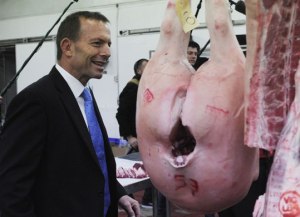
Have you seen the bigger piggies
In their starched white shirts
You will find the bigger piggies
Stirring up the dirt
And they always have clean shirts to play around in.

And in their styes with all their backing
They don’t care what goes on around
And in their eyes there’s something lacking
What they needs a damm good whacking.

Yeah, everywhere there’s lots of piggies
Playing piggy pranks
And you can see them on their trotters
Down at the piggy banks
Paying piggy thanks
To thee pig brother

– everybody: –
Everywhere there’s lots of piggies
Living piggy lives
You can see them out for dinner
With their piggy wives
Clutching forks and knives to eat their bacon.

Leadership chatter. Assange’s passport. Blonde girls in short shorts

24 Jul

There is no way chatter about ALP leadership is going to stop before the next election, the next leadership change, a decision by the party to close ranks and stop white-anting, or a blackout by the media on the topic.  The latter is the most unlikely option, so we might as well resign ourselves to endless speculation, and learn to stick our fingers in our ears.

I’ve now arrived at what I like to call the “shit or get off the pot” point. It’s that place in the mind you reach when you’ve had a gut full of listening to the same narrative over and over and over again. Usually I’m hounded to this place of ultimatum by people who are deeply dissatisfied with their intimate relationships and feel they have to tell me about it because I’m a good listener. Over a period of years they reiterate their complaints against their partners with a monotony that makes me feel like pulling out my fingernails with pliers, on the theory that the resultant physical pain will  distract me from the mental anguish I’m enduring by having to listen.

It’s a human failing, that we can be so afraid of change we choose instead to remain in a state of miserable grievance. Indeed, the very act of complaint becomes a raison d’être. The  whine: “Oh, if I could only be happy” replaces any possibility of actually finding happiness because one has, without even thinking about it, chosen whining as a way of life rather than risking satisfaction.

There is of course the opposite situation in which there seems to be a destructive addiction to superficial change while the underlying matters remain un-addressed.

As with all things, it is necessary to find the middle road, grasshopper.

But I digress. I don’t care who will lead the ALP to the next election. Being an ALP leader is a poisoned chalice. Anyone mad enough to take it on has my sympathy, but only in the abstract. The present leader, Julia Gillard, is drinking deep of the tainted wine and nothing good will come of it for her, just as nothing good eventuated for her toppled predecessor, Kevin Rudd. What this says to me is that the problems are not entirely to do with party leaders, and that continuing to change the leader will do nothing to resolve the problems.

I know there are good people in the ALP who deliver results for their electorates. My own federal member, Janelle Saffin, is one of them. It does seem that in politics the good people are either not interested in taking prominent roles or are not considered prominent role material by the back room boys and girls who determine these matters. The criteria the back room crowd use to arrive at their choices is puzzling. I strongly suspect those moral and ethical qualities we don’t talk about anymore, lest acknowledging our loss breaks our hearts, do not rate highly in their list of necessary leadership qualities.

Of course one could also argue that on becoming leader a good person may well undergo a transformation, goodness and leadership seemingly anathemas in today’s political world. According to ALP legend Kevin Rudd, who seemed decent enough, became the antichrist when they won government.  I liked Julia Gillard as deputy PM. Enough said about both.

One of the more disturbing aspects of the unsettling Julian Assange story as aired on Four Corners last night, was the effort by then Attorney-General Robert McClelland, presumably supported by the PM, to rescind Assange’s Australian passport at the time of the Wikileaks cable dump. Footage of PM Gillard declaring Assange’s actions to be “illegal” without any evidence at all for that declaration, also gave pause for thought.

The US, of course, was the nation-state most grievously affected by the dump. Our government’s rush to condemn one of its own citizens looks sadly like a an ill-considered attempt to show what good and loyal friends we are to the US, by cutting Assange loose without bothering to establish his innocence or guilt. This is an example of what I mean about the incommensurability of goodness and power.

I would hate to think I live in a country where anyone’s passport can be taken away from them because the government says so, without any investigation and without any evidence that the accused has done anything to justify such drastic action.

Assange has committed no offence against his own country. It is yet to be determined whether or not he has committed any offences in any country. Yet our PM declared him guilty of illegal activities, and decided he should be relieved of his passport. This is very scary stuff, and we should not take it lightly. According to Four Corners, plans to relieve Assange of his most important document were abandoned when it was pointed out that leaving him in possession of his passport would make tracking his whereabouts that much easier.

And people wonder why Assange is worried for his future?

I was baffled during the programme, by the blurred and recurring shots of a young blonde woman in short shorts walking away from the viewer along a train station platform. This young woman seemed to bear no resemblance in dress or manner to the two women who have accused Assange of sexual misconduct. She did seem to signify sexual availability, and presumably the long blonde hair referenced her Scandinavian origins. I have no idea why this image was necessary, except to imply a certain stereotyped lasciviousness in young Swedish women which might by association be extrapolated to the complainants. Hmmm. Tacky, anyone?

And just who wears short shorts?

A brief history of the Coalition’s hostile encounters with the UN

17 Jul

March 28, 2005 – “Australia was facing a United Nations committee’s scrutiny for the first time in five years. The event went unreported back home and the verdict – handed down on March 12 – was the subject of only a few, scattered reports in the press.”

“Australia was rebuked for its treatment of migrants, Muslims, asylum seekers, refugees and Aborigines. In the eyes of the Geneva committee, the list of this country’s failures on the human rights front has only grown longer since the Howard Government came to office.”

The Coalition’s recent insistence that asylum seekers can only be sent to states that have signed the Refugee Convention is startling, given its history with the UN throughout the Howard government years. This history can be fairly described as hostile and bordering on the pugilistic, with then Foreign Minister Alexander Downer reacting to negative UN committee reports with this outburst:

  “We won’t cop it any longer. We are a democratically elected government in one of the most liberal and democratic countries you will find on Earth. And if a United Nations committee wants to play domestic politics here in Australia, then it will end up with a bloody nose.”

On Howard’s watch in 1998, Australia became the first Western nation to be issued with an “urgent action” notice following what the UN committee identified as a risk of “acute impairment” to native title rights. We were then found in breach of our obligations to the Committee on the Elimination of all Forms of Racial Discrimination (CERD) and again earned the dubious distinction of being the first Western nation to incur a breach finding.

John Howard reacted to UN criticisms thus: “Australian laws are made by Australian parliaments elected by the Australian people, not by UN committees.” Amnesty International confirmed his attitude with this observation, after a 2004 High Court ruling sanctioned mandatory detention:  “These findings show the limited impact that international human rights law has had to date on Australian law-making.”

As an indication of the Coalition attitude in 2001, Liberal Senator Ross Lightfoot referred to boat arrivals as “uninvited and repulsive peoples whose sordid list of behaviours included scuttling their own boats.” (Human Rights Watch Report, 2003).

In 2002, at the request of the UN High Commissioner for Human Rights, Mrs Mary Robinson, the Howard government agreed to allow Special Envoy Justice P.N. Bhagwati to assess the conditions of asylum seekers held in indefinite mandatory detention, with specific regard to the question of their human rights.

Justice Bhagwati’s report, which can be read in full at the above link, contains this observation:

As noted above, the International Covenant on Civil and Political Rights (Article 7) and the Convention Against Torture and Other Cruel, Inhuman or Degrading Treatment or Punishment, explicitly prohibit torture and all cruel, inhuman and degrading treatment and punishment. The human rights situation which Justice Bhagwati found in Woomera IRPC could, in many ways, be considered inhuman and degrading.

Australia signed the CAT treaty in 1985, and ratified in 1989.

Justice Bhagwati’s report was described by Howard government ministers as “fundamentally flawed,” “emotive” and lacking objectivity. The government received an advanced copy of the report, and had the opportunity to correct any “flaws” prior to its release. The Special Envoy was also accused of interfering in domestic policies.

A personal observation: I visited Woomera Detention Centre in 2002, just before Justice Bhagwati undertook his visit to Australian detention centres. It was entirely appropriate to react with emotion to the conditions in that place, and to the suffering of the children, women and men behind its razor wire. Indeed, the inability to feel disturbed by those conditions and the resultant human suffering, indicates the presence of sociopathic tendencies, an inability to accept those imprisoned there as human.

For a much more thorough analysis of the Coalition’s relations with the UN than I’ve provided, I strongly recommend “The Howard Government’s Record of Engagement with the International Human Rights System” by Sarah Joseph.

The series of events over the last decade and more rather gives lie to this extravagant claim: “The Opposition’s immigration spokesman Scott Morrison says the Coalition has always supported the UN Refugee Convention, and will continue to do so.”

The Opposition’s recent decision to refuse to allow asylum seekers to be sent to any country that hasn’t signed the Refugee Convention is wildly inconsistent with its attitude to the United Nations for the last fourteen years. When in government, the Coalition regarded the UN as toothless, and our obligations to the treaties we signed as irrelevant. These include the Convention on the Rights of the Child, as children were and still are kept in mandatory detention, with and without their parents.

These attitudes are not peculiar to the Opposition. The current government does not observe our obligations either.

Now Scott Morrison seems to be getting himself in something of a twist, having declared the Refugee Convention to be out of date and needing an overhaul, while simultaneously demanding the government observe the fundamental protections it offers in ensuring asylum seekers are sent to a signatory country.

Neither major party have anything to boast about when it comes to Australia’s treatment of asylum seekers. Both pander to the prejudice and xenophobia of voters they believe will give them government. Both claim they wish to avoid deaths at sea, but they apparently have little or no concern about asylum seekers dying anywhere else, as long as it’s out of our sight and mind.

This is a drastic failure of leadership on both parts. It’s been shown time and time again, that if people are given the opportunity to meet and know asylum seekers, even the most hardened attitudes can change dramatically. Leaders worth the title would grasp this, and take the opportunity to extend our hearts and minds rather than encourage their shrinkage for political gain. There are many things that can be described as despicable in politics, but surely up there at the top must be the demonisation of human beings, and exploitation of their suffering for domestic political gain.
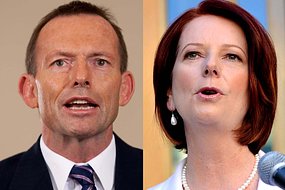
A pox on both their houses.