Archive | Politics RSS feed for this section

Abbott’s religiosity is no basis for policy

11 Jul

A couple of days ago on July 10, Tony Abbott took part in a radio interview that the Australian headlined: Abbott slams boatpeople as unChristian

“Asked on ABC Perth radio why his attitude to asylum-seekers was unchristian, the Opposition Leader responded: “I don’t think it’s a very Christian thing to come in by the back door rather than the front door…But I think the people we accept should be coming the right way and not the wrong way…If you pay a people-smuggler, if you jump the queue, if you take yourself and your family on a leaky boat, that’s doing the wrong thing, not the right thing, and we shouldn’t encourage it.”

Abbott doesn’t answer the question about his perceived lack of Christian charity towards those in need. Instead he attempts to blame Muslim asylum seekers for acting in a manner he believes is unChristian. Abbott does this as if people who are not Christian are at grievous fault for being not Christian. That failure taints every action they take in their lives, it seems, and they should be held accountable, mostly by being excluded.

Presumably Abbott is aware that the majority of boat arrivals are Muslim. Presumably Abbott is aware that the largest Islamic democracy in the world is our neighbour, Indonesia. Dog whistling? Following Scott Morrison’s anti Muslim strategy?

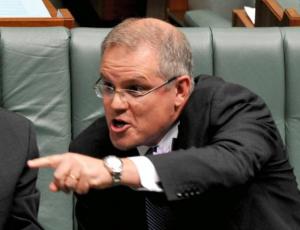
Morrison sees votes in anti-Muslim strategy. The opposition immigration spokesman, Scott Morrison, urged the shadow cabinet to capitalise on the electorate’s growing concerns about “Muslim immigration”, “Muslims in Australia” and the “inability” of Muslim migrants to integrate… Lenore Taylor, Sydney Morning Herald, February 17 2011.

Oh, yes, most boat arrivals aren’t Christian, unlike Scott Morrison who is a member of the Assemblies of God Pentecostal Church. Not all Christians cultivate an aura of entitlement, privilege and absolute rightness, but too many Christian politicians in Australia today seem to hold those beliefs about themselves. Not all Christians consider other faiths to be lesser faiths, but too many Christian politicians seem to hold those views.

Abbott might as well have accused the asylum seekers of being unAustralian. Either way, what is on display is Abbott’s inability to envisage cultures other than his own as legitimate and equal, and his inclination to judge those cultures in terms of his own limited experience. Abbott’s lack of sophistication coupled with his religiosity, are not qualities we look for in a leader.

However, they do in part explain why Abbott seems arrogantly convinced that he can bully the Indonesians into letting him send back the boats. The Indonesians had a nickname for former Liberal Immigration Minister Philip Ruddock They called him “the minister with no ears” because he harangued them but didn’t listen. Is it Abbott’s aim to inherit this title as he perpetuates the disrespect for a culture he doesn’t care to understand?

Abbott also believes he has the right to bully the navy into towing back boats, in spite of considerable advice as to the undesirable possibilities of taking that course, both in terms of life threatening risks to asylum seekers and navy personnel, as well as disruption to our relations with Indonesia.  “He will not be able to have a constructive relationship with Indonesia and tow boats back,” Philip Coorey quotes an official as remarking, in his recent National Times piece. How much of Abbott’s arrogance in this matter is fuelled by a sense of Catholic Christian superiority to a Muslim nation?

Describing asylum seekers as “unChristian” is an example of how Abbott frames Australian politics through the prism of that Catholic Christianity. Is he capable of making a separation between his religious beliefs and his job as a politician? Increasingly the answer seems to be no, he’s not.

Neither does Abbott speak for all Christians, many of whom are deeply involved in the refugee cause, and would likely distance themselves from his arbitrary judgments.

Whatever the problems are with boat arrivals (most of which are caused by Australia’s treatment of them) they will not be solved through invoking Tony Abbott’s Catholic Christianity and Scott Morrison’s fundamentalist terror of Muslims.  Indeed, neither have any place in the debate. We urgently need decent policy, not religious prejudice and personal superstition.

In his last solo Qanda appearance in April 2010, Tony Abbott was asked the question “When it comes to asylum seekers, what would Jesus do?”

TONY ABBOTT: Well, Jesus wouldn’t have put his hand up to lead the Liberal Party, I suspect. Or the Labor Party, for that matter.

TONY JONES: Okay. But someone who believes in principles that he espoused did do that, so it’s a legitimate question.

TONY ABBOTT: Yeah. Don’t forget Jesus drove the traders from the temple as well. Now, I mean, you know…

TONY JONES: What’s the point of that?

TONY ABBOTT: The point is…

TONY JONES: What’s the analogy?

TONY ABBOTT: …Jesus didn’t say yes to everyone. I mean Jesus knew that there was a place for everything and it is not necessarily everyone’s place to come to Australia.

TONY JONES: It’s quite an interesting analogy because, as you know, and a whip was used on that occasion to drive people out of the temple. You know, if that’s the analogy you’re choosing, should we take it at face value?

TONY ABBOTT: No. No. I’m just saying that, look, Jesus was the best man who ever lived but that doesn’t mean that he said yes to everyone, that he was permissive to everything, and this idea that Jesus would say to every person who wanted to come to Australia, “Fine”, the door is open, I just don’t think is necessarily right.”

“Jesus didn’t say yes to everyone.” And Tony Abbott of course knows to whom Jesus would say yes in 2012. This is old-fashioned Sunday School rhetoric. This is drivel. Tony Abbott is a man showing all the signs of being out of his depth. Give him a slogan, put a funny hat on his head, get him making pies, yes he can do all that. But the serious business of leadership? Of policy? Of decent public discussion?

Jesus is reputed to have driven moneylenders from the temple, and he did it violently. The analogy Abbott makes between usurers and asylum seekers is both despicable and revealing. Jesus acted because he believed the moneylenders were defiling a sacred place where they had no right to be plying their sordid trade. The story is an example of Jesus’ righteous anger, and his desire to protect his beloved father’s house from the contamination of profane activities. Jesus wanted the temple kept pure and to this end, he drove the impure out.

How interesting, then, that a Christian should choose this particular analogy to explain why not everybody who wants to come to Australia may do so, in particular those of other faiths who arrive seeking asylum by boat. Dog whistling again? Capitalising on concerns about a presumed Muslim inability to integrate into a country Abbott wants to think of as unspoiled and Christian?

“Jesus didn’t say yes to everyone. I mean Jesus knew that there was a place for everything and it is not necessarily everyone’s place to come to Australia.”

There is no place for religiosity in the asylum seeker debate or anywhere else in our politics. There’s especially no place for a future Prime Minister who believes he knows what Jesus would do, and makes policy accordingly. Jesus is irrelevant in the asylum seeker impasse, as are Tony Abbott’s projections of what Jesus might think.

Having said that I can’t help but feel if Jesus was around now, he might well stride into parliament with a stock whip and kick some arse.

Abbott on Pell: “One of the greatest churchmen Australia has seen.”

4 Jul

When I saw Cardinal Pell on Qanda a couple of months ago, I felt a kind of  appalled pity for the man.

Pity, I hasten to add, is not an emotion I enjoy, based as it is in disinterested contempt, and complete lack of interest in its object’s fate. When I pity someone, they are pretty much dead to me.

Pell seemed subject to moments of confusion and rather bad judgement.

Then, in the ABC Four Corners report this past Monday on the sexual abuse of children by priests of his church, Pell again seemed quite out of his depth, and rigidly adhering to a well-worn script.

Pell clings to his belief in the word of three priests, even though there is very strong evidence to the contrary, including an admission in court by an accused rapist, Father F, that he did indeed perform some of the criminal acts of which he stands accused.

Pell was himself accused of sexually molesting a child,as is discussed here in an 2008 interview conducted by ABC journalist Ali Moore with former priest and now commentator Dr Paul Collins. Reading this 2008 interview I was struck by the similarities. Four years later, Cardinal Pell does not seem to have changed his perspective, in spite of more ghastly revelations about the behaviours of his priests, and the number of suicides thought to be related to sexual abuse.

I’m sometimes undecided as to who is the worst offender: the perpetrator or those who cover up for the perpetrator. I can only imagine the number of little kids whose lives would have been so different if the church authorities who knew about the pederasts in their ranks had taken proper action. Proper action in this instance is informing the police, however the Catholic church seems loathe to concede that sexually molesting a child is a crime, and treat it accordingly.

I note here that Cardinal Pell was very, very quick to threaten legal action against Catherine Deveney when he felt she had slandered him in a tweet. His reputation apparently warranted the protection of the law, unlike the lives of the children whose rape and molestation his church failed to report to the police.

As far as the mistreatment of children is concerned, I’m of the opinion that there are no innocent bystanders. Everyone who has anything to do with children professionally is required by law to report suspicions of abuse. This ought to include the Catholic church. When anyone knows something bad is happening to a child and keeps it quiet, she or he is enabling the perpetrators. The church takes that one step further and protects them as well.

It is my hope that like the US, it will be possible in this country to charge Catholic bishops and hold them criminally liable for the behaviours of the priests they supervise.

In the meantime I take my hat off to the ABC journalists who are persisting with this story, as well as other stories of child abuse. As a survivor, it does my heart good to know there are people willing to pursue these criminals and uncover their crimes. It is very difficult to speak about these things when you’ve endured them. We need others to help. We need others to confront and challenge those who would be innocent bystanders, and in their denial and silence, enable abuse to continue. I know it’s awful to have to listen to these things. But it is far, far worse to experience them.  Thank you to everyone with the courage to listen and care, and say so.

Finally, Opposition Leader Tony Abbott is credited here with having described Cardinal George Pell as ” one of the greatest churchmen Australia has seen.” If this is a measure of Abbott’s ability to judge character, and an example of someone he profoundly admires, I fear even more for our future should he become the next Prime Minister.

Tony Abbott, trainee priest, St Patrick’s Seminary

On desperation

30 Jun

While politicians of various bents have found it expedient to weep in the Parliament these last days, what is absent in the asylum seeker policy brawl is an indication that the majority of them have any understanding at all of the desperation that drives the global movements of refugees.

And it is a global movement and we must eventually accept that we are not the only developed country stateless peoples look to for refuge, and indeed, we are so un-beleagured as to make us the laughing stock of nations whose borders are crossed by thousands of asylum seekers every week.

What I’m about to write about desperation may be unsettling, and may act as a trigger for some people. It is my experience of desperation, and it’s an experience that gives me the authority to speak on the topic.

As a young girl, from the age of about seven, I lived in very dangerous circumstances. I was beaten with hose pipes, fishing rods and my stepfather’s bare hands. I was tied up, always after I’d been ordered to remove my clothes. On many occasions until I was fifteen, I was threatened with death by this man who wielded a loaded gun that he fired into cushions. I was regularely absent from school because of my injuries.

I was first raped when I was ten. These rapes continued at regular intervals until I was fifteen. I cannot talk about these rapes more than to state their occurrence.

My stepfather was a doctor, and he performed various medical procedures on me in the surgery that was attached to our house. I cannot talk about these.

He also photographed me, posed and naked from the age of ten.

There’s nothing to be gained for either me or my readers in attempting descriptions of these events, and I am barely able to write this much. I am trembling. I am sweating. I am weeping. My heartbeat is loud and irregular. I feel nauseous. My body hurts everywhere. The pain in my head is appalling.

During those years  I told at least seven adults what was happening to me. Every one of them sent me back.  Every time I arrived home I was beaten, tied up, threatened with death if I did it again, and raped. I never stopped telling people, even though I knew the next telling might cost me my life.  In retrospect this seems to me something of a miracle. I love my young self, I love her with all of my heart, for her determination to help herself survive, for her willingness to risk death in the attempt to have her life.

So what does this have to do with asylum seekers? As Judith Lewis Herman wrote in the introduction to her book “Trauma and Recovery: From Domestic Abuse to Political Terror:”

This is a book about restoring connections…it is a book about commonalities: between rape survivors and combat veterans, between battered women and political prisoners, between the survivors of vast concentration camps created by tyrants who rule nations and the survivors of small, hidden concentration camps created by tyrants who rule their homes…

One of the things we have in common, those of us who survive the small, hidden concentration camps, and those of us who survive political terror, is our experience of desperation. Desperate to escape. Desperate to live. Desperate to experience the ordinary. Desperate to feel we can sleep safely in our beds at night, whether we fear the invasion of soldiers, or the stealthy night time visits of the rapacious stepfather. Desperate to be allowed to eat and drink. Desperate to live like a human being, untrammelled by the kind of primitive terror that reduces everything to a question of day to day survival.

The will, not just to live but to live a decent life, is inexpressibly powerful. Death can seem preferable to suffering the tyrannies of the imposed will of another, tyrannies that strip one of all integrity. This much I know. I know it with the full authority of my experience, and my survival.

One does not have to suffer in order to appreciate desperation. One does not have to experience prolonged terror and coercive methods of control. What is required for understanding is emotional intelligence and imagination. The majority of our politicians would seem to be seriously lacking both. Instead they appear to be, in the words of philosopher Martha Nussbaum  …people whose imaginations are blunted, who simply refuse the acknowledgement of humanity.

The odious tears of the sentimental who weep for the cameras yet support policies that will condemn the desperate to even more desperation, are deeply offensive to me as a survivor.  Your emotions count for less than nothing, when deterrence is your only answer to desperation.

The leaders of this country are behaving as did those adults who sent me back to the dangerous hell that was my home. I do not think those people were evil. I think they didn’t want to become involved. I think they were incapable of imagining the circumstances I was attempting to escape. I think they wanted more than anything to maintain the equilibrium of their lives, and I was a child who could disturb that forever. They moved me on, out of their sight and mind. They were cowards.

The concept of a human right to ask for help and protection seems barely to exist in our world. Such requests are viewed as impositions, and those who make them, importunate. The implication of our treatment of asylum seekers is that they are sub-human, and that seeking asylum is a criminal offence. We deny any recognition of a priori suffering, and instead focus on maintaining an abstract construct of national sovereignty.

Those who denied me asylum did so to maintain their domestic sovereignty. They could not let me in, for fear of the ruptures dealing with my suffering would provoke.

I can never forget desperation. I can call it up in an instant. When I see it in another I have to respond. Try as I might, I find it very difficult not to despise those who wilfully close their ears and eyes and hearts to desperation. I have even wished it on them, that they walk a mile in the shoes of the desperate and know what it is to be turned away, when all you are asking is help to conduct a decent life.

Thank you for reading this. I give the last word to Emmanuel Levinas:

To shelter the other in one’s own land or home, to tolerate the presence of the land-less and homeless on the “ancestral soil” so jealously, so meanly loved – is that a criteria of humanness? Unquestionably so. 

“If that means deaths at sea continue, he said, so be it.”

26 Jun

As I read today’s piece by Peter van Onselen on the asylum seeker policy stand-off, the following stood out: 

One well-placed Liberal source told The Australian that Abbott would rather see Labor continue to bleed politically with ongoing boat arrivals. If that means deaths at sea continue, he said, so be it.

Let me just say that again.

One well-placed Liberal source told The Australian that Abbott would rather see Labor continue to bleed politically with ongoing boat arrivals. If that means deaths at sea continue, he said, so be it.

Fasten your seat belts: turbulence ahead

25 Jun

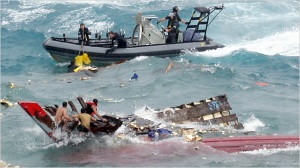
It was with a certain contempt that I watched footage of Opposition Leader Tony Abbott piously declaring that he would hold his forked tongue for twenty four hours while the bodies of drowned asylum seekers were recovered and taken to a makeshift morgue on Christmas Island.

And I noted the absence of any comment, pious or otherwise, from Shadow Minister for Immigration Scott Morrison. Perhaps they’ve put the muzzle on in case he comes out with observations somebody might construe as racist.

However, it seems inevitable that all gloves will be off when Parliament resumes today, and we will be subjected to the self-interested politicising of the plight of asylum seekers that began with John Howard and hasn’t stopped since.

No doubt the government will attempt a revival of its Malaysia plan. This surely will necessitate re-negotiations with that country, as the initial agreement covered only 800 boat arrivals, after which, presumably, we went back to how things always were.

Mr Abbott will no doubt adhere to his demands that the government re-open his beloved Nauru detention facilities, because, he will argue, when they were operative they stopped the boats. Quite how the Nauru option will stop the boats is unclear to me, after all, practically everyone who got to Nauru was found to be a refugee and resettled. Hardly seems like a disincentive.

What both major parties apparently fail to grasp is the desperation of people who undertake these journeys. The dangers they face are no deterrent. They risk their lives to have a life. An inability to comprehend desperation is fairly typical of most politicians. They lack the imagination, and are far too occupied with saving their own arses than they are with the plight of human beings in dire circumstances, at home and abroad. Lack of political will is responsible for some of the most obscene travesties on the planet.

What we urgently need is a regional approach to managing people movements. This will require a degree of co-operation between the government, the Coalition and the Greens. This possibility looks as likely as Gina Rinehart funding care and housing for homeless children.

What we will get is yet another extended brawl that will achieve nothing. Then there will be another catastrophe in which more lives are lost. Then we will have another extended brawl that achieves nothing. Then there will be another catastrophe in which more lives are lost.

As well as the asylum seekers, you know who I feel sorry for? The good people of Christmas Island who have to deal with the stark reality of these events in their back yards.

This piece from the Castan Centre unpacks the complexities with clarity. The author addresses the notion of saving lives by deterring asylum seekers from embarking in the first place. Perhaps, if our objective really is to save lives, we would supply safer boats?  Or is the saving of life a cover for deeper concerns about border protection and just stopping the boats?

Thus far our politicians have proved themselves entirely inadequate on this matter. It isn’t good enough. Refugees are not going away. The numbers seeking resettlement here are miniscule compared with many other countries. It is a regional problem, but how can Australia take a responsible role in addressing it at this level when our politicians continue to domestically exploit widespread human misery to further their own interests?

Don’t let facts get in the way of hate…

21 Jun

In December 2010 when the WikiLeaks cable dump hit the headlines, Prime Minister Julia Gillard declared: “I absolutely condemn the placement of this information on the WikiLeaks website – it’s a grossly irresponsible thing to do and an illegal thing to do.”

A couple of days later, Ms Gillard was at a loss to explain her inflammatory comments.

“The foundation stone of it is an illegal act,” Ms Gillard told reporters in Canberra.

But the “foundation stone” was the leaking of the documents to the website, not the publishing of the cables.

“It would not happen, information would not be on WikiLeaks, if there had not been an illegal act undertaken,” Ms Gillard said.

Mr Assange’s lawyers have said they are considering defamation action against Ms Gillard after she accused the whistleblower of “illegal” conduct over the leak of US documents.

Thus our Prime Minister launched a campaign of misinformation about both Wikileaks and Assange, based solely on her personal opinion and clearly with little if any regard to her legal training.

The government then attempted to find legal cause to withdraw Assange’s Australian passport, in spite of the fact that he had broken no Australian laws.

Hardly surprising then, that Assange and his team of lawyers have come to believe he’s been abandoned by his government. While it may be true that Assange has received whatever consular support is due to him, Prime Minister Gillard had Assange hung, drawn and quartered from the get go, and she has never retracted her accusations and her condemnation.

If we follow Ms Gillard’s logic, then the newspapers who published the leaked cables they obtained from Assange, newspapers such as the Sydney Morning Herald, The Australian, The Guardian, The New York Times et al, are also acting irresponsibly and illegally because ““It would not happen, information would not be on WikiLeaks [or in the SMH, the Oz, the NYT, the Guardian et al] if there had not been an illegal act undertaken.” 

At this point I quote Anna Funder, winner of this year’s Miles Franklin Literary award:  I have spent my professional life studying totalitarian regimes and the brave people who speak out against them. And the first thing that someone with dictatorial inclinations does is to silence the writers and the journalists.


This is a link to an account by The Guardian of the events in Sweden that have led to Assange being accused of sexual misconduct. As you can see, the circumstances as described are unsavoury, though they would not all necessarily be considered sexual offences in Australia. They are also entirely a matter of she said/he said.

I have no idea of their veracity and I believe Assange, for his own sake, ought to have the opportunity to respond to the allegations made against him.  As well, the complainants are entitled to have their allegations addressed. It is puzzling that Swedish prosecutors are delaying the resolution of the women’s complaints by demanding, against, apparently, their own Supreme Court decision on interviews (see below) that Assange return to the country, rather than conduct a video link interview with him.

Bjorn Hurtig, Assange’s early Swedish counsel, makes these observations in his witness statement:

I also think it unreasonable that in a case of this kind, where extensive mutual assistance between the UK and Sweden would readily permit a video-link interview, for the prosecution to be so absolutely insistent that Mr Assange return (and at his own expense) to face questions that could easily be put over the video-link.

[Assange has many times offered to do this, and offered to engage in interviews with Swedish officials in person in the UK. The Swedish authorities have consistently refused these offers, demanding extradition instead. Assange continues to offer to answer the allegations via video link from the Embassy of Ecuador.]

I note that at least one of the complainants have been interviewed by telephone and the insistence that Mr Assange come back to Sweden merely for an interview is, therefore, unreasonable and contrary to the decision of our Supreme Court (NJA 2007, p. 337).

The problem for Assange with returning to Sweden is explained here. Briefly:

Michael Ratner of the Center for Constitutional Rights, which represents the WikiLeaks founder in the US, said Assange and his legal team considered it highly likely that he would face an onward extradition to the US if he were sent to Sweden.

The concrete reality [is] that he was facing a political prosecution in the US, he was facing the death penalty or certainly life in jail. Faced with that, he had extremely limited choices.

The US empanelled a secret grand jury investigation into WikiLeaks and Assange in May 2011, but has not issued any requests for his extradition to the UK or Sweden. However, Ratner said both he and Assange believed it was “more likely than not” that a sealed indictment had been drawn up.

According to a Human Rights Watch report, Sweden has form. In 2001 Sweden was involved in the illegal US rendition of  two asylum seekers suspected of terrorism from Stockholm to Cairo. This involvement violated the global ban on torture. Both asylum seekers were tortured when they arrived in Egypt, despite assurances given to Swedish diplomats.

The UN Committee Against Torture concluded that Sweden violated the Convention against Torture by illegally expelling him [Al Zari] to Egypt, and stated that “procurement of diplomatic assurances [from Egypt], which, moreover, provided no mechanism for their enforcement, did not suffice to protect against this manifest risk.”

The US has imprisoned Private Bradley Manning, the WikiLeaks cables source, in a manner that has been described by Glenn Greenwald as “conditions that constitute cruel and inhumane treatment and, by the standards of many nations, even torture.”

One need not be a conspiracy theorist to see where this is headed. The bizarre refusal by Swedish authorities to question Assange by video link in an interview which is designed to establish whether or not there are grounds for bringing charges against him. The oft -forgotten fact that Assange has already been questioned on these matters while in Sweden, the allegations were dismissed, and he was allowed to leave the country.

And on the matter of these allegations it’s worth reading this brief interview with Oscar Swartz, author of A Brief History of Swedish Sex: How the Nation that Gave Us Free Love Redefined Rape and Declared War on Julian Assange.  Swatrz claims that  in Sweden: “Sex is being increasingly used to control communications – and as a political weapon,” and says his book shows “how Sweden descended from one of the western world’s most sexually liberated nations to its most repressive.”

The hatred expressed against Assange in Australia is frightening, and much of it seems to be based on personal antipathy. A great deal of it seems to originate with journalists and has from the start, as I wrote in these two articles in December 2010

It is even more frightening in the US where there have been calls for his assassination and demands that he be hunted down like bin Laden. Hatred such as this, and the unworthy example of presumption of guilt set by Prime Minister Gillard at the start of the story obscures the complexity of the narrative, and reduces it to a George W Bush story of good versus evil.

Personal opinions about Assange and his character ought not to blind anyone to the bigger picture unfolding here. There is something rotten in the manner in which these events have been and continue to be handled by the Australian, Swedish, and US governments. This should sound alarm bells for all of us, especially, one would think and hope, for journalists and writers whose responsibility it is to hold governments to account and protect us from dictators. WikiLeaks efforts to do this may have been clumsy, and at times carelessly cavalier. However, to my mind, Bradley Manning, Julian Assange & WikiLeaks have struck a blow for transparency in high places that in spite of claims to the contrary has struck nerves. For this they have my admiration and my ongoing concern for their welfare.


Annabel Crabb and Peter Reith

19 Jun

Yesterday I read a tweet from Annabel Crabb to a tweep who’d complained that Peter Reith was on The Drum AGAIN. Anyone on my Twitter feed will know that we are constantly complaining about the regular presence of Mr Reith, both on the televised and the online version of The Drum. Regulars like David Horton of the Watermelon Blog ask several times a week that the ABC reveal Reith’s contract with the public broadcaster, to no avail.

Many tweeps repeatedly point out the role Reith played in the Howard government, particularly in regard to the so-called “Children Overboard” scandal, in which the government made unsubstantiated (and later discredited) claims that seafaring asylum seekers had thrown children overboard in a presumed ploy to secure rescue and passage to Australia.

A Senate Select committee later found that no children were thrown overboard from SIEV 4, and that several Howard government ministers including Peter Reith had deliberately misled the public by “cynically exploiting voters’ fears of a wave of illegal immigrants by demonising asylum seekers.”

It was also found that on no less than fourteen occasions, Reith and/or his office were informed that children had not been thrown overboard, and that photos Reith claimed proved the allegations were in reality images of asylum seekers and children struggling in the water after their boat had sunk.

Add to that charges of the improper use of a phone card, and Reith’s much criticised handling of the waterfront dispute when he was Industrial Relations Minister, and you have a politician with a very fraught history. His close relationship with the ABC is regularly and rightly questioned. The public broadcaster usually makes no comment, but yesterday Ms Crabb broke with tradition and tweeted:

@annabelcrabb: @preciouspress I’m always pleased when Peter Reith’s on. I think he’s a great panel member.”

While I acknowledge that the ABC’s responsibility to attempt a balance of perspectives in its opinion and analysis means there will inevitably be guests with whom somebody disagrees, I do wonder why a politician with a record such as Reith’s is their choice as a regular participant.

Now I wonder why Ms Crabb decided to so wholeheartedly endorse him, and in such a personal fashion. I thought we’d just established through the shaming of Stephen Long, that it is not the job of ABC journalists to express displeasure or favour  towards any public figure.

The ABC presumably offers Peter Reith as a credible, honest commentator on current affairs. Now endorsed by Annabel Crabb, it seems confirmed that as we have long suspected, Mr Reith’s history is irrelevant to the ABC because he’s “a great panel member.”  The ABC legitimises Mr Reith by offering him a regular platform, and now by Ms Crabb’s personal seal of approval as well.

There are many far more credible alternatives to Peter Reith, whom the ABC might invite to express a right-wing point of view. Personally, I am unable to dismiss Mr Reith’s role in the Children Overboard affair, and I am saddened that the ABC and Annabel Crabb apparently find it so easy to erase that shameful chapter of our history, and to redeem and grant legitimacy to someone who was a central participant in that disgrace.


Scott Morrison. Racism. The facts.

14 Jun

Racism: (just to refresh our memories)

1. the belief that human races have distinctive characteristics which determine their respective cultures, usually involving the idea that one’s own race is superior and has the right to rule or dominate the others.

2. offensive or aggressive behaviour to members of another race stemming from such a belief.

3. a policy or system of government and society based upon it. (Macquarie Dictionary)

Morrison sees votes in anti-Muslim strategy. The opposition immigration spokesman, Scott Morrison, urged the shadow cabinet to capitalise on the electorate’s growing concerns about “Muslim immigration”, “Muslims in Australia” and the “inability” of Muslim migrants to integrate…But after Mr Morrison’s comments this week on the cost of asylum-seeker funerals and his role in the controversial decision to cut a Howard government program to fund schools in Indonesia, colleagues are privately questioning whether he is trying to pursue an anti-Muslim political strategy unilaterallysources say Mr Ruddock, the shadow cabinet secretary, was particularly “blunt” in his rejection of the suggestion, saying a well-run and non-discriminatory immigration policy was essential for nation building.
Lenore Taylor, Sydney Morning Herald, February 17 2011. [emphasis mine]

Ugly game of race baiting. Morrison decided to see if he could win some political points by inflaming racism and resentment. More specifically, he zeroed in on some of the most vulnerable people in the country for political advantage.

Morrison publicly raised objections to the government’s decision to pay for air fares for some of the survivors of the Christmas Island boat wreck to travel to Sydney for the funerals of their relatives.

Some were Christian funerals, others were Muslim. But all of them were foreigners, all of them were boat people, all of them were dark-skinned, and to Morrison that made them all fair game. Peter Hartcher, SMH, February 19 2011.

From the blog of well-known free speech advocate Andrew Bolt comes this quote from ABC journalist Stephen Long. I am obliged to reference Mr Bolt’s blog because it appears the ABC have removed this episode of The Drum Online from their website. Mr Long was a panellist on The Drum earlier this week. Along with other panellists he was invited to express his opinion on various topical issues. With reference to the Coalition’s recent comments on immigration policy, Mr Long observed:

I think that it is a cynical manipulation of an underlying prejudice in the Australian community and that it has very little policy merit. It is fraught with problems and it is really awful actually and I think Scott Morrison in particular as a spokesman in this area has just pushed way beyond acceptability in a way that he is willing to pander and manipulate that level of prejudice in what is essentially a racist manner. He is my local member in the electorate for Cronulla, the scene of the Cronulla riots …

Mr Long’s opinion was consistent with that of some of Mr Morrison’s political colleagues, and other journalists. However, Mr Morrison demanded an apology from the ABC for Mr Long’s remarks. The ABC aquiesced, and the apology was delivered on air yesterday evening by the show’s host, Steve Cannane.

This leads me to wonder why it is acceptable to describe someone as “pursuing an anti Muslim strategy unilaterally” but unacceptable to describe that activity as “racist” (refer to definition of racism above). Perhaps there is a way of pursuing an anti Muslim strategy unilaterally that is not racist? Perhaps the activity is indeed racist (check definition again) but under no circumstances are we allowed to say so?

Colour me confused.

On his website Mr Morrison, who is a member of the Assemblies of God Pentecostal Church, writes: “My Christian faith remains the driving force for my family, beliefs and values.”

Note to commenters: As Mr Morrison appears to be sensitive at the moment and may even incline towards litigation, please take care not to leave any comments that might be construed as defamatory.


Belief versus human rights

13 Jun

After my blog yesterday on Prime Minister Gillard’s belief that homosexuals should not be allowed to marry, I became embroiled in several robust Twitter fights. One of the points of contention was that the PM, like anyone else, is entitled to her personal beliefs. I was threatened with Voltaire, told belief does not require any knowledge, described as intolerant and blind to the mote in my own eye,  and finally accused of risking the downfall of the government and an Abbott ascendency, by criticising Ms Gillard’s personal belief about same-sex marriage.

While there’s a good community here at Sheep, Rupert Murdoch I’m not.

Be that as it may, the fights led me to thinking about belief. While I agree that everyone is entitled to their beliefs, I don’t agree that everyone is entitled to act on those beliefs to the detriment of others. Once a belief is extrapolated from the personal realm and used to determine the lives of others it is no longer personal, it is political.

Personal belief can legitimately determine the course of one’s own life. If you don’t believe same-sex marriage is right, for example, then don’t make a same-sex marriage. Nobody in our country will force you into an arrangement that powerfully disturbs your moral sensibility.

What disturbs me, however, is the argument that personal beliefs ought to be set apart from the interrogations we are at liberty to apply to all other human processes. The personal belief is elevated to the sacred, inspiring respect and reverence simply because it is a personal belief, and regardless of its substance. While I find this bizarre, hinting as it does at some transcendental exterior governance, I have little problem with it, as long as the belief remains in the realm of the personal. When it becomes prescriptive, I argue that it is no longer protected from scrutiny and critique by reverence.

Tony Abbott, for example, holds a personal belief that abortion is wrong, as well as being opposed to same sex marriage. In this article titled Rate of abortion highlights our moral failings Mr Abbott explores his personal beliefs about this procedure, including his belief that abortion is a lifestyle choice made to suit the mother’s convenience.

Of course Mr Abbott is entitled to hold these beliefs. Anyone can believe anything they want. He is not entitled to impose his beliefs on others. When he does, the belief has ceased to be personal, and has become political.

If I am expected to unquestioningly respect Ms Gillard’s personal beliefs on homosexual marriage, I gather I am also expected to respect Mr Abbott’s beliefs on abortion and refrain from challenging them?

What about Hitler, because no argument about belief is complete without a reference to Hitler. Hitler’s personal belief was that  human beings who did not fit his ideal didn’t deserve to exist. Including homosexuals. When Hitler’s personal belief burst out of his private realm, millions upon millions of human beings were starved, tortured and murdered. Yet Hitler’s personal belief ought to have gone unchallenged because personal beliefs are sacred?

I could go on with endless examples of the dire repercussions of actions based on personal beliefs, but I know you’ve got my drift.

Perhaps a belief can be considered sacred only as long as it remains personal. Once it affects anyone other than the believer it is no longer personal, and no longer entitled to protection from interrogation.

Were I to be given the chance, I would ask Ms Gillard if she has reasonable, plausible evidence for her core belief that homosexuals should not marry. I use the term core belief  because I’m assuming that the PM has actively thought about her position on same sex marriage and has come to a state of justified true belief. Otherwise we would be dealing with something more akin to superstition, of the kind practised by Jim Wallace and the ACL.

The reason I care about this has nothing to do with marriage, about which I personally give not a toss. It has to do with the right all homosexuals have to be treated equally. It is about the right homosexuals have to be recognised as being as fully human as heterosexuals, and as entitled to participate in our institutions to precisely the same degree. This is not, in my opinion, a matter for anybody’s personal beliefs to determine. It’s a matter of human rights.


The PM, belief, and marriage equality.

12 Jun

On Qanda last night, Prime Minister Julia Gillard was asked the inevitable question about her position on gay marriage. To which she replied that nobody who knows her personal circumstances (she lives in a heterosexual de facto relationship) would be surprised to hear her say that a relationship doesn’t need to be a marriage in order to be successful.

If the question had been about the purpose of marriage and whether or not we ought to abolish the institution, then Ms Gillard’s observation would have been mightily relevant. But it was not. It was about why Ms Gillard does not support same-sex marriage. The PM ought not to have been allowed to get away with avoiding the question, and with employing the classic obfuscation by conflation tactic, so beloved by politicians.

There are two separate issues in play. One: is there any need for the state to involve itself in relationships in the first place through the Marriage Act? Two: given that Marriage Act is unlikely to be abolished anytime soon, on what grounds do we continue to prevent same-sex couples who wish to marry from doing so?

The PM does not support same-sex marriage because she deeply believes marriage can only be celebrated between a man and a woman. Every time Ms Gillard refers to the Marriage Act to support her “belief” someone needs to remind her that the Act reads as it does because John Howard made it so. In 2004 the Marriage Act 1961 was amended in federal parliament to define marriage as a union between a man and a woman. The Amendment also states that any existing same-sex marriage from a foreign country is not to be recognised as a marriage in Australia.

Like any other citizen, the PM is entitled to her personal opinions. Legislators, however, are not entitled to legislate based on their personal opinions. If we are to continue to forbid same-sex marriage, we need to have very good reasons for that. “I believe” is not a reason.

Many of us strongly defend Ms Gillard when she’s subjected to attacks on her personal choices by conservative moralists who believe a woman isn’t  “complete” unless she has children. This belief is as silly and as offensive as the belief that only heterosexuals should be allowed to marry. It’s not very long since Ms Gillard would have been prohibited from holding her current job because of ludicrous and offensive beliefs about what women should be allowed to do. Not reasons. Beliefs.

If any politician wants to deny marriage equality to those who seek it, I want to know on what grounds they justify that denial. I don’t want to hear about their beliefs on the subject. I don’t care about their beliefs. I want some good solid reasons to support their denial of this equality. If belief had been allowed to govern our world, we’d still be flat earthers and Ms Gillard would not Prime Minister, living in a de facto relationship in the Lodge.

Time to give something back, PM?