Archive | Non Fiction RSS feed for this section

Happy feckin New Year from No Place for Sheep!

1 Jan

stock-photo-happy-new-year-spanish-letters-in-fire-flooding-water-on-black-background-22012522


Dear Everyone,

As we charge headlong into 2013 thank you massively for being here through 2012.

This new year will be chocks full of political pus, so we will never be lost for a topic to lance.

May we all be safe, may we all be as happy as we ought to be, and may we all stay well or near enough to it!!

(The Spanish is for you, Gruffbutt)

Mothers who say F**ck

30 Dec

I recently engaged in a robust exchange of views with one of my sons. This particular adult child has long-held a reputation for forgetting to tell anybody things, unless we happen to be in the same room as him when something that might need to be told to us occurs.

On this most recent occasion, the stuff he forgot to tell me was totes important, and my lack of knowledge caused me untold aggravation, and the rest. So I rang him up and let him know where he currently stood with me. As he’s always thought of himself as “the good child,” this came a something of a shock.

First we had to deal with the “oh, it was just a misunderstanding” meme. No it wasn’t, I told him, I didn’t misunderstand anything how could I when you didn’t tell me anything I could misunderstand?

Then we negotiated the “Mum you’re losing control” meme. I’m not losing control, I told him, are you? And by the way, you really need to learn the difference between expressing emotion and losing control. The two are not necessarily the same thing, I told him.

I was also thinking of his wife when I said this. I thought, I bet he says this to her when there’s a disagreement, so I better bring him up to speed about women expressing ourselves. This “you’re losing control” thing is an attempt to shut us up, a projection, and a put down. In my experience it is usually said by males who fear they are losing an argument, though it’s not necessarily gender-based.

Finally, I was reduced by his wilful obduracy to foul language. Fucking hell, I said. “Don’t swear at me down the phone, Mum,” he demanded. Oh my! I cackled, in capital sarcasm font, so in your moral universe me swearing is a bigger offence than you not telling me stuff I really needed to know?

“We’re going round in circles,” he bleated. Indeed we are, I replied, taking pity. Let’s sleep on it and talk again in a couple of days.

My sons taught me foul language. Since becoming husbands and fathers they’ve turned on me. I can’t swear, and I’m reprimanded every time I do something they consider the least bit edgy and that is quite a lot of stuff I do and say. Last time I took Archie out and stopped for coffee, his father asked me if I’d left the baby in the car while I went into the cafe. I looked long at him, and shook my head in a WTF kind of way.  Archie’s mother then stepped in and reminded her husband that he’d survived my mothering quite well, and he should perhaps pull his head in.

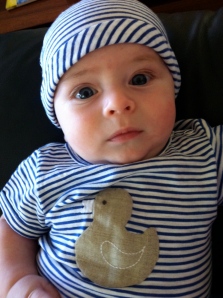
I am extremely fond of Archie’s mum. I see a lot of me in her. Archie is also showing signs of a possibly anarchic personality. On his recent first plane trip, and though only fourteen months old, he stood up on his seat and hurled peanuts at the passengers sitting behind him till his dad grabbed him by the nappies and hauled him off to the toilet where he gave him a stern talking-to and probably told him he was losing control.

I’m considering forming a group called “Mothers Who Say Fuck.”  I’m sure I’m not the only mother who overnight finds herself dealing with a role reversal initiated by her adult children who for some reason, and without consultation, have cast her as the irresponsible adolescent and themselves as long-suffering adults who are burdened with keeping an eye on her and monitoring her language. I can’t quite get my head around this phenomenon. All things considered, they have some nerve.

This attitude does, however, make for a special bond between grandmothers and grandchildren. We share a common cause – defying their parents. We will both be instructed to mind our mouths. We will both be exhorted to act responsibly, and to act our age. On the positive side, we can sit at tables and roll our eyes at one another when their parents issue yet another fucking edict. We can slink off and comfort one another when we’ve been reprimanded and given time outs. We will always know we have each other, when everyone else is pissed off at us because we’ve thrown the metaphorical peanuts. Oh, yeah. I see only good times ahead for Archie and me.

Me and Archie


Happy holidays everyone from No Place for Sheep!!!

24 Dec

Be well!! Be safe!! Be kind to one another!! (even if it’s just for a day) 


Lots of ♥ from Jennifer, Mrs Chook & The Dog.

Thank you

10 Dec

No Place for Sheep has suffered lately as a consequence of personal matters that have consumed my energy and time. However, in spite of the lack of new posts, some people have stayed around, talked among themselves and stuck by the blog.

Thank you. When things have been really difficult and I’ve had five minutes just to look at Sheep, I’ve seen you still visiting and still engaging with each other, even when I haven’t posted for days. I find this remarkable, and I count myself lucky to have you here.

I think the worst is over, and I can get back to the thinking, writing and sharing that I love.

Thank you!

Hey, Mr Tamborine Man

3 Dec

Tambourine Man


(With thanks to @ForrestGumpp for the title, and for reminding me of Dylan’s song)

I’m sitting in the Mt Tamborine library, availing myself of free wireless for three hours. It’s the most delightful little library I’ve seen in a long time, the kind of library in children’s story books with jolly librarians and interesting-looking customers. Something fantastical could happen in this library.

Take me on a trip upon your magic swirlin’ ship…

Mrs Chook sits opposite me, researching some nasty-sounding nasal surgery she’s been guaranteed will fix her blocked nose. She keeps asking me to tell her if she ought to have it done or not, but why anyone would ask my opinion on something like that, let alone someone who knows me as well as Mrs Chook does,  I don’t know. I can’t even decide what to have for breakfast, after four months of sustained stress that has left me exhausted, and second-guessing every step I take.

My weariness amazes me…

We’re here because my Archie family has just moved up from the coast to live here, but now they’ve gone to Hawaii and we’re looking after the dogs and luxuriating in the panoramic views from their front windows, views that stretch from the Gold Coast to Mt Warning. It’s  about five degrees cooler than the coast and a good deal less humid. Watching the sun rise out of the sea made me teary this morning. Followed by a hike through an enchanting palm grove with enormous and ancient red carabeen trees, then coffee, lime and coconut scones at a North Tamborine cafe and the world is looking a whole lot better than it did a few days ago.

Far from the twisted reach of crazy sorrow…

In the forest we startled large groups of what look like very small wallabies, Mrs Chook is researching them as well to find out what they are. They squatted, staring at us gravely and with surprising trust.

We just had a fight about a picture she says is them and I say isn’t. This may not end well.

I haven’t watched the news, read a paper, or given a stuff about politics and politicians, so I have nothing to contribute to whatever is going on. All I know is when you just can’t take anymore, head for the natural world and immerse.

Let me forget about today until tomorrow…

But…Campbell Newman is doing his best to stuff up Queensland’s natural beauty, and the mayor of the Gold Coast is trying for a cable car from Surfers to the top of the mountain. It never feckin ends, does it?

Hey ! Mr Tambourine Man, play a song for me
I’m not sleepy and there is no place I’m going to
Hey ! Mr Tambourine Man, play a song for me
In the jingle jangle morning I’ll come followin’ you.
 
Though I know that evenin’s empire has returned into sand
Vanished from my hand
Left me blindly here to stand but still not sleeping
My weariness amazes me, I’m branded on my feet
I have no one to meet
And the ancient empty street’s too dead for dreaming.
 
Hey ! Mr Tambourine Man, play a song for me
I’m not sleepy and there is no place I’m going to 
Hey ! Mr Tambourine Man, play a song for me
In the jingle jangle morning I’ll come followin’ you.
 
Take me on a trip upon your magic swirlin’ ship
My senses have been stripped, my hands can’t feel to grip
My toes too numb to step, wait only for my boot heels
To be wanderin’
I’m ready to go anywhere, I’m ready for to fade
Into my own parade, cast your dancing spell my way
I promise to go under it.
 
Hey ! Mr Tambourine Man, play a song for me
I’m not sleepy and there is no place I’m going to 
Hey ! Mr Tambourine Man, play a song for me
In the jingle jangle morning I’ll come followin’ you.
 
Though you might hear laughin’, spinnin’ swingin’ madly across the sun
It’s not aimed at anyone, it’s just escapin’ on the run
And but for the sky there are no fences facin’
And if you hear vague traces of skippin’ reels of rhyme
To your tambourine in time, it’s just a ragged clown behind
I wouldn’t pay it any mind, it’s just a shadow you’re
Seein’ that he’s chasing.
 
Hey ! Mr Tambourine Man, play a song for me
I’m not sleepy and there is no place I’m going to 
Hey ! Mr Tambourine Man, play a song for me
In the jingle jangle morning I’ll come followin’ you.
 
Then take me disappearin’ through the smoke rings of my mind
Down the foggy ruins of time, far past the frozen leaves
The haunted, frightened trees, out to the windy beach
Far from the twisted reach of crazy sorrow
Yes, to dance beneath the diamond sky with one hand waving free
Silhouetted by the sea, circled by the circus sands
With all memory and fate driven deep beneath the waves
Let me forget about today until tomorrow.
 
Hey ! Mr Tambourine Man, play a song for me
I’m not sleepy and there is no place I’m going to 
Hey ! Mr Tambourine Man, play a song for me
In the jingle jangle morning I’ll come followin’ you.
 
Bob Dylan

For all the babies

7 Jul

Especially this one: 

Because when the chips are down, what you need is a little bit of love. 

Forever Young

 Bob Dylan

May God bless and keep you always
May your wishes all come true
May you always do for others
And let others do for you

May you build a ladder to the stars
And climb on every rung
May you stay forever young
May you stay forever young.

May you grow up to be righteous
May you grow up to be true
May you always know the truth
And see the lights surrounding you

May you always be courageous
Stand upright and be strong
May you stay forever young
May you stay forever young.

May your hands always be busy
May your feet always be swift
May you have a strong foundation
When the winds of changes shift

May your heart always be joyful
And may your song always be sung
May you stay forever young
May you stay forever young.

And for these big kids too:  

Battling the Imaginary Pretentious.

28 Jun

Guest post today by my friend, writer, film maker and photographer Samuel Webster.  The Sydney Dance Company recently performed the show  2 One Another, an interpretation of Samuel’s poetry.

Just to demonstrate how current we are on Sheep, I note that the prestigious Salon.com published on this topic JUST A MERE FEW MOMENTS AGO.

Over to Samuel:

It’s been three months since my last collaboration opened at the Sydney Theatre, and I’ve talked a lot about it. I had been working with Rafael Bonachela and Sydney Dance Company on 2 One Another, and before it hit the stage, I had to do the usual rounds of media to promote and discuss the show. I’ve never minded doing interviews – I don’t find it a grind – because I enjoy talking about my work. Part of that is pure egotism, I’m sure, but I think there’s something more to it. Personally, I think I’m still finding the ‘mythology’ which pop artist Momus has referred to in his own work.

That mythology is part method and part a system of thought. The latter is such that even as I write this, the first time I have done so since undertaking the task of writing poetry for dancers, I find it evolving. It is the system of thought, beyond technique, which gives an individual artist some style. It’s that system which allows me to feel comfortable promoting myself as a film maker and poet, a photographer and painter. Because it sits above the technique and medium and informs the message.

It is this state of mind that I took into the studio. Without it, a poet working with dancers might turn out to be as strange as it sounds. By adapting myself as someone who represents and interprets, and forgetting the technical element with which I do so, I feel that I can work in any scenario based in impulse response. It is for this reason that none of the interviews filed about the show refer to the technical. Though I have made some effort to describe the kind of output that the process created, that was not the focus of the work. The focus of the work was always about building that mythology, contained and centralised in the dance studio, to inform the creation of abstract work. It is my firm belief that, unlike other forms of art, modern dance would cease to exist if it let go of the necessity for mythology. For me, contemporary dance’s means of representation is far too abstract to sustain without some grander consideration. Working with Rafael Bonachela may have spoiled me on this fact, because he is a very intelligent choreographer who has almost completely succumbed to the whimsy of such ‘mythological’ elements, yet has the technical ability to back it up. In fact, he is one of the artists I aspire to be like for this reason. I have not yet found the place where I can surrender to those elements, though I suspect that is part of an artist’s ongoing development. This is not to say that I wish to find my place in complete abstraction, but rather, I would like to train myself in a method which mythologises the real.

Reality is the catalyst for abstract expression – it is the anchor for grander ideas. Over the last few years, I’ve found myself strangely enamoured by work which finds itself in reality. Like Billy Collins naming the silence between himself and his dead father, or the way modern poets experiment with Twitter as a social medium of brevity. These are intellectual rich endeavours, yet sit in a plain of reality I find comforting. However, the appeal of such things has the by-product of leading me away from the simple enjoyment of the popular. Pop music is the first casualty, but film is sure to follow as I sink deeper into the comfort of pretence.

That dreaded term, ‘pretentious’, seems now to be the empty dismissal of anything lacklustre to which effort seems to have been applied. Indeed, even engaging with it is likely to have me branded likewise. Nevertheless, I don’t see any reason to shy away from an idea for the sake of avoiding marginalisation.

It seems that the term ‘pretentious’ is the cry of the less engaged when feeling forced to think beyond the pure aesthetic of a piece of art. Why does that drive me away from pop culture? Because, those who really engage with the genre can come to one of two ends:

  1. Pop culture is naturally, and intentionally, devoid of meaning.
  2. Pop culture is unaware of the triviality of the tropes it propagates.

Pop musicians and blockbuster directors don’t guide us either way, because a belief in either direction requires conviction to the cause. Admitting superficiality could be a death knell for an artist who has been perceived otherwise.

So, instead of degrade a genre which the majority enjoys, we say that ”art has changed” and the art which refuses to change is “pretentious.” The term pretence literally refers to the act of intentional deception. But by that virtue, all art is pretentious, because even the furthest attempts at portraying reality are not without some form of deception. This is not a bad thing, because deception (a magician’s disappearing act) is not the same as insincerity (a loaded roulette wheel). Pretence seems necessary to me, so ‘pretentious’ as a term should not be used to degrade cerebral art.

Additionally, the notion of Art evolving into Pop Culture we see today is patently false. If anything, art has split into Intentional Art and Entertainment, and it did so because people engaged in the Entertainment business hijacked it with considerable amounts of money.

Perhaps, we could redefine the way we refer to the cultural landscape: ‘Art’ could refer to the use of a medium to bring about a point of some philosophical or intellectual statement or engagement; ‘Culture’, the repetition of specific tropes within a society which promote engagement and work toward some form of identifiable structure; ‘Entertainment’, is the use of a creative medium to fascinate and engage without aspiration to a developing consciousness. Instead of just accepting that the modern world’s concept of art is preoccupied with nightclubs and the hedonistic exploits therein, why not establish pop music as entertainment and deconstruct it through aesthetics instead of philosophical arguments?

Of course, none of this is particularly new, though we have more and more platforms on which to discuss it.  In 1988, Momus released “Tender Pervert”, a stand out track of which claims: “Whenever I played my protest songs, the press applauded me, rolled out the red carpet and parted the red sea. But the petit bourgeois philistines stayed away. They preferred their artists to have nothing to say.” (I Was a Maoist Intellectual)

If the music industry claims to be interested in art, why did people call for censorship when Sinead O’Connor tore an image of the Pope on national television? Why is such an act not standard fare?

A year after releasing Tender Pervert, Momus responded to the accusation that he could be considered pretentious with this: “You’ve got to have a mythology, a set of ideas to live by. Otherwise you have to get your ideas from News at 10 or Brookside or something. Pretentious – okay, I’ve read a couple of books in my time, because I was lonely and had nothing better to do on a Friday night than read Nabokov. I would probably have preferred to go down to the Stretton discotheque and boogie down, but that’s not the way my life turned out.”

To consider the pretence of something is like breaking apart the “technical playground” of the Ferris Wheel. Sure, knowledge of physics isn’t a requirement to enjoy the ride, but the manipulation of that knowledge, on the engineer’s behalf, is key.

The problem with conflating pretence and insincerity is simple. What should be niche, high order thinking, is dismissed because of some consideration that says an aspiration toward intelligence cannot occur without some level of arrogance. This way of thinking implies that the intellect exists only for perpetuating elitism, when it is more frequently the case that art aims to destroy the bourgeois, not strengthen it. In fact, if there’s anything that perpetuates the elite, it’s the pop music industry which profits hugely while paying artists a pittance.

With lovers of entertainment judging the progression of art, it seems that the only way to avoid the cry of arrogance seems to be to shoot for the middle-ground. This is the problem with bundling the arts and entertainment together. It is a bundling which places soviet war anthems alongside UK dance hits. The genre matches but the intention, reception and intellectual potential differ. Sadly, funding is also lumped together in this way, such that $1 million dollars for the rights to Annie is quoted, alongside grants for new opera, dance and theatrical works, as ‘funding for the arts’ when they are quite different in form.

My next project is to shoot images in Tuscany, to experiment with the concept of memory and history and clashing nostalgias. Is this pretentious? Of course. It is an engagement with a localised mythology, defined by geography and constrained by medium. Without a doubt, the focus will be intentional and the colour balance deliberately manipulated. To lose the mythology would be to turn myself over to pure aestheticism and publish only those images which matched the generic representation of Italy. There may be those who have no need for deeper considerations than this but, for me, that is not art; it is entertainment. I have no wish to be an entertainer.

Read more about Samuel Webster here.

 SAMUELS NEXT PROJECT, BELLA TOSCANA, IS PUBLICLY FUNDED IN EXCHANGE FOR REWARDS FROM THE PHOTOGRAPHIC SERIES. VISIT THE PROJECT PAGE ON POZIBLE FOR MORE INFORMATION

Another little break

18 Feb

I’m off for week’s holiday this morning, so my visits to Sheep will be intermittent, depending on when my household let me have access to my laptop! I’ve been banned from use of social media on a daily basis for the week.

And for my regular commenter Hypo, I’ve done everything necessary to retrieve you from spam so you shouldn’t have any more trouble.

Have a good week.

Forgiveness and human rights: a response to Charles Griswold

15 Feb


Part One

In which I argue the nature and purpose of forgiveness from a secular perspective, that is, from a horizontal, inter-human position, rather than the vertical, theological position of divine forgiveness and grace. I argue against the appropriation of forgiveness to the service of a philosophical discourse, and for multiple understandings and practices of forgiveness that are not reliant either on philosophy, or religious belief.

Must we not accept that, in heart or in reason, above all when it is a question of ‘forgiveness’, something arrives which exceeds all institution, all power, all juridico-political authority? Jacques Derrida

So let us speak of the mystery of forgiveness. Forgiving is imperative…it is extremely difficult to forgive. I don’t even know if forgiveness exists. Hélène Cixous

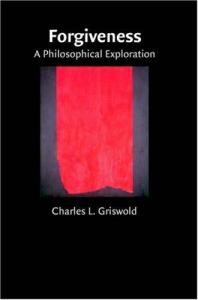
In his 2007 philosophical exploration of forgiveness, Charles Griswold, Professor of Philosophy at Boston University, states that forgiveness should be understood as

…a moral relation between two individuals, one of whom has wronged the other, and who (at least in the ideal), are capable of communication with each other. In this ideal context, forgiveness requires reciprocity between injurer and injured. I shall reserve the term forgiveness for this moral relation. All parties to the discussion about forgiveness agree, so far as I can tell, that this is a legitimate context for the use of the term; and most take it as its paradigm sense, as shall I.

A further definition of forgiveness is ‘…first and foremost the foreswearing of revenge…and of the other abuses of resentment.’ This definition will be implicit throughout my argument, but not in the context of its application being restricted to the paradigm of ideal conditions proposed by Griswold.

Griswold also states that his inquiry is secular, however within that stated secularity he has constructed a dogma, a system of principles and tenets authoritatively laid down, as by a church. Failure to attain the requirements of these principles and tenets results, Griswold claims, in exclusion from the possibility of forgiveness: ‘Where none of the conditions is met, the threshold of what will count as forgiveness is not crossed; sadly, and painfully, in such cases we are either unforgiven, or unable to forgive,’ he claims.

I explore the ramifications of this prohibition primarily from the perspective of the injured, and suggest that it is an extremely serious matter to cast either the injured or the injurer as beyond the ameliorating possibilities of forgiving and forgiveness, whether this is done under the umbrella of philosophy or religion.

I’m going to argue that the most appropriate context for discussions of forgiveness is within an embodied discourse of human rights. I’m also intrigued by what Judith Butler describes as the ‘…moral predicament that emerges as a consequence of being injured’ and from that argue that forgiveness is both a practical and an ethical necessity, and that it is the victim’s privilege, task and responsibility.

As well, I argue against Griswold’s belief that the perpetrator’s remorse is necessary for forgiveness. I also claim in opposition to Griswold that the attitude of perpetrators to their victims can and frequently must be irrelevant to the victim’s decisions about forgiveness.  We need a paradigm of forgiveness that is based in the embodied experiences of the injured, rather than defined as an abstract ideal to which the injured must aspire.

I don’t know what forgiveness is, though I’ve spent many hours thinking about it. Some say that it’s a state of grace that comes without announcement. Some say it’s a calm, in which there’s no ill will, and perhaps no thought at all. Some say it’s when you know something has ended and move on, without even really noticing

None of my propositions comply with the requirements of a concept of ideal forgiveness, whether that is theological or philosophical. They are a consequence of my experience of injury, and the subsequent profound moral dilemma I experienced. This dilemma is centred on the quite natural desire for redress and revenge, and the possibility of becoming a perpetrator if I act on this desire.

While Griswold’s definition is a legitimate context for the use of the term forgiveness, to declare this context the ‘paradigm sense’ taken by ‘most’, is to exclude from the experience of forgiveness millions upon millions of the injured who, for various reasons, are denied or legitimately shy away from the possibility of communication with their injurer. I argue instead for a much broader understanding of forgiveness, one in which unilateral forgiveness, that is, forgiveness that does not require the co-operation of the perpetrator, is included in the forgiveness paradigm.

I do this because injuries after which there is a possibility of ‘reciprocity’ are likely to be less common than those in which the perpetrator is unavailable or unrepentant. Such latter injuries can range in nature from the offended householder whose freshly painted wall is vandalised by unknown graffiti artists, to the victim of sexual assault whose rapist cannot be found, to the survivors of genocide whose tormentors are dead or unidentified. That is, circumstances which Griswold casts as ‘non-paradigmatic’, for example ‘…forgiving the dead or unrepentant…’ are likely to be more frequent than instances in which the injured and injurer are capable of communication and resolution.

As well, Griswold situates his argument ‘…in the ideal…’ and circumstances extraneous to this ideal are described as ‘…lacking or imperfect relative to the paradigm.’ If the circumstances do not fit Griswold’s ideal paradigm of dyadic forgiveness due to their failure to comply with the necessary ‘…baseline conditions…’ then, he claims: ‘…you are not engaged in forgiving, but doing something else.’

Below ideal baseline conditions for legitimate entry into Griswold’s country of forgiveness: ‘…may lie excuse, or condonation, or explanation, or any number of psychological strategies from rationalisation to amnesia…’ In other words if I assert that I have forgiven my perpetrator without having entered into communication with him, and without the benefit of his expressed remorse, then I am deluding myself.  Griswold elaborates: ‘…just being in the psychic state of no longer feeling resentment…whether that state is induced by medication, therapy, an astonishing act of will, an ostensibly religious revelation, or what have you,’ is not, he claims, sufficient to qualify as forgiveness.

As any survivor will attest, there is no such thing as ‘just being’ free of resentment: the struggle to overcome that feeling and everything associated with it is enormous, frequently ongoing and often demands more than just one ‘astonishing act of will.’ There is also a considerable difference between being medicated, and exercising one’s will. This argument for what forgiveness is not and why it is not is unconvincing, as is any argument that concludes an extensive list of unrelated generalisations with the phrase ‘what have you’.

The construction of an ‘ideal’ that is exterior to the imperfect human condition, complete with prescriptives and prohibitions for its attainment, is not entirely dissimilar to constructing a theology, not least in that both demand an original act of faith and belief in the existence of a fixed transcendental, from which subsequent thinking ensues. While the secular as proposed by Griswold is firmly disassociated by him from the religious, their prescriptive, exclusionary, and monolithic discourses are remarkably similar. For example: ‘…we count the capacity to forgive – in the right way and under the right circumstances – as part and parcel of a praiseworthy character,’ states Griswold. Who are the ‘we’ represented here, by what authority and process do they determine the ‘right way and circumstances’ for forgiveness, and how and by whom is the praiseworthiness of character determined?

The phrase ‘right way and circumstances’ inevitably makes reference to a metaphysical authority that ultimately determines what is praiseworthy and right, unless Griswold is assuming this authority for himself.

In a paper titled ‘Derrida, Death and Forgiveness,’ Andrew McKenna observes that Derrida

…claims to find in Western Philosophy a crypto-theology. His analyses regularly uncover presuppositions about foundations and primacies, points of origin and authoritative presences that correspond to nothing other than a Supreme Being, however veiled or unapproachable.

It is just such a crypto-theology that Griswold has constructed in his philosophy of forgiveness, in which forgiveness is perceived first and foremost as an ideal concept located in the authority of an unidentified exteriority, and one that the imperfect human being must struggle to attain.

In claiming the necessity for a sovereign ideal that must create notions of lack, imperfection, exclusion and failure, Griswold is describing a vertical concept of forgiveness that can be seen as largely irrelevant to the temporal and inter-human experience of suffering and forgiveness, as viewed through the secular lens, and through the horizontal discourse of human rights. Human beings are most usefully served, I would argue, by considering forgiveness not as an ideal whose conditions one may fail to meet, and perhaps through no fault of one’s own, but rather as a universally accessible, cosmopolitan practice.

To be continued.

Entitlement, bullying, and private faith

21 Jan

Since I received defamation threats from Melinda Tankard Reist’s lawyers, I’ve had occasion to consider just what a defamation threat is actually intended to achieve.

If I had done what was demanded of me, that is apologised, retracted, signed and published a letter drafted by the lawyers, and then paid all Tankard Reist’s legal costs, I would now be free of fear. This is the deal. Do what we say and you won’t have to worry about massive legal costs that will break you. Don’t do what we say and you risk ruin.

This is what a defamation threat does. It is weighed in favour of the plaintiff. It does not require a fair hearing in a court of law for it to be effective. It works entirely on fear. It is bullying. There’s no other way to describe it. It’s a bullying scam. The plaintiff counts on you collapsing and doing what she’s demanded, for fear of what will happen to you if you don’t.

You pay all the costs of her instigating this bullying action against yourself. The plaintiff will get exactly what she wants, which is you silenced, and it won’t cost her a cent.

Neither Tankard Reist nor her lawyers counted on their intended victim announcing she’d received defamation threats on Twitter. That wasn’t the way it was supposed to play out. Bullying only works when there’s secrecy. Take it out into the open, shine the light of day on it, and it’s useless as an intimidatory tactic.

Tankard Reist is reportedly horrified at the swell of reaction against her, some of which has been quite foul. I have also received some disgusting tweets from people claiming to be her supporters. I know how to use the block button. I know Melinda does as well. It works. If you don’t want to see them, Melinda, get someone else to monitor Twitter for you. And take responsibility for having created this situation all by yourself.

In her article in the SMH today, Julia Baird says in her last paragraph that it would be a pity if Tankard Reist’s faith was used to try to discredit her.

I’ve never used the ad hominem argument that MTR’s views should be dismissed because she’s a Christian. My argument is that as a public figure, seeking to influence public policy on female sexuality and its representation, and on abortion to which she is unequivocally opposed, she needs to be upfront about her religious allegiances. Women have the right to know if someone who is working to prevent access to abortion is doing so from concern for women, or is fueled by her belief system.

We need to have from MTR evidence -based arguments against abortion, and many other issues she argues on emotive and anecodotal grounds. Because if this evidence isn’t available, her conclusions are subjective. This is not good enough.

No one should be attacking Tankard Reist because of her faith. She should be rigorously questioned on her evidence for her claims and if she has none, then she should be asked to explain on what they are based. This is the price paid for advocating a public morality. I don’t care what she tells her children to do. But once she’s prescribing for women, thats another story.

Baird also asks the question when must a private faith become public? I would say certainly when the believer is in a position to effect public policy making on issues of morality. The churches have considerable power, consider for example their exemption from anti discrimination legislation in the matter of employing gays and lesbians. Any other employer who refused to hire on the grounds of sexual orientation would be liable for prosecution. Not so the churches. Why? Because of their beliefs.

So are we required on the one hand to adjust our laws to accommodate the Christian faith, while simultaneously granting the believers who influence those laws the right to conceal that faith from the public gaze?

Are any Christians entitled to wield such influence, and to demand protection from all scrutiny as well?

I don’t understand this notion of privacy around religion. It seems to me many religious followers, perhaps not all Christians but certainly some, believe that living their faith in the light of day is one of the things their God requires of them. Christian politicians for example, usually seem reasonably up front about where they are coming from. What reasons would a Christian have for demanding privacy for their faith in Australia? They aren’t facing any kind of discrimination or persecution, indeed it is their churches that are enacting discrimination.

This:

Matthew 5:14-16  “You are the light of the world. A city set on a hill cannot be hidden. Nor do people light a lamp and put it under a basket, but on a stand, and it gives light to all in the house. In the same way, let your light shine before others, so that they may see your good works and give glory to your Father who is in heaven.”

And this:

Matthew 28:18-20
(18)  And Jesus came and spake unto them, saying, All power is given unto me in heaven and in earth.  (19)  Go ye therefore, and teach all nations, baptizing them in the name of the Father, and of the Son, and of the Holy Ghost:  (20)  Teaching them to observe all things whatsoever I have commanded you: and, lo, I am with you always, even unto the end of the world. Amen.

While it seems that faith is regarded as personal in many Christian teachings, it is not regarded as private, and these are two entirely separate things.

Tankard Reist has publicly said that she tries to live her life doing what Jesus wants. Where does Jesus require his followers to be private about their belief in him?

I don’t know how long Tankard Reist and her lawyers can keep their threats hanging over my head. I have no control over this. In the meantime thank you to everyone who is helping me with their concern, interest, signing of the petition, tweets, DMs, blog comments, phone calls, and even dinners and wine. I count myself lucky. Very, very lucky. And I thank you.