Archive | October, 2011

Satire is not dead, but you’ll only find the good stuff in the blogosphere

8 Oct

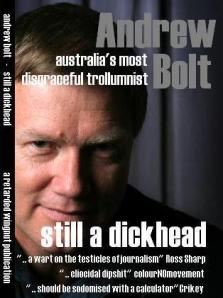
Do you want to know what drives Andrew Bolt? Even if you don’t give a tinker’s curse, it’s worth reading this piece by Under the Milky Way. Very funny, very erudite, my favourite combination of talents.
Then trot across to The Political Sword and learn how Sophie Mirabella and Scott Morrison take over the dumped ABC Collectors program. Warning: this piece contains references to a diarrhetic seabird so you might want to leave it till after your coffee and croissants.

And if you want something a little more serious in tone try Rolling Stone on the end of Australia and climate change:

Want to know what global warming has in store for us? Just go to Australia, where rivers are drying up, reefs are dying, and fires and floods are ravaging the continent

Don’t forget to check out the comments, many posted by outraged Aussies. WTF! Rolling Stone doesn’t even write about music properly anymore so where do they get off doing our Oz and climate change!!!! they bleat.

The Slap: a middle class morality tale

7 Oct

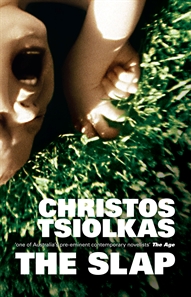
I haven’t read the book but I watched the show.
The first thing I thought was how absolutely awful that middle class marriage looked from the outside, and I thanked God I wasn’t in one. He’s drinking, smoking, snorting coke and considering an affair, all to escape the confines of a relationship that he looks to be pretty fed up with, and the responsibilities of fatherhood he seems to be pretty much over as well. I mean, telling your slightly plump young son to get off his fat arse isn’t loving, especially after you’ve yelled at him for eating potato chips and being sedentary into the bargain. Is it?

She’s harassed, feels she’s responsible for everything he doesn’t want to be responsible for and therefore is unfairly burdened, and on top of that she’s got highly manipulative in-laws he won’t stand up to, who want to ruin the only couple holiday they’ve planned in years by taking them all to Greece instead. He is not overly concerned with this interference, leading one to imagine he wasn’t that keen on the couple holiday in the first place.

Somehow we are meant to believe that the slap itself brought about a complete change of heart in him, and in the much younger woman he was planning to conjoin with as a temporary reprieve from his miserable life. The slap apparently shocked them both out of their  lustful fantasies, and caused them to within half an hour or so re-evaluate their lives and conclude they’re very lucky and they’d better not screw it up, so to speak.

I don’t find that instantaneous change of heart in a moment of shock entirely credible as a long-term prospect, but perhaps I’m a cynic.

An urgent post-slap marital root on the kitchen bench that seemed to afford passing satisfaction to him and little if any at all to her, acts as a temporary circuit breaker, and she grudgingly agrees to find ways to capitulate to her in laws’ travel plans.

An aside – I’ve never understood those sex scenes in which the woman is banged hard against some unyielding surface without any foreplay whatsoever, and likely very little skin on skin contact where it matters most, and apparently is left totally satisfied by the encounter. This doesn’t make a lot of sense when you think about it. Yet it is probably the most frequently employed portrayal of heterosexual sex in movies and on the telly. I get how it’s fine for the bloke, but…

Back to The Slap. You just know that the next morning or the next, however long it takes for the post-coital glow to subside, they’ll be back at it, him on his various drugs of choice, and her on her overburdened, aggrieved and resentful trip. This is the warp and woof of the marriage. Brief interludes of sex and drug induced relief punctuating vast expanses of chronic, unaddressed ill-feeling.

Mrs Chook, I’m sorry to say, slept through the slap, not the entire program but the actual swipe. Who did it, she muttered, rousing herself from her slumbers, who did the slap? Christ, I told her I can’t believe that of all the bits you could have happily slept through you chose the central event around which all else revolves. Shut up, she said. I’m tired, she said. I’ve been talking to phone people all day trying to get your bloody smart phone organized since you jacked up and said you were effing over it.

An aside: my daughter-in-law persuaded me onto Skype. I did it straight away before I could frighten myself out of it. It was so easy! Last night I talked to the new baby as he lurched about in a milk coma while his mother held him up to the camera and told him I’m his grandma. I still have to get the smart phone, but they’ve let me off Facebook. Compromise and negotiation: this is what gets you a happy family life.

Back to The Slap. I usually refuse to fill in bits people miss when they fall asleep on account of it gets tedious and they should just go to bed and let me record it for them. But I made an exception in this case, as it was pivotal. Mrs Chook said I was being uncharacteristically pleasant, but I let that pass on account of her generous attention to my smart phone difficulties.

It was not OK for that bloke to slap Hugo, nobody’s going to get an argument from me on that. At the same time I totally understand what led him to do it. Whenever somebody inflicts pain on us it’s instinctive to lash out, and the kid served up what must have been a very painful kick to the bloke’s shins. In what looked like a completely reflexive reaction, he delivered a hard retaliatory slap. Not premeditated. Totally reactive. Totally useless. Wrong. Understandable.

So what are the moral lessons we are to take from this first episode of what looks to be shaping up as a middle class morality tale? Well, there seems to be an inference that if you breast feed a child longer than the culture feels is necessary, you’ll end up with a brat everybody hates, and even if that isn’t why everybody hates him, it won’t help.

The second moral seems to be that an undisciplined child can wreak havoc far beyond his immediate family, and so middle class people have a moral obligation to properly discipline their children. Apart from anything else it’s just good manners as nobody wants their party ruined by a fractious, willfully disobedient, destructive escapee from South Park.

The third moral I took from the first episode was that it doesn’t matter how grubby your middle class marriage is, you have to find ways to make it tolerable for yourself because the alternative is too terrifying to contemplate. Even if that means having an affair, and everybody knows that marriages frequently survive affairs, and that affairs can often be, in the long-term, quite good for a marriage if not for the cast-off lovers who are dumped in favour of maintaining the institution.

The fourth moral I took was that human beings are frail and fragile, and we generally expect too much of them, whether it’s ourselves or somebody else.

I thought the acting was pretty good, the story interesting, and I’m not troubled by foul language. The smoking has copped a bit of criticism but people still smoke, and it does go to establishing character. The cigarettes were an important symbolic connection between Hector and the much younger woman he wanted to root, I think, and anyways, you can’t censor everything unsavoury and unhealthy out of stories or you’ll have no story left, unless it’s the Wiggles, or Mr Rabbit and Jemima Puddleduck.

I’m going to keep watching.

ABC promotes private interests: what happened to impartiality?

6 Oct

Between June 15 and October 5 2011, the ABC’s Religion and Ethics Online and the Drum have published eight articles written by anti pornography campaigners and colleagues who share the same perspective on pornography.

Judging from many of the comments on some articles, the views of this collective are regarded as extreme, and pushing right wing Christian conservative values.

Seven of these articles were written by contributors to Big Porn Inc, a collection of anti pornography essays edited by activists Melinda Tankard Reist and Abigail Bray.

In five of the articles reference is made to the soon-to-be-released Big Porn Inc, and three of them are extracts from the book. Clive Hamilton‘s article in Religion and Ethics reads like a book launch speech, and his last two paragraphs enthusiastically promote Big Porn Inc.

Gail Dines, also an author in Big Porn Inc, appears in R&E on September 15 promoting her anti pornography position. Meagan Tyler writes in the Drum on October 5th defending Gail Dines against critics, and promoting the same anti porn position. Tyler has another anti porn piece in the Drum on September 20th.

During this period the ABC has published one, yes that’s one alternative perspective to that put forward by all the above authors. That piece was by academic Alan McKee on September 23rd. McKee addresses many of the criticisms launched at him and his colleagues by some of the above authors.

Editor of the ABC’s Religion and Ethics forum, Scott Stephens, is launching the book the ABC has been blatantly promoting in Brisbane next week.

The ABC Code of Practice states as follows:

4. Impartiality and diversity of perspectives

Principles: The ABC has a statutory duty to ensure that the gathering and presentation of news and information is impartial according to the recognised standards of objective  journalism.

Aiming to equip audiences to make up their own minds is consistent with the public service character of the ABC.  A democratic society depends on diverse sources of reliable information and contending opinions.  A broadcaster operating under statute with public funds is legitimately expected to contribute in ways that may differ from commercial media, which are free to be partial to private interests.

Judgements about whether impartiality was achieved in any given circumstances can vary among individuals according to their personal and subjective view of any given matter of contention.  Acknowledging this fact of life does not change the ABC’s obligation to apply its impartiality standard as objectively as possible.  In doing so, the ABC is guided by these hallmarks of impartiality:

• a balance that follows the weight of evidence;

• fair treatment;

• open-mindedness; and

• opportunities over time for principal relevant perspectives on matters of contention to be expressed.

By neglecting to observe the required balance, the ABC has promoted both a specific position on pornography, and  a book written entirely from this position. This has continued for five months, with only one article that challenges this perspective published during that time period.

At the editor’s website, the launch of Big Porn Inc is headlined thus: “ABC Editor Scott Stephens to launch Big Porn Inc in Brisbane October 14.”

That the ABC should promote a book that is subsequently launched by one of its employees is bizarre. The ABC is not publishing this book. It isn’t written by ABC employees.

There’s a big difference between noting publications in an author’s biography, and the kind of intense promotional activity immediately prior to a book launch we’re seeing here. There’s a big difference between the ABC interviewing an author about his or her book, and the promotional activity seen here. There’s a lot of cosiness between the book’s editors and the ABC Religion and Ethics editor. None of this is good for a public broadcaster whose mission is to convey as many perspectives as reasonably possible on issues that affect the whole of our society.

Comments on all pornography articles on the Drum in 2011 reveal a wide variety of community views, the majority of which dispute those purveyed by the collective currently dominating the issue at the ABC. There are many comments calling for the publication of other perspectives.

Gail Dines was shouted down by left wing tossers, claims academic

5 Oct
Caricature on "The great epidemic of porn...

Image via Wikipedia

Oh my god, I just got home after a terrible day trying to buy a smart phone only to find this on the Drum. 

The good Dr Meagan Tyler is having a dummy spit at those of us who did not take to Professor Gail Dines and her anti pornography messages, and those of us who continue to resist the same harangues from MTR, Abigail Bray, and the man I’ve written about twice already this week so I won’t say his name because Steve at the Pub will say I’m obsessed.

Many anti porn activists are reasonable and rational and don’t want to ban anything, Tyler assures us, giving Dines as one of her examples of the rational and reasoned. She then claims the Professor was “shouted down” on Q&A, and otherwise abominably humiliated by left-wing tossers who feel they have a duty to be sympathetic to the plight of pornography consumers, whether they agree with porn or not.

Plight? What plight?

Needless to say I’ve dashed off a response, but whether or not the Drum will use it is another matter. As one commenter remarks, there are so many articles on the Drum written by anti porn campaigners, and hardly anything putting another perspective. I venture that maybe two of my articles there are among the very, very few that challenge the anti porn status quo. Why is that, I wonder?

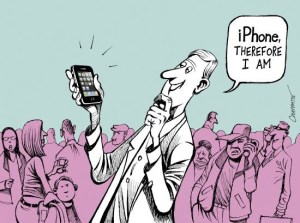
Smart phones. I tried to explain to the man in the phone shop, who had very bad breath, that all I really want is to receive photos of the new baby, send emails and tweets and texts, and a few other little things.  Talking on the phone is not one of my great interests so I don’t really need 500 million hours of talk time. Turns out I’m an aberration on two counts: 1: not having got a smart phone way before now, and 2, not liking to talk on the phone. There’s no plan that caters for my needs he said, rather triumphantly I thought, for somebody with dog’s breath.

So tomorrow I’m going to another shop, but I’m wondering just how much of my life I want to waste on this mission. It’s the plans that do your head in. How did it all get so hard? Why don’t they just make an iPad with phone stuff? Should I just stick to email and forget the phone? Then I’ll miss out on the baby pictures everybody else gets on their smart phones. I’ll be marginalized. I won’t belong. An outsider. They won’t love me.

I’m hungry. I’m tired. I have to walk the dog.I can’t think straight. It’s cold.

Lentils

4 Oct
lentil

Image via Wikipedia

Guest blogger (also a farmer and an artist) Gerard Oosterman tells it like it is…

Stock up on lentils, the end is nigh.

It must be clear to all of us. The good times are now beginning to fade rather seriously. For far too long we have complained about the over-indulgence of the wealthy, their utter ignorance of what life ought to be about.

Some of us knew that waste was bad. We grew up with that. But, the promise of limitless and endless supply of better and bigger things is what blinded many, especially those born in the late eighties, early nineties, not ever having known to do without, to save up, to delay instant gratification.

The call of the credit card was irresistible. Spend and spend more. The lure of consumerism was calling them up endlessly from somewhere deep within their primitive and fledgling conscience. They barely had the time to grow up into savvy financial adulthood. The debt card (let’s be honest, that’s what it is) drove them on relentlessly. The era of frugality had not yet arrived.

The last few weeks world markets are again heading for seismic shifts. The financial tectonic plates are grinding against each other yet again.  Billions are being wiped off every day. On the (flat-screen) TV we watch anxious faces watching the tumbling numbers on computer screens. Nervous Wall Street floor traders are running again, shouting, throwing arms up in utter despair and wiping sweaty foreheads.

It might perhaps not be as voluntary as we would have liked, none-the-less, it is something that some of us had prayed for. Surely, wanton over the top shopping till we‘re dropping was never supposed to be the goal for most of us to strive for. Aiming for endless growth surely is hardly the stuff of any enlightened person, while millions still have to walk for miles to fill a bucket of water?

Of course, growth in girth did happen and how? With over 50% obesity here in Australia we can only watch in awe the Danes, who have put a limit on girth growth by taxing fat. But, get a load of this; The Danes just have a mere 10% of obese people. Talk about nipping it in the bud!

Here in Australia we just feel that it will all sort itself out through some kind of reliance on the magic of … wait for it…”the market”.  We are adult enough to understand kilojoules, carbon hydrates, and we are not in the business of interfering with big grown-ups. The same with pokies: we are all mature and the sport clubs all support gambling, boozing and brawling afterwards. It’s good for ‘the markets’.

But getting back to our tumbling (western) world economies, has anyone noticed the eerie emptiness of electrical, furniture/ white goods emporiums, the likes of the (euphemistically called) ‘Good Guys” or those screaming ‘get it now’ Harvey Norman shops? What happened to the shoppers?

Has the Age of Aquarius arrived again, the age of frugality, of making do? Our world politicians seem as always frozen in some kind of eternally stuck vinyl recording, in the ‘economic growth’ groove. Entire countries are being bailed out, staving off the inevitable.

The question is; if economic growth is the cause of depleting our world, damaging our world, making the future more and more unlivable, should we not accept, perchance by hook and by crook, and even welcome a stop to this manic obsession with endless growth?

Was it last night’s ABC Four Corners telling us that in the UK 1% of the population own 20 % of its wealth?

Of course, no one has to walk anywhere to get a bucket of water. We might just have to get serious about stocking up on lentil beans. Looking through the acres of rubbish food on super-markets shelving, those little lentils are rather elusive. Strange how good wholesome food is now even harder to get.

Yes, definitely time to stock up the larder. Get your lentils NOW.

Gerard blogs at  Oosterman Treats Blog

New born babies, and gender: what is it good for?

4 Oct

As I welcomed a baby boy into the world last Wednesday,  I wondered just what kind of a planet he’ll be inheriting from his elders.

For a start I’d been unable to buy any decent clothes prior to his birth in either the US or here, because the parents decided they didn’t want to know their baby’s sex. Access to prior knowledge has come to mean insanely stupid gender divisions in the infant clothing market, and if you say you don’t know shop people look at you as if you’ve come out of a cave. So the infant had nothing much other than hospital garments to wear for his first couple of days on Earth, as everyone waited to hear about the newborn genitals before they went on a spend.

If I was still bringing children into the world I’d dress them in primary colours from birth, stuff the pinks and the blues, and anybody who said girls always or boys always would be banned from the infant’s presence.

Which reminds me that I am seriously pissed off with the likes of Clive Hamilton telling me all about women and men, as if the possession of a vagina or penis is the only determining factor in the life span of one’s entire being. Women, according to Clive, are supposed to provide an ameliorating presence that soothes the warring and destructive instincts of men. The very idea it’s the role of women to soothe the violence of men is so ludicrous that you wonder what Hamilton’s on that he’d even suggest it, let alone seriously argue for it.

Well, Clive, I could tell you some stories about a few warring and destructive women that would make your hair curl. Sorry, I forgot you haven’t got any, but you know what I mean.

I could tell you some stories about tender, pacifying, nurturing men that would turn all those essentialisms of yours right on their heads (is that another new word I made up? Essentialisms?) because the argument you’re running flat-out denies the possibility of such men, and shame on you for that.

I just watched a young man with his first baby and I’m telling you Clive, he’d match any woman any day in the nurturing stakes. Talk about feeling the love.

It seems to me that the gender card is usually brought into play when somebody wants to use it as a blaming weapon. Like, men never do the dishes properly, women never read maps right. Men abuse women, women are the victims of men. Women are compassionate, men would rather fight. Men are from Mars Bars, Women are from Venus fly traps. Gender, like race, is a construct and it pays to have a long hard look at who is currently constructing it and why.

I’m all for acknowledgment and appreciation of difference, but not for using difference as a reason for discrimination, accusation, blame,and lower pay scales.

OMG! I just got up to close the door and shut my finger in it. There’s a gender devil in the room, and it’s looking to hurt me!

I told our baby boy, whispering it into his tiny (pink) ear, that he can be as tender, nurturing and ameliorating as he wants, and he’ll probably feel violent and aggressive now and again as well, but somebody, likely his dad and mum, will show him how to handle that without acting it out on somebody. I told him he could grow up to love men or women or both and none of us will think twice about it because he’s ours and we love him, and love is love whether there’s a penis or a vagina involved. By the time he gets round to thinking about it, I told him, gay marriage will be legal and that’s one less battle he might have to fight on his own behalf or that of others.

I hope, I told him, that the climate change deniers will have gone to their god, and somebody in charge will have attended to the situation before it gets so bad his life will be spent in a hostile environment. I am so very sorry, my darling, I whispered, that we have let it come to this, and that we’ll die off and leave you with the wreckage.

The world is an amazing place, I told him (I watch a lot of SBS) in spite of all its problems, enmities and murderous ways. There’s still wondrous people in it, and thrilling things to see and do.  I’ll shout you a trip around the globe when you finish school, if they still do gap years then, so you can see its marvels for yourself.

I’ll mind you as often as your parents will let me, I promised him. It’s a family tradition that at some point in adolescence, everyone goes to live with a grandmother when their parents get naff. I did it, your dad did it, your uncle did it, your aunties did it, and I’m pretty damn sure a few of your cousins will do it as well. I’m here for you, then and always, I told him, if I’m the granny you choose.

And here the infant opened his eyes and looked at me for the very first time. How, I wondered, as I fell immediately and irrevocably into love, can we live with such disregard for the futures of those who’ll succeed us? They are newly formed human beings. They come in utter helplessness and trust. They come with a vulnerability that makes the heart ache.  Don’t we owe them everything?


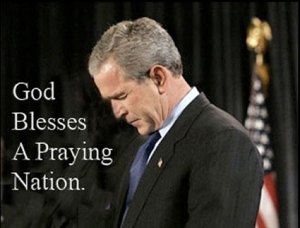
Did Bush claim God told him to invade Iraq? Yes, he did.

3 Oct

On Q&A tonight, News Limited journalist Greg Sheridan insisted, and insisted, and insisted again that George Bush did not claim that God had told him to invade Iraq.


But the BBC, The Independent, The Guardian, The Age, and The Washington Post said this in October 2005:

(In June 2003)…the former Palestinian foreign minister Nabil Shaath says Mr Bush told him and Mahmoud Abbas, former prime minister and now Palestinian President: “I’m driven with a mission from God. God would tell me, ‘George, go and fight those terrorists in Afghanistan.’ And I did, and then God would tell me, ‘George go and end the tyranny in Iraq,’ and I did.”

And “now again”, Mr Bush is quoted as telling the two, “I feel God’s words coming to me: ‘Go get the Palestinians their state and get the Israelis their security, and get peace in the Middle East.’ And by God, I’m gonna do it.”

Those Christian fundamentalists and their imaginary friends.

Those News Limited journalists and their selective hearing.

Those warmongering religious fanatics with God on their side.

But now we got weapons
Of the chemical dust
If fire them we’re forced to
Then fire them we must
One push of the button
And a shot the world wide
And you never ask questions
When God’s on your side.

Licensed to Kill

3 Oct

Defence Minister Stephen Smith’s decision to allow women to assume unrestricted combat defence roles has caused ethics Professor Clive Hamilton to despair that “it is time to sound the Last Post over the rotting corpse of feminism.” Hamilton goes on to argue that the pursuit of equality has brought us to a sorry state of feminist affairs when women, like men, are granted a license to kill. This step signals the “final annihilation of difference,” and the end of women’s role as a “subtle, civilising power that has always worked to restrain the violent tendencies of men.” Without much success, one is obliged to point out.

In order to earn a license to kill, women must prove themselves psychologically, physically and mentally up to the job, a job that is on offer only from that bastion of hegemonic masculinity, the defence forces.

There are many men who would not fulfil the requirements and indeed, would not wish to. I recall my sons singing to Tchaikovsky’s 1812 Overture, “Join the army get your balls blown off” whenever a recruitment advertisement appeared on television. Being licensed to kill isn’t for everyone, regardless of genitals.

Instead of throwing in the feminist towel at this strike for equal opportunity, perhaps it’s valid to note that licensing women to kill is recognition that some women are capable of acquiring and practising the violent arts, therefore the capacity for deadly violence is not gender specific. The Defence Department has, perhaps unwittingly, subverted culturally imposed gender roles of the kind espoused by Professor Hamilton that would have women incapable of or unwilling to perpetrate violence. The Department has now acknowledged women as trainable as men, should we choose to embark on that course.

We can’t have it both ways

I’m at a loss to see how debunking that particular gender myth can be anything but positive for everybody. The majority of women will not choose to earn their killing license, just as many men do not choose that path either. At least it is now acknowledged in public policy that women are human beings capable of a wide variety of behaviours including state-sanctioned killing, just like men.

This is in direct contrast to another Gillard Government policy designed to prevent violence against women and their children. This policy defines domestic violence as overwhelmingly perpetrated by men. The policy does not acknowledge that female violence against children and other women is of equal concern, despite increasing international research and anecdotal evidence that this is indeed the case. The designers of this policy seem, like Professor Hamilton, to be labouring under the misapprehension that women are not capable of violence because it isn’t in our nature. It is only in our nature to be victims and/or soothers of male aggression.

You really can’t have it both ways. Women either are or are not capable of learning to use violence, either from the state or from the influences of their environment and their genes, just like men. You really can’t have the Defence Department heralding this as equality, while at the same time the Office for Women portrays us as overwhelmingly victims and rarely perpetrators. You really cannot insist on contextualising women’s violence (when it’s actually admitted) while leaving male violence out there as if men are born bad and it’s their base nature.

If the Defence Department has shown us anything, it’s that they consider the ability to engage in deadly violence to be non-gender specific. If we are to accept that, we must accept women are equally capable of violence in other situations as well. Joining the armed forces isn’t going to cause the sudden emergence of a brand new aggressive characteristic in the human female. It’s going to nurture and nourish what already exists.

The feminist struggle for equality

The mainstream feminist struggle for equality has always been about escaping restrictive gender roles and that escape has been perceived as our liberation. It has always been about ensuring women have equal opportunity and that has been perceived as our liberation. Mainstream feminism has rarely interrogated the type of masculinity that determines the Western capitalist culture within which it has sought equality. Mainstream feminists have not sought to radically change this culture, but rather to find an equal footing with that specific masculinity, within its parameters.

Thus we have our first female Prime Minister who is determined to deny the human rights of women and children in her urgency to pursue entrenched masculinist policies of sovereignty and border protection. Such a goal is far from feminist, yet mainstream feminists were (and some still are) ecstatic that we have a female PM. How long will it take to grasp that ownership of a vagina does not a feminist make?

What’s gone wrong with the feminist debate?

What has gone badly awry in the equality debate is a shocking lack of clarity and truth. For a movement that railed against the destructive consequences of stereotyping women, we’ve certainly done more than our fair share with regard to both sexes, and this has brought us undone.

There is no such animal as “men” and there is no such animal as “women.” Such erroneous concepts are the foundational lie on which much equality rhetoric rests. It’s a lie feminists railed against on behalf of women, yet enthusiastically embraced when it came to men. It’s a lie Stephen Smith confronted and faced down, whether he meant to or not. This lie is what is bringing feminism to its knees, not, as Clive Hamilton would have it, women being licensed to kill, or vomiting drunk on a Saturday night just like the boys.

We are rightly outraged when all Muslims are cast as terrorists. We are outraged when all Indigenous people are cast as drunken child abusers. Or we should be. Yet we don’t bat an eyelash at the use of “men” and “women” by just about everybody who has something to say on the subject. “Women’s morality differs from men’s,” writes Professor Hamilton, for example. Both sexes ought to be outraged at this stereotyping. It is an untruth, as all generalizations are untruths. I am not Woman. I’m a woman. My “morality” is the product of all of my experiences and what I have made of them. Here’s a male ethicist prescribing my female moral life, while claiming to have feminism’s best interests at heart. What is wrong with this picture?

A common enemy

It’s rarely acknowledged that many women and men share the common enemy of hegemonic masculinity. Recognising that there are infinite ways in which we are all undone, devalued and dehumanized by this dominant form of the masculine would allow us to co-operate in its demise. Instead, hegemonic masculinity pits us against one another, and we co-operate by couching our grievances in terms of gender warfare. The debate ought to be couched in terms of the dominant masculinist principles to which some women are as bound as some men, and that disadvantage whole subcultures regardless of sex, though sex may determine the manner in which the disadvantage is enacted.

Mainstream feminists have embraced these principles, with the result that some women have successfully adapted to the institutions, and the institutions themselves remain intact and largely unchallenged. The goals and aspirations of the majority of people demand a capitulation to masculinist forces that govern every aspect of our Western lives from cradle to grave, forces that remain largely unchallenged by feminism.

Who’s going to take away their license to kill?

Issuing women with a license to kill is a formal recognition of women’s equal capacity for sanctioned violence. Equality within the status quo was the intention of mainstream feminism, not radical structural change. This move by Defence is entirely in keeping with feminist goals.

We were never going to be much more than tokens in the patriarchy, and we aren’t. This isn’t going to change until we stop being victims. We will never stop being victims until we acknowledge our full capabilities, including those for violence and harm. This is what finally liberates us from victim-hood: owning our capacity for behaviours that are collectively denied in women because our culture doesn’t want women to have them, and because when the chips are down neither do we. How much nicer to be romantically imagined as “those who pacify the beast” than as those who are complicit in the beast’s violent projects.

The Defence decision acknowledges that women are first human beings, capable of feeling and acting in ways that have long been regarded as exclusively male by the orthodoxy. While in the short-term this may result in what can seem undesirable female behaviour, in the long-term it will allow us a fullness of humanity we’ve been denied for far too long. Human beings can be violent, destructive and murderous. Human beings have to learn to deal with these impulses in ways that do not bring about devastation. This can’t happen if we continue to deny that the female half of the human race has these capabilities, in the face of mounting evidence to the contrary.

Women who feel liberated enough to publicly express violence will initially do so in destructive and copycat ways, and they will call it equality because male acting-out is all they have to measure themselves against. They’re quite right. Equality is exactly what it is. The right to be equally human, for better and for worse, is what any feminist worth her salt should work towards. We can’t cherry pick equality.

As long as violence sanctioned or not is perceived as gender determined, no society can adequately address its causes, its effects, and what can be done about it. Rather than gnashing and wailing that women are becoming as awful as men, we should be questioning the limited means of expression both sexes have within a hegemonic masculinity that depends for survival on strict gender roles. We should be recognizing that these expressions are determined and controlled not by “men,” but by a specific manifestation of masculinity that disadvantages and dishonours both sexes. Then we can really examine violence and war, not as fought by men or women, but as perpetrated and fought by human beings on and against other human beings.