Archive | August, 2011

Sunday with Leonard; born to be bad, and how long is a duck’s dick?

15 Aug

In need of spiritual nourishment and it being Sunday, I gave myself a dedicated Leonard Cohen day. This entailed, along with the scented oils, incense, beeswax candles and floaty shawls, a total immersion in music and lyrics enabled by our new system that transcends anything we’ve ever had before in terms of thrilling quality of sound.

As it turns out, it is perfect for Cohen’s fruity rasp, and for appreciating the brilliance of his musicians and backers, each one of whom is a top class artist in her or his own right.

Later,as the white blond moon peered through the window at me and the dog with the cauliflower ear, I settled down with a glass of red to a viewing of the On The Road DVD, featuring excerpts from Leonard’s recent world tour, and, how sweet it is, backstage stuff about Leonard’s quirks.

Needless to say the rest of the household had buggered off by then. Sympathetic to Cohen’s music though they are, nobody has my staying power.

I am crazy in love with this man, or at least the idea of him, having never met him. Up close he’s probably as irritating as every other human being can be: it never pays to confuse the art with the artist, especially someone like Cohen who writes many of his songs from what appears to be an imagined God perspective. Or channels them, depending on your belief system. This might make him even more difficult personally than the average bloke.

(An aside, check out David Horton’s piece on climate change sceptics today, titled “I believe.” It’s a little gem. As Leonard says: Take the only tree that’s left, and stuff it up the hole in your culture…)

Back to writing in the God voice, look at the Lover Lover lyrics: (I’m using the capital “G” because I’m referring to one imagined transcendental being, not a whole bunch of them in which case I would use the small “g.” The concept of a whole bunch of them doesn’t work at all in this instance. And I know God could just as easily be a woman, but that doesn’t work either.)

I asked my father, 
I said, “Father change my name.” 
The one I’m using now it’s covered up 
with fear and filth and cowardice and shame. 
Yes and lover, lover, lover, lover, lover, lover, lover come back to me, 
yes and lover, lover, lover, lover, lover, lover, lover come back to me. 

He said, “I locked you in this body, 
I meant it as a kind of trial. 
You can use it for a weapon, 
or to make some woman smile.” 

Yes and lover, lover, lover, lover, lover, lover, lover come back to me 
yes and lover, lover, lover, lover, lover, lover, lover come back to me. 

“Then let me start again,” I cried, 
“please let me start again, 
I want a face that’s fair this time, 
I want a spirit that is calm.” 

Yes and lover, lover, lover, lover, lover, lover, lover come back to me 
yes and lover, lover, lover, lover, lover, lover, lover come back to me. 

“I never turned aside,” he said, 
“I never walked away. 
It was you who built the temple, 
it was you who covered up my face.” 

Yes and lover, lover, lover, lover, lover, lover, lover come back to me 
yes and lover, lover, lover, lover, lover, lover, lover come back to me. 

And may the spirit of this song, 
may it rise up pure and free. 
May it be a shield for you, 
a shield against the enemy. 

Yes and lover, lover, lover, lover, lover, lover, lover come back to me 
yes and lover, lover, lover, lover, lover, lover, lover come back to me. 

Now, personally I can barely resist the notion of an imagined transcendental being driven by such passion and such profound longing for reunion with me. It busts the heart right open, but only if it’s Cohen that’s singing about it, I’m not getting sucked in by those fundamentalists banging on about how God loves me and longs for my love in return.

Which reflects badly on me, I know, suggesting as it does that it’s the aesthetic not God after all, that transports me with delight.

There’s nothing “pure and simple” about violence and greed. Yet this phrase and others like it have been used over and over again as “explanations” of the motivations of those who rioted and looted in British cities last week.

It’s becoming evident that the offenders were not a homogenous group. Students, employed people, young kids, representatives of the middle class, the unemployed and a variety of ethnicities were all involved. Perhaps the only generalization that holds up is that they were young.

That their behaviours are criminal is unquestionable. That they ought to be held accountable is also unquestionable. What does need to be questioned is why this particular group of opportunistic looters are being singled out for attention when the world is awash with the predatory species. Check this link to the Drum today and Michael Brull’s excellent piece.

Like drug mules, the rioters and looters easy targets. They’re at the bottom of the opportunistic criminal food chain.

“They did it because they can” is another “explanatory” phrase. But all opportunistic criminals do it because they can, many of them causing far more mayhem and misery, unchecked, and for far longer periods. Opportunistic criminal behaviours, like domestic violence and incest, cross social divides. Those who are protected from the surveillance of authorities by money, power and influence are rarely called to account. Those who act out their capacity for violence and greed in the public gaze are pulverized by the self-righteous orthodoxy with the means to conceal their own criminality.

Lock them up and throw away the key, stop their benefits, chuck them out of public housing and make them homeless, that will teach them a lesson they’ll never forget.

The orthodoxy will do all this and more, because it can. It will do this because its prevailing attitude is that certain people are born bad and that’s all there is to it, and to them. The born bad fulfill a useful purpose: they distract public attention from greater opportunistic crimes perpetrated by another certain kind of person. This kind of person is presumably not born bad because being born bad means not having the ability to hide your criminality. The not born bad opportunistic  criminal commits crimes that are not perpetrated in clear sight. This species is among those with whom the orthodoxy is on good and mutually self-interested terms.

British politicians led by Old Etonian David Cameron are also engaged in giving the police a bollocking for not doing things properly. Which is a bit rich considering it took Cameron a few days to get back from his holidays in a Tuscan villa. It looks as if the only people not responsible for any of it are the politicians, who have been badly let down by both the opportunistic looters and rioters and the coppers, while they had their backs turned on their hard-earned summer holidays.

I can’t run no more,
With that lawless crowd
While the killers in high places say their prayers out loud…


That last line always makes me think of Tony Blair. You have heard about his Faith Foundation, haven’t you, the one that “promotes respect and understanding about and between the world’s major religions,” and has a flourishing branch at the University of Western Australia?

I suppose it makes a change from bringing democracy to Iraq through Blair, Howard and Bush’s Christian method of bombing the living shit out of civilians no matter what faith they follow.

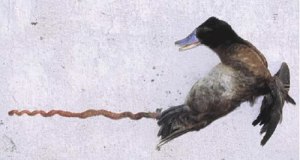
Finally, I now know that the Argentine duck has a penis that is almost half a metre in length, and is, dear God, shaped like a corkscrew.

Here is a picture of a duck checking on his penis. He looks like he can’t believe it either. That’s mine?! WTF!

I don’t know how the female deals with this appendage. Please don’t anybody feel they have to tell me.

Did God give the Argentine duck his body to make the girl duck smile? Hallelujah!!!

Government control of social media: take away Murdoch’s phones!

12 Aug

As predicted, British PM David Cameron is now flagging the possibility of controlling social media access to those the authorities perceive as responsible for inciting and participating in anti-social behaviour such as rioting and looting.

Just how this would work in practice is not yet clear, if indeed it is possible at all. The police confiscate the social media tools of anybody found wearing a hoodie? Males of particular ethnic appearance between the ages of x and x are obliged to relinquish their phones in times of unrest? Females with black nail polish and piercings likewise?

Who will judge that the usual suspects are in the throes of planning a campaign of violent civil disobedience? What criteria will they use?  Will Britain become one of those authoritarian regimes that shuts down the Internet when there’s trouble?

The idea is ludicrous. It’s another of those impotent threats trotted out by politicians who have no control over events, and are desperately casting about to find some punishment that will dissuade the mob from ever doing it again.

The threat of taking away their toys if they don’t behave is likely to incite further explosive protest. This is a cohort that already believes it’s over surveilled and singled out for police persecution.

Has anybody thought to threaten the Murdoch empire with the restriction or removal of their phones if they don’t stop hacking? Didn’t think so.

The impotent threats of impotent leaders

11 Aug

They may come from different political perspectives (in theory, anyway) but there are interesting similarities between British PM David Cameron’s authoritarian threats against the rioting mobs, and those used by Julia Gillard on the matter of water-borne asylum seekers.

Whenever there is social unrest of almost any kind, politicians pull up the same violently repressive cliches: stamp out, crack down. I/we will not allow, full force of the law, tough stance against criminals, illegals, queue jumpers. This ritualized language is the backbone of authority’s discourse when faced with challenges it ‘s very likely incapable of controlling. The less likely the possibility of control, the more violently repressive politicians’ language becomes.

While there is a place for dissent and disobedience in a liberal democracy, these acts can only be performed within the strict parameters of acceptable middle class behaviour. It is not acceptable to riot, either in the streets of London or behind the razor wire of a detention centre. Middle class manners do not allow for extreme behaviours of any kind. This is why politicians have absolutely no hope of competently addressing extreme behaviours: they don’t understand them and they’re scared to death of them. All they can think of to do is threaten with imprisonment or expulsion, either of which may at some point become necessary, but neither of which do anything to calm a red-hot situation.

The bottom line is, David Cameron cannot control the rioters. He may bring in water cannon. Australians know from Woomera that doesn’t work. It’s a very bad look, especially for a country aiming to put on the best Olympics ever next year. The effects of water cannon are extremely temporary, unless it inadvertently kills or injures someone, and it’s use will further incite the rioters it blasts all over the streets.

The bottom line is, Julia Gillard cannot control the asylum seekers who are already here awaiting assessment, or those she intends to expel to Christmas island. She cannot stop them trying to poison themselves, going on hunger strikes, sewing up their lips or killing themselves. Her plan to despatch them to Malaysia is now completely out of her control, and in the hands of the High Court. Even if she has them shot again them with bean bag bullets she’s still got no control over them, and that’s a bad look too.

You cannot control human beings who feel they have nothing to lose. You can only attempt to create a society in which human beings are not driven to that extreme. People exhausted by failure frequently resort to savagery. Politicians consistently fail to understand this. There’s no votes in understanding it.

Once, in less sophisticated times, the public might have been reassured by politicians using tough language in a crisis. Not anymore, but politicians haven’t caught up with the change in the public’s credulity. Consequently they look increasingly impotent as it becomes more apparent that their rhetoric is hollow. The objects of their wrath are entirely un-cowed by the blustering, and more often than not, they’re driven to greater extremes by the threats.

So Cameron throws hundreds of youths in jail. Imprisonment then becomes a right of passage and the offenders emerge even more brutal and brutalized than when they went in.

God only knows what’s going to happen to the asylum seekers, but it doesn’t look like the boats are doing any stopping, and there’s still the problem of expelling unaccompanied minors into very uncertain conditions and futures.

So what exactly do the politicians hard line positions achieve?

Votes, of course. Because there’s still enough of us who want to hear the rhetoric, even if we know it doesn’t work. The authoritarian rhetoric reassures. It makes us think somebody’s in charge even though we don’t really believe it. In full authoritarian flight, the politician appears to possess the “truth” about the situations we’re facing, and the right things to do about them. It’s a chicken and egg thing: the use of authoritarian language facilitates authority.

Of course, the fact that these events are taking place at all signifies the degree to which our politicians really have lost control.

Why tough talk won’t stop London burning: look to Johnny Rotten

10 Aug

Predictably, British PM David Cameron is talking tough, threatening anarchic marauders with the full force of the law, promising terrified residents that the government will defeat the masked and hooded teenage hoodlums with the toughest possible action. He will jail them. He will put them in juvenile detention. He will teach them not to burn and loot, by God he will.

Meanwhile, the bizarrely opinionated Brendan O’Neill of Spiked, recently in Australia where he earned a reputation for thoroughly irritating an astonishing cross section of people, has decided that the entire responsibility for the chaos can be laid at the door of the bloody welfare state. The offending yobs have suckled at the state’s tit for their entire lives, and so have their parents, and as a consequence none of them have the slightest idea about standing on their own two feet and behaving decently like their working class grandparents did. By God, the English aren’t what they used to be.

A brief aside: I was brought up by working class grandparents for a few years, and the difference was they really were working class because there was work for them to do. My granddad was never unemployed: the coal mines or the gasworks gave us food on our table and a Saturday drink at the club. Very different times, Brendan.

Jonathan Freedland of the Guardian alleges that the rioters have the “opportunistic desire to steal and get away with it.” Which, come to think of it, also describes the motives of many of those financial types who got away with ruining untold investors and still managed to reward themselves. Or the British MPs who stole taxpayers money to build moats around their castles, and swimming pools, and pay for illicit sex and exotic holidays and extra houses near Hampstead Heath.

Or even the police and politicians who fell on their knees before the Murdoch empire and turned a blind eye to vile illegalities that empire was busily engaged in perpetrating. These same police and politicians are now claiming the high moral ground in their shocked outrage against the raging youth, and in their self-righteous determination to get these delinquents who’ve had the nerve to behave really, really badly. But where are the leaders with any moral compass? Who’s setting a moral example? The rot starts at the top.

That the rioters have trashed their own neighbourhoods has been the source of much bewilderment. It’s not rocket science. These kids don’t consider themselves as part of any community. They don’t perceive themselves as having a stake in any neighbourhood. Alienation at this level comes with enormous and inarticulate rage. They don’t belong. They can’t belong. They’ll never belong. How did a society let this happen?

This isn’t a social movement designed to challenge the status quo and bring about change. This is pure destruction, and self-destruction. These kids don’t care, and they especially don’t care about themselves. Incarcerate them for a few years and they’ll likely come out worse. If David Cameron or anyone else is kidding themselves that tough talk is going to even touch these youths, they’re dreamin.’ The time for tough talk is long gone. When you ain’t got nothin’ you got nothin’ to lose, and like Bob, I’m not talking about material possessions.

The nihilistic lyrics of Johnny Rotten and the Sex Pistols pretty much sum up the mindset:

When there’s no future, how can there be sin?
We’re the flowers in the dustbin
We’re the poison in the human machine
We’re the future, we’re the future…God Save the Queen

London’s burning: Blame it on the BlackBerry

9 Aug

We live in a global culture in which the ability to consume is the primary measure of human freedom. To be a prosperous consumer is to be free. Given this reality, violence, theft, and rioting by disaffected youths stealing trainers and plasma TVs, while shocking, should not come entirely as a surprise.

The marauding gangs have been described as criminal opportunists, a description that can be as accurately applied to the News of the World phone hackers,  the Wall Street financiers who gave us the first global financial crisis, the private companies making exorbitant profits from the misery of war in Iraq and Afghanistan, the sub-prime mortgage mongerers, authorities entrusted with public well-being who take bribes to work against the common good. Countries such as Australia, the UK and the US have been governed by men who are widely considered to be war criminals: make up your own list, the possibilities are endless.

We commit our crimes in accordance with our means and circumstances. The better our means and circumstances, the less likely we are to engage in the crimes of looting and arson. The London riots are complex in their genesis but without doubt unemployment, poverty and lack of hope play their part.

Of all the reports and analyses I’ve read thus far the one that grabbed my attention was the blame it on the BlackBerry explanation. BlackBerry offers its customers a private messenger service (BBM) that encrypts your messages, unlike the other social media that are available to everyone, including the authorities. It seems that many rioters are communicating via their BlackBerries, and when this is the case, police cannot find out until it’s too late where the next outbreak of violence will be. This has allegedly led to the rapid expansion of trouble spots around the country, as agitators’ communications cannot be decoded by authorities in time to prevent new outbreaks.

It seems something of a long bow. Presumably  an intercity tweet can also get things going faster than police can organize officers on the ground. The real objection to BBM is that it thwarts official surveillance, and when disaffected youth have a means of communication that excludes any possibility of the authorities cracking their codes, this is perceived as a menace in principle, if not in practice.

The mobile phone is one of the iconic symbols of consumption. BlackBerrys cost less than smartphones and BBM is both essentially cost-free and invisible to police. In order to communicate, BBM users must exchange PINs, but their conversations are private. They can spread their PINs via SMS, Twitter or other means.

There’s little doubt that the use of social media is a vital force in getting uprisings of all kinds off the ground, and its use enables rapid expansion. But to blame the London riots on the BlackBerry is like blaming the Arab Spring on Facebook. Social media is a tool available to everyone to use how they see fit. Undoubtedly there’ll be a call to ban BBM before too much longer, or distribute the facility only to those authorities deem to be worthy of their trust.

The violence and looting is awful. But blanket condemnation of the guilty is too simplistic. Yes, they have to be held accountable. Yes, they have to face the consequences of their actions. But these events don’t happen in a vacuum. Criminal behaviour is not peculiar to disaffected youth. Stealing trainers and plasma TVs is no more or less criminal and deserving of punishment than hacking phones, exploiting dead children, starting illegal wars and ruining the global economy. We don’t call for a law and order crackdown except when the crimes are perpetrated by disaffected youth. It’s a class-based demand.

Western culture worships consumerism. We measure worth by what we have and what we can afford. Everywhere we look there’s corruption and criminal behaviour. It’s the zeitgeist. Commentators have been quick to point out that these riots are not political uprisings because one of the goals is to steal stuff.  They’re wrong. These riots are absolutely political. The ultimate assessment of human worth in Western culture is what the human owns and is capable of owning. The middle class aspire to wealth. The working class aspires to what the middle class has. When a large enough group feels it has no stake in society, that group will revolt. Trainers and plasma TVs are the pathetic symbols of the revolt of the have nots against the haves. Not political? You must be dreamin.’

What does brain plasticity have to do with leadership?

9 Aug

Guest post today by Dr Stewart Hase 

There are three related issues that I’d like to briefly mention here on the way to providing some hard science that people who want to be leaders could find useful, if not compelling.The first is that the ‘great’ debate about whether leaders are born or made is a non-event. The issue is more about what people do that make them leaders and whether they have the capacity to perform the behaviours. It is clear that some people can’t be good leaders and others can. The second issue is closely related to the first and that is that people in leadership roles do not pay much attention to the social, anthropological and psychological evidence about what great leaders do and how to get the most out of people and, ergo, organisations. Leadership is treated a bit like counselling and teaching (other than in schools), that it that anyone can do it, without any formal training, if they have the inclination. It is fascinating that we still promote people to leadership roles on the basis that they have demonstrated high levels of competence in their profession (being an engineer, academic, town planner). Lastly, for this little article at least, the leadership literature is, at best, fluffy and has probably not had much impact, other than the occasional halo effect, on what most people in leadership roles do at the coalface.With these three issues in mind it is interesting to actually look at the science behind what people need to do in order to become good leaders. The evidence is pretty well overwhelming concerning the conditions in which people perform best at work. The tragedy is that the evidence is not accessed, oversimplified or incorrectly interpreted. I know of many organisations that have been sold psychological ‘pups’ by consultants or whose CEOs have read a trendy book on leadership at the airport that sounds good but has not evidential base. These ‘pups’ come in the form of untested theories and models that are anecdotal at best. They might consist of colourful and sexy personality testing instruments that have no reliability or validity whatsoever and are simplistic in the extreme. Medical practitioners, psychologists, dentists, nurses, physiotherapists, engineers are required to use evidence based practice. Why not people in leadership roles?We know from many social psychological experiments that people work best in an environment where they have control over their immediate work, are informed, make a contribution to decision making, feel that what they do is worthwhile, feel that they have a positive future, feel a valued member of the team, are acknowledged for what they do, are appropriately rewarded, have interesting work, and enjoy optimal variety in their work,

We also know, again from social psychological research, what it is that good leaders do to have influence and to get the best out of people. They have empathy, listen attentively, have good interpersonal skills, make people feel valued by involving them, are optimistic and positive, involve people in decision making that affects them, and don’t micro-manage (they believe that expertise outranks rank). Good leaders consciously create the type of environment or culture described in the paragraph above.

In recent years technology has made it possible to view in living brains how experiences change our brain structure, how new neural networks grow and how relationships between the various are affected. In general it can be said that positive experiences have a growth and positive effect on our nervous system and negative experiences have the opposite.

This research has now given us some explanations of why the social factors described above seem to be important in what has come to be called employee engagement. People perform best in a situation of what I call Goldilocks Stress: it has to be just right. That is, not too much and not too little. This means the environment has to be safe and you don’t have to be Sigmund Freud to see that the factors described above from social research lead to a sense of safety. People are more likely to learn and adapt when they feel safe and is a central theme in the research on brain plasticity.

Research into brain plasticity also tells us that people learn and function better in enriching and challenging environments. This would explain why people tell us that they enjoy work when they feel that they are involved, have a valued role to play, work in functional team settings, have a role in decision-making and have control over what they do. Positive parenting has been shown to have very powerful cognitive and emotional advantages to children thus exposed. There is no reason to suspect that the same thing is not true for adults whose brain, we now know, develops throughout the lifespan.

Finally, we can see the role that positive interpersonal relationships are such an important aspect of leadership. Specifically, it is easy to see why people report that they most admire and are engaged with leaders who have empathy, listen and demonstrate good interpersonal skills. In short, it has a positive effect on their nervous system. Bullying behaviour, for example, has the opposite effect: it creates stress, reduces enrichment and diminishes cognitive ability.

At least there is a significant physical science to reinforce the already considerable social psychological evidence that what managers/leaders do really does matter. As does what they do not do.

Dr Stewart Hase

Guest author Dr Stewart Hase is a registered psychologist and has a doctorate in organisational behaviour as well as a BA, Diploma of Psychology, and a Master of Arts (Hons) in psychology.

Stewart blogs at stewarthase.blogspot.com


Malaysian solution: Judge complains government case is “half-baked”

8 Aug

In the High Court hearing on the Malaysian solution this afternoon, Justice Kenneth Hayne reprimanded the Commonwealth Solicitor-General for appearing before him with a”half-baked” case. Considering the government’s frequently expressed confidence that it has all the legal bases covered in the matter of its expulsion of asylum seekers to Malaysia, it’s remarkable that they should have irritated the judge so early in the piece. Perhaps they are not as on top of things as they would have us believe. As pretending to be on top of things while flying by the seat of its pants  is pretty much par for the course for the Gillard government, one ought not to be surprised at the “half-baked” comment. Nevertheless, I was surprised to hear they are already in disarray.

Justice Haynes extended the injunction that prevents expulsion of asylum seekers until arguments on the lawfulness of the government’s actions can be heard by the full bench.

One of the points that will be contested is that the agreement with Malaysia, in which that country has undertaken to provide certain protections for the 800 asylum seekers from Australia, is a political not legal agreement, and therefore unenforceable. This casts doubt on Immigration Minister Bowen’s declaration, in which he unequivocally states that Malaysia is a safe destination where human rights and protections will be observed. As Malaysia is not a signatory to any UN Conventions, asylum seekers will not have the protection of international law either.

I wonder what effect these shenanigans will have on Australia’s bid for a seat on the Security Council, so single-mindedly pursued by Foreign Minister Kevin Rudd? Helped by some $10.5 million in promotional funding over the next two years?

Ministerial Declaration process corrupted by Gillard’s political and personal ambition

8 Aug

Lawyer David Manne and his team have succeeded in obtaining a temporary High Court injunction preventing the transportation of asylum seekers to Malaysia, planned for this morning. They will return to court later today seeking to extend the injunction, and to argue against the legality of the Gillard government’s Malaysia solution.

Manne’s team will argue that Australian law permits asylum seekers to request refugee assessment in this country, and that as the guardian of unaccompanied children, Immigration Minister Chris Bowen will be putting his charges in harm’s way and abandoning them if he sends them to Malaysia.

It’s been revealed that on July 25th, Chris Bowen made a Ministerial Declaration on the suitability of Malaysia to receive asylum seekers Australia refuses to process. In his Declaration Bowen claims that Malaysia is a safe destination, and that the country offers adequate human rights and protections, despite the fact that it is not a signatory to the UN Convention, and is globally renowned for its harsh attitude to refugees.

The government’s agreement with Malaysia was accompanied by considerable hype, however the Minister’s Declaration was nowhere mentioned, and was revealed only in the court action taken by Manne yesterday.

Ministerial Declarations are powerful instruments. The government believes Bowen’s Declaration is protected from being contested in the High Court, alleging that the Court has no jurisdiction to review these Declarations. Manne’s team will challenge the government’s position, and argue that the Court can and should review Bowen’s Declaration.

The danger with allowing this Declaration to stand is that in the future any minister can make any such Declaration about any country with impunity. Clearly there is plenty of evidence to contradict Bowen’s assertions about Malaysia. The Minister has ignored this evidence, and has made his declaration for purely political concerns. This is an abuse of power, and the raw exercise of political power for political gain is not the purpose of Ministerial Declarations.

What is most disturbing is that Malaysia is not a signatory to the UN Conventions that set the standard for the treatment of refugees and also of children, refugee and otherwise. The Gillard government refused to use Nauru as a dumping ground for asylum seekers, because that country is not a signatory either. Gillard took an ethical and moral stand on this. That stand is now revealed as a concern held for a nanosecond by the fake Julia – the real Julia doesn’t give a fig about non signatory countries if they’ll take asylum seekers off her hands.

Political expediency, and utter desperation at hideous polls, have corrupted Gillard and Bowen’s moral and ethical perspectives to the degree that not only are they now willing to use a non signatory country, they are also willing to abuse their power and to lie in a Ministerial Declaration, in the hope that they’ll shore up electoral support for their “solution.”

It’s a very dangerous situation when an individual minister can exercise this amount of power. That power can be, and some argue is currently being, exploited for the advancement of political and self-interest, with little regard for the human beings involved. No matter what your position on asylum seekers, this ministerial instrument of power should give you pause for thought.

If Bowen’s Declaration stands unchallenged it will mean that in theory, any minister can order the refoulement of refugees, despite our agreement with the UN to not engage in such practices. The present government can be grateful to John Howard for making this situation possible. In amendments to the Migration Act brought in by the Howard government, the Immigration Minister may unilaterally decide if another sovereign state  is considered suitable to receive asylum seekers. The law says the minister may declare that a specified country “provides protection for persons seeking asylum” and “meets relevant human rights standards in providing that protection”. The fact that the UNHCR has failed to support the Malaysian solution and has expressed concerns over the Malaysian government’s treatment of refugees is in conflict with Bowen’s assessment. The Howard amendment does not appear to require that ministers substantiate their declarations with evidence.

Some of the most recent boat arrivals have claimed fear of persecution in Malaysia on religious grounds however, Bowen’s Declaration pays no heed to these considerations, as he has declared that country safe. If his Declaration is allowed to stand by the High Court, we will know we are living in a country in which a government minister has absolute power that cannot be challenged, no matter if it is unjust, dishonest, self-seeking and corrupt.

These cynical moves by the Gillard government are beyond despicable. They are an insult to our democratic process, and to the trust we place in politicians to use the powerful legislative processes available to them wisely and compassionately. Instead, they have employed this instrument solely to advantage themselves, and as a consequence are putting the lives and well being of asylum seekers, including children, at risk.

One would hope that a minister would inform him or herself on all aspects of a situation before issuing a Declaration that is apparently uncontestable in law. This is the trust that we place in those to whom we award high office. Once that trust is betrayed, the fabric of our society is torn. Once that trust is abused, and political expediency and personal ambition are placed above the rule of law, our democracy is in deep trouble.

We can only hope the High Court is able to challenge Bowen’s Declaration, for the sake of asylum seekers, unaccompanied children, and all Australian citizens.

Bowen claims he believes it is safe for asylum seekers in Malaysia. Well, Tony Blair and John Howard believed there were WMD’s in Iraq. We know and knew at the time, that they based those beliefs on insufficient evidence because they didn’t want to hear the UN weapons inspectors’ reports that contradicted their beliefs.

The selective beliefs of politicians should not be allowed to take us into war, or to expel vulnerable people to countries where they are at further risk. In both cases, evidence was ignored in the pursuit of political gains. This story is becoming way too familiar in our political system.  We cannot trust politicians with the powers we give them, and those powers urgently need to be curbed.

Guns and God: Fred Nile says secular ethics led to Nazi atrocities

5 Aug

Christian democrat MP Fred Nile today claimed that the secular humanist philosophy on which he believes ethics classes in schools are based led to the worst Nazi atrocities of the second world war.

It’s unclear whether or not the Reverend Nile knows what secular humanism is, and it’s also worrying that he seems to equate Nazism with communism.

I find it difficult to see anything the least bit ethical in Nile’s attempts to blackmail the NSW government into dropping ethics classes from schools. But what is most puzzling is the Christian furore over these classes in the first place, and the insecurity that gives rise to it. This insecurity must be considerable if they resort first to Godwin’s Law.

Apparently Christianity is on such shaky ground in NSW that its proponents feel they must destroy anything they perceive to be the least bit competitive. Non-Christians are under attack. We have the school chaplaincy program trying to get converts, and telling our troubled young that Jesus loves them, and Fred Nile trying to quelch (is that a word? Did I just make it up? A neologism?) any alternative to Christian values. Actually, there are no alternatives, according to Fred. You can’t have ethics without Christianity. Where this leaves all the rest of the world’s religions, who knows.

I’m over these Christian types who try to impose their will on the rest of us. They have some nerve. I’ve met a few over the years and one thing that has always seemed incongruous about them is their reluctance to die. Yes. Faced with serious illness they do not want to go to God. They take as many evasive measures as those of us who think we’re looking at annihilation. I do not understand this. If you’ve lived your life in anticipation of the much better time you’re going to have after you’re dead, why put it off?

The linking of secular humanist philosophy with Nazi atrocities signals a new low in Fred’s fight. He’s always been an irritant, like something you get in your eye on a windy day. Elevated to his current position of power, he’s a menace. In NSW we are in the hands of gun-mongering lunatics who want every school child to learn how to shoot, and god- mongering lunatics who will break things if they don’t get their way. Guns and God. Now that combination should scare the bejesus out of any right-minded person.

The Daughter

5 Aug

Warning: disturbing content 
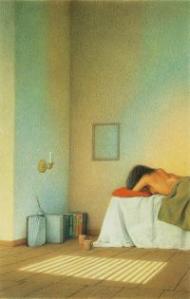
The daughter is back with her photographs. Searching, as she has through the winter and into the wet heat of summer, and still she hasn’t found what she’s looking for.

She wants to remember the man. She has only one image. It’s a photograph of him and her mother on their wedding day. When she thinks of taking the photograph out of its envelope, or even approaching the box in the cupboard under the stairs where it is stored, she feels an unpleasant churning in her belly. A vertiginous sensation, as if she’s not turning in time with world and could easily fall right off it.

She takes the brown envelope from where it lies separated from the other pictures. Then the photograph is in front of her. She’s taken it from its cover without any awareness of what she’s doing, and she’s placed it on the cream carpet in her cool, safe room where she sits in the lotus position, planning first to discover and then to tell herself the story of her life.

She stares at the ceiling. Her heart is too loud. She doesn’t want to look at the photo but she knows she has to. She feels like she felt the day she found a snake on its way out of the upstairs bathroom. The snake and she froze in place. After a few moments just staring, she crept backwards down to the kitchen where she found the metal dish cover they used to keep flies off food. She tiptoed back to where the snake had held its position, halfway across the threshold between the bathroom and the hallway. Slowly she lowered the cover and then, when it was in place, she leapt away as the snake understood it had been confined and began to thrash and spit.

She fetched her glasses, the better to observe and identify. She stared, with that fearful fascination typical of the enthralled. It was a long thin snake, its brown scales flecked with blue, and as it raised itself to strike at her she saw it had a pale yellow belly.

When finally she looks at the photograph she can’t see him. Instead she sees her mother. Her mother wears shoes with high thin heels, a wool coat that comes to the middle of her calves. There’s a small hat perched on the top of her head, over hair the daughter knows is very dark. She’s smiling, though it looks like a forced smile. Her handbag is over her arm and in the same hand she holds a pair of gloves. Her other arm is linked through her husband’s. I don’t know where my blonde hair came from, is what the daughter thinks about next. She thinks that thought for a long time.

Still the daughter doesn’t look deeply, instead skimming over the surface of the image like a dragonfly hovering nervously over a still pool. Maybe some murderous fish will leap out at any moment and take its small life, regardless of its future plans. The daughter has no desire to draw the man out into her present world but she does feel compelled to describe him, as if description is the first step towards making him real. This is a paradox: she knows she’s holding off the reality of him every day and night. It isn’t lost to her, far from it. She’s simply become adept at shutting it out.

If she can let him be real will she become real? Is this the price she has to pay to uncover her own authenticity? Can they still be so linked, after death and time and memory and forgetting have done their work?

The daughter is dizzy from shallow breathing. She looks towards the door that she’s left open in case she has to run. The Dog has draped himself across this threshold like a guardian at the gate. The sight of him reminds her of where and who she is. She whispers his name. His tail thumps on the floor but his gaze remains fixed beyond this room. A small growl escapes his throat. Who is he warning?

It’s very hot and still this January morning and she’s sweating in a light sarong and cotton blouse. She untangles her legs and lies flat on her back. She watches the daddy-long-legs drop from their threads in the corner of the ceiling and hang suspended in midair. There’s not the slightest breeze to disturb them. The photograph lies beside her and she’s careful not to look at it, or to let her hand touch its flat shiny surface.

After she’d trapped the snake she was at a loss as to what to do next. Alone in the house, she thought she’d better wait till Jane came home, as Jane is much more knowledgeable in these matters. Nevertheless, she felt compelled to go back to the scene every few minutes. Once there, she’d get down on her knees and put her face close to the spitting snake and stare at its small head and forked black tongue. Perhaps the power of her gaze might help her to incorporate the animal into the familiar, might rob it of its alterity, that disturbing aura of the utterly other, of being out of reach of any human appeal. She knew though, that what they had in common was life, and a blind impulse to live it, and she felt bad for imprisoning the animal, even though letting it roam the house was out of the question.

The daughter sits up and puts on her glasses. She leans over the photograph. She sees the man beside her mother is in his early thirties, tall and substantial, with thin, brown hair that falls across his forehead. She knows that when he is anxious or needs to connect himself again with his body, he runs his fingers through these strands of hair that lie across his forehead close to his eyebrows, and sweeps them away with a slight backward movement of his head. He has grey eyes. His face is well-fleshed and broad, and pleasant for those who look without knowledge. His teeth are discoloured from the unfiltered cigarettes he smokes. This habit has left his fingers stained. His nails are bitten to the quick. They are thick, stubby fingers stained brown. They are big fingers on big hands. He is a doctor and well liked in the small community in which he lives with his wife, and the child of his wife and another man. The child is ten. Her name is Angel. Her mother and this man call her by another name, but Angel is the name given to her by the grandmother the child loves most out of all the grown-up people in her world. When she is most lost and most afraid she whispers Angel to herself, and calls up the image of her grandmother.

Angel accepts the fiction that the fair man is her father though she is aware of some mystery surrounding her origins. She calls him “father” to herself and everybody else, until she is thirteen and he tells her otherwise.

Angel hears things in the night. The unforgettable sound of feet running down the hallway of the house, pursued by a heavier tread.
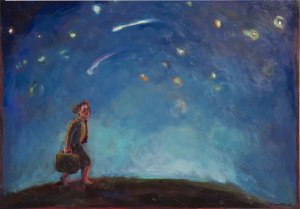
You lie in your bed, in your bed and your heart beats so loud you’re certain he’ll hear it. Your breath is so noisy, and you try not to breathe it. You slow down your heart and your breathing like a hibernating creature in a long dark winter. That, you believe, is the only way to stay alive in the circumstances in which you currently find yourself.

But will you ever learn to open up again? To let the heart beat to its own desires and the breath whistle carelessly through your body?

The day comes when he decides to do something he’s been contemplating for some time. The child is pretty, though not exceptionally so. More than that she is full of life, bright and intelligent with a wide smile and the skin that is the privilege of all young children, the skin one longs to stroke, like satin under the tips of the fingers. He likes the idea of having two females in his house available to him.  He chews on his fingernails as he sits in his chair drinking beer out of a pewter tankard and looking at his roses through the sitting room window. He brushes the hair out of his eyes and tosses his head. Then he chews his nails again till he draws blood. He isn’t contemplating doing anything wrong, he decides, giving fleeting attention to the morality of the situation. It has to be secret because other people will put their own interpretation on it. He gets angry just thinking about other people’s opinions on the matter. He gets defensive just thinking about someone else’s disapproval of him.

If he knows in his heart that he shouldn’t carry out this plan he stifles that knowledge. This is easy to do as his desire is great and outweighs every consideration his better nature might put forward. He has a better nature. He is a doctor, well liked in the town, he has healing hands. He has a better nature.

But his dark desire puts him beyond the reach of the ameliorating qualities of human love that would have him first consider the child. He pours another drink out of the bottle on the small table at the side of his chair, and lights another cigarette. He is not a man to deny himself his desires. He is a man with a sense of entitlement.

The phone rings. His wife calls him. He grinds out his cigarette and stands up, pushing the hair off his brow, adjusting his clothes. As he strides down the hall to the surgery at the side of the house, he puts his fantasies aside. By the time he’s reached the phone on his desk he’s become the doctor. He listens quietly to a patient’s concerns. He reassures, and says he will be there in ten minutes. He hangs up the phone. He gathers his bag, his stethoscope, the miniature torch he uses to look down sore throats. He strides out to the garage, gets into his car and takes out the packet of mints he keeps in the glove box. He puts two in his mouth and sucks on them. He’s thinking of the patient, what might be the cause of the sudden onset of high fever. He enjoys the regard in which his patients hold him. He won’t allow anybody to spoil that.

Sometimes while she was observing the snake, the daughter imagined fetching the shovel and decapitating it. But she was confounded by the logistics. How was she to keep the snake in place while she lifted the cage, put it down again on the floor, picked up the shovel and made ready to strike? How could she be sure the snake wouldn’t leap at her and sink its fangs into her cheek as she bent over and lifted off the metal cover? She paced the kitchen, thinking things through. She couldn’t settle to anything, knowing that snake was in the house.

She even thought she could let it bite her. She could take that irrevocable step into the unknown. She could alter the course of her life forever, in one instant. She could give in to the “unnameable lust.” She could. The decision was hers.

There’s a barrier between those who’ve known violence and those who haven’t. Behind this barrier Angel is, she fears, forever an outsider.

Her secret sets her apart. Dark knowledge taints her. She’s sullied. How will she ever make herself clean again? Once she sought to bridge this distance by confiding her experiences, only to see reflected back in her listener’s eyes her own confusion. Confessing something can sometimes make you feel worse than keeping it to yourself. Whatever is most difficult to tell. That is what counts.

If Angel reveals to you what she knows will she taint you in some way? Will she force into your life knowledge that can’t help but change the way you look at the world? Against your will, angering you, causing you to avoid her next time you pass in the street? Will she make you afraid of her because of what she knows?

The daughter experiences this barrier as a dense membrane, impenetrable, a thick sac in which she is enclosed and from which she attempts to look out at the world. The world seen through these membranous layers is always distorted, as if she’s looking through wet plastic, material that ought to be tangible, that she ought to be able to grasp in her hands, but can’t. If she could, it would be slick, like a foetal sac she must break through, kicking and tearing, in order to get out into the earth’s atmosphere and breathe for herself.

She sees the world coloured by her own experiences, as does everyone, but she doesn’t know that. For example, she looks at her friends and thinks that their fathers must do the same things. All girls must know what she knows, and part of what they know is that the knowledge must never be shared. They are all enclosed in their separate, thick worlds from which they gaze at one another with dull eyes. They will stay this way as long as they are in their fathers’ houses.

There is no clarity of vision from inside a membranous sac. The edges of things are always blurred, and boundaries are uncertain. You can’t touch anyone and nobody can touch you. Only the father can tear through and the layers separate for him and he enters and when he withdraws, the layers close over again, skin growing back, leaving no visible scar.
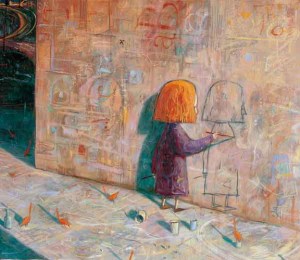
In referring to herself in the third person, Angel believes that she not only puts a distance between herself and her experiences, she creates herself as well. She brings herself into being. When she’s accomplished this, when she’s managed to construct herself, she’ll step into this borrowed figure, much as the hermit crab crawls into an empty shell and makes it her own by virtue of occupancy. Much as a bird settles into an elaborately woven nest and is then identified by the type of home she’s built, the materials she’s chosen, the way she’s arranged them.

When she speaks of herself in the third person she does it to ward off a certain pain that is always threatening to overtake her. Only in the third person can she find the courage to allow voice to the truths that sit on her shoulder, chattering and salivating like cast-out demons wanting back in.

She has no desire to think of herself as victim for the rest of her life. There must be a way she can stand with dignity in the midst of the sum total of her life’s experiences, denying none of them their due, resisting any attempt at domination by a single horror, granting equal value to all.

Though the January day is dripping with humidity, the daughter feels cold on the carpet in her room. Chilled to her very bones. She puts the photograph back in its envelope. She doesn’t know what she’s achieved by this exercise. She doesn’t feel any closer to having a real past than she did before, her head is aching and she feels sick. She whistles the Dog, he comes to her and rests his head in her lap. She buries her face in the thick white fur around his neck and inhales his dog smell.

After a while she thinks perhaps she might have put a tiny piece of her heart back where it belongs. That’s what it is, this painstaking process of singing in all the voices languishing on the outer edges. It’s the delicate job of putting a heart back together so it can die whole. She dare not die as she’s lived, bits of her scattered all over the place, forgotten, repressed, and denied.

Angel hears Jane’s footsteps as she enters through the upstairs door and sets her parcels down in the kitchen. The Dog sits up and makes ready to go to her, angling for a treat. If Angel follows him Jane will smile at her, and they will drink tea under the mango tree and watch the sun fall into the river, and pray for a thunderstorm to clear the stifling air. This is her ordinary life. This is the precious and ordinary life, given to her by Jane, that she never expected to have.
Eventually, on the day of the snake, she realised she couldn’t stay in the house any longer. Carefully, she printed on a piece of cardboard: Beware of the Snake. She propped this warning on the top of the stairs. Then she went out to buy chocolate.

When she got back, Jane was home, pulling on her gumboots and gardening gloves. She’d found a large sack. Together they went upstairs. Angel slowly lifted the wire cage and the snake wriggled out into the bag Jane held in front of it. Jane tied up the bag and they transported the thrashing snake to the bush at the end of their street. There they let it go.

‘Did you want me to kill it?’  Jane asked later as they drank tea and ate the chocolate, their reward for bravery and endurance

‘Nope. I just didn’t want it in the house. That bloody dog was useless you know. Didn’t even notice it.’

As a child the daughter’s nature was ebullient. It was hard for her to learn to disappear herself. It was hard for her to learn to think of herself in the third person.