Tag Archives: Women

I’m gonna stand by my woman now

18 Jun

Women bagging women is nothing new, but last week there was something of a spike in the pastime that left me wondering why we need patriarchy to do it for us.

I’m not referring to disagreement or critique, I’m talking about spite, judgement, contempt, and downright bitchiness that does nothing to progress civilisation, of the kind that feeds an exclusionary dynamic and precious little else.

First I came across this piece of anti bisexual woman contempt in the HuffPost Gay Voices blog, from radical feminist lesbian writer Julie Bindel. Ms Bindel is railing against allegedly hedonistic bisexual women “tourists” who “sleep with women on the weekends and go back to hubby on Monday mornings.” They have no sexual politics, she claims, and are exploiting full-time lesbians who have a political as well as sexual commitment to same-sex relationships.

I guess dedicated lesbians are capable of refusing to sex to touristing bisexual air heads lacking a sexual politics. I mean, nobody’s forcing them to put out for a woman who also engages with a penis are they?

Ms Bindel concludes: “If bisexual women had an ounce of sexual politics they would stop sleeping with men.” One could equally argue that perhaps if lesbians had an ounce of sexual politics they’d stop sleeping with bisexual women?

Then I read Elizabeth Farrelly’s column in the Sydney Morning Herald titled “The New Feminism: if it’s girly it’s good.” “Here’s the truth. I’m not a misogynist” Farrelly begins, perhaps not the best first line I’ve ever read. She then gets stuck into women who refuse to leave what she calls “the sewing circle” to take on the wider world of real  things. “Most of what passes for feminism these days… just legitimises girliness” she writes. I can see where Farrelly is coming from on this: I’ve moaned more than once about how feminism seems to be about body hair and lipstick these days. At the same time, I see nothing at all wrong with a bit of girliness: it is possible to have a reputable sexual politics and talk to other women about clothes and lipstick and occasionally have a good giggle over cocktails as well. This insistence on categorising is so, well, patriarchal. Real women break out of boxes, in my opinion.

However Farrelly goes further. She dislikes, she says, “boring” women authors like Margaret Atwood and Jeanette Winterson, preferring instead “writing with a higher IQ and lower pH than most women can manage…”

Ouch. That’s misogynist.

“It is clear,” Farrelly claims, “that to criticise women, or worse, poke fun is considered misogynist.”

Well, sometimes it is misogynist and sometimes it isn’t. Every time someone criticises Julia Gillard somebody else claims it’s misogyny,and while there’s certainly plenty of examples of that, there’s also legitimate criticism that has nothing to do with gender.

Then there’s Lara Bingle. About whom I know practically nothing more than the vitriol I’ve seen directed at her because of her TV reality show, “Being Lara Bingle.” I was initially confused by this title, wondering if it referenced the movie, “Being John Malkovich,” in which a miserable puppeteer stumbles across a portal into the star’s mind and charges people $200 a pop to spend fifteen minutes seeing the world as he does. Great and absorbing complications ensue, of the kind I simply could not imagine in a TV reality show about a young woman who seems to have done little other than perform in a failed tourism promotion and have a public fight with a famous cricketer who then dumped her.

For reasons I cannot fathom, Ms Bingle’s foray into reality TV has provoked quite vile criticism from many quarters, overwhelmingly from women. This caused me to ponder on the way women treat women, especially when the woman in question is young, and has the kind of beauty that is currently favoured in the mainstream. I mean, don’t watch it girls, if it hits your spite buttons. Ms Bingle is merely trying to make a life for herself, and accepted an opportunity practically every girl would if it came along.

“She decided to do it, now she’ll have to pay the price” was one piece of  self-satisfied Schadenfreude from an older woman who sounded as if she’d been waiting her whole life for Ms Bingle to fall flat on her face.

Ease up, girls. We have men to put shit on us.

Finally, this isn’t overtly about women bagging women but behind the scenes you’ll find much anti woman sentiment masked as concern and feminist politics. Many of you will have heard of Valerie Solanas and her Society for Cutting Up Men, otherwise known as SCUM. Solanas authored the SCUM Manifesto, a rabidly intense and sustained attack on men that states, among other things:  In other words, the male is an incomplete female, a walking abortion, aborted at the gene stage. To be male is to be deficient, emotionally limited; maleness is a deficiency disease and males are emotional cripples, and  SCUM will kill all men who are not in the Men’s Auxiliary of SCUM.

Ms Solanas went on to attempt the assassination of artist Andy Warhol after a dispute with him about a film script.

And so to the current Australian connection with SCUM. In July 2011 the SCUM Radical Feminist Conference was held in Perth. It was advertised as being of interest to  females who want to overthrow the government, eliminate the money system, institute complete automation and destroy the male sex. Workshops, guest presenters and social activities, plus a space to celebrate and re-member the life and work of Valerie Solanas and other radical feminists.

At the top of the updated SCUM Conference program there’s an announcement of the launch of Melinda Tankard Reist’s book, Big Porn Inc.

I was utterly shocked to discover Ms Reist’s apparent affiliation with the SCUM Radical Feminist Conference. I had no idea Ms Reist was so radical in her feminism, indeed there are some leading feminists who have publicly argued that Reist is not a feminist at all. (Another example of women bagging women, I suggest and a serious one. BTW I am the blogger mentioned in this article whom Reist is still threatening to sue. See Defamation category on this blog).

Reading through the program I discovered that Ms Reist’s publisher, Spinifex Press director Susan Hawthorne, gave a paper at the conference on feminist manifestos and SCUM.

I have yet to understand how exploitation of women and girls can be prevented through violence against males. All males, that is, indiscriminately, because they are male, and as advocated by SCUM. I fail to see the logic.

I could just be thick but to my mind, having my name and my book heading the program for a Society for Cutting Up Men conference would imply I was sympathetic to their cause.

And what would Jesus say?

So in conclusion, I’ve had  belly full this last week of women bagging women. Is that all we can do with our liberation, such as it is?

PS This Kravitz song will aggravate many people and is begging for a feminist deconstruction.

What is objectification, anyway?

7 Jun

The following are philosopher Martha Nussbaum’s criteria for objectification, that is, the act of treating a person as an object:

instrumentality: the treatment of a person as a tool for the objectifier’s purposes;

denial of autonomy: the treatment of a person as lacking in autonomy and self-determination;

inertness: the treatment of a person as lacking in agency, and perhaps also in activity;

fungibility: the treatment of a person as interchangeable with other objects;

violability: the treatment of a person as lacking in boundary-integrity;

ownership: the treatment of a person as something that is owned by another (can be bought or sold);

denial of subjectivity: the treatment of a person as something whose experiences and feelings (if any) need not be taken into account.

To which Professor Rae Langton, MIT, adds the following:

reduction to body: the treatment of a person as identified with their body, or body parts;

reduction to appearance: the treatment of a person primarily in terms of how they look, or how they appear to the senses;

silencing: the treatment of a person as if they are silent, lacking the capacity to speak.

The criteria all refer to the treatment of a person. From this I understand that objectification is enacted in encounters between people, when one party behaves towards the other as if she or he is a means to an end, and not a human being who is entitled to have her or his needs and feelings taken into account.

There’s an almost constant stream of allegations of objectification through sexualisation currently being made in Western society. These are leveled by concerned citizens against much popular culture, and based largely on images of women that culture produces. These allegations presume an objectifying gaze, that is, they insist the viewer will inevitably reduce women portrayed in certain ways to objects to be used for sexual gratification, rather than seeing them as equal human beings. Clothing, facial expressions and postures are used as signifiers of objectification, as well as language.

The signifiers chosen by concerned citizens are based on a Judeo-Christian perception of the adult female body as unruly, dangerous and indecent, and requiring concealment except in specific circumstances such as marriage and other committed monogamous relationships. Clothing that reveals too much of the body’s “private” zones is regarded as transgressing moral codes, as are postures and language that imply female sexual desire, and/or stimulate male “lust.”

Here I should note that the objectification debate is heteronormative. Apparently gays and lesbians don’t objectify each other or if they do, concerned citizens don’t include this in their ambit.

To interpret the clothing, postures and movements as indecent one must first have a particular set of moral values. Otherwise the image will be attractive, unattractive or entirely uninteresting, and it will carry no moral weight.

An image may invite the objectifying gaze. The viewer may accept. However, it’s a big leap to assume that all viewers who find an image “sexy” will inevitably progress from that opinion to objectifying a woman the next time he or she is face to face with one, and will inevitably set about finding ways to use the woman as a means to an end. This assumption imbues the image with nothing less than supernatural powers, as well as denying the viewer’s autonomy and self-determination. It also denies the viewer agency. It denies the viewer’s subjectivity and it also silences the viewer by imposing another’s values on the viewer’s gaze. According to Nussbaum, these are all acts of objectification. In other words, when concerned citizens make these assumptions, they treat the viewer as less human than themselves.

An image can invite us to objectify, but it can’t cause an objectifying consciousness to develop where it previously did not exist.

The inability to perceive others as human like oneself is a symptom of several psychological disturbances, as well as immaturity. These factors are not brought about through viewing an image, and they will not be resolved by removing an image from public view.

The argument that women choose to display their bodies in these ways holds little credence with concerned citizens. The most frequent response is that women don’t understand they’re inviting objectification through presenting their bodies to the admiring and at times desirous male gaze.  Another argument is that society (patriarchy) has so “normalised” the objectification of women that only those policing it will notice when it’s happening.

It’s something of a leap to assert that a woman is, without any awareness or agency, issuing an invitation to men to turn her into an object when she steps in front of a camera in small clothes, or plays football in lingerie. I can think of many reasons why women choose to undertake these activities dressed in these ways, and none of them are to do with the kind of compulsive masochism implied in their critics’ interpretations of their actions.

Indeed, such an attitude towards a woman could be read in Nussbaum’s criteria as treating her as if she is lacking in autonomy and self-determination, and treating her as a person lacking in agency. It also denies her subjectivity, and attempts to silence her by imposing an interpretation other than her own on her actions. In other words, the concerned citizens are engaged in objectifying her.

It seems to me that the entire objectification movement is an attempt to impose a particular set of moral values on society. Notions of propriety, largely middle class, are disturbed for example, by the spectacle of women playing football in lingerie. This discomfort is pathologised as objectification, and extrapolated as threatening to all women and girls, who as a consequence of the LFL will be regarded as nothing more than sex objects for male gratification. While there certainly are males who act as if this is their opinion of women, the majority do not. The majority of people understand there is a difference between personal encounters, and imagery.

The charge of objectification is a serious one. It should not be trivialized to serve a moral agenda.

It seems obvious to me that the key to accepting the human right of others not to be treated as a means to an end, lies in education and not censorship. Attempting to build a society on the assumption that all its members are possessed of an objectifying consciousness and everything possible must be done to prevent them indulging that consciousness seems to me insane, and asking for trouble. Respect and value for others as equals is an acquired skill, and we depend on caregivers to instruct our young in acquisition and practice. It’s a work in progress for the human race. Concerned citizens would do better to apply themselves to encouraging and assisting this work, rather than attempting to impose a moral code that adds nothing at all to the civilizing project. An attempt that in its practice commits the very offences it claims to vehemently oppose.


Game of Thrones, The Sopranos, Women.

6 Jun

I’ve just watched the first two episodes of Game of Thrones, the wildly successful HBO series set in faux Medieval times in what is now the UK and “across the Narrow Sea” in what we call Europe.  I was enthralled. I can’t wait for this evening when our household gathers to watch the next episode and in the words of Laurie Penny in the New Statesmen “enjoy the shit out of it,” despite its unexamined ‘racist rape-culture” ambience, and its appalling representation of women.

Life in Medieval times was not good for women, you might argue, and you would be right. There is no way of cushioning this reality, nor should anyone attempt such falsification. Women were for breeding and fucking. Relationships of all kinds evolved, because that’s what happens between humans regardless of class and circumstance. However, male allegiance is primarily to the King, or he who would be King. Women may not interfere with this requirement. No man would consider staying home from the slaughter because his woman asked it of him.

The wars fought between these opposing Medieval forces demand sacrifices from the top down, unlike our modern wars in which politicians dispatch the sons and daughters of others to do their killing while themselves remaining comfortably removed from trauma and death. This is only one of the differences between wars then and now, but that’s another story.

Reading Penny’s piece I found myself making comparisons between Game of Thrones and that other HBO success story, The Sopranos, in terms of their representation of women. The Sopranos is set in a very different world, that of organised crime in the US state of New Jersey in the present day. They have in common a ruthless hierarchical structure that demands total obedience from its male members to the King or the Captain. Mob women who do not comply with this requirement don’t last long, either in the family or in some instances, in this world. There is a divide between business and family that women may not cross.

That is not to say women in both series are entirely powerless, because they clearly are not. However, there are limits to the expressions of their power, and they exceed those limits at their peril. Overstepping the mark frequently results in physical retribution, sometimes death.

As in Game of Thrones, there are the women men marry and breed with, and the women men fuck. Occasionally there is confusion, and a “bastard” child results.

Sex is usually represented in both narratives as primarily for male gratification, urgent, hydraulic, and frequently performed from the rear, though in The Sopranos women are allowed to be on top a lot more. Women men fuck are generally less clothed in Medieval times and the present day, while wives and legitimate girlfriends get to wear expensive stuff.

In spite of this blatant and offensive sexism, and the highly aggravating madonna/whore complex that we just can’t seem to escape in our narratives, I was and remain enthralled by The Sopranos. In this and in Game of Thrones I’m willing to suspend my hard-won feminist critical faculties, and instead of righteously loathing the unreconstructed males who populate both worlds, I can’t stop myself enjoying the shit out of the shows. In particular, Tony Soprano remains a character of Shakespearian magnitude to me, his at times terrifying complexities holding my attention like a helpless deer caught in his headlights.  This series is littered with powerful characterisations, and I have not yet seen enough of Game of Thrones to judge if it achieves a similar standard.

At first blush, I suspect not. As Penny argues, Thrones is not subtle. After two episodes I feel I’ve got a decent handle on the characters and how they’re likely to behave. Be that as it may, I’m still enthralled.

There’s a critique of Penny’s critique here, written by Sarah Ditum.

What does intrigue me is my willingness, a willingness shared by millions of other women apparently, to suspend my outrage at the portrayal of women in both HBO masterpieces, and enter deeply into these created worlds, emerging at the end of each episode with a sense of having been transported to another reality and for better and for worse, being somehow embiggened by the experience.

I tentatively put this down to the difference between creativity and ideology. Ideology tells me things should be this or that way, and must be made to be.  Creativity tells me anything is possible, and while I might not like it, it exists and must be understood.

As Laurie Penny says: a piece of art doesn’t have to be perfectly politically correct to be fun, or important. We’re allowed to enjoy problematic things, as long as we’re honest about their problems.

Well, I’m honest about the woman problem in Game of Thrones and The Sopranos. The way we’re portrayed in both sucks, and is likely an accurate representation of  life for women in both those cultures.  Will that stop me watching, enthralled? No way.

The footballer & the anti porn campaigner: not cool as FCUK

6 May

On Melinda Tankard Reist’s website today you’ll find this article about AFL footballer Lance “Buddy” Franklin. Franklin has another job as well as football: he is co-director of clothing company Nena & Pasadena. This company apparently specialises in tee-shirts featuring women in exaggerated sexual poses, sometimes handcuffed, and partially clothed. There’s often a slogan or two, in case we haven’t managed to interpret the images.

Reist asks: “What message does this clothing send N&P’s target market of young men about women?”

What message does this send about women?

Reist’s answer is that the message conveyed by Buddy’s shirts is that women are sexual objects, not human beings. She feels the images degrade us.  I don’t read it that way. To me, the shirts say nothing much at all about women, and everything about the fantasy lives of those who design, produce and wear them. These shirts say nothing about who women are, and everything about what the men who wear them want us to be.

I don’t believe another person’s fantasies degrade me. They don’t reflect on me in any way at all. This is what we need to teach our young. You aren’t what somebody else imagines you are. As we’re never going to control anyone’s imagination and ought not to try,  we need to focus on educating children to refuse the imposition of other people’s fantasies on their sense of who they are. It’s not rocket surgery. It’s being proactive. It requires us to dump the language of victimisation and replace it with the language of empowerment. We are in dire need of this paradigm change.

At this point I’ll refer you to this horribly sexist vintage ads site. While there’s definitely less flesh and far less overt sexual imagery, the message is the same. These ads are also a reflection of the desires and fantasies of some men, and say nothing much at all about women. They do say a great deal about a dynamic that remains consistent. These ads, like Buddy’s shirts, cast women in an inferior and tiresome role. We may have our clothes on in the vintage ads, but they are only a variation of Buddy’s fantasies.

When we protest that these images degrade and objectify us, we give them the power to do exactly that. There are always two sensibilities involved in the interpretation of any text: that of its author and that of its reader. As a reader I’m free to conclude that the text is not about me. It’s all about the author. I’m free to refuse the author’s construction of my sexuality, a construct based on the author’s desires. Why should I grant anyone that power over me?

Personally, I’ve never been attracted to clothing featuring pictures and advertising: I’m not a billboard. Even if such clothing isn’t pushing a brand, it is self-revealing: by my clothes you’ll know me. There are occasions like demonstrations, conferences when it feels good to state my position through what I’m wearing, and cartoonist First Dog on the Moon’s shirts I’ll wear anytime.

That said I do have a couple of FCUK tee-shirts, one that says “Cool as FCUK” and another proclaiming “Lucky FCUK,” neither of which I would be caught dead in outside the house, but that’s just me.

Reist then asks: “What does it say about men and women when clothed men wear t-shirts of naked women?”

A man who feels the need to wear an image of a naked woman on his tee-shirt is making a statement or a series of statements about himself, about his opinions of women, about his attitude to women. Such clothing says nothing about “men and women.” It says some things about some men. Again, women are not obliged to join such men in their fantasies and desires. We are not demeaned and objectified unless we accept the wearer’s world view. Unless we allow that world view to construct us and so become complicit in our own victimisation and dehumanisation.

That being said, I have no problem with letting Buddy know his tee-shirts say everything about him, and nothing about women, and what he’s saying about himself is pretty crap. I’ve no problem passing that message onto the shops that stock his wares, either. That’s the easy part. The hard part is changing the paradigm from first accepting then protesting victimisation, to refusal of men like Buddy’s interpretations of women and our sexuality in the first place. We do this by giving our children the tools they need to resist believing they are what somebody else says they are, and that they have to be what somebody else wants them to be. We’re never going to stop the Buddies but we can disempower them. We refuse the victimisation in the first place, then we don’t have to waste our energies protesting it.

Buddy, your tee-shirts reveal some weird things about you. You might want to think about that, mate.

International Women’s Day

8 Mar

What I want more than anything is for there to be no need for an International Women’s Day.

Seeing as that’s not going to happen anytime soon, what I want next is for IWD to be dedicated to women living in situations where their survival and the survival of the children in their care is a daily struggle.

Who are the most outstanding and inspirational women? The women who keep on going against all odds. The women who’ll never get their names in lights because the work they do isn’t considered light-worthy. The women who’ll never bust through any glass ceiling. The women who at the age of fifty and more, take on the children of their children when their children can’t do it.

International Women’s Day belongs to the unknown woman. Light a light for her.

Abbott’s ascendency puts women’s choice at risk

27 Oct

Is this the face of the next Prime Minister?

This article was first published in On Line Opinion

US Republican Presidential Candidate Michele Bachmann started her campaign as the Tea Party Queen, promising fiscal conservatism and an end to “Obamacare,” otherwise known as the Patient Protection and Affordable Care Act that in 2010 extended health care insurance to some 30 million Americans, arousing the fury of many who feared it was an indicator of what they allege is President Obama’s destructive inclination towards socialism.

Bachmann describes herself as a social conservative who believes that wives must be submissive to their husbands. She is the mother of five children, and appears to be of the opinion that it is virtuous to produce large families. She is a graduate of the Oral Roberts University, a Christian college where she studied tax law at the insistence of her husband, and where she learned that Christian morality is the basis of US law.

The term “social conservative” is considered by some in the US blogosphere to be code for evangelical Christian or Christian conservatism. Bachmann believes that what the US needs now is a marriage between fiscal and social conservatism, a marriage that she is attempting to contrive as the Tea Party’s apparent willingness to risk national default in the pursuit of their political goals saw some of their supporters take a set against them, and against Bachmann herself. Bachmann’s fortunes also took a turn for the worse when Texas Governor Rick Perry entered the Presidential race. In an effort to regain ground, Bachmann is now appealing directly to evangelical Christians, and focusing her efforts on gaining the support of conservative Christian voters.

 The Heartbeat Informed Consent Act

To this end, Congresswoman Bachmann has proposed a bill in the US House of Representatives known as the Heartbeat Informed Consent Act. This is federal legislation that would require pregnant women to have ultrasounds, and be shown pictures of the foetus they are carrying before an abortion could be performed.

The Act also requires that doctors be required by federal law to capture the sound of the feotal heartbeat and play it to the pregnant woman, before an abortion can legally be performed.

Penalties for abortions carried out without observance of these proposed laws are fines of $100,000 for the first offence, and $250,000 for repeat offences.

The premise on which the proposed bill is based is that a woman is far less likely to go through with an abortion if she sees the foetus, and hears the heartbeat. To this end, the proposed legislation requires that ultrasound pictures “accurately portray the presence of external members and internal organs, if present.”

Right-to-lifers have apparently given up attempting outright to have all abortion criminalized. Instead they are adopting a back door approach that seeks to move the permissible time frame to when the foetal heartbeat can be detected, thus legally redefining “life.” The heartbeat can be heard as early as eighteen days, and in Ohio, for example, the state version of the “Heartbeat Bill” proposes that all abortion is outlawed after a heartbeat is detected.

There is little likelihood of Bachmann’s federal bill getting past the Senate, and President Obama has let it be known that in the event that it does, he will veto it. However, a very similar piece of legislation known as the Informed Consent Bill is now being advocated in every US state, by anti abortion groups who are aware that Bachmann’s bill won’t be legislated at the federal level. At the state level this bill is backed by major conservative groups such as National Right to Life, the US Conference of Catholic Bishops, Americans United for Life, Susan B Anthony’s List, and Family Research Council Action. In some states the bill stands a good chance of becoming law. In Rick Perry’s Texas for example, the bill has passed through two readings and requires only one more.

The Protect Life Act

This Act recently passed the House of Representatives with every Republican voting in favour, along with eleven Democrats who crossed the aisle to join them.

The Protect Life Act prohibits women from buying health insurance plans that cover abortion under the Affordable Care Act, and makes it legal for hospitals to deny abortions to pregnant women with life-threatening conditions. Its purpose is ostensibly to ensure that no taxpayer dollars flow to health care plans that cover abortion. In fact it is already against the law in the US to use taxpayer funds for abortion procedures, a fact right-to-lifers consistently ignore or misrepresent. Abortions are covered only by private insurance payments. However, this Bill would prevent women from buying an insurance plan that includes abortion through a state health care exchange, even though most private plans currently cover abortion.

The Protect Life Act also allows hospitals morally opposed to abortion, such as Catholic institutions, to do nothing for a woman who needs an emergency abortion to save her life. Hospitals in the US currently have an obligation to provide care in a medical emergency, however under the new Act that obligation would legally come second to the institutions’ moral objections to providing abortions.

This bill is also likely to be defeated in the Senate, and again President Obama has signaled his intention to veto the bill should it land on his desk.

However, it’s worth remembering that every Republican voted for it, as well as eleven Democrats.

In some quarters the bill has become known as the “Let Women Die Bill.”

Vow to withdraw federal funding for contraception.

Another Republican Presidential hopeful, Catholic father of seven Rick Santorum, has vowed to repeal all federal funding for contraception should he be elected President, on the grounds that contraception “is a license to do things in the sexual realm.” Santorum also holds the view that “ sex is supposed to be within marriage,” and he talks at length about “the dangers of contraception.” Santorum, like Bachmann, is a social and fiscal conservative.

Mitt the Mormon Bishop.

Mormon feminist academic Professor Judith Dushku developed a life-threatening blood clot when she was pregnant with her sixth child. Arrangements were made to abort the foetus and thus save her life. When Dushku arrived at the hospital for the procedure she was met by her then Mormon bishop and father of five, Mitt Romney. The following exchange allegedly took place between Dushku and Romney:

He said – What do you think you’re doing?

She said – Well, we have to abort the baby because I have these blood clots.

And he said something to the effect of – Well, why do you get off easy when other women have their babies?

And she said – What are you talking about? This is a life-threatening situation.

And he said – Well what about the life of the baby?

And she said – I have four other children and I think it would be really irresponsible to continue the pregnancy.

Dushku proceeded with the termination, and lived to bring up her four children. Though previously friends Romney and Dushku no longer speak, at his insistence.

In 2005 as Governor of Massachusetts, Romney revealed a change of principles on abortion, moving from the “unequivocal” pro-choice position he adopted throughout his 2002 gubernatorial campaign, to a staunch pro-life stand that saw him veto a bill that would expand access to emergency contraception in hospitals and pharmacies, on pro-life grounds.  Romney revealed to Dushka prior to their falling out that he had only adopted his pro-choice stand because he’d been advised it would be more appealing to voters, and that his true position had always been one of pro-life.

Meanwhile, back in Australia

If an election were held in Australia today it would be won by the Coalition, headed by Tony Abbott. Mr Abbott is a Catholic. In 2004 when he was Federal Health Minister, Mr Abbott stated in an interview with ABC Radio’s AM program that he was concerned about the “abortion epidemic” apparently raging in Australia. He said:

I certainly share the concerns that many people have about the number of abortions that are taking place in Australia today. We have something like 100,000 abortions a year, 25 per cent of all pregnancies end in abortion and even the most determined pro-choice advocates these days seem to be rightly concerned at the way that the abortion epidemic has developed.

The then Health Minister was supported in his concerns by his then junior Minister, Christopher Pyne, who expressed his moral difficulties with late-term abortion.

On ABC Radio’s PM program November 15 2005, then Federal Health Minister Tony Abbott explained why he had refused to approve the use of the abortion pill RU-486 for Australian women as follows:

TONY ABBOTT: I conclude that there is no reason, based on the report from the Chief Medical Officer, to change longstanding practice in regards to RU-486.

 CATHERINE MCGRATH: But the AMA says itself, that it is the best and safest, or it is an option for the best and safest termination, where doctors are assessing the risks to the patient.

TONY ABBOTT: That’s not my reading of the report from the Chief Medical Officer. My reading of that report is that there are significant additional health risks associated with medical terminations, and that the safest way to have a termination is a surgical termination.

CATHERINE MCGRATH: To say the AMA is stunned is an understatement, and the peak medical body takes issue with the advice Tony Abbott has received.

The AMA said Mr Abbott’s information on RU-486 “is plain wrong” and “ignores international research.” The AMA further said that the drug would be denied to Australian women for political reasons.

Then there’s this piece on Abbott’s website titled: Rate of Abortion Highlights our Moral Failings. The problem with the Australian practice of abortion is that an objectively grave matter has been reduced to a question of the mother’s convenience… Even those who think that abortion is a woman’s right should be troubled by the fact that 100,000 Australian women choose to destroy their unborn babies every year… When it comes to lobbying local politicians, there seems to be far more interest in the treatment of boatpeople, which is not morally black and white, than in the question of abortion, which is.

The belief that the question of abortion is “morally black and white” is one Tony Abbott shares with evangelical Michele Bachmann, Mormon Mitt Romney, and fellow Catholic Rick Santorum. Australian women should be very concerned about living under an Abbott-led Coalition government. Abbott’s stated (and written) beliefs on abortion are deeply entrenched. As Federal Health Minister he managed to prevent Australian women accessing RU-486 on entirely spurious grounds, grounds that were fiercely contested by medical experts, and international research. This is the action of a man whose decisions about women’s reproductive rights are determined solely by his religious faith.

RU-486 is still not readily available. There are only approximately 100 doctors Australia-wide who are Authorised Prescribers of the drug, and then only within their own practices and hospitals, the majority of which are in capital cities.

Do Australian women want to risk Tony’s rosaries on our ovaries again?

Abortion in Australia is a state, not federal matter. Laws vary between the states. In NSW, Queensland, South Australia, Northern Territory and Tasmania, abortion is subject to criminal law codes and acts. In the ACT there are no laws regarding abortion in the Crimes Act, and in Victoria the procedure is covered by the 2008 Abortion Law Reform Bill.

In Queensland in 2010 a young couple was prosecuted for obtaining an “unlawful abortion” after self-administering medication designed to cause early abortion. They were found not guilty. That such a case could be brought highlights the urgent need for abortion law reform in Australia. It’s well worth a visit to this site for examples of why such reform is imperative for women, and to see evidence that the Australian debate is in some quarters unnervingly similar to that in the USA.

An Abbott-led government is not good for Australian women’s reproductive health and our hard-won right to choose.

Related articles

Licensed to Kill

3 Oct

Defence Minister Stephen Smith’s decision to allow women to assume unrestricted combat defence roles has caused ethics Professor Clive Hamilton to despair that “it is time to sound the Last Post over the rotting corpse of feminism.” Hamilton goes on to argue that the pursuit of equality has brought us to a sorry state of feminist affairs when women, like men, are granted a license to kill. This step signals the “final annihilation of difference,” and the end of women’s role as a “subtle, civilising power that has always worked to restrain the violent tendencies of men.” Without much success, one is obliged to point out.

In order to earn a license to kill, women must prove themselves psychologically, physically and mentally up to the job, a job that is on offer only from that bastion of hegemonic masculinity, the defence forces.

There are many men who would not fulfil the requirements and indeed, would not wish to. I recall my sons singing to Tchaikovsky’s 1812 Overture, “Join the army get your balls blown off” whenever a recruitment advertisement appeared on television. Being licensed to kill isn’t for everyone, regardless of genitals.

Instead of throwing in the feminist towel at this strike for equal opportunity, perhaps it’s valid to note that licensing women to kill is recognition that some women are capable of acquiring and practising the violent arts, therefore the capacity for deadly violence is not gender specific. The Defence Department has, perhaps unwittingly, subverted culturally imposed gender roles of the kind espoused by Professor Hamilton that would have women incapable of or unwilling to perpetrate violence. The Department has now acknowledged women as trainable as men, should we choose to embark on that course.

We can’t have it both ways

I’m at a loss to see how debunking that particular gender myth can be anything but positive for everybody. The majority of women will not choose to earn their killing license, just as many men do not choose that path either. At least it is now acknowledged in public policy that women are human beings capable of a wide variety of behaviours including state-sanctioned killing, just like men.

This is in direct contrast to another Gillard Government policy designed to prevent violence against women and their children. This policy defines domestic violence as overwhelmingly perpetrated by men. The policy does not acknowledge that female violence against children and other women is of equal concern, despite increasing international research and anecdotal evidence that this is indeed the case. The designers of this policy seem, like Professor Hamilton, to be labouring under the misapprehension that women are not capable of violence because it isn’t in our nature. It is only in our nature to be victims and/or soothers of male aggression.

You really can’t have it both ways. Women either are or are not capable of learning to use violence, either from the state or from the influences of their environment and their genes, just like men. You really can’t have the Defence Department heralding this as equality, while at the same time the Office for Women portrays us as overwhelmingly victims and rarely perpetrators. You really cannot insist on contextualising women’s violence (when it’s actually admitted) while leaving male violence out there as if men are born bad and it’s their base nature.

If the Defence Department has shown us anything, it’s that they consider the ability to engage in deadly violence to be non-gender specific. If we are to accept that, we must accept women are equally capable of violence in other situations as well. Joining the armed forces isn’t going to cause the sudden emergence of a brand new aggressive characteristic in the human female. It’s going to nurture and nourish what already exists.

The feminist struggle for equality

The mainstream feminist struggle for equality has always been about escaping restrictive gender roles and that escape has been perceived as our liberation. It has always been about ensuring women have equal opportunity and that has been perceived as our liberation. Mainstream feminism has rarely interrogated the type of masculinity that determines the Western capitalist culture within which it has sought equality. Mainstream feminists have not sought to radically change this culture, but rather to find an equal footing with that specific masculinity, within its parameters.

Thus we have our first female Prime Minister who is determined to deny the human rights of women and children in her urgency to pursue entrenched masculinist policies of sovereignty and border protection. Such a goal is far from feminist, yet mainstream feminists were (and some still are) ecstatic that we have a female PM. How long will it take to grasp that ownership of a vagina does not a feminist make?

What’s gone wrong with the feminist debate?

What has gone badly awry in the equality debate is a shocking lack of clarity and truth. For a movement that railed against the destructive consequences of stereotyping women, we’ve certainly done more than our fair share with regard to both sexes, and this has brought us undone.

There is no such animal as “men” and there is no such animal as “women.” Such erroneous concepts are the foundational lie on which much equality rhetoric rests. It’s a lie feminists railed against on behalf of women, yet enthusiastically embraced when it came to men. It’s a lie Stephen Smith confronted and faced down, whether he meant to or not. This lie is what is bringing feminism to its knees, not, as Clive Hamilton would have it, women being licensed to kill, or vomiting drunk on a Saturday night just like the boys.

We are rightly outraged when all Muslims are cast as terrorists. We are outraged when all Indigenous people are cast as drunken child abusers. Or we should be. Yet we don’t bat an eyelash at the use of “men” and “women” by just about everybody who has something to say on the subject. “Women’s morality differs from men’s,” writes Professor Hamilton, for example. Both sexes ought to be outraged at this stereotyping. It is an untruth, as all generalizations are untruths. I am not Woman. I’m a woman. My “morality” is the product of all of my experiences and what I have made of them. Here’s a male ethicist prescribing my female moral life, while claiming to have feminism’s best interests at heart. What is wrong with this picture?

A common enemy

It’s rarely acknowledged that many women and men share the common enemy of hegemonic masculinity. Recognising that there are infinite ways in which we are all undone, devalued and dehumanized by this dominant form of the masculine would allow us to co-operate in its demise. Instead, hegemonic masculinity pits us against one another, and we co-operate by couching our grievances in terms of gender warfare. The debate ought to be couched in terms of the dominant masculinist principles to which some women are as bound as some men, and that disadvantage whole subcultures regardless of sex, though sex may determine the manner in which the disadvantage is enacted.

Mainstream feminists have embraced these principles, with the result that some women have successfully adapted to the institutions, and the institutions themselves remain intact and largely unchallenged. The goals and aspirations of the majority of people demand a capitulation to masculinist forces that govern every aspect of our Western lives from cradle to grave, forces that remain largely unchallenged by feminism.

Who’s going to take away their license to kill?

Issuing women with a license to kill is a formal recognition of women’s equal capacity for sanctioned violence. Equality within the status quo was the intention of mainstream feminism, not radical structural change. This move by Defence is entirely in keeping with feminist goals.

We were never going to be much more than tokens in the patriarchy, and we aren’t. This isn’t going to change until we stop being victims. We will never stop being victims until we acknowledge our full capabilities, including those for violence and harm. This is what finally liberates us from victim-hood: owning our capacity for behaviours that are collectively denied in women because our culture doesn’t want women to have them, and because when the chips are down neither do we. How much nicer to be romantically imagined as “those who pacify the beast” than as those who are complicit in the beast’s violent projects.

The Defence decision acknowledges that women are first human beings, capable of feeling and acting in ways that have long been regarded as exclusively male by the orthodoxy. While in the short-term this may result in what can seem undesirable female behaviour, in the long-term it will allow us a fullness of humanity we’ve been denied for far too long. Human beings can be violent, destructive and murderous. Human beings have to learn to deal with these impulses in ways that do not bring about devastation. This can’t happen if we continue to deny that the female half of the human race has these capabilities, in the face of mounting evidence to the contrary.

Women who feel liberated enough to publicly express violence will initially do so in destructive and copycat ways, and they will call it equality because male acting-out is all they have to measure themselves against. They’re quite right. Equality is exactly what it is. The right to be equally human, for better and for worse, is what any feminist worth her salt should work towards. We can’t cherry pick equality.

As long as violence sanctioned or not is perceived as gender determined, no society can adequately address its causes, its effects, and what can be done about it. Rather than gnashing and wailing that women are becoming as awful as men, we should be questioning the limited means of expression both sexes have within a hegemonic masculinity that depends for survival on strict gender roles. We should be recognizing that these expressions are determined and controlled not by “men,” but by a specific manifestation of masculinity that disadvantages and dishonours both sexes. Then we can really examine violence and war, not as fought by men or women, but as perpetrated and fought by human beings on and against other human beings.


How to incite a moral panic about sex

5 Sep
220

Image via Wikipedia

In On Line Opinion today How to incite a moral panic about sex. Researchers claim there’s increased sexualized images of women in popular media, but their only source is Rolling Stone magazine.

Have they gone too far and confused sexy with sexualized? There is a difference and it’s an important one. Jennifer reads between the lines.

The Daughter

5 Aug

Warning: disturbing content 
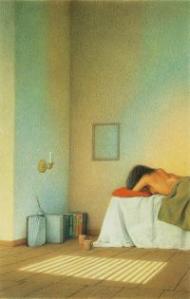
The daughter is back with her photographs. Searching, as she has through the winter and into the wet heat of summer, and still she hasn’t found what she’s looking for.

She wants to remember the man. She has only one image. It’s a photograph of him and her mother on their wedding day. When she thinks of taking the photograph out of its envelope, or even approaching the box in the cupboard under the stairs where it is stored, she feels an unpleasant churning in her belly. A vertiginous sensation, as if she’s not turning in time with world and could easily fall right off it.

She takes the brown envelope from where it lies separated from the other pictures. Then the photograph is in front of her. She’s taken it from its cover without any awareness of what she’s doing, and she’s placed it on the cream carpet in her cool, safe room where she sits in the lotus position, planning first to discover and then to tell herself the story of her life.

She stares at the ceiling. Her heart is too loud. She doesn’t want to look at the photo but she knows she has to. She feels like she felt the day she found a snake on its way out of the upstairs bathroom. The snake and she froze in place. After a few moments just staring, she crept backwards down to the kitchen where she found the metal dish cover they used to keep flies off food. She tiptoed back to where the snake had held its position, halfway across the threshold between the bathroom and the hallway. Slowly she lowered the cover and then, when it was in place, she leapt away as the snake understood it had been confined and began to thrash and spit.

She fetched her glasses, the better to observe and identify. She stared, with that fearful fascination typical of the enthralled. It was a long thin snake, its brown scales flecked with blue, and as it raised itself to strike at her she saw it had a pale yellow belly.

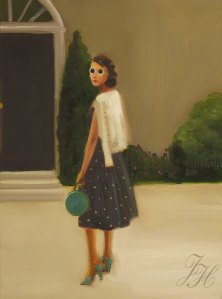
When finally she looks at the photograph she can’t see him. Instead she sees her mother. Her mother wears shoes with high thin heels, a wool coat that comes to the middle of her calves. There’s a small hat perched on the top of her head, over hair the daughter knows is very dark. She’s smiling, though it looks like a forced smile. Her handbag is over her arm and in the same hand she holds a pair of gloves. Her other arm is linked through her husband’s. I don’t know where my blonde hair came from, is what the daughter thinks about next. She thinks that thought for a long time.

Still the daughter doesn’t look deeply, instead skimming over the surface of the image like a dragonfly hovering nervously over a still pool. Maybe some murderous fish will leap out at any moment and take its small life, regardless of its future plans. The daughter has no desire to draw the man out into her present world but she does feel compelled to describe him, as if description is the first step towards making him real. This is a paradox: she knows she’s holding off the reality of him every day and night. It isn’t lost to her, far from it. She’s simply become adept at shutting it out.
If she can let him be real will she become real? Is this the price she has to pay to uncover her own authenticity? Can they still be so linked, after death and time and memory and forgetting have done their work?

The daughter is dizzy from shallow breathing. She looks towards the door that she’s left open in case she has to run. The Dog has draped himself across this threshold like a guardian at the gate. The sight of him reminds her of where and who she is. She whispers his name. His tail thumps on the floor but his gaze remains fixed beyond this room. A small growl escapes his throat. Who is he warning?

It’s very hot and still this January morning and she’s sweating in a light sarong and cotton blouse. She untangles her legs and lies flat on her back. She watches the daddy-long-legs drop from their threads in the corner of the ceiling and hang suspended in midair. There’s not the slightest breeze to disturb them. The photograph lies beside her and she’s careful not to look at it, or to let her hand touch its flat shiny surface.

After she’d trapped the snake she was at a loss as to what to do next. Alone in the house, she thought she’d better wait till Jane came home, as Jane is much more knowledgeable in these matters. Nevertheless, she felt compelled to go back to the scene every few minutes. Once there, she’d get down on her knees and put her face close to the spitting snake and stare at its small head and forked black tongue. Perhaps the power of her gaze might help her to incorporate the animal into the familiar, might rob it of its alterity, that disturbing aura of the utterly other, of being out of reach of any human appeal. She knew though, that what they had in common was life, and a blind impulse to live it, and she felt bad for imprisoning the animal, even though letting it roam the house was out of the question.

The daughter sits up and puts on her glasses. She leans over the photograph. She sees the man beside her mother is in his early thirties, tall and substantial, with thin, brown hair that falls across his forehead. She knows that when he is anxious or needs to connect himself again with his body, he runs his fingers through these strands of hair that lie across his forehead close to his eyebrows, and sweeps them away with a slight backward movement of his head. He has grey eyes. His face is well-fleshed and broad, and pleasant for those who look without knowledge. His teeth are discoloured from the unfiltered cigarettes he smokes. This habit has left his fingers stained. His nails are bitten to the quick. They are thick, stubby fingers stained brown. They are big fingers on big hands. He is a doctor and well liked in the small community in which he lives with his wife, and the child of his wife and another man. The child is ten. Her name is Angel. Her mother and this man call her by another name, but Angel is the name given to her by the grandmother the child loves most out of all the grown-up people in her world. When she is most lost and most afraid she whispers Angel to herself, and calls up the image of her grandmother.

Angel accepts the fiction that the fair man is her father though she is aware of some mystery surrounding her origins. She calls him “father” to herself and everybody else, until she is thirteen and he tells her otherwise.

Angel hears things in the night. The unforgettable sound of feet running down the hallway of the house, pursued by a heavier tread.
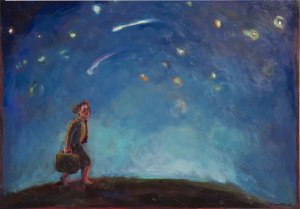
You lie in your bed, in your bed and your heart beats so loud you’re certain he’ll hear it. Your breath is so noisy, and you try not to breathe it. You slow down your heart and your breathing like a hibernating creature in a long dark winter. That, you believe, is the only way to stay alive in the circumstances in which you currently find yourself.

But will you ever learn to open up again? To let the heart beat to its own desires and the breath whistle carelessly through your body?

The day comes when he decides to do something he’s been contemplating for some time. The child is pretty, though not exceptionally so. More than that she is full of life, bright and intelligent with a wide smile and the skin that is the privilege of all young children, the skin one longs to stroke, like satin under the tips of the fingers. He likes the idea of having two females in his house available to him.  He chews on his fingernails as he sits in his chair drinking beer out of a pewter tankard and looking at his roses through the sitting room window. He brushes the hair out of his eyes and tosses his head. Then he chews his nails again till he draws blood. He isn’t contemplating doing anything wrong, he decides, giving fleeting attention to the morality of the situation. It has to be secret because other people will put their own interpretation on it. He gets angry just thinking about other people’s opinions on the matter. He gets defensive just thinking about someone else’s disapproval of him.

If he knows in his heart that he shouldn’t carry out this plan he stifles that knowledge. This is easy to do as his desire is great and outweighs every consideration his better nature might put forward. He has a better nature. He is a doctor, well liked in the town, he has healing hands. He has a better nature.

But his dark desire puts him beyond the reach of the ameliorating qualities of human love that would have him first consider the child. He pours another drink out of the bottle on the small table at the side of his chair, and lights another cigarette. He is not a man to deny himself his desires. He is a man with a sense of entitlement.

The phone rings. His wife calls him. He grinds out his cigarette and stands up, pushing the hair off his brow, adjusting his clothes. As he strides down the hall to the surgery at the side of the house, he puts his fantasies aside. By the time he’s reached the phone on his desk he’s become the doctor. He listens quietly to a patient’s concerns. He reassures, and says he will be there in ten minutes. He hangs up the phone. He gathers his bag, his stethoscope, the miniature torch he uses to look down sore throats. He strides out to the garage, gets into his car and takes out the packet of mints he keeps in the glove box. He puts two in his mouth and sucks on them. He’s thinking of the patient, what might be the cause of the sudden onset of high fever. He enjoys the regard in which his patients hold him. He won’t allow anybody to spoil that.

Sometimes while she was observing the snake, the daughter imagined fetching the shovel and decapitating it. But she was confounded by the logistics. How was she to keep the snake in place while she lifted the cage, put it down again on the floor, picked up the shovel and made ready to strike? How could she be sure the snake wouldn’t leap at her and sink its fangs into her cheek as she bent over and lifted off the metal cover? She paced the kitchen, thinking things through. She couldn’t settle to anything, knowing that snake was in the house.

She even thought she could let it bite her. She could take that irrevocable step into the unknown. She could alter the course of her life forever, in one instant. She could give in to the “unnameable lust.” She could. The decision was hers.

There’s a barrier between those who’ve known violence and those who haven’t. Behind this barrier Angel is, she fears, forever an outsider.

Her secret sets her apart. Dark knowledge taints her. She’s sullied. How will she ever make herself clean again? Once she sought to bridge this distance by confiding her experiences, only to see reflected back in her listener’s eyes her own confusion. Confessing something can sometimes make you feel worse than keeping it to yourself. Whatever is most difficult to tell. That is what counts.

If Angel reveals to you what she knows will she taint you in some way? Will she force into your life knowledge that can’t help but change the way you look at the world? Against your will, angering you, causing you to avoid her next time you pass in the street? Will she make you afraid of her because of what she knows?

The daughter experiences this barrier as a dense membrane, impenetrable, a thick sac in which she is enclosed and from which she attempts to look out at the world. The world seen through these membranous layers is always distorted, as if she’s looking through wet plastic, material that ought to be tangible, that she ought to be able to grasp in her hands, but can’t. If she could, it would be slick, like a foetal sac she must break through, kicking and tearing, in order to get out into the earth’s atmosphere and breathe for herself.

She sees the world coloured by her own experiences, as does everyone, but she doesn’t know that. For example, she looks at her friends and thinks that their fathers must do the same things. All girls must know what she knows, and part of what they know is that the knowledge must never be shared. They are all enclosed in their separate, thick worlds from which they gaze at one another with dull eyes. They will stay this way as long as they are in their fathers’ houses.

There is no clarity of vision from inside a membranous sac. The edges of things are always blurred, and boundaries are uncertain. You can’t touch anyone and nobody can touch you. Only the father can tear through and the layers separate for him and he enters and when he withdraws, the layers close over again, skin growing back, leaving no visible scar.
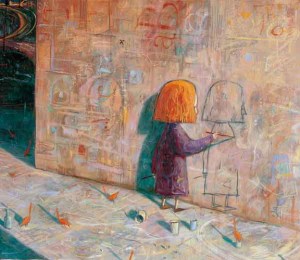
In referring to herself in the third person, Angel believes that she not only puts a distance between herself and her experiences, she creates herself as well. She brings herself into being. When she’s accomplished this, when she’s managed to construct herself, she’ll step into this borrowed figure, much as the hermit crab crawls into an empty shell and makes it her own by virtue of occupancy. Much as a bird settles into an elaborately woven nest and is then identified by the type of home she’s built, the materials she’s chosen, the way she’s arranged them.

When she speaks of herself in the third person she does it to ward off a certain pain that is always threatening to overtake her. Only in the third person can she find the courage to allow voice to the truths that sit on her shoulder, chattering and salivating like cast-out demons wanting back in.

She has no desire to think of herself as victim for the rest of her life. There must be a way she can stand with dignity in the midst of the sum total of her life’s experiences, denying none of them their due, resisting any attempt at domination by a single horror, granting equal value to all.

Though the January day is dripping with humidity, the daughter feels cold on the carpet in her room. Chilled to her very bones. She puts the photograph back in its envelope. She doesn’t know what she’s achieved by this exercise. She doesn’t feel any closer to having a real past than she did before, her head is aching and she feels sick. She whistles the Dog, he comes to her and rests his head in her lap. She buries her face in the thick white fur around his neck and inhales his dog smell.

After a while she thinks perhaps she might have put a tiny piece of her heart back where it belongs. That’s what it is, this painstaking process of singing in all the voices languishing on the outer edges. It’s the delicate job of putting a heart back together so it can die whole. She dare not die as she’s lived, bits of her scattered all over the place, forgotten, repressed, and denied.

Angel hears Jane’s footsteps as she enters through the upstairs door and sets her parcels down in the kitchen. The Dog sits up and makes ready to go to her, angling for a treat. If Angel follows him Jane will smile at her, and they will drink tea under the mango tree and watch the sun fall into the river, and pray for a thunderstorm to clear the stifling air. This is her ordinary life. This is the precious and ordinary life, given to her by Jane, that she never expected to have.
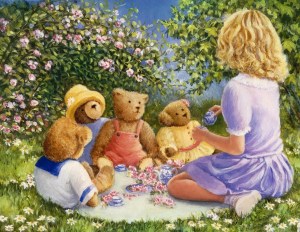
Eventually, on the day of the snake, she realised she couldn’t stay in the house any longer. Carefully, she printed on a piece of cardboard: Beware of the Snake. She propped this warning on the top of the stairs. Then she went out to buy chocolate.

When she got back, Jane was home, pulling on her gumboots and gardening gloves. She’d found a large sack. Together they went upstairs. Angel slowly lifted the wire cage and the snake wriggled out into the bag Jane held in front of it. Jane tied up the bag and they transported the thrashing snake to the bush at the end of their street. There they let it go.

‘Did you want me to kill it?’  Jane asked later as they drank tea and ate the chocolate, their reward for bravery and endurance

‘Nope. I just didn’t want it in the house. That bloody dog was useless you know. Didn’t even notice it.’

As a child the daughter’s nature was ebullient. It was hard for her to learn to disappear herself. It was hard for her to learn to think of herself in the third person.
Gillard government guidelines say women don’t commit domestic violence: in On Line Opinion today.

5 Jul

In On Line Opinion this morning, I press on with my solitary mission to bring some reality into the Gillard government’s National Plan to reduce Violence against women and their children.

It’s a dark and lonely job but someone has to do it.

Every time I take this on, especially on the Drum, I’m called anti feminist (that’s an insult these days?) an apologist for rapists, a”man fondler” who is determined to attack feminism any way I can; of having a prick in my head and various other slings and arrows shot at me by women who call themselves feminists.

Yet I remain strangely unaffected.