Tag Archives: Women

The cupboard under the stairs

29 Oct

A combination of illness and heart carnage has resulted in weight loss that has seen me holding myself together for the last few months with safety pins, and belts with new holes gouged in them by Mrs Chook’s screwdrivers. I knew that somewhere I had a store of thin clothes but I’ve lacked the energy and interest to look for them. I always hurl everything I don’t immediately need into a vast cupboard under the stairs that has no adequate lighting so a torch is required, or one of those reading lights that fit around the head. Having light doesn’t stop me forgetting that at some point I can no longer stand up in the cupboard, and I always crack my head on a beam. Nothing is stored in any kind of order so I have to trawl through all kinds of stuff to find the one thing I need. The whole process drives me mad, but seeing as I couldn’t stand safety pins for another day, I had to do it. I found my thin clothes, which are probably vintage by now but that’s all right, vintage is good, it’s like having a new wardrobe, and the pleasure of wearing something that actually fits me is great.

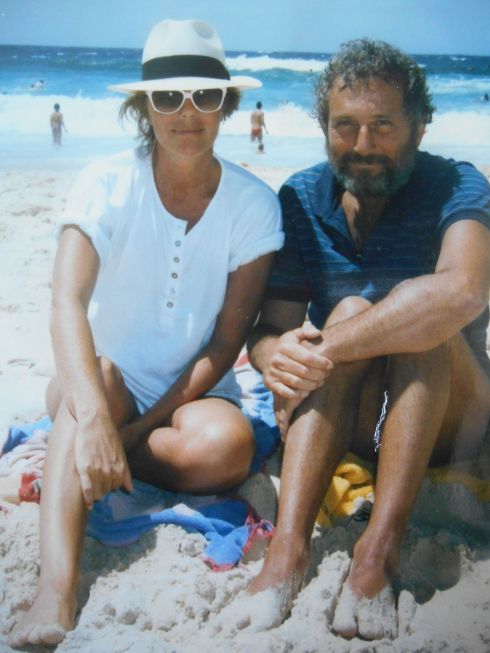
In the cupboard I found my husband and me a long time ago on Bondi Beach

Arnie and me

Arnie was a very unobservant Jew, except for Passover feasts which he loved, but I never acquired a taste for gefilte fish and matzah ball soup and fortunately, he delighted in cooking them. He loved as well getting into vigorous arguments with the man from Jews for Jesus up at Bondi Junction, and if he could, he’d bale up the Hasidic Jews who lived round the corner from us and have a robust exchange with them about the Talmud. Very occasionally he would go to the synagogue, and in his seventies he started Hebrew classes. I used to say he was conflicted about his tribe, to which he invariably responded “Ah, conflicted, schmicted,” with a rabbinical shrug. When I first met my mother-in-law in Hartford, Connecticut, she said, “For a shiksa, you’re a doll.” He always said that when we die we become energy in the universe. I don’t know in which part of the universe he has become energy, but I hope I can find him.

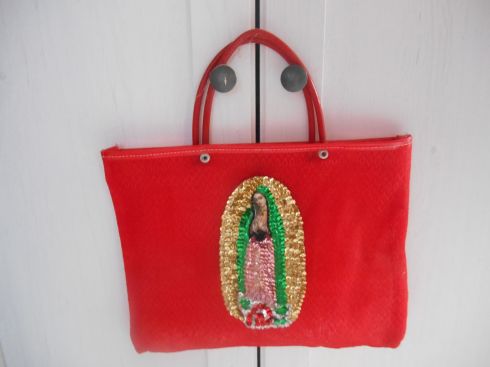
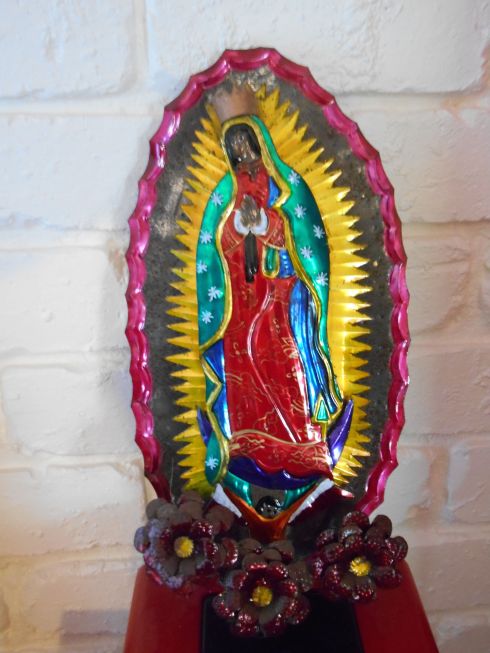
I discovered all kinds of things in my rummaging, including Mexican kitsch I’d forgotten all about. While living there a few years ago I became fond of the Virgin of Guadalupe, not least because she is also known as the Woman of the Apocalypse, “clothed with the sun, and the moon under her feet, and upon her head a crown of twelve stars.” I found her on a handbag in a market

Virgin bag

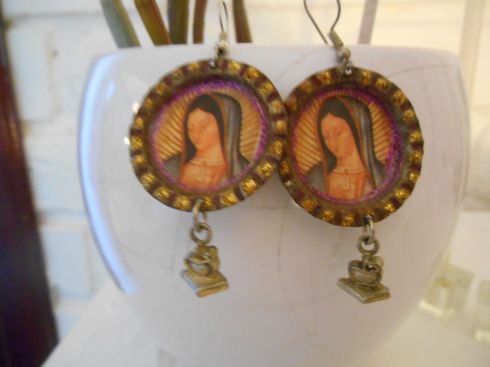
I found her in another market on earrings made from beer bottle tops

virgin earrings two

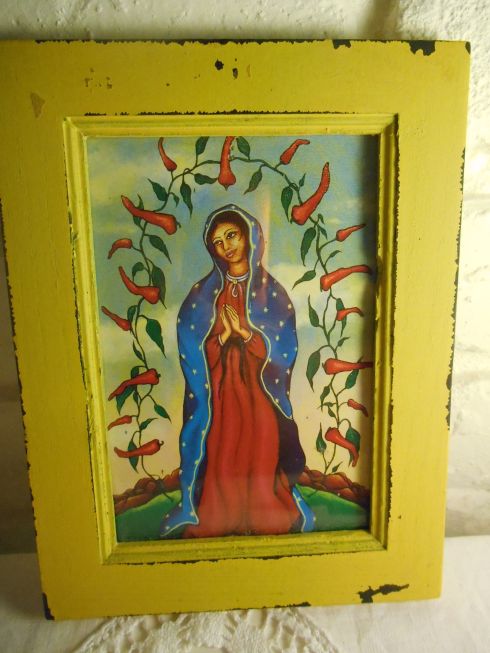
I found her on a postcard that I’ve put in a frame beside my bed

virgin photo

I found her on matchboxes and scarves, and in beaten tin that I’ve hung on the sitting room wall where she can watch over me while I sleep on the couch. She comforts me, and there are times in life when we must take our comfort wherever we can find it.

virgin guadalupe

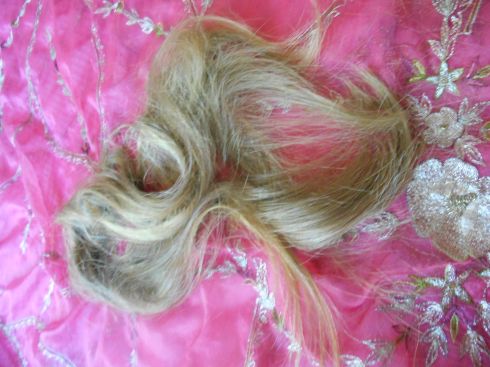
Then I found my hair, cut off when I was twelve

Hair aged 12

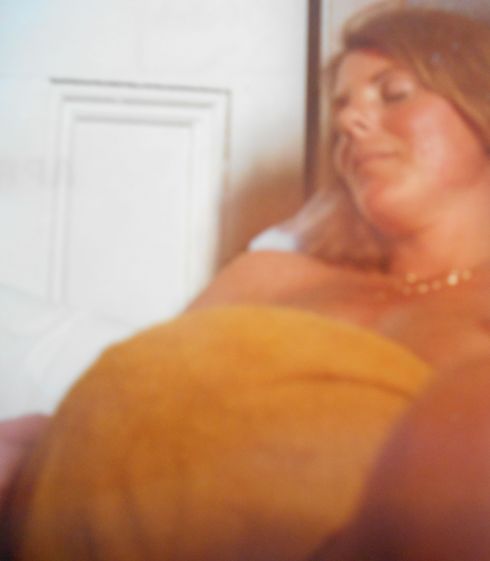
And then I found this

In labour

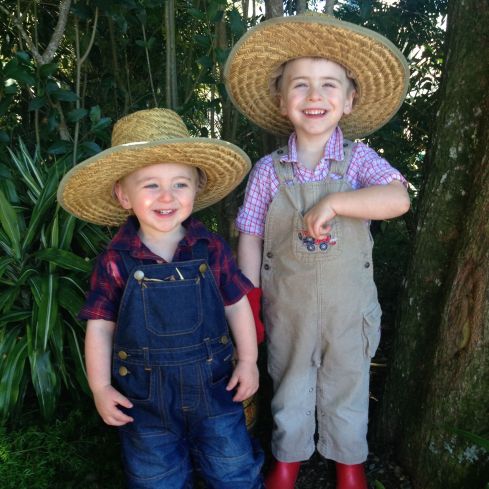
The child I gave birth to that April day is now the father of these two

farm boys

And after being in that cupboard I like to fancy that we are all women of the apocalypse, clothed with the sun, and the moon under our feet, and upon our heads a crown of twelve stars, and if I can remember that when I go into the universe perhaps my husband will find me, and I won’t even have to look for him.

What a woman wants, what a woman needs…

28 Feb

Yesterday I visited a place on the NSW south coast that once served as a sanctuary, a place to which I fled after an almost terminal encounter with cancer left my whole being drastically weakened, terrified to live and equally terrified to die. Daily life had become impossible, I no longer knew how to fulfil its expectations. I needed solitude, away from city life, I needed to escape the claims and demands of human interaction, even with those I loved and who loved me, and I needed this so desperately I think I might have physically attacked anyone who tried to hold me in place. Fortunately, nobody did, I was reluctantly let go when I promised to allow visits, as long as nobody stayed too long, and how long was ‘too long’ was to be determined by me.

DSCN0892

It was also fortunate that we owned a caravan behind the sand dunes on a largely deserted beach. You can’t live in a caravan, they said. You can’t live there all by yourself, you’ve been so sick, look at you, you have no hair and all your bones are showing. Fuck off, of course I can, I told them, unkindly. Any attempt at what I perceived as thwarting me made me frantically distressed, as if I was being pinned down by a body stronger and more powerful than mine that I had to fight off, or suffocate.

The caravan was in one of those old-fashioned parks where families spent their holidays year after year for as long as anyone could remember. When I arrived, exhausted from the four-hour drive and the emotion of goodbyes, the place was largely empty, being out of holiday season and in the middle of autumn. It was cold. The south coast climate is at best fickle, I have known us wrapped in sweaters and blankets on Christmas Day. The caravan, unoccupied for months during my illness and initial recovery, was musty and damp, a habitat for spiders and insects. The day was overcast, adding to the gloom, and while our spot beside the creek in a grove of melaleucas was idyllic, it allowed for little light under such a low grey sky. I had a panic attack. I couldn’t stay in the spider-infested gloom. I couldn’t go back to our light-filled Bondi Beach home where I suffered anxiety attacks every time I went out the front door into the neighbourhood I had, prior to my illness, loved to inhabit, with its cafes where I met my friends, ate weekend breakfasts with my husband and whoever else happened by, where we swam or walked the winter beach hand in hand talking as we always did with such energy and delight, even at the times we disagreed with practically everything the other said.

DSCN0889

After the cancer, I couldn’t talk about anything anymore. The ongoing blows inflicted by the illness, so unexpected, so unpredictable, they seemed unending in their variety and persistence. After cancer is a time largely underestimated in its power to disrupt. Generally, people think you ought to be relieved, happy you got away with it this time, determined to embark on a recovery regime that will get you back in the swim of things just like you were before. In reality, at least for me, it’s when the horror of the experience actually hits home, something that is impossible when you’re going through the treatments and your world has become medicalised to the extent that it overwhelms all other realities. Post cancer, every little twinge in your body is noted with alarm: is it coming back? For months I woke in the night drenched in sweat, from nightmares the details of which I could never remember, and a debilitating weariness dogged my days. There was nothing that did not leave me exhausted, and tearful. I couldn’t manage all this, and human beings as well.

I walked along this same beach yesterday, under a similar low, soft grey sky, the familiar smell of kelp, the haunting cries of seagulls, the gritty south coast sand between my toes. At the end of my beach there’s a broken wooden jetty where I used to lie on my stomach, peering intently at the stingrays gliding through the clear water beneath me. The rhythm of those days and weeks and months of solitude came back to me. In the mornings waking up sweat-soaked and panicked, climbing out of my single bunk bed to make tea on the gas stove, cold, even if the day was warm, because what I remember from those months is how I could never warm myself, even under piles of blankets, even in the hottest sun, it was as if I had a frigid core that nothing could reach, it was as if I had entirely lost my previously automatic ability to regulate even my body temperature. The trembling of my body, most especially my thighs, and the cold sweat drying on my skin. The fear of moving. The terror of putting one foot in front of the other. The utter loss of everything ordinary.

My husband and my adolescent children would visit and though I loved to see them, the relief I felt at their departure, at the resumption of my solitude, made me ashamed. I remembered yesterday the feeling of my starved gulping, my greedy devouring of nourishment not from my loved ones whom I invariably felt I had to reassure, but from the solitude of the natural world in which I was immersed. That was my healing. My guilt at abandoning them was great. But my need to be alone in this wild landscape overwhelmed it. I wanted nothing except what I needed to stay alive, some books, some music. The hurt I caused them did not become fully apparent till some years later when my eldest son, beside himself with unexpressed distress from that whole period of our lives, shouted at me, You didn’t need any of us! You just left us! You didn’t let us help you, you are such a fucking loner, Mum, you don’t fucking need anybody!

Which left me speechless. And reaching out for him and he came into my arms, grown up, so much bigger than me, and sobbed.

DSCN0891

I don’t know how it is for others, but I’ve always had a dreadful struggle between what I need for myself, and what others need from me, and what I want to give them because I love them. Sometimes I think I will die if I don’t have time absolutely alone. Sometimes I cannot bear to engage in one more conversation about, essentially, nothing, the kind of conversations that make up so much of our daily discourse, the words that serve to weave the binding threads between people, and that is their purpose. Sometimes I think if I am not able to sit in silence in the natural world for as long as I need to, I will start breaking things. It’s as if the healing never really finishes, needs to be topped up from time to time with a return to the inner self who increasingly becomes more solid, more real, than any outer persona and whose needs are so far from anything found in the everyday world with its constructed conventions, and its claims that largely require almost incessant, low-intensity interactions for their fulfilment.

For a woman to do what I did, leaving home, husband and family who cared for me through the desperate and dangerous phase of my illness, insisting on solitude rather than accepting their love was seen largely as selfish, and it was, there’s no denying that. It had a price, for all of us, but yesterday I understood that there’s nothing intrinsically wrong or frightening about paying a price for something deeply desired, these are deals we strike every day, choices made, choices rejected, and almost every one of them has some effect on someone to a greater or lesser degree. I still don’t know, after all this time in this life, how much I am allowed to take for myself, how much selfishness I am allowed, how many choices I may make that cause another hurt or discomfort, how responsible I must be for protecting another from disruption in the pursuit of my own desires and needs. With every situation this must be weighed up anew, and I have made some horrible errors. It seems that the important thing is that I continue to bother to attempt these fraught calculations, even though my sums may be dreadfully wrong. I hope that is the case, though I don’t expect I shall ever know.

Quint Buchholz. lemaze-studio.com

Quint Buchholz. lemaze-studio.com

All about women

9 Apr

“All About Women” was the title given to a day of feminist conversation and debate between women about women, at the Sydney Opera House on April 7.

Aside: I understand Bob Ellis inveigled his way onto some panel or other, on the topic of whether or not men can be feminists. He took the opportunity to reveal that he has not had sex with his wife since 1966. (CORRECTION. APPARENTLY ELLIS SAID HE HAS NOT SLEPT WITH HIS WIFE SINCE 1966) In either case, whether he believes this makes him a feminist or not I don’t care to contemplate.

I’m all for women gathering to discuss ideas and exchange views, however I did get more than a little infuriated by the title of this event.

For as long as I’ve been a feminist (or an anti-feminist as some would have it) I’ve complained, and the women I associate with have complained, about what I will term “the patriarchy” and its offensive tendency to refer to us as “women” much as one refers to “cows” or “chickens” or “fish.” That is, as if we are an homogenous group with no individual characteristics, who all think the same, desire the same, and act the same because we have breasts and vaginas.

Take, for example, Freud’s infamous question “What do women want?” asked as if we are not individual women but Woman, the planet’s largest hive mind, and there really is one thing, if only Dr Freud could have found it, that would solve Man’s problems with us.

My feminist friends and I have expended much energy over the years in an effort to educate the patriarchy in the unacceptability of dehumanising half the human race by referring to us as one being.

So understandably, I was enraged when I learned that a feminist wordfest had been given the title “All About Women.”

There must be an inherent and entirely unexamined sense of privilege and entitlement  at work, to allow any woman to consider that anything she has to say can be extrapolated to all women.

What the title does is refer us yet again to an elite feminism that claims these days to be feminism. And it seems to me this kind of feminism has taken an unfortunate turn in its abandonment of first principles. We are not a hive mind. We are not “women” or “Woman.” We are complex and individualised human beings with an infinite number of concerns,ambitions, desires, sorrows and griefs. If leading feminists have become so damn lazy they’ve forgotten that, then we need new leaders.

“All about some women” is admittedly not quite as catchy as is the universal, but it is a good deal more honest.

woman

Elite feminism. Who is it good for?

1 Apr

This piece by Anne Summers on women in government sent me to Twitter with the question “Can Anne Summers explain to me the advantage of having a conservative female PM over a conservative male PM?”

There isn’t an answer to that question unless you are a fanatic, which Summers seems to increasingly become on the matter of Julia Gillard, and then the only answer is, vagina.

It might be worth noting that all the women ministers remained loyal to Gillard in the attempted coup on her leadership, Summers writes. Although a few female members of caucus supported Kevin Rudd (and were willing to be filmed with him while he spoke after the meeting where Gillard was re-elected unopposed), there were no women in the key group of plotters. Nor did any women resign as a result.

An act of double treason, then, that the females who supported Rudd were willing to be filmed with him as well? They should have hidden their allegiances, perhaps, not flaunted them, standing by his side?

Is this an example of gender solidarity, Ms Summers muses. Except of course for the women, (are they real women?) who legged it to Rudd’s camp. And how to explain that failure?

This is an aspect of feminism, increasingly dominant, that I find, well, I don’t think repulsive is too strong a word. It affects me viscerally, as is required of true repulsion. The concept that female genitals correlate with good governance is dangerous in so many ways I don’t even know where to begin. Surely such a gendered concept is one women have been fighting against for centuries now? Surely it is the very cornerstone of patriarchy? 

Just what these women in government are achieving for women not in government is not immediately clear. Indeed, for many single mothers the change to Newstart, for example, is nothing short of disastrous (so much for gender solidarity). I’m informed on Twitter when I voice objections to this obscenity, it was John Howard’s legislation.

This confuses me. We are supporting our first female Labor Prime Minister, even when she perpetuates John Howard’s policies?

The Gillard government’s record on asylum seekers? Makes me want Howard back. Same-sex marriage? ‘Twas Howard who changed the Marriage Act to prevent this, & despite her party supporting a reversal of Howard’s meddling to allow same-sex nuptials, Prime Minister Gillard will have no truck with it.

But that’s all right, because, vagina.

Of course women must participate in government, and at the highest levels. But why I am supposed to support women whose policies I despise, just because women, is beyond me. This “Rah rah ra! Women are in power!” stuff shits me to tears.

It is a particularly middle class, privileged feminism that spares little thought for women who do not inhabit its exclusive clubs. It is offensively self-congratulatory. It is dishonest. It is distorted. And outside of its immediate rarified circles, I can’t see what good it does anybody.

We did once hope that when women got to the top they would take care of their sisters. Which, come to think of it, is just as naive and dangerous as Ms Summer’s position.

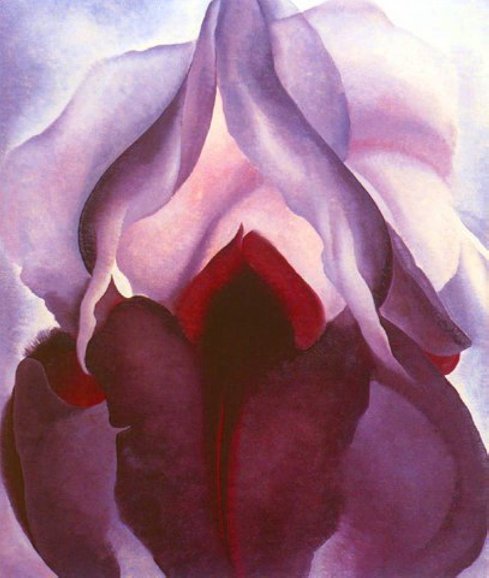
Flower of Life. Georgia O'Keeffe

Flower of Life. Georgia O’Keeffe

Has our first female PM legitimised misogyny?

18 Jan

“We all recognise that if there’s one overarching issue for women it’s the way that religion can be manipulated to subjugate women.” Mary Robinson, first female President of Ireland, former United Nations High Commissioner for Human Rights.

Late in 2012 Australia’s first female Prime Minister, Julia Gillard, made a stirring and globally applauded speech in the House of Representatives, on misogyny and sexism in the Parliament.

Ms Gillard declared “I will not be lectured on sexism and misogyny by the Leader of the Opposition.”

Ms Gillard asked: “What does misogyny look like to modern Australia?”

Ms Gillard deplored LOTO Tony Abbott’s double standards when it comes to misogyny and sexism.

Ms Gillard demanded Tony Abbott apologise to the women of Australia for his misogyny and sexism.

Ms Gillard stated “I am always offended by sexism and statements that are anti women.”

Ms Gillard declared “Double standards should not rule this parliament” and “sexism is always unacceptable” and that “we are entitled to a better standard than this.”

Prime Minister Gillard was absolutely right on all counts, and the stand she took was long overdue.

∫

The Gillard government has undertaken the consolidation of anti discrimination legislation. In the course of this it has decided to preserve existing exemptions that permit religious organisations to discriminate against , as David Marr puts it:  any or all gays and lesbians, single mothers, adulterers – yes, even adulterers! – bisexuals, transsexuals, the intersex and couples such as Julia Gillard and Tim Mathieson.

The practical outcomes for women of these exemptions  are starkly illustrated in this story of an unmarried teacher who became pregnant and was subsequently sacked from her job at a Christian kindergarten in Queensland.

Australian Christian Lobby CEO Jim Wallace claims Julia Gillard “reassured” religious organisations that they would retain their right to discriminate against women in this manner, as well as to discriminate against women who live in de facto relationships, women who commit “adultery,” women who are bisexual and lesbian, and the intersex.

It is unclear how much of this discrimination is directed against men, except in the case of gay men, who it seems are not regarded as “real” men by religious groups such as the ACL and Christians the ACL claims to represent. Women who transgress the ACL’s rigid criteria are demonised by the Lobby’s determination to exclude them from the right to employment, not because they are in any way unable to perform the work required, but because of their “lifestyle.” Whether or not the man who impregnates the single woman is similarly discriminated against remains unclear.

British philosopher AC Grayling in The Guardian:  I leave to you the not very congenial task of totting up the ways in which more enthusiastic forms of religion in general, not just Islam but Roman Catholicism, puritanical forms of Protestantism, and orthodox Judaism, have treated women: all the way from closeting them, covering the up, and silencing them, to sewing up their vaginas: it is a ghastly litany of repression, all the less excusable because discrimination against women which began in these ways persists in our society in modified forms: the fact that a woman earns about 70% of what an equally qualified and experienced man does is a residue in our own society of the attitude which in today’s sharia law states that a woman is worth half a man.

∫

The ACL is anti-abortion, and against the use of the drug RU 486, licensed in Australia only for the termination of very early pregnancies. They strongly object to Australian aid being used to promote family planning in recipient countries. In other words the ACL is keenly interested in controlling and regulating women’s bodies, at home and abroad.

Former US President and Christian Jimmy Carter: The truth is that male religious leaders have had – and still have – an option to interpret holy teachings either to exalt or subjugate women. They have, for their own selfish ends, overwhelmingly chosen the latter. Their continuing choice provides the foundation or justification for much of the pervasive persecution and abuse of women throughout the world. This is in clear violation not just of the Universal Declaration of Human Rights but also the teachings of Jesus Christ, the Apostle Paul, Moses and the prophets, Muhammad, and founders of other great religions – all of whom have called for proper and equitable treatment of all the children of God. It is time we had the courage to challenge these views and set a new course that demands equal rights for women and men, girls and boys.

At their most repugnant, the belief that women are inferior human beings in the eyes of God gives excuses to the brutal husband who beats his wife, the soldier who rapes a woman, the employer who has a lower pay scale for women employees, or parents who decide to abort a female embryo. It also costs many millions of girls and women control over their own bodies and lives, and continues to deny them fair and equal access to education, health care, employment, and influence within their own communities.

∫

Australia’s first female Prime Minister, Julia Gillard, has chosen to walk a path that is very different from that of Mary Robinson as far as women are concerned. Ms Gillard has, by pandering to the demands of religious bodies for exemptions to anti discrimination law, legitimised the religious misogyny that perpetuates the myth of female inferiority, to the degree that we are not considered capable or worthy enough to retain control over our own bodies. Ms Gillard has legitimised a misogyny that would deny her the right to employment because of her “lifestyle” as a single woman living with a man. Would her partner Mr Mathieson also be denied employment?

Ms Gillard has legitimised a religious misogyny that believes it is righteous to sack unmarried pregnant women, at a time when they and their unborn babies most need support. At the same time, they would if they could deny a single pregnant woman access to abortion, if that was her choice.

Ms Gillard has thrown her support behind a Christian cult with unsettling links to “dominionist organisations throughout the world, not least through its own board and staff.” (I strongly recommend reading Chrys Stevenson’s excellent piece to which I have linked, in which she unpacks the connections between dominionists and the ACL).

The National Alliance of Christian Leaders (NACL) with whom ACL is closely associated, stated their goals thus: “… unity in truth; recognition of Christ’s authority in the church, family, individual and government; … legislature to force Christian values; … the kingdom permeating the structures of society; biblical government.”

Ms Gillard, an atheist, has capitulated to the demands of organisations such as these and has enabled them to enact their stated goal of introducing “legislature to force Christian values” on our secular society.

∫

Dear Ms Gillard

I will not be lectured on sexism and misogyny by you.

Dear Ms Gillard

What does misogyny look like in modern Australia?

Dear Ms Gillard

I deplore double standards when it comes to misogyny and sexism.

Dear Ms Gillard

I am always offended by sexism and statements that are anti women.

Dear Ms Gillard

I agree absolutely that “Double standards should not rule this parliament” and “sexism is always unacceptable” and that “we are entitled to a better standard than this.”

Dear Ms Gillard

What are you going to do about it?

Jennifer Wilson. Woman.

Sexualisation in the city

24 Sep


This extended stay in the city has brought me into much closer proximity with many more human beings than is normally the case, living as I do in a tiny village in a rainforest girt by sea and the mighty Clarence river.

Even living at Bondi Beach doesn’t do as much as one might imagine to relieve the constant pressure of humanity and its leavings, given the domination of buildings and people overwhelming the landscape, but even so I’d rather be here than inland.

Sometimes at home, sitting in my feckin Swedish chair in my peaceful work room from which at night I can hear the sea, I wondered if the entire sexualisation of women and girls moral panic might be passing me by, simply because I didn’t see enough. I was protected from intrusive advertising in public spaces, and most of all, from the observation of women and girls in great numbers going about their daily lives dressed as they saw fit.

Perhaps it’s because Bondi, but there’s a lot of very tiny very tight shorts  about. What I think when I see them is oh my gods, that must hurt you are cutting off the blood supply your lady bits will atrophy what about thrush there’s no air in there doesn’t it chafe when you move…and then I remember in my twenties and thirties lying flat on my back on my bed so I could zip up jeans that sat just as snugly. I remember wearing very short skirts and midriff tops even in a London winter. I remember a period of shoe fetish when I teetered about on stilettos holding babies, a practice that ought to be forbidden for the babies’ sakes. It was fun. It was costuming. But it wasn’t “sexualising.” “Sexualising” was what was done to me as a child through sexual abuse.  There is a world of difference.

There’s a good piece on what sexualisation is and isn’t here by Ray at the Novel Activist blog.

Young women in revealing clothing are not “sexualising” themselves.  They may indeed wish to look sexy. Whether they succeed or not is entirely in the eye of the beholder but the desire to look sexually attractive is perfectly normal for a young woman. How she performs her sexual power is largely dictated by the dominant social customs of the day, and I don’t think those customs have changed dramatically in the last few decades. They remain as restricted and unimaginative as ever.

To the moral campaigners a display of flesh signifies their concept of  a prostitute, and to them, there’s little worse than a prostitute. They fail to see that displaying flesh is not automatically offering that flesh for sale or use, and in their failure, they mimic the consciousness of rapists and sexual abusers. Healthy people don’t assume that a young girl wearing short shorts is offering herself for sex. Healthy people know there’s a good deal more involved in navigating a sexual encounter than mere apparel, and they know that mutual and agreement are the key words, no matter what a woman is wearing.

What the moral campaigners want is that women take responsibility for controlling male sexual desire by not provoking it with our flesh. They’d be more useful if instead they put their considerable energies to work in campaigns that focus on educating boys to become men who take responsibility for their own sexual desires, and how they enact and gratify them.

If it is true that young women feel obliged to sexually service young men to a degree previously unheard of, then surely we need to be better educating our boys in sexual manners, rather than wringing our hands about our girls’ short shorts.

Sex is everywhere and why that should surprise anyone I don’t know. It is a powerful, dominating human force. Of course it is everywhere. Of course the majority of humanity is interested in sex. Of course sex sells. Of course women and men want to be sexually attractive. I mean, get over it.

In my utopia we’d be educating girls and boys about sex at school and at home as soon as they showed an interest. We’d be preparing them for the overwhelming nature of sexual feelings and emotions. We’d be accepting the role sex plays in our own lives and passing that acceptance on to our young, and we’d be doing it without guilt and shame.

Covering the female body is not going to achieve a thing. The campaigners are very noisily barking up the wrong tree, and from what I can see around me, nobody much is listening to them.


More Abbott on women: equality is “folly” ‘cos biology.

11 Aug

It would be folly to expect that women would ever approach equal representation in a large number of areas simply because their aptitudes, their abilities and interests are different for physiological reasons.  Tony Abbott

As recently as 2010, Tony Abbott was given the opportunity to elaborate on the above statement and to withdraw it, if it no longer represents his views on women. He did neither, so I can only conclude he continues to hold these biologistic views about women’s potential.

I wonder if Abbott extends his beliefs on biological determinism and inequality to any group other than women?  It seems unlikely that someone holding to that ideology would only apply its doctrines to sexual difference.

What are these “large number of areas” in which women can never have equal representation, cos vagina? The only one I can think of is being a sexist dick.

Abbott reveals in this statement his belief that difference is a barrier to equality. Women can never be equal to him because we are biologically different from him. Only those who are biologically the same as him are his equals. Ergo, all others are in some way lesser beings.

Does he apply this theory to skin colour as well as genitals?

The prospect of a leader of this country who holds views that are the basis for the theory of eugenics, ought to give us all pause for thought.

Not only are women lesser beings and therefore un-entitled to desire equality, it is , according to Abbot, folly to believe that we can ever be otherwise. Foolishness. Silliness. Nonsense. Madness, even, to think that women, hampered by our biology, potential destroyed by our vaginas, can aspire to even approach equal representation in large, but unspecified numbers of areas. Areas like medicine? The law? Politics? Academia? The finance sector?

In which areas of life does having a vagina determine your ability or otherwise to think?

I don’t think Abbott is unequal to me because he’s got a penis. He’s unequal to me because he thinks owning a penis makes him superior, and that makes him a fool.

In one sentence Abbott reveals what he thinks of women

8 Aug

The problem with the Australian practice of abortion is that an objectively grave matter has been reduced to a question of the mother’s convenience. Tony Abbott. 

Reduced by whom? Who has reduced abortion to a question of the mother’s convenience? Well, according to Tony Abbott it must be women who have reduced abortion to a question of the mother’s convenience, presumably because:

  • Abortion is a “grave” matter and women are incapable of perceiving it as such because they are women, stupid.
  • Women are dumb, or at least a whole lot dumber than Tony Abbott.
  • Women need men like Tony Abbott to guide them on the matter of abortion because they are too wilfully unintelligent to grasp its complexities all by themselves.
  • Women will, willy nilly if you let them, rid themselves of unwanted foetuses because they don’t know any better and what’s more, they don’t feckin care, do they?
  • Women actually have no moral compass.
  • Women are innately frivolous and untrustworthy.
  • Women don’t know half as much about abortion as do men like Tony Abbott.
  • Women must be made to understand how serious it is to abort a foetus because they clearly just don’t.
  • Women are twats.
  • Women will murder their children unless men like Tony Abbott stop them
  • Men like Tony Abbott have a moral obligation to protect women from themselves.
  • Men like Tony Abbott have a moral obligation to protect a foetus from its mother who will kill it, just because she thinks it will inconvenience her.
  • Women are pathologically selfish when it comes to a foetus.
  • Women have no grasp of the awesomeness of life.
  • Women are not men.
  • Women are not Tony Abbott


Marissa Mayer and the F word

24 Jul

And here we go again. Another “how dare she say she’s not a feminist” rant against a high achieving woman, this time newly appointed Yahoo CEO Marissa Mayer. You’ll find it at the mamamia website, written by self-described feminist Jamila Rizvi.

The term “feminist” has become extremely fraught, not least because of the rantings of  those feminists who demand every other woman on the planet describe herself thus. Many women are understandably disinclined to use the term about themselves. Many of us will not on principle, describe ourselves as others say we should, because we are engaged in a process of liberation from all those who arrogantly claim the right to tell us who we are, and who we should be.

Instead of addressing the complexities that have developed around the term, feminists such as Ms Rizvi wrongly attack women who do not wish to include that word in their lexicon of self-description. The problem is not that some women do not wish to describe themselves as feminists. The problem is that feminists like Ms Rizvi insist on publicly shaming such women.

Rizvi writes: Somewhere along the way being a feminist has become associated with hating on men, rather than being equal with them. So, I can see why women like Marissa Mayer, who work in male dominated professions, simply cannot afford to attract the label of ‘feminist’. After all, success doesn’t come to the woman who throws her hand up in the air and says ‘look at me, look at me, I’m a man-hater’.

No, Ms Rizvi, you are wrong. “Somewhere along the way” feminism has become associated with women bullying women, bullying us into describing ourselves as feminists, for example, by using abusive tirades that were they employed against us by a male, would be regarded as emotional violence.

“Somewhere along the way” feminists such as yourself decided to take over patriarchy’s work for them, and assume the right to define women.

“Somewhere along the way”  the cant of ideological purity  has blinded some feminists to the reality that when ideology of any kind gets the upper hand, the war is lost, and the revolution has become the  orthodoxy.

“Somewhere along the way” as well as being acceptable to the patriarchy, we now must be also be acceptable to a hegemonic feminism that demands we identify ourselves with its  laws, otherwise we are traitors to the women who have gone before us?

If I don’t  choose to identify myself as a “feminist”,” for example, that does not indicate that I am either ignorant of or ungrateful to the women who’ve gone before me, and by their hard work enabled some of us to achieve what was once unthinkable. I do not have to call myself a “feminist” in order to honour and appreciate those women. I do not have to use the label “feminist” for myself in order to actively care about equality. I do not have to play by your rules, Ms Rizvi, and I do not have to use your language.

There are feminists who would tear Rizvi to shreds for her love of red lipstick, her fondness for five-inch heels and her love of men. They would never grant her the right to the title. This is another reason many women refuse the label: it is, unfortunately, divisive, its meaning is unclear, and nobody quite knows what it’s describing.

I am delighted that a pregnant young woman has achieved what Marissa Mayer has achieved. I don’t give a stuff if she calls herself a feminist or not. The problem lies not with Ms Mayer. It lies with those people, women and men, who demand that human beings fit into pre-determined categories and in so doing, trash the human spirit and deprive it of its freedom.

I don’t believe for one moment that’s what the early feminists intended for us.

I do think of myself as  feminist. One of the reasons I claim that title is my belief that it is a woman’s right to call herself whatever feels appropriate for her, regardless of what others may think or demand. I will not define myself according to another’s lights. I will only define myself by my own. Feminists do not condemn a woman for defining herself by her own lights. That is the task of tyrants.

What is this “IT” that women should want all of?

8 Jul

The other day I tweeted that if I heard one more discussion about women having it all, there would be blood spatter. I take that back because I want to say a thing or two.

There are two quite separate issues here that are being misleadingly conflated. One is the real need for adequate affordable child care for all women, and a non-discriminatory workplace in which we are treated with respect and equality, properly paid and not penalised for creating the next generation who will keep the country going. I wholeheartedly support those aspirations.

But while some of us weren’t looking it seems that a particular strand of feminism has declared that Woman’s highest and most noble aspiration is To Have IT all. This has recently drowned out the real struggle for equality for all women, and focused the debate on a privileged few.

As far as I can ascertain, the IT holy grail involves building and maintaining a highly successful career while shaping your body to fit into designer suits and stilettos that create a complex ambience of sexy yet capable. When you’ve got a sure foothold in your profession you then take time to partner up, get pregnant, gestate, and give birth. Then you get back to work looking as untouched by these experiences as possible.

You then have it all. Career, partner, family, money. You will need the support of other women to enable your lifestyle. Child care workers, nannies, cleaners, the majority of whom are female, are paid far less than you, but that’s all right, you are creating jobs in your efforts to succeed at everything except the boring, unglamorous stuff other women will do for you.

Sustaining and promoting the patriarchal paradigm, the “be born, get everything until you die because you are entitled” ethic so beloved by hegemonic masculinity, is apparently the only way a woman can achieve real power in the Western world. While there may be the occasional inroad into better conditions for women who are caught up in the various levels on which this paradigm operates,  the paradigm itself is not subject to real interrogation and real change. This is still a world that in the West at least, is founded on the principle of entitlement to everything, just because.  That is not feminism as I understand it:

I would like to blame the patriarchy for  the IT women should suddenly want all of. It looks to me like an attempt at counter insurgency operational propaganda, using collaborating women they’ve turned as agents. If ever you wanted to set up a disruptive enemy for a catastrophic fall, this is the way to go about it. Use the media to build unrealistic expectations in the female population and persuade the target audience to introject them. Bombard with images of glamorous women who have brilliant jobs, dishy supportive husbands often with their own high-powered professional lives, and adorable children and pets. Make the audience crave this, for because who wouldn’t want a life like that? If you aren’t having it, there’s something wrong with you. If you don’t want it, there’s something even more wrong with you.


The propaganda won’t work on everybody because not all women are susceptible, but it will probably work on enough of us to redirect anger away from the system where it belongs, and onto the self where it doesn’t. Mission accomplished. Feminism co-opted in the service of capitalism. System safe. Oh yeah.

What surprises me about high achieving women who are given as examples of having IT all, is that despite all their obvious intelligence and talent, they seem universally disinclined to question the IT. This is disappointing. Imagine if they  got in there and started up a ruckus.IT? What is this IT of which you speak? Happiness? Contentment? A lifestyle, as opposed to a life? DEFINE THE IT!

Of course, that would be biting the hand that feeds them, and women who want it all know before they know anything else that if you can’t fight them you join them and once you’ve joined them, that’s IT.

In a bizarre sense, these women do achieve a kind of equality but I have to ask the question, who wants to be equal to that? I mean can’t we aspire to something better than “I want it all?”

There was a time when thinking you could have everything was a sign of immaturity. Adults accepted that choices had to be made. Only the greedy narcissist, frozen in the mindset of a two-year-old, thought they were entitled to everything and everyone else had to help them get it.

What seems important to me is that we keep the complaints of privileged women quite separate from the real issues facing the majority of us. They are not the same thing, they do not have anything like the same urgency, and besides, the “I want it all” creed is not going to work for the planet. I don’t believe feminism was ever about having it all. It was, and remains about equality, not matching excessive male privilege. Privilege, I might add, that the majority of males don’t enjoy either.

Feminism isn’t about “wanting it all.” Nobody has that right. The ideology is about creating a world in which everyone has a better chance at decent survival, not just a greedy few of either sex whose sense of entitlement is in danger of raging out of control, to everybody’s cost.