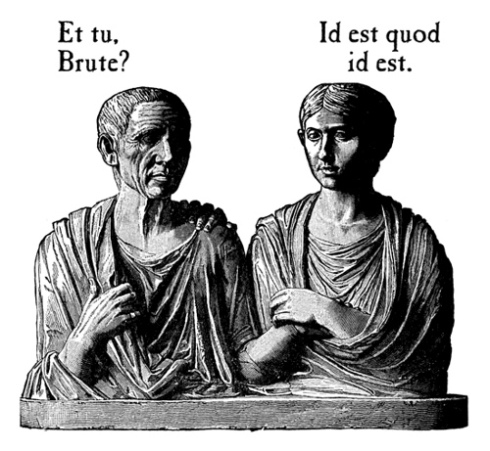
I’m not a physically violent woman but when somebody says “It is what it is” I want to smack them repeatedly upside the head and bite them till they swear never to say it again, at least not in my hearing.
What does it mean? What does it effing mean? What does it mean when someone stands in front of you like Obi-Wan Kenobi and says, “It is what it is” and why is it wrong to want to poke them in both ears with your Jedi knight light saber?
The meaning of the phrase is illegible. It lacks any relation to reality. It contributes nothing to the understanding of our lives.
The phrase belongs in a suppository of ersatz wisdom of the kind peddled by pop psychology hacks, who think that the mere repetition of words like “Love” “Happiness” “Acceptance” “Joy” “Family” will make everything that’s nasty go away, especially if you paint those words on a piece of distressed faux wood and hang it on the wall.
The signs claim and are claimed to represent the real. This is a fine example of Baudrillard’s “order of sorcery” in which meaning is conjured so that it appears to be referentially linked to the real, but in fact simulates reality and renders meaning illegible and obsolete.
Our biggest and most difficult concepts reduced to prescriptives on distressed faux wood.
Representation used as replacement for the real. Unlike the myriad forms of art, which at their best are an exploration of the emotion and psychology of our big ideas that move, inspire, frighten and otherwise stir the human heart.
From a psychological perspective the phrase sounds to me like resignation, capitulation, the verbal expression of a depressive perception that nothing can ever change, because “it is what it is.”
Or it’s a closing down of conversation, as in, what is the point of talking about this anymore because “it is what it is.”
Well, sod off, Jedi Master. By all means say, I don’t want to talk about this anymore. That’s honest. But don’t disguise your reluctance for discussion as the utterance of a universal truth.
It isn’t what it effing is. If we have learnt nothing else these past decades, we ought to have learned the inevitable fluidity of circumstances, that nothing is or can be certain, and that one of the most damaging things we can do to ourselves or others is to demand certainty where there can be none.







 No Place For Sheep
Recent Comments