
Tag Archives: Melinda Tankard Reist

The conservative sexual crusader wants kilos of McFadden’s flesh

3 Mar

At Melinda Tankard Reist’s website today there’s a list of tweets from the hapless Brian McFadden, promising to donate money to rape crisis centres, and saying he’s sorry that his lyrics have been misunderstood.

He reiterates that he intended them as an intimate song for fiancee Delta Goodrem, and not as triggers for women who’ve been sexually assaulted while drunk.

I’m inclined to believe the bloke. I don’t think for  minute he wrote that song with the intention of glorifying or encouraging the rape of senselessly drunk women.

But his apologies and donations are not enough for Melinda Tankard Reist. Not a truckload of money, she writes, will make up for the damage he has done to women.

Even in a court of law, intention counts when you’re passing sentence. But not in the courts of Christian sexual conservatism.

MTR also holds Delta Goodrem partially responsible. Why didn’t Delta check the lyrics before allowing Brian to record them, she asks. Is Delta so inured to sexual violence that she didn’t even notice what Brian was on about?

This would be unfortunate, MTR implies, as Delta is a spokeswoman for Avon Voices, a group that raises awareness of violence against women.

I guess the sexual conservatives also hold women responsible for what the men they live with do.

Personally, I think that’s a pretty low and unnecessarily malicious swipe.

Then there’s a letter from a victim of sexual assault whilst she was drunk, telling how McFadden’s song has brought it all back and is severely distressing her.

Nina Funnell then writes a long reassuring response to the victim, and I hope the woman follows this up with counselling.

There are triggers that cause memories of sexual assault, and many other traumatic experiences to flood back into consciousness, often without any warning.  This is very hard for the survivor to deal with.

Triggers can be almost anything. I once worked with someone whose flashbacks were caused by pieces of green soap with a particular smell. Triggers are impossible to predict, extremely individual, and powerfully connected to the original trauma.

As much as the survivor would like never to have encounter these triggers, it is literally impossible to clear the world of them.

In some instances they may be so particular as to rarely emerge. Sometimes they aren’t known until the moment they strike. In many instances the triggers are all too common, and people have to deal with them on a daily basis.

It would be a foolish therapist indeed who recommended total avoidance of anything likely to act as a trigger. That would be condemning the survivor to a miserable life.

What we can do is teach cognitive behavioural techniques that can be used to manage the distressing flashbacks. This has the added advantage of empowering the survivor, both with the skills to handle bad times, and with the sense that she or he has some control over circumstances that can feel uncontrollable.

Given the proliferation of sexual topics in popular culture, it’s unrealistic to blame any artist for triggering a survivor’s flashbacks. As the triggers are so individual, its impossible to know what they might be.

As stupid as you might think McFadden’s song is, blaming him for activating post traumatic stress disorder is wrong. You might as well blame the manufacturer of green soap, and I believe McFadden, in his intentions, is as  undeserving of blame.

The world is not an easy place to live in when you’re suffering post traumatic stress disorder. Many people don’t understand it, and have a low tolerance of sufferers who can seem difficult, withdrawn, moody, angry, weepy, and generally not interested in much. It’s tough, having first to withstand the trauma, and then to spend your time dealing with the aftermath.

The most difficult part is working with people towards an acceptance of their experiences, in the sense that they cannot be changed and must be lived with, as must the aftermath. The survivor has to take responsibility for learning to do this. This is the cornerstone of recovery. It can take many years, and nobody can do it for them.

I don’t think it helps survivors to be encouraged to look for someone to blame in the world around them. Nobody deliberately triggers someone’s flashbacks, unless they are entirely sadistic and know the survivor well enough to be able to do it.

If a creator of any kind must first consider if something in their work will cause distress to someone somewhere, and then abandon it in case it does, then nothing will be created.

I think Tankard Reist’s crusade against McFadden, and now Goodrem as well, is bordering on the vicious. She wants what she wants, which is an abject confession that they’ve caused immeasurable distress to women everywhere by recording the song. If she doesn’t get that, she will hound them, of that I’m certain.

She is displaying all the signs of the outraged self-righteous good Christian woman bent on vengeance, not only on him but on the woman he loves, and that is not a pretty sight.

And let’s remember, he isn’t a rapist. He wrote a song.

Fundamentalist sexual propaganda dominates at the ABC’s Drum

1 Mar
Masturbation by Klimt, drawing 1913

Gustav Klimt 1913. Masturbation. via Wikimedia

Lately The Drum seems to have been co-opted as an advocate for right wing fundamentalist Christian propaganda about the “pornification” and “sexification” of women.

Commentator Melinda Tankard Reist, sometimes supported by observations from journalist and researcher Nina Funnell, has published three pieces in the last three weeks, peddling her views on the “proper” expression and representation of female sexuality in the media and popular culture.

Given that some of her opinions can only be read as extremist (her war on Victoria’s Secret underwear, for example; her unrelenting insistence that women are doomed to be the hapless victims of men) it is astonishing that the Drum hasn’t come up with anything that directly contests these views, and gives voice to the opinions and feelings of the millions of women who find Victoria’s Secret fun to wear, and consider ourselves anything but victims.

If this right wing agenda manifested in any other subject area on the Drum, we would all be astonished, and a challenge would immediately be published. But not when it’s about controlling how women express our sexuality, apparently.

Tankard Reist’s grim visions of the inevitable baseness of men, the fear of and contempt for female sexuality revealed in her propaganda, continue to dominate the Drum’s pages.

It’s left to a handful of determined commenters to take her on.

Perhaps the Drum doesn’t consider the representation and expression of female sexuality a topic worthy of defense, even on the eve of International Women’s Day.

This is not on, our  ABC. There’s no balance here. You should be putting up articles that celebrate female sexuality, and support a woman’s right to decide how she’ll express it. Centuries of patriarchy have tried to control our sexuality, and now we’ve got the Christians at it again. Enough, already.

Why are you assisting the fundamentalists in this project, Jonathan Green, and why aren’t you giving a voice to women who love their sexuality, don’t see any reason to hide it and have no quarrel with underwear companies and stupid songs?

Women who revel in taking responsibility for ourselves, and don’t need MTR and Nina Funnell to do it for us, thanks all the same.

For those of you dissatisfied with the Drum’s promotion (by omission) of a right wing sexual agenda, On Line Opinion will fight back on Friday.

At least there’s still someplace where a woman can say she doesn’t mind a lacy thong and cleavage.

Do as we say, not as we do: the moral code of the censors

27 Feb

Talk about hypocrisy!

In the above link to a post titled ‘Surrounded by a culture in which girls are all body and only body’ Melinda Tankard Reist objects to Lea Michele, star of hit television show Glee, appearing on the cover of Cosmo showing cleavage. Michele is in her twenties, BTW, and the dress is unremarkable.

Such appearances, claims MTR, teach girls that the only thing that matters is what they look like, and that it’s of prime importance that they look “sexy.” Who they are and what they do is subjugated to the imperative to cultivate and flaunt their sexual power.

All well and good.

So how  does MTR feel about her fellow campaigner, (who also trains those recalcitrant footballers in how to respect women)and frequent contributor to her website Nina Funnell, appearing in Cosmo October 2010, wearing a sexy mask, and stilletos  with slave girl ankle bands? (About as “offensive” as the cleavage shot.)

The occasion was a competition to find the year’s most influential woman. But before Cosmo selected contestants for their career and personal achievements, they first had to pass the Cosmo “look” test.

Every woman in the competition is styled within an inch of her life. There are no mature aged women. Odd, if we’re looking for influential role models. They are all slim, have good hair, teeth, and legs, and some of them show a great deal of thigh. As much if not more than we see of Lea Michele’s breasts.

by Clee Villasor via flickr

The women’s faces are partially covered in glamorous masks, I really don’t know why. The glamourous mask usually implies the possibility of anonymous sexual encounter. So what does that sexual implication have to do with being influential, and a mentor to young women?

‘Surrounded by a culture in which girls are all body and only body’, you might say, seeing as how they look is the most important consideration in this competition, and if they don’t have the look, they don’t get to enter, no matter how much they’ve achieved in their lives.

Not a peep from the Tank about this travesty. Maybe because her fellow campaigner is one of the stars?

Bottom line, the Cosmo competition is way more destructive than the Michele cleavage shot. The competition pretends to be about a woman’s achievements. But it’s really only about the achievements of a handful of women who have the right look. If you don’t have the look, forget it. No matter what you achieve you’ll never be a Cosmo influential woman of the year.

KanYe West, Melinda Tankard Reist, and the control of the representation of desire.

26 Feb

by Lucero Design via flickr

At Melinda Tankard Reist’s website underwear manufacturer Victoria’s Secret is under attack, two hapless tools from the Gold Coast trying to sell real estate using a woman in her undies are copping it, and oh no! Not that, still! Yes, the KanYe West Monster video clip, months after we all got into that epic tussle at the Drum, is still absorbing the Tank’s attention.

Last week MTR was described by Stephen Harrington at the Punch as “Australia’s Helen Lovejoy,” for her complaints about this video clip, as well as the “what about the children” rhetoric she invokes as an argument against just about everything.

(For those not familiar with the Simpsons, Helen Lovejoy is the ultra conservative wife of the local Christian minister whose catchcry is “But what about the children!”)

Melinda pours retributory scorn on Harrington here. The West video is, she claims, a “significant watershed in the de-humanisation of women.”

That’s a bit hyperbolic, in my opinion, given the on going, grave, and global abuses of women’s human rights that certainly do de-humanise those groups subjected to them.

The psychotherapists’ interpretations

At New Matilda, psychotherapist Zoe Krupke interprets the video clip from her professional perspective, and explains that violence such as is portrayed therein can be a consequence of “denial of personal weakness and fragility,” resulting in projection of these qualities onto others, in this case the strung-up, zombiefied and helpless women.

In other words, controlling others through violence allows the perpetrator to bury feelings of inadequacy and vulnerability, and replace them with an illusion of power.

All of which is true enough, but if you read the lyrics it’s clear that they are about nothing but West’s feelings of personal weakness and fragility; rage at perceived exploitation by the music industry, and women, rage at his admitted inability to behave in any way other than monstrous; identification with other monster figures, and a pathetic plea for someone to love him.

by Maximillian Dinslage via flickr

None of which are expressed in ways that are likely to get him any of the things he seeks, but rather are an explosion of fury, frustration, and self-mockery.

I’m a monster
no good blood-sucker
everybody know I’m a
muthaf*cking monster
None of you n*ggas know the carnage I’ve seen
I still hear fiends scream in my dream…

And so on. The thoughts and feelings of a disturbed being, a rapper having a laugh, or both, depending on your perspective.

Feminists aren’t the only ones with opinions

You've Been Dickrolled. by David Jackmanson via flickr


What is certain (I’m sorry, at this point I can’t help myself, the only certainty is the certainty of uncertainty, thank you so much for the philosophical insight, Tony the Tool, another of the known unknown unknowns littering the political landscape, and pictured here damn near naked) is that while a feminist analysis of the work is worthwhile, it’s far from being the only possible analysis. The video and lyrics are complex, with racial references as well as those mentioned above, and to attempt to have it censored because it “dehumanises” women is, in my opinion, the kind of sadly unimaginative reaction we’ve come to expect from some media feminists these days.

What the video clip certainly is: the concretisation of one rapper’s subjective vision of his world. If it weren’t as popular as it is, there would be no need for further discussion. But it is tremendously popular, (listed in Rolling Stone’s best 30 albums of 2010) and has received critical acclaim from that magazine’s  informed commentators

These accolades suggest West’s Beautiful Dark Twisted Fantasies strike a chord, so to speak with millions of others. It may not be the kind of chord MTR wants struck, whatever that is, and I can’t figure that out. What do these women want? Nevertheless, it’s popularity alone makes it culturally significant, and worthy of examination.

Not that I’m suggesting popularity is the only criterium for cultural significance because clearly it isn’t. The bizarre and complex vision represented in this piece lifts it out of the mundane.

It isn’t everybody’s vision of the world. Then again, neither is a man nailed to a cross, blood seeping out of his wounds and a hole pierced in his side everybody’s vision of a healthy religious experience. John the Baptist’s bloody head on a silver platter doesn’t cut it as inspiring religious commentary for all of us either.

I have a strong visceral response against most moves to censor. No matter what you think of the aesthetic quality or otherwise of the KanYe West video, it is the expression of an artist’s vision.  Are we to live in a world bereft of all dark and difficult imagery? Are we to censor all representations of emotions and passions because they make some people uncomfortable?
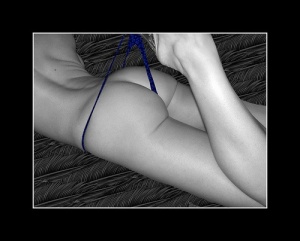
Cindy and that sexy thong. by Dave Lee via flickr


When women choose to earn their living from their bodies

Women who model for Victoria’s Secret do so of their own free will, and are well paid for their work. Likewise the women who appeared in the West clip as simulated corpses and zombies.

The luscious woman in the Gold Coast real estate agents’ ad was also, presumably, paid for her work. Many women with lovely bodies enjoy using them as a source of income. Many other women and men enjoy looking at those bodies. Is this really “objectifying” women? Or is it merely admiring, and maybe sometimes envying their beauty?

I’m not likely to meet any of them. They are likely to remain only one-dimensional images to me. So why do I have any responsibility at all to see them as anything else? Why is it wrong for me to take pleasure their beauty? How am I offending them?

If I were to treat the women and men around me as one dimensional, then I would be objectifying and insulting them. But like most people, I know the difference between an image and a fully fleshed human being.

There are some who try to make the people in their lives more closely resemble a one-dimensional image they’ve seen on screen or in a magazine. Their problems, and the problems of their partners, won’t be solved by banning the images. I’d suggest their difficulties are deep, and if no images are available they’ll manifest in some other equally unfortunate way.

The desire to be desired

The desire to be desired is a normal human need. Practically everyone at some time wants, indeed needs, to bathe in the glow of somebody’s desiring gaze. But desire and its expression and representation are intensely personal matters. Lacy panties or cottontails, stilettos or bare feet, cleavage or buttoned up modesty – there’s a place for everything, but not in the world of Melinda Tankard Reist. In that world there’s only one possibility for the expression and representation of desire, and that’s hers.

Baffled by her negativity, I’m as yet entirely unable to ascertain what her vision actually consists of. Though she unrelentingly castigates us for our unhealthily fetishistic and voyeuristic gaze, I’ve never once heard MTR give an example of how she thinks female sexuality ought to be represented and expressed.

We should pretend we aren’t sexual beings, and deny that we love to look at each other, even though much of the time society requires us to do that with a furtive gaze?

We should pretend that erotic zones are not of intense interest to us, starting when we emerge from the latency period laughing ourselves silly at jokes about underpants?

If every publicly revealed body is an exploited and objectified body, are we all to cover up to protect ourselves from a gaze that MTR would have us believe can only be interpreted as exploitative and objectifying?

The battle for the control of the representation of desire

by Breezer, via flickr


MTR is fighting a two fronted battle for  the right to determine not only what we should look at, but how we should look at it. She wants to be inside our heads, telling us how to see things. Where she see exploitation, so must we.

She wants to control the representation and expression of human desire. She wants to control the interpretation of the gaze.

MTR seeks to superimpose her moral vision upon everyone else, a vision that cannot allow the possibility of a benign desiring gaze, a vision that insists the desiring gaze is always dangerous, unless it is confined to encounters between to consenting adults (preferably married) in the privacy of their own homes. Once desire is provoked outside of the marriage bed, her thinking goes, it must inevitably result in damage of some kind. I have long suspected this to be at the heart of MTR’s crusades. Now she’s proved it, by taking on Victoria’s Secret.

In her vision, the free flow of desire in the world, far from being a driving creative force, is miserably reduced to a threat to women.

This is why MTR does not offer her vision of an acceptable public representation of female sexuality. There isn’t one in her moral framework.

In this, she’s a bit like the followers of Sharia law.

But feminists fought for freedom

MTR and her followers justify their desire to impose their desire, by dressing their arguments up as feminist rhetoric, and indeed there are some conjunctions.

But feminists fought for freedom. If a woman chooses to use her body to earn her living then it’s nobody’s business but hers. Melinda Tankard Reist makes an unfortunate conflation between free choice and exploitation. That exploitation and abuse of women exists is not at issue. However, it does nobody any good to confuse the two, and in the process attempt to shame women who are making a free choice, and attempt to deprive them of that right. That’s an anti feminist move, in my book.

The argument that we’re brainwashed to think we must do our best to look like underwear models or we’re inadequate, holds some water. There’s a great deal to critique in fashion magazines that manipulate insecurities in order to get us to go out and buy something to address those perceived failings.

On the other hand, one of MTR’s fellow campaigners, journalist and researcher Nina Funnell, whose tirade against the KanYe West video can be read here recently took part in a Cosmopolitan (October 2010) competition to find the year’s most influential woman. All the competitors were young, and had the Cosmo look, including killer heels, and sexy masks. There were obviously initial selection criteria that had everything to do with the contestant’s physical appearance. Only after those requirements were met, were the women’s career and personal achievements considered.

There were no older women in the contest, baffling, given that older women are often excellent mentors and influential figures.

In my book, an outrageous and insidious abuse and objectification of women right on our doorstep, sending the message that how you look matters much more than what you do and are, from a magazine read by thousands of young Australian women. Yet not a  murmur was raised in the MTR camp.

To wrap it up…

The Gold Coast tools are pretty funny, I thought when I watched their video clip on Melinda’s website. Their ad is so over the top as to be bordering on a spoof of using sex to sell. It wouldn’t make me want to buy their penthouse, so in that sense it’s an advertising failure.

Corset, Paris 1902. Unknown via Wikimedia

Corset, Paris 1902. Unknown, via Wikimedia

As for Victoria’s Secret well, good luck with that one. While the sight of stunning women in lacy thongs and balconette bras might not be everyone’s idea of beautiful or sexy, it is currently a dominant cultural expression of those qualities. Once the sight of an ankle did it for us, and who can forget the practically (in my opinion) only good bit in Jane Campion’s The Piano, when Harvey Keitel caressed Holly Hunter’s leg through a hole in her stocking? Aaaargh, the recollection can make me shiver with delight even now.

Feminist Christian reproduces sexualised images of children on website.

15 Jan
Vogue magazine cover, May 1917

Image via Wikipedia

It’s a complete mystery to me how those demanding the removal of sexualised images of children from the media can justify reproducing those very images in their campaigns.

For example, on the website of Melinda Tankard Reist, Australian feminist Christian advocate for children and women, there’s a series of images reproduced from French Vogue depicting very young children wearing adult clothing, shoes and makeup. Some of them are suggestively posed in sexually suggestive environments.

The point of the post is to cause outrage in readers at these sexualised images of little girls. In order to do that, I suppose their argument goes, readers have to be able to see them.

But there’s something awry about this reasoning. You don’t want these images viewed, you think it’s wrong that they are readily available in the media, and yet you reproduce them on the Internet to make a point?

You disseminate these images yourself, while at the same time railing against their publication in other arenas?

What is going on here?

I wouldn’t like any little girls in our family to be in this Vogue photo shoot. Then again, I wouldn’t like the little girls in our family to be in any Vogue photo shoot, even if they were covered head to toe and clutching soft toys. I want our little girls to do what little girls enjoy doing, and not what adults enjoy little girls doing. From what I’ve heard about photo shoots, they’re no picnic.

My first thought on seeing these pictures was, what were their parents thinking? Surprisingly, nobody addresses this aspect on the MTR website. It’s all Vogue’s fault. Well, it certainly is Vogue’s fault, but some adult caretaker allowed these little girls to do this photo shoot. Some adult caretakers allowed their charges to be transformed into sexualised commodities by French Vogue. As long as parents are willing and eager to offer their children up, somebody will be willing and eager to provide them with the opportunity.

It comes down to the individual. It’s a very personal matter. It’s about morality on a very intimate level, and this is where it has to be addressed, as well as more broadly as a media responsibility.

Perhaps Tankard Reist could have set a personal example by declining to publish the children’s photos on her website?

It would have made her post less titillating, and readers would have had to go find the photos for themselves. But at least it would have been one less publication of those dreadfully sad pictures, and one less exploitation of those little girls.

Tankard Reist criticizes the media for sexualizing children. But what she fails to realize is that she is part of the media. Her blog is on the Internet. Anybody, even the pedophiles she fears will be drawn to these images, can access her blog and see the pictures of the children she has published there.

I don’t think you have to be a parent to feel anguish for these little girls, or to feel a desire to protect them by refusing to perpetuate the circulation of these photographs.

What has happened to feminism that the end now justifies the means?

And doesn’t publishing these photographs make a mockery of their protests against French Vogue?

On the same website there’s a post critical of those who’ve published the names of the women involved in the Assange sexual misconduct allegations. Yet Tankard Reist, apparently without any awareness of what she’s doing, publishes an article by another blogger, in which the women are named!

Tankard Reist has now added her own name to the long list of people who’ve targeted the women by outing them on the Internet.

Then there’s an article by Clive Hamilton, failed Greens federal candidate, and Professor of Public Ethics at Charles Sturt University. Under the heading: Dymocks Bookshop: Porn Merchants? Professor Hamilton gives Dymocks a good old telling off for stocking a boxed set containing the first ten years of Playboy.  I can’t imagine what’s in them, and neither, apparently, can Professor Hamilton.

Call me picky, but I always think it’s a good idea to personally acquaint yourself with something, before you go on a public campaign to ban it.

MTR has kindly furnished an email address where you can send your objections to Dymocks about them stocking Playboy and acting like porn merchants.

Clive Hamilton is also a mandatory Internet filtering advocate, whose position is that while some legitimate websites would probably face accidental blocking by a mandatory blacklist, that’s a necessary evil, and that the good outweighs the bad.

Maybe it’s just me, but when I hear phrases like the good outweighs the bad, I get edgy. It sounds as if someone hasn’t really thought things through and they want to shut me up with a phrase designed to repress and suppress.

And who is Hamilton to make decisions for the rest of us? We have to take his definition of the good as a universal and filter the Internet? Non, merci.