Tag Archives: marriage equality

The profound nastiness of the Turnbull government

29 Aug

pyne box


It was inevitable that any opposition by the ALP or Greens to Abbott’s reeking legacy, the proposed plebiscite on marriage equality, would provide the Turnbull government with the ammunition to  claim (with confected indignation) that both parties are creating an obstacle that thwarts an opportunity for same-sex marriage.

There are bound to be those who accept this warped inversion, however they are likely to be the same groups and individuals that reject marriage equality anyway.

What this situation reveals yet again is the profound nastiness of the LNP. This nastiness (there really isn’t a better word for it, their attitude towards their fellow humans is as base as that) has been evidenced in Treasurer Scott Morrison’s decision to deprive the unemployed and pensioners in order to fix his budget, and the vengeful exercise of raw power as illustrated by Peter Dutton’s ongoing implacability over asylum seekers and refugees. It’s reflected in the image that heads this post: even the dead are perceived as new sources of revenue for the LNP.

I don’t need to go on, the evidence of their nastiness is everywhere we look, and it multiplies as we sleep.

Nastiness is the Turnbull government’s default position. From the apparent banality of nastiness all manner of evils flourish, and if you ever doubted that it is being enacted daily, for you to witness, in our parliament.

Though the Northern Territory can’t be ever be taken as typical, the carnage wrought on the CLP this weekend gives me small hope. Citizens can become sickened by nastiness, and they can wreak havoc on the party of nasty when they’ve had enough.

There is not one rational reason to deny marriage equality. We are a secular state: religious arguments ought not to influence our decisions. The unholy alliance of religion and nastiness currently hold sway.

It’s my hope that the ALP hold out against a plebiscite. No Liberal MP has any obligation to honour a yes result. Those who touchingly believe a plebiscite =marriage equality need to disabuse themselves of that belief, because it does not. We could well go through the torturous process and still have necessary amendments to the Marriage Act blocked by MPs who are not bound to accept a yes vote.

At the heart of the demand for a plebiscite is nastiness, and a poisonous hatred for anyone who doesn’t fit a narrow definition of “normal.” The influence of pure nastiness has been overlooked in our arguments yet it is a powerful driver of irrational behaviour and you’d have to go a long way to find behaviour more irrational than that of Turnbull’s government in just about any area you can name.

There are rumours again that Abbott is preparing himself to challenge Turnbull’s leadership. Not only are they nasty to citizens, they are exceptionally nasty to one another. I would take great pleasure in watching the LNP continue to cannibalise itself. I doubt it would affect our governance to any great degree: they aren’t doing much of that anyway.

It’s my hope that the fate of the NT CLP is the Turnbull government’s future. Barely enough seats left to form a party? I’d go for that.


The Marriage Act: what is it good for?

30 Jun

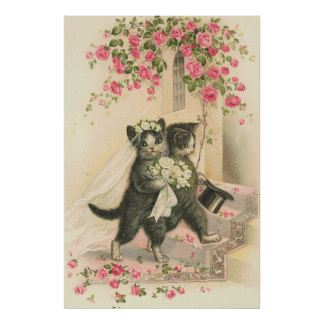
vintage_cat_bride_and_groom_wedding_poster-rb775e43b418c4418bb91943fdadaf714_wvg_8byvr_324


In 2004, the Howard LNP government amended the Marriage Act of 1961 to read as follows:

Marriage means the union of a man and a woman to the exclusion of all others, voluntarily entered into for life.
Certain unions are not marriages. A union solemnised in a foreign country between: (a) a man and another man; or (b) a woman and another woman; must not be recognised as a marriage in Australia.

Then federal Attorney-General Philip Ruddock introduced the amendment in order to prevent any legal challenges to the concept of marriage as a solely heterosexual institution.

It would be useful if religious organisations opposing marriage equality took note of the origins of this amendment. It did not come from god. It was authored by Philip Ruddock and John Howard.

Then Greens leader Bob Brown described the amendment as “the straight Australia policy.”

There was no plebiscite held on the amendment, and no referendum.

I have yet to be convinced that the state has any role at all to play in the voluntary unions of its citizens, and would prefer to get rid of the Marriage Act altogether rather than just the 2004 amendment.

As it stands, the Act is discriminatory and has no place in a just society. It privileges traditional heterosexual marriage, an institution that functions more in its idealisation than its reality, and whose many and massive failings remain largely unexamined.

We do not need the state to define and control our expressions of love. Of all the situations in which we ought to be able to act with agency and autonomy, this must surely be the most fundamental. All citizens are entitled to enjoy this agency and autonomy, regardless of whom we love.

The fight for marriage equality is also the fight for everyone’s freedom, and our right to live without state intrusion, definition  and control of the most deeply intimate aspects of human life.

Do you really want politicians deciding what marriage is?


Christian Lobby claims it needs hate speech to argue against ssm

16 Feb

ssm


In a new and bitter twist in the ongoing debate about the plebiscite we’re having because politicians lack the courage to do the job they were elected to do and just change the damn marriage laws, Lyle Shelton, managing director of the right-wing fundamentalist Australian Christian Lobby, has now called for anti discrimination laws forbidding hate speech against LGBTQI people to be relaxed, so that his tribe can argue the “no” side in the same-sex marriage plebiscite without fear of legal action being taken against them.

It’s difficult to know where to start deconstructing the bigotry of this: a Christian lobby group is demanding the right to use, with impunity, what the law defines as hate speech to argue its case against same-sex marriage.

If any group needs access to hate speech in order to argue its case about anything, it obviously has no case. The very request for impunity from the law is all the evidence needed to demonstrate that its case is already illegal, before any argument is embarked upon. However, Shelton argues that anti-discrimination laws have “such a low threshold,” anything the no side argues will make them vulnerable to the constant threat of legal action.

Shelton intends to use what he describes as “the millennia-old argument” that marriage should only be between a man and a woman. Millennia-old arguments are not the best place to start when debating a point of view: they can be refuted in seconds, and besides, before proceeding with such an argument the proponent must demonstrate why longevity is an argument for anything.

I’m not a fan of marriage, however, it is currently a powerful institution and every man and woman who wants to live in that institution has the right to do so, regardless of sexual orientation. Shelton, et al, are arguing for their religious ideology. They have now admitted that they can’t make that argument without employing bullying, and discrimination. This, to me, says their religious ideology is tyrannical, as is their determination to inflict their views on those of us who do not wish to be subjected to them.

I don’t think Shelton has a hope of having anti-discrimination laws relaxed to enable him to use whatever speech he likes to argue against marriage equality.  However, the upside of this unforeseen aspect of the debate about how we should run the plebiscite debate before we actually get to debating the plebiscite, let alone voting on the most unnecessary plebiscite EVAH, is that it demonstrates as nothing else can, the bigotry and tyranny of the no faction.

It also demonstrates the level of stupidity with which we are dealing, and it isn’t all on the ACL side.

Marriage equality: what is it good for?

8 Dec

Marriage Equality

I realised during an enthusiastic debate on Twitter yesterday with @amicus_AU and @chronicfemme on the question of marriage equality, that apparently both ends of the continuum fear that same-sex marriage will result in an apocalypse for their cause. Marriage conservatives fear equality will bring about the death of marriage in an inexplicable metaphysical erosion of heterosexual values, while some in the queer community fear it will bring about the death of queer, as queer couples reject the radical demand to abolish state-sanctioned commitments altogether, and instead seek acceptance within the heteronormative paradigm of marriage.

The marriage equality debate inevitably becomes conflated with the debate about the institution of marriage, which is unfortunate, to my mind. They are two separate and equally important issues, and neither is done justice when they are intertwined.

Nobody wants the state in their bedroom. It is not the state’s business whom one chooses to marry, or live in a de facto relationship with. At the same time, when such arrangements break down, there must be protections in place for the wellbeing of vulnerable parties, usually women and children under current arrangements, who are likely to come off second best in serious matters such as property settlements, child support, access to a parent and all the other miserable detritus that commonly litters the personal landscape when things go wrong.

Humans being what we are, and being even more what we are in times of relationship breakdown, many of us cannot be trusted to behave reasonably when we are in the grip of extreme emotion provoked by the collapse of hope and future and the losses involved. We need laws at these times, and state-sanctioned relationships provide us with these laws.

If the argument is for no state involvement at all then we cannot argue for recognised de facto relationships either, as these are also governed by the state at times of breakdown, though not in precisely the same way as is marriage.

If it is heteronormative for queer couples to marry, is it also heteronormative for them to be covered by the protections offered to de factos?

Are queers arguing against marriage equality actually arguing that creating a couple is heteronormative? This is to my mind an interesting argument, and one that takes us into the fascinating territory of theories of constructed desires, et al, however, in practice as a society we have to contend with coupledom and its consequences for the vulnerable being currently rather more in our faces than theories of desire, and requiring our urgent practical attention.

Which is not to say people shouldn’t think about these things if that is our inclination, and radically interrogate entrenched norms.

I’m at a loss to imagine a system of relationship in which the state is not involved. It cannot be left up to individuals to fairly sort out the messes that occur when intimate relationships break down. Therefore, it is absolutely unjust for that protection to be denied to couples other than the heterosexual. There is simply no valid argument to deny marriage equality: every human being is entitled to the same protections, regardless of sexual orientation.

If you don’t “believe” in the state having anything to do with your relationship, don’t call upon its laws to protect you if your relationship breaks down. Find a radical new paradigm, rather than simply calling for our current arrangements to be abolished. I haven’t heard or read any discussion of viable alternatives that can achieve what state intervention achieves when marriages and de facto relationships collapse, and people have to salvage what they can of their lives and the lives of any children involved.

As for the supernaturally destructive powers invested in marriage equality by opponents of all kinds: if your ideology is so fragile that people loving each other in the manner they choose is going to destroy it, maybe it’s time to find a new ideology?

Marriage, equality, and the sentimental

20 Apr

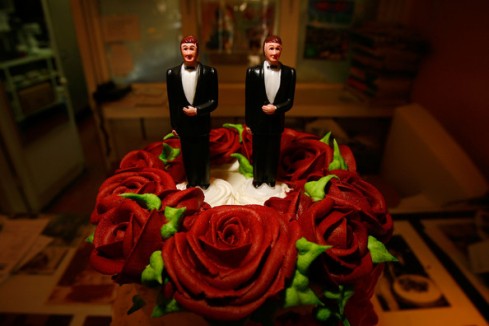
DO YOU KNOW WHAT I HATE MORE THAN RAINBOWS IT IS PICTURES OF TWO WHITE PLASTIC MEN ON TOP OF A FUCKING CAKE. Helen Razer, April 19 2013.

Gay wedding cake

Razer’s tweet caused me to reflect on sentimentality, what it is, and just how much it has to do with our society’s attachment to getting married. It seems to me that rainbows, and cakes such as the above, symbolise easily accessible emotions and contribute to a wider cultural inclination to substitute such emotions for critical thinking and reason. This isn’t peculiar to same-sex weddings: there seems to me to be a strong element of the sentimental in the very nature of weddings, no matter how “tasteful.” Which, of course, can be half the fun, but just how much does that aspect blind us to the faults of the institution?

“Sentimental” is in current usage a pejorative term, though it was not always thus. The sentimental is considered shallow, excessive, spurious, dishonest, false, and mawkish. It is emotion devoid of reason and critical judgement, indeed the sentimental stands accused of privileging diluted and short-lived emotional experience over logic to such a degree, that ethical and intellectual judgements that ought to be applied to a situation are abandoned in favour of the thrill of a temporarily heightened state.

In a sense, the sentimental has served to obfuscate the debate we have to have, which is about the institution of marriage itself, and redirected our attention and energies to the question of marriage equality. I don’t think anyone can deny the presence of the sentimental in this dispute, and perhaps the wonderfully excessive Maori wedding song sung by that joyous group in the New Zealand parliament the other day is an indicator of the rush of heightened emotion associated with all weddings, but especially so when those weddings have been forbidden and are now sanctioned. We don’t think about the failings of the institution, and how it functions in society, so carried away are we by the uncomplicated thrillingness of the romance of it.

I have to say here that as long as we have marriage in our culture and remain in its thrall, there is no question but that it ought to be available to everyone who desires it and is of an age to consent. Forbidding a group of people what they very much want to have  while it is freely available to everyone else, simply on the grounds that they have the same genitalia, is absolutely wrong, and counter productive. The marriage equality debate brilliantly demonstrates how we are distracted from arguing the deeper considerations of the ethics of the institution itself.

No one who wants to marry and is prevented by our laws from doing so, is going to want to start questioning the institution from which they are unfairly excluded, because the exclusion and the desire to be admitted will take precedence. I don’t believe we will be in any position to seriously challenge marriage until it is available to everyone, and the dust of the fight for equality has settled.

Rainbows, hearts, and plastic gay or heterosexual couples on excessive confectionery, can be read as symbols of the sentimental, signifying  a dominant aesthetic of sentimentality that obscures the deeper questions and feelings, and quite rightly thoroughly aggravates observers such as Razer who rail against our collective willingness to settle for the sentimental, and allow it to dull our judgement and reason. Judgement and reason ought to cause us to first think critically about this institution we are celebrating: sentimentality seduces us into settling for the heightened emotion that inevitably surrounds the desire of two people to commit themselves to lifelong state-sanctioned monogamy. Sentimentality is strongly present in that desire: the desire is, I would argue, not born of logic and reason, and it is perhaps not particularly ethical either, unless qualified as an intention, rather than a vow.

I recall a wedding a few years ago, non-religious, colourful and casual, pretty much your north coast upmarket hippy event, and a lot of fun. After the couple exchanged their vows, a friend standing next to me said in a voice that was much louder than she’d intended, owing to a sudden lull in the celebrations, “Well, it’s all down hill from here.” The bride and groom looked aghast. I dug her hard in the ribs with my elbow. “Well, it’s true,” she hissed at me defensively. “I know, but you don’t have to bloody well say it,” I hissed back.

All the weddings I’ve attended have been joyful, including both of my own. But there has been a great deal of sentimentality associated with them and more, with the idea of them. Personally I’m very taken with the love and hope that cause two people to throw their lot in together for life. I suppose that’s why I’ve done it twice and would probably do it again, because third time lucky and anyway I’m closer to death than I was the first two times.

The impulse to fidelity and mutual trust seems to me a worthy one, however I think I would add “To the best of my ability” or “I’ll do my very best” next time, because one never knows what’s ahead, and reason and logic suggest vows are sentimental in their very nature, and therefore untrustworthy.

Then there is the question of the regulation of the expression of emotion. It makes people very happy to marry one another at the time, and on the whole. It usually, one hopes, makes their friends and relations happy as well. Who has any right to deny others this happiness, even if the aesthetics and politics of it are not to one’s taste?

Yes, the institution may be a flawed foundation stone of a conservative agenda. Yes, conservatives love marriage because they love what they consider family. There is actually nothing in the least bit wrong with loving family, it is the traditional conservative notion of what a family consists of that is at fault here.

That the state has no business deciding who may or may not marry is a given. The fact that our Prime Minister does not approve of marriage equality ought to be of no consequence to anyone other than Ms Gillard herself. Nobody will make her marry another girl. It is remarkable to me that Ms Gillard, herself living in a de facto relationship, continues to take this obstructionist stand against marriage equality. Apparently marriage is not an institution she values for herself, yet she is perfectly willing to deny it to others on the spurious grounds that it is supposed to take place only between a man and a woman.

It is not so very long ago that Ms Gillard’s de facto relationship would have made her  occupation of the Lodge an impossibility. The Prime Minister has much to be grateful for. Society’s changes have worked to her great advantage. Why then, does Ms Gillard persist in denying these same advantages to others? I’m certain her stand has little or nothing to do with the sentimental.

rainbowA very sentimental rainbow but at least there is no unicorn

Make my day…

9 Jun

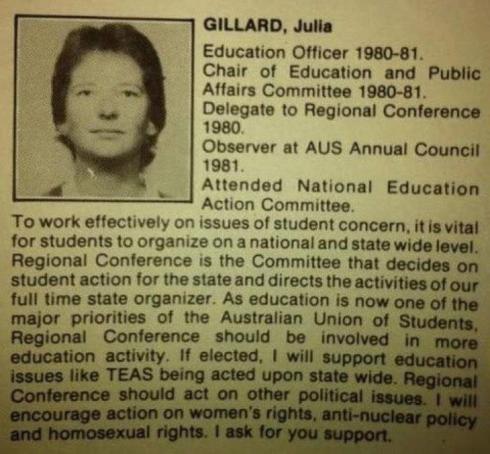
Back when the PM supported gay rights…

3 Dec

Reclaiming marriage from the great big Christian hijack

10 Feb

This essay was first published by Graham Young in On Line Opinion, December 2010

In view of the scare tactics employed by the Australian Christian Lobby in their new petition to prevent the legalisation of gay marriage, it seems timely to publish it again.
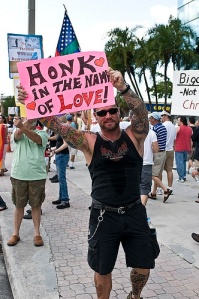
by Danny Hammontree via flickr


Judging from the flurry of articles that have appeared recently written by Christians against same sex marriage (as well as same sex adoption, in which many similar religious justifications are invoked) one can be forgiven for thinking that many Christians believe their god invented the institution.

This could not be further from the truth. Marriage has existed a whole lot longer than Christianity. The Chinese philosopher Confucius, born in 551 BC, offered this delightful definition: “Marriage is the union of two different surnames, in friendship and in love.”

Indeed, there is considerable historical evidence that in Greece, Rome, China and Europe same-sex marriages were celebrated along with the heterosexual unions deemed necessary either for economic purposes, or for men to ensure (they hoped) the parentage of children.

For a period in our history marriage had little to do with romance and love, and much to do with economic and physical survival. The spiritual and emotional dimensions of marriage that many Westerners feel are at its core are relatively recent developments.

Christians imposed their beliefs on an institution that was already long in place, and called this fallacy god’s will. Instead of acknowledging that Christian marriage is but one example of that institution, they appear to deny validity to any other and thus attempt to reify their singular take on the concept.

So successful has this reification been that there are people who want to marry in churches, even though they never set foot in them before or after the ceremony. Many people feel an understandable desire for their marriage to be “blessed,” and there’s no doubt the Christian ritual can be quite beautiful.

I’ve no wish to throw the baby out with the bathwater.

But people marry for all kinds of reasons. For example, it’s estimated that some 200,000 marriages per year take place in the United States expressly for the purpose of obtaining a Green Card for the spouse who is not a US citizen. There are marriages made in Australia for the same pragmatic reason. These unions apparently disrespect the Christian god’s purpose for marriage, and ought to cause offence to believers. However, they don’t appear to be anywhere near as offensive to Christians as are same sex marriages, chosen on the basis of love, and the desire for commitment and family.

On the other hand, marriage between blacks and white in the US southern states (miscegenation) was illegal until 1967. Not only did the Christian god demand that marriage only take place between a man and a woman at that time, apparently he needed them to be the same skin colour as well.

It took that country’s Christians some 276 years to overthrow that particular racist injustice.

Christian beliefs about marriage change, as the above example demonstrates. Presumably, this is as a consequence of god changing his mind, and somehow relaying that change to the faithful who then update the law.

But what a truly intolerable state of affairs, that the lives and futures of many same sex couples are at the mercy of the arbitrary decisions of a transcendental exteriority that many citizens don’t believe exists at all, or not in the form touted by Christians.

This state of affairs is undemocratic. It breaches the human right to have freedom from religion as well as to have freedom of religion.

As some 60% of Australians are in favour of same sex marriage, it is puzzling that the two major parties continue to believe they can afford to ignore this majority. One can only conclude their mutual fear of offending the religious vote is stronger than their fear of offending the 60%, who they probably assume will not rate this issue highly on their wish lists of what they want governments to change.

One person’s god is another person’s superstition. Christians are not renowned for their democratic principles when it comes to the many varieties of spiritual practice at work in the world. Who can forget the scary tale of Mother Theresa baptising dying Hindus who were too ill to protest?  An act of spiritual terrorism by stealth if ever there was one.

The problem with many believers (not just Christians) is that their belief prevents them from respecting another person’s point of view. Non- believers are dismissed as simply wrong headed. They’re on their way to hell in a handcart, and they will be sorry when they get there that they didn’t listen when they had the chance.

There’s no reasoning with this mindset. Once you come up against the tunnel vision of implacable belief (often known as “faith”) you’ve come to the end of the discussion, and all that’s left to do is to walk away.

Then there’s the question of Christian credibility. The churches currently have a very bad reputation to overcome. The appalling incidence of sexual, physical and emotional abuse of children in their care, and the equally appalling attempts to cover up and deny these abuses, have gone a long way to undermining the churches’ credibility in any thinking person’s mind.

It was Jesus who said “It were better for him that a millstone were hanged about his neck, and he be cast into the sea, than that he should offend one of these little ones.”

Yet while ordinary Christians are more than willing to speak out against same sex marriage and same sex adoption, among many other issues of which they disapprove, they are bone-chillingly silent when it comes to protesting the evils perpetrated in their own back yards. Has there ever been a better illustration of Burke’s maxim “All it takes for evil to flourish is for good men [sic] to remain silent?”

Perhaps what is required from Christians these days is a little humility. An acknowledgement that they haven’t got everything right, indeed there are things they have got horrifically wrong, and that there is a collective as well as an individual responsibility for this that must be addressed before they can legitimately turn their rigorous attention to the maintenance of a broader human morality.

If I were imagining a god, she/he would care a whole lot more about believers destroying the bodies, hearts and souls of children than about preventing same sex marriage, and same sex adoption. If my god was going to smite anybody, I hope she/he would be smiting the perpetrators of those crimes against children, and those who enabled and protected those perpetrators and denied their crimes. I hope she/he would take positive action to enlighten those who would deprive children of love and legal security, solely because these people are unable to personally deal with the concept of love between same sex partners.

My god would teach that loving one another is the only thing that matters, and from that all else will grow.

She/he would also be smart enough to admit that loving one another is the hardest thing we’ll ever have to do on this planet.

“Love one another. As I have loved you, so you must love one another,” said Christ.

“We must love one another, or die,” said the poet, W.H. Auden.

“If I speak with the tongues of men and of angels, but do not have love, I have become a noisy gong or a clanging cymbal,” warned St Paul.

It’s time to reclaim marriage from the Christians. They can’t claim it as their own. It belongs to everybody. Marriage in Australia in 2010 is about loving one another, whatever gender the other happens to be. It is about hope, and deeply good intentions. It’s about wanting to be the best a human being can be. It’s about wanting to create a living, breathing mystery, day by day, with the person you love and who loves you.

It doesn’t always work. Hearts get terribly broken. We dust ourselves off, and sometimes have another crack at it, because we are very brave, and we are full of hope, and we have a vision of enduring love that keeps us going, no matter what form our marriages take, or even if they end.

We do this whether we are Christians or not. We do it because we are human beings who at our best are capable of living out these wonders regardless of gender, and oftentimes in spite of the difficulties gender can create for us.

I’m perfectly happy to let Christians conduct their marriage ceremonies according to their beliefs. And every other religious group as well. They don’t have to celebrate same sex marriage in their own places of worship if they don’t want to. This is one of the freedoms our democracy guarantees. I don’t wish to take that freedom away from Christians or any other religious group.

But what no democratic government should tolerate is Christians, or any other religious group, defining marriage and dictating its practices in this country. Government decisions must not be based on religious belief in our pluralist society. They must be based on what is fair, what is just, and what is non-discriminatory. Democracy is inclusive. Christianity, sadly, increasingly demonstrates that it is not.

Same sex marriage and same sex adoption are not dangers from which governments need to protect us. But the tyranny of religions destroying anybody’s democratic rights to these things, most certainly is.