Tag Archives: Julia Gillard

Men who hate women are everybody’s problem.

13 Jun

It’s no surprise that there dwell among us packs of males, whose feelings about women are so conflicted that while outwardly conducting apparently reasonable relationships with females close to them, they display the most base hostility to women they perceive as different, and in some way dangerous.

It also comes as no surprise that this hostility is expressed in sexual terms. Our breasts and our genitals serve as a focus for the fear and hatred felt towards us by some men, all of whom have mothers, some of whom have wives and female lovers, many of whom have daughters and sisters. Our body shapes and our faces are also the focus for this hatred, and our physical characteristics are almost always the first object of complaint when such a man feels himself provoked by something we have or have not done.

What ought to really terrify us, apart from the frequently repressed fear of going about our daily lives amongst these marauding packs, fear we must repress or we’ll never get out of our front doors, is that some of them will likely soon form the government of this country.

The Prime Minister, Julia Gillard, has served as a lightening rod for woman hatred , but anyone who thinks it’s only about her needs to think again. Any one of us who crosses any one of those men will be treated in exactly the same way, because that is what they do. They have no idea how to do anything else, and they don’t care to find out.

These men, and the women who support them, will have control over an array of legislation that directly affects women in terms of our reproductive health, and child care, for example. If the ALP defeat is as catastrophic as is forecast, there will be little in place to curb their enthusiasm for controlling our lives. We must not have men who hate us and the women who support them, wielding such power over us. Read this piece, by Lenore Taylor, on the possibilities.

This is Tony Abbott’s statement on abortion

If the last few days of ugliness have shown us anything, it’s that there are men who hate women and women who will make excuses for them, fast heading into a situation where they will have an alarming degree of control over our bodies and our lives.

I know there are men who are disgusted and repulsed by the attitudes and actions of some of their fellows. You have to speak up. This is not just a problem for women. Anything you can do and say. Whenever you can do and say it.

It is a bizarre and isolating feeling, to live in a body that can be so vilified simply because it is female. The slurs may be directed against Ms Gillard in these latest instances, but they threaten every woman. Everyone needs to take a stand against those men who need to belittle women, in order to feel good about themselves. It isn’t fun. It isn’t just a joke. It’s a sick and perverted masculinity.

Come September,vote with your reason not your emotions

11 Jun

Of all the scurrilous campaigns conducted by the Federal Opposition, and maniacally propagated by almost all the mainstream media, the erroneous suggestion that we vote for a leader when we elect a government in this country has to be one of the most dangerous.

Dangerous because it deliberately disguises the manner in which our Westminster political system actually works. We do not elect our leaders. We elect a party that is entirely responsible for electing its own leader. As we know all too well, a party can sack their leader, without consulting us, at any time.  Had any of us been in any doubt about this, it was made graphically obvious when the ALP defenestrated Kevin Rudd in  his first term as leader, and after he’d led them to an extraordinary victory.

Be that as it may.

I’ve heard and read of many people vowing that if the ALP now defenestrates Prime Minister Julia Gillard, they will never vote Labor again. While I can fully sympathise with this enraged despair, an expression of powerlessness if ever there was one, at the same time it is alarmingly nihilistic, and the country can ill-afford dramatic gestures at this point in our politics.

The ALP needs to get its house in order and earn back the trust it squandered with heart-stopping recklessness since 2007. It may well be doing this from the Opposition benches. Things may well have got so bad there really is no hope of them retaining government, no matter who leads them. But disillusioned as many of us are, we have to do our bit and use our heads, not our hearts. If there is any chance at all of minimising a Labor defeat, we have to take it. The alternative, a coalition government led by Tony Abbott, likely in place for decades, is simply too appalling to contemplate.

The notion that we vote for our leader is part of the Opposition campaign, which relies almost entirely on disseminating false information through the use of simplistic   narratives. The degree to which it has taken hold in the electorate is shocking. That we behave and vote as if we live in a presidential electoral system reveals a vast and profound ignorance of our reality, an ignorance the Opposition and certain sections of the media manipulates and exploits to its own advantage.

No matter how pissed off you are with those in the ALP who have brought us to this, look first to who is standing in your electorate, not to who will or will not be, temporarily, the leader. I know they don’t deserve our trust. But nobody deserves decades of a Coalition government, while the ALP languishes in greatly reduced numbers, as ineffective in opposition as they have been in dealing with their internal strife.

Come September, vote with you reason, not your emotion. And that way, perhaps the damage can be minimised.

From Woomera to Manus: 12 years of state brutality in exchange for votes

2 May

I have beside me on my desk the transcript of ABC Four Corners, May 19 2003. This is the link to ABC Four Corners, April 29 2013

The transcript I’m currently reading is that of reporter Debbie Whitmont’s investigation into the secrecy surrounding the conditions at the Woomera Detention Centre.

Whitmont is also the reporter on the April 29 programme, an investigation into the secrecy and the conditions at the Manus Island Detention Centre.

Excerpts, 2003 transcript

80% of those detained [in Woomera] were found to be genuine refugees and given temporary visas. Many who worked at the centre say they were pressured to stay silent about what they saw and did. It is only now that the full story is starting to be told.

Alley Crace, Welfare Officer [at Woomera] 1999-2001: Just basically, I see the compound all the time. I see hundreds and hundreds of people begging and crying, and I see people dehydrating in the sun. I see people with sewn lips and buried in the ground, cause that’s what they did. I see people slashed up and cut their throats and their arms.

Phillip Ruddock, Minister for Immigration (Howard Government): It is not a holiday camp nor should it be seen as one.

After a riot at Woomera, detainees were put in lock down. Psychiatric nurse Peter Ostarek-Gammon, who worked at Woomera during 2000-2001 and witnessed the aftermath of the riot:

Yeah, well, there was a lot of anger from the officers and the management, a lot of anger directed towards the detainees. In fact, some of them were not just locked into their dongas, but they were drilled in. The doors were drilled closed. I did see that, yeah. Another nurse and myself actually had to visit one of those guys one day and they had to get an electric drill to open the cabin. 

Debbie Whitmont: Four Corners has obtained the computer records of thousands of official reports written by Australian Correctional Management (ACM) [who ran the centre at the time] and given daily to the Department of Immigration. They document the relentlessness of hundreds and hundreds of self-harms and suicide attempts. Like this boy, who smashed his own head with a rock. And this fourteen-year-old girl who saw him do it cut herself and told staff she was frustrated with the Department of Immigration.

After repeated attempts by staff to assist and protect a 12 year-old Iranian boy who was being sexually assaulted, Alley Crace tells Whitmont:

At that stage, I was told that because the people had no identity and that they weren’t actual people in Australia, there was no need, or necessities to report to Family and Community Services – as in FACS.

During the time of the Four Corners investigation, some detainees were on a hunger strike. Whitmont spoke to one of them:

He tries to explain that the detainees have nothing left to use but their bodies to plead their desperation.

Man: We are crying, we are screaming. And we are all “What to do?” We have nothing. This is what you want? This is Australia say to us? Please help us and listen as we are suffering inside. We don’t want to make any rampage. We don’t want any things to do this. (Sobs) We all came from bad condition. We want help.

Sydney Morning Herald, Tuesday 13 May, 2003

Children locked up in Australia’s immigration centres have the highest rate of mental illness ever recorded in modern medical literature, according to a new study. 

The study found each of the 20 children surveyed had at least one psychiatric illness with more than half suffering major depression and post-traumatic stress disorder…

Dr Zachary Steel, [from the University of NSW’s School of Psychiatry] said the findings showed detention centre were not the place for children. 

The above events took place during the Coalition government of John Howard. Since then, we’ve had a change of government. Now identical events are taking place under the Labor government of Julia Gillard, this time off-shore, more secretly and less accessibly.

Politicians of both major parties have continued to brutalise, scapegoat  and illegally detain, in shocking conditions, those who have arrived here by boat, requesting asylum.

Communicate with your local member and let her or him know this is unacceptable to you. The only way this will change is if politicians believe there are more votes in behaving humanely, than there are in brutally abusing arrivals.

This is what it boils down to. Votes. This is a very frightening comment on the type of people who run this country, no matter what their political allegiance.

Marriage, equality, and the sentimental

20 Apr

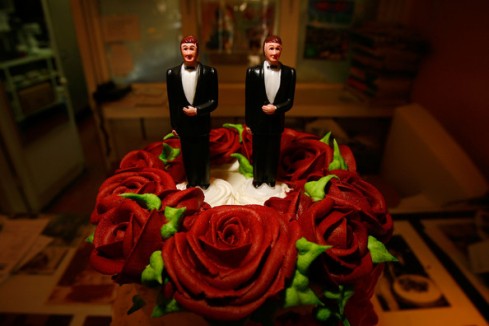
DO YOU KNOW WHAT I HATE MORE THAN RAINBOWS IT IS PICTURES OF TWO WHITE PLASTIC MEN ON TOP OF A FUCKING CAKE. Helen Razer, April 19 2013.

Gay wedding cake

Razer’s tweet caused me to reflect on sentimentality, what it is, and just how much it has to do with our society’s attachment to getting married. It seems to me that rainbows, and cakes such as the above, symbolise easily accessible emotions and contribute to a wider cultural inclination to substitute such emotions for critical thinking and reason. This isn’t peculiar to same-sex weddings: there seems to me to be a strong element of the sentimental in the very nature of weddings, no matter how “tasteful.” Which, of course, can be half the fun, but just how much does that aspect blind us to the faults of the institution?

“Sentimental” is in current usage a pejorative term, though it was not always thus. The sentimental is considered shallow, excessive, spurious, dishonest, false, and mawkish. It is emotion devoid of reason and critical judgement, indeed the sentimental stands accused of privileging diluted and short-lived emotional experience over logic to such a degree, that ethical and intellectual judgements that ought to be applied to a situation are abandoned in favour of the thrill of a temporarily heightened state.

In a sense, the sentimental has served to obfuscate the debate we have to have, which is about the institution of marriage itself, and redirected our attention and energies to the question of marriage equality. I don’t think anyone can deny the presence of the sentimental in this dispute, and perhaps the wonderfully excessive Maori wedding song sung by that joyous group in the New Zealand parliament the other day is an indicator of the rush of heightened emotion associated with all weddings, but especially so when those weddings have been forbidden and are now sanctioned. We don’t think about the failings of the institution, and how it functions in society, so carried away are we by the uncomplicated thrillingness of the romance of it.

I have to say here that as long as we have marriage in our culture and remain in its thrall, there is no question but that it ought to be available to everyone who desires it and is of an age to consent. Forbidding a group of people what they very much want to have  while it is freely available to everyone else, simply on the grounds that they have the same genitalia, is absolutely wrong, and counter productive. The marriage equality debate brilliantly demonstrates how we are distracted from arguing the deeper considerations of the ethics of the institution itself.

No one who wants to marry and is prevented by our laws from doing so, is going to want to start questioning the institution from which they are unfairly excluded, because the exclusion and the desire to be admitted will take precedence. I don’t believe we will be in any position to seriously challenge marriage until it is available to everyone, and the dust of the fight for equality has settled.

Rainbows, hearts, and plastic gay or heterosexual couples on excessive confectionery, can be read as symbols of the sentimental, signifying  a dominant aesthetic of sentimentality that obscures the deeper questions and feelings, and quite rightly thoroughly aggravates observers such as Razer who rail against our collective willingness to settle for the sentimental, and allow it to dull our judgement and reason. Judgement and reason ought to cause us to first think critically about this institution we are celebrating: sentimentality seduces us into settling for the heightened emotion that inevitably surrounds the desire of two people to commit themselves to lifelong state-sanctioned monogamy. Sentimentality is strongly present in that desire: the desire is, I would argue, not born of logic and reason, and it is perhaps not particularly ethical either, unless qualified as an intention, rather than a vow.

I recall a wedding a few years ago, non-religious, colourful and casual, pretty much your north coast upmarket hippy event, and a lot of fun. After the couple exchanged their vows, a friend standing next to me said in a voice that was much louder than she’d intended, owing to a sudden lull in the celebrations, “Well, it’s all down hill from here.” The bride and groom looked aghast. I dug her hard in the ribs with my elbow. “Well, it’s true,” she hissed at me defensively. “I know, but you don’t have to bloody well say it,” I hissed back.

All the weddings I’ve attended have been joyful, including both of my own. But there has been a great deal of sentimentality associated with them and more, with the idea of them. Personally I’m very taken with the love and hope that cause two people to throw their lot in together for life. I suppose that’s why I’ve done it twice and would probably do it again, because third time lucky and anyway I’m closer to death than I was the first two times.

The impulse to fidelity and mutual trust seems to me a worthy one, however I think I would add “To the best of my ability” or “I’ll do my very best” next time, because one never knows what’s ahead, and reason and logic suggest vows are sentimental in their very nature, and therefore untrustworthy.

Then there is the question of the regulation of the expression of emotion. It makes people very happy to marry one another at the time, and on the whole. It usually, one hopes, makes their friends and relations happy as well. Who has any right to deny others this happiness, even if the aesthetics and politics of it are not to one’s taste?

Yes, the institution may be a flawed foundation stone of a conservative agenda. Yes, conservatives love marriage because they love what they consider family. There is actually nothing in the least bit wrong with loving family, it is the traditional conservative notion of what a family consists of that is at fault here.

That the state has no business deciding who may or may not marry is a given. The fact that our Prime Minister does not approve of marriage equality ought to be of no consequence to anyone other than Ms Gillard herself. Nobody will make her marry another girl. It is remarkable to me that Ms Gillard, herself living in a de facto relationship, continues to take this obstructionist stand against marriage equality. Apparently marriage is not an institution she values for herself, yet she is perfectly willing to deny it to others on the spurious grounds that it is supposed to take place only between a man and a woman.

It is not so very long ago that Ms Gillard’s de facto relationship would have made her  occupation of the Lodge an impossibility. The Prime Minister has much to be grateful for. Society’s changes have worked to her great advantage. Why then, does Ms Gillard persist in denying these same advantages to others? I’m certain her stand has little or nothing to do with the sentimental.

rainbowA very sentimental rainbow but at least there is no unicorn

Elite feminism. Who is it good for?

1 Apr

This piece by Anne Summers on women in government sent me to Twitter with the question “Can Anne Summers explain to me the advantage of having a conservative female PM over a conservative male PM?”

There isn’t an answer to that question unless you are a fanatic, which Summers seems to increasingly become on the matter of Julia Gillard, and then the only answer is, vagina.

It might be worth noting that all the women ministers remained loyal to Gillard in the attempted coup on her leadership, Summers writes. Although a few female members of caucus supported Kevin Rudd (and were willing to be filmed with him while he spoke after the meeting where Gillard was re-elected unopposed), there were no women in the key group of plotters. Nor did any women resign as a result.

An act of double treason, then, that the females who supported Rudd were willing to be filmed with him as well? They should have hidden their allegiances, perhaps, not flaunted them, standing by his side?

Is this an example of gender solidarity, Ms Summers muses. Except of course for the women, (are they real women?) who legged it to Rudd’s camp. And how to explain that failure?

This is an aspect of feminism, increasingly dominant, that I find, well, I don’t think repulsive is too strong a word. It affects me viscerally, as is required of true repulsion. The concept that female genitals correlate with good governance is dangerous in so many ways I don’t even know where to begin. Surely such a gendered concept is one women have been fighting against for centuries now? Surely it is the very cornerstone of patriarchy? 

Just what these women in government are achieving for women not in government is not immediately clear. Indeed, for many single mothers the change to Newstart, for example, is nothing short of disastrous (so much for gender solidarity). I’m informed on Twitter when I voice objections to this obscenity, it was John Howard’s legislation.

This confuses me. We are supporting our first female Labor Prime Minister, even when she perpetuates John Howard’s policies?

The Gillard government’s record on asylum seekers? Makes me want Howard back. Same-sex marriage? ‘Twas Howard who changed the Marriage Act to prevent this, & despite her party supporting a reversal of Howard’s meddling to allow same-sex nuptials, Prime Minister Gillard will have no truck with it.

But that’s all right, because, vagina.

Of course women must participate in government, and at the highest levels. But why I am supposed to support women whose policies I despise, just because women, is beyond me. This “Rah rah ra! Women are in power!” stuff shits me to tears.

It is a particularly middle class, privileged feminism that spares little thought for women who do not inhabit its exclusive clubs. It is offensively self-congratulatory. It is dishonest. It is distorted. And outside of its immediate rarified circles, I can’t see what good it does anybody.

We did once hope that when women got to the top they would take care of their sisters. Which, come to think of it, is just as naive and dangerous as Ms Summer’s position.

Flower of Life. Georgia O'Keeffe

Flower of Life. Georgia O’Keeffe

Now is not the time to have a pity party for the PM

2 Mar

Considering the kind of lives many women are living on planet Earth at this time, Prime Minister Julia Gillard’s is up there in the very top level of privilege.

So it comes as something of a shock to read leading feminist Anne Summer’s piece today, in which she frames Ms Gillard as a victim. Victim of bastardry and misogyny, cruelly mocked, scoffed at, subjected to vile commentary including pornographic representation; criticised whichever way she turns, frequently on the basis of her sex, and shown “not the slightest drop of mercy or respect.”

Not only is Ms Gillard deprived of respect, Summers writes, but as a consequence of  personal disdain for her, the office of Prime Minister is also inevitably disrespected.

It’s a bit rich to expect the public to respect the office of Prime Minister given the complete contempt the ALP itself showed towards this office when it was inhabited by Kevin Rudd. This disrespect was compounded when the ALP gave us no warning of their intention to topple the man who had so triumphantly defeated John Howard, and instead acted as if they were governing a nation of mushrooms.

Be that as it may…

While there is much truth in Summer’s assessment of the situation, one has to wonder if it is wise to paint the Prime Minister in such catastrophically underdog terms at this time. There will be plenty of opportunity to dissect the sexism Ms Gillard has endured after the election. If she leads her party to victory she can be portrayed as a glorious survivor of vile misogyny. If she leads them to failure, books can be written about the cruel and unfair treatment of our first female Prime Minister. But right now, nobody wants a victim in charge of a government that is already hurtling down the road to ignominy.

No matter what your opinion of Ms Gillard, I don’t think you could deny that she is a woman of extraordinary strength and tenacity, and a damn good fighter.  Indeed some, perhaps all of her best speeches have been made when she’s been on the back foot, and defending herself against personal attacks. Think the globally acclaimed misogyny speech, for example, as well as the press conference she gave to settle the matter of her alleged involvement in dodgy dealings whilst working at Slater and Gordon. These are not the actions of a woman with a victim mentality. They are the actions of a survivor.

What Ms Gillard endures is sadly no different from what many women endure on a daily basis. That any of us have to put up with misogyny is an outrage, and there are many among us who live with a great deal more of it than Ms Gillard, without any of the compensations she enjoys. In view of this, while it is appropriate to point out misogyny when it so publicly manifests against  a high-profile woman, it isn’t appropriate to cast that woman as a helpless victim. In the hierarchy of female suffering at the hands of the patriarchy, Ms Gillard is luckily on a low level.

I find it difficult to imagine that the Prime Minister herself would appreciate the gender card being played in this way at this time. I see no indication that she considers herself in any way an underdog, and her reaction to sexism and misogyny has been anything but that of a woman looking for mercy.

“Is mockery the new misogyny?” Summers asks.

Mockery may well be yet another form of expressing misogyny in this situation. But the sad fact is that we can’t afford to focus on that right now. Gillard is facing the fight of her political life. Far more importantly, the ALP is facing the same. Do we really want to offer the nation the picture of a victimised, bullied, vilely mocked woman as our next PM? Or should we be wise enough to keep our peace on the misogyny angle, and leave the pity party for another time?

Tony Abbott: I’m your man

7 Feb

If you want a boxer 
I will step into the ring for you 
And if you want a doctor 
I’ll examine every inch of you 
If you want a driver 
Climb inside 
Or if you want to take me for a ride 
You know you can 
I’m your man* 

It’s unsettling to observe the speed with which Tony Abbott is attempting a personal transmogrification from street fighting, slogan-chanting, Putin-wannabe stuntman into calm, responsible, intelligent and concerned alternative prime minister.

Some might argue this is an indicator of the man’s ability to adapt to changing situations, and therefore positive. Others might point out that Abbott’s willingness to turn himself into whatever he thinks you want him to be is a troubling personality trait for the leader of the country. Does it indicate a lack of certainty on his part as to who he really is? Or, if he does know who he is, does his preparedness to adapt indicate a compulsion to act out what he thinks is required of him in any particular moment, rather than be himself?

We saw a similar early attempt to be who she thought we wanted her to be on the part of the incumbent PM, Julia Gillard. Ms Gillard went so far as to publicly declare the emergence of the “real Julia”, in retrospect not the most wise course of action for a leader, and likely a contributing factor to the punters’ lack of trust in her. Announcing that you’re going to be real now, as Abbott has done without actually declaring he’s doing it, can only cast troubling doubt on what you’ve been until that declarative moment.

The majority of punters don’t really care for leaders with shaky personalities. Someone who will change with the wind doesn’t inspire trust. There’s a fine but important line between mature adaptability, and self-interested false accommodation in the interests of gaining or maintaining power.

Abbott has spent the last two years showing us his aggression, his wilful ignorance, his inability to deal with anything remotely complex, his fascist reliance on slogans, and his willingness to use women close to him as human shields. In the space of forty-eight hours he wants us to believe he’s become prime ministerial material. All he’s done is change into yet another set of new clothes and clothes, as my grandmother always told me, do not maketh the man.

*Leonard Cohen, I’m your man.

fire fighting abbott

Has our first female PM legitimised misogyny?

18 Jan

“We all recognise that if there’s one overarching issue for women it’s the way that religion can be manipulated to subjugate women.” Mary Robinson, first female President of Ireland, former United Nations High Commissioner for Human Rights.

Late in 2012 Australia’s first female Prime Minister, Julia Gillard, made a stirring and globally applauded speech in the House of Representatives, on misogyny and sexism in the Parliament.

Ms Gillard declared “I will not be lectured on sexism and misogyny by the Leader of the Opposition.”

Ms Gillard asked: “What does misogyny look like to modern Australia?”

Ms Gillard deplored LOTO Tony Abbott’s double standards when it comes to misogyny and sexism.

Ms Gillard demanded Tony Abbott apologise to the women of Australia for his misogyny and sexism.

Ms Gillard stated “I am always offended by sexism and statements that are anti women.”

Ms Gillard declared “Double standards should not rule this parliament” and “sexism is always unacceptable” and that “we are entitled to a better standard than this.”

Prime Minister Gillard was absolutely right on all counts, and the stand she took was long overdue.

The Gillard government has undertaken the consolidation of anti discrimination legislation. In the course of this it has decided to preserve existing exemptions that permit religious organisations to discriminate against , as David Marr puts it:  any or all gays and lesbians, single mothers, adulterers – yes, even adulterers! – bisexuals, transsexuals, the intersex and couples such as Julia Gillard and Tim Mathieson.

The practical outcomes for women of these exemptions  are starkly illustrated in this story of an unmarried teacher who became pregnant and was subsequently sacked from her job at a Christian kindergarten in Queensland.

Australian Christian Lobby CEO Jim Wallace claims Julia Gillard “reassured” religious organisations that they would retain their right to discriminate against women in this manner, as well as to discriminate against women who live in de facto relationships, women who commit “adultery,” women who are bisexual and lesbian, and the intersex.

It is unclear how much of this discrimination is directed against men, except in the case of gay men, who it seems are not regarded as “real” men by religious groups such as the ACL and Christians the ACL claims to represent. Women who transgress the ACL’s rigid criteria are demonised by the Lobby’s determination to exclude them from the right to employment, not because they are in any way unable to perform the work required, but because of their “lifestyle.” Whether or not the man who impregnates the single woman is similarly discriminated against remains unclear.

British philosopher AC Grayling in The Guardian:  I leave to you the not very congenial task of totting up the ways in which more enthusiastic forms of religion in general, not just Islam but Roman Catholicism, puritanical forms of Protestantism, and orthodox Judaism, have treated women: all the way from closeting them, covering the up, and silencing them, to sewing up their vaginas: it is a ghastly litany of repression, all the less excusable because discrimination against women which began in these ways persists in our society in modified forms: the fact that a woman earns about 70% of what an equally qualified and experienced man does is a residue in our own society of the attitude which in today’s sharia law states that a woman is worth half a man.

The ACL is anti-abortion, and against the use of the drug RU 486, licensed in Australia only for the termination of very early pregnancies. They strongly object to Australian aid being used to promote family planning in recipient countries. In other words the ACL is keenly interested in controlling and regulating women’s bodies, at home and abroad.

Former US President and Christian Jimmy Carter: The truth is that male religious leaders have had – and still have – an option to interpret holy teachings either to exalt or subjugate women. They have, for their own selfish ends, overwhelmingly chosen the latter. Their continuing choice provides the foundation or justification for much of the pervasive persecution and abuse of women throughout the world. This is in clear violation not just of the Universal Declaration of Human Rights but also the teachings of Jesus Christ, the Apostle Paul, Moses and the prophets, Muhammad, and founders of other great religions – all of whom have called for proper and equitable treatment of all the children of God. It is time we had the courage to challenge these views and set a new course that demands equal rights for women and men, girls and boys.

At their most repugnant, the belief that women are inferior human beings in the eyes of God gives excuses to the brutal husband who beats his wife, the soldier who rapes a woman, the employer who has a lower pay scale for women employees, or parents who decide to abort a female embryo. It also costs many millions of girls and women control over their own bodies and lives, and continues to deny them fair and equal access to education, health care, employment, and influence within their own communities.

Australia’s first female Prime Minister, Julia Gillard, has chosen to walk a path that is very different from that of Mary Robinson as far as women are concerned. Ms Gillard has, by pandering to the demands of religious bodies for exemptions to anti discrimination law, legitimised the religious misogyny that perpetuates the myth of female inferiority, to the degree that we are not considered capable or worthy enough to retain control over our own bodies. Ms Gillard has legitimised a misogyny that would deny her the right to employment because of her “lifestyle” as a single woman living with a man. Would her partner Mr Mathieson also be denied employment?

Ms Gillard has legitimised a religious misogyny that believes it is righteous to sack unmarried pregnant women, at a time when they and their unborn babies most need support. At the same time, they would if they could deny a single pregnant woman access to abortion, if that was her choice.

Ms Gillard has thrown her support behind a Christian cult with unsettling links to “dominionist organisations throughout the world, not least through its own board and staff.” (I strongly recommend reading Chrys Stevenson’s excellent piece to which I have linked, in which she unpacks the connections between dominionists and the ACL).

The National Alliance of Christian Leaders (NACL) with whom ACL is closely associated, stated their goals thus: “… unity in truth; recognition of Christ’s authority in the church, family, individual and government; … legislature to force Christian values; … the kingdom permeating the structures of society; biblical government.”

Ms Gillard, an atheist, has capitulated to the demands of organisations such as these and has enabled them to enact their stated goal of introducing “legislature to force Christian values” on our secular society.

Dear Ms Gillard

I will not be lectured on sexism and misogyny by you.

Dear Ms Gillard

What does misogyny look like in modern Australia?

Dear Ms Gillard

I deplore double standards when it comes to misogyny and sexism.

Dear Ms Gillard

I am always offended by sexism and statements that are anti women.

Dear Ms Gillard

I agree absolutely that “Double standards should not rule this parliament” and “sexism is always unacceptable” and that “we are entitled to a better standard than this.”

Dear Ms Gillard

What are you going to do about it?

Jennifer Wilson. Woman.

ACL’s Wallace claims PM promised religious exemptions will stay

16 Jan
Wallace & Gillard

Swan & Gillard

( I’ve  just changed the caption on this image. When I put it up last evening I thought at first blush that was Jim Wallace.  Never noticed before how similar they look. LOL. Apologies.)

Jim Wallace, head of the Australian Christian Lobby, claims in this article that Prime Minister Julia Gillard has reassured him that the privileges currently enjoyed by religious organisations that allow them exemption from anti discrimination laws will be maintained.

It’s timely to recall that the day after Ms Gillard replaced Kevin Rudd as Prime Minister, she made a point in her first speech after assuming office of inexplicably announcing that she would not make any changes to the Marriage Act. It’s likely that nobody much cared at that particular moment, reeling as we were from the shock of completely unanticipated events. Was this also an assurance to the ACL, an assurance that gay marriage would not be legalised on her watch?

The article states: The Government says those exemptions apply where the conduct conforms to the doctrines of the religion or is necessary to avoid offending the religious sensitivities of adherents.

On this evening’s ABC PM program, Labor Senator Doug Cameron complained somewhat bitterly that this matter had not been discussed in Caucus, and the PM has offered these reassurances to Mr Wallace without proper consultation. Senator Cameron feels strongly that the way to deal with this situation is for religious organisations to be as answerable to anti discrimination legislation as everyone else, when they are being funded from the public purse. Apparently this is the case in the UK, and it works well.

This book is for sale on the ACL website

This book is for sale on the ACL website

This image gives an insight into the kind of minds and belief systems to which Ms Gillard has astoundingly chosen to pander.

If a religion has to harm others in order to maintain its integrity, there is something seriously awry with that religion.

As for  “offending the religious sensitivities of adherents,” what is so exceptional about religious sensitivity that it must be exempted from laws that the rest of us must observe?

I’m told that Ms Gillard owes a significant debt to some Christians in the ALP who allegedly backed her ascension to the top job. Part of her repayment plan, apparently, is to maintain the illusion of exceptionalism these Christians nurture for themselves and their belief system.

We are faced with the choice between a devout catholic PM in Tony Abbott, and an atheist PM in Julia Gillard. However, given Ms Gillard’s unrelenting commitment to religious sensitivities and values, as opposed to basic human rights, one has to pity the voters who put their faith in the separation of church and state for the paucity of choice available to them.

The Wayne LaPierre solution to religious exemption from secular law

15 Jan

David Marr’s excellent piece in the Fairfax press yesterday is a reminder of just how conflicted our anti discrimination legislation is, and has been for some time.

Exemption from the law for religious organisations means they are permitted to behave in ways that are unlawful for the rest of us, because of their beliefs. For example, employing someone who does not engage in a heteronormative sexual life, employing a woman who becomes pregnant outside of marriage (the same rule does not apply to the man who impregnates her, by the way) and  employing people who live together unmarried (such as Prime Minister Julia Gillard, but her partner Tim Mathieson as well? This is not clear, perhaps it is only women religious institutions demand marry) transgresses some religious beliefs about how human beings ought to conduct themselves in their private lives. No religious institution should be obliged to put itself in a situation where its beliefs are insulted, it is argued, therefore they are all exempt from anti discrimination legislation that applies to everyone else.

I might find it difficult to work alongside someone who holds any or all of the above beliefs because they do not accord with mine and I find them offensive and insulting. However, were I to refuse the believer employment, or to terminate their employment because their beliefs trouble me, I will be committing an offence under the anti discrimination legislation and if they complain, I will be punished.

As I am not a religious institution, I must employ the religious regardless of my beliefs. This irrational imbalance continues, for some inexplicable reason, to be legitimised by the Labor government, itself led by an atheist woman living in a de facto relationship. In other words, as Marr points out, Prime Minister Gillard is legislating against herself.

Perhaps the solution is to declare atheism and agnosticism  religions, and apply for exemption from the law. I call this the Wayne LaPierre solution, after  the Executive President and CEO of the NRA. LaPierre recently claimed what is needed to stop bad guys with guns is good guys with guns. By the same reasoning, we might consider allowing the rest of us the privilege of denying employment to religious people as they may do to us. Then we will have achieved the equal right to deny a livelihood to everyone except ourselves and those who think like us. Which of us is good or bad will remain as subjective as it as ever been, but we’ll all have big guns with which to kill each other’s prospects.

On the other hand, the current consolidation of the anti discrimination laws offers a golden opportunity to effect changes that would revoke privileges extended to religious institutions, and level the playing field. Attorney General Nicola Roxon has introduced additions to the bill that now declare offending or insulting someone to be an unlawful act. Unless of course you are religious institution and then you can offend and insult somebody’s protected attributes (if they do not comply with your belief system) to your heart’s content by refusing to employ them, or by dismissing them on the grounds of that attribute, and you will get clean away with it. If we can accept additions, surely we can effect the subtraction of what is a most discriminating practice that makes a mockery of the entire legislation?

What we need to ask ourselves is: why are we prepared to allow religious institutions to behave in ways that are so unacceptable to the rest of the community that we have declared them unlawful?

The religious are entitled to their beliefs, of course. A secular state is not obliged to adapt its legal system to those beliefs, it is especially not required to do that when the adaptation is to behaviours that for the rest of the population are unlawful because they are deemed extremely harmful to others.

If an act is so undesirable that we have found it necessary to administer punishment to some of those who perform it, how can we say that same act is not undesirable because it is ameliorated by the balm of religious “belief?” And why on earth should we?