The Dog
(Part One can be found in Pages)
We went to the Woomera Detention Centre ten years ago.
ABC Radio National’s Background Briefing, Sunday March 13th, reveals that little has changed over a decade, despite another government. Societal attitudes have hardened, as exemplified by the horrific 2GB competition Guess how many asylum seekers are being buried today?
The next day, Jane and Jennifer present themselves at the detention centre gates, as instructed at nine o’clock, and are admitted after the anticipated hassle about the right papers and the proper permissions. Two nice if misguided middle class ladies, in the eyes of the guards.
On the strength of their niceness, and their endearing oddness in carting a large dog to Woomera with them, some errors in their paperwork are overlooked. Fletcher is allowed to lie on a mat in the air-conditioned outer office while Jane and Jennifer go through the formal searches, leave their backpacks in lockers, and are escorted through the final portals into the depths of the prison.
Jennifer thinks that somehow this journey wouldn’t have been possible without the dog. This is rationally inexplicable. She looks back at Fletcher. He’s watching them go, on full alert, ears up, head raised, sniffing the air. Then they pass through security and are gone, out of his sight to the other side.
From where they sit in the Visitor’s Centre, silenced by their miserable surroundings, she can see through the open door another compound fenced in with barbed wire. Inside this compound are several dongas in which the detainees live.
The windows of the Visitor’s Centre are barred with steel; plastic chairs and tables are spread haphazardly round; there is no air-conditioning. Ceiling fans barely stir the air. There’s little if any insulation in the tin roof; they sit in an oven.
The women haven’t spoken to each other since the guards left them. Jennifer’s busy trying to assimilate everything: her notebook has been taken off her and she can’t write anything down. She’s also unnerved, not because she fears anything untoward happening to them, but because the ambience here is tense and edgy; the physical outlook is unrelentingly grim.
Jennifer’s known much in her life, but not institutional violence, state approved violence, publicly sanctioned violence against other human beings. She knows enough about the nature of fear to recognise its presence outside the familial setting. Now she’s now struggling to grasp that the darkness she’d imagined was confined to the family, abroad in the wider world is different, yet the same.
Institutions, in her case the school, were places of safety, places of protection from the private practices of adults who were not to be trusted for a minute. Those adults were the ones you knew best, in your own home, not strangers behind a razor wire fence. She was prepared for the conditions here in the abstract: the reality is something else altogether. There are ways in which Jennifer has lived a charmed and sheltered life.
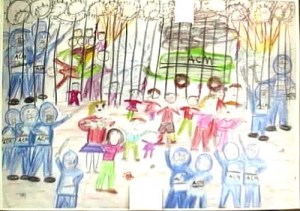
Woomera child's drawing. by Karen Elliot via flickr
There is no grass for the children to play on, or for the babies to practice their walking. She watches three small children scuffing aimlessly about in the red dust at the steps of their donga; a Muslim girl of about twelve in her headscarf, lifted from her shoulders by the hot wind; a boy of about eight in shorts and bare feet. The sand is hot. Doesn’t it burn him?
Between them they help the smallest child, who is still tottering on his uncertain baby legs. A woman in a black burqa sits on the top step of the donga with her head in her hands. Outside the administration block, they noticed when they arrived, there’s a garden of emerald green grass, young trees, and beds of brilliant flowers. The garden isn’t visible from these dongas. Later they’re told it’s tended by some of the inmates.
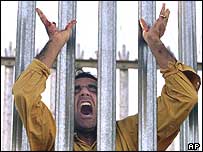
As she watches, a man emerges from another donga in the compound. He runs down the steps and across the red dust, screaming in a language that is unintelligible to her, but his despair needs no translation. He flings himself repeatedly at the wire that keeps him contained, like an animal in a zoo maddened by its confinement. He shakes the wire back and forth while the children watch in frightened silence. The eldest girl puts her arms round the younger ones. The man’s screams rouse the woman in the burqa: she raises her head and briefly stares at him, then returns to her own private despair.
‘Oh, Christ,’ says one of the guards standing outside the door of the Visitor’s Centre,

Razor Wire 101. by Amy Leonard via flickr
‘what’s wrong with bloody Mustafa now?’
Jennifer is sitting very still. She’s been holding her breath, and now she’s feeling dizzy and sick. Her body is warning her that this is not a sight she should witness, but she’s here now, there’s nothing she can do.
Mustafa isn’t trying to attack anyone other than himself: it’s the sight of an adult man completely out of control of himself, a woman watching from a distance and returning to her self-absorbed despair; three children silently witnessing this scene. Are these scenes here in the detention centre, these scenes and many more like them and worse, are they making intolerable memories for these children? Will these children, in their middle age, sweat when they recall these events?
It’s getting hotter as the day moves on towards noon. The dongas shimmer like mirages. She’s been afraid ever since they crossed the threshold into the prison, ever since they drove down the bitumen road from the caravan park in the Woomera township towards prison surrounded by gibber desert and saltbush. She’s been afraid of the detention officers, and the blue water cannon positioned at the gate and the high, intimidating security lights that promise to illuminate everything without mercy, no crevice left untouched, no places left to hide.
She’s way out of her comfort zone, and anyway, fear is her Achilles heel.
Everybody’s got their personal weakness: greed, grief, free-floating anxiety, lust, anger, despair. Hers is fear. It can bring her undone in a nanosecond. This is a new kind of fear, she’s only dreamed this kind of fear, in nightmares when she’s been pursued by soldiers, unable to find a hiding place in a napalmed landscape. All their journey so far, through the drought and the death stench and the tormented landscapes, past the sun-bleached bones of animals dead from starvation, picked clean by buzzards and eagles, all this has finally brought them to this place.
The journey has been a fitting preparation.
The women saw the interrogatory lights cutting through the dark sky when they made a furtive reconnoitre the night before. Having arrived too late in the day to visit the centre, they set up camp, tied up the dog in the back of the truck and crawled without headlights as close to the prison parameters as they dared.
‘Shit,’ Jane whispered.
‘What?’
‘It’s just like bloody South Africa. I can’t believe it. What country am I in?’
‘God’s own,’ Jennifer told her.
They saw headlights approaching.
‘Get going!’
‘Shut up!’
Jane threw the truck into reverse.
In retrospect they’re hard-pressed to explain their panic. Jane was worried that if they were caught hanging round, their visits the next day would be jeopardised and this was a realistic apprehension. Oppression works swiftly. The guards were completely in control. If the women offended them, they’d find some way of refusing them entry. Driving round the perimeters of the detention centre at night could be construed by the guards as suspicious.
This is how the people inside have to think every day. If I do this I won’t be allowed to do that. About the smallest, most insignificant things.
‘We aren’t doing anything wrong,’ Jennifer whispered. ‘We’re on a public road.’
‘We’re hanging round. We’re looking. That’s wrong enough for these people.’
‘Christ,’ Jennifer said disgustedly, ‘we’re still in Australia.’
‘And this is what Australia is these days,’ Jane said and they fell silent, contemplating the state of their country. God’s own be buggered.
‘Why are we whispering?’ Jennifer asked finally.
‘Dunno. We’re out of our depth aren’t we? Two white ladies from out of state. We’re out of our depth, the landscape, the Detention Centre, Woomera, which I think is a very strange town, by the way. Did you notice those parks full of planes and bombs and rockets? And how green the grass is, where do they get the bloody water from? And those empty, smashed-up apartment blocks with the doors hanging off their hinges and banging in the wind and all their windows broken? Like a post nuclear movie.’
Jane drove them back to the park. A high wind had sprung up, rocking their caravan. It was cold. Large spots of rain fell on them as they moved from the truck to the van. The park was almost empty. No one came here anymore the manager told them, owing to that fucking Detention Centre. Everyone’s afraid there’ll be a break out and they’ll get caught up in it.
‘Used to be a busy, thriving park,’ he said. ‘Now fucking look at it.’
They didn’t tell him the reason for their visit. Just passing through, they said, on their way to somewhere else. They had no wish to get into a fight with him about the detainees. They were closing down, husbanding their resources.
There was only one other van parked for the night. The park was asphalt with squares cut out of it in which frail saplings tried to grub a life for themselves out of the red dirt. They could see the lights of the Detention Centre. They made tea and climbed into their beds. Fletcher settled down on the floor in between them.

Human Rights. by Hugo via flickr
Though the guards complain to each other about Mustafa’s on-going expressions of despair, nobody goes to help him, or even to tell him to shut up, or whatever they do with people in there in extremis. Which seems to be very little. Mustafa’s frantic screaming subsides into sobs. He wraps his arms round himself and rocks back and forth in that movement typical of human beings, adults and children, who have given up on any hope of comfort other than what they can provide for themselves. Then he leaps up again and grabs at the wire.
Earlier the guards had spoken to the women about their feelings towards the detainees.
‘They’ve got everything,’ two guards, a man and a woman, told them as they deposited their bags in the lockers and waited to be searched.
‘They’ve got TVs, clothes, videos, everything.’
‘We have not got our freedom!’ shouted an inmate, overhearing the guards’ account of things as he swept and mopped the office floors.
‘That’s relative, mate!’ the male guard shouted back. ‘Freedom’s relative. I’m not free either, you know. I’ve got to show up for work here every day, can’t sit around on my arse watching TV like you. Can’t even afford a bloody TV like they’ve got,’ he told the women. ‘Working my butt off and I can’t afford what they’ve got for nothing. Then they trash it! Bloody trash TVs, DVDs, computers! You wouldn’t believe it.’
He shook his head and swore softly under his breath.
Jennifer reflects on this exchange as they sit in the Visitors’ Centre waiting for the asylum seekers they’ve arranged to meet with. The irony of the situation doesn’t escape her. The guards, poorly paid and in one of the worst work places in the country, measure their success in life by the things they can buy with their wages. This is a widespread marker of success in Western culture, the guards are no different from most other people in their material ambitions.
All the things they see the detainees getting ‘for nothing’ and then ‘trashing’ when there’s a riot, are things they’re busting their guts in this god-awful place to earn the means to obtain. The guard doesn’t feel free, because of this, and he’s in no frame of mind to start measuring his degree of freedom against that of the detainees. He’s not about to argue degrees of freedom and personal choice. He feels powerless, except in his right to exercise power over the detainees.
It’s easy enough to say the guards don’t have to be there. And they don’t, nobody’s forcing them. But as violent as they reputedly are, as racist and resentful as they clearly are, to tell them that they don’t have to do this doesn’t seem to be the answer. They think they do.
The noon temperature is forty-two degrees Celsius. There’s a hot wind roaring
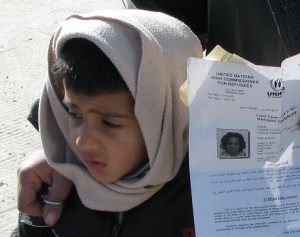
Iraqi refugee child. by Catholic Relief Services via flickr
across the plain. Mustafa has stopped crying and sits quietly in the dust, his head resting against the wire. The children walk towards him. The girl’s scarf whips round her head in the wind. She holds the baby’s hand.
They all stare at the visitors. Jane and Jennifer smile. Nobody smiles back. They aren’t allowed to approach the children or talk to them. Jennifer knows she will remember this scene for the rest of her life, the three solemn children, the damaged, broken man, the woman silent on the step, her head buried in her hands.
It’s as if they’ve reproduced, in the middle of their democratic country, conditions that bear an eerie similarity to those that caused the people to flee their homelands in the first place.
‘If they’ll bother to get up,’ the guard is saying to Jane.
‘What?’ Jennifer asks.
‘It’s Ramadan. Your detainees might be late. They pray all night and sleep all day. Weird, eh?’
The guard is wired for every kind of sound. He’s got technical aids every which way. He looks at Jennifer as if he wants her to form an alliance with him against this ‘weirdness’ he has to endure on a daily basis. She thinks she might have pretended to something of the kind before she actually got into the place. Getting in was tricky, touch and go, they knew they had to play things very straight. But once in, the guards could go to buggery. Like the bloody country.
‘So why are they lazy, lying in bed all day if they’ve been praying all night?’ she asks, hostile. ‘It’s an important thing, Ramadan, like Christians have important things. Isn’t it? Anyway, it’s not as if they’ve anything to get up for, you don’t let them do anything.’
The guard looks truculent.
‘I guess this is a pretty awful job,’ Jane intervenes, deciding on diplomacy.
He softens.
‘Mate, it’s the bloody pits. Nobody knows. Nobody hears our side of the story. We’re just the bastards. You know,’ he went on, settling in for a rare opportunity to whinge to a member of the public, ‘I daren’t tell anyone I work here. You imagine that? Having to lie about where you work?’
‘Why’s that?’
‘Because the place’s got such a bad name nobody else’ll employ me after I’ve been working here.’
He leans back in his chair. They can see the tension bristling through his body. His face is congested, his beer gut large, his uniform too tight. He’s on the edge, as are many other guards they meet on their way through the system.
‘I don’t even tell me mates what I do. I tell ‘em I work in Woomera for the Government and it’s secret, what I do. Never mention the Detention Centre. No way.’
Jane reflects on the difficulties and stresses such daily deceits must bring to a life.
‘That’s bad,’ she tells him. ‘That’s a hard thing to do.’
‘My oath. Then you get these bastards in here smashing everything up they get given. Bloody mad. Don’t make sense.’
His radio squawks. He listens and then speaks into it rapidly.
‘Well there’s three of the ones you asked to visit on their way.’
‘Three? We arranged to meet with twelve.’
‘Th’other nine aren’t allowed visitors. They’ve being playin’ up, lost their privileges.’
‘What? All nine of them?’ Jane protests.
‘Well, except Parvin, she’s too sick.’
‘She was fine a couple of days ago.’
‘Yeah, well now she’s too sick. So do you want to see these blokes or not?’
‘Yes, yes of course we do.’
He speaks into his radio.
The three young men follow the guards into the Visitors’ Centre. They introduce themselves, awkwardly. The women have corresponded with the young men, so they know something of each other’s lives, but in the face-to-face encounter they are all shy, hesitant.
Nasrim, Ali and Mohammed sit across the table from Jane and Jennifer and they look at one another in silence. The young men all have olive-skin, with bloodshot mahogany eyes under full brows, and black hair cut short as if there is only one style permitted inside the prison. Ali, who looks to be the youngest, has a round face with soft features. His expression is open though baffled, permanently so, Jane thinks. His eyes are huge, like dark, full moons and they glisten. He is plump, the soft plumpness of a young man who hasn’t yet grown into his adult body.
Nasrim has an athletic build, lean and supple. His cheekbones are well-defined, his eyes shift rapidly, checking out the women, his surroundings, his friends, noting where the guards have settled. He drums his fingertips on the table, waiting for someone to speak.
The third man, Mohammed, wears an untidy beard, beginning to show premature flecks of grey and when he smiles his lips are rosy and his teeth white, framed by the dark hair. He is heavy and muscular. He drops heavily into an orange plastic chair and drops his hands on his thighs.
‘Welcome,’ he says to the women. ‘Welcome to our palace in the desert!’
Nasrim has a packet of biscuits in his hand and Ali and Mohammed carry water, orange cordial and paper cups.
‘There is a good guard, a kind man,’ Nasrim says, ‘he gives us these things for us to give to our visitors. He understands that at home, in our country, it is very wrong to greet the visitor with an empty hand and so he lets us have these things for you.’
Mohammed breaks open the biscuits. Jane and Jennifer take one. It crumbles in Jennifer’s dry mouth and she thinks she’s going to choke. Conversation is difficult.
‘You all speak good English,’ she offers, ‘ did you learn that here?’
‘We have been in detention for ten months in Port Hedland, nineteen months in the Woomera,’ Mohammed tells us. ‘We are Hazara from Afghanistan but the Immigration, they say we are from Pakistan and are not refugees. This is not the truth.’
‘How old are you?’ Jane asks.
‘I am twenty-four, he is twenty-two and he is nineteen,’ Nasrim points to Mohammed and Ali as he speaks. ‘We learn the English here but we learned some in our country. We have left our country because the Taliban they kill Hazara, they have fatwah on Hazara. My father, my mother they are killed in our village, the Taliban destroy our village, I see my family, my sisters they are killed.’
Nasrim’s eyes fill with tears and he looks away, out of the door and into the compound where the three children still stand at the fence, staring. He yells at them in their shared language. The children stay where they are and stare at him.
‘I told them: “Go to your mother!”’ he translates. ‘These little children, they see a crazy man, made crazy here, they watch him cut himself with razor all over, blood splash out on children.’
‘The little ones saw this? They were splashed with his blood?’
‘Yes, yes, they see everything. Children here see everything, very bad thing I think.’
‘Is that their mother, sitting on the steps?’ Jane asks him.
‘Yes, that is their mother. She is sick, very sick, they give her no medicine, she does not look after them because she is sick.’
‘Where is their father?’
‘He is gone. He is given temporary visa, he is gone.’
‘His wife and children left behind here?’ Jane asks, incredulous.
‘Missus,’ says Mohammed, ‘this is happening very often here. Many families. Maybe thirty, fifty, in this place. The father, brothers, on temporary visas, the women children kept in the Woomera.’
‘The women gets sick,’ Nasrim tells them,’ without the husbands, the men the womens get sick and nobody cares for the children. This is bad place,’ he continues and looks at the ground. ‘Very bad place, much bad things happen.’
‘You mean the Immigration gives the men the visas and keeps the rest of the family in detention?’ Jane now remembers now that someone has told her this happens.
‘Yes, that is so.’
‘Why do they think you’re from Pakistan?’
‘One day, we have interviews with officer from DIMIA, she say our language is from Pakistan, she say she is expert at knowing this,’ Nasrim says. He throws his hands up in disgust. ‘She knows nothing of our language!’
The young men wear an assortment of trainers, T-shirts, shorts and track pants. Nasrim is edgy, he fidgets, picks at his fingers, runs his hands through his short hair. Ali in contrast is still: he sits calmly, gazing out the door. Mohammed rests his elbows on the table and puts his head in his hands. These young men are close in age to Jennifer’s sons. She imagines Harry and Samuel living this life. It is an intolerable imagining. She looks out of the door into the compound. A wedge-tailed eagle rises from the roof of a donga and moves upwards in slow circles out of her line of sight.
‘Ali makes the garden,’ says Mohammed.
‘The garden at the administration building?’ Jane asks.
‘Yes, I like it, I like it to do the garden, ‘I keep garden clean, plant things, empty rubbish, I have life here, job, it is not so bad.’ He has a slow, wide smile. He eats another biscuit.
‘Idiot!’ scoffs Nasrim. ‘You should dream of leaving here.’
Ali smiles again. He seems institutionalised, Jane thinks, he doesn’t have the fierce dreams of leaving detention that clearly fuel Nasrim. And what of the events they suffered before fetching up in detention centres, she wonders. What is the aftermath of those traumas?
They all met, it turns out, on the boat from Indonesia sailed by people smugglers, a journey that landed them at Ashmore Reef. None of them has any other family in Australia. All of them have come to the end of their appeals for visas to stay. What will happen to them now? Jane asks. Ali shrugs and doesn’t answer.
‘The Australian Government they give us money to go back to Afghanistan, everybody says so,’ Nasrim tells us. ‘I will go, I think.’
‘But what will happen to you? Will you be safe? Have you any family left there?’
‘I have uncle. Our village is destroyed. The Taliban is not so big anymore. Maybe I work for the Americans. It cannot be worse than this.’
He waves his hand at their surroundings.
‘I would rather die man than animal. If I die let it be for being Hazara in Taliban fatwah, not here in black hole of hell in Australia like pig.’
He stands abruptly, then paces the small room with his hands in his pockets. Ali shakes his head at us.
‘Would you go back, Ali?’ Jane asks.
‘I don’t know, Missus. I am afraid of soldiers. They try to make me killed. I don’t know if I will go back. Maybe I stay here, grow garden.’
Mohammed has his head in his hands and doesn’t speak. Outside Mustafa has begun screaming again. Nasrim flings himself back into his plastic chair and bites at his fingers.
Jennifer thinks to herself that there was a long and venerable democratic tradition that once existed in the world, a tradition that recognised the right of the stranger to seek sanctuary and to ask for help. There was a corresponding duty to oblige and offer assistance. What has happened to this tradition? Or was it just a dream?
‘Why is Mustafa crying like that?’ Jane asks.
Ali and Nasrim shrug.
‘He’s crazy, his wife, his children they died in his country and he is made crazy.’
Nasrim makes the motions of putting a needle through his lips.
‘Very bad,’ he says, ‘the children, some of them too do this.’
The guards are not in the room but they are by the door in the next room, keeping an eye on things, talking among themselves, laughing, their radios squawking intermittently. Jennifer gets up and goes over to them, leaving Jane talking to the three men.
‘We were invited to visit some of the women here,’ she says. ‘Are we going to able to do that?’
‘There’s nobody else on your list,’ the guard tells her, checking his clipboard.
‘I have the letters here that the women sent, asking us to visit them.’
She takes them out of her shirt pocket and shows him. He gives them a cursory glance and looks away. He’s in his thirties, clean-shaven, medium build with a crew cut. He works out: she can see the muscles under his tight blue shirt. He’s a rock. Nothing she says will persuade him to let them see anybody else.
‘Well, I don’t know, they’re not on your list, except Parvin and she’s too sick.’
‘Parvin had Federal Court a couple of weeks ago. Did she get a visa?’
‘Can’t tell you that I’m afraid. Confidential.’
‘So we won’t be able to visit with the women?’
‘Nope, they’re not on your list. Anyway a whole bunch of them have lost privileges for playing up.’
‘The women?’
‘Not just the women but some of them are women.’
‘What did they do?’
‘Can’t tell you. Confidential.’
‘What if we come back tomorrow?’
‘You’ve only got this one list, that won’t change tomorrow.’
‘Who made up our list?’
‘We have officers who do that.’
‘Can I see one of them?’
‘They’re not here at the moment.’
‘Thanks.’
Jennifer returns to her plastic chair. Nasrim pushes the biscuit packet across. Vanilla creams.
‘Thanks, Nasrim. What happened here, why have so many of you lost your privileges?’
‘There was fighting, somebody broke computers, people screaming, women throw chair, very bad.’
‘One month ago a big fire light in our detention centre,’ Mohammed suddenly speaks without lifting his head from his hands. ‘I working in kitchen with Ali. Everybody lose privilege. No visitors.’
‘How long do they lose privileges for?’
‘I do not know. Maybe days, maybe longer.’
Nasrim casts furtive looks at the guards in the next room. Jane looks over at Jennifer. Jennifer feels as if great weights are tied to her ankles and wrists, preventing her from movement, a sense of overwhelming oppression and helplessness. Jane’s eyes are glazed behind her glasses, her features dulled with heat, shock, Jennifer doesn’t know.
‘We do not have mothers,’ Mohammed lifts his head from his hands and says this quietly but with feeling.
‘We do not have mothers, his is killed, mine is lost, Ali, nobody knows of Ali’s mother. You have sons, missus?’ he directs his question to Jennifer.
‘Yes, two sons,’ she tells him.
He takes a drink of orange cordial. Cottee’s Cordial?
My dad picks the fruit
that makes the cordial that I like best.
‘They are free, they work, have girls, go out, they are in city?’
‘Yes, they do all those things. Harry works for the United Nations in a refugee camp in Tanzania. He teaches the children how to play football. Samuel is a chef, in Stockholm.’
‘Ah!’ Ali cries. ‘I too am cook! I cook here sometimes, in kitchens.’
‘Do you like cooking?’ Jane asks him.
‘Oh yes, very much. Good job. Plenty to eat!’ he chuckles.
‘In our country,’ Nasrim, glowering, says,’ when visitor come we make feast, much food, goat, chicken, rice, here we have only these biscuits and this drink!’ He sweeps the pile of plastic cups off the table.
‘Even when little food always we share with visitor! This,’ he gestures at the biscuits and the cordial, ‘this is…’
His English leaves him and he flings his hands in the air. He says something in his own tongue. The others look at him. A guard enters, curious about the noise.
‘Not playing up, are we, Nasrim?’ he asks.
Nasrim replies again in his own language.
‘Time’s over, anyway,’ says the guard.
‘Can we have a bit longer,’ Jane asks,’ we promised to take a list of things the men need with us so we can send them.’
‘They’ve got everything they need. But okay.’
They have to ask the guards for pencils and paper as all their things are in their backpacks in the lockers. Jennifer can’t believe those children are still out there in the broiling sun. The little baby is sitting down now in the red dust with the older children. Mustafa has vanished, as has the children’s mother. She can’t see any other adults. How long the days must seem in here.
‘Jennifer,’ Jane says as they drive back along the bitumen road to the caravan park, ‘how is it that they’re denied visas because the immigration people don’t believe they come from Afghanistan, yet they’re offered money to go back there?’
‘I don’t know, I don’t understand that. I don’t understand why they release the men and keep women and kids in there either.’
Jennifer saw some film footage on the news before they left, of an Afghan man who’d returned to his bombed-out village. He was scraping blindly at the earth where his home used to be with a teaspoon. It was one of the saddest images she’d ever seen. Is that what’s awaiting Nasrim, she wonders.
As they leave the three men, Mohammed thrusts a piece of paper into Jane’s hand.
‘Read this,’ he tells her. ‘My friend he is at Baxter now, he write this, is good, good writing. Maybe you put in paper in book for him but you not use his name, he is afraid of people knowing.’
They look at the poem as they sit in the truck in the Detention Centre car park. They’ve retrieved the dog and their personal belongings, thanked the guards, walked out to the truck on trembling legs, exhausted. Jennifer’s now trying to take photos of the centre through the windscreen without drawing the attention of the guards. She wants a picture of the water cannon at the gates. The guards are in their towers with binoculars, and patrol cars pass by every few minutes. Nevertheless, she manages a few badly-focussed images.
What kind of stupid incompetent terrorists would try to infiltrate the country via people smugglers and end up imprisoned here for years, Jennifer wonders, recalling a politician’s claims about the asylum seekers true purposes.
Down the road a bit, they stop and look back at the steel compound topped with razor wire. It has a beauty that comes from its simple proportions, the satisfying alignments of all its angles, the sun glinting off its shadowless surfaces. It is simultaneously incongruous and perfectly placed in the wilderness that surrounds it; a savage stronghold, impossible to ignore. Its designers have succeeded in eclipsing the drama of the arid landscape: the eye is drawn in awful fascination: one cannot look away.
‘Christ,’ says Jane.
It isn’t until a week later, camped by a flowing Victorian river in a field knee-deep with poplar seeds like balls of ripe cotton and a herd of roaming Jersey cows rubbing up against their caravan, that they both break down. It was awful, they agree, to have to leave the men behind in that place (Surrounded by peoples with no love,as the poet wrote) to have to say goodbye and walk away. And those children.
They know bad things happen in that desert place; they’re in its atmosphere. Later they will discover just how bad when the conditions are gradually revealed to the public by people who’ve worked there and decided to spill the beans.There are raped children behind the razor wire, beaten women and crazed men.
A common suffering. A common humanity. The women are full of admiration for the visitors who live close by, who go there every couple of weeks, month after month, offering support and companionship.
Their journey home is long and much of it passes in silence. What has confounded them both is that these things are happening in their own country. They are ashamed, and very angry.
‘Not in my name,’ growls Jane. ‘Not in my bloody name.’
One Silent Night
The wind is blowing to one side
Here it touches my body
I feel like just in heaven
Suddenly I open my eyes and look around
Oh God I am behind the fences
Still filled with unhappiness
I would like to fly just like a bird
But I know I can not
God created this world for everyone
But some people try to destroy it
And some people try to keep it for their own way
Why do they keep on behaving like that
I need a new world to live
I want different skies every day
Can I live with out fear of war and terror
Could my dreams come true one day
In my childhood I thought
I was the luckiest person in the world
Because my life was secure
Now I think I am the unluckiest person in the world
Surrounded by peoples with no love.
By………
Baxter IDF.
Tags: asylum seekers, children, Human rights, Human Rights and Liberties, Politics, Refugee, Refugee Convention, Woomera Detention Centre
 The opposition is quite within its rights to call for marching in the streets as a reaction to the Gillard government’s deal in progress with Malaysia to send boat arrivals to camps in that country.











 No Place For Sheep
Recent Comments