Tag Archives: Feminism

Has our first female PM legitimised misogyny?

18 Jan

“We all recognise that if there’s one overarching issue for women it’s the way that religion can be manipulated to subjugate women.” Mary Robinson, first female President of Ireland, former United Nations High Commissioner for Human Rights.

Late in 2012 Australia’s first female Prime Minister, Julia Gillard, made a stirring and globally applauded speech in the House of Representatives, on misogyny and sexism in the Parliament.

Ms Gillard declared “I will not be lectured on sexism and misogyny by the Leader of the Opposition.”

Ms Gillard asked: “What does misogyny look like to modern Australia?”

Ms Gillard deplored LOTO Tony Abbott’s double standards when it comes to misogyny and sexism.

Ms Gillard demanded Tony Abbott apologise to the women of Australia for his misogyny and sexism.

Ms Gillard stated “I am always offended by sexism and statements that are anti women.”

Ms Gillard declared “Double standards should not rule this parliament” and “sexism is always unacceptable” and that “we are entitled to a better standard than this.”

Prime Minister Gillard was absolutely right on all counts, and the stand she took was long overdue.

The Gillard government has undertaken the consolidation of anti discrimination legislation. In the course of this it has decided to preserve existing exemptions that permit religious organisations to discriminate against , as David Marr puts it:  any or all gays and lesbians, single mothers, adulterers – yes, even adulterers! – bisexuals, transsexuals, the intersex and couples such as Julia Gillard and Tim Mathieson.

The practical outcomes for women of these exemptions  are starkly illustrated in this story of an unmarried teacher who became pregnant and was subsequently sacked from her job at a Christian kindergarten in Queensland.

Australian Christian Lobby CEO Jim Wallace claims Julia Gillard “reassured” religious organisations that they would retain their right to discriminate against women in this manner, as well as to discriminate against women who live in de facto relationships, women who commit “adultery,” women who are bisexual and lesbian, and the intersex.

It is unclear how much of this discrimination is directed against men, except in the case of gay men, who it seems are not regarded as “real” men by religious groups such as the ACL and Christians the ACL claims to represent. Women who transgress the ACL’s rigid criteria are demonised by the Lobby’s determination to exclude them from the right to employment, not because they are in any way unable to perform the work required, but because of their “lifestyle.” Whether or not the man who impregnates the single woman is similarly discriminated against remains unclear.

British philosopher AC Grayling in The Guardian:  I leave to you the not very congenial task of totting up the ways in which more enthusiastic forms of religion in general, not just Islam but Roman Catholicism, puritanical forms of Protestantism, and orthodox Judaism, have treated women: all the way from closeting them, covering the up, and silencing them, to sewing up their vaginas: it is a ghastly litany of repression, all the less excusable because discrimination against women which began in these ways persists in our society in modified forms: the fact that a woman earns about 70% of what an equally qualified and experienced man does is a residue in our own society of the attitude which in today’s sharia law states that a woman is worth half a man.

The ACL is anti-abortion, and against the use of the drug RU 486, licensed in Australia only for the termination of very early pregnancies. They strongly object to Australian aid being used to promote family planning in recipient countries. In other words the ACL is keenly interested in controlling and regulating women’s bodies, at home and abroad.

Former US President and Christian Jimmy Carter: The truth is that male religious leaders have had – and still have – an option to interpret holy teachings either to exalt or subjugate women. They have, for their own selfish ends, overwhelmingly chosen the latter. Their continuing choice provides the foundation or justification for much of the pervasive persecution and abuse of women throughout the world. This is in clear violation not just of the Universal Declaration of Human Rights but also the teachings of Jesus Christ, the Apostle Paul, Moses and the prophets, Muhammad, and founders of other great religions – all of whom have called for proper and equitable treatment of all the children of God. It is time we had the courage to challenge these views and set a new course that demands equal rights for women and men, girls and boys.

At their most repugnant, the belief that women are inferior human beings in the eyes of God gives excuses to the brutal husband who beats his wife, the soldier who rapes a woman, the employer who has a lower pay scale for women employees, or parents who decide to abort a female embryo. It also costs many millions of girls and women control over their own bodies and lives, and continues to deny them fair and equal access to education, health care, employment, and influence within their own communities.

Australia’s first female Prime Minister, Julia Gillard, has chosen to walk a path that is very different from that of Mary Robinson as far as women are concerned. Ms Gillard has, by pandering to the demands of religious bodies for exemptions to anti discrimination law, legitimised the religious misogyny that perpetuates the myth of female inferiority, to the degree that we are not considered capable or worthy enough to retain control over our own bodies. Ms Gillard has legitimised a misogyny that would deny her the right to employment because of her “lifestyle” as a single woman living with a man. Would her partner Mr Mathieson also be denied employment?

Ms Gillard has legitimised a religious misogyny that believes it is righteous to sack unmarried pregnant women, at a time when they and their unborn babies most need support. At the same time, they would if they could deny a single pregnant woman access to abortion, if that was her choice.

Ms Gillard has thrown her support behind a Christian cult with unsettling links to “dominionist organisations throughout the world, not least through its own board and staff.” (I strongly recommend reading Chrys Stevenson’s excellent piece to which I have linked, in which she unpacks the connections between dominionists and the ACL).

The National Alliance of Christian Leaders (NACL) with whom ACL is closely associated, stated their goals thus: “… unity in truth; recognition of Christ’s authority in the church, family, individual and government; … legislature to force Christian values; … the kingdom permeating the structures of society; biblical government.”

Ms Gillard, an atheist, has capitulated to the demands of organisations such as these and has enabled them to enact their stated goal of introducing “legislature to force Christian values” on our secular society.

Dear Ms Gillard

I will not be lectured on sexism and misogyny by you.

Dear Ms Gillard

What does misogyny look like in modern Australia?

Dear Ms Gillard

I deplore double standards when it comes to misogyny and sexism.

Dear Ms Gillard

I am always offended by sexism and statements that are anti women.

Dear Ms Gillard

I agree absolutely that “Double standards should not rule this parliament” and “sexism is always unacceptable” and that “we are entitled to a better standard than this.”

Dear Ms Gillard

What are you going to do about it?

Jennifer Wilson. Woman.

Marissa Mayer and the F word

24 Jul

And here we go again. Another “how dare she say she’s not a feminist” rant against a high achieving woman, this time newly appointed Yahoo CEO Marissa Mayer. You’ll find it at the mamamia website, written by self-described feminist Jamila Rizvi.

The term “feminist” has become extremely fraught, not least because of the rantings of  those feminists who demand every other woman on the planet describe herself thus. Many women are understandably disinclined to use the term about themselves. Many of us will not on principle, describe ourselves as others say we should, because we are engaged in a process of liberation from all those who arrogantly claim the right to tell us who we are, and who we should be.

Instead of addressing the complexities that have developed around the term, feminists such as Ms Rizvi wrongly attack women who do not wish to include that word in their lexicon of self-description. The problem is not that some women do not wish to describe themselves as feminists. The problem is that feminists like Ms Rizvi insist on publicly shaming such women.

Rizvi writes: Somewhere along the way being a feminist has become associated with hating on men, rather than being equal with them. So, I can see why women like Marissa Mayer, who work in male dominated professions, simply cannot afford to attract the label of ‘feminist’. After all, success doesn’t come to the woman who throws her hand up in the air and says ‘look at me, look at me, I’m a man-hater’.

No, Ms Rizvi, you are wrong. “Somewhere along the way” feminism has become associated with women bullying women, bullying us into describing ourselves as feminists, for example, by using abusive tirades that were they employed against us by a male, would be regarded as emotional violence.

“Somewhere along the way” feminists such as yourself decided to take over patriarchy’s work for them, and assume the right to define women.

“Somewhere along the way”  the cant of ideological purity  has blinded some feminists to the reality that when ideology of any kind gets the upper hand, the war is lost, and the revolution has become the  orthodoxy.

“Somewhere along the way” as well as being acceptable to the patriarchy, we now must be also be acceptable to a hegemonic feminism that demands we identify ourselves with its  laws, otherwise we are traitors to the women who have gone before us?

If I don’t  choose to identify myself as a “feminist”,” for example, that does not indicate that I am either ignorant of or ungrateful to the women who’ve gone before me, and by their hard work enabled some of us to achieve what was once unthinkable. I do not have to call myself a “feminist” in order to honour and appreciate those women. I do not have to use the label “feminist” for myself in order to actively care about equality. I do not have to play by your rules, Ms Rizvi, and I do not have to use your language.

There are feminists who would tear Rizvi to shreds for her love of red lipstick, her fondness for five-inch heels and her love of men. They would never grant her the right to the title. This is another reason many women refuse the label: it is, unfortunately, divisive, its meaning is unclear, and nobody quite knows what it’s describing.

I am delighted that a pregnant young woman has achieved what Marissa Mayer has achieved. I don’t give a stuff if she calls herself a feminist or not. The problem lies not with Ms Mayer. It lies with those people, women and men, who demand that human beings fit into pre-determined categories and in so doing, trash the human spirit and deprive it of its freedom.

I don’t believe for one moment that’s what the early feminists intended for us.

I do think of myself as  feminist. One of the reasons I claim that title is my belief that it is a woman’s right to call herself whatever feels appropriate for her, regardless of what others may think or demand. I will not define myself according to another’s lights. I will only define myself by my own. Feminists do not condemn a woman for defining herself by her own lights. That is the task of tyrants.

What is this “IT” that women should want all of?

8 Jul

The other day I tweeted that if I heard one more discussion about women having it all, there would be blood spatter. I take that back because I want to say a thing or two.

There are two quite separate issues here that are being misleadingly conflated. One is the real need for adequate affordable child care for all women, and a non-discriminatory workplace in which we are treated with respect and equality, properly paid and not penalised for creating the next generation who will keep the country going. I wholeheartedly support those aspirations.

But while some of us weren’t looking it seems that a particular strand of feminism has declared that Woman’s highest and most noble aspiration is To Have IT all. This has recently drowned out the real struggle for equality for all women, and focused the debate on a privileged few.

As far as I can ascertain, the IT holy grail involves building and maintaining a highly successful career while shaping your body to fit into designer suits and stilettos that create a complex ambience of sexy yet capable. When you’ve got a sure foothold in your profession you then take time to partner up, get pregnant, gestate, and give birth. Then you get back to work looking as untouched by these experiences as possible.

You then have it all. Career, partner, family, money. You will need the support of other women to enable your lifestyle. Child care workers, nannies, cleaners, the majority of whom are female, are paid far less than you, but that’s all right, you are creating jobs in your efforts to succeed at everything except the boring, unglamorous stuff other women will do for you.

Sustaining and promoting the patriarchal paradigm, the “be born, get everything until you die because you are entitled” ethic so beloved by hegemonic masculinity, is apparently the only way a woman can achieve real power in the Western world. While there may be the occasional inroad into better conditions for women who are caught up in the various levels on which this paradigm operates,  the paradigm itself is not subject to real interrogation and real change. This is still a world that in the West at least, is founded on the principle of entitlement to everything, just because.  That is not feminism as I understand it:

I would like to blame the patriarchy for  the IT women should suddenly want all of. It looks to me like an attempt at counter insurgency operational propaganda, using collaborating women they’ve turned as agents. If ever you wanted to set up a disruptive enemy for a catastrophic fall, this is the way to go about it. Use the media to build unrealistic expectations in the female population and persuade the target audience to introject them. Bombard with images of glamorous women who have brilliant jobs, dishy supportive husbands often with their own high-powered professional lives, and adorable children and pets. Make the audience crave this, for because who wouldn’t want a life like that? If you aren’t having it, there’s something wrong with you. If you don’t want it, there’s something even more wrong with you.


The propaganda won’t work on everybody because not all women are susceptible, but it will probably work on enough of us to redirect anger away from the system where it belongs, and onto the self where it doesn’t. Mission accomplished. Feminism co-opted in the service of capitalism. System safe. Oh yeah.

What surprises me about high achieving women who are given as examples of having IT all, is that despite all their obvious intelligence and talent, they seem universally disinclined to question the IT. This is disappointing. Imagine if they  got in there and started up a ruckus.IT? What is this IT of which you speak? Happiness? Contentment? A lifestyle, as opposed to a life? DEFINE THE IT!

Of course, that would be biting the hand that feeds them, and women who want it all know before they know anything else that if you can’t fight them you join them and once you’ve joined them, that’s IT.

In a bizarre sense, these women do achieve a kind of equality but I have to ask the question, who wants to be equal to that? I mean can’t we aspire to something better than “I want it all?”

There was a time when thinking you could have everything was a sign of immaturity. Adults accepted that choices had to be made. Only the greedy narcissist, frozen in the mindset of a two-year-old, thought they were entitled to everything and everyone else had to help them get it.

What seems important to me is that we keep the complaints of privileged women quite separate from the real issues facing the majority of us. They are not the same thing, they do not have anything like the same urgency, and besides, the “I want it all” creed is not going to work for the planet. I don’t believe feminism was ever about having it all. It was, and remains about equality, not matching excessive male privilege. Privilege, I might add, that the majority of males don’t enjoy either.

Feminism isn’t about “wanting it all.” Nobody has that right. The ideology is about creating a world in which everyone has a better chance at decent survival, not just a greedy few of either sex whose sense of entitlement is in danger of raging out of control, to everybody’s cost.

I’m gonna stand by my woman now

18 Jun

Women bagging women is nothing new, but last week there was something of a spike in the pastime that left me wondering why we need patriarchy to do it for us.

I’m not referring to disagreement or critique, I’m talking about spite, judgement, contempt, and downright bitchiness that does nothing to progress civilisation, of the kind that feeds an exclusionary dynamic and precious little else.

First I came across this piece of anti bisexual woman contempt in the HuffPost Gay Voices blog, from radical feminist lesbian writer Julie Bindel. Ms Bindel is railing against allegedly hedonistic bisexual women “tourists” who “sleep with women on the weekends and go back to hubby on Monday mornings.” They have no sexual politics, she claims, and are exploiting full-time lesbians who have a political as well as sexual commitment to same-sex relationships.

I guess dedicated lesbians are capable of refusing to sex to touristing bisexual air heads lacking a sexual politics. I mean, nobody’s forcing them to put out for a woman who also engages with a penis are they?

Ms Bindel concludes: “If bisexual women had an ounce of sexual politics they would stop sleeping with men.” One could equally argue that perhaps if lesbians had an ounce of sexual politics they’d stop sleeping with bisexual women?

Then I read Elizabeth Farrelly’s column in the Sydney Morning Herald titled “The New Feminism: if it’s girly it’s good.” “Here’s the truth. I’m not a misogynist” Farrelly begins, perhaps not the best first line I’ve ever read. She then gets stuck into women who refuse to leave what she calls “the sewing circle” to take on the wider world of real  things. “Most of what passes for feminism these days… just legitimises girliness” she writes. I can see where Farrelly is coming from on this: I’ve moaned more than once about how feminism seems to be about body hair and lipstick these days. At the same time, I see nothing at all wrong with a bit of girliness: it is possible to have a reputable sexual politics and talk to other women about clothes and lipstick and occasionally have a good giggle over cocktails as well. This insistence on categorising is so, well, patriarchal. Real women break out of boxes, in my opinion.

However Farrelly goes further. She dislikes, she says, “boring” women authors like Margaret Atwood and Jeanette Winterson, preferring instead “writing with a higher IQ and lower pH than most women can manage…”

Ouch. That’s misogynist.

“It is clear,” Farrelly claims, “that to criticise women, or worse, poke fun is considered misogynist.”

Well, sometimes it is misogynist and sometimes it isn’t. Every time someone criticises Julia Gillard somebody else claims it’s misogyny,and while there’s certainly plenty of examples of that, there’s also legitimate criticism that has nothing to do with gender.

Then there’s Lara Bingle. About whom I know practically nothing more than the vitriol I’ve seen directed at her because of her TV reality show, “Being Lara Bingle.” I was initially confused by this title, wondering if it referenced the movie, “Being John Malkovich,” in which a miserable puppeteer stumbles across a portal into the star’s mind and charges people $200 a pop to spend fifteen minutes seeing the world as he does. Great and absorbing complications ensue, of the kind I simply could not imagine in a TV reality show about a young woman who seems to have done little other than perform in a failed tourism promotion and have a public fight with a famous cricketer who then dumped her.

For reasons I cannot fathom, Ms Bingle’s foray into reality TV has provoked quite vile criticism from many quarters, overwhelmingly from women. This caused me to ponder on the way women treat women, especially when the woman in question is young, and has the kind of beauty that is currently favoured in the mainstream. I mean, don’t watch it girls, if it hits your spite buttons. Ms Bingle is merely trying to make a life for herself, and accepted an opportunity practically every girl would if it came along.

“She decided to do it, now she’ll have to pay the price” was one piece of  self-satisfied Schadenfreude from an older woman who sounded as if she’d been waiting her whole life for Ms Bingle to fall flat on her face.

Ease up, girls. We have men to put shit on us.

Finally, this isn’t overtly about women bagging women but behind the scenes you’ll find much anti woman sentiment masked as concern and feminist politics. Many of you will have heard of Valerie Solanas and her Society for Cutting Up Men, otherwise known as SCUM. Solanas authored the SCUM Manifesto, a rabidly intense and sustained attack on men that states, among other things:  In other words, the male is an incomplete female, a walking abortion, aborted at the gene stage. To be male is to be deficient, emotionally limited; maleness is a deficiency disease and males are emotional cripples, and  SCUM will kill all men who are not in the Men’s Auxiliary of SCUM.

Ms Solanas went on to attempt the assassination of artist Andy Warhol after a dispute with him about a film script.

And so to the current Australian connection with SCUM. In July 2011 the SCUM Radical Feminist Conference was held in Perth. It was advertised as being of interest to  females who want to overthrow the government, eliminate the money system, institute complete automation and destroy the male sex. Workshops, guest presenters and social activities, plus a space to celebrate and re-member the life and work of Valerie Solanas and other radical feminists.

At the top of the updated SCUM Conference program there’s an announcement of the launch of Melinda Tankard Reist’s book, Big Porn Inc.

I was utterly shocked to discover Ms Reist’s apparent affiliation with the SCUM Radical Feminist Conference. I had no idea Ms Reist was so radical in her feminism, indeed there are some leading feminists who have publicly argued that Reist is not a feminist at all. (Another example of women bagging women, I suggest and a serious one. BTW I am the blogger mentioned in this article whom Reist is still threatening to sue. See Defamation category on this blog).

Reading through the program I discovered that Ms Reist’s publisher, Spinifex Press director Susan Hawthorne, gave a paper at the conference on feminist manifestos and SCUM.

I have yet to understand how exploitation of women and girls can be prevented through violence against males. All males, that is, indiscriminately, because they are male, and as advocated by SCUM. I fail to see the logic.

I could just be thick but to my mind, having my name and my book heading the program for a Society for Cutting Up Men conference would imply I was sympathetic to their cause.

And what would Jesus say?

So in conclusion, I’ve had  belly full this last week of women bagging women. Is that all we can do with our liberation, such as it is?

PS This Kravitz song will aggravate many people and is begging for a feminist deconstruction.

Game of Thrones, The Sopranos, Women.

6 Jun

I’ve just watched the first two episodes of Game of Thrones, the wildly successful HBO series set in faux Medieval times in what is now the UK and “across the Narrow Sea” in what we call Europe.  I was enthralled. I can’t wait for this evening when our household gathers to watch the next episode and in the words of Laurie Penny in the New Statesmen “enjoy the shit out of it,” despite its unexamined ‘racist rape-culture” ambience, and its appalling representation of women.

Life in Medieval times was not good for women, you might argue, and you would be right. There is no way of cushioning this reality, nor should anyone attempt such falsification. Women were for breeding and fucking. Relationships of all kinds evolved, because that’s what happens between humans regardless of class and circumstance. However, male allegiance is primarily to the King, or he who would be King. Women may not interfere with this requirement. No man would consider staying home from the slaughter because his woman asked it of him.

The wars fought between these opposing Medieval forces demand sacrifices from the top down, unlike our modern wars in which politicians dispatch the sons and daughters of others to do their killing while themselves remaining comfortably removed from trauma and death. This is only one of the differences between wars then and now, but that’s another story.

Reading Penny’s piece I found myself making comparisons between Game of Thrones and that other HBO success story, The Sopranos, in terms of their representation of women. The Sopranos is set in a very different world, that of organised crime in the US state of New Jersey in the present day. They have in common a ruthless hierarchical structure that demands total obedience from its male members to the King or the Captain. Mob women who do not comply with this requirement don’t last long, either in the family or in some instances, in this world. There is a divide between business and family that women may not cross.

That is not to say women in both series are entirely powerless, because they clearly are not. However, there are limits to the expressions of their power, and they exceed those limits at their peril. Overstepping the mark frequently results in physical retribution, sometimes death.

As in Game of Thrones, there are the women men marry and breed with, and the women men fuck. Occasionally there is confusion, and a “bastard” child results.

Sex is usually represented in both narratives as primarily for male gratification, urgent, hydraulic, and frequently performed from the rear, though in The Sopranos women are allowed to be on top a lot more. Women men fuck are generally less clothed in Medieval times and the present day, while wives and legitimate girlfriends get to wear expensive stuff.

In spite of this blatant and offensive sexism, and the highly aggravating madonna/whore complex that we just can’t seem to escape in our narratives, I was and remain enthralled by The Sopranos. In this and in Game of Thrones I’m willing to suspend my hard-won feminist critical faculties, and instead of righteously loathing the unreconstructed males who populate both worlds, I can’t stop myself enjoying the shit out of the shows. In particular, Tony Soprano remains a character of Shakespearian magnitude to me, his at times terrifying complexities holding my attention like a helpless deer caught in his headlights.  This series is littered with powerful characterisations, and I have not yet seen enough of Game of Thrones to judge if it achieves a similar standard.

At first blush, I suspect not. As Penny argues, Thrones is not subtle. After two episodes I feel I’ve got a decent handle on the characters and how they’re likely to behave. Be that as it may, I’m still enthralled.

There’s a critique of Penny’s critique here, written by Sarah Ditum.

What does intrigue me is my willingness, a willingness shared by millions of other women apparently, to suspend my outrage at the portrayal of women in both HBO masterpieces, and enter deeply into these created worlds, emerging at the end of each episode with a sense of having been transported to another reality and for better and for worse, being somehow embiggened by the experience.

I tentatively put this down to the difference between creativity and ideology. Ideology tells me things should be this or that way, and must be made to be.  Creativity tells me anything is possible, and while I might not like it, it exists and must be understood.

As Laurie Penny says: a piece of art doesn’t have to be perfectly politically correct to be fun, or important. We’re allowed to enjoy problematic things, as long as we’re honest about their problems.

Well, I’m honest about the woman problem in Game of Thrones and The Sopranos. The way we’re portrayed in both sucks, and is likely an accurate representation of  life for women in both those cultures.  Will that stop me watching, enthralled? No way.

The footballer & the anti porn campaigner: not cool as FCUK

6 May

On Melinda Tankard Reist’s website today you’ll find this article about AFL footballer Lance “Buddy” Franklin. Franklin has another job as well as football: he is co-director of clothing company Nena & Pasadena. This company apparently specialises in tee-shirts featuring women in exaggerated sexual poses, sometimes handcuffed, and partially clothed. There’s often a slogan or two, in case we haven’t managed to interpret the images.

Reist asks: “What message does this clothing send N&P’s target market of young men about women?”

What message does this send about women?

Reist’s answer is that the message conveyed by Buddy’s shirts is that women are sexual objects, not human beings. She feels the images degrade us.  I don’t read it that way. To me, the shirts say nothing much at all about women, and everything about the fantasy lives of those who design, produce and wear them. These shirts say nothing about who women are, and everything about what the men who wear them want us to be.

I don’t believe another person’s fantasies degrade me. They don’t reflect on me in any way at all. This is what we need to teach our young. You aren’t what somebody else imagines you are. As we’re never going to control anyone’s imagination and ought not to try,  we need to focus on educating children to refuse the imposition of other people’s fantasies on their sense of who they are. It’s not rocket surgery. It’s being proactive. It requires us to dump the language of victimisation and replace it with the language of empowerment. We are in dire need of this paradigm change.

At this point I’ll refer you to this horribly sexist vintage ads site. While there’s definitely less flesh and far less overt sexual imagery, the message is the same. These ads are also a reflection of the desires and fantasies of some men, and say nothing much at all about women. They do say a great deal about a dynamic that remains consistent. These ads, like Buddy’s shirts, cast women in an inferior and tiresome role. We may have our clothes on in the vintage ads, but they are only a variation of Buddy’s fantasies.

When we protest that these images degrade and objectify us, we give them the power to do exactly that. There are always two sensibilities involved in the interpretation of any text: that of its author and that of its reader. As a reader I’m free to conclude that the text is not about me. It’s all about the author. I’m free to refuse the author’s construction of my sexuality, a construct based on the author’s desires. Why should I grant anyone that power over me?

Personally, I’ve never been attracted to clothing featuring pictures and advertising: I’m not a billboard. Even if such clothing isn’t pushing a brand, it is self-revealing: by my clothes you’ll know me. There are occasions like demonstrations, conferences when it feels good to state my position through what I’m wearing, and cartoonist First Dog on the Moon’s shirts I’ll wear anytime.

That said I do have a couple of FCUK tee-shirts, one that says “Cool as FCUK” and another proclaiming “Lucky FCUK,” neither of which I would be caught dead in outside the house, but that’s just me.

Reist then asks: “What does it say about men and women when clothed men wear t-shirts of naked women?”

A man who feels the need to wear an image of a naked woman on his tee-shirt is making a statement or a series of statements about himself, about his opinions of women, about his attitude to women. Such clothing says nothing about “men and women.” It says some things about some men. Again, women are not obliged to join such men in their fantasies and desires. We are not demeaned and objectified unless we accept the wearer’s world view. Unless we allow that world view to construct us and so become complicit in our own victimisation and dehumanisation.

That being said, I have no problem with letting Buddy know his tee-shirts say everything about him, and nothing about women, and what he’s saying about himself is pretty crap. I’ve no problem passing that message onto the shops that stock his wares, either. That’s the easy part. The hard part is changing the paradigm from first accepting then protesting victimisation, to refusal of men like Buddy’s interpretations of women and our sexuality in the first place. We do this by giving our children the tools they need to resist believing they are what somebody else says they are, and that they have to be what somebody else wants them to be. We’re never going to stop the Buddies but we can disempower them. We refuse the victimisation in the first place, then we don’t have to waste our energies protesting it.

Buddy, your tee-shirts reveal some weird things about you. You might want to think about that, mate.

Greer at the Opera House, Eva Cox, Julia Gillard and MTR. Feminism today. *Sigh*

7 Feb

There’s been a debate raging in the media for over three weeks now as to whether or not morals campaigner Melinda Tankard Reist’s claim to be a feminist is legitimate. Some of the arguments are addressed here and here.

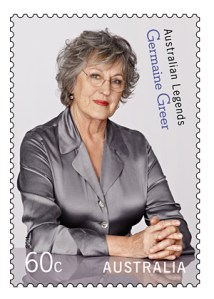
This has come at a convenient time for the Sydney Opera House events management team, who have now co-opted the debate and the threats of defamation made against me by Tankard Reist as advertising material for their upcoming event starring Germaine Greer and Naomi Wolf. This event is titled “The F-Word,” and up until the legal threat the organisers were worried that nobody was interested in feminism anymore. The resulting internecine wars have gone a long way towards cheering them up.

Any woman who believes she has the right to tell any other woman she may not call herself a feminist is engaging in an act of bullying. A woman may self-identify in whatever way she chooses. Others may disagree with her choice but disagreement isn’t the same thing as attempting to deny her the right to define herself as she sees fit.

There were at least twenty-seven different factions of feminism last time I counted, many with oppositional points of view. Hegemonic attempts to impose just one definition of the ideology as the norm on all women who would thus identify themselves, is antithetical to feminist principles.

In a situation where the group calls itself “feminist” and is but one of many groups identifying as such, on what grounds does this group assume the entitlement and privilege that allows them to declare all others ineligible?

The ongoing fights about who is entitled to identify herself as a “feminist” are a sad indicator of an ideology that is rapidly disappearing up its own fundament. For example, presented with a choice between engaging in public debate about the other issues the Reist defamation threats have raised, such as free speech, our defamation laws, the rights of bloggers and social media users, all of which are or would once have been considered feminist issues, the public feminists decided to ignore all that.

Then we have the pro Tankard Reist argument that she is an “authentic” feminist as presented here. Whenever someone uses the word “authentic” in an argument such as this I wonder why. To cast other feminists as “inauthentic” perhaps? The article is written by women who describe themselves as “radical” feminists. Are they also authentic? Have I fallen down a rabbit hole?

The battle for and against is two sides of the same struggle for sole possession and domination of the feminist narrative. A struggle that is founded on exclusion, expulsion, entitlement, privilege, and an appalling lack of imagination.

If I wanted to define feminism for myself, I would turn to bell hooks

Visionary feminism is a wise and loving politics. It is rooted in the love of male and female being, refusing to privilege one over the other. The soul of feminist politics is the commitment to ending patriarchal domination of women and men, girls and boys.

 At the risk of incurring the usual old anti feminist slurs, I’d suggest that any woman or group of women who seek to take possession of the term “feminist” are engaging in their own form of patriarchal domination, and one that we could all do well without.

I don’t know if Greer and Wolfe will be discussing any of this. But I am bemused as I watch a defamation threat made against me by a self-described feminist, turned into an advertisement for an Opera House event at which two of the planet’s most famous feminists will discuss the relevance of feminism. Irony, anyone?

Then there’s the furore about whether or not criticism leveled at Julia Gillard is sexist and misogynist. This is difficult. I’m of the opinion that there is a strong misogynist undercurrent, but I can’t prove it. It’s easy enough to find examples of male PM’s whose appearance is subject to mockery, and exaggerating physical appearance of politicians is the cartoonists’ stock in trade.

Gillard comes with baggage of the worst kind. Would the emotions surrounding that baggage have remained so powerfully alive had a man ousted Kevin Rudd? Is it worse when a woman does it? And if so, why? Is this a manifestation of unresolved mother issues from the time when many of us were under some woman’s thumb, and powerless? Does it hurt more when a woman does it because they aren’t supposed to?

Fascinating questions for an analyst of the collective psyche.

I do take issue with the argument that because she’s a woman Gillard has less authority. She has authority, and in my opinion that authority is both increasing and stabilising as she grows into her role.

Rather, there are those among us who resent a woman’s authority. We might like to reframe that as the woman’s regrettable lack of that quality, however I don’t believe that’s the case in this instance. Anyone who watched as Gillard calmly instructed her bodyguards to ensure Abbott’s safety on Australia Day can’t claim the woman has no authority. It’s innate.

The inability to accept and deal with a female authority figure  is often expressed in dismissive contempt.

In many ways turning the Gillard story into a gender argument is not helpful, even though misogyny is undoubtedly present and ought to be outed if possible. Nevertheless, a woman can’t win when gender becomes the focus of the debate, and Bob Brown didn’t do Gillard any favours by attempting to defend her. I doubt it’s a stoush the PM herself is eager to engage with.

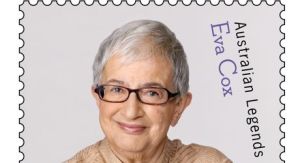
And so to the second feminist Australian Legend to be honoured by Australia Post, Eva Cox.

After referring to me as a nit-picking blogger in her article for New Matilda on whether Tankard Reist is a feminist or not, Cox later apologised for the insult.

However, as she then went ahead and published the same article again here I’ve come to the conclusion that her apology meant less than nothing.

It’s interesting being silenced from both ends of the feminist spectrum. Tankard Reist uses the law in an effort to control me. Cox chooses the arguably more subtle method of refusing to name me and dismissing my arguments at the same time. A man would be pilloried for using the same negating tactics against a woman writer.

Cox apparently has no objections to the law being employed to silence female dissent, which surprises me somewhat, but there you go. Tankard Reist has positively seized upon the law as an instrument of personal control, and has now resorted to the United Nations Declaration of Human Rights as well.

Then there’s this description of me and my kind made by Cathy Sherry, in her article defending Tankard Reist. I am, she writes, an  “unaccountable blogger sneering and abusing from the safety of [my] bedroom.” According to Ms Sherry, I’m not even worthy of an office simply because I blog. In a later comment elsewhere Ms Sherry refers to me as “faceless” as well, while Anne Summers refers to me simply as “a blogger”. Summers also apologised later.

How to explain this feminist contempt for female bloggers? One would think that blogging and feminism were made for each other. The blog offers an ordinary woman a voice where once there was a deep silence that has been broken only by a select few.

At the end of  three weeks of remarkable encounters with a variety of self-described feminists I have to conclude that because I’m unknown, a blogger, and entirely without influence I don’t count as a feminist or as a woman, and am to be shut up one way or another by a feminist who has more of a public presence than me.

I’m not unduly upset by all this, but I am very puzzled, as well as a little aggravated. I fear it says a great deal about where feminism is today, and it isn’t pretty. I fear it suggests that feminism has sold itself out to some of the values it once despised and resisted. I fear it’s going to be all down hill from here, if we aren’t very careful.

Feminism? In a pig’s feckin’ ear.

25 Jan

And yet another feminist in the msm makes it all about feminists.

And they’re even running  a poll about it.

Apparently feminism has been reduced to public spats about who has ownership of the brand. Feminism these days apparently no longer cares about much else. The co-option is complete.

Feminism, at least that faction of it that has a public voice, has now been entirely subsumed by capitalism. How the patriarchy must be cheering! Look at these feminists in these cat fights about who is allowed to be a feminist!

But we’re not complaining. While they fight about nothing, they aren’t focusing on us.

I’ve always had a wry little laugh at Bob Ellis when he sets to lamenting about the moral demise of the ALP. He shouldn’t take it so seriously!  But not anymore. It is heartbreaking to watch as a vision you believed in sells out to the degree that it is unrecognizable. To watch as it becomes the property of a handful of white middle class  women who figured out how to make a name and a living for themselves by being just feminist enough to gain a foothold in both camps.

Feminism was about equality, and that includes equality between women, not just equality with men. Feminism was about honesty, and shining intelligence, feminism was an analytic tool that was unique and adopted by many seeking to expose all kinds of inequality.

Feminism and feminists helped me save my own life.

And now?

It’s enough to make a strong woman weep. Weep, I tell you! Feckin’ bloody weep!

The f word, the virgin birth and the sword of Damocles

24 Jan

I love feminism in the way I love some of the insights and opinions attributed to Jesus. I love it in a bell hooks kind of way:

Visionary feminism is a wise and loving politics. It is rooted in the love of male and female being, refusing to privilege one over the other. The soul of feminist politics is the commitment to ending patriarchal domination of women and men, girls and boys.

So it was with increasing outrage that I watched the story of Melinda Tankard Reist’s legal threats against me hijacked by one high-profile feminist after another in an unedifying brawl about who can and can’t be called a feminist. Debates about feminism: yes. Debates about who is allowed to be called a feminist: why?

One of feminism’s struggles has been about giving women a voice. So it was initially with amusement and later indignation that I saw two of Australia’s most public feminists, Eva Cox and Anne Summers, describe me in their articles as a blogger  being threatened by Tankard Reist. Not even a female blogger, thank you very much, and Cox says I’m a nit picker to boot. She doesn’t name me, but she says I’m nit-picking. Any man who did that to a woman writer would be flayed.

I objected loudly to this, not as some might have it because I’m especially egotistical, though I could well be, but because this denial of my voice seems to me to exemplify a steady watering down of feminist principles, and perhaps, according to hooks’ analysis of contemporary feminism, a co-option by capitalism that has virtually disempowered it as a force for change.

Thus we are reduced to brawling in national newspapers about who can and cannot be a feminist, while the big issues raised by Tankard Reist’s action, such as freedom of speech, the politics of the economic power of one woman being used against another to silence her, are left to brilliant bloggers such as Scepticlawyer to unpack.

Interestingly, every other account of the stoush I’ve read in blogs and the MSM has named me. I become anonymous and stereotyped only in the leading feminists’ pieces. I am not well-known, therefore it isn’t necessary to name me in an MSM argument about feminists who are well-known. Yes. Capitalism has co-opted.

While I don’t believe that either Summers or Cox was being malicious, their failure to use a woman’s name in an article about feminism indicates a troubling forgetfulness as to what feminism is about.

Both women have since apologised for the oversight.

I’m receiving a steady flow of demands that I “get [my] facts straight” about the virgin birth. There are no facts about the virgin birth. There is no evidence. It’s a story. I’m as entitled as anyone else to interpret the story and comment on it. There’s a long feminist tradition of commenting on these stories and analysing them through a feminist lens. It’s but one of many options for analysis and it’s as valid as any of the others.  Contest my analysis by all means, but not by demanding “facts” that simply don’t exist.

It appears that Melinda Tankard Reist can legally hold her threat of defamation action over my head for the next twelve months without doing anything more than she has already done. If she so chooses, she can continue bullying, threatening and intimidating me for the next year, and theoretically curtailing my freedom to speak for that time, as anything I write can be co-opted into her list of grievances against me to be subjected to threats of legal action.

While I don’t care if Tankard Reist is called a feminist or not, I do find it interesting that she has chosen to employ patriarchy’s most oppressive and repressive tool, the law, against me. But what is even more interesting is that neither Summers nor Cox   has even remarked on this attempt to silence a woman with patriarchy’s weapons.

The last word by bell hooks:

I will not have my life narrowed down. I will not bow down to somebody else’s whim or to someone else’s ignorance.

This in the Age today: “Tankard Reist explain yourself.” A very informative piece about Tankard Reist’s background. I’m very, very glad this got up in the msm.

The editor, not the author called me “a blogger.”

Licensed to Kill

3 Oct

Defence Minister Stephen Smith’s decision to allow women to assume unrestricted combat defence roles has caused ethics Professor Clive Hamilton to despair that “it is time to sound the Last Post over the rotting corpse of feminism.” Hamilton goes on to argue that the pursuit of equality has brought us to a sorry state of feminist affairs when women, like men, are granted a license to kill. This step signals the “final annihilation of difference,” and the end of women’s role as a “subtle, civilising power that has always worked to restrain the violent tendencies of men.” Without much success, one is obliged to point out.

In order to earn a license to kill, women must prove themselves psychologically, physically and mentally up to the job, a job that is on offer only from that bastion of hegemonic masculinity, the defence forces.

There are many men who would not fulfil the requirements and indeed, would not wish to. I recall my sons singing to Tchaikovsky’s 1812 Overture, “Join the army get your balls blown off” whenever a recruitment advertisement appeared on television. Being licensed to kill isn’t for everyone, regardless of genitals.

Instead of throwing in the feminist towel at this strike for equal opportunity, perhaps it’s valid to note that licensing women to kill is recognition that some women are capable of acquiring and practising the violent arts, therefore the capacity for deadly violence is not gender specific. The Defence Department has, perhaps unwittingly, subverted culturally imposed gender roles of the kind espoused by Professor Hamilton that would have women incapable of or unwilling to perpetrate violence. The Department has now acknowledged women as trainable as men, should we choose to embark on that course.

We can’t have it both ways

I’m at a loss to see how debunking that particular gender myth can be anything but positive for everybody. The majority of women will not choose to earn their killing license, just as many men do not choose that path either. At least it is now acknowledged in public policy that women are human beings capable of a wide variety of behaviours including state-sanctioned killing, just like men.

This is in direct contrast to another Gillard Government policy designed to prevent violence against women and their children. This policy defines domestic violence as overwhelmingly perpetrated by men. The policy does not acknowledge that female violence against children and other women is of equal concern, despite increasing international research and anecdotal evidence that this is indeed the case. The designers of this policy seem, like Professor Hamilton, to be labouring under the misapprehension that women are not capable of violence because it isn’t in our nature. It is only in our nature to be victims and/or soothers of male aggression.

You really can’t have it both ways. Women either are or are not capable of learning to use violence, either from the state or from the influences of their environment and their genes, just like men. You really can’t have the Defence Department heralding this as equality, while at the same time the Office for Women portrays us as overwhelmingly victims and rarely perpetrators. You really cannot insist on contextualising women’s violence (when it’s actually admitted) while leaving male violence out there as if men are born bad and it’s their base nature.

If the Defence Department has shown us anything, it’s that they consider the ability to engage in deadly violence to be non-gender specific. If we are to accept that, we must accept women are equally capable of violence in other situations as well. Joining the armed forces isn’t going to cause the sudden emergence of a brand new aggressive characteristic in the human female. It’s going to nurture and nourish what already exists.

The feminist struggle for equality

The mainstream feminist struggle for equality has always been about escaping restrictive gender roles and that escape has been perceived as our liberation. It has always been about ensuring women have equal opportunity and that has been perceived as our liberation. Mainstream feminism has rarely interrogated the type of masculinity that determines the Western capitalist culture within which it has sought equality. Mainstream feminists have not sought to radically change this culture, but rather to find an equal footing with that specific masculinity, within its parameters.

Thus we have our first female Prime Minister who is determined to deny the human rights of women and children in her urgency to pursue entrenched masculinist policies of sovereignty and border protection. Such a goal is far from feminist, yet mainstream feminists were (and some still are) ecstatic that we have a female PM. How long will it take to grasp that ownership of a vagina does not a feminist make?

What’s gone wrong with the feminist debate?

What has gone badly awry in the equality debate is a shocking lack of clarity and truth. For a movement that railed against the destructive consequences of stereotyping women, we’ve certainly done more than our fair share with regard to both sexes, and this has brought us undone.

There is no such animal as “men” and there is no such animal as “women.” Such erroneous concepts are the foundational lie on which much equality rhetoric rests. It’s a lie feminists railed against on behalf of women, yet enthusiastically embraced when it came to men. It’s a lie Stephen Smith confronted and faced down, whether he meant to or not. This lie is what is bringing feminism to its knees, not, as Clive Hamilton would have it, women being licensed to kill, or vomiting drunk on a Saturday night just like the boys.

We are rightly outraged when all Muslims are cast as terrorists. We are outraged when all Indigenous people are cast as drunken child abusers. Or we should be. Yet we don’t bat an eyelash at the use of “men” and “women” by just about everybody who has something to say on the subject. “Women’s morality differs from men’s,” writes Professor Hamilton, for example. Both sexes ought to be outraged at this stereotyping. It is an untruth, as all generalizations are untruths. I am not Woman. I’m a woman. My “morality” is the product of all of my experiences and what I have made of them. Here’s a male ethicist prescribing my female moral life, while claiming to have feminism’s best interests at heart. What is wrong with this picture?

A common enemy

It’s rarely acknowledged that many women and men share the common enemy of hegemonic masculinity. Recognising that there are infinite ways in which we are all undone, devalued and dehumanized by this dominant form of the masculine would allow us to co-operate in its demise. Instead, hegemonic masculinity pits us against one another, and we co-operate by couching our grievances in terms of gender warfare. The debate ought to be couched in terms of the dominant masculinist principles to which some women are as bound as some men, and that disadvantage whole subcultures regardless of sex, though sex may determine the manner in which the disadvantage is enacted.

Mainstream feminists have embraced these principles, with the result that some women have successfully adapted to the institutions, and the institutions themselves remain intact and largely unchallenged. The goals and aspirations of the majority of people demand a capitulation to masculinist forces that govern every aspect of our Western lives from cradle to grave, forces that remain largely unchallenged by feminism.

Who’s going to take away their license to kill?

Issuing women with a license to kill is a formal recognition of women’s equal capacity for sanctioned violence. Equality within the status quo was the intention of mainstream feminism, not radical structural change. This move by Defence is entirely in keeping with feminist goals.

We were never going to be much more than tokens in the patriarchy, and we aren’t. This isn’t going to change until we stop being victims. We will never stop being victims until we acknowledge our full capabilities, including those for violence and harm. This is what finally liberates us from victim-hood: owning our capacity for behaviours that are collectively denied in women because our culture doesn’t want women to have them, and because when the chips are down neither do we. How much nicer to be romantically imagined as “those who pacify the beast” than as those who are complicit in the beast’s violent projects.

The Defence decision acknowledges that women are first human beings, capable of feeling and acting in ways that have long been regarded as exclusively male by the orthodoxy. While in the short-term this may result in what can seem undesirable female behaviour, in the long-term it will allow us a fullness of humanity we’ve been denied for far too long. Human beings can be violent, destructive and murderous. Human beings have to learn to deal with these impulses in ways that do not bring about devastation. This can’t happen if we continue to deny that the female half of the human race has these capabilities, in the face of mounting evidence to the contrary.

Women who feel liberated enough to publicly express violence will initially do so in destructive and copycat ways, and they will call it equality because male acting-out is all they have to measure themselves against. They’re quite right. Equality is exactly what it is. The right to be equally human, for better and for worse, is what any feminist worth her salt should work towards. We can’t cherry pick equality.

As long as violence sanctioned or not is perceived as gender determined, no society can adequately address its causes, its effects, and what can be done about it. Rather than gnashing and wailing that women are becoming as awful as men, we should be questioning the limited means of expression both sexes have within a hegemonic masculinity that depends for survival on strict gender roles. We should be recognizing that these expressions are determined and controlled not by “men,” but by a specific manifestation of masculinity that disadvantages and dishonours both sexes. Then we can really examine violence and war, not as fought by men or women, but as perpetrated and fought by human beings on and against other human beings.