
I’ve just heard a Radio National Science Show story that has stirred my imagination more than anything in a long time.
Robin Williams interviewed Canadian environmental activist, scientist and academic David Suzuki, who is the driving force behind a movement to have enshrined in the Canadian constitution a clause that states everyone has the right to clean water, clean air, and food.
One hundred and ten countries already have protection for the earth enshrined in their constitutions. Ecuador, Bolivia and Mexico have guaranteed protection for Pachamama, Mother Earth, in theirs. Suzuki, together with First Nations peoples, artists, musicians, and writers such as Margaret Atwood, are taking the Blue Dot Tour around Canada and having extraordinary success in their campaign to persuade cities and municipalities to adopt the Blue Dot Declaration for a Healthy Environment.
However, this isn’t merely a grand statement. So far fourteen cities, including Montreal and Vancouver, have committed to enacting legislation protecting the environment within the next two years.
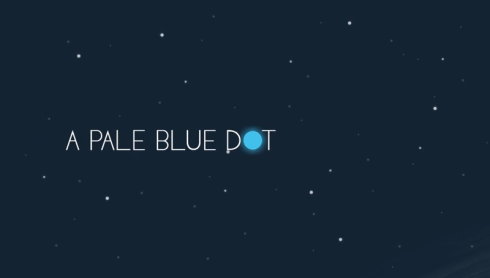
The Blue Dot Tour takes its name from the famous essay by Carl Sagan, written after Voyager I cameras were, at his suggestion, trained on earth. Our planet appeared as a pale blue dot in a sea of darkness. Here is an extract from Sagan’s essay:
From this distant vantage point, the Earth might not seem of any particular interest. But for us, it’s different. Consider again that dot. That’s here, that’s home, that’s us. On it everyone you love, everyone you know, everyone you ever heard of, every human being who ever was, lived out their lives. The aggregate of our joy and suffering, thousands of confident religions, ideologies, and economic doctrines, every hunter and forager, every hero and coward, every creator and destroyer of civilization, every king and peasant, every young couple in love, every mother and father, hopeful child, inventor and explorer, every teacher of morals, every corrupt politician, every “superstar,” every “supreme leader,” every saint and sinner in the history of our species lived there—on the mote of dust suspended in a sunbeam.
The significance of the proposed Canadian environmental protection legislation is considerable. The burden of evidence will shift from activists who currently must prove a developmental project will damage the environment, to developers who will have to prove it will not. Such legislative shifts immediately change the discourse, putting the well-being of Pachamama and the human beings living on her and with her before economic considerations and profit.
As Suzuki points out, without air we die in three minutes. Without clean air we become sick. Without water we die in a few days. Without clean water we become sick. Without food we die in a couple of weeks.
In NSW, changes introduced by the LNP government now determine that the “principal consideration” for decision makers such as the Planning Assessment Committee must be the economic benefits of the proposed mining project. The massive Shenhua coal mining venture in the Liverpool Plains, vigorously opposed by environmentalists and farmers for almost seven years, was given approval at the end of January 2015, after twice being knocked back, under this “principal consideration” change.
However, the matter is now before federal Environment Minister Greg Hunt, who has “stopped the clock” on the project until further investigation into the effects of the mine under federal government Water Trigger Legislation, which states that
Australia’s national environment law, the Environment Protection and Biodiversity Conservation Act 1999 (EPBC Act), was amended in June 2013, to provide that water resources are a matter of national environmental significance, in relation to coal seam gas and large coal mining development.
It will be very interesting to see how Greg Hunt handles this situation.
Those of us living on this part of the mote of dust suspended in a sunbeam could send an email to Greg Hunt, quoting the extract from the Carl Sagan essay above.





 No Place For Sheep
Recent Comments