Malaysian solution: Judge complains government case is “half-baked”

8 Aug

In the High Court hearing on the Malaysian solution this afternoon, Justice Kenneth Hayne reprimanded the Commonwealth Solicitor-General for appearing before him with a”half-baked” case. Considering the government’s frequently expressed confidence that it has all the legal bases covered in the matter of its expulsion of asylum seekers to Malaysia, it’s remarkable that they should have irritated the judge so early in the piece. Perhaps they are not as on top of things as they would have us believe. As pretending to be on top of things while flying by the seat of its pants  is pretty much par for the course for the Gillard government, one ought not to be surprised at the “half-baked” comment. Nevertheless, I was surprised to hear they are already in disarray.

Justice Haynes extended the injunction that prevents expulsion of asylum seekers until arguments on the lawfulness of the government’s actions can be heard by the full bench.

One of the points that will be contested is that the agreement with Malaysia, in which that country has undertaken to provide certain protections for the 800 asylum seekers from Australia, is a political not legal agreement, and therefore unenforceable. This casts doubt on Immigration Minister Bowen’s declaration, in which he unequivocally states that Malaysia is a safe destination where human rights and protections will be observed. As Malaysia is not a signatory to any UN Conventions, asylum seekers will not have the protection of international law either.

I wonder what effect these shenanigans will have on Australia’s bid for a seat on the Security Council, so single-mindedly pursued by Foreign Minister Kevin Rudd? Helped by some $10.5 million in promotional funding over the next two years?

Ministerial Declaration process corrupted by Gillard’s political and personal ambition

8 Aug

Lawyer David Manne and his team have succeeded in obtaining a temporary High Court injunction preventing the transportation of asylum seekers to Malaysia, planned for this morning. They will return to court later today seeking to extend the injunction, and to argue against the legality of the Gillard government’s Malaysia solution.

Manne’s team will argue that Australian law permits asylum seekers to request refugee assessment in this country, and that as the guardian of unaccompanied children, Immigration Minister Chris Bowen will be putting his charges in harm’s way and abandoning them if he sends them to Malaysia.

It’s been revealed that on July 25th, Chris Bowen made a Ministerial Declaration on the suitability of Malaysia to receive asylum seekers Australia refuses to process. In his Declaration Bowen claims that Malaysia is a safe destination, and that the country offers adequate human rights and protections, despite the fact that it is not a signatory to the UN Convention, and is globally renowned for its harsh attitude to refugees.

The government’s agreement with Malaysia was accompanied by considerable hype, however the Minister’s Declaration was nowhere mentioned, and was revealed only in the court action taken by Manne yesterday.

Ministerial Declarations are powerful instruments. The government believes Bowen’s Declaration is protected from being contested in the High Court, alleging that the Court has no jurisdiction to review these Declarations. Manne’s team will challenge the government’s position, and argue that the Court can and should review Bowen’s Declaration.

The danger with allowing this Declaration to stand is that in the future any minister can make any such Declaration about any country with impunity. Clearly there is plenty of evidence to contradict Bowen’s assertions about Malaysia. The Minister has ignored this evidence, and has made his declaration for purely political concerns. This is an abuse of power, and the raw exercise of political power for political gain is not the purpose of Ministerial Declarations.

What is most disturbing is that Malaysia is not a signatory to the UN Conventions that set the standard for the treatment of refugees and also of children, refugee and otherwise. The Gillard government refused to use Nauru as a dumping ground for asylum seekers, because that country is not a signatory either. Gillard took an ethical and moral stand on this. That stand is now revealed as a concern held for a nanosecond by the fake Julia – the real Julia doesn’t give a fig about non signatory countries if they’ll take asylum seekers off her hands.

Political expediency, and utter desperation at hideous polls, have corrupted Gillard and Bowen’s moral and ethical perspectives to the degree that not only are they now willing to use a non signatory country, they are also willing to abuse their power and to lie in a Ministerial Declaration, in the hope that they’ll shore up electoral support for their “solution.”

It’s a very dangerous situation when an individual minister can exercise this amount of power. That power can be, and some argue is currently being, exploited for the advancement of political and self-interest, with little regard for the human beings involved. No matter what your position on asylum seekers, this ministerial instrument of power should give you pause for thought.

If Bowen’s Declaration stands unchallenged it will mean that in theory, any minister can order the refoulement of refugees, despite our agreement with the UN to not engage in such practices. The present government can be grateful to John Howard for making this situation possible. In amendments to the Migration Act brought in by the Howard government, the Immigration Minister may unilaterally decide if another sovereign state  is considered suitable to receive asylum seekers. The law says the minister may declare that a specified country “provides protection for persons seeking asylum” and “meets relevant human rights standards in providing that protection”. The fact that the UNHCR has failed to support the Malaysian solution and has expressed concerns over the Malaysian government’s treatment of refugees is in conflict with Bowen’s assessment. The Howard amendment does not appear to require that ministers substantiate their declarations with evidence.

Some of the most recent boat arrivals have claimed fear of persecution in Malaysia on religious grounds however, Bowen’s Declaration pays no heed to these considerations, as he has declared that country safe. If his Declaration is allowed to stand by the High Court, we will know we are living in a country in which a government minister has absolute power that cannot be challenged, no matter if it is unjust, dishonest, self-seeking and corrupt.

These cynical moves by the Gillard government are beyond despicable. They are an insult to our democratic process, and to the trust we place in politicians to use the powerful legislative processes available to them wisely and compassionately. Instead, they have employed this instrument solely to advantage themselves, and as a consequence are putting the lives and well being of asylum seekers, including children, at risk.

One would hope that a minister would inform him or herself on all aspects of a situation before issuing a Declaration that is apparently uncontestable in law. This is the trust that we place in those to whom we award high office. Once that trust is betrayed, the fabric of our society is torn. Once that trust is abused, and political expediency and personal ambition are placed above the rule of law, our democracy is in deep trouble.

We can only hope the High Court is able to challenge Bowen’s Declaration, for the sake of asylum seekers, unaccompanied children, and all Australian citizens.

Bowen claims he believes it is safe for asylum seekers in Malaysia. Well, Tony Blair and John Howard believed there were WMD’s in Iraq. We know and knew at the time, that they based those beliefs on insufficient evidence because they didn’t want to hear the UN weapons inspectors’ reports that contradicted their beliefs.

The selective beliefs of politicians should not be allowed to take us into war, or to expel vulnerable people to countries where they are at further risk. In both cases, evidence was ignored in the pursuit of political gains. This story is becoming way too familiar in our political system.  We cannot trust politicians with the powers we give them, and those powers urgently need to be curbed.

Guns and God: Fred Nile says secular ethics led to Nazi atrocities

5 Aug

Christian democrat MP Fred Nile today claimed that the secular humanist philosophy on which he believes ethics classes in schools are based led to the worst Nazi atrocities of the second world war.

It’s unclear whether or not the Reverend Nile knows what secular humanism is, and it’s also worrying that he seems to equate Nazism with communism.

I find it difficult to see anything the least bit ethical in Nile’s attempts to blackmail the NSW government into dropping ethics classes from schools. But what is most puzzling is the Christian furore over these classes in the first place, and the insecurity that gives rise to it. This insecurity must be considerable if they resort first to Godwin’s Law.

Apparently Christianity is on such shaky ground in NSW that its proponents feel they must destroy anything they perceive to be the least bit competitive. Non-Christians are under attack. We have the school chaplaincy program trying to get converts, and telling our troubled young that Jesus loves them, and Fred Nile trying to quelch (is that a word? Did I just make it up? A neologism?) any alternative to Christian values. Actually, there are no alternatives, according to Fred. You can’t have ethics without Christianity. Where this leaves all the rest of the world’s religions, who knows.

I’m over these Christian types who try to impose their will on the rest of us. They have some nerve. I’ve met a few over the years and one thing that has always seemed incongruous about them is their reluctance to die. Yes. Faced with serious illness they do not want to go to God. They take as many evasive measures as those of us who think we’re looking at annihilation. I do not understand this. If you’ve lived your life in anticipation of the much better time you’re going to have after you’re dead, why put it off?

The linking of secular humanist philosophy with Nazi atrocities signals a new low in Fred’s fight. He’s always been an irritant, like something you get in your eye on a windy day. Elevated to his current position of power, he’s a menace. In NSW we are in the hands of gun-mongering lunatics who want every school child to learn how to shoot, and god- mongering lunatics who will break things if they don’t get their way. Guns and God. Now that combination should scare the bejesus out of any right-minded person.

The Daughter

5 Aug

Warning: disturbing content 
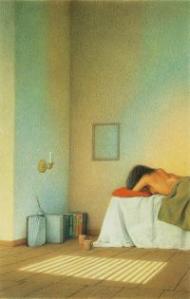
The daughter is back with her photographs. Searching, as she has through the winter and into the wet heat of summer, and still she hasn’t found what she’s looking for.

She wants to remember the man. She has only one image. It’s a photograph of him and her mother on their wedding day. When she thinks of taking the photograph out of its envelope, or even approaching the box in the cupboard under the stairs where it is stored, she feels an unpleasant churning in her belly. A vertiginous sensation, as if she’s not turning in time with world and could easily fall right off it.

She takes the brown envelope from where it lies separated from the other pictures. Then the photograph is in front of her. She’s taken it from its cover without any awareness of what she’s doing, and she’s placed it on the cream carpet in her cool, safe room where she sits in the lotus position, planning first to discover and then to tell herself the story of her life.

She stares at the ceiling. Her heart is too loud. She doesn’t want to look at the photo but she knows she has to. She feels like she felt the day she found a snake on its way out of the upstairs bathroom. The snake and she froze in place. After a few moments just staring, she crept backwards down to the kitchen where she found the metal dish cover they used to keep flies off food. She tiptoed back to where the snake had held its position, halfway across the threshold between the bathroom and the hallway. Slowly she lowered the cover and then, when it was in place, she leapt away as the snake understood it had been confined and began to thrash and spit.

She fetched her glasses, the better to observe and identify. She stared, with that fearful fascination typical of the enthralled. It was a long thin snake, its brown scales flecked with blue, and as it raised itself to strike at her she saw it had a pale yellow belly.

When finally she looks at the photograph she can’t see him. Instead she sees her mother. Her mother wears shoes with high thin heels, a wool coat that comes to the middle of her calves. There’s a small hat perched on the top of her head, over hair the daughter knows is very dark. She’s smiling, though it looks like a forced smile. Her handbag is over her arm and in the same hand she holds a pair of gloves. Her other arm is linked through her husband’s. I don’t know where my blonde hair came from, is what the daughter thinks about next. She thinks that thought for a long time.

Still the daughter doesn’t look deeply, instead skimming over the surface of the image like a dragonfly hovering nervously over a still pool. Maybe some murderous fish will leap out at any moment and take its small life, regardless of its future plans. The daughter has no desire to draw the man out into her present world but she does feel compelled to describe him, as if description is the first step towards making him real. This is a paradox: she knows she’s holding off the reality of him every day and night. It isn’t lost to her, far from it. She’s simply become adept at shutting it out.

If she can let him be real will she become real? Is this the price she has to pay to uncover her own authenticity? Can they still be so linked, after death and time and memory and forgetting have done their work?

The daughter is dizzy from shallow breathing. She looks towards the door that she’s left open in case she has to run. The Dog has draped himself across this threshold like a guardian at the gate. The sight of him reminds her of where and who she is. She whispers his name. His tail thumps on the floor but his gaze remains fixed beyond this room. A small growl escapes his throat. Who is he warning?

It’s very hot and still this January morning and she’s sweating in a light sarong and cotton blouse. She untangles her legs and lies flat on her back. She watches the daddy-long-legs drop from their threads in the corner of the ceiling and hang suspended in midair. There’s not the slightest breeze to disturb them. The photograph lies beside her and she’s careful not to look at it, or to let her hand touch its flat shiny surface.

After she’d trapped the snake she was at a loss as to what to do next. Alone in the house, she thought she’d better wait till Jane came home, as Jane is much more knowledgeable in these matters. Nevertheless, she felt compelled to go back to the scene every few minutes. Once there, she’d get down on her knees and put her face close to the spitting snake and stare at its small head and forked black tongue. Perhaps the power of her gaze might help her to incorporate the animal into the familiar, might rob it of its alterity, that disturbing aura of the utterly other, of being out of reach of any human appeal. She knew though, that what they had in common was life, and a blind impulse to live it, and she felt bad for imprisoning the animal, even though letting it roam the house was out of the question.

The daughter sits up and puts on her glasses. She leans over the photograph. She sees the man beside her mother is in his early thirties, tall and substantial, with thin, brown hair that falls across his forehead. She knows that when he is anxious or needs to connect himself again with his body, he runs his fingers through these strands of hair that lie across his forehead close to his eyebrows, and sweeps them away with a slight backward movement of his head. He has grey eyes. His face is well-fleshed and broad, and pleasant for those who look without knowledge. His teeth are discoloured from the unfiltered cigarettes he smokes. This habit has left his fingers stained. His nails are bitten to the quick. They are thick, stubby fingers stained brown. They are big fingers on big hands. He is a doctor and well liked in the small community in which he lives with his wife, and the child of his wife and another man. The child is ten. Her name is Angel. Her mother and this man call her by another name, but Angel is the name given to her by the grandmother the child loves most out of all the grown-up people in her world. When she is most lost and most afraid she whispers Angel to herself, and calls up the image of her grandmother.

Angel accepts the fiction that the fair man is her father though she is aware of some mystery surrounding her origins. She calls him “father” to herself and everybody else, until she is thirteen and he tells her otherwise.

Angel hears things in the night. The unforgettable sound of feet running down the hallway of the house, pursued by a heavier tread.
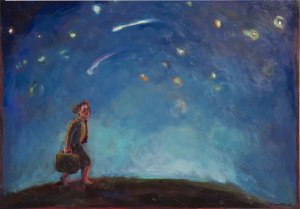
You lie in your bed, in your bed and your heart beats so loud you’re certain he’ll hear it. Your breath is so noisy, and you try not to breathe it. You slow down your heart and your breathing like a hibernating creature in a long dark winter. That, you believe, is the only way to stay alive in the circumstances in which you currently find yourself.

But will you ever learn to open up again? To let the heart beat to its own desires and the breath whistle carelessly through your body?

The day comes when he decides to do something he’s been contemplating for some time. The child is pretty, though not exceptionally so. More than that she is full of life, bright and intelligent with a wide smile and the skin that is the privilege of all young children, the skin one longs to stroke, like satin under the tips of the fingers. He likes the idea of having two females in his house available to him.  He chews on his fingernails as he sits in his chair drinking beer out of a pewter tankard and looking at his roses through the sitting room window. He brushes the hair out of his eyes and tosses his head. Then he chews his nails again till he draws blood. He isn’t contemplating doing anything wrong, he decides, giving fleeting attention to the morality of the situation. It has to be secret because other people will put their own interpretation on it. He gets angry just thinking about other people’s opinions on the matter. He gets defensive just thinking about someone else’s disapproval of him.

If he knows in his heart that he shouldn’t carry out this plan he stifles that knowledge. This is easy to do as his desire is great and outweighs every consideration his better nature might put forward. He has a better nature. He is a doctor, well liked in the town, he has healing hands. He has a better nature.

But his dark desire puts him beyond the reach of the ameliorating qualities of human love that would have him first consider the child. He pours another drink out of the bottle on the small table at the side of his chair, and lights another cigarette. He is not a man to deny himself his desires. He is a man with a sense of entitlement.

The phone rings. His wife calls him. He grinds out his cigarette and stands up, pushing the hair off his brow, adjusting his clothes. As he strides down the hall to the surgery at the side of the house, he puts his fantasies aside. By the time he’s reached the phone on his desk he’s become the doctor. He listens quietly to a patient’s concerns. He reassures, and says he will be there in ten minutes. He hangs up the phone. He gathers his bag, his stethoscope, the miniature torch he uses to look down sore throats. He strides out to the garage, gets into his car and takes out the packet of mints he keeps in the glove box. He puts two in his mouth and sucks on them. He’s thinking of the patient, what might be the cause of the sudden onset of high fever. He enjoys the regard in which his patients hold him. He won’t allow anybody to spoil that.

Sometimes while she was observing the snake, the daughter imagined fetching the shovel and decapitating it. But she was confounded by the logistics. How was she to keep the snake in place while she lifted the cage, put it down again on the floor, picked up the shovel and made ready to strike? How could she be sure the snake wouldn’t leap at her and sink its fangs into her cheek as she bent over and lifted off the metal cover? She paced the kitchen, thinking things through. She couldn’t settle to anything, knowing that snake was in the house.

She even thought she could let it bite her. She could take that irrevocable step into the unknown. She could alter the course of her life forever, in one instant. She could give in to the “unnameable lust.” She could. The decision was hers.

There’s a barrier between those who’ve known violence and those who haven’t. Behind this barrier Angel is, she fears, forever an outsider.

Her secret sets her apart. Dark knowledge taints her. She’s sullied. How will she ever make herself clean again? Once she sought to bridge this distance by confiding her experiences, only to see reflected back in her listener’s eyes her own confusion. Confessing something can sometimes make you feel worse than keeping it to yourself. Whatever is most difficult to tell. That is what counts.

If Angel reveals to you what she knows will she taint you in some way? Will she force into your life knowledge that can’t help but change the way you look at the world? Against your will, angering you, causing you to avoid her next time you pass in the street? Will she make you afraid of her because of what she knows?

The daughter experiences this barrier as a dense membrane, impenetrable, a thick sac in which she is enclosed and from which she attempts to look out at the world. The world seen through these membranous layers is always distorted, as if she’s looking through wet plastic, material that ought to be tangible, that she ought to be able to grasp in her hands, but can’t. If she could, it would be slick, like a foetal sac she must break through, kicking and tearing, in order to get out into the earth’s atmosphere and breathe for herself.

She sees the world coloured by her own experiences, as does everyone, but she doesn’t know that. For example, she looks at her friends and thinks that their fathers must do the same things. All girls must know what she knows, and part of what they know is that the knowledge must never be shared. They are all enclosed in their separate, thick worlds from which they gaze at one another with dull eyes. They will stay this way as long as they are in their fathers’ houses.

There is no clarity of vision from inside a membranous sac. The edges of things are always blurred, and boundaries are uncertain. You can’t touch anyone and nobody can touch you. Only the father can tear through and the layers separate for him and he enters and when he withdraws, the layers close over again, skin growing back, leaving no visible scar.
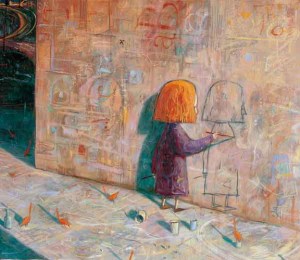
In referring to herself in the third person, Angel believes that she not only puts a distance between herself and her experiences, she creates herself as well. She brings herself into being. When she’s accomplished this, when she’s managed to construct herself, she’ll step into this borrowed figure, much as the hermit crab crawls into an empty shell and makes it her own by virtue of occupancy. Much as a bird settles into an elaborately woven nest and is then identified by the type of home she’s built, the materials she’s chosen, the way she’s arranged them.

When she speaks of herself in the third person she does it to ward off a certain pain that is always threatening to overtake her. Only in the third person can she find the courage to allow voice to the truths that sit on her shoulder, chattering and salivating like cast-out demons wanting back in.

She has no desire to think of herself as victim for the rest of her life. There must be a way she can stand with dignity in the midst of the sum total of her life’s experiences, denying none of them their due, resisting any attempt at domination by a single horror, granting equal value to all.

Though the January day is dripping with humidity, the daughter feels cold on the carpet in her room. Chilled to her very bones. She puts the photograph back in its envelope. She doesn’t know what she’s achieved by this exercise. She doesn’t feel any closer to having a real past than she did before, her head is aching and she feels sick. She whistles the Dog, he comes to her and rests his head in her lap. She buries her face in the thick white fur around his neck and inhales his dog smell.

After a while she thinks perhaps she might have put a tiny piece of her heart back where it belongs. That’s what it is, this painstaking process of singing in all the voices languishing on the outer edges. It’s the delicate job of putting a heart back together so it can die whole. She dare not die as she’s lived, bits of her scattered all over the place, forgotten, repressed, and denied.

Angel hears Jane’s footsteps as she enters through the upstairs door and sets her parcels down in the kitchen. The Dog sits up and makes ready to go to her, angling for a treat. If Angel follows him Jane will smile at her, and they will drink tea under the mango tree and watch the sun fall into the river, and pray for a thunderstorm to clear the stifling air. This is her ordinary life. This is the precious and ordinary life, given to her by Jane, that she never expected to have.

Eventually, on the day of the snake, she realised she couldn’t stay in the house any longer. Carefully, she printed on a piece of cardboard: Beware of the Snake. She propped this warning on the top of the stairs. Then she went out to buy chocolate.

When she got back, Jane was home, pulling on her gumboots and gardening gloves. She’d found a large sack. Together they went upstairs. Angel slowly lifted the wire cage and the snake wriggled out into the bag Jane held in front of it. Jane tied up the bag and they transported the thrashing snake to the bush at the end of their street. There they let it go.

‘Did you want me to kill it?’  Jane asked later as they drank tea and ate the chocolate, their reward for bravery and endurance

‘Nope. I just didn’t want it in the house. That bloody dog was useless you know. Didn’t even notice it.’

As a child the daughter’s nature was ebullient. It was hard for her to learn to disappear herself. It was hard for her to learn to think of herself in the third person.
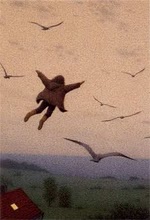
Orang-utans and boat people.

2 Aug

Guest post today kindly written by Gerard Oosterman, artist, farmer and blogger.

Rangas

Does anyone see the irony of the complaints by Malaysians about Australia’s treatment of Orang-utans at Melbourne zoo and the habit of caning people in Malaysia, or even more relevant, the treatment of our boat people in detention?

The latest news tells that a representative of a Malaysian Palm oil counsel had made complaints about the Orang-utans’ treatment at a Melbourne zoo. They were horrified about the Orang-utans being somewhat cold. They had heard sounds of sad crying and signals of distress from the animals. The Orang-utans were shivering and a picture was even shown of one of them carrying a coat. Melbourne Zoo retaliated and stated that the outside and inside temperature in their environments was kept at a cosy constant 20 celsius. “They are the happiest Orang-utans in the world,” they replied. http://www.abc.net.au/news/2011-08-01/orang-utans/2819534

At the same time, we are all being reassured that the latest boat arrivals to Australia that will be sent back to Malaysia will not be caned. We also are now being told on the news that those unwilling to board the plane back to Malaysia might be forced to do so with  full authority given to the Federal Police to use whatever they can muster for the boat people to comply.   There are lawyers busy on a formal protest about the possible use of force on people already traumatized.

Are we getting care for Orang-utans and people somewhat mixed up or confused? If the Orang-utans are the ‘happiest’ in the world, I wonder about the level of ‘happiness’ of boat people being returned to Malaysia.

The federal police have been given ‘carte blanche’ by our PM Julia Gillard to ensure the boat people would board the plane back to Malaysia. This, we were assured might involve whatever the federal police have at their disposal. This, it was suggested, could well include the use of ‘potential lethal force’ with no ‘blanket exemptions’ even for unaccompanied children. This lethal force has been used on Christmas Island already. We are not shy from using lethal force when it comes to boat people. Bean bag bullets fired from shotguns, batons, tear gas, capsicum spray, handcuffs, the whole arsenal at the Feds disposal has been used to force compliance on more than just one occasions. So far our treatment of boat people and refugees is not showing the world much about our compassion towards the less fortunate.

http://www.abc.net.au/news/2011-08-01/gillard-asylum-seekers-malaysia/2819786

While we don’t cane people in Australia, we are not far from it, edging inexorably closer. Not the cane, instead the possible use of electric Tasers or cattle prods instead. It could be debated whether being stunned by a Taser or bean bag bullet is better or worse than a caning. The concern by the Malaysians about treatment of Orang-utans in Melbourne could perhaps be best answered by giving a Malaysian delegation a grand tour of our own Australian refugee camps in isolated Australia’s outback and on Christmas Island. Let’s show them how we do it so much better, so much more humane!

I am not sure about the percentage of self harm by our zoo inhabitants including the alleged shivering Orang-utans but I bet it is a lot less that amongst our own boat people locked up for long periods, living in uncertainty, in isolation, behind gates, fences and barbed wire. The ombudsman had all the figures, mind numbing it was.

Was it fifty a day, twenty or was it a hundred a month or just a couple of real or attempted hangings daily? Did it include lip sewing, roof jumping, wrists slashings and hunger strikes? Razors for shaving are taken away after the shower. Just in case. All points of possible hanging are removed. Suicide has been made harder as well. It has not only become mind bogglingly numbing, it is now heart numbing as well. We just let it go on and we shut our hearts and prefer to focus on royal weddings or the passing of a bill in the US.

It’s getting harder and harder to push away images of the Holocaust whereby people were also traumatised and pushed onto transport by the use of force. Most countries are coping with refugees in the tens of thousands, some in the millions. Even overcrowded Malaysia is coping with over eighty thousand refugees registered with the UNHCR. We seem unable to just treat people like we do with the Orang-utans at Melbourne zoo. We are using the same jack boot methods that were so popular in dealing with another traumatised and defenceless people some seventy years ago.

One can just imagine within the next day or so, footage of boat people being herded by force into the plane. Journalists will have their cameras focussed and the world will again learn about us.

When did we lose our hearts?

Gerard blogs at  Oosterman Treats Blog

Gillard calls up the AFP: the act of a privileged,craven coward

2 Aug

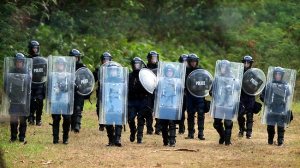
AFP on Christmas Island today

This is the photograph the Australian published today showing Australian Federal Police in full riot gear, in training on Christmas Island to prepare them to force any recalcitrant asylum seekers on board their flight to Malaysia.

This is the beginning of the vile trade in perceived worthy and unworthy humans that the Gillard government has entered into with that country.

It’s in the Australian’s interests to show up the Gillard government as one that has essentially lost control of border security and boat arrivals as part of the Murdoch press on-going anti ALP/ Greens/ Independents campaign.  So it is not surprising that the paper has suddenly acquired a conscience, and a compassion for asylum seekers that it did not exhibit during John Howard’s time as coalition Prime Minister.

Let’s not forget Howard’s overkill when he sent the SAS in full regalia to board the Tampa, when its captain had requested only medical assistance.

La plus çe change…

Gillard’s privilege

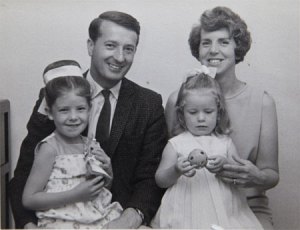
The Gillard Family

Julia Gillard, like many, many others who have made this country their home including me, came here as a child. Her family didn’t flee persecution, or a country torn to shreds by wars perpetrated by self-interested Western powers, in which the majority of the injured and dead are innocent civilians.

No, Julia Gillard’s family came from a peaceful Welsh village, and chose to immigrate to this country in large part to give Julia a better chance in life. She suffered ill-health, and doctors advised a gentler climate.

This privileged child now holds the highest political office in this country, albeit without a mandate.

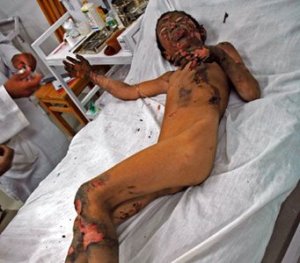
This is a child burned in a US/ Nato bombing in Afghanistan.
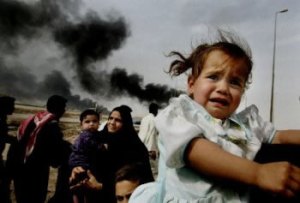

The difference between the privileged child Julia Gillard was, and this burnt, devastated victim of Western powers is nothing more than an accident of birth.

Unlike those who flee war zones and the multiplicity of dangers they face in such places, the Gillard family, or so Ms Gillard proudly tells us, came here the “right” way. The Gillard family were the “worthy” immigrants who wanted a better life for themselves and their children.  Families of children who are at risk from attacks such as those suffered by the child in this picture are the “unworthy” potential immigrants, even though they share the same goals and desires for themselves and their children as did the Gillards.

Families such as the one this injured child belongs to don’t have the privilege of doing it the “right” way, and doing it the “right” way is a privilege, let’s not forget.

These families do anything they can to get themselves or their children out. If they have money, they use it. So would I. And I’d like to meet one Australian who would not use every means available to them if their children or themselves were living in any of the countries the boat arrivals are fleeing.

In the Australian article, Gillard is quoted thus on the issue of expelling the unworthy humans to Malaysia:

“Obeying instructions here is not a question of volunteering,” Julia Gillard said yesterday. (Sounds like something they’d tell you when you arrive in hell. My comment.)

“People will be given an instruction to board a plane. We will be looking to people to obey that instruction. If it’s not obeyed, then we have security personnel, we have the Australian Federal Police, we also have counsellors available to talk things through with people.” 

Asylum seekers arriving by boat are not criminals. They are legally permitted to arrive by boat, and to request asylum in this country. Asylum seekers are no more illegal than was the Prime Minister and her family when they came to this country looking for a better life. The Gillard family, due to nothing more “worthy” or “right” than an accident of birth, were able to travel here knowing they would be able to realize their ambitions.

At the very least, one would hope that the recipient of such privilege and generosity would show herself capable of compassion for those less fortunate.

Setting the riot police on a handful of frightened, confused asylum seekers who have fled war zones is the act of a craven coward. It is the act of a self-interested, privileged  woman whose political ambition far exceeds both her common sense and her capacity for decency. It is a distasteful, disgraceful act that will bring shame on this country.

Gillard would do well to remember that history will record her role in these events as it has already recorded John Howard’s: with utter contempt.

The war you don’t see; Blair wows the msm, and the Malaysian solution becomes a reality

1 Aug

Whatever the criticisms of John Pilger, he has achieved the remarkable feat of keeping alive his indignation towards government and media manipulations and duplicities for decades. His recent documentary The War You Don’t See is no exception. I rather belatedly sat down to watch this yesterday.

Pilger takes the global media to task for its sycophantic coverage of the Iraq war, when journalists had to be embedded if they wanted to work for any of the mainstream press, and once embedded, were compromised as to what they could reveal and what they would have to conceal.

As with any account of events, current or historical, there is much truth to be found in the authors’ silences. What has been omitted and why is perhaps the first question a discerning reader needs to ask. In the case of Iraq, there are alternative sources such as Al Jazeera, independents and blogs and of course Wikileaks. Pilger has gone to these sources as well as interviewing big names such as Dan Rather  and a couple of very defensive and pedantic VIPs at ITV and the BBC.

“Well, it depends what you mean by the word links,” the ITV VIP argues, in a pathetically unsuccessful attempt at sophistry that serves only to confirm Pilger’s allegations of sycophantic bias. ‘Blair was very careful when he chose to use the word links,” the ITV Blair apologist continues, demonstrating in one sentence the entire Pilger thesis of conspiracy and collusion between government and mainstream media. (Of course, we know even more about this parasitic relationship since the recent Murdoch News of the World downfall. Say what you like, Pilger’s still on track.)

Under Pilger’s politely unrelenting pressure, these media bosses acknowledge their obsequience to their government in the matter of their reportage of the Iraq invasion, as well as WMD’s and chemical weapons allegedly held by Iraq and used, falsely, to justify the invasion.

The footage of the suffering of Iraqi people is horrific. Up to 90% of those injured and killed in this war are civilians. This is of course a reflection of the increasing sophistication of weaponry: in the first World War there were comparatively few civilian casualties. “Collateral damage” in wars has increased exponentially with the aggressor’s ability to bomb the living shit out of anything that moves.

As I wrote here this documentary was banned from screening at some events in the US and Pilger’s invitation to speak was revoked. Having watched it, I can see why it is perceived in some quarters as a threat, as it clearly explains the role of media as the servant of government  in the propaganda of war.

Alleged war criminal Tony Blair has been in Australia this past week, and has been predictably courted by over-awed mainstream journalists. Blair, a convert to Catholicism, is promoting a faith-based attitude to global affairs and has harsh words for secularists like Julia Gillard, who he seems to feel are missing the point.

Personally, I’m unable to take Blair out of the context of his slavoring admiration for  George Bush, and his lack of judgement on the Iraq invasion. There was plenty of evidence available at the time to cause any serious-minded political leader to pause and re-consider his position.

Blair, like John Howard, did not do this, and took us to war in spite of a great deal of opposition from their respective electorates. The consequences of this were and continue to be death, death, and more death with a very large dose of suffering thrown in.

Aren't I having fun?

The first fifty asylum seekers to be sent to Malaysia were intercepted yesterday. They will be taken to Christmas Island, and held for 72 hours for preliminary health and identity checks before being flown out.

As another example of how government propaganda works through information that is either omitted or collectively and consistently ignored, nobody wants to address the small matter of our laws. In domestic law, asylum seekers are permitted to arrive in Australia in any manner whatsoever, with or without papers, and to request protection while their refugee status is ascertained.

I would sincerely like to know why there is no move to rescind this law, seeing as we have no intention now or in the future of upholding it. Like the human appendix, it would seem to be a useless evolutionary remnant, and we should get rid of it in case it turns septic and poisons the whole system.

Apart from that, it is psychologically unhealthy for an individual or a country to exist in a state of cognitive dissonance. No good can come from it, and we ought to be lining up our laws with our actions if we don’t want consequences.

I would also like to know why asylum seekers who arrive by plane are not sent to Malaysia. Why do we have this two tier system in Australia, and why are we creating a two tier system in Malaysia? How to explain this peculiar attachment to promoting inequality amongst the world’s most vulnerable and desperate people?

Of course, I am asking the wrong questions, that is, the ones nobody wants to hear, but there’s nothing to be done except to keep on asking them.

Everybody knows that none of this has anything at all to do with asylum seekers and refugees per se. It is solely to do with “stopping the boats” in the desperate hope of shoring up the increasingly tenuous possibility that the Gillard government will survive the next election. Asylum seekers arriving by boat are collateral damage in this domestic battle. Strangely, many of them are already collateral damage as a consequence of the wars we’re involved in, in their home countries.

I guess there are just some human beings who can be damaged collaterally over and over again by the same people, and nobody thinks it matters.

Why?

The healing properties of the Dog, the moon and the stars

29 Jul

Last night I took a late walk with the Dog. Where I live it’s still possible to do that in safety.
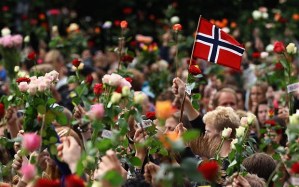

Though there’s a world heritage-listed littoral rainforest between me and the ocean, the seas must have been rough because I could hear a roar like an approaching tsunami from an ocean that generally offers a comforting background susurration to lull me to sleep.

The night sky was clear and it was cold. Dog trotted happily but slowly beside me as he’s old, and has a bad back leg.

Earlier in the evening I’d avoided my usual news fix. For the last couple days I’ve felt overdosed, satiated to the point of disgust by the self-regarding so-called cultural warriors who’s reaction to the Norwegian massacre has been to point ideological fingers and crow at one another as the terrorist Breivik’s influences were revealed in his manifesto as including various Australians.

This, combined with the mind-numbing repetitive exchange of insults between politicians that passes for serious debate on vital issues that have been stripped of any pretense to moral or ethical consideration, has left me feeling sickened and in urgent need of the healing properties of dogs, trees, stars, moon, beaches and the sea.

The Dog was taken in hand by one of our household very early in his life, and trained to refrain from chasing all living creatures, with the exception of cats. This household member, whom I will not name for all kinds of reasons, is outraged that cats in our little settlement are allowed by some irresponsible owners to run free at night, un-belled and murderous.

The problem is they kill the birds. We’ve gone to great lengths to plant native trees that feed birds, and mornings and evenings at our place are wonderfully cacophonous. It’s the first thing I miss when I’m away from home, the unrestrained brawls between the raucous parrots who manage to slander one another even as they hang upside down stuffing their beaks. Bit like politicians, really but far more beautiful and entertaining than that unimaginative rabble.

So Dog will merely twitch and stiffen if he encounters native animals, but when he comes across a cat, it’s on. Miraculously, he forgets his arthritic leg and takes off like a teenager after the same felines every night. He never gets anywhere near them of course, and that is not his intention. It’s the chase.

Dog knows he’s no match for a cat. Indeed, when he was young he was severely mauled by a ginger tom called Gilbert, who tore his nose to shreds and would have had his eyes out if the cat’s owner hadn’t scooped him up, yowling and flailing, and locked him in the laundry for the rest of the afternoon. Surprisingly, Dog didn’t suffer any obvious post traumatic stress after this beating, instead it apparently inspired him.

A brief listen to the news this morning is sufficient to tell me that nothing has improved overnight. The braying hysteria of Sarah Palin made my stomach lurch, so I turned it off and ate my toast and drank my tea in silence, except for the battle of the birds. Later I will take the Dog to Terry the Vet as he’s got a bizarre swelling on his ear that might be a tick. The Dog loves Terry and Terry loves him. He consistently refuses to charge me for anything like the services he provides. I asked him why he won’t let me pay him what he deserves?

“Because he’s a ripper dog,” Terry told me. “Ripper.”

I don’t know about anybody else, but for me unrelieved exposure to the political scene brings about kind of spiritual starvation, and I have to stop, withdraw, and reconnect with all my other dimensions. The political discourse is so pitifully reduced – where is the inspirational rhetoric, the moral vision, the desire to bring something good into the world rather than to just win an election?

The political discourse does not nourish us, indeed it frequently shames us, with its one-dimensional narrative that takes no account of complexity, and the human heart. One has to get away from time to time, or else become dulled and shriveled, forgetful of any other story. Like the ideologues who see in the Norwegian massacre primarily how it personally affects them and their ideology. They couldn’t even wait until all the bodies have been found, before making it all about them.

Ah well. There’s a moral in that for all of us. Go look at the stars, even if you’re lying in the gutter.


Anders Behring Breivik: terrorist or madman?

27 Jul

Flowers in Oslo

Since the news of the Norwegian massacre broke, the blogosphere and mainstream media have been engaged in understandably urgent efforts to make some sense of the weekend’s ghastly events. One of the methods employed is a semantic discussion as to whether or not the perpetrator ought to be identified as a terrorist, or a lone madman acting out his insane fantasies.

As some authors have pointed out, the term terrorist is largely used when the violent events are performed by Islamic fundamentalists. When the perpetrator is identified as white and homegrown, they are described as mad, lunatic, a lone wolf, or a crazy isolationist. Terrorism has become synonymous with Muslims, while attacks on civilians such as those carried out by non Muslims like Anders Behring Breivik,  Timothy McVeigh, or Jared Lee Loughner are constructed by the media and often politicians as the insane actions of a crazed loner.

In fact all three of these murderers of non combatants had a political agenda that to them justified their actions, and all three had a political and ideological goal – this is the definition of a terrorist.

The reluctance of the West to identify it’s homegrown aggressors as terrorists is symptomatic of a widespread Islamophobia that defines terrorists as Muslims. Islamophobes perceive Islam as violent, aggressive, and supportive of terrorism. Islam is widely associated with terrorism, by Islamophobes, unlike other major religions, and largely as a consequence of the 9/11 attacks on the US. The term terrorist when  used in much Western media signifies cultural and emotional associations with Islam, indeed it has apparently become a metonym for Islam.

That this is the case was proved beyond doubt when global mainstream media initially declared the Norwegian terrorist to be an agent of Al Qaeda. With no evidence and little information, prominent commentators in the popular press made this assumption based solely on the nature of the attacks. When the gunman turned out to be an “Aryan poster boy” who expressed a loathing of Muslims and identified with right wing Christian fundamentalists (as well as our own homegrown John Howard, Cardinal Pell, Peter Costello and Keith Windschuttle, all of whom are quoted admiringly in Breivik’s manifesto) this came as something of a shock to the complacent, and as it turned out ignorant, purveyors of media misinformation.

In an aside, the Windschuttle link above will take you to Murdoch journalist Andrew Bolt‘s blog. There you’ll find the headline “The new blood libel of the Left,” underneath which Windschuttle presents his response on hearing of Breivik’s admiration of him and the Left’s “gleeful” reaction to this.

In another aside, the contentiously anti semitic term “blood libel” was used by Sarah Palin when she attempted to defend herself against charges that her extremist right wing rhetoric had inspired Jared Lee Loughner to shoot Congresswoman Gabrielle Giffords. Giffords is Jewish.

What a tangled web.

Murdoch’s minion Bolt, one of the many public voices who rushed to judgement, declared when he discovered the killer had ties to right wing Christians that Breivik was not really a Christian. Presumably this is because Christians don’t carry out such atrocities, while in Bolt’s book Muslims do.

At this moment it is likely of little interest to the families and friends of the Norwegian dead, and to the injured survivors of Breivik’s monstrous attacks whether he is defined by the rest of the world as a terrorist or a madman. Those of us less directly affected are privileged to be in a state of mind that permits these speculations. While it makes no immediate difference to the agony so many people must be feeling, it is important that those of us who can do have this discussion: we owe it to the dead and injured, and to those who mourn, to ensure that the truth be spoken as best as is possible about the man who brought this misery and loss down upon them, and about the world in which he developed his anti-immigrant, anti-Muslim philosophy.

It is too easy to describe Breivik simply as crazed, though mentally unhinged he most certainly is. Breivik is also a terrorist. There is an argument that all terrorists are inevitably crazed, that the act of slaughtering civilians in the pursuit of a political and/or ideological goal is not the act of a sane person. Whether or not Breivik would meet the legal definition of insane is as yet undetermined but certainly colloquially there can be no doubt.

But that’s not the end of it. Breivik is also a product of the zeitgeist. Islamaphobia is everywhere. The beliefs that to him justified his rampage are everywhere. So widespread, so culturally embedded are they in the West, that his murderous actions were immediately attributed to the group he so powerfully loathed. It could only be Al Qaeda or its associates, for who else kills Westerners in a terrorist attack?

The irony is heartbreaking.

What we owe to the Norwegian dead and grieving is to seriously examine ourselves and the societies in which we live. While Breivik is an extremist and his actions are thank God extreme, scapegoating, anti-Muslim  and anti-immigration rhetoric and the beliefs that fueled his insanity are everywhere, and are increasingly normalized as they are sanctioned by the mainstream political system and the media that represents it.

We could start in our own back yards. For example, the Malaysian solution. Is it just a coincidence that the majority of the 800 asylum seekers we will send to Malaysia will be Muslim, while the majority of the 4,000 refugees we receive in return will be non Muslim?

Breivik did not kill Muslims, for all his hatred of them. He killed the young members of the Norwegian political party he believed was responsible for allowing Muslims into his country in greater numbers than was acceptable to him. He killed his own people. He is a domestic terrorist, like McVeigh and Loughner. Like McVeigh and Loughner, he is also crazy.

It can also be argued that any of these terrorists could have hung their craziness on whatever cause took their fancy, and this is also true. The impulse to slaughter and the capacity to act on the impulse is in their personalities. Politics and ideology did not make them into murderers. Politics and ideology offered them an avenue for the expression of their extreme violence and hatred.

As for the origins of that violence and hatred, we may never know. Many, many people endure difficulties and hardships in childhood and very few become terrorists. Many many people feel violent and hateful, but they do not act on those emotions. There are human beings whose pathology is inexplicable. But when there is a perfect storm of pathology and zeitgeist, the terrorist is born.

There is little we can do about the pathology.  About the zeitgeist we can do everything if we have the collective will. But we will need leaders who give a damn.

Why the Malaysia Solution could be a lose lose for Gillard

25 Jul

For a government phobic about “queue jumpers”, and a Prime Minister who said only a few weeks ago that the Malaysian solution would send boat arrivals to the “back of the queue,” they’ve certainly done a serious back flip today.

The 800 asylum seekers Australia is sending to Malaysia will be entitled to work, to health care and to education. None of these benefits are available to the almost 100,000 refugees already in that country, many of whom have been there for years.

Far from being sent to the back of a mythical queue, the 800 will be in a highly privileged position in the Malaysian system. Indeed, in theory they will be better off than the refugees held in indefinite mandatory detention in Australia as they will be allowed to live and work in the community while awaiting re-settlement.

There is of course no way of guaranteeing that the 800 will receive the preferential treatment both governments assure us will be afforded them. Once they are in the community they are at the mercy of a vigilante system that has demonstrated its hostility and aggression towards even those who carry the UNHCR cards that identify them as refugees. The 800 will be taking their chances on the streets, just like the other refugees. Singled out for preferential treatment, they may be even more vulnerable, and neither government has yet come up with a concrete plan to protect them.

Desperate people might well consider it’s worth the risk and get on boats anyway, especially if they believe they will be eligible for benefits like work, health care and education in Malaysia.

Even knowing that mandatory detention awaited them has not deterred asylum seekers from making the dangerous voyage to Australia: why then should they be deterred from persisting in their efforts to find a new life by the comparatively benign prospect of spending a few years in Malaysia, where they believe they’ll live a relatively normal existence while awaiting re-settlement?

The government’s efforts to “stop the boats” have today become farcical. Not that we needed one, but here’s another reason to mistrust the Gillard government’s judgement and integrity. If the 800 asylum seekers are treated badly in Malaysia, the deal will be like an albatross around the government’s neck, and place the opposition on fairly unassailable high moral ground. The “at least we know they wouldn’t be caned in Nauru,” sort of moral ground.

And if things go well for the 800 asylum seekers transported to Malaysia, there’s every reason to expect the boats will continue to arrive. After all, living in the community in Malaysia with health care, education and work sounds a whole lot better than war, terror, and persecution, or indefinite detention in an Australian hell hole far away from anywhere. Then the opposition will occupy the political high ground because “she hasn’t stopped the boats, has she and look how much it’s costing the taxpayer.”

Whichever way you look at it, there’s a strong possibility it’s going to be a lose lose situation for the Gillard government.