Scott Morrison and “diseased” asylum seekers.

28 Feb

Below is a media release  issued yesterday by Scott Morrison, Shadow Minister for Immigration and Citizenship.

Typhoid cases on latest boats highlight the risk of Labor’s border failures

Monday 27th February 2012

The confirmation of two cases of typhoid for asylum seekers on recent illegal boat arrivals to Christmas Island highlights again the risks and consequences of Labor’s failed border protection policies, Shadow Minister for Immigration and Citizenship, Scott Morrison said today.

“When illegal boats turn up in our waters there will always be the risk that people on these boats will carry serious communicable diseases. The more boats there are, the greater the risk of serious diseases presenting,” Mr Morrison said.

“Last year there were 56 cases of communicable disease from those who had arrived on illegal boats. These cases included everything from Tuberculosis and Hepatitis C to Chlamydia and Syphilis. These latest cases have now added typhoid to the list,” he said.

“Of greatest immediate concern is the risk to Australians living on Christmas Island, including children attending the local schools, as well those who come in direct contact with asylum seekers including our defence forces, Customs and border protection officers, federal police, detention centre workers, health professionals and immigration staff.

“These Australians have been living on the front line of Labor’s failed border protection for the past four years.

“Despite the best efforts of our health professionals and other officials responsible for dealing with these situations, there are no guarantees that the arrival of people carrying these diseases could not lead to an outbreak on Christmas Island or the transfer of these diseases to the mainland. This is the risk of failed border protection policy.

“In the past three months more than 2,100 people have turned up on 26 illegal boats. This is the highest number of arrivals over summer on record and 50% more than Labor’s previous record two year ago.

“Labor’s largest ever summer of boats followed their decision to introduce mainstream release of asylum seekers into the community, with support payments, free housing and set up packages worth up to $10,000.

“As long as Labor’s soft policies on our borders continue, these boats will continue to arrive along with the risks they carry, including people with serious communicable diseases,” Mr Morrison said.

The following communicable diseases were detected in immigration detention facilities on Christmas Island from 1 July 2010 to 6 May 2011 –

Diagnosis – Total
Chlamydia – 4
Dengue – 2
Gonorrhoea – 1
Hepatitis B – 10
Hepatitis C – 3
Malaria – 1
Pertussis – 1
Shingles – 3
Syphilis – 29
Tetanus – 1
Tuberculosis
(active) – 1
Grand Total 56
Source: Question on Notice, 11/12 Budget Estimates (BE11/0615)

A tale told by idiots

26 Feb

And so we enter the next stage of the Gillard/Rudd cage fight.

It’s nasty. It’s dirty. And despite Attorney-General Nicola Roxon’s political speak, Monday’s leadership challenge will not be the end of it, no matter which contestant triumphs. In a valiant effort to shut the stable door after the horse has bolted, Roxon is now calling for everyone to get behind whoever wins. Yes. I can see that happening. They’ve all demonstrated their capacity to focus on the big picture, haven’t they?

We are witnessing a clash of egos. It’s likely that anyone who seeks to lead a government is going to need exceptional self-belief and both Gillard and Rudd have demonstrated they’ve got it in spades. Remember Gillard announcing Rudd’s ousting with the revelation that the government had lost its way and she was the messiah who was going to get it and the country back on track?

Then this week we have Rudd telling us that only he can save us from an Abbott-led coalition government, to which Roxon responded that we ought to stop being fanciful about messianic rescuers. Of course she didn’t add, only if they were Rudd.

Neither of the contestants is messianic. They’re both more than a little shabby, and tainted by circumstances of their own making. If anyone is depending on either of them to save the country from Tony Abbott, they’re going to be very disappointed.

There’s a monumental battle going on to claim the high moral ground, when it ought to be about good governance. The level of vitriol directed at Rudd by Wayne Swan, Simon Crean and others is alarming: suppose Rudd does win tomorrow, or at  later date, how are they going to work with him? Have they all forgotten why they were elected? Man up, people. Stop whining about the demon Rudd and get on with your jobs. The world is full of people who don’t get on with their bosses. Most of them have to just suck it up.

This can’t be the first government to endure serious tensions, but they usually don’t get into this disgraceful self-eviscerating state about them.

As if that isn’t enough, the populace by far prefers Rudd to both Gillard and Abbott. It’s a reckless politician that denies the popular will, especially with this history behind it.

The overthrow of Rudd was bound to end in tears. What a pity those who dreamed up that scheme lacked the foresight to predict it’s inevitably long-lasting and complex repercussions. There seems to be an alarming disconnect between the government and the people, one that began when Rudd was ousted without much explanation. It’s a bit late now to wash that dirty linen, and it also looks rather after the fact.

Gillard may well be more capable of facilitating the daily business of governing the country than Rudd proved to be. Rudd may well be streets ahead in popularity, and perhaps this does indicate he stands a better chance against Abbott in 2013. That depends on what he does between now and then, should he win tomorrow. If his return to the leadership causes widespread revolt and ministerial resignations that’s only going to play into Abbott’s hands. This doesn’t augur well for Roxon’s preferred solution, and as she has already stated that if Rudd offered her a portfolio she wouldn’t accept it, one has to wonder just what she’s on about. While Rudd may be difficult, some of the others don’t sound so straightforward either. They also sound a long way from making the best of it and getting behind whoever wins.

This morning Education Minister Peter Garrett announced he wouldn’t work in a Rudd government. Who do these people think they are? Elected representatives, that’s who they are, and they aren’t elected to refuse portfolios.

If Gillard is returned, she and her camp can be accused of yet again ignoring the will of the people, who’ve demonstrated in the polls they want Rudd back, and more, didn’t want him thrown out in the first place. Somehow, Gillard will have to turn around those who are resentful, feel cheated, and don’t want her as leader when it comes time to fight the next election. One can imagine how Abbott will use this “denial of the will of the people” narrative against the ALP.

The only winner of tomorrow’s contest is likely to be Abbott, I fear. Serves the ALP right, I also fear. But pity the poor punters. We’re the victims in this farce. Not Rudd. Not Gillard. Not any of those precious pollies who just couldn’t find a way to work with their boss. They should have tried harder, shouldn’t they? Because they are probably going to pay the ultimate price for ousting him when they become the opposition in 2013.

This is truly a tale told by idiots, full of sound and fury, signifying nothing.

Another little break

18 Feb

I’m off for week’s holiday this morning, so my visits to Sheep will be intermittent, depending on when my household let me have access to my laptop! I’ve been banned from use of social media on a daily basis for the week.

And for my regular commenter Hypo, I’ve done everything necessary to retrieve you from spam so you shouldn’t have any more trouble.

Have a good week.

Forgiveness and human rights: a response to Charles Griswold

15 Feb


Part One

In which I argue the nature and purpose of forgiveness from a secular perspective, that is, from a horizontal, inter-human position, rather than the vertical, theological position of divine forgiveness and grace. I argue against the appropriation of forgiveness to the service of a philosophical discourse, and for multiple understandings and practices of forgiveness that are not reliant either on philosophy, or religious belief.

Must we not accept that, in heart or in reason, above all when it is a question of ‘forgiveness’, something arrives which exceeds all institution, all power, all juridico-political authority? Jacques Derrida

So let us speak of the mystery of forgiveness. Forgiving is imperative…it is extremely difficult to forgive. I don’t even know if forgiveness exists. Hélène Cixous

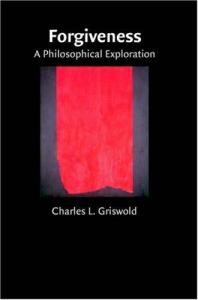
In his 2007 philosophical exploration of forgiveness, Charles Griswold, Professor of Philosophy at Boston University, states that forgiveness should be understood as

…a moral relation between two individuals, one of whom has wronged the other, and who (at least in the ideal), are capable of communication with each other. In this ideal context, forgiveness requires reciprocity between injurer and injured. I shall reserve the term forgiveness for this moral relation. All parties to the discussion about forgiveness agree, so far as I can tell, that this is a legitimate context for the use of the term; and most take it as its paradigm sense, as shall I.

A further definition of forgiveness is ‘…first and foremost the foreswearing of revenge…and of the other abuses of resentment.’ This definition will be implicit throughout my argument, but not in the context of its application being restricted to the paradigm of ideal conditions proposed by Griswold.

Griswold also states that his inquiry is secular, however within that stated secularity he has constructed a dogma, a system of principles and tenets authoritatively laid down, as by a church. Failure to attain the requirements of these principles and tenets results, Griswold claims, in exclusion from the possibility of forgiveness: ‘Where none of the conditions is met, the threshold of what will count as forgiveness is not crossed; sadly, and painfully, in such cases we are either unforgiven, or unable to forgive,’ he claims.

I explore the ramifications of this prohibition primarily from the perspective of the injured, and suggest that it is an extremely serious matter to cast either the injured or the injurer as beyond the ameliorating possibilities of forgiving and forgiveness, whether this is done under the umbrella of philosophy or religion.

I’m going to argue that the most appropriate context for discussions of forgiveness is within an embodied discourse of human rights. I’m also intrigued by what Judith Butler describes as the ‘…moral predicament that emerges as a consequence of being injured’ and from that argue that forgiveness is both a practical and an ethical necessity, and that it is the victim’s privilege, task and responsibility.

As well, I argue against Griswold’s belief that the perpetrator’s remorse is necessary for forgiveness. I also claim in opposition to Griswold that the attitude of perpetrators to their victims can and frequently must be irrelevant to the victim’s decisions about forgiveness.  We need a paradigm of forgiveness that is based in the embodied experiences of the injured, rather than defined as an abstract ideal to which the injured must aspire.

I don’t know what forgiveness is, though I’ve spent many hours thinking about it. Some say that it’s a state of grace that comes without announcement. Some say it’s a calm, in which there’s no ill will, and perhaps no thought at all. Some say it’s when you know something has ended and move on, without even really noticing

None of my propositions comply with the requirements of a concept of ideal forgiveness, whether that is theological or philosophical. They are a consequence of my experience of injury, and the subsequent profound moral dilemma I experienced. This dilemma is centred on the quite natural desire for redress and revenge, and the possibility of becoming a perpetrator if I act on this desire.

While Griswold’s definition is a legitimate context for the use of the term forgiveness, to declare this context the ‘paradigm sense’ taken by ‘most’, is to exclude from the experience of forgiveness millions upon millions of the injured who, for various reasons, are denied or legitimately shy away from the possibility of communication with their injurer. I argue instead for a much broader understanding of forgiveness, one in which unilateral forgiveness, that is, forgiveness that does not require the co-operation of the perpetrator, is included in the forgiveness paradigm.

I do this because injuries after which there is a possibility of ‘reciprocity’ are likely to be less common than those in which the perpetrator is unavailable or unrepentant. Such latter injuries can range in nature from the offended householder whose freshly painted wall is vandalised by unknown graffiti artists, to the victim of sexual assault whose rapist cannot be found, to the survivors of genocide whose tormentors are dead or unidentified. That is, circumstances which Griswold casts as ‘non-paradigmatic’, for example ‘…forgiving the dead or unrepentant…’ are likely to be more frequent than instances in which the injured and injurer are capable of communication and resolution.

As well, Griswold situates his argument ‘…in the ideal…’ and circumstances extraneous to this ideal are described as ‘…lacking or imperfect relative to the paradigm.’ If the circumstances do not fit Griswold’s ideal paradigm of dyadic forgiveness due to their failure to comply with the necessary ‘…baseline conditions…’ then, he claims: ‘…you are not engaged in forgiving, but doing something else.’

Below ideal baseline conditions for legitimate entry into Griswold’s country of forgiveness: ‘…may lie excuse, or condonation, or explanation, or any number of psychological strategies from rationalisation to amnesia…’ In other words if I assert that I have forgiven my perpetrator without having entered into communication with him, and without the benefit of his expressed remorse, then I am deluding myself.  Griswold elaborates: ‘…just being in the psychic state of no longer feeling resentment…whether that state is induced by medication, therapy, an astonishing act of will, an ostensibly religious revelation, or what have you,’ is not, he claims, sufficient to qualify as forgiveness.

As any survivor will attest, there is no such thing as ‘just being’ free of resentment: the struggle to overcome that feeling and everything associated with it is enormous, frequently ongoing and often demands more than just one ‘astonishing act of will.’ There is also a considerable difference between being medicated, and exercising one’s will. This argument for what forgiveness is not and why it is not is unconvincing, as is any argument that concludes an extensive list of unrelated generalisations with the phrase ‘what have you’.

The construction of an ‘ideal’ that is exterior to the imperfect human condition, complete with prescriptives and prohibitions for its attainment, is not entirely dissimilar to constructing a theology, not least in that both demand an original act of faith and belief in the existence of a fixed transcendental, from which subsequent thinking ensues. While the secular as proposed by Griswold is firmly disassociated by him from the religious, their prescriptive, exclusionary, and monolithic discourses are remarkably similar. For example: ‘…we count the capacity to forgive – in the right way and under the right circumstances – as part and parcel of a praiseworthy character,’ states Griswold. Who are the ‘we’ represented here, by what authority and process do they determine the ‘right way and circumstances’ for forgiveness, and how and by whom is the praiseworthiness of character determined?

The phrase ‘right way and circumstances’ inevitably makes reference to a metaphysical authority that ultimately determines what is praiseworthy and right, unless Griswold is assuming this authority for himself.

In a paper titled ‘Derrida, Death and Forgiveness,’ Andrew McKenna observes that Derrida

…claims to find in Western Philosophy a crypto-theology. His analyses regularly uncover presuppositions about foundations and primacies, points of origin and authoritative presences that correspond to nothing other than a Supreme Being, however veiled or unapproachable.

It is just such a crypto-theology that Griswold has constructed in his philosophy of forgiveness, in which forgiveness is perceived first and foremost as an ideal concept located in the authority of an unidentified exteriority, and one that the imperfect human being must struggle to attain.

In claiming the necessity for a sovereign ideal that must create notions of lack, imperfection, exclusion and failure, Griswold is describing a vertical concept of forgiveness that can be seen as largely irrelevant to the temporal and inter-human experience of suffering and forgiveness, as viewed through the secular lens, and through the horizontal discourse of human rights. Human beings are most usefully served, I would argue, by considering forgiveness not as an ideal whose conditions one may fail to meet, and perhaps through no fault of one’s own, but rather as a universally accessible, cosmopolitan practice.

To be continued.

When it’s ethical to disclose your religious beliefs

11 Feb

I grew up in a nominally Christian household. I was educated at a boarding school run by Anglican nuns. As a young mother I had my sons baptised. Soon I’ll attend the baptism of my infant grandson.

In my early thirties, I ceased to believe in the Christian God and organised religion. A few years later feminism gave me the analytic tools to deconstruct religion and reveal it for the powerfully oppressive force it can be for women.

I look back to my time with the nuns with great gratitude, but I no longer subscribe to their beliefs.

What I learned about being a Christian is that a follower is expected to live his or her faith. It isn’t some abstract concept that is trotted out on Sundays. It’s supposed to imbue every aspect of life, every action the believer takes is to be taken in God’s light, and when a Christian encounters difficulties of any kind, a Christian prays to God for guidance and sustenance. No matter what one’s profession, one is expected to perform it as a Christian, according to Christian values.

I don’t know if all Christians learn this, but we certainly did.

Followers are also expected to identify themselves in the hope that others will “see their good works and glorify their father in heaven.” And, hopefully, join the religion.

These seem to me a commendable set of expectations. Transparency, honesty, willingness to share, and to extend invitations to others to join you in what you believe to be the best way to live a life here on earth.

As long as they remain strictly invitations.

So I am entirely unable to comprehend the attitude held by Melinda Tankard Reist that her religious faith distracts from her work and she doesn’t want to talk about it for fear of being “labelled.” Labelled what, I’d like to ask. Labelled Christian? How and why does Tankard Reist believe that being labelled as a Christian distracts or detracts from her work?

In an interview with Reist on Mia Freedman’s website mamamia is this observation: Ms Reist herself has said in the past that she is reluctant to discuss her stance on religion because people tend to use it to ‘colour’ the rest of her work.

My understanding is that a Christian is supposed to “colour” their work, indeed colour their whole lives with the presence of God. Why is this “colouring” regarded as negative by Reist to the degree that she is reluctant to discuss her religious views and appears to distance herself from them when the question of their influence on her work arises?

In the same interview a comment from Herald Sun journalist Jill Singer:

Worst of all, in my view, is that Tankard Reist protests robustly if anyone dares question what it is that informs her strongly held opinions. Specifically, she gets very, very edgy if anyone dares suggest her Christian beliefs influence her opinions.

If you are proud of your beliefs, and are living a life based on them, why would you become “very, very edgy” if anyone suggests those beliefs influence your opinions?

As she is a Christian we can legitimately expect that Reist comes to her morality influenced and guided by the morality of her faith. If this is not the case, then one has to wonder what kind of Christianity she practices, as the concept of a Christian who is Christian in everything other than her morality is somewhat baffling.

When Reist in her role as the morals police seeks to influence public morality and public policy, it is entirely reasonable for her audience to ask if her morality is influenced by her Christian beliefs. Christians have very specific moral positions. They are not all the same, and unless Reist reveals what hers are, we can only make assumptions. To claim, as does Reist, that her Christian beliefs are in some way different from her moral campaigns and can’t be discussed as they will “distract” from those campaigns, is more than a little bizarre.

Ethically, Reist is required to reveal how her Christian beliefs influence her opinions.  The public is not required to sit meekly by and unquestioningly accept a social order likely designed according to Christian morality, particularly if that morality is in some way concealed.

My Christian upbringing taught open-ness, pride, and joy in that faith. The idea that faith would detract from a moral message is simply incomprehensible. Does one build compartments, then? In here my faith, in there my morality and the two have no relationship?

The ethics of the situation are obvious. If Tankard Reist is a practicing Christian then there is no doubt that her faith guides her moral values. If she has a relationship with God in which she seeks through prayer advice and instruction on her work, as Christians are required to do, then she is ethically obliged to disclose this.

If she is seeking to morally prescribe for the public then we need to know if she does this in conjunction with her relationship with the Christian God, or if she is acting entirely alone.

Why? Because there are millions of us who do not believe in that God and do not wish to be forced to live our lives subject to any Christian morality. We have a human right to live free of religion and the imposition of religious morality.

We have the right to ask, is Tankard Reist acting in the best interests of human beings or in the service of her God? Because the two do not always coincide. The bottom-line with just about all religions is what many of the followers perceive to be God’s will, and not necessarily the welfare of human beings. We have overwhelming evidence of this priority.

If anyone seeks to morally prescribe from such a position, I am entitled to know that and to make my decisions accordingly. In those circumstances it is, to my mind, completely unethical to refuse to discuss one’s relationship with religion and its influence on one’s very public work.


Greer at the Opera House, Eva Cox, Julia Gillard and MTR. Feminism today. *Sigh*

7 Feb

There’s been a debate raging in the media for over three weeks now as to whether or not morals campaigner Melinda Tankard Reist’s claim to be a feminist is legitimate. Some of the arguments are addressed here and here.

This has come at a convenient time for the Sydney Opera House events management team, who have now co-opted the debate and the threats of defamation made against me by Tankard Reist as advertising material for their upcoming event starring Germaine Greer and Naomi Wolf. This event is titled “The F-Word,” and up until the legal threat the organisers were worried that nobody was interested in feminism anymore. The resulting internecine wars have gone a long way towards cheering them up.

Any woman who believes she has the right to tell any other woman she may not call herself a feminist is engaging in an act of bullying. A woman may self-identify in whatever way she chooses. Others may disagree with her choice but disagreement isn’t the same thing as attempting to deny her the right to define herself as she sees fit.

There were at least twenty-seven different factions of feminism last time I counted, many with oppositional points of view. Hegemonic attempts to impose just one definition of the ideology as the norm on all women who would thus identify themselves, is antithetical to feminist principles.

In a situation where the group calls itself “feminist” and is but one of many groups identifying as such, on what grounds does this group assume the entitlement and privilege that allows them to declare all others ineligible?

The ongoing fights about who is entitled to identify herself as a “feminist” are a sad indicator of an ideology that is rapidly disappearing up its own fundament. For example, presented with a choice between engaging in public debate about the other issues the Reist defamation threats have raised, such as free speech, our defamation laws, the rights of bloggers and social media users, all of which are or would once have been considered feminist issues, the public feminists decided to ignore all that.

Then we have the pro Tankard Reist argument that she is an “authentic” feminist as presented here. Whenever someone uses the word “authentic” in an argument such as this I wonder why. To cast other feminists as “inauthentic” perhaps? The article is written by women who describe themselves as “radical” feminists. Are they also authentic? Have I fallen down a rabbit hole?

The battle for and against is two sides of the same struggle for sole possession and domination of the feminist narrative. A struggle that is founded on exclusion, expulsion, entitlement, privilege, and an appalling lack of imagination.

If I wanted to define feminism for myself, I would turn to bell hooks

Visionary feminism is a wise and loving politics. It is rooted in the love of male and female being, refusing to privilege one over the other. The soul of feminist politics is the commitment to ending patriarchal domination of women and men, girls and boys.

 At the risk of incurring the usual old anti feminist slurs, I’d suggest that any woman or group of women who seek to take possession of the term “feminist” are engaging in their own form of patriarchal domination, and one that we could all do well without.

I don’t know if Greer and Wolfe will be discussing any of this. But I am bemused as I watch a defamation threat made against me by a self-described feminist, turned into an advertisement for an Opera House event at which two of the planet’s most famous feminists will discuss the relevance of feminism. Irony, anyone?

Then there’s the furore about whether or not criticism leveled at Julia Gillard is sexist and misogynist. This is difficult. I’m of the opinion that there is a strong misogynist undercurrent, but I can’t prove it. It’s easy enough to find examples of male PM’s whose appearance is subject to mockery, and exaggerating physical appearance of politicians is the cartoonists’ stock in trade.

Gillard comes with baggage of the worst kind. Would the emotions surrounding that baggage have remained so powerfully alive had a man ousted Kevin Rudd? Is it worse when a woman does it? And if so, why? Is this a manifestation of unresolved mother issues from the time when many of us were under some woman’s thumb, and powerless? Does it hurt more when a woman does it because they aren’t supposed to?

Fascinating questions for an analyst of the collective psyche.

I do take issue with the argument that because she’s a woman Gillard has less authority. She has authority, and in my opinion that authority is both increasing and stabilising as she grows into her role.

Rather, there are those among us who resent a woman’s authority. We might like to reframe that as the woman’s regrettable lack of that quality, however I don’t believe that’s the case in this instance. Anyone who watched as Gillard calmly instructed her bodyguards to ensure Abbott’s safety on Australia Day can’t claim the woman has no authority. It’s innate.

The inability to accept and deal with a female authority figure  is often expressed in dismissive contempt.

In many ways turning the Gillard story into a gender argument is not helpful, even though misogyny is undoubtedly present and ought to be outed if possible. Nevertheless, a woman can’t win when gender becomes the focus of the debate, and Bob Brown didn’t do Gillard any favours by attempting to defend her. I doubt it’s a stoush the PM herself is eager to engage with.

And so to the second feminist Australian Legend to be honoured by Australia Post, Eva Cox.

After referring to me as a nit-picking blogger in her article for New Matilda on whether Tankard Reist is a feminist or not, Cox later apologised for the insult.

However, as she then went ahead and published the same article again here I’ve come to the conclusion that her apology meant less than nothing.

It’s interesting being silenced from both ends of the feminist spectrum. Tankard Reist uses the law in an effort to control me. Cox chooses the arguably more subtle method of refusing to name me and dismissing my arguments at the same time. A man would be pilloried for using the same negating tactics against a woman writer.

Cox apparently has no objections to the law being employed to silence female dissent, which surprises me somewhat, but there you go. Tankard Reist has positively seized upon the law as an instrument of personal control, and has now resorted to the United Nations Declaration of Human Rights as well.

Then there’s this description of me and my kind made by Cathy Sherry, in her article defending Tankard Reist. I am, she writes, an  “unaccountable blogger sneering and abusing from the safety of [my] bedroom.” According to Ms Sherry, I’m not even worthy of an office simply because I blog. In a later comment elsewhere Ms Sherry refers to me as “faceless” as well, while Anne Summers refers to me simply as “a blogger”. Summers also apologised later.

How to explain this feminist contempt for female bloggers? One would think that blogging and feminism were made for each other. The blog offers an ordinary woman a voice where once there was a deep silence that has been broken only by a select few.

At the end of  three weeks of remarkable encounters with a variety of self-described feminists I have to conclude that because I’m unknown, a blogger, and entirely without influence I don’t count as a feminist or as a woman, and am to be shut up one way or another by a feminist who has more of a public presence than me.

I’m not unduly upset by all this, but I am very puzzled, as well as a little aggravated. I fear it says a great deal about where feminism is today, and it isn’t pretty. I fear it suggests that feminism has sold itself out to some of the values it once despised and resisted. I fear it’s going to be all down hill from here, if we aren’t very careful.

The second letter.Tankard Reist claims human rights abuse.

7 Feb

to Dr Jennifer Wilson

“You have in your published writings pointed to the fact that child abuse is a transgression of several articles of the Universal Declaration of Human Rights and have called for domestic law to give effect to a charter of rights. You are no doubt aware that the Universal Declaration of Human Rights powerfully affirms the right to honour and reputation. Article 12 provides that “No one shall be subjected to arbitrary interference with his privacy, family, home or correspondence, nor to attacks on his honour and reputation. Everyone has the right to the protection of the law against such interference or attacks.”

You should reflect upon the fact that you have seriously flouted your obligation to uphold the Universal Declaration. Would you care to be described publicly as “deceptive and duplicitous?”

Australian law protects Ms Tankard Reist against your breach of her rights, through the law of defamation. It is an imperfect protection, because it cannot require you to retract or apologise for your breach.

The only remedy the law provides is the right to obtain a judgment declaring that what you wrote was false, and an award of compensation. If you will not retract, the law will protect our client’s rights.

Without prejudice, we note that our client’s aim in this is not to bankrupt you. She would much rather you came to your senses and realised that a person who wishes to be taken seriously as a social commentator, who has pretensions as a scholar of human rights with a PhD should check their facts, and not indulge in flights of libellous fancy. If this matter can be resolved by negotiation resulting inter alia in a correction and apology, that would be far preferable to the expense of proceedings in the ACT Courts.”

Rick Lucas, Colquhoun Murphy.

A little break

1 Feb

I’m taking a few days away with family till next week, so probably won’t be online much.

Enjoy yourselves, everyone, and see you in a little while.

A woman’s response to authentic feminism.

30 Jan

The ABC invited me to respond to an article by Melinda Tankard Reist’s publishers, Susan Hawthorne and Renate Klein, on the ABC Religion and Ethics website. Their article was titled The authentic feminism of Melinda Tankard Reist.

Here’s my response

I haven’t entered into discussions as to Melinda Tankard Reist’s eligibility to be identified as a “feminist,” let alone an “authentic” one as defined for us by her publishers, self-described radical feminists Susan Hawthorne and Renate Klein.

I believe this straw-woman argument has diverted attention away from the more important issues of free speech and bullying that are inevitably raised by threats of defamation action. These issues affect many more people than does the somewhat narcissistic obsession with whether or not someone is a feminist.

I’m slightly taken aback at the authors’ vigilante assessment of my legal situation, expressed in their claim that I posted “defamatory statements.” They disagree with my comments, therefore my comments are defamatory. They apparently have no need to wait until a case is argued in court. (There is a very comprehensive analysis of the situation thus far written by a UK lawyer.)

Faced with the authentic radical feminist determination to take possession of the narrative before it has hardly begun, I am quite glad of the law.

Hawthorne and Klein point out that “misinformation, falsehoods and rumours” about Tankard Reist’s religious affiliations have been around for some time (since 2007 in some instances) and that they have been concerned about this “over many years.” (I’ll go into this at some length, as it is the heart of the matter.)

I’m not aware of Tankard Reist taking steps to correct this claimed misinformation? That would have prevented it being re-published by people such as myself. Had there been denials, I certainly would have included them in anything I wrote.

The most recent information available when I wrote the offending blog was a November 2011 television interview with ABC journalist Jane Hutcheon, in which Tankard Reist claimed when asked that she did not wish to discuss her religious beliefs as she feared such discussion would distract from her work. She did not say how or why.

Tankard Reist didn’t take the opportunity to counter years of what she claims is misinformation when Hutcheon invited her to clarify her religious views, and their effect if any on her work.

Neither did she avail herself of the chance to set the record straight in her interview with journalist Rachel Hills in January 2012.

We now know Tankard Reist is a Christian, and there is no doubt that she did work for Catholic Brian Harradine for twelve years as his bioethics advisor. During this time the former Tasmanian senator used his power to prevent aid agency AusAID from supplying reproductive education, abortion services and birth control to women in underdeveloped recipient countries (with serious repercussions for women who wished to have access to these denied services).

All this information is published on the blogs Unbelief.org (now inactive) and that of Leslie Cannold, along with a brief history of Reist’s career and early life, and her long association with a variety of conservative Christian groups. This latter is verifiable through conservative Christian sources such as Salt Shakers, evangelical Christian Bill Muehlenberg, the Australian Christian Lobby, the anti-choice lobby group Women’s Forum Australia (of whom Reist was a founding director) other sources on the web and in State Public Libraries.

There is no “misinformation” in the biography on Cannold’s blog. There are no rumours. There are no falsehoods. What, then, are these “falsehoods, rumours, and misinformation” that so trouble Reist and her publishers?

The first time I learned anything was amiss was when I received a letter of demand from Tankard Reist’s lawyer on 14 January 2012, stating that his client is not a Baptist.

I am of the opinion that if someone is aware of misinformation circulating for years, is repeatedly questioned about it and does absolutely nothing to contest it, then they really have no grounds for complaint if others believe it to be true. So I was rather surprised to receive this letter.

I was even more surprised to receive a second letter reiterating the threat, and referring to “false claims” made by other bloggers. The only “false claim” identified by the lawyers as a source of grievance is our statement that their client is a Baptist.

Is the identifier Baptist defamatory? Was she a Baptist when the biography was published? If we had all simply said “Christian” would none of this happened? Are you confused? Does anybody care, other than Baptists, perhaps, who might take umbrage at their faith being perceived as potentially defamatory material by another Christian.

Then there is the considerable amount of material that has nothing to do with either Unbelief.org or Cannold’s blog, material that documents her conservative Christian associations over a period of years. This includes the articles written by her for, among other groups, the Endeavour Forum.

The Forum began life as “Women Who Want to be Women” and its mission statement reads: “Endeavour Forum was set up to counter feminism, defend the unborn and the traditional family. (‘A feminist is an evolutionary anachronism, a Darwinian blind alley.’)” Now there’s a friendly environment for an authentic feminist!

None of this need matter much. What matters is transparency and credibility, both absolutely vital for a person claiming the moral authority to exert influence over society’s sexual behaviours and values. And Tankard Reist most certainly claims moral authority.

On the question of abortion, when reading Hawthorne and Klein’s arguments we see their inclination to conflate: because some abortions are traumatic, all abortion is suspect. In the case of Tankard Reist, because a very small number of women she interviewed had a stressful emotional reaction post the procedure, all abortion is bad for all women and will inevitably lead to mental health problems.

A hard decision is also a choice. Women have to resist the maternalistic efforts of radical and authentic feminists to prevent us from exercising our right to make hard decisions and choices about abortion. Women must resist any efforts by these feminists to deny us sovereignty over our bodies. Women have the right to fully live our lives, and that must include learning to live with regret, or living unconcerned, or sometimes being on a continuum between the two.

I also take issue with the authors’ description of males as “men who are ‘free’ to act whenever they are ‘unable to control’ their sexual urges and must have the latest hit of porn.”

This is a profoundly disturbing statement, and gives insight into the contempt the authors apparently feel towards men, whom they seem to perceive as a dangerously unruly, abusive and sexually crazed homogenous mass.

We should demand that Hawthorne and Klein clarify exactly who are they talking about? To which demographic do they refer? My sons? Men I love? Men who are my friends? Men I respect as colleagues?

This gender prejudice appears again when they claim in reference to abortion: “sex is often coercive.” There are likely very many women who find themselves in need of an abortion not after “coercive” sex, but after loving consensual sex. What evidence do the authors have that abortion is often the result of men “coercing” women to have sex?

Sometimes some men coerce some women. It might be more useful to speak of these things truthfully, instead of using the stereotyping and dehumanizing rhetoric of extremism and polarization.

Tankard Reist could have at any time approached me about the problems she has with anything I’ve written. She has a public platform much larger than mine, where she could also have voiced her objections. Instead, she has gone first to the law as a means of silencing a woman who has questioned her publicly for over two years without ever receiving a response.

We may or may not have an authentic feminist here, but we most certainly have an authentic feminist issue.

It’s also worth noting that I have a very small blog and I am not a public figure. Threatening legal action to force me to remove the post has resulted in the content being plastered all over the media, in Australia and overseas. Literally thousands of people have visited the blog and read the post, only because legal action was threatened.

Hundreds of blog posts have been written on the threatened action from any number of perspectives, because it touches on a variety of deep and globally shared concerns.

Dialogue, had Tankard Reist been willing to enter into it, would have been a better, more honest and more discreet way to address the situation. Dialogue would have protected Tankard Reist from the unpleasant exposure she’s currently experiencing. That scrutiny will intensify if the matter proceeds to court.

Perhaps Tankard Reist believed I would be intimidated into cowering compliance by legal threats and that I would maintain a frightened, obedient silence. If this is the case, that belief alone speaks volumes.

This is a cautionary tale for those who would threaten anyone who is a member of an online community. Perhaps Reist and her lawyers naively assumed I wouldn’t tell my cyber community what was happening to me.

Within seconds, the story was tweeted around the globe. This immediately resulted in the so-called “Streisand” effect in which the information someone has sought to restrict becomes even more available, entirely as a consequence of the action taken to restrict it.

With the explosion of social media, it’s no longer as easy for those with a public profile and access to money to safely issue legal threats designed to intimidate an unknown and entirely un-influential blogger into silence.

Canberra Times journalist Crispin Hull looks at the costs of such actions, and supports my apprehension that I will be financially ruined if I defend an action.

Is Tankard Reist an “authentic feminist” as Hawthorne and Klein claim? I will leave this to others to decide, if they consider the effort worth their while.

Riffing in the Lismore Pharmacy. A story by Maria Simms

30 Jan


Christmas cheer had eluded me when I walked into the tinsel festooned Lismore pharmacy. In fact I’d been feeling dispirited for some time. Isolation on a steep bush block, distance from friends, lack of city buzz, and a bad case of writer’s block had got to me. My lifelong desire to find myself at the pulse of a literary cultural life, or by this time any cultural life at all, had taken on a Quixotic quality without the romance of that eternal dreamer tilting at windmills from his wobbly horse. I was over grappling with heat and floods and weeds and reading about hugely successful writers in the weekend newspaper supplements.

The vista of Christmas glitz; the press of the sick, the anxious and depressed milling about at the prescriptions-out counter and the clamour of carols billowed towards me. The service number slip I’d been holding so optimistically seemed to droop as I sidled along a row of shelves towards the prescriptions counter passing creams promising relief from everything – ingrown toe-nails to inflamed joints and herpes. I have to admit I was almost enticed by tiers of chocolate boxes offering more tangible and immediate satisfaction.

Emerging triumphant from my bout of weakness near the chocolates I turned the corner at the end of the shelves and there she was, a glorious creature from head to toe. She was sitting in one of two white, plastic chairs carefully positioned for the tired and feeble opposite the crowded counter. I made for the empty chair next to her. Dark beseeching eyes and a vulnerable smile greeted me as she wriggled further onto her chair in a show of making room for me. A vacant seat in a pharmacy crowded with exhausted Christmas shoppers? And next to an exotic trannie? I had my Christmas miracle.

She wore a slim t-shirt above tiny shorts with fashionably tatty edges. Endless golden legs were tucked neatly under the chair. There was a hint of sequinned sandals. Around her face long black (extension aided) hair was caught in a thick fall that couldn’t disguise the beginning of male-pattern balding at her thinning hairline.

We sat beside each other in silence for a minute or two.

‘I love your earrings.’ The husky voice.

The thick paste of pancake was applied well with just a hint of prickle beneath it. Eyeliner formed a kohl shoreline around limpid eyes. Lipstick, discreet not garish, framed largish white teeth.

‘Thank you.’ I felt the earrings to remember what I’d pushed into my earlobes before I’d left the house. Ah, yes. The rough stone and odd shape. ‘Turquoise and silver,’ I said. ‘I always like it. Bit Navajo don’t you think?’

‘Definitely Navajo, Mexican too,’ she replied.

And there it was. The language was banal but the sub-text was something else – like a musical riff sending a frisson through the players.

The musician, Rikky Rooksby,describes a riff as ‘a short, repeated, memorable musical phrase, often pitched low on the guitar, which focuses much of the energy and excitement of a rock song’.* In academic circles it might be called a discourse, a language that holds the key for entry to its world. A bit like the language and tacit understandings needed to penetrate the world of the British upper class, or medicine, or journalism for that matter.

She and I knew this particular language!

Ours was a riff born in the inner cities where sub-cultures have developed numerous tribal cadences. This one I knew from the Sydney theatre scene in the late 1960s where transvestites and gays flouted conventional society as they’d done for eons, certainly since Socrates, condemned by some 550 judges, shlupped on his sandals out of a court in Athens. Found guilty of corrupting Athenian youth with provocative ideas he preferred downing hemlock to being silenced.

‘They look lovely on you,’ she said referring to the earrings.

It was my turn.

‘And the aquamarine around your neck is beautiful,’ I replied, truthfully. Seeing it brought to mind, fondly, the first boyfriend, a surfing, prize-winning pastry-cook with a crazed mother. He’d given me the ring. Aquamarine.

We were firing now – the banjo scene getting underway in Deliverance.

She hooked a finger under the chain and held the stone towards me. ‘It belonged to a friend of mine who’s passed. I wear it for her.’

AIDS? I wondered. So many taken by it. There was a pause – a bit like the silence for the fallen in RSL clubs. Then I pushed on. ‘The blue does look wonderful against your skin. You have lovely skin.’

Yes,’ she said. ‘It’s the Samoan in her.’ This reference to herself in the third person may have been part of her patter, or a slip of the tongue, but I suspected it was more like a test. Would I pull away, she was asking me.

She stretched out a leg. We both contemplated the burnished gold from thigh to foot. ‘I’ve got some Samoan in me,’ she repeated.

My arm rested in my lap, next to her leg. Freckled skin, the scourge of my life.

‘I wish I had some Samoan in me,’ I said.

There was a beat while she made a decision. She took another risk.

‘Well …’ she said, slowly at first, perhaps a lead-in tease, ‘that could be taken a different way.’

This to an older, ordinary looking woman she’d never met before. I admired her daring.

‘I knooww,’ I said, claiming the innuendo I hadn’t intended or even seen. Well, reader, I was rusty. It’d been a long time. But the idea of a young Samoan lover made me laugh. It made us both laugh and I suppose that’s when our riff really hit its stride.

For me it thrummed with a song from the past – a heady mix of theatre and the social and cultural upheavals sweeping Sydney in the late 1960s and 70s.

Here, for you, the reader, I can expand on what in the Lismore pharmacy was just a sense of that past lifting its head and shaking itself off. Fragments of it play like disjointed scenes from a Fellini movie. The theatre sequence began in 1967 at an evening spent sitting on planks at what had to be one of the earliest plays staged at The Pram Factory in Melbourne. (I remember it as a halting exposé of domestic dissatisfaction – rough around the edges, dimly lit, hard to hear, but determined at the core.) Then back to Sydney to the thrill of America Hurrah at The New Theatre with police standing by to rush the actors off to the clink for writing ‘cunt’ on the stage wall and holding large nude, vagina pink I’m told, puppets. My dear friend, Carole Skinner was in it, and in another transgressive production she told me she was worried about revealing her ‘bum hole’ to the audience as, having cast off her chastity belt, she climbed, naked, up high platforms onstage! (It was the first time we’d met.)

Which brings another fragment into focus. I was enthralled by the esoteric weirdness of late night performances at Martin Sharp’s Yellow House. This is where Carole, who was to become an iconic Australian actor, played Mae West trailing pieces of A4 paper stuck together around the tiny performance space left at the centre of the room by we onlookers squashed around the walls.

‘Don’t … step on … m’thesis,’ she said, so close to me I could have nibbled her earlobe.

Before this I’d found my way to the Ensemble Theatre where they were walking the talk of ‘method’ acting and I was hooked by this revolutionary approach – as so many were before and after me.

While I studied I did bits and pieces: a minor job on Hair; sweating in a huge felt costume (hot as a sauna) in a Commedia play under a tin roof at Christmas; being onstage with vital props and occasionally an actor missing; dancing with two left feet in ABC operas; a play I’m told I was in at The Wayside Theatre in Kings Cross, but can’t remember at all. I do remember being surprised at an invitation to participate in a workshop run by the famously experimental Polish director, Jerzy Grotowski, and his troupe. No English on their side, no Polish on ours. We gawked and ducked while they emitted grunts and sudden squeals and made great leaps across the bare room and tumbled over our heads.

A Midsummer Night’s Dream swept into Sydney like a new broom. Peter Brook’s production with actors on trapezes swinging high on a white set and Hugh Keays Byrne beating his chest as Snug and roaring through the audience in his lion suit, was inspired. John Bell’s version, his first play after arriving back in Sydney from London – had a warm-voiced girl from Barbados playing the most beautiful Titiana I’ve ever seen.

Leonard Cohen brought his orchestra and shared his vision of life in bitter/sweet songs of laughter and longing with his wonderful violinist uncle stepping into the spotlight to wrench wild gypsy music from his violin. Dust motes rising like soaring spirits. And Buffy St Marie, a native American Indian blacklisted in the US by Lyndon Johnson, played her throbbing songs of resistance and compassion to a packed State Theatre. And all the while Dylan’s endless tambourine was banging out the new era.

And police were banging on open doors to terrace houses where music poured down noisy, crowded hallways and out into the night. I remember two of them coming in to drink a beer and gaze curiously at a culture they couldn’t be part of before thanking us politely and pushing off. And the sweet sad chemist/actor (I see him again now that I’m writing about a pharmacy) stretched out so often on the lounge-room floor of the Paddington terrace I shared with artists and a soon to be screenwriter/editor, playing ‘Norwegian Wood’ over and over again while people stepped across him.

(The soon to be screenwriter/editor was Galia, then soon to be, Hardy. She married Alan and together they birthed Marieke You’ll Be Sorry When I’m Dead Hardy! How do you describe a friend’s intelligence, talent, wit, and generosity of spirit without it sounding like a hagiography? I’m not even going to try.)

On a darker note there was the bedroom at Taylor Square painted entirely black by a gay costume-designing predecessor who must have had hopes for its power to inspire. It certainly inspired hope in a large, well-known actor I knew who fancied himself as a Marlon Brando type. Using the pretext of wanting to be shown around the house he pushed me onto the bed when we got to the top of the stairs and lay on top of me, still and stealthy in that black-walled cocoon, as if the soft pressure of his weight on me would be persuasive. Galia’s arrival saved me. I’ll never forget my joy at hearing the front door slam and her voice calling up the stairs.

And finally, enter my life’s mate, young, tall, slender, exquisite. Directing black comedies and enticing me with his talent.

‘I’ve had my eye on a little number down there by the perfumes,’ she said, low voiced, leaning towards me to indicate the section of the pharmacy she meant.

It was hard for me to pick the alluring little number out in the crowd as I craned my neck for a better view.

‘I’ve been hovering around the perfumes to get a closer look,’ she said.

‘Were you trying some of those perfumes on yourself?’ I asked.

‘Yes, I was. Can you smell them?’

We both laughed.

‘You know Rihanna? She’s …’

‘A singer. I know.’

She stopped for a moment … a classic double-take … then continued.

‘Well, she’s just put out a perfume called Reb’l Fleur. It’s gorgeous.’

‘Hhmm … I’m not really one for perfumes,’ I said, hoping not to sound negative. This wasn’t the place to mention that you could walk into any house in our family wearing perfume and everyone in it would drop dead from allergic anaphylactic shock.

‘I know just the one for you,’ she said, undeterred. ‘It’s called Giorgio. By Armani.’

‘Ah, Giorgio,’ I breathed – both ‘g’s soft – the Italian way.

‘Giorgio,’ we crooned together, loving the sound.

And our riff ended there, both of us hitting the same warm note, in the Lismore pharmacy.

The assistant called her name and she left her seat for the counter where she stood with her long legs tucked together as neatly as she could manage and her tall body scrunched over to look smaller, more feminine I suppose, as she bent down to sign her prescriptions. Would she say goodbye I wondered. But she walked off … to where? What was happening in her life? Did she live around Lismore?

A woman I’d noticed standing nearby came to sit in the vacated chair. A nice enough looking county woman. Tidy, greying hair. As a gesture towards Christmas festivity she’d donned a red top and white, calf-length, elastic waisted, nylon pull-ups. The kind we of a certain age buy at Katies to accommodate our girth and our atrophied bits, sensitive to chaffing. Thick sandals suggested painful feet.

‘Well,’ she said, voice pursed, ‘if she was any taller she’d break.’

‘Lovely skin,’ I replied.

We stared ahead.

A bronzed hand appeared around the end of the shelves and squeezed my shoulder.

‘Goodbye darling,’ she said.

I clasped my hand over hers.

‘Goodbye, darling,’ I replied.

And then she was gone – the rebel flower!

______________________

* Rooksby, Rikky. Riffs: How to create and play great guitar riffs. San Francisco: Backbeat Books. pp. 6–7

© Maria Simms

Dr Maria Simms is a published novelist and short story writer who has worked as an academic for many years. Her crime novel, The Dead House, won the New Holland Genre Fiction Award. Maria has been a general editor; lecturer in creative and academic writing; head of a large university academic study centre; and director of university continuing education programs. In an earlier incarnation she worked in theatre and graphic design. Her interests include creative and academic writing, textual and cultural theory and Australian history with an emphasis on the place of women in the narrative of Australia. She loves a good yarn and hearing about the lives of people she meets.

Maria is the managing director of WordCraft Consulting, a company specialising in academic, business and creative writing. She can be contacted at: maria.simms@bigpond.com