Thrilling deconstruction of Prince’s performance in the above video from Daniel Ralston here

The question “Why doesn’t she just leave” continues to be asked of and about women who live or have lived with domestic violence.
Aside from practical considerations such as ever-decreasing government funding to frontline refuge and legal aid services that make it difficult for a woman to find somewhere to go and access the trained assistance she needs. Apart from the acknowledged fact that attempting to leave is the most dangerous time for women and children, as her desperate assertion of independence can incite a perpetrator to even greater brutality as he attempts to maintain control of her.
Aside from those considerations, there are the well-documented complexities of human reactions frequently demonstrated in situations when violence is inflicted by those upon whom we are in some way dependent. Even a rudimentary understanding of these complexities will expose the question “Why doesn’t she just leave” as the statement of monumental ignorance and cruel disdain it actually is. A question that reveals far more about the questioner than it ever can about the questioned.
What it reveals about the questioner is that they are ill-informed, simplistic in their thinking, lazy,and lacking the ability to imaginatively transpose themselves into the shoes of another. They are also likely living comparatively safe lives, and haven’t been unduly challenged. They are disturbed by domestic violence and wish it would just go away, or that the victims would just leave and then it would all go away and most importantly, cease disturbing them. It’s a question always asked with an undertone of exasperation and an overtone of blame: why can’t you take responsibility for yourself? What’s wrong with you?
It is an accusatory question that blames the victim.
In short, the question is utterly disrespectful.
It’s likely difficult or impossible to prove this theory, but I’ve been thinking for some time now that lack of concern for violence against women by governments (amply demonstrated in reduced funding, lack of refugees, denied access to legal assistance and the rest, in spite of many grand words about “respect”) is underpinned by the question “Why doesn’t she just leave?” In other words, violence against women continues with little and indeed lessening government alarm, because women are judged as not having the sense or the willpower to leave situations that are patently bad for themselves and their children, so why, if they won’t help themselves, should governments and taxpayers bother?
Do governments also secretly ask “Why doesn’t she just leave?”
People who ask this question have the emotional intelligence of a turnip. I’d like to know, though I probably never will, just how deeply this attitude is entrenched in politicians who make decisions about combating intimate violence against women. Do they secretly believe all a woman needs is to have the guts to walk away, to somewhere, into the sunset perhaps? And does this explain the lack of interest in assisting her?
There is no sensible explanation for the general lack of political will to do far more about intimate violence than has yet been done. The options for women attempting to leave violent partners are decreasing. Police have fewer refuges to which they can take victims. Specialist domestic violence services have been subsumed under the umbrella of homelessness. And the numbers of dead and injured women and children keep rising.
When someone asks “Why doesn’t she just leave” maybe it would be interesting to respond “Why are you asking that question?”
Women enduring domestic violence and its aftermath ought not to be subjected to such questioning, overt or covert and I suspect the question, and the attitude that makes it possible for such a question to even be asked, is somewhere close to the heart of an explanation of why governments will not act in ways commensurate with a crisis that, like it or not, affects everyone, even the complacent, in some detrimental way.
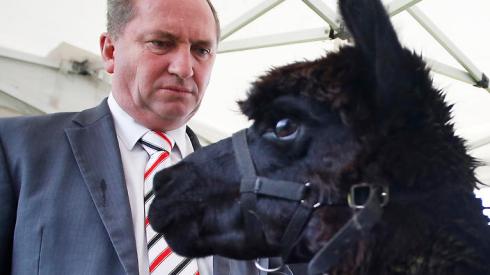
Ceci n’est pas un chien.
Image: Daniel Munoz
Barnaby Joyce is always saying something remarkable for its inanity, and the last couple of days he’s done nothing to cause me to reassess my low opinion of his tortuous thought processes.
I watched him on ABC News 24 as he descended into red-faced blather on the subject, yet again, of Johnny Depp’s damn dogs, free associating like a unicyclist careening around the pavement whilst juggling plates about at any moment to topple, on the dangers Depp’s canines presented to our biological security. Not that I wish to play down Depp’s arrogant offences but Barnaby in the mix can reduce almost any topic, however serious, to farce.
Barely recovered from that comedic interlude, I was almost immediately subjected to Barnaby’s strident claim that Prime Minister Malcolm Turnbull should be returned as PM on the grounds that he, unlike Opposition leader Bill Shorten, has made a quid in his life.
I confess myself somewhat unnerved by this narrative newly entering our politics and seeking normalisation, that the only requirement for holding high office is the demonstrated ability to make a quid, or rather, millions of them. It matters not how the quid is made, indeed the less said about that the better, it’s merely the having of the quid that counts because having lots of quids equals substance and talent sufficient to run a country.
By this measure it is only a matter of time before one of the Kardashians runs for public office.
Those of us who have not made a quid, and I use the phrase as a metonym for wealth rather than the middle-class comfort that aspires to and imitates the shenanigans of the wealthy, are in this narrative called upon to respect the rich and accept the fact of their greater wisdom because after all, nongs like us are disqualified from power having not earned it, because we haven’t got the nous to acquire the requisite quids.
This attitude has been joyfully embraced by right-wing Christian fundamentalists, who have now incorporated as evidence of God’s love and favour the possession of wealth. You have quids because god wants you to have quids and if you don’t have quids it’s because god doesn’t want you to have quids because you haven’t been sufficiently subservient to him and you haven’t done his will.
This combination of politics and religion creates a powerful discourse in which having quids is normalised as a measure of sacred and profane achievement. Ultimately it relieves both religion and politics of the burden of giving a damn about anybody with less quids: either you haven’t earned it when you should have, or god doesn’t love you enough to let you have it so why should we?
As we approach the next federal election, assume the crash position and kiss your arse goodbye, because barring a miracle, this poisonous narrative will have found the normalisation it seeks, and the majority, who continue to show themselves as being far from the full quid, will keep the conservatives in place, normalising inequality, normalising lack of health care and education, normalising draconian police powers and further normalising the outrageous privilege of those with quids.
It is astounding how some people most disadvantaged by conservative ideology continue to support its rhetoric.
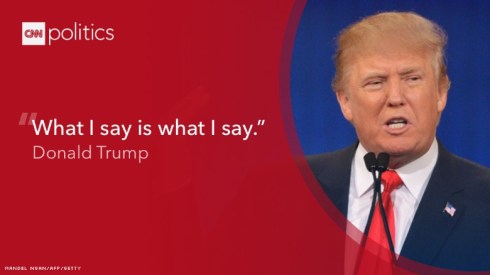
Trump’s wisdom? Or trumps wisdom?
Guest post by psychologist Dr Stewart Hase. Stewart blogs here
Human Irrationality 102: The Trump Phenomenon
As a psychologist, it is difficult to resist exploring the Trump phenomenon. There are two aspects to what is happening in probably the most bizarre presidential race that I have seen in my lifetime. The first is the man himself and the second, probably more important factor is the support that has gathered around him.
Most psychological profiling is undertaken using a mixture of interviews and sophisticated personality testing tools. For me, the well constructed interview is the most effective means to understanding people, if you know what you are looking for and have the right interviewing technique. To construct a profile of someone from just watching them from afar is fraught with risk. You probably wouldn’t do this with most politicians, who show very little of themselves. In the case of Donald Trump, we have a gift that keeps on giving in terms of the showing of himself. Furthermore, there is a consistency to what you see, as well as a fairly well documented history of the man himself. So, I’ll have a go.
Trump is extremely narcissistic. As well as an inflated sense of his own importance, that is at odds with reality, he is quick to anger when criticised. We have seen his angry retorts towards his critics, as well as his tendency towards litigation in his many business failures in which he quickly blames others.
It is pretty clear he lacks empathy and is extremely impulsive. This combination is unfortunate because he fails to understand the behaviour of others, is not concerned about their feelings and does not think before he acts or speaks. Added to this is an obvious, ‘Do what it takes’ attitude to getting what he wants. Ordinary people lost lots of money investing in his ventures that he, without a second thought, abandoned. He sees these people as ‘losers’. Trump just doesn’t care much about people and, gives the impression that he is a bully both at work and elsewhere.
What does Trump believe in? I suspect that he doesn’t much believe in anything, given his about-face on so many issues and his business antics. He has probably never had any long-term goals-in fact he may not be able to set any. Trump has never run for any kind of political office before, has never trained himself. He was trained in the family real estate business but his ventures since then have been impulsive and, mostly ill-conceived. Apart from 4 bankruptcies, that he has been able to personally avoid, he has a string of huge business failures.
On the face of it, Trump is very confident and seems to lack anxiety. While there may be many insecurities in his deep unconscious driving this behaviour (I’ll leave it to Jung to sort this out), we see someone who believes in himself and believes that he is right. This lack of fear along with his impulsivity and inability to plan makes for an interesting combination.
I saw somewhere in the media the question of what is happening in Trump’s mind. I suspect that it is chaotic in there. He is an extreme extrovert, he thinks out loud and has a low attention to detail. There is a lot spinning around in his head and it just has to come out, verbally. Many people in public life are extraverts but Trump is completely off the scale. He just has to process information by speaking. Again this is linked to an inability to plan and to foresee consequences. I think he is probably cognitively intelligent (although I’m not totally convinced of this) but very low on social/emotional intelligence.
The support Trump has gathered is significant. Many commentators have pointed to the fear that the republican machine has gradually built up since the inauguration of Obama. He inherited an economy in a mess, two wars, social systems in chaos, high unemployment and so on, but this was sheeted home to him and his party by a cleverly orchestrated fear campaign. It is also clear that there are a lot of people suffering in the USA from a variety of causes but which can be attributed to long-term middle class policy failure and the darker side of capitalism. In short, capitalism has not delivered on its promises. Trump inherited an environment of fear and has used it to his advantage.
When people, and more so groups of people, become fearful they look around for someone to blame. In Germany in the 1930s it was the Jews and many governments around the world, including the Vatican, turned a blind eye to the systematic abuse of a whole ‘nation’. In the US of A at the moment it is vilification Muslims, Mexicans, African-Americans, the ‘soft’ government, drug abusers, women, Bernie Sanders and all other democrats, and so on-you’ve heard it all. But this time nations, thanks to social media, are taking notice.
So, we should not be surprised, given it has happened before, that someone like Trump is able to gather people around him. He has been able to appeal to the darker side of human nature-stereotyping, bigotry, racism, misogyny, narrow mindfulness, hatred, and the need to express discontent through violence. If it were France in the late 18th century we would hear the tumbrils clattering along the cobbled streets heading for Madame Guillotine.
Human irrationality is a fascinating phenomenon and we are seeing it in spades in the US of A right now. But, irrationality is around us all the time in everyday life and often has very unfortunate consequences. Perhaps the civilisation of the human species is a fantasy given the current state of our evolution.

Guest post by Paul Walter, a longtime friend of No Place for Sheep
Fans of Media Watch will recall from twenty years ago an episode where Channel 7’s TDT got caught out on a profound fraud involving the pursuit of Christopher Skase in Spain.
Now, why am I bought to mind of this?
At the moment a big story has broken involving the arrest of a 60 minutes team in Beirut during an episode about a “recovery” of children held by their father who had failed to return them to their mother after a holiday.
Now, my sympathies are deeply for this woman, but my real interest in the event is a growing unease in my own mind about what on earth possessed Channel Nine to pursue a risky and violent stratagem in pursuit of a story. In fact I am inclined to wonder to what extent the woman was exploited and now risks jail for such a venture, let alone the crew and highly paid rescue team
Did Nine choose the story in the hope of hope impressing their public or was this a genuine interest and concern in the issue of custody battles involving kids in different countries?
I believe what changes the issue is the use of Muslims as a subject at a time when an election is due and emotions have been high concerning what some term “Islamophobia”, as well as a crass faux conservative feminist aspect (I did say earlier my sympathies are with the woman and I bear no grudge against feminism itself, the point is the pretence of feminism as a means for reinforcing political and ethnic tendencies in an audience, as well as providing a cognitive pay-off for the continued watching of such reports; no nuances, just heroes and villains brought to book by 60 Minutes heroes.)
Now, what further arouses my reawakening of scepticism about what happens behind the scene with this sort of television comes from the old issue of chequebook journalism and the lack of much information about how these events are constructed.
What local msm seem not to have reported is the huge sum paid a mercenary rescue crew to do the snatch whist conveniently watched by cameras for a bit of drama. But the violence of the snatch caused a nasty incident, not a heroic moment for 60 Minutes and jeopardised this woman’s chance of getting her kids back.
No doubt a huge campaign will be launched further valorising 60 Minutes and worsening our relationship with mid-easteners, perhaps also ramping up emotion with local Muslim youth as well…cultural sensibilities.
My opinion is that this sort of thing is reckless and dangerous and done for a whole bundle of poor reasons, yet the truth must “out” as to the reliability of media and press as sources of information, these days.

(Trompe de l’oeil is an art technique that creates the optical illusion that the depicted objects exist in three dimensions. Literally “trick the eye.”)
That Republican Presidential candidate Donald Trump’s appeal is one-dimensional hardly needs saying, however, what is worth remarking is his ability to deceive supporters into thinking he has depth. Trump makes astoundingly ludicrous statements, but he makes them with the faux moral authority of the extremely wealthy in a world in which the possession of wealth is in itself a signifier of moral substance deserving of respect. As with our own Malcolm Turnbull, if a man or woman manages to accrue enough money, it is assumed that he or she is capable of running a country.
Trump possesses the talent required of all successful propagandists: to make one-dimensional, exclusionary and divisive statements resound with the ring of deep truth, in the style of a painting intended to mislead with a convincing illusion of reality.
As Trump’s popularity rises and rises in the US , a woman can be forgiven for questioning the usefulness of a representative democracy that permits a blatantly disturbed majority the opportunity to determine a country’s governance.
Trump hates women, that is to say, he loves women until we cross him, sometimes entirely inadvertently by not physically presenting as he thinks women ought, and then he hates us. He has unresolved issues with menstruation: he thinks it makes us mentally incapacitated, homicidal, and disgusting as well.
It is actually possible to purchase from a US website panties, or what we more comfortably refer to as knickers to wear during our time of the month, that feature Trump’s face on the crutch so we can bleed on him. I’m conflicted. I get the satisfaction of bloodying Trump’s dial, but at the same time, having that dial nestled against my lady bits? I don’t know. It gives a whole new meaning to the phrase, she’s on the rag.
As a trompe de l’oeil politician Trump is, sadly, far from unique. Failed Prime Minister Tony Abbott is an outstanding example of one-dimension striving for the illusion of multiplicity. This explains his bizarre use of three-word slogans, yes it does, one for each dimension, you know I’m right.
I doubt current Prime Minister Malcolm Turnbull varies greatly in his capacity for perspective, though he claims to be agile, innovative, and what’s the third one?
Trompe de l’oeil has largely fallen out of favour as an art form, except when used ironically on the walls of cramped inner city gardens. Unfortunately, it has become many politicians’ favoured method of operation, as one after the other they abandon all remaining substance, replacing it with the illusion/delusion of eye-tricking depth.
As Baudrillard would have it, we live in the time of simulation, of references with no referents. Trump is the face of this hyperreality: bleeding on it may well be our only option.
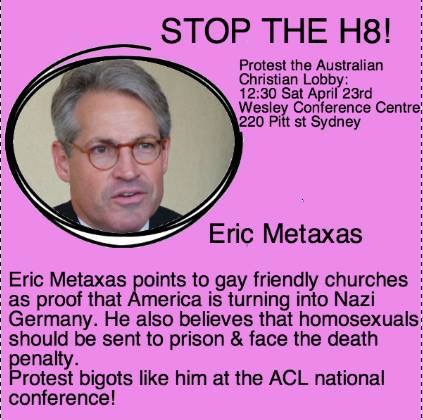
Twitter just alerted us to the news that Treasurer Scott Morrison will be speaking at the Australian Christian Lobby’s 2016 conference at the Wesley Centre in the Sydney CBD on Saturday, April 23.
This piece in New Matilda reveals that the conference star turn is one Eric Metaxas, a Christian who believes there are parallels between the failure of church groups to resist Nazism in the 1930s and the growing acceptance by liberal US Christians of LGBTQI people. Metaxas has also backed gay conversion therapy.
We already know the ACL and its spokesman Lyle Shelton have campaigned, successfully it seems, to have the Safe Schools program gutted. We also know that the ACL has an inordinate amount of influence over our governments, including that of atheist PM Julia Gillard, whom Jim Wallace persuaded to keep the school chaplaincy program.
Why are our politicians beholden to this minority group of fundamentalist extremists?
Also speaking at the conference are Miranda Devine, Noel Pearson and Dr Jeffrey J Ventrella, whom New Matilda describes thus: A Senior Counsel at the litigious Alliance Defending Freedom, Jeffery Ventrella argued in 2012 that the US government should divert funds from LGBTI health programs and instead spend the money convincing those in the communities to change their sexuality.
There’s no doubt in my mind that if Morrison speaks at the conference without challenging its homophobic slant, he is endorsing that perspective.
He is billed on the conference website as The Hon Scott Morrison MP, Treasurer of the Commonwealth of Australia, so we can assume from this he is appearing in his official capacity, and thus as a representative of the Turnbull government.
It is most alarming that the Treasurer of this country should support the extreme discriminatory views expressed by Metaxas and Ventrella. It’s extremely alarming that Morrison should represent the Turnbull government at a conference that seeks to disseminate homophobic perspectives.
There is probably an argument to be made that politicians, particularly those holding high office, ought not to publicly support any religious views in their official capacity. We are a secular country. Our governments are not vehicles for the furtherance of religious beliefs of any kind.
There is definitely an argument to be made that no politician and legislator should publicly support views that are contrary to our anti discrimination laws, such as those held by Metaxas and Ventralla.
As usual, I don’t support no platforming. I do support protest, and support for protesters if you can’t actually be there on the day.

On April 9 and 10, Melinda Tankard Reist is hosting a conference marketed thus: ” ‘World’s oldest oppression,’ the first ever gathering of sex industry survivors and abolitionists in Australia, will be held at RMIT University in Melbourne next weekend.” On Tankard Reist’s website it is further described as a “two-day conference for a world free of sex trade abuse,” and a “feminist human rights conference.”
Various parties have called for no platforming action against the conference, on the grounds that it offers an opportunity for hate speech, and the furthering of a religious/moral agenda against all sex work. This agenda intentionally conflates sex work with an international and abusive sex trade of women and girls. The two are not the same, and Tankard Reist et al do their cause no favours by this conflation. Given my knowledge of Tankard Reist and other participants in this forum, I’d be inclined to agree with the apprehension of conflation: these participants steadfastly refuse the possibility of sex work as a choice, and make no distinction between women who are the victims of sex trade abuse, and women who choose sex work as their career.
Reist, Caroline Norma and Julie Bindel have all at some time made the argument that women who choose sex work as their profession are victims of a kind of false consciousness, that is, they don’t actually make a choice because they have been abused to the point where choice is no longer possible, they just don’t know that about themselves. This seems to me a most presumptuous and offensive conclusion for anyone to arrive at, other than the women concerned, and it should be identified and challenged.
I need to disclose here my personal encounters with Tankard Reist, when she threatened to sue me for defamation after I’d written on this blog about her religious affiliations and their influence on her moral and political sensibilities . While it was a difficult period in my blogging career, and brought all manner of people from Anne Summers to Julia Baird to Miranda Devine down on my head, and made me for a nanosecond a global cause and the subject of a change.org petition to save me, it also taught me valuable lessons about efforts to silence a contrary point of view, and it is this learning that I’m drawing on in my argument that Reist et al must be permitted their platform.
After my experience of Reist attempting and failing to bully me into silence with threats of financial ruin if I didn’t shut up and retract, (supported in her efforts by some of the mainstream press) I’m highly sensitised to any form of censorship. As an academic committed to the deconstruction of controversial ideas rather than their silencing, I baulk at the current penchant for refusing a platform to those who hold a position with which I strongly disagree. I can’t support authoritarianism in any form, and withholding the right to express ideas is an authoritarian act. Who is to decide which ideas may or may not be expressed? And since when was it possible to destroy any idea by denying opportunities for its expression?
The fact that RMIT hosts this conference (which at first blush appears perfectly acceptable, after all, who wouldn’t like to abolish sex trade abuse) doesn’t indicate administrative support for views expressed during the conference. Permitting the expression of ideas does not indicate acquiescence or agreement with those ideas. If ideas are forbidden expression on a university campus, we are in deep excrement.
Tankard Reist is adept at tailoring her marketing to fit her desired outcomes: in this instance she is using an understandable abhorrence for the trafficking of women and children into sexual slavery as an opportunity to attack all sex work. This approach needs not to be silenced, but identified and challenged.
Reist also states that survivors of sex trade abuse are speaking at the conference and I cannot, in any universe, agree to the silencing of the voices of survivors. Undoubtedly they are survivors who support Reist’s opinions: they ought not to be denied a voice because of this. I’m a survivor of child sexual abuse: is someone ready to instruct me that I may speak of this only within their terms of reference?
The weapon in situations such as this is not censorship but protest. Demanding that a third-party, in this case university authorities, step in and take action on students’ behalf is infantile. If you don’t want someone speaking on your campus get out there and protest and hopefully the academic staff who agree will support you. No platforming is the first resort of the weak. You can’t no platform the world and everything in it you don’t want to hear. You have to learn to use your own voice for the whole of your life so you might as well start at university.
I’d like to add that Vixen Collective, who are protesting the “World’s Oldest Oppression” conference, have not called for RMIT to no platform. They have simply asked for an opportunity to have a voice in the discussions. That request has been ignored by the conference organisers.
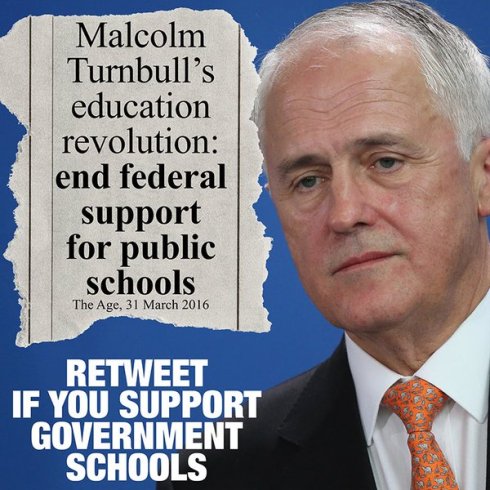
Look, you may already be across this but for various reasons I’ve only just caught up. Prime Minister Malcolm Turnbull actually proposed that the states take on the entire responsibility for funding public schools, while Turnbull’s own government, proposing nary a cent to the project of educating children who don’t attend private schools, is happy to continue its excessive fiscal support of educational privilege.
Aside: It’s usually against my personal code of not wasting time with click bait to read, let alone link to Mamamia, however I like to think I’m big enough to overlook that code under exceptional circumstances so I did.
I cannot see any sense, decency, respect, care or concern for the country’s future in such a move. It is pure ideology. It comes a mere two weeks or so after the appointment of new Liberal Senator James Paterson, who declared that public school kids lack a work ethic found in private school kids, an interesting indictment seeing as he is himself the product of the public school system.
Oh wait. Paterson probably thinks he’s exceptional. Believing yourself to be exceptional is a core requirement for membership of the LNP. Please read: public school kids with the notable exception of James Paterson, don’t have a work ethic as strong as private school kids.
These arrogant, privileged twerps are in need of a damn good smack down and some serious re-education as to what the role of government actually is. It isn’t a license to impose an ideology of privilege. It is the responsibility to ensure as far as is possible equal access across society to core necessities such as education. To do otherwise is to bring a country to its knees. Intelligence and talent are not restricted to postcodes. Any nation that limits the potential of its young is a nation in its death throes. If you don’t believe me, please note that the majority of this government was educated in private schools. Need I say more?
This is class warfare. Federal de-funding of public schools while continuing funding of private schools is a divisive and dangerous proposition. It perpetuates the myth that having money (no matter how you got it or where you hide it) is morally sound; that money in and of itself has a moral value that supersedes the manner in which it is obtained.
Good government isn’t divisive and dangerous, and it isn’t focused on ideology. It’s capable of some semblance of economic literacy as well. Turnbull’s government is exceptionally agile with economic policy: it should be a star turn at Cirque du Soleil.
Bob Ellis has died after a valiant struggle with liver cancer.
His talent was enormous and wide-ranging. He delighted, entertained, alarmed, offended, confronted, infuriated, and spoke truth to all kinds of power. I will miss his work so very much.
Vale Bob.

This blog is archived at the Pandora Web Archive, National Library of Australia





 No Place For Sheep
Recent Comments