Archive | The Personal RSS feed for this section

Always

17 Aug

This.

Who could have known there would be so many tears?

15 Aug

Hello everyone,

I’m on my way to Sydney to sit with my husband, who has suffered a massive stroke.

Though we’ve been married for some twenty-six years, a second marriage for both of us, for the last few years we’ve had little to do with one another. Ours was a ‘love of my life but we can’t live together ’ situation.

We could never bring ourselves to divorce. “I’ll never want to marry anybody else,” he said, when I once angrily advised him to expect the papers. Of course, his response disarmed me completely, and I realised I probably wouldn’t want to marry anyone else either, so we never took that final step.

I thought I saw him for several days before I heard the news of his illness. Going about my business in the little village where I live, I thought I saw him walking ahead of me, the loping gait, the baseball cap, the jeans and checked shirt.

I remember that every time he was about to make another appearance in my life, I would sense his presence in the days before he arrived in the flesh, or rang up, or emailed, or sent something in the post. So I knew these imagined sightings were precursors. He always said he also knew when I was about to make an appearance, because he started dreaming about me.

I don’t know why we couldn’t sort it out a whole lot better than we did.

He said he wanted to die before me because he didn’t want to be on this planet if I wasn’t. I said if that was the case, I wanted to lie down beside him and hold him in my arms as he left me.

He may or may not know me now.

For some reason all the planes were full today, so I’ve had to take the train. As it turns out I don’t mind at all. I don’t feel like being above the earth. I feel like being firmly upon it. The landscape is simply gorgeous at 7am on a winter’s morning, with fog rising above the rivers and paddocks, and sun on the dew. My best friend, with whom I share a house (she a widow, me still yet a wife) drove me to the station in the dark. I call her Mrs Chook. She calls me Senora. These nicknames have something to do with a trip we made to Mexico, though I’ve forgotten what. The Dog, who yesterday cost us $200 for his dental hygiene, was left sulking at home.

Yesterday Mrs Chook visited a sleep clinic in search of a remedy for her snoring. Around 6pm she walked in rigged up like a suicide bomber, with wires on her head and hard-cased things wrapped around her torso to monitor her sleep. This is because I recently refused to travel with her anymore in situations where we have to share a room. It was for her own good, I told her. I would have injured her eventually, probably fatally.

Mrs Chook has lately had to care for her ageing mother and a sick brother. We have been thrust into a world of aged care facilities and hospitals, an area both of us have been free of for some time.

At the other end of the cycle, we regularly spend time with my youngest grandchild, to whom Mrs Chook is an honorary grandma. This gives both of us a satisfying sense of connection with the beginning and ending of life, of extremes we don’t understand, but that somehow fully ground us. Without each other, neither of us would do it half as well, I suspect. It seems to be our fate, for the time being, to stand by the others as they move into life or out of it.

I think it will be hard to see him helpless, he who was always vigorous. How he will hate his present predicament, if he has any awareness of it.

I have spent today with him. It’s terribly difficult to understand him as his speech is severely compromised. “Why are you here?” I think he said. “Because I love you,” I replied. “Aaaah,” he sighed, “take me to the Opera House.” “Not today,” I said, “but I’ll sing if you want.” “No, no, no!”

His food arrives. Baby mush, the same stuff I fed to my infant grandson two weeks ago. He rails at the nurse. “Not you! She’ll feed me! Her!” All goes well till dessert. “Not fucking apple sauce! I won’t have fucking apple sauce.”

That came out quite clear.

Then he cries. And cries. His body is so small now I can scoop him in my arms. These last weeks my arms have been filled with baby Archie, and now they are filled with him.

Then five minutes ago, a message that another new grandchild is on its way, and will arrive in the autumn.

Who could have known there would be so many tears?

This is what my arms are for. The beginning of life. The end of life. I am glad beyond words, that I have them.


Birthing Buck Naked

30 Apr

I’m posting this story for Carolyn Hastie and the women I’ve met on Twitter who want us to have the support we need to birth our babies safely at home if we choose.

“We have turned away from our bodies. Shamefully we have been taught to be unaware of them, to lash them with stupid modesty… woman, writing herself, will go back to this body that has been worse than confiscated… ” Hélène Cixous

I’m having a phone conversation with my son in Montreal. He’s complaining that I wrote a poem about his brother and not him. Which I didn’t but anyway. 

“Well,” I say, “I’ve written a story about you being born.”
“Cool,” he says, “send it to me.”
“OK. I’ve changed your name to protect your privacy.”
“Hmmmmm. What did you call me?”
“Harry,” I reply.
“Harry! You can’t call me Harry! That sucks!”
“OK,” I sigh. “What would you like me to call you?”
There is a long and expensive silence. Then:
“Buck Naked!” he crows triumphantly. “Call me Buck Naked!”
So I have. The title of this story is not ‘Birthing Harry’ as I intended, but ‘Birthing Buck Naked.’ I understand that as a title it is somewhat ambiguous but what can I do? I’m a mother.

I prepared a corner in the room downstairs where I’d decided to give birth. I arranged cushions, pillows and blankets. I made a nest as warm and welcoming as that of any Arctic bird making a shelter for its young from spring rains and driving gales. I placed a pile of thick towels close by and on my feet I wore winter socks of cream wool. Then I rang Stephen.

“I’m starting,” I said. There was silence at his end. Starting what? I could hear him thinking.

“Oh God, I’m sorry. God, I’m on my way right now, I’ll be there in twenty minutes.”

“It’s all right,” I told him. “I feel fine and I’ve rung the midwife.”

It wasn’t cold, though I’d prepared as if it was. It was April in Sydney, an unusually hot April but I knew I would feel cold in labour, and I thought outside of me could never be as warm as inside for the new child.

For the last couple of weeks I’d laid dreaming on the couch near the glass doors that led into the garden, rousing myself only to care for my four-year-old, Samuel, and attend to what was essential to maintain our daily lives. I gathered my focus and guided it inwards. A deep certainty filled my days and nights. I moved, languidly, to other rhythms. I became an ancient being, rooted in timelessness. I smiled when spoken to. I was engulfed by a great calm.

I knew plenty about the child. I was familiar with his restless stirrings on humid nights. I knew the energy in his limbs as he turned in my uterus. I knew his hiccoughs. His hands that seemed to be reaching out to me through the layers of flesh that kept us apart. The impatient, arrogant thrusts of his feet as he sought more freedom of movement than could ever be offered in my confined spaces.He was me, and he was not me. He was inside me, but I could not know him. Through me he lived, but the life outside would be his to choose.

Nobody can tell you ho hard it is to love someone so completely, and know as well that your task is to let him go. Nobody can tell you that from his birth it will be his task to learn to live without you. Nobody tells you how it will feel to whisper: “Go, my darling, into the world, into your life, and may everything good watch over you and bless your every moment.”

 I determined quite early in the piece that I’d have this child at home. This decision surprised everyone, not least of all me. I’d never thought of myself as interestingly alternative in my life practices. Indeed, quite the opposite: a traumatic and marginalised childhood had left me with a deep yearning for all things ordinary. Everyone I knew gave birth in hospital, as had I the first time. But something about the indignity of that experience, its clinical nature, the smells, the brisk and efficient manners; something about the instruments, the pipes in the wall, the lights, all conspired to convince me that I wanted to try another way.

Stephen went white when I announced my decision. He wasn’t a fearful man and usually faced demanding situations with courage and confidence. But this decision propelled him miles away from his zone of comfort. He attempted to dissuade me. The possibilities of error. Sudden dysfunction in the birth process. He called in our mothers, friends, the doctor who lived down the street. But I would not yield to argument or reason. I didn’t care to understand, at the time, the burden I’d placed on him. I was in the grip of a most profound determination, and nobody could change my mind.

We’d made the child in France, on a camping holiday in Provence. At the end of the trip, driving endlessly around the Boulevarde Périphérique trying to find our way into Paris, I threw up and realised I was growing a baby. That holiday, and living in the UK gave me the idea. Babies were born at home as a matter of course. It was no big deal. I’d read my Margaret Drabble: the birthing of the baby of a snowy night, the sleepy midwife, the snug bed. At that point we had no idea which country the child would be born in. It would be cosmopolitan. It would be born the European way.

Years later, grown up, he is a restless young man, nomadic. He takes leave of us for long periods during which he hitchhikes across the vast Canadian plains, offering his services as a ranch hand, barman and dogsbody. He takes jobs on fabulous yachts owned by French casino bosses, moored in Spain and the South of France. He swabs the decks, and serves cocktails to the wives, mistresses and daughters of the international mafia. He sends postcards from a market in Marrakesh. He rides the ferry from Sweden to Estonia, the Greyhound from New York to New Orleans in time for Mardi Gras. He sends emails: I love you Mum and I always miss you. I send emails: I love you, my darling and I always miss you. Please remember to brush your teeth.

There is a point in labour where a woman may decide she’s not going through with it. It can happen in the best of labours. I arrived at that pivotal moment. I told them, that’s it. I’ve had enough. I’m stopping now. They laughed, kindly, and gave me chips of ice on which to suck. Damn you! I cried. You have no idea what this is like, I sobbed. Then I heaved myself up from the birthing couch and lumbered into the laundry, where I threw up in the sink. Gazing out the window at the peach tree in the back yard, it occurred to me that seeing a project through to the end was not something  I was renowned for. This urge to escape had been masked, in my first labour, by gas and drugs. Now I was feeling the full brunt of it. I looked at my hopelessly swollen stomach, and understood there was no way out. I cried. I’d tried to avoid positions of such singular responsibility all my life. The others could help me. Rub my back. Remind me to breathe. But bottom line, I was on my own. I turned from the window and propelled my massive self back to the nest. All right, I told them. I’m ready now. Let’s do it.

I want a new name for that valley between the contours of my thighs. Swollen with birthing, a bursting chakra radiant with heat. If I could see the colours of those energies, what would they be? Gold, rose-pink, ruby-red, lilac and lavender, and burgundy streaked with the rays of the rising sun. Sensation radiated from my centre and down the inside of my legs. The waves of birth pain overwhelmed me and as I’d learned, I gave myself up to them. If I cannot control this, if I cannot escape, I will yield to this pure sensation, unmediated by thought or explanation. I will yield.

Between my thighs the midwife spied the first tentative appearance of the child’s head. As the contraction subsided he slipped back,as if overcome by a sudden change of plan. The wily little character taunted us: Would he do this or not? But like me, he had no choice in the matter, we were in the grip of another force altogether and for him, like me, there was no going back. Another huge wave of sensation propelled him, regardless of his wishes, further down the birth canal towards his new life on earth.

They wiped my brow. I swatted at them as if they were flies. Everything was now an aggravation. I hated them. They distracted me with their advice. Fuck off! I roared at them, at the same time clutching their hands to keep them with me. Then something unrecognised and thrilling surged through me. Its force brooked no argument or interference. In its wake the infant’s poor squashed face, a study in fierce concentration, slid into the waiting hands of his father who crouched, white-lipped and weeping, between my naked thighs.

There are photographs of this event taken by my sister, who set up her tripod and captured it all.

Until he was twenty, Buck Naked steadfastly refused to acknowledge this newborn as himself, claiming it had to be his brother. At twenty he came home for the first time with a girlfriend he cared enough about to introduce to us, and after dinner one night he said: “Mum can we show Alice the pictures of me being born?”

I was astonished. Not only was he owning the event as his, he wanted to share it. I dug out the photos and we all gazed at them. They are curiously compelling. Nobody said much. We all sighed a lot. They are imbued with magical powers, those photos, though to what purpose I remain unsure.

After the birth they offered me Champagne we brought home from France just for this occasion, but all I wanted was tea, gallons of it, milky, sweet and hot. Neighbours dropped by with food and flowers. This was the first home birth in our street and everyone was interested. I found myself something of a folk hero. Even the disapproving congratulated us. The following year two more women in our street gave birth at home. It was a small movement.

The child latched immediately onto my breast. I had made it know beforehand that I wanted the placenta buried in the back yard and a tree planted to mark Harry’s arrival. Now I heard discussions about stray dogs digging it up, and hygiene and illegality. Stephen’s face was close to mine and our newborn child. “Please do what I want with it,” I whispered. “Don’t listen to them. It will be OK.” He nodded and kissed me.

In retrospect I see I lacked appreciation for his courage. After all, I seemed to be possessed of some esoteric knowledge about this birth that reassured me. All he had was my word for it. This man, whose life so far had prepared him for nothing that even came close to this experience, trusted the intuitions of his obsessed wife, and fulfilled her wishes. It was an act of faith on his part. It wasn’t as if I’d ever proved my reliability.

I remember those days in terms of the body. Of bodily fluids: waking in the morning in pools of milk from overflowing breasts. The infant’s liquids. The eroticism. The strange delight I took in bodily messes. I was real. I was flesh and blood and milk and desire and lust and sensation. It was good. I was good. I was embodied. I was, finally, earthed.

I received an indignant email from Canada concerning the flirtations of Alice. Echoing Freud, Buck Naked demanded: “What do women want, Mum? Just what the hell do women want?” 

I’m not sure he wanted me to answer this question. It had the ring of a complaint rather than a general inquiry, as perhaps did Freud’s original query. I never took to Aice, I must confess. In private moments I referred to her as “Miss Canada” owing to her uppity nature and her air of knowing everything. She ran rings around him, I could tell.

I wanted to take Buck Naked on my knee as I did in the days when he wore a soft yellow sleep suit with built-in feet. I wanted to take him back against my heart so he could feel its beating, and know that he is loved. Instead I sent another email. I addressed his pain as comfortingly as possible, and then I wrote: I love you my darling and I always miss you. Please remember to brush your teeth.

“There is always at least a little good mother milk left in her. She writes with white ink.” Hélène Cixous


Home

28 Dec

I’m looking for a
Home- where the wheels are turning
Home- why I keep returning
Home- where my world is breaking in two. Brian Eno & David Byrne, “Home”

The house protects the dreamer, the house allows one to dream in peace…the house is a large cradle…it maintains him [sic] through the storms of the heavens and those of life. Gaston Bachelard, “The Poetics of Space”

Because it’s Xmas I’ve been thinking about home, and the devastating effects of not having one.

Homelessness takes several forms. There’s hard-core dispossession, when people literally have no roof over their heads and live on the streets. Sometimes they find a bed at a shelter for a few nights. There’s couch surfing homelessness when people move round friends and relatives’ homes in an effort to stay off the streets. There are families and single people living in cars.

There’s the homelessness of asylum seekers, dislodged from their belonging by circumstances outside of their control, seeking somewhere on earth where they can safely settle.

Then there’s living in places where you just don’t belong, such as institutions, where you are only there because you have no choice. That was my kind of homelessness from the age of fifteen.

My kind of homelessness was middle class. I had a roof over my head. The roof was that of the boarding school I’d been attending. The family I’d lived in up to that point consisted of my mother, her second husband, my stepfather, and my two little half sisters. My mother married her second husband when I was seven, and he brought us to Australia from England.

Up to that point I’d been raised by my grandparents in what seems now an almost idyllic situation. We were cash strapped – Granddad was a retired coal miner, and working as a night watchman at the gasworks. I was much-loved by him and Eleanor, my grandmother, even though they’d raised three children of their own. We had food, clothes, shelter, entertainment, and Granddad’s corgi dog. I had an uncle, and an aunt who kindly painted my tiny toenails for me by the kitchen fire when she was attending to her own. I idolized my uncle. I was safe, treasured, and kindly disciplined. I had what every child needs – a bevy of adults to take a loving interest in her. There was always someone to listen, and there was always someone to play with.  It worked for the adults as well: nobody was overburdened with sole responsibility for my well-being.

I hardly remember my mother during this time. She lived in the same house but must have been largely absent from my child’s world, as the impression she left was negligible. It didn’t matter.

It must therefore have been a great shock to me to be wrenched from that cosy world into the uncertain future offered by my stepfather and mother, both of whom were practically strangers to me, and transported to the other side of the world. Such a shock that to this day I have absolutely no memory of the parting. While she was alive, my grandmother revisited this trauma endlessly whenever we saw each other, which was rarely as we were now worlds apart, in every possible way.

My mother made an upwardly mobile marriage – her second husband was a doctor. Her first, my father, to whom she was married till I was three months old, played drums in a band. I know almost nothing about this man.I did go through a period of trying to find out, without success, and eventually I thought what the hell, the man obviously didn’t care about me and do I really want to find someone who didn’t care about me? No, I decided, and finally let it go.

The marriage took my mother out of the North Yorkshire mining town and working-class culture she loathed, to a new country and the rich possibilities of middle class professional life.

Unfortunately, her new husband was violent, abusive in every way possible, and had an eye for her seven-year old daughter. Suffice to say the next seven years of my life were a kind of hell into which I felt I had fallen through some fault of my own. Children do this. They assume responsibility for the most enormous adult events and if no one tells them otherwise, they labour under the burden for years.

The contrast between those seven years and the seven that preceded them was absolute.

At the age of almost fifteen, I revealed to one of the nuns at my Anglican boarding school just exactly what was going on in my home. Astonishingly, these intelligent, compassionate women believed me. I’d explained for them their bewilderment at my lack of scholastic progress when I clearly wasn’t stupid, my inability to sleep, my habit when I did sleep of walking and falling down the stairs, my inability to eat and thus to thrive, and my constant illnesses. Within days they had taken action. They consulted the Bishop, the Dean, and their lawyers. They summoned my mother and stepfather to the school, having first hidden me in a safe house so neither of them could see me. Lawyers, nuns, the Bishop and Dean confronted my parents, who made no attempt to deny my account of events in our house.

A deal was done. I was to be handed over to the guardianship of the nuns. I was never to go home again. My mother would be allowed to visit with me, but my stepfather must agree to never attempt to see me again, otherwise they would call in the police.

I was safe.

I was ambivalent about these arrangements. My family was appalling, at the same time it was the only one I had. My home was a place of great danger, at the same time, it was the only one I had.  I was relieved and grateful to have been rescued, but at the same time, I had no home. A boarding school is not a home, no matter how kind they are to you. I was supposed to go to various friends’ homes for holidays, which I did for a while, until the mortification of being unable to reciprocate their hospitality became too much for me. I would hide on the last day of school, and not reveal myself until they’d all gone. Then I’d be allowed to stay with the nuns in the great big empty boarding house, until term started again.

The nuns were good to me. They were beyond good to me. They did everything they could to make up for my losses. I wasn’t always grateful. When I played the piano in a competition where everyone else’s mothers and fathers showed up to support and admire, I wept after my performance that the nuns who’d come with me weren’t my parents, and I was the only girl there without anyone. My final act of ingratitude was to repudiate their religion.

The humiliation of living as an emotional beggar in an atmosphere of comfortable middle class families stayed with me for years. It will probably never entirely leave me. Where I live, though I’ve been here for years, still feels disturbingly temporary. Every time I try to think of it as home, I baulk.I can’t go there. Such is the power of a word. I don’t believe I won’t lose  home again, and a real home is not supposed to be a thing you can lose.  No amount of rational thinking and concrete experience convinces me otherwise. I remain, on this topic, seven years old, and dumbfounded at the turn my fortunes have taken literally overnight.

The legacies of that time have been many and I’d be hard pressed to decide which was the worst. However, this is a piece about home, so I’ll focus on that one. I have never been able to get my head around the concept of home. It’s not about bricks and mortar. It’s a magical name for a yearned for and unattainable state, full of meaning, feeling and emotion that I’m unable to let myself experience. Why? Because first I’d have to rage and grieve over having home snatched out from under me all those years ago, and that’s a dark place I can only very infrequently visit. To survive I’ve held those feelings at bay. I hop over them as I hop over hot sand on a blistering summer day, never letting my feet settle long enough to suffer anything more than slight discomfort. And only when I’ve forgotten my thongs.

The price I pay for acquiring these skills of avoidance and denial is never being able to feel I’m at home, or even that I have a home. The pay off is survival. We’re urged to confront that which disturbed us, rather than allowing it to fester and thrive and taint our daily lives.  While that is necessary, timing is all. Premature confrontation brings down the defenses that have been our friends, and allowed us function in the world. After all these years, my instinct tells me it’s time to let them go, and I couldn’t have done it a moment sooner.

For our house is our corner of the world, Bachelard writes,…it is our first universe, a real cosmos in every sense of the word. 

What then, of the child whose cosmos consists of abuse and exploitation? What, then, of the child whose topoanalysis reveals primarily sites of torment and terror?

The truth for me is that I can’t let myself feel home in the present until I grieve for the loss of that first one. I can’t imagine doing that grieving, and surviving the experience. Emotional cowardice provokes childish, self-berating dialogue: I can’t do it! Yes you can, you have to! No I don’t, you can’t make me! Well, if you don’t you’ll stay homeless forever! I won’t! I will not! You can’t say that stuff to me!

In a more adult state I realise I have to lay these matters to rest. I don’t want to leave this life carrying so much ancient sorrow into whatever comes next, even into nothingness. I want to leave with the cleanest possible emotional slate, grievings grieved, angers soothed, losses accepted, insult and injuries forgiven, both those I inflicted and those I suffered, at peace, as much as is possible, with the hand I was dealt. I want to have used my potential for surviving that hand to my fullest extent, and I want to leave satisfied that I achieved that.

In other words, I want to go home.

So this is my New Year’s resolution. I will do whatever needs to be done to assuage the loss of home. And then, with any luck, I’ll be able to feel home again, as I did when I was born, as I did as a little girl, as I did till I was seven. I think this will not only make life better for me, I’ll probably be a more pleasant person all round, having relinquished one more source of post traumatic stress that shuts me off from others whom I care for, and who care for me. The misery buck has to stop somewhere in a family. Let it stop with me.

Heaven knows- what keeps mankind alive
Every hand- goes searching for its partner
In crime- under chairs and behind tables
Connecting- to places we have known

Selling our old crap

14 Oct

Tomorrow, our place, garage sale.

Last one we sold the Subaru to some bad bastards with dirty beards and violent pink-eyed dogs tied up on the back of their ute. They looked at the car then went away and came back hours later with a paper bag full of $100 notes, some with traces of white powder on them, which they exchanged for the Subaru. It seemed fair.

I didn’t mind the cash. I was on my way to Mexico and it came in handy. We hadn’t meant to sell the Subaru. It just happened to be there and then they turned up and asked for it.

I’m not allowed to have any of the proceeds from tomorrow’s garage sale because I haven’t helped. I’ve just bitched and moaned about refusing to waste hours of my life putting stickers on crap when I could be tweeting. You should have heard them scoff at that, but tweeting sharpens the brain and hones writing skills while sorting through crap is just depressing.

In a minute I’m sneaking into the garage and getting back stuff I might want, and then I’m going through friends’ stuff they’ve left us to sell for them while they go for a ferry ride and lunch by the river, thank you very much, to see if there’s anything I might want. I have to do this surreptitiously. Last night I tried to do something surreptitious and I trod on the Dog’s squeaky toys that he’d left all over the garage floor despite being warned time and time again that there’d be consequences. I was caught red-handed in the act of retrieving a fondue pot circa 1976.

However, as the Dog was diagnosed just yesterday with some kind of canine emphysema (I told him to stay off the cigs but would he listen) I can’t be too hard on him. He still has a cauliflower ear. He wouldn’t stop boxing either though he knows what I think of that brutal activity.

No wonder I blog. Nobody listens to me in my own home.

On top of all this my brand new iPhone arrived today, after Telstra kept sending me emails that said “Your iPhone has left the warehouse.” Eventually I got fed up with these communications, sent one back asking if they’d delivered it to Gracelands, and whined that I was lonesome tonight. But now it’s arrived I have no time to play with it till the bloody garage sale is over and cleaned up and all the rubbish hauled to the tip.

Have a good weekend.

The Daughter

5 Aug

Warning: disturbing content 
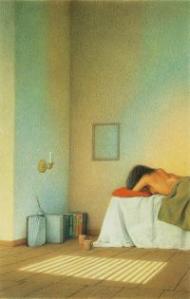
The daughter is back with her photographs. Searching, as she has through the winter and into the wet heat of summer, and still she hasn’t found what she’s looking for.

She wants to remember the man. She has only one image. It’s a photograph of him and her mother on their wedding day. When she thinks of taking the photograph out of its envelope, or even approaching the box in the cupboard under the stairs where it is stored, she feels an unpleasant churning in her belly. A vertiginous sensation, as if she’s not turning in time with world and could easily fall right off it.

She takes the brown envelope from where it lies separated from the other pictures. Then the photograph is in front of her. She’s taken it from its cover without any awareness of what she’s doing, and she’s placed it on the cream carpet in her cool, safe room where she sits in the lotus position, planning first to discover and then to tell herself the story of her life.

She stares at the ceiling. Her heart is too loud. She doesn’t want to look at the photo but she knows she has to. She feels like she felt the day she found a snake on its way out of the upstairs bathroom. The snake and she froze in place. After a few moments just staring, she crept backwards down to the kitchen where she found the metal dish cover they used to keep flies off food. She tiptoed back to where the snake had held its position, halfway across the threshold between the bathroom and the hallway. Slowly she lowered the cover and then, when it was in place, she leapt away as the snake understood it had been confined and began to thrash and spit.

She fetched her glasses, the better to observe and identify. She stared, with that fearful fascination typical of the enthralled. It was a long thin snake, its brown scales flecked with blue, and as it raised itself to strike at her she saw it had a pale yellow belly.

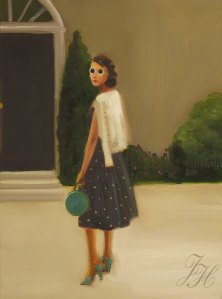
When finally she looks at the photograph she can’t see him. Instead she sees her mother. Her mother wears shoes with high thin heels, a wool coat that comes to the middle of her calves. There’s a small hat perched on the top of her head, over hair the daughter knows is very dark. She’s smiling, though it looks like a forced smile. Her handbag is over her arm and in the same hand she holds a pair of gloves. Her other arm is linked through her husband’s. I don’t know where my blonde hair came from, is what the daughter thinks about next. She thinks that thought for a long time.

Still the daughter doesn’t look deeply, instead skimming over the surface of the image like a dragonfly hovering nervously over a still pool. Maybe some murderous fish will leap out at any moment and take its small life, regardless of its future plans. The daughter has no desire to draw the man out into her present world but she does feel compelled to describe him, as if description is the first step towards making him real. This is a paradox: she knows she’s holding off the reality of him every day and night. It isn’t lost to her, far from it. She’s simply become adept at shutting it out.
If she can let him be real will she become real? Is this the price she has to pay to uncover her own authenticity? Can they still be so linked, after death and time and memory and forgetting have done their work?

The daughter is dizzy from shallow breathing. She looks towards the door that she’s left open in case she has to run. The Dog has draped himself across this threshold like a guardian at the gate. The sight of him reminds her of where and who she is. She whispers his name. His tail thumps on the floor but his gaze remains fixed beyond this room. A small growl escapes his throat. Who is he warning?

It’s very hot and still this January morning and she’s sweating in a light sarong and cotton blouse. She untangles her legs and lies flat on her back. She watches the daddy-long-legs drop from their threads in the corner of the ceiling and hang suspended in midair. There’s not the slightest breeze to disturb them. The photograph lies beside her and she’s careful not to look at it, or to let her hand touch its flat shiny surface.

After she’d trapped the snake she was at a loss as to what to do next. Alone in the house, she thought she’d better wait till Jane came home, as Jane is much more knowledgeable in these matters. Nevertheless, she felt compelled to go back to the scene every few minutes. Once there, she’d get down on her knees and put her face close to the spitting snake and stare at its small head and forked black tongue. Perhaps the power of her gaze might help her to incorporate the animal into the familiar, might rob it of its alterity, that disturbing aura of the utterly other, of being out of reach of any human appeal. She knew though, that what they had in common was life, and a blind impulse to live it, and she felt bad for imprisoning the animal, even though letting it roam the house was out of the question.

The daughter sits up and puts on her glasses. She leans over the photograph. She sees the man beside her mother is in his early thirties, tall and substantial, with thin, brown hair that falls across his forehead. She knows that when he is anxious or needs to connect himself again with his body, he runs his fingers through these strands of hair that lie across his forehead close to his eyebrows, and sweeps them away with a slight backward movement of his head. He has grey eyes. His face is well-fleshed and broad, and pleasant for those who look without knowledge. His teeth are discoloured from the unfiltered cigarettes he smokes. This habit has left his fingers stained. His nails are bitten to the quick. They are thick, stubby fingers stained brown. They are big fingers on big hands. He is a doctor and well liked in the small community in which he lives with his wife, and the child of his wife and another man. The child is ten. Her name is Angel. Her mother and this man call her by another name, but Angel is the name given to her by the grandmother the child loves most out of all the grown-up people in her world. When she is most lost and most afraid she whispers Angel to herself, and calls up the image of her grandmother.

Angel accepts the fiction that the fair man is her father though she is aware of some mystery surrounding her origins. She calls him “father” to herself and everybody else, until she is thirteen and he tells her otherwise.

Angel hears things in the night. The unforgettable sound of feet running down the hallway of the house, pursued by a heavier tread.
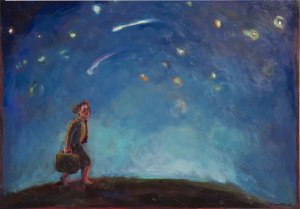
You lie in your bed, in your bed and your heart beats so loud you’re certain he’ll hear it. Your breath is so noisy, and you try not to breathe it. You slow down your heart and your breathing like a hibernating creature in a long dark winter. That, you believe, is the only way to stay alive in the circumstances in which you currently find yourself.

But will you ever learn to open up again? To let the heart beat to its own desires and the breath whistle carelessly through your body?

The day comes when he decides to do something he’s been contemplating for some time. The child is pretty, though not exceptionally so. More than that she is full of life, bright and intelligent with a wide smile and the skin that is the privilege of all young children, the skin one longs to stroke, like satin under the tips of the fingers. He likes the idea of having two females in his house available to him.  He chews on his fingernails as he sits in his chair drinking beer out of a pewter tankard and looking at his roses through the sitting room window. He brushes the hair out of his eyes and tosses his head. Then he chews his nails again till he draws blood. He isn’t contemplating doing anything wrong, he decides, giving fleeting attention to the morality of the situation. It has to be secret because other people will put their own interpretation on it. He gets angry just thinking about other people’s opinions on the matter. He gets defensive just thinking about someone else’s disapproval of him.

If he knows in his heart that he shouldn’t carry out this plan he stifles that knowledge. This is easy to do as his desire is great and outweighs every consideration his better nature might put forward. He has a better nature. He is a doctor, well liked in the town, he has healing hands. He has a better nature.

But his dark desire puts him beyond the reach of the ameliorating qualities of human love that would have him first consider the child. He pours another drink out of the bottle on the small table at the side of his chair, and lights another cigarette. He is not a man to deny himself his desires. He is a man with a sense of entitlement.

The phone rings. His wife calls him. He grinds out his cigarette and stands up, pushing the hair off his brow, adjusting his clothes. As he strides down the hall to the surgery at the side of the house, he puts his fantasies aside. By the time he’s reached the phone on his desk he’s become the doctor. He listens quietly to a patient’s concerns. He reassures, and says he will be there in ten minutes. He hangs up the phone. He gathers his bag, his stethoscope, the miniature torch he uses to look down sore throats. He strides out to the garage, gets into his car and takes out the packet of mints he keeps in the glove box. He puts two in his mouth and sucks on them. He’s thinking of the patient, what might be the cause of the sudden onset of high fever. He enjoys the regard in which his patients hold him. He won’t allow anybody to spoil that.

Sometimes while she was observing the snake, the daughter imagined fetching the shovel and decapitating it. But she was confounded by the logistics. How was she to keep the snake in place while she lifted the cage, put it down again on the floor, picked up the shovel and made ready to strike? How could she be sure the snake wouldn’t leap at her and sink its fangs into her cheek as she bent over and lifted off the metal cover? She paced the kitchen, thinking things through. She couldn’t settle to anything, knowing that snake was in the house.

She even thought she could let it bite her. She could take that irrevocable step into the unknown. She could alter the course of her life forever, in one instant. She could give in to the “unnameable lust.” She could. The decision was hers.

There’s a barrier between those who’ve known violence and those who haven’t. Behind this barrier Angel is, she fears, forever an outsider.

Her secret sets her apart. Dark knowledge taints her. She’s sullied. How will she ever make herself clean again? Once she sought to bridge this distance by confiding her experiences, only to see reflected back in her listener’s eyes her own confusion. Confessing something can sometimes make you feel worse than keeping it to yourself. Whatever is most difficult to tell. That is what counts.

If Angel reveals to you what she knows will she taint you in some way? Will she force into your life knowledge that can’t help but change the way you look at the world? Against your will, angering you, causing you to avoid her next time you pass in the street? Will she make you afraid of her because of what she knows?

The daughter experiences this barrier as a dense membrane, impenetrable, a thick sac in which she is enclosed and from which she attempts to look out at the world. The world seen through these membranous layers is always distorted, as if she’s looking through wet plastic, material that ought to be tangible, that she ought to be able to grasp in her hands, but can’t. If she could, it would be slick, like a foetal sac she must break through, kicking and tearing, in order to get out into the earth’s atmosphere and breathe for herself.

She sees the world coloured by her own experiences, as does everyone, but she doesn’t know that. For example, she looks at her friends and thinks that their fathers must do the same things. All girls must know what she knows, and part of what they know is that the knowledge must never be shared. They are all enclosed in their separate, thick worlds from which they gaze at one another with dull eyes. They will stay this way as long as they are in their fathers’ houses.

There is no clarity of vision from inside a membranous sac. The edges of things are always blurred, and boundaries are uncertain. You can’t touch anyone and nobody can touch you. Only the father can tear through and the layers separate for him and he enters and when he withdraws, the layers close over again, skin growing back, leaving no visible scar.
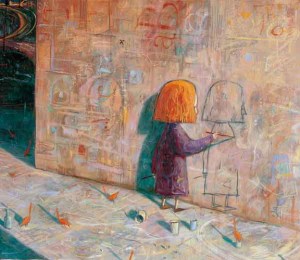
In referring to herself in the third person, Angel believes that she not only puts a distance between herself and her experiences, she creates herself as well. She brings herself into being. When she’s accomplished this, when she’s managed to construct herself, she’ll step into this borrowed figure, much as the hermit crab crawls into an empty shell and makes it her own by virtue of occupancy. Much as a bird settles into an elaborately woven nest and is then identified by the type of home she’s built, the materials she’s chosen, the way she’s arranged them.

When she speaks of herself in the third person she does it to ward off a certain pain that is always threatening to overtake her. Only in the third person can she find the courage to allow voice to the truths that sit on her shoulder, chattering and salivating like cast-out demons wanting back in.

She has no desire to think of herself as victim for the rest of her life. There must be a way she can stand with dignity in the midst of the sum total of her life’s experiences, denying none of them their due, resisting any attempt at domination by a single horror, granting equal value to all.

Though the January day is dripping with humidity, the daughter feels cold on the carpet in her room. Chilled to her very bones. She puts the photograph back in its envelope. She doesn’t know what she’s achieved by this exercise. She doesn’t feel any closer to having a real past than she did before, her head is aching and she feels sick. She whistles the Dog, he comes to her and rests his head in her lap. She buries her face in the thick white fur around his neck and inhales his dog smell.

After a while she thinks perhaps she might have put a tiny piece of her heart back where it belongs. That’s what it is, this painstaking process of singing in all the voices languishing on the outer edges. It’s the delicate job of putting a heart back together so it can die whole. She dare not die as she’s lived, bits of her scattered all over the place, forgotten, repressed, and denied.

Angel hears Jane’s footsteps as she enters through the upstairs door and sets her parcels down in the kitchen. The Dog sits up and makes ready to go to her, angling for a treat. If Angel follows him Jane will smile at her, and they will drink tea under the mango tree and watch the sun fall into the river, and pray for a thunderstorm to clear the stifling air. This is her ordinary life. This is the precious and ordinary life, given to her by Jane, that she never expected to have.
Eventually, on the day of the snake, she realised she couldn’t stay in the house any longer. Carefully, she printed on a piece of cardboard: Beware of the Snake. She propped this warning on the top of the stairs. Then she went out to buy chocolate.

When she got back, Jane was home, pulling on her gumboots and gardening gloves. She’d found a large sack. Together they went upstairs. Angel slowly lifted the wire cage and the snake wriggled out into the bag Jane held in front of it. Jane tied up the bag and they transported the thrashing snake to the bush at the end of their street. There they let it go.

‘Did you want me to kill it?’  Jane asked later as they drank tea and ate the chocolate, their reward for bravery and endurance

‘Nope. I just didn’t want it in the house. That bloody dog was useless you know. Didn’t even notice it.’

As a child the daughter’s nature was ebullient. It was hard for her to learn to disappear herself. It was hard for her to learn to think of herself in the third person.
I must be alive ’cos my heart’s still beating.

29 Jan

Some time ago I was told that I have an indolent lymphoma, a death sentence, the specialist implied. But so is life, I said. The moment I’m born I’m old enough to die. David stared in dismay, as if he found my attitude cavalier. As if he feared I hadn’t been listening.

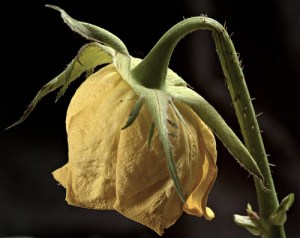
Dying Rose. By lovestruck via flickr

After receiving this dismal news, I left David’s office and went into the hospital bathroom, where I stood looking in the mirror for a long time, talking myself down from the ceiling and back into my body.

Who am I, I wondered as I stared at the pale woman in front of me.

Where am I going?

This sudden loss of self- recognition and purpose spooked me. Get a grip, I advised myself. I adjusted my old leather backpack on my shoulders. I washed my face, put some balm on my cracked lips, and left the hospital.

I was wearing jeans, brown boots, and a white shirt. An emerald green silk scarf, a gift from my youngest son whom we all call The Adventurer, was thrown carelessly around my neck. The scarf was stiff with tears and snot. I’d lost my bravado when David insisted on repeating his diagnosis. I’d held up both palms in protest, as if to keep him and all his words away from me, then I’d sobbed like a little girl who’d been unjustly punished, that it wasn’t fair.

David pushed the tissues across the desk. I’d used my scarf instead. It smelled, still, of my child.

This is how my life ended, and my dying began.


GET OFF MY CLOUD

After leaving the hospital I walked carefully down the familiar Newtown streets,leaking vital energies like a dying alien.

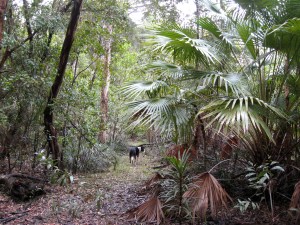
Dog in the forest

To return to the city after a long absence is to invite a serious assault on the senses. My senses were attuned to the ocean, and the secret scents of the rainforest.To the distant chug of trawlers as they crossed the bar at sunset, heading out for the night’s fishing.

My senses were used to the sounds of the whistling kites nesting at the bottom of the garden, and the sorrowful cries of the black-capped terns on the winter beach. Calmed by the blue heron absorbed in picking its delicate way across the mud flats in the wispy grey of an early morning river mist.

These senses were ill-prepared for traffic fumes and the roar of trucks; the hot sun glaring off shop windows, and dog shit in steaming piles around my feet. Neither had they managed well with the hospital’s chemical odours, and the sight, through an uncovered window, of a purple-gloved hand preparing a large syringe.

Purple. The colour of bishops, martyrs,and feminism, and now of cancer.

I was much taken with the name of my illness. It sounded refreshingly non-medical, even poetic. In.do.lent. Having or showing a disposition to avoid exertion. Sluggish, I read when I looked it up, the better to get a handle on the nature of the intruder.

I imagined the Indolent Lymphoma loafing on a Caribbean beach in a Panama hat, sunning itself under a striped umbrella, with a pink cocktail in its hand and a bag of weed in the pocket of its board shorts. I imagined myself confronting it.

‘We need to talk,’ I’d begin. ‘You’re on my cloud. You need to get off. Your attitude is costly for my life, and it cannot be allowed to continue.’

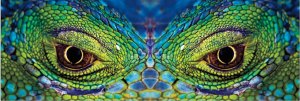
When I got up close I saw the creature had reptilian eyes and a self-satisfied leer. It winked at me and sucked on its roach. It didn’t speak, but roused itself enough to adjust the umbrella to keep the sun off its face. Then it idly threw the last of the roach into the warm turquoise sea. I lost my temper.
‘Well fuck you!’ I yelled.‘This isn’t fucking over yet, you know!’


STUFF FUCKING EVERYTHING

For a long time I slept with my teeth clenched, and woke each morning with an aching jaw. I couldn’t rouse myself enough to talk to anyone. I dreamed I was swimming in a turbulent sea and when I sank beneath the waves, my skirt became trapped under a rock.

I told no one I was ill. I thought that by telling someone I would make the diagnosis real. I lived alone then. My children were scattered across the world, and I was bereft of husbands and lovers. It was easy to keep a secret.

The dreams became worse. Apocalyptic, with tidal waves; angry wolves, soldiers, and smoking theatres of war littered with the limbless dead. I became afraid to fall sleep. I sat up at night watching infomercials on television and drinking red wine. In the early hours of the morning I’d swallow non-prescription calmatives. I didn’t consciously consider suicide, though I had it in mind if things became too bad, if pain became too bad further down the track.

A frightening aridity then took hold of me. My fevers were dry and wouldn’t break. My skin shrivelled. My eyes felt full of grit. My salivary glands reduced their output and my tongue, deprived of normal lubrication, became unwieldy and attached itself to the roof of my mouth as if both were lined with Velcro. I craved fluids and drank frequently and in large quantities. But the liquids brought no relief.

My spirit is burning itself out, I thought. I hadn’t anticipated this deathly dryness, this burning up, this slow progression towards grey ash.

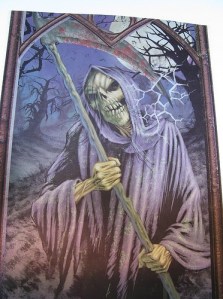
Grim Reaper. By Brave Heart via flickr

‘I don’t know how long I’ve got,’ I realised in a rare moment of reflection and assessment. ‘What do I most want to do?’

I had infant grandchildren as yet unmet on the other side of the world. Why not take a trip and visit them? At this thought I was immediately afraid. Fear has always been my Achilles heel.

‘What if I get sick, really sick in a foreign country?’ I worried, as I walked the winter beach with my black and white dog.

‘But why does it matter where I get really sick?’ I argued back.’Does anywhere feel like home to me? Where do I belong, where have I ever belonged? Does it matter at all where I die?’

I considered these questions mostly in the abstract. As generalised philosophical meditations, as a scholar rather than a sufferer, and got nowhere.

There are times when knowledge fails to make the necessary journey from the head to the heart.

‘Stuff fucking everything,’ I thought one day, overwhelmed by circumstances of such magnitude that my mind rebelled against admitting them. And besides, I was beginning to bore myself. There is only so much time one can spend contemplating one’s death. It was now a time for action, not stasis.I also wanted very much to start smoking again after twenty-four years of abstinence, and that urge had to be resisted at all costs.

So, with what felt like my last reserves of self-care, I decided I would go to Mexico. My son the Chef lived on the Mexican Caribbean coast with the grandchildren I had yet to meet. What better journey could I make? And my best friend, Jane, agreed to join me there later in the year.

I stored my winter clothes in boxes. Where I was going it was always summer. I packed my bags and boarded the 10am Qantas flight from Sydney to Los Angeles, to Dallas, Forth Worth, and on to Cancún. A thrilling optimism took me over. No regrets! No tears goodbye! Hola! Buenos dias, senors y senoritas!

Flying into...

Continue reading