Archive | The Personal RSS feed for this section

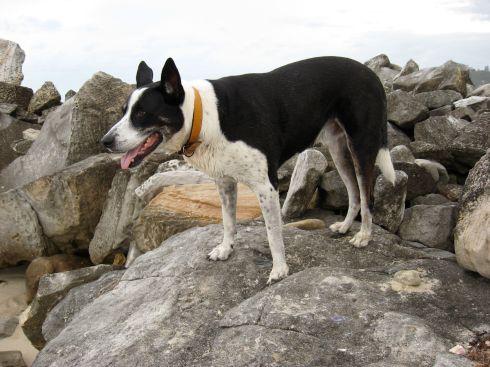
Vaya con dios, Big Dog

26 Nov

Big Dog Four


Our beautiful Big Dog died today. Mrs Chook held him in her arms and I stroked his head and told him he was a ripper dog, and Terry the Vet sent him on his way. I thought Terry would be used to these events, but he cried and I had to hold his hand.

We brought Big Dog home and buried him under the mango tree where he had his favourite sandy hole. Yesterday he watched as we dug his grave and I didn’t think that was very good for him, but there was a thunderstorm at the time and he always had to be practically in our laps whenever there was thunder so there was no dissuading him. Then we thought he might fall in it when we weren’t watching which would have been too darkly farcical for us to cope with, so we filled it up with garden chairs.

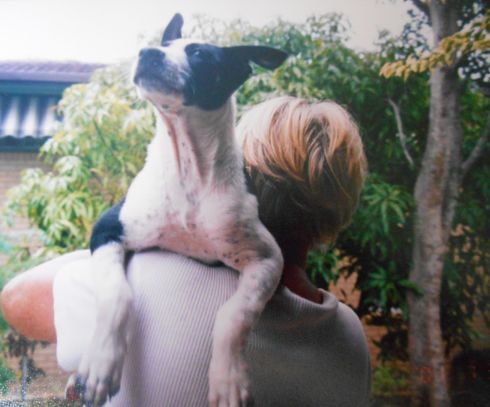
He was the first dog I’ve ever had who was really mine and he always let me hug him, which Mrs Chook said he did only under sufferance and because he loved me. Until he got too big he slept on my bed, and when he was very young, he travelled the house draped around my neck.

He is probably the only dog to have been allowed into the Woomera Detention Centre, when we visited refugees incarcerated there. You’ve got a bloody dog, the guards said, he can stay in the office it’s too hot outside, but the little children were outside, behind the razor wire, barefoot on hot sand because there was no grass for them to play on.


Big Dog One


Mrs Chook taught him to find koalas for her, and not to chase any living creature. Once a parrot flew into his mouth and he just stood there while I took it out and let it go. He never bit anything or anyone, never tried to hump your leg, and never rolled in dead things. Once he jumped out of the window of a moving car trying to get at his arch-enemy, a boxer dog who was walking with his owner down the street. When they came face to face, they just growled at each other. Children crawled all over him and he never got fed up with them. When we took him to obedience classes he was a star, except when Mrs Chook was his handler and then he wouldn’t do anything. This pissed her off mightily especially when the trainer told her she was useless at it and to give him back to me. It’s usually me who is useless at such things, but Big Dog made me a star as well.

The last five months have been full of loss and grief for me, and I think of the Dylan line, When you think that you lost everything you find out you can always lose a little more. 

Bye bye Big Dog. You were the best dog ever and I loved you.


The cupboard under the stairs

29 Oct

A combination of illness and heart carnage has resulted in weight loss that has seen me holding myself together for the last few months with safety pins, and belts with new holes gouged in them by Mrs Chook’s screwdrivers. I knew that somewhere I had a store of thin clothes but I’ve lacked the energy and interest to look for them. I always hurl everything I don’t immediately need into a vast cupboard under the stairs that has no adequate lighting so a torch is required, or one of those reading lights that fit around the head. Having light doesn’t stop me forgetting that at some point I can no longer stand up in the cupboard, and I always crack my head on a beam. Nothing is stored in any kind of order so I have to trawl through all kinds of stuff to find the one thing I need. The whole process drives me mad, but seeing as I couldn’t stand safety pins for another day, I had to do it. I found my thin clothes, which are probably vintage by now but that’s all right, vintage is good, it’s like having a new wardrobe, and the pleasure of wearing something that actually fits me is great.

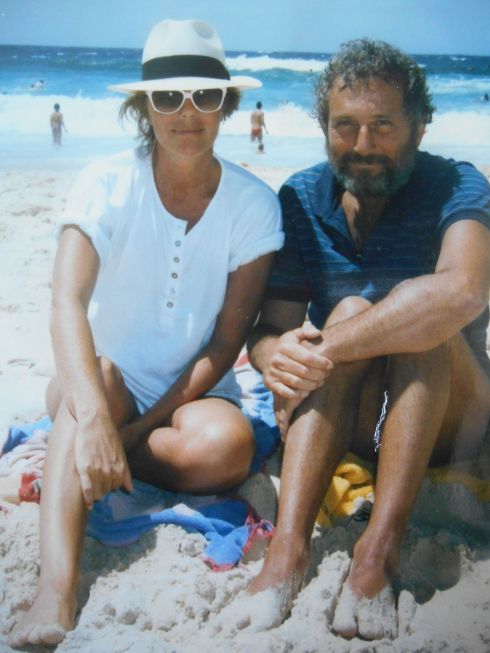
In the cupboard I found my husband and me a long time ago on Bondi Beach

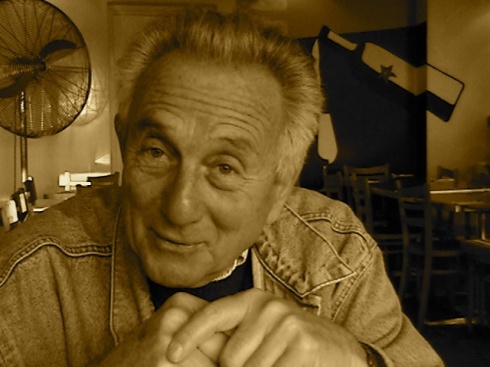
Arnie and me

Arnie was a very unobservant Jew, except for Passover feasts which he loved, but I never acquired a taste for gefilte fish and matzah ball soup and fortunately, he delighted in cooking them. He loved as well getting into vigorous arguments with the man from Jews for Jesus up at Bondi Junction, and if he could, he’d bale up the Hasidic Jews who lived round the corner from us and have a robust exchange with them about the Talmud. Very occasionally he would go to the synagogue, and in his seventies he started Hebrew classes. I used to say he was conflicted about his tribe, to which he invariably responded “Ah, conflicted, schmicted,” with a rabbinical shrug. When I first met my mother-in-law in Hartford, Connecticut, she said, “For a shiksa, you’re a doll.” He always said that when we die we become energy in the universe. I don’t know in which part of the universe he has become energy, but I hope I can find him.

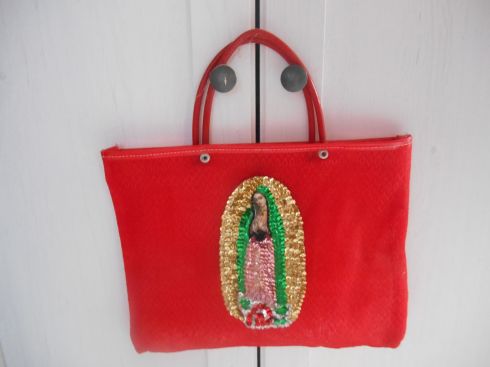
I discovered all kinds of things in my rummaging, including Mexican kitsch I’d forgotten all about. While living there a few years ago I became fond of the Virgin of Guadalupe, not least because she is also known as the Woman of the Apocalypse, “clothed with the sun, and the moon under her feet, and upon her head a crown of twelve stars.” I found her on a handbag in a market

Virgin bag

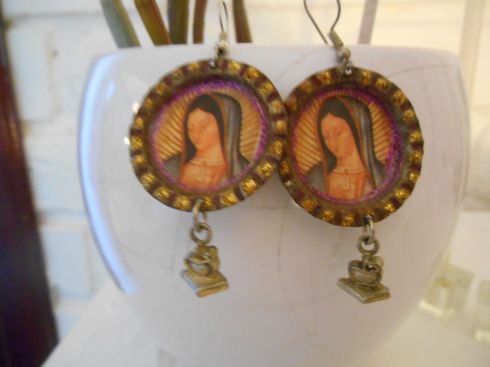
I found her in another market on earrings made from beer bottle tops

virgin earrings two

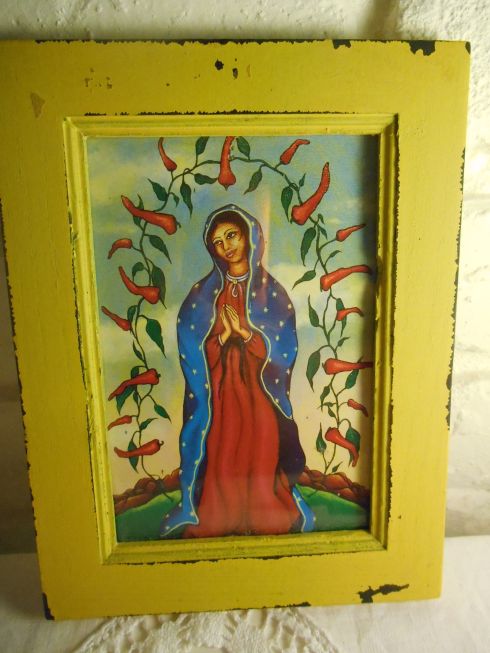
I found her on a postcard that I’ve put in a frame beside my bed

virgin photo

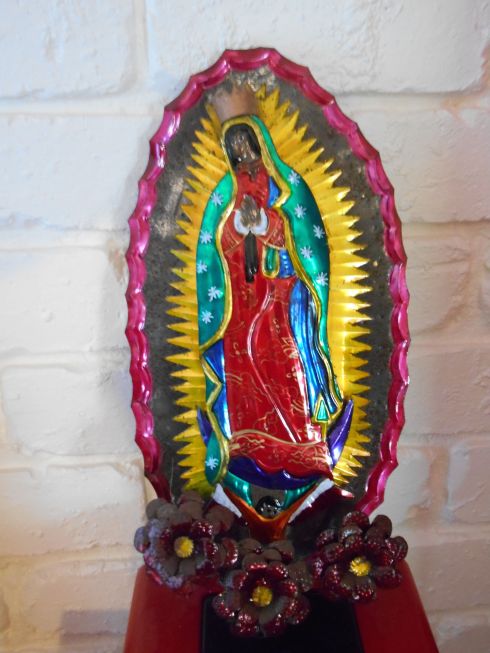
I found her on matchboxes and scarves, and in beaten tin that I’ve hung on the sitting room wall where she can watch over me while I sleep on the couch. She comforts me, and there are times in life when we must take our comfort wherever we can find it.

virgin guadalupe

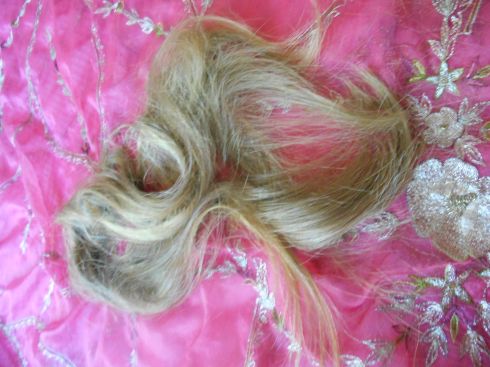
Then I found my hair, cut off when I was twelve

Hair aged 12

And then I found this

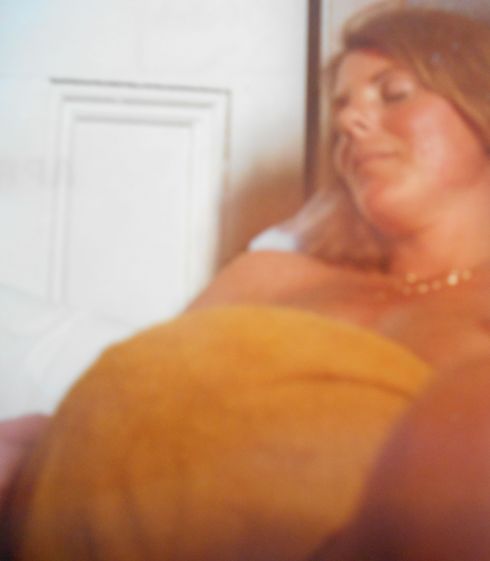
In labour

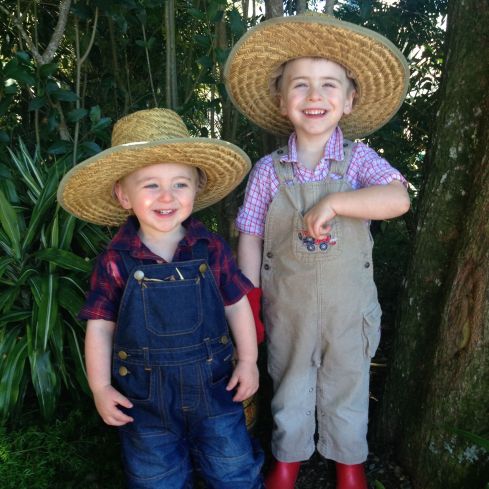
The child I gave birth to that April day is now the father of these two

farm boys

And after being in that cupboard I like to fancy that we are all women of the apocalypse, clothed with the sun, and the moon under our feet, and upon our heads a crown of twelve stars, and if I can remember that when I go into the universe perhaps my husband will find me, and I won’t even have to look for him.

The house of widows

23 Jun

Mrs Chook, with whom I share a home, two dogs, and much of my life, became a widow some considerable time ago, after nursing her husband through lung cancer. For a while she was a member of the local Widows Club. They had good times, played cards and golf, got drunk and raucous, spoke realistically of the men they’d lost, acknowledging their aggravating complexities, at times speaking ill of their dead because there’s no human being who can’t be spoken ill of to some degree, and the Widows Club women were nothing if not honest.

I was once invited to become an honorary member, not because I was widowed but because I was separated, living life without my husband’s daily presence and sharing it with Mrs Chook, but I declined, feeling out of place. Yes, I’d lost my husband in a very real sense, but to see that misadventure as widowhood did not feel true to me.

A separation is indeed a kind of death. But death has different dimensions, and they must be given their due.

I’m sitting in a bus station watching the World Cup on the overhead TV. I’m between worlds, and remembering another bus station, another World Cup on an overhead TV in Cancun, Mexico, another country when I was alone just like now, and it occurs to me that there is something of a pattern in this, bus stations, football, overhead televisions, a heart in a confusion of desire, loss, grief, a woman facing an unknown future. A sense of the complete unknowableness of certain events, transgressive events that tear apart the fabric of the ordinary, events that force open the portal into the extremities of human experience. I realise I have no control over death, or desire or love, and should I attempt to exert any illusionary control I will make myself ludicrous. There are forces abroad in the world that far exceed my puny human capabilities, and there is nothing to be done but ride them out as best I can.

The bus station today is not in Cancun but Sydney, my husband is dying, and I suddenly recall with bizarre accuracy the notice on the door of a hotel room in Mexico City:

 Many people are injured having fun in Mexico.
Air pollution in Mexico City is severe.
Failure to pay hotel bills or pay for other services rendered is considered fraud under Mexican Law.


 I’m at a loss to understand the workings of my memory until I recall that my journey to Mexico caused my husband great angst, indefinite as I’d announced it would be, determined as I was to go without him as he had travelled so often without me. It marked a turning point in the dynamics between us. I had asserted myself as the leaver rather than the left. Twenty years older than me, he was outraged and bewildered, having spent much of our marriage wishing me to be Penelope, spinning faithfully at my wheel at home and keeping suitors at bay while Odysseus travelled the earth. The role never sat well with me and seemingly out of nowhere I exploded out of it, like a woman blown from the mouth of a cannon. This turning of the tables unhinged my husband somewhat, and he wept at the airport. Not even his tears could melt my determined heart. A woman has to do what a woman has to do I didn’t say, but I could have. These were serious endings. I was no longer who I had been up to that point, and neither was he who had never in his life before wept at an airport, while a woman he loved left him behind.

It is tempting to describe these endings as deaths, but I have a profound distaste for the appropriation of death as a metaphor. There is nothing in life for which death can be asked metaphorically to stand. There is nothing in life that can be likened to the radical absence that is the signifier of death. Death is the one situation in which all hope for presence ends. Up to that point, one has merely endured absence.

I have recently become a legitimate member of the Widows Club, though it no longer exists in its original form. More than three decades of marriage, always unconventional, have ended and I am no longer just living separately from my husband while we continue to love one another in spite of our differences. I am widowed. I have begun the labour of mourning, as Freud described the gradual relinquishing of all hope of connection with the loved one that is made inevitable by his or her death. I will never again see his face. I will never again hold his hand. I will never again climb up on his hospital bed and lay my warm body along the length of his frail and shrunken frame.

It’s the finality that brings me undone. I find myself repeating, in my struggle to come to terms with his departure, I never will again.

In the end, I did not leave him weeping at an airport. He left me. I don’t know if he heard me tell him I will always love him. I don’t know if he heard me tell him he did not have to stay, that I did not begrudge him this journey, that I did not need or want him to remain here with me, that I wanted only his release, that he could leave with my blessing, I don’t know if he heard those things I whispered as I laid my body the length of his, and held his beloved head against my breasts.

 Because we’re alive, we inhabit the country of the living; that which is outside, we don’t have the heart to believe, I read, in Hélène Cixious. She’s right I don’t have the heart to believe, yet it is necessary to find the heart to believe, what else is there to do?  We live in the house of widows, I tell Mrs Chook, sitting on her bed in my dressing gown, Little Dog lying on my feet, you’re so pale, she says, and I don’t tell her I’ve woken up maybe ten times in the night, crying those tears you know are serious because they are hot, and burn their way down your cold cheeks. We will be all right, she tells me. You will be all right. In time. It takes time.

As is to be expected at the death of a loved one, memories are crowding in on me, our life together parading itself well out of any chronological order, according to some time line I cannot recognise as having anything to do with reality. I see him dancing towards me across our sitting room, singing, You made me love you, I didn’t want to do it, I didn’t want to do it, which always symbolised for me his infuriating reluctance to take responsibility for anything. Give me give me give me give me what I sigh for, you know you’ve got the kind of kisses that I’d die for redeemed him, as he always knew it would. The night before he died I found on YouTube a video of him talking about poetry, made just before his stroke. And then, for reasons I cannot explain, I recalled a scene from The Sopranos in which Meadow Soprano sits beside her unconscious father, crime boss Tony, whom she fears is dying, and reads the Jacques Prevert verse:

Our Father which art in Heaven
Stay there
And we shall stay on earth
Which is sometimes so pretty
 

I shall stay on earth, which is sometimes so pretty. Vale, Arnold Lawrence Goldman.

Arnie


What a woman wants, what a woman needs…

28 Feb

Yesterday I visited a place on the NSW south coast that once served as a sanctuary, a place to which I fled after an almost terminal encounter with cancer left my whole being drastically weakened, terrified to live and equally terrified to die. Daily life had become impossible, I no longer knew how to fulfil its expectations. I needed solitude, away from city life, I needed to escape the claims and demands of human interaction, even with those I loved and who loved me, and I needed this so desperately I think I might have physically attacked anyone who tried to hold me in place. Fortunately, nobody did, I was reluctantly let go when I promised to allow visits, as long as nobody stayed too long, and how long was ‘too long’ was to be determined by me.

DSCN0892

It was also fortunate that we owned a caravan behind the sand dunes on a largely deserted beach. You can’t live in a caravan, they said. You can’t live there all by yourself, you’ve been so sick, look at you, you have no hair and all your bones are showing. Fuck off, of course I can, I told them, unkindly. Any attempt at what I perceived as thwarting me made me frantically distressed, as if I was being pinned down by a body stronger and more powerful than mine that I had to fight off, or suffocate.

The caravan was in one of those old-fashioned parks where families spent their holidays year after year for as long as anyone could remember. When I arrived, exhausted from the four-hour drive and the emotion of goodbyes, the place was largely empty, being out of holiday season and in the middle of autumn. It was cold. The south coast climate is at best fickle, I have known us wrapped in sweaters and blankets on Christmas Day. The caravan, unoccupied for months during my illness and initial recovery, was musty and damp, a habitat for spiders and insects. The day was overcast, adding to the gloom, and while our spot beside the creek in a grove of melaleucas was idyllic, it allowed for little light under such a low grey sky. I had a panic attack. I couldn’t stay in the spider-infested gloom. I couldn’t go back to our light-filled Bondi Beach home where I suffered anxiety attacks every time I went out the front door into the neighbourhood I had, prior to my illness, loved to inhabit, with its cafes where I met my friends, ate weekend breakfasts with my husband and whoever else happened by, where we swam or walked the winter beach hand in hand talking as we always did with such energy and delight, even at the times we disagreed with practically everything the other said.

DSCN0889

After the cancer, I couldn’t talk about anything anymore. The ongoing blows inflicted by the illness, so unexpected, so unpredictable, they seemed unending in their variety and persistence. After cancer is a time largely underestimated in its power to disrupt. Generally, people think you ought to be relieved, happy you got away with it this time, determined to embark on a recovery regime that will get you back in the swim of things just like you were before. In reality, at least for me, it’s when the horror of the experience actually hits home, something that is impossible when you’re going through the treatments and your world has become medicalised to the extent that it overwhelms all other realities. Post cancer, every little twinge in your body is noted with alarm: is it coming back? For months I woke in the night drenched in sweat, from nightmares the details of which I could never remember, and a debilitating weariness dogged my days. There was nothing that did not leave me exhausted, and tearful. I couldn’t manage all this, and human beings as well.

I walked along this same beach yesterday, under a similar low, soft grey sky, the familiar smell of kelp, the haunting cries of seagulls, the gritty south coast sand between my toes. At the end of my beach there’s a broken wooden jetty where I used to lie on my stomach, peering intently at the stingrays gliding through the clear water beneath me. The rhythm of those days and weeks and months of solitude came back to me. In the mornings waking up sweat-soaked and panicked, climbing out of my single bunk bed to make tea on the gas stove, cold, even if the day was warm, because what I remember from those months is how I could never warm myself, even under piles of blankets, even in the hottest sun, it was as if I had a frigid core that nothing could reach, it was as if I had entirely lost my previously automatic ability to regulate even my body temperature. The trembling of my body, most especially my thighs, and the cold sweat drying on my skin. The fear of moving. The terror of putting one foot in front of the other. The utter loss of everything ordinary.

My husband and my adolescent children would visit and though I loved to see them, the relief I felt at their departure, at the resumption of my solitude, made me ashamed. I remembered yesterday the feeling of my starved gulping, my greedy devouring of nourishment not from my loved ones whom I invariably felt I had to reassure, but from the solitude of the natural world in which I was immersed. That was my healing. My guilt at abandoning them was great. But my need to be alone in this wild landscape overwhelmed it. I wanted nothing except what I needed to stay alive, some books, some music. The hurt I caused them did not become fully apparent till some years later when my eldest son, beside himself with unexpressed distress from that whole period of our lives, shouted at me, You didn’t need any of us! You just left us! You didn’t let us help you, you are such a fucking loner, Mum, you don’t fucking need anybody!

Which left me speechless. And reaching out for him and he came into my arms, grown up, so much bigger than me, and sobbed.

DSCN0891

I don’t know how it is for others, but I’ve always had a dreadful struggle between what I need for myself, and what others need from me, and what I want to give them because I love them. Sometimes I think I will die if I don’t have time absolutely alone. Sometimes I cannot bear to engage in one more conversation about, essentially, nothing, the kind of conversations that make up so much of our daily discourse, the words that serve to weave the binding threads between people, and that is their purpose. Sometimes I think if I am not able to sit in silence in the natural world for as long as I need to, I will start breaking things. It’s as if the healing never really finishes, needs to be topped up from time to time with a return to the inner self who increasingly becomes more solid, more real, than any outer persona and whose needs are so far from anything found in the everyday world with its constructed conventions, and its claims that largely require almost incessant, low-intensity interactions for their fulfilment.

For a woman to do what I did, leaving home, husband and family who cared for me through the desperate and dangerous phase of my illness, insisting on solitude rather than accepting their love was seen largely as selfish, and it was, there’s no denying that. It had a price, for all of us, but yesterday I understood that there’s nothing intrinsically wrong or frightening about paying a price for something deeply desired, these are deals we strike every day, choices made, choices rejected, and almost every one of them has some effect on someone to a greater or lesser degree. I still don’t know, after all this time in this life, how much I am allowed to take for myself, how much selfishness I am allowed, how many choices I may make that cause another hurt or discomfort, how responsible I must be for protecting another from disruption in the pursuit of my own desires and needs. With every situation this must be weighed up anew, and I have made some horrible errors. It seems that the important thing is that I continue to bother to attempt these fraught calculations, even though my sums may be dreadfully wrong. I hope that is the case, though I don’t expect I shall ever know.

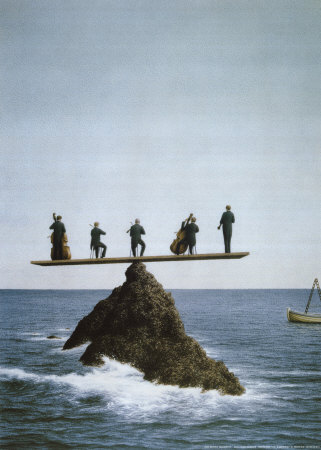
Quint Buchholz. lemaze-studio.com

Quint Buchholz. lemaze-studio.com

Stranded in the shit field

30 Oct
Shit Field, by poo on you

Shit Field, by poo on you


Now and again in a life, one runs into what I like to call a shit field – a series of apparently unconnected events that occur simultaneously, or hard on one another’s heels, all of which share a common theme.

It can be difficult to recognise you’re in the shit field at the time, because its very nature clouds the mind and takes a toll on perceptions.

For the last twelve months, and particularly the last four or five, some of the effects of trudging through the shit field have been an increasing lack of creativity, loss of interest in the world, crippling anxiety, depression, and a sense of having completely lost control of my life and my ability to make good decisions.

I apologise to everyone who has stayed with the blog, for my increasing lack of output, and the deteriorating quality of the posts I have managed.

I wrote here about the experience of being with my beloved husband last year, after he suffered a massive stroke. I underestimated the length of time it would take me to recover from the loss of the man with who I had shared a long, fraught love affair of such intensity that I couldn’t ever imagine loving anyone else. I’m familiar with the Kubler Ross theory of the five stages of grief, though in my experience they are not necessarily consecutive, and I don’t recall ever doing any bargaining, probably because I don’t believe in a higher power so I don’t have a transcendental exteriority in my life with whom to cut a deal.

Apart from that, I’d say the model is fairly accurate, and applies to important loss of any kind, not solely death and dying, if one needs a framework to help explain the chaos inside.

I also underestimated the exhaustion I would feel and for how long I would feel it, after week upon week of sitting at my husband’s bedside, watching him deteriorate, watching in shocked despair as he railed and screamed at me in a language I could no longer understand, and at the end of these rantings, trembling as I watched him break down, as he stroked my face with his one good hand, and begged me for I knew not what. I assumed comfort. Many times I climbed onto his bed and laid my body the length of his frail frame, and held him while he fumbled, sobbing, for my breasts.

I would leave him at the end of these gruelling days, and make my way back to the Bondi Beach apartment a friend’s daughter had loaned me while she was overseas. Sometimes I’d catch a bus. More often I’d walk, as a way to calm myself, and reconnect with the world outside of the nursing home. I was not really a fit companion for anyone, and generally too exhausted for dinners or meetings with old friends. I found it difficult to sleep. These days I hate the city, and found adapting to its racket after the silence of my north coast home, almost impossible. I missed my dog. I missed him something awful.

Our life together, mine and A’s, had been largely conducted in Bondi where we lived at the beach, apart from a brief period when A realised a life-long dream, and bought a converted Pittwater ferry that we moored at the Newport Marina and lived on for a couple of years on and off. Our weekend pleasure was to motor slowly round the waterways, and come back to haul up our crab pots full of blue swimmers that A would then cook in a huge pot and we’d eat for supper with wine or a beer.  I remember once standing beside him at the boat’s wheel, my skirt flying open in the wind, my hair whipping at my face, and A turning to me and saying “If I died now, here with you, I would die a happy man.”

I told him this and other stories of our life as I sat beside him, holding his hand. I think he heard. I think he remembered. I think it gave him some sense of who he was, and had been.

I know now that I had never loved him more than I did those months I sat vigil at his bedside. I don’t know where that love came from. I felt it enter me as I walked through the nursing home doors. I felt its energy fill me as I climbed the stairs to his room. I felt that love sustain me through everything that occurred, every day it occurred. That love overwhelmed me.  Without it, I couldn’t have lasted a week. I’m not a believer in anything much. But I believe in that love.

When my friend’s daughter returned from New York, I moved to the glorious cliff top eyrie owned by my friend, Elisabeth Wynhausen, who recently died, who swore me to secrecy when she discovered her cancer, and whom I miss.

The theme of my shit field is emerging.

Then, to my utter surprise, when I had decided such things were over for me, earlier this year I fell in love.  The circumstances were challenging. Everything indicated this was not going to be easy. And yet again, out of nowhere, that love swept in with such power and took hold of me, even harder than before if that was possible, and I said a yes.

Well, in keeping with the theme of the shit field the challenges were too great, and I find myself once again in the stages of grief, or perhaps I never really got out of them.

What strikes me as remarkable, however, is that something so comparatively short-lived can cause an anguish not dissimilar to the loss of the love affair of decades. Of course there isn’t the history to mourn. But the loss. Oh god, the loss.

Or perhaps it is an accumulation of loss that finally overwhelms. I can’t tell yet. I’m still too much in love. I haven’t caught up with events. I’m still talking to him in my head as if he hasn’t gone. I’m still hurt when there’s no good morning and goodnight. I haven’t got used to the loss of him beginning my days and ending my nights. The absence of his presence.

So, I doubt I’ll be out of the shit field anytime soon. Thank you for staying around.


Black dog

10 Aug

She feels as if she’s walking through treacle, that is, she feels the effort of pushing her body through a thick, sticky substance whenever she wants to move from one place to another. This isn’t anything like she usually feels. Usually she moves effortlessly, through friendly light air, like a dancer, with grace, as she was taught, a being responsive to music even when it’s only in her head, a being on good terms with the element that supports her life.

In the mornings, she wakes to find she’s crying. She’s detached from this crying. Nothing of her is involved in it. There’s no sobs. There are no physical convulsions. There’s just tears down her cheeks, an overflow. She wipes her face on her sheet. She gets out of bed. She goes into her bathroom. She avoids looking at herself in the mirror. She sits on the toilet. She pees, her elbows on her knees, her head in her hands. She feels like really crying but she won’t. This is her goal for the day, the same goal as yesterday and the day before and the day before that. She will not cry.

She puts on pyjama pants, socks and the dressing gown hanging on a hook in the bathroom. It’s chilly, in what passes for winter in northern NSW. She looks in the mirror. Her hair is wild from the night. She pushes it off her face, behind her ears. She looks into her eyes. I don’t even know who you are, she thinks, without emotion.

She goes into the room where the dogs sleep. There are two dogs since she inherited Little White Dog from her son. Her own dog, called Big Dog now, is old and can’t accompany her on the long walks she likes to take on the beaches and through the forest. Little Dog, though, has proved fearless and inexhaustible and follows her over all kinds of difficult terrain, and though she has never been drawn to fluffy white dogs, she is fond of this one.

She goes into their room and they greet her joyously, as if they’ve been separated from her for months, not one night. She strokes them, tells them they are beautiful, and urges them out into the garden. Then she goes upstairs, into the kitchen, puts on the kettle, finds the teapot, puts bread in the toaster, by which time the dogs have peed and are lined up at the kitchen door waiting for breakfast.

She has learned that things will remain fairly manageable if she takes one small task at a time. If she attempts too much, she’ll be overcome by despair and a crippling sense of incompetence. She’s usually very good at doing a lot of things but since the air turned to treacle and since she’s had to spend so much time making sure she’s not crying, her energies and her attention span have diminished. If she gets this toast and tea made and served up to Mrs Chook and feeds the dogs, that’s a good early morning.

She makes an extra piece of toast for the dogs. She used to share the crusts from her own, but with two of them she doesn’t get any. She hears Mrs Chook waking up. She takes the tea and toast into the upstairs bedroom where Mrs Chook is struggling to fight her way out of sleep and the mountain of doonas, books, scarves, papers, socks, pillows and various other detritus littering her bed. She sets the tea and toast on a minute space on the cluttered bedside table, mutters good morning and quickly leaves, because talking just now is way beyond her capabilities and besides, she can’t think of one single thing to say.  Language is leaving her, at least in its spoken form. It’s still present in her head, her own words, the words of others, poems, lyrics, conversations. But the effort of getting it from her mind to her mouth is beyond her and anyway, she thinks, what’s the point? Talking was always over-rated, wasn’t it? I would like, she thinks, to sit with someone, with him perhaps, in absolute silence. I would like, she thinks, with him perhaps, to simply gaze and be gazed upon. Then I would like, with him perhaps, to touch, just fingertips. I would like, she thinks, with him perhaps, to let the bodies and the hearts have their moment, released from the obligations of the spoken word. I am, she thinks, too tired for speech. Too tired for the enunciation. Too tired.

She takes her tea back downstairs to her domain, and turns on her computer. There’s mail. Stuff in which she has no interest, and a video from her daughter-in-law of her toddler grandson laughing. Mrs Chook says Archie laughs like his grandmother. If you look at photos of grandmother, son and grandson you can see they share the same full-faced grin, showing their teeth, joyful beings engaged with life, the three of them. She’s always loved it, that they share her laugh.

Archie, in the video, is beside himself with laughter. It seems to be inspired by a game his dad is playing with him. The child laughs with his whole body. He shivers, and prances with delight. He holds up his little hands and shrieks. He doubles over, clutching his belly and his hair flies out around his head, electrified with joy.  She watches the video over and over again. She isn’t crying, but the tears are running down her cheeks again quite without any input from her. She wipes them away with the sleeve of her dressing gown, and wipes her nose while she’s at it.  She turns up the sound. Archie’s laughter fills her study. She wants to be with him. She wants to hold his squirming body, catch his small hands in her own. Last time she saw him he was sick with a cold. He languished for long periods in her arms, and let her love him. He hadn’t been so long in her arms since he was a tiny infant, when she never wanted to put him to sleep in his cot where he ought to have been, even though his parents told her not to spoil him.

It’s all right, she thinks. Hold on. You can still want, so it’s not too bad. The worst time is when she can’t want. When all desire slips away, out of reach, and she can’t even remember how desire feels.

She turns off the video. She makes a plan. Shower. Dress. Take the dogs for a small walk, one that won’t exhaust Big Dog. Come home. Domestic tasks. One at a time. Then write. She must write. She must not give up writing.

Go out again, this time for a long walk with Little Dog. Take music. Stay out all morning. That way she won’t have to talk to anyone. That way she can concentrate on getting through this day the best she can.

It occurs to her that the only thing she knows how to do is to keep on keeping on.

She loads the dogs into the truck. The sun is shining. It’s warm now.

She can only write about herself in the third person. It’s better than nothing, she thinks.

Love. That is all.

20 Jul

A few months ago I wrote here about spending time with my seriously ill husband, and my experience of coming to terms with the end of a love that had been everything to me.

It took years to accept that love was over, and what I eventually took from that lonely, arid time was painful instruction on the power of human attachment.

When I visited A last year,  desperately ill after a massive stroke, unable to speak coherently and only intermittently recognising me, our life together did indeed parade itself before my eyes, and I laid many things to rest as I sat for weeks beside his bed, holding his hands while he struggled to tell me he loved me and always would.

The miracle was, that after everything that went wrong we did still love each other. I wasn’t altogether surprised to find that in me, because I am very bad at endings. The life may no longer be a shared one, but something in me, deep in my belly, refuses to entirely let go of the love. I don’t know if this is a good or a bad thing, it just is. So I can look at someone I loved years ago and think  oh, yes, I loved you and oh yes, the ending was hard and I hated you for a while, and oh yes, though I don’t want to do anything about it and my life has changed, still there is tenderness, and gratitude for what we knew together.

Grief is an altered state. It can take you by surprise, long after you think you’ve done with it. It becomes less wild, less consuming as time passes. It can take on a sorrowful tenderness that for all its softness, still wrenches the heart. Grief can be triggered unexpectedly, long after you think you’re done with it, and you find yourself needing to hide away while you work out what has suddenly gone wrong with your breathing, and why out of nowhere you badly want to cry.

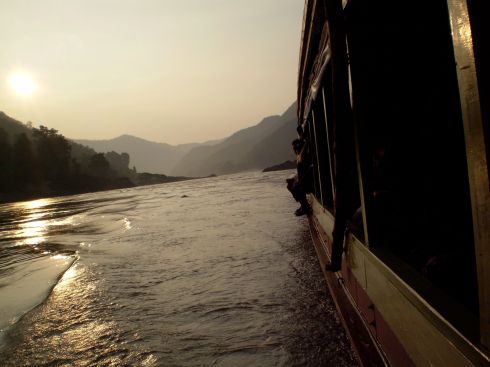
For example, I walked into a room today where someone was playing Mendelssohn’s Sonata for Cello and Piano, #2 in D Major. I listened to this Sonata, along with the Brahms #1 in F, during a very rough period in my marriage, during the last of many journeys A and I made together, down the Mekong, through Laos. I’ve heard both many times since, of course, but never without some emotion, the power of which has lessened over time. Yet today, for reasons I can’t explain, I heard the familiar first movement as if I was back on that long boat, sitting on my backpack beside A, both of us silenced by the misery of knowing it was too late for this journey or any other journey together, and neither of us able to end it.

OLYMPUS DIGITAL CAMERA

I don’t have a list of things I want to do before I die. At times I think, vaguely, of travelling to places I’ve never been because it would be excellent to leave the earth having seen as much of it as possible. At times I think I want to go back to the place where I was born one more time, because every time I return to that North Yorkshire country I feel a primitive and powerful sense of belonging that I have never felt anywhere else.

But lately I’ve been thinking that these things come a poor second to love, in all its frequently unexpected and varied manifestations, and it’s likely love that tops my bucket list.

Today my friend said, there’s no such thing as a perfect relationship is there?  There is, I said, after a while. The perfect relationship is the one where you care enough to bother struggling through the shitty bits and find you still want to stay in it. The perfect relationship is the one where you don’t want to struggle through the shit, and you have the decency and the courage to leave before you cause anymore damage to yourself and the other. Love is required for both. Isn’t it?

OLYMPUS DIGITAL CAMERA

Today I re-learned that nothing ends when you think it has. This annoys me, because I don’t live easily with loose ends. Somewhere along the way I’ve got it into my head that one must have “closure,” resolution, well-defined endings in order to move onto anything new. But actually, I’m coming to think that’s crap. My life is a chaos of ongoing love of varying kinds and depths, and I can’t think how to tidy up any of it. Perhaps I don’t have to? Perhaps instead I must learn to live with the disorder of a functioning human heart? Perhaps for years to come I will unexpectedly feel grief for my husband, for my dead mother, for my friend, for everyone I’ve  loved and will love, with various degrees of complexity and difficulty, success and failure.

There is a human being. There is love. That is all.


And it’s been worth every mile

13 Apr

With the coming of another child into our family, I’ve been thinking about love.

The human heart seems to have an infinite capacity for love. A new child, and the moment you hold him in your arms or even before, even as he is being handed to you by your son, his father, whom you also love beyond understanding, already you are in love with this new life.

Then you look on as your son falls in love with his baby, and you realise that however much you loved your son up to that moment, now you love him even more.

Then you remember the other kind of falling in love. And how, if it’s the kind that lasts long enough, you don’t just fall in love with the beloved once, but over and over again. And each time it feels deeper, and more strong, and somehow your heart expands and gives this growing love a home as well.

And somehow, there is room for everyone. And somehow, it’s worth every mile:

May you always be courageous…

6 Apr

So, this is why I’ve been away for the last few days: my grandson, Theodore Peter, known as Ted:

Ted 2

pictured here in my arms. Brother to Archie.

archie in the garden

May God bless and keep you always
May your wishes all come true
May you always do for others
And let others do for you
May you build a ladder to the stars
And climb on every rung
May you stay forever young
Forever young, forever young
May you stay forever young.
May you grow up to be righteous
May you grow up to be true
May you always know the truth
And see the lights surrounding you
May you always be courageous
Stand upright and be strong
May you stay forever young
Forever young, forever young
May you stay forever young.
May your hands always be busy
May your feet always be swift
May you have a strong foundation
When the winds of changes shift
May your heart always be joyful
And may your song always be sung
May you stay forever young
Forever young, forever young
May you stay forever young.
Bob Dylan, Forever Young

Dance me to the end of love

25 Mar


Some months ago I wrote here about going to my husband, from whom I’d been separated for some time, after he’d suffered a massive stroke.

With a bizarre assortment of clothes flung distractedly into a bag and no toothbrush, I took the train because all the flights from my part of the world were full.

I had no idea what to expect. He won’t know you, they told me. He doesn’t know anybody. He can’t speak. His right side is paralysed. I’ll come with you, a friend offered, so you don’t have to deal with the shock by yourself.

I accepted her offer. Once I never accepted anybody’s offers of help. I had no idea how to. I knew from early in life how to get through things on my own when there wasn’t any choice. I knew how to trust me, when I couldn’t trust anybody else.

At first, accepting help felt like betraying myself. I confused it with weakness. It wasn’t until I found at the age of 40 that I had cervical cancer and was in serious trouble, that I began to tentatively say, please help me. And everybody did. I’ve not much to feel grateful to that cancer for, but it did cause me to change, and let people love me.

When I walked into A’s room, he was strapped into a wheelchair. I pulled up a chair beside him and took his hand, the one still in working order. He looked at me for a long time, balefully, I thought. I found this look reassuringly familiar. Although he stopped wanting me long before I stopped wanting him, he never seemed to keep that chronology in mind and on the occasions we met after our final separation, acted aggrieved, as if I’d been the one to leg it. Well, I had, but only because I finally understood his desire for me was gone, and how can you stay around for that?

I say desire, which is usually and wrongly understood to be primarily sexual, but I mean it in a much broader sense. He never stopped wanting me sexually, nor I him, but it got to the point where that was all he wanted of me, while I still trembled at the whole of him.

Sometimes I finally get to thinking of the past,
We swore to each other that our love would surely last
I kept right on loving, you went on a fast
Now you are too thin and my love is too vast…*


It was 2006, and I’d been in Mexico for months without him because, on the surface of it, timing. We exchanged dozens of acrimonious emails in which he berated me for going without him, and I hurled back heartbroken accusations to the effect that for more than twenty years he’d only been a tourist in my life when what I’d wanted was a dedicated traveller. He then wrote that he supposed I was fucking some rich Mexican with a hundred-dollar haircut, or maybe I’d gone back to my old ways and was enjoying a senorita in some lesbian resort on the Caribbean coast, to which I replied, too exhausted to try for wit or even something vaguely cutting, what’s it to you, anyway. Leave me alone. I’m not talking to you anymore. A lengthy, angry, miserable silence ensued.

Not long after I returned home A emailed me from Singapore. I’d no idea he’d planned to be in Singapore when I left him in Sydney, but I learned how to do geographicals from him so it shouldn’t have been a surprise. Meet me in Thailand, he wrote. My life is stupid without you. I’ve transferred the frequent flyer points to your account. Don’t argue, please. Don’t turn your face away from me. Meet me in Chang Mai. We’ll go down the Mekong to Luang Prabang, like we always said we would…

I didn’t want to go. I’d done a lot of hard work separating myself whilst in Mexico. I thought I was getting closer to being over it. I knew that if I was ever going to have the life that I wanted, I had to walk away. Twenty years are long enough to try to work things out.

But I went.

It was unspeakably horrible. There is little worse than travelling down the Mekong in a long-boat without seats, crouched on your backpack beside a man you’ve been married to for twenty years who made passionate love to you the night before but in the morning, can hardly bring himself to talk to you. I listened to music on my headphones. I listened to the Brahms & Mendelssohn cello concertos, over and over and over. I’m listening to them now, as I write this. To this day, I can’t hear a cello without a tempest of feeling starting up in me.

I have a photo A took of me standing on the desolate, windswept airstrip in Northern Laos that was used by the Russians during the Vietnam War to supply arms to the Viet Cong. In the background the denuded hills, stripped of their fecund jungle by US chemical warfare, and all these years later, still not healed. In the foreground, a woman, grimly enduring the worst loneliness of her adult life.


We kept going through the whole damn trip and I have no idea why I didn’t just catch the first plane home, except I was too crippled by misery to take any positive action on my own behalf. Every time we made love, and inexplicably, we continued to make something, I did so in an altered state of anguish so intense it acquired a kind of sublimity. Knowing that though it was so finished I was still unable to refuse his touch, indeed, I wanted it as badly as I ever had, made me feel as debased as any addict begging on the street for enough money to get me a fix.

When I left him at the airport in Bangkok I knew without doubt it had to be the end.

Grief expresses itself very physically in me. I have to howl. I have to wail. I have to curl in a foetal ball on some dirty floor somewhere. I can’t care about what I look like, or brushing my teeth, or changing my socks or washing my hair. I can’t eat. I can drink, which does not, in the long run, help at all.

Eventually, after a long, long time, I started on my new life without him in it. I achieved ambitions, enjoyed my family, and my friends. Yet sometimes, compelled and not understanding at all by what, except the most pathetic, abject longing, I wore my wedding ring. I met potential lovers, and quite soon realised that if I expected to be in circumstances in which that might happen, I put on my wedding ring to make sure it didn’t. Desire abandoned me, a lost cause. I threw myself into my celibate life and got so used to longing, I didn’t even notice I was feeling it anymore.

I even managed to conduct civil encounters with A, in places such as the Botanical Gardens and Bondi cafes, and when he touched me, kissed my lips or took my hand, I gently removed myself from him. I could have gone home with him, back into our bed, I felt the stirrings, I knew I wasn’t entirely dead to passion, that I could go there with him again, but I knew I’d likely die as a consequence, one way or another.


I spent many weeks at his side, after his stroke. He knew me straight away. I fed him, wiped the dribble from the side of his mouth that doesn’t work anymore, held his hand while he alternately raved and cried, licked up his tears with my tongue. One day, as I leaned over him to adjust his bed, his good hand found the buttons on my shirt and struggled to undo them. I realised what he wanted, and did it for him, releasing my breasts so he could touch them again. He closed his eyes and fondled me, moving his hand from one breast to the other, as if amazed there could be two of them. I felt no sexual desire, rather an overwhelming desire of another kind: to give him this pleasure, this comfort.

For a couple of weeks, he would signal for me to give him my breasts at every visit. I wore clothes that made this easy, and discreet in case we were interrupted. And then he grew too tired. He began to slip away into another place where I couldn’t be. He still knew me. He just didn’t have the strength to care anymore.

I said goodbye to him, as I knew I must. I sat with him for a long time on our last day. He slept through much of it. Once he woke enough to stroke my face.

I won’t go back. There’s nothing left for me to do there. I always wanted him to die in my arms, or me to die in his, but that was never one of his desires.

I’ve put my wedding ring away now. For such a long, long while I couldn’t contemplate desire. I had to keep it far away from me, I had to hold up the palms of my hands to keep it at bay, because desire only meant him, and saying its name reminded me only of the loss of him.

As I finish this, I realise I have listened to the Brahms & and the Mendelssohn concertos over and over again this morning, and it has been all right. This morning, a momentous one in my life, I’m looking at the time we had together, A and me, and wish I could have learned sooner how bad it was for me. I wish I hadn’t lost so much of my life to something that was never going to be what I wanted. I wish I hadn’t squandered so much love, and so much effort, trying to make something that simply could not be.

Although it was never his intention, the man who showed me how to be a scholar, thrilling me with his intellect; the man who guided me into sexual desire, thrilling me with what he showed me I could feel, that man also, quite inadvertently, taught me how to I want to love, and be loved. Though that love was never to be realised with us, I see today, at long last through clear eyes, that it is A’s greatest gift to me.


Dance me to the children who are asking to be born
Dance me through the curtains that our kisses have outworn
Raise a tent of shelter now, though every thread is torn
Dance me to the end of love *

*Leonard Cohen, Tonight will be fine

*Leonard Cohen, Dance me to the end of love