Archive | Society RSS feed for this section

Whistleblowing: a chilling account

6 Jan

Robina Cosser is a guest author, and an expert on whistle blowing.

By tiganatoo via flickr

Blowing the whistle into an empty room

By Robina Cosser

So …

You become aware that something is “going on” in The Department. And you decide that you must do something about the situation. You decide that you must “blow the whistle” – you must tell somebody who will do something about the situation.

So you struggle over the wording of your disclosure for several days, or even weeks, trying to explain your disclosure as clearly as possible. And you collect lots and lots of supporting documentation.

Then you mail your disclosure and the supporting documentation to a person that you think cannot possibly be corrupt. The Director-General of The Department, maybe.

But you don’t realise that you are doing battle with the public service. And that no public servant in The Department wants to be held responsible for hearing you blow the whistle. And that The Department’s public servants have generations of experience in “not hearing”, “not understanding”, “not knowing” and “not finding any evidence of”.

And so your disclosure is “lost”. Or the supporting documents are “lost”. Or your disclosure is reduced to gibberish – the cover letter and the first page of your disclosure are saved, the next eight pages are “lost” and the remaining pages of your disclosure are sent to another office, in another city, and jumbled up with lots of other documents.

Or every alternate page of your disclosure is “lost”. Or two pages of your disclosure are recorded, two are “lost”, two are recorded, two are “lost”, etc. Or your disclosure is reduced to half-size and turned around and printed sideways on the page, so that it is very difficult to read.

And The Department do nothing about your disclosure.

So, after waiting for some time, you decide that you have to make your disclosure to another government department, one that is not corrupt. The Crime and Misconduct Commission, maybe.

So you ring the CMC. And you make your disclosure very, very clearly to the CMC officer.

And the CMC officer writes down her own gibberish version of your disclosure. And she makes a note that, having spoken with you, she has doubts about your credibility. And she puts these notes on your file.

You have a suspicion that the CMC officer was reluctant to record your disclosure. Something in her tone of voice. And so you send her an email, making your disclosure very, very clear to her. So that she cannot pretend to misunderstand.

But the CMC officer does not open your email. She simply records that you have sent her yet another pesky email. And the CMC officer “devolves” your disclosure – she sends it back to The Department, The department that you are complaining about.

And so the CMC have no record of your disclosure, just a record of their own gibberish version of your disclosure. And The Department’s investigation into your disclosure is based on the gibberish version of your disclosure.

And The Department’s investigation is not really an investigation; it is a “review”. And the rules of the “review” are that you are not allowed to speak to the reviewer. And the reviewer is not allowed to ask any questions. So you have no way of finding out that your disclosure has been reduced to gibberish.

A few days before or after the “review” begins, Freedom of Information documents are released to you by The Department. And you realise that your official records have been extensively falsified. So you email the Director-General. And you tell him that your official records have been extensively falsified.

He emails back.

Lots of times.

With lots of promises and re-assurances.

And you email the Director of Ethical Conduct. You tell him that your official records have been extensively falsified. And he emails back. Lots of times. With lots of promises and re-assurances.

Then, a few days before a copy of the review is released to you under “Freedom of Information”, the CMC and The Department each “accept” the review – the review based on the gibberish version of your disclosure and the falsified records – and they each declare your case “closed”.

So that when you write and protest that the review has been based on a gibberish version of your disclosure and on a huge mass of falsified “official records”, no public servant reads your letters. No public servant “knows”. Because your case has been declared “closed”.

And when you ask, under freedom of Information, what the Director-General and the Director of Ethical Conduct actually did in response to your emails, you are advised that there was a computer problem in The Department. And all of your emails to and from the Director-General and the Director of Human Resources over several months were “lost”. And so there is no official record of your complaint to them that your “official records” have been extensively falsified. And there is no official record of any of their promises and the re-assurances.

So you decide to phone another government department, one that is not corrupt. And you explain your disclosure again, very clearly. You notice a slight whining noise as you are speaking. When you have finished making your disclosure the Public Servant asks you if, “besides that”, anything else is bothering you. And so you struggle to give him some other examples of corruption. And you notice that the whining noise has now stopped. And later you wonder if the Public Servant could have been pausing his tape recorder while you were explaining your disclosure.

So you visit the Head Office of The Department. And you take your own tape recorder. And you place it on the table.

And the Head Office Public Servant places his own tape recorder on the table, beside yours. And, while you are speaking about a particular group of the falsified records, the Head Office Public Servant fiddles anxiously with his tape recorder. Twice. And, later, when you listen to your own recording, you notice that there is a loud straining noise on your own tape while you were explaining that a witness has told you that this particular group of “official records” are entirely falsified.

And you wonder if the Head Office Public Servant could have paused his tape recorder while you were talking about these particular “official records”.

The Department eventually appoint an “independent investigator”.

And the Head Office Public Servant whose behaviour you have complained about to the CMC is given control of the “independent investigation”. The Head Office Public Servant tells the “independent investigator” that he is only allowed to “consider” the falsified documents that you have discovered on your official records. He is not allowed to consider your evidence that these “records” are extensively falsified. Nor is he allowed to consider the many “official records” that are still being refused to you under Freedom of Information.

He is only allowed to “consider” the falsified documents.

Again.

And, one year before the CMC receive a copy of the “external investigation” report, they declare your case “closed”.

And two years before fragments of the “external investigation” report are released to you under Freedom of Information, The Department “accept” the investigation report and write to you, declaring your case “closed”.

And, when you receive fragments of the Investigation Report under Freedom of Information, you realise that your disclosure has still not been investigated. And, when you write more protest letters, no public servant reads your protest letters because your case has been declared “closed”.

Again.

So you decide that you have to send your disclosure to somebody that you think really cannot be corrupt. The State Premier, maybe.

And the Premier’s office do nothing. For months.

And so you write again. Did they receive your disclosure?

And again the Premier’s office do nothing. For months.

And so you write again.

You give more information. But you do not repeat your disclosure – because you have already “disclosed” to them twice. And this third letter triggers a response. A “Briefing Note for the Premier” is prepared by a senior public servant.

The Premier is advised that you keep on writing pesky letters. But no mention is made of the disclosure in your first two letters. And the Premier is advised not to reply to your pesky letters.

And the Premier agrees not to reply to your letters. He signs the “Briefing Note” with a big, swirly signature. And all of his senior public servants also agree not to respond to your pesky letters.

And so all of your letters to the Premier from that date onwards are simply filed by a machine, without being read.

And no public servant “knows”.

And eventually you realise that you are whistling into an empty room.

This article was first published in On Line Opinion, December 14 2010

Robina Cosser edits the  Teachers Are Blowing Their Whistles and Whistleblowing Women. She is Schools Contact Person and a Vice-President of Whistleblowers Australia.

America and the little wild bouquet

4 Jan

New York Times columnist Nicholas Kristof , in an article titled: Inequality is eating away at America’s soul January 4 2011 writes:

The gap between rich and poor in the US is vast and it’s growing.

John Steinbeck observed that ”a sad soul can kill you quicker, far quicker, than a germ”.

That insight, now confirmed by epidemiological studies, is worth bearing in mind at a time of such polarising inequality that the wealthiest 1 per cent of Americans possess a greater collective net worth than the bottom 90 per cent.

There’s growing evidence that the toll of this stunning inequality is not just economic but also is a melancholy of the soul……Among rich countries, those that are more unequal appear to have more mental illness, infant mortality, obesity, high school dropouts, teenage births, homicides, and so on. 

They find the same thing is true among the 50 American states. More unequal states, such as Mississippi and Louisiana, do poorly by these social measures. More equal states, such as New Hampshire and Minnesota, do far better.

So why is inequality so harmful? The Spirit Level suggests that inequality undermines social trust and community life, corroding societies as a whole. It also suggests that humans, as social beings, become stressed when they find themselves at the bottom of a hierarchy…continued at SMH January 4 2011.

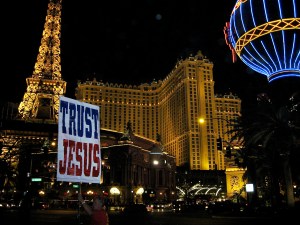
Las Vegas Strip on a Saturday night.

Las Vegas Strip on a Saturday night. By Jane Bronotte

Or as L. Cohen so hopefully puts it in Democracy:
I’m sentimental, if you know what I mean
I love the country but I can’t stand the scene.
And I’m neither left or right
I’m just staying home tonight,
getting lost in that hopeless little screen.
But I’m stubborn as those garbage bags
that Time cannot decay,
I’m junk but I’m still holding up
this little wild bouquet:
Democracy is coming to the U.S.A.

Cosmetic surgery, the gender revolution, and J.M. Coetzee.

30 Dec

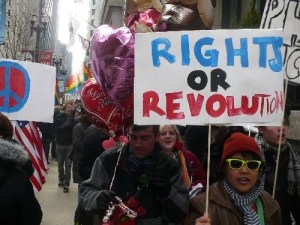
Rights or Revolution. By Gay Liberation Network. flickr

The last few weeks have been interesting. First up, I was bored and channel surfing and I came across the ABC’s Hungry Beast at the beginning of a report of cosmetic surgery on female genitals. This is apparently becoming popular in Australia. It’s performed by plastic surgeons on women who think their genitals need a bit of a tidy. As I come from the generation who thought it revolutionary to crouch over the mirror and have a look, I was immediately engrossed in this report. I thought it might tell me how far we’d come.

How do you actually know your genitals need tidying, I wondered idly, as my revolution didn’t consist of a wide-scale comparative survey of loads of others. And this is where it really got scary.

The soft porn industry in Australia is allowed to publish images of female genitalia. However, these images may not be too explicit. You can’t show too many bits. So the photographs are airbrushed, with the result that the women in these magazines are portrayed as having genitals that are more likely to belong to a pre-pubescent girl.

In a wonderful example of a Baudrillardian nightmare in which the virtual not the actual has come to define what is ‘normal’, I learned that women and oftentimes their partners are taking these airbrushed models as guides to the way women’s genitals should be. The mature genitalia with their wrinkly bits and pieces are now perceived as imperfect. We can, and some think we should, get our genitals surgically deconstructed and reconstructed to look like we looked when we were ten.

The processing of photographs was described by porn industry air brushers as altering the appearance of the “vagina.” This confused me greatly for a while, being as the vagina is the inside bit. It seemed even more frightening than slicing up external bits. But to my relief the reporter explained that the industry prefers to use the term “vagina” rather than the term “labia,” due no doubt to some bizarre desire not to offend by being explicit.

I then watched in anguished disbelief as we were taken into the operating rooms of a plastic surgeon who was in the process of injecting anaesthetic into the genital area of an attractive young woman. After a bit of chat, and then getting down to some business we couldn’t see as he was filmed with his back to the camera, the surgeon emerged triumphant from his flurry under the blue sheets, holding aloft a piece of bloodied skin that immediately put me in mind of Van Gogh’s severed ear. It was, in fact, a good-sized chunk of one of the young woman’s labium.

Barely recovered from this, I next encountered the appalling treatment of Norrie by the NSW government. Norrie was registered as male at birth. Norrie began hormone treatment at 23 and then had surgery to become a woman. Norrie has since stopped taking hormones and identifies as neither sex. Norrie had become the first person in the state to be legally recognised as without gender.

When I heard this news, I was delighted. This is a great step forward for our society, I thought. At last we have matured enough to acknowledge difference, and to free ourselves from the cultural brainwashing that would have us imprisoned for life in limiting binary gender categories, and their at times crushing roles.

People like Norrie are, in my view, heroic vanguards of the better world that is there for us if we can only liberate ourselves from these entirely constructed (frequently by religions, then supported by the State) concepts of what is “normal” and what is “natural.”

But my pleasure was short lived. In a disgraceful turnaround, Norrie was stripped by the NSW government of the right to be legally recognised as genderless on the grounds of some obscure twaddle dragged out of some obscure twaddle book, specifically for the purpose of calming the fears of red-necked twaddlers everywhere who couldn’t get their heads around Norrie’s circumstances and just wanted it all stopped. The NSW government capitulated to these fear-ridden, angst-ridden, deeply threatened voters, and stopped it.

One step forward. Ten steps back. Norrie has vowed to fight on.

Finally, J.M. Coetzee. Who is one of my favourite authors and who is currently reading his novel “Youth” on ABC Radio National’s Book Show. I will state right now that it is not acceptable for the views of narrators and characters in a novel to be attributed by the reader to the novel’s author.

The narrator of Coetzee’s novel is describing the character’s first homosexual encounter. A shabby, impersonal encounter with a stranger that leaves the character feeling isolated and unsatisfied.

Prior to this encounter, the character wonders if he is homosexual and if that were the case, would this “explain his woes from beginning to end?”

After the encounter the character decides that homosexuality is a “puny activity…a game for people afraid of the big league…a game for losers.”

I first mused that some heterosexual encounters could be described as puny. The lack of connection and sense of distaste after engaging in impersonal and furtive sex is not confined to homosexual activity. The lack of interest in a partner as anything more than a means to achieving gratification as quickly as possible then let’s zip up and clear off is an un-gendered state of mind. Women do it too. The uncomfortable emotions it can lead to (but aren’t inevitable if you haven’t been looking for anything more) are un-gendered. While we have different bits, men and women and un-gendered people do share human emotions, many of which appear to be similar in certain situations.

So I decided that Coetzee’s character was on the wrong track – it wasn’t the homosexuality of the encounter that was puny it was the nature of the encounter itself. As long any character doesn’t grasp that, that character is doomed to reproduce the grotty experience regardless of their partner’s gender or if the partner has no gender at all. This isn’t an issue of sexual preference. It’s just sad sex.

I then thought that this characterisation of homosexual sex as something for people who can’t manage heterosexual sex, or who are losers, is very much alive and well and abroad in the world.  Homosexual sex often isn’t thought of as “real” sex, heterosexual sex is held up as the “real” mature expression of sexual love. “Real” blokes have sex with women, and if you tell a bloke to “man up” the last thing you mean is go have gay sex.

In the same way that Norrie’s lack of gender is now not legally recognised, gay marriage is still not permissible in this country, and probably for some similar reasons. Marriage can only take place between a man and a woman, trumpet those who oppose, and it will be devalued if gays and lesbians and un-gendered people are allowed to do it too.

De-valued? De gays and de lesbians and de no-gendered people will strip the institution of marriage of a mysterious value that is only brought to it, that can only be brought to it, by heterosexuals?

What, one wonders, can that value possibly be?

Have these objectors ever stopped to consider that we live in a world in chronic need of all the love it can get, I wonder.  So perhaps we have a sacred (in the sense of not to be disrespected) responsibility to celebrate love, including sexual love, wherever it appears, between men and men, women and women, un-gendered people, or women and men.

Apart from anything else, the refusal to recognise Norrie’s situation, and that of gays and lesbians who wish to marry, contravenes the human rights of all parties involved.

But not to worry. As long as we can still get our genitals sculpted we can be justifiably proud of the democracy in which we live.

I have wondered if this surgical procedure is available for men, and how many are taking it up. But which bits are considered the untidy bits?

I once had a fellowship at a writers’ retreat. There were several other writers present and after a hard week’s work, we took ourselves down to the pub. Everyone had a few margueritas and on the last round, a woman among us who had been very quiet in social situations up to that point, suddenly became raucous. She wanted to propose a toast, she said, to the best crowd of women she’d come across in a long time.

“Up yer flaps, girls!” she roared, and all the men at the bar turned round to stare. “Yair, that’s right mate,’ she sang out again, lifting her glass and her middle finger in their direction. “Up yer flaps!”

This article was first published in On Line Opinion, 26.03.2010