Archive | Society RSS feed for this section

KanYe West, Melinda Tankard Reist, and the control of the representation of desire.

26 Feb

by Lucero Design via flickr

At Melinda Tankard Reist’s website underwear manufacturer Victoria’s Secret is under attack, two hapless tools from the Gold Coast trying to sell real estate using a woman in her undies are copping it, and oh no! Not that, still! Yes, the KanYe West Monster video clip, months after we all got into that epic tussle at the Drum, is still absorbing the Tank’s attention.

Last week MTR was described by Stephen Harrington at the Punch as “Australia’s Helen Lovejoy,” for her complaints about this video clip, as well as the “what about the children” rhetoric she invokes as an argument against just about everything.

(For those not familiar with the Simpsons, Helen Lovejoy is the ultra conservative wife of the local Christian minister whose catchcry is “But what about the children!”)

Melinda pours retributory scorn on Harrington here. The West video is, she claims, a “significant watershed in the de-humanisation of women.”

That’s a bit hyperbolic, in my opinion, given the on going, grave, and global abuses of women’s human rights that certainly do de-humanise those groups subjected to them.

The psychotherapists’ interpretations

At New Matilda, psychotherapist Zoe Krupke interprets the video clip from her professional perspective, and explains that violence such as is portrayed therein can be a consequence of “denial of personal weakness and fragility,” resulting in projection of these qualities onto others, in this case the strung-up, zombiefied and helpless women.

In other words, controlling others through violence allows the perpetrator to bury feelings of inadequacy and vulnerability, and replace them with an illusion of power.

All of which is true enough, but if you read the lyrics it’s clear that they are about nothing but West’s feelings of personal weakness and fragility; rage at perceived exploitation by the music industry, and women, rage at his admitted inability to behave in any way other than monstrous; identification with other monster figures, and a pathetic plea for someone to love him.

by Maximillian Dinslage via flickr

None of which are expressed in ways that are likely to get him any of the things he seeks, but rather are an explosion of fury, frustration, and self-mockery.

I’m a monster
no good blood-sucker
everybody know I’m a
muthaf*cking monster
None of you n*ggas know the carnage I’ve seen
I still hear fiends scream in my dream…

And so on. The thoughts and feelings of a disturbed being, a rapper having a laugh, or both, depending on your perspective.

Feminists aren’t the only ones with opinions

You've Been Dickrolled. by David Jackmanson via flickr


What is certain (I’m sorry, at this point I can’t help myself, the only certainty is the certainty of uncertainty, thank you so much for the philosophical insight, Tony the Tool, another of the known unknown unknowns littering the political landscape, and pictured here damn near naked) is that while a feminist analysis of the work is worthwhile, it’s far from being the only possible analysis. The video and lyrics are complex, with racial references as well as those mentioned above, and to attempt to have it censored because it “dehumanises” women is, in my opinion, the kind of sadly unimaginative reaction we’ve come to expect from some media feminists these days.

What the video clip certainly is: the concretisation of one rapper’s subjective vision of his world. If it weren’t as popular as it is, there would be no need for further discussion. But it is tremendously popular, (listed in Rolling Stone’s best 30 albums of 2010) and has received critical acclaim from that magazine’s  informed commentators

These accolades suggest West’s Beautiful Dark Twisted Fantasies strike a chord, so to speak with millions of others. It may not be the kind of chord MTR wants struck, whatever that is, and I can’t figure that out. What do these women want? Nevertheless, it’s popularity alone makes it culturally significant, and worthy of examination.

Not that I’m suggesting popularity is the only criterium for cultural significance because clearly it isn’t. The bizarre and complex vision represented in this piece lifts it out of the mundane.

It isn’t everybody’s vision of the world. Then again, neither is a man nailed to a cross, blood seeping out of his wounds and a hole pierced in his side everybody’s vision of a healthy religious experience. John the Baptist’s bloody head on a silver platter doesn’t cut it as inspiring religious commentary for all of us either.

I have a strong visceral response against most moves to censor. No matter what you think of the aesthetic quality or otherwise of the KanYe West video, it is the expression of an artist’s vision.  Are we to live in a world bereft of all dark and difficult imagery? Are we to censor all representations of emotions and passions because they make some people uncomfortable?
Cindy and that sexy thong. by Dave Lee via flickr


When women choose to earn their living from their bodies

Women who model for Victoria’s Secret do so of their own free will, and are well paid for their work. Likewise the women who appeared in the West clip as simulated corpses and zombies.

The luscious woman in the Gold Coast real estate agents’ ad was also, presumably, paid for her work. Many women with lovely bodies enjoy using them as a source of income. Many other women and men enjoy looking at those bodies. Is this really “objectifying” women? Or is it merely admiring, and maybe sometimes envying their beauty?

I’m not likely to meet any of them. They are likely to remain only one-dimensional images to me. So why do I have any responsibility at all to see them as anything else? Why is it wrong for me to take pleasure their beauty? How am I offending them?

If I were to treat the women and men around me as one dimensional, then I would be objectifying and insulting them. But like most people, I know the difference between an image and a fully fleshed human being.

There are some who try to make the people in their lives more closely resemble a one-dimensional image they’ve seen on screen or in a magazine. Their problems, and the problems of their partners, won’t be solved by banning the images. I’d suggest their difficulties are deep, and if no images are available they’ll manifest in some other equally unfortunate way.

The desire to be desired

The desire to be desired is a normal human need. Practically everyone at some time wants, indeed needs, to bathe in the glow of somebody’s desiring gaze. But desire and its expression and representation are intensely personal matters. Lacy panties or cottontails, stilettos or bare feet, cleavage or buttoned up modesty – there’s a place for everything, but not in the world of Melinda Tankard Reist. In that world there’s only one possibility for the expression and representation of desire, and that’s hers.

Baffled by her negativity, I’m as yet entirely unable to ascertain what her vision actually consists of. Though she unrelentingly castigates us for our unhealthily fetishistic and voyeuristic gaze, I’ve never once heard MTR give an example of how she thinks female sexuality ought to be represented and expressed.

We should pretend we aren’t sexual beings, and deny that we love to look at each other, even though much of the time society requires us to do that with a furtive gaze?

We should pretend that erotic zones are not of intense interest to us, starting when we emerge from the latency period laughing ourselves silly at jokes about underpants?

If every publicly revealed body is an exploited and objectified body, are we all to cover up to protect ourselves from a gaze that MTR would have us believe can only be interpreted as exploitative and objectifying?

The battle for the control of the representation of desire

by Breezer, via flickr


MTR is fighting a two fronted battle for  the right to determine not only what we should look at, but how we should look at it. She wants to be inside our heads, telling us how to see things. Where she see exploitation, so must we.

She wants to control the representation and expression of human desire. She wants to control the interpretation of the gaze.

MTR seeks to superimpose her moral vision upon everyone else, a vision that cannot allow the possibility of a benign desiring gaze, a vision that insists the desiring gaze is always dangerous, unless it is confined to encounters between to consenting adults (preferably married) in the privacy of their own homes. Once desire is provoked outside of the marriage bed, her thinking goes, it must inevitably result in damage of some kind. I have long suspected this to be at the heart of MTR’s crusades. Now she’s proved it, by taking on Victoria’s Secret.

In her vision, the free flow of desire in the world, far from being a driving creative force, is miserably reduced to a threat to women.

This is why MTR does not offer her vision of an acceptable public representation of female sexuality. There isn’t one in her moral framework.

In this, she’s a bit like the followers of Sharia law.

But feminists fought for freedom

MTR and her followers justify their desire to impose their desire, by dressing their arguments up as feminist rhetoric, and indeed there are some conjunctions.

But feminists fought for freedom. If a woman chooses to use her body to earn her living then it’s nobody’s business but hers. Melinda Tankard Reist makes an unfortunate conflation between free choice and exploitation. That exploitation and abuse of women exists is not at issue. However, it does nobody any good to confuse the two, and in the process attempt to shame women who are making a free choice, and attempt to deprive them of that right. That’s an anti feminist move, in my book.

The argument that we’re brainwashed to think we must do our best to look like underwear models or we’re inadequate, holds some water. There’s a great deal to critique in fashion magazines that manipulate insecurities in order to get us to go out and buy something to address those perceived failings.

On the other hand, one of MTR’s fellow campaigners, journalist and researcher Nina Funnell, whose tirade against the KanYe West video can be read here recently took part in a Cosmopolitan (October 2010) competition to find the year’s most influential woman. All the competitors were young, and had the Cosmo look, including killer heels, and sexy masks. There were obviously initial selection criteria that had everything to do with the contestant’s physical appearance. Only after those requirements were met, were the women’s career and personal achievements considered.

There were no older women in the contest, baffling, given that older women are often excellent mentors and influential figures.

In my book, an outrageous and insidious abuse and objectification of women right on our doorstep, sending the message that how you look matters much more than what you do and are, from a magazine read by thousands of young Australian women. Yet not a  murmur was raised in the MTR camp.

To wrap it up…

The Gold Coast tools are pretty funny, I thought when I watched their video clip on Melinda’s website. Their ad is so over the top as to be bordering on a spoof of using sex to sell. It wouldn’t make me want to buy their penthouse, so in that sense it’s an advertising failure.
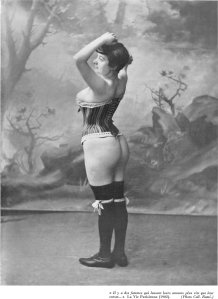
Corset, Paris 1902. Unknown via Wikimedia

Corset, Paris 1902. Unknown, via Wikimedia

As for Victoria’s Secret well, good luck with that one. While the sight of stunning women in lacy thongs and balconette bras might not be everyone’s idea of beautiful or sexy, it is currently a dominant cultural expression of those qualities. Once the sight of an ankle did it for us, and who can forget the practically (in my opinion) only good bit in Jane Campion’s The Piano, when Harvey Keitel caressed Holly Hunter’s leg through a hole in her stocking? Aaaargh, the recollection can make me shiver with delight even now.

How to spot the psychopath in your workplace

23 Feb

Psychopaths rule our world. by Adam Crowe via flickr


Get back in the Box: Nurse Ratched is Alive and Well

by Dr Stewart Hase

In the famous book and movie, One Flew Over the Cuckoo’s Nest, Nurse Ratched thoroughly runs the roost. From a Jungian archetype perspective Nurse Ratched represents the dominating and emasculating mother. Her main modus operandi is to manipulate the male patients into believing that their welfare is her primary concern and that everything she does is for their benefit. With this backdrop of apparently caring intention, she holds tightly onto control in the guise of benefactor and protector from the evils of the world. The most mischievous component of her behaviour, however, is to build up expectations for rewards in the form of activities, treats or even positive attention from her as a projection of their mother, and then shatter them at the last moment. It is consummate controlling and deeply obsessive behaviour. When McMurphy (Jack Nicholson in the movie) challenges Nurse Ratched by emancipating the patients and shows signs of winning the battle for control, he is lobotomised.

Ken Kesey’s Nurse Ratched character is based in reality. I actually saw this archetype in the real world when working in a psychiatric hospital in Western Australia in the early 1970s. In my case Nurse Ratched was a male. So, what follows is equally applicable to both sexes but I refer to Nurse Ratched as female throughout to be consistent with the fictional character and, hopefully, not for any other unconscious desire.

by Corey Bond via flickr

Some recent research I have conducted with colleagues suggests that the Nurse Ratched archetype is alive and well in organisations other than psychiatric institutions. It appears in various configurations and degrees but has the same end game, which is to control the inmates: to keep them in their box. This reinforces Nurse Ratched’s sense of power, strengthens the mask that hides a deep-seated insecurity, a poorly developed sense of self and a sense that all is not well with herself, and, hence by projection, the world. Nurse Ratched has developed a set of behaviours that serve to protect her from seeing her true self and the maintain the illusion that others can’t see it either.

Nurse Ratched is a micromanager. Nothing is left to the deliberations of others. Of course there are committees, although one might find precious few of them and they are functionally impotent. This impotence is openly reinforced by Nurse Ratched who frequently overwrites their decisions using an unwritten but thoroughly understood power of veto. All decisions no matter how minute and trivial such as office allocation and travel claims are made by this manager: nothing is left to chance.

The archetype is surrounded by supplicants who have been handpicked to ensure that they do not challenge in any real way. Most importantly they all toe the party line. Dissidents are seen as not being loyal and either micromanaged or managed out. Members of the management group are found on most committees in the organisation. Committee membership has less to do with expertise and more to do with ensuring control. Loyalty is much more important then ability to be appointed as an acolyte. Even the most appalling manager and bully will be supported as long as they are loyal, get the job done and make Nurse Ratched look good.

Nurse Ratched makes sure that appointments are carefully managed. Selection panels are small and consist of herself, a couple of acolytes and a rep from HR. It is important not to have someone on the committee with expertise in the area of the appointment. Lower levels of staff are never involved in the selection process. It is not unusual for Nurse Ratched to veto an appointment and tap someone on the shoulder either within or from outside the organisation. Nepotism is so commonplace that it is taken to be normal. It is one of the rare instances where the manager does not employ a clone of self. There is room for only one Nurse Ratched in an organisation.

Information flow is carefully managed by our archetype. Most critical information is held by the management group and does not filter down: there is a hard communication barrier between senior management and the inmates. The acolytes realise that their survival depends on making sure that only selected information is sent upwards.  Meanwhile Nurse Ratched is fed a diet of misinformation from employees dotted around the organisation that are the result of the nepotistic and political appointment processes. There is nothing like pillow talk to sink an upstart’s reputation.

Nurse Ratched likes to make sure the inmates are busy: extremely busy. Staff levels are kept to a minimum, performance expectations are high and there is little room for diversion from the key tasks of the business. This archetype depends on looking good in front of the board or shareholders and this is achieved by ensuring positive business outcomes no matter what the cost to people or organisational climate. There is a Calvinesque austerity and lack of celebrations of success are rare and token. Nurse Ratched depends on an efficient and well-run ward. In the movie McMurphy’s joie de vive is a major irritant and is finally silenced by reducing him to a vegetable. With such a threat people become malleable.

The result of this archetype’s behaviour is an adversarial, ‘us and them’ culture. The ‘management team’ interpret any discontent as being due to the implicit failing of the inmates and not the result of dysfunctional leadership and a toxic culture. The inmates should be grateful: let them eat cake.

Widespread cynicism pervades the organisation underpinned by powerlessness. Some inmates, like the Chief in One Flew Over the Cuckoo’s Nest, find a way to escape-he throws a water cooler through the window and runs away. In less potent expressions of their disappointment, the more imaginative and stronger personalities soon see the organisation for what it is and fly the coop. There are others who don’t quite understand the culture and innocently push back. But they are soon put in their box one way or another by being micromanaged to death, assigned meaningless tasks, and/or subtly bullied. Many are trapped due to circumstances and suffer the same pathology as Seligman’s dogs, learned helplessness that manifests itself as depressive behaviour. Denial and rationalisation of their situation help maintain a tolerable level of mental health in many.

People being people, they will in even the most adversarial environment find a way to let their creative juices flow and mostly find satisfaction in doing well what they often love doing. This is tolerated as long as the widgets continue to be churned out and there is not too much dysfunction. In fact Nurse Ratched rewards this behaviour with acknowledgement, which is gratefully received from inmates starved of recognition and positive reinforcement. But beware if the light shines too bright or the irrelevance of the activity to Nurse Ratched’s agenda is brought to her attention, the tit-bits are quickly withdrawn. After all, it is for the inmates’ own good.

This is the most toxic aspect of the culture that Nurse Ratched presides over and is the hallmark of the ultimate bully: the manipulation of the human need for recognition. The bully keeps the other in a state of constant desire for acknowledgement by maintaining a high level of disappointment, an air of disapproval. The victim’s diminishing self-esteem cries out for recognition and is occasionally, momentarily rewarded. The rush of pleasure increases desire for more and the person works even harder even as the tsunami of disappointment washes them away yet again.

Such is the dark side of organisations.

Dr Stewart Hase


Guest author Dr Stewart Hase is a registered psychologist and has a doctorate in organisational behaviour as well as a BA, Diploma of Psychology, and a Master of Arts (Hons) in psychology.

Stewart blogs at stewarthase.blogspot.com

How to “lovingly” expel a homosexual student, or, God is in the house.

20 Feb

God hates fags.com via flickr


Brigadier Jim Wallace of the Australian Christian Lobby believes that a church school should have the right to expel any openly gay student.

“But I would expect any church that found itself in that situation to do that in the most loving way…I think it’s a loving response,” he says.

It’s legal for religious institutions in NSW to expel homosexual students, and Attorney-General John Hatzistergos, supports that law. While there are churches that oppose it, Jim Wallace gives it his whole-hearted support.

It’s difficult to know where to begin addressing the offensiveness of Wallace’s comments, but perhaps from a human rights point of view, it is most shocking in its reduction of the identity of a young human being solely to their sexual preference.

Nothing else about these students has any apparent value for Wallace, other than their sexuality. The intrinsic worth of the student is reduced to his or her sexual orientation. If the young person is brilliant, gifted, a high achiever – and gay, the Christian school should expel him or her, according to the well known Christian, Wallace.

“Lovingly,” of course.

Would this be another version of “tough love” perhaps?

How does one “lovingly” expel a young person from their school community because of their sexual orientation? Please explain.

Reducing a human being to one aspect of their character is a dehumanising tool used in all propaganda. When we can’t see another’s humanity, we’re far more likely to treat them badly.  It requires a leap of the imagination to make an identification with people who’ve been reduced to stereotypes, and many of us don’t want to/can’t be bothered with that imaginative exercise.

Propaganda ensures that certain lives (homosexual in this case) are not considered lives at all in the fullest sense. Reduced to the issue of sexual preference, and on the sole grounds that they are not heterosexual, gay students are punished by expulsion from their community, their lives stigmatized as deviant by their churches.

Failure to see young people as individuals in their own right leads to serious repercussions for them, and for society. Homophobic religious imperatives are determining the course of some students’ lives, with the support of politicians whose first concern is not the welfare of young people, but winning the religious vote.

Belief systems with discriminatory attitudes are putting young people at risk, and governments are supporting the process. This is described by Hatzistergos as maintaining “…the sometimes delicate balance between protecting individuals from unlawful discrimination while allowing people to practice their beliefs.”

Since he admits homophobia is “unlawful discrimination,” Hatzistergos’ position is that what the rest of the community has declared illegal is acceptable if it occurs within a belief system.  That church schools are granted permission to behave illegally makes a mockery of anti discrimination laws.

If a behaviour is illegal, it is illegal.

Religions in this country should be abiding by the laws of this country.

Around Australia, churches are exempt from anti discrimination legislation that prevents others from dismissing gay, lesbian, and trans gendered people, solely because of their sexual orientation.

Culturally salient beliefs normalize these problematic practices. One of these beliefs is that religious freedom trumps the anti discrimination culture.

But only some religious freedom, otherwise we’d be condoning genital mutilation and the polygamous and forced marriages of ten year old girls.

We’re selective about which religious freedoms we uphold.

Religious beliefs are fluid. Values change, often quite radically. There’s disagreement within religious circles about the expulsion of gay students.  It isn’t the government’s role to legalise these vacillating values, or to give legal validity to one point of view within the churches at the expense of another.

As our law declares discrimination illegal, the government’s role is to support and validate the country’s law.

Religions in this country should abide by the laws of this country. We require this of non Judeo Christians, especially those most recently arrived here. State and federal governments must require it of all religions in Australia, and particularly of all schools.

GOD IS IN THE HOUSE,  Nick Cave and the Bad Seeds

Nick Cave, by Ben Houdijk via flickr


Homos roaming the streets in packs,
queer bashers with tyre-jacks
Lesbian counter-attacks
That stuff is for the big cities
Our town is very pretty
We have a pretty little square
We have a woman for a mayor
Our policy is firm but fair
Now that God is in the house
God is in the house
Any day now he’ll come out
God is in the house.


Linda Burney’s punitive stand on surrogacy.

6 Feb
Dibujo del perfil de Nicole Kidman

Image via Wikipedia

If Nicole Kidman and Keith Urban had hired an overseas surrogate to carry baby Faith Margaret while living in any of their NSW homes, and then returned with their baby,they would be subject to fines and jail sentences, under the terms of  the amendment to surrogacy legislation introduced by NSW Minister for Community Services, Linda Burney.

On March 1 2011 NSW legislation on surrogacy will pass into law, making commercial surrogacy illegal in the State.

Linda Burney has added an extra territorial amendment to the original surrogacy bill, extending the criminalisation of commercial surrogacy to those who employ overseas surrogates.

The penalties for using an overseas surrogate will be a fine of some $110,000, and/or two years jail.

As well, the child parents bring home will have no legal rights and protection, as do all other children in NSW, regardless of the method of their conception.

Parents may apply for parentage orders for their children, however in doing so will run the risk of criminal prosecution, with fines and possible jail terms.

This would seem a powerful disincentive to applying for appropriate orders, leaving the children in a right-less and unprotected limbo.

As well, Burney’s amendment assumes that all those seeking overseas surrogacy arrangements will look for underprivileged women who need the money.

There are many commercial surrogates overseas who are middle class women, and who make an informed choice to carry a child for another woman.

The Minister’s justifications

Minister Burney’s justification for the extra territorial clause is that she wishes to, in her language, punish those who “take advantage of women who hire out their bodies because they are poor.” Criminalizing those who have been unable to find altruistic surrogates in NSW and turn instead to women overseas is the realisation of Burney’s desire to punish.

It is unrealistic in the extreme to expect this criminalizing of a minority group of NSW citizens will make any dent at all in the exploitation of women in countries where commercial surrogacy is legal. One might as well criminalize everyone who buys a t-shirt made in a Bangkok sweatshop by six year old children who are paid 20 cents a day for their labours.

Or what about the Australian citizens who travel overseas for say, a kidney transplant to a country where the traffic in human organs is unregulated and people sell the parts they can live without for an income? Are we going to criminalize those citizens and prosecute them when they come home with their new illegal part on board?

A divisive issue

Commercial surrogacy is a morally divisive issue. Those against it argue that it results in the depersonalisation of pregnancy and childbirth, and that it treats both women and children as commodities. Wealthy couples can “rent a womb” from financially vulnerable women, and this, in the eyes of some, is exploitation of the worst kind.

Commercial surrogacy is felt by some to be degrading to both women and children. It is perceived as morally offensive, and as treating other human beings merely as a means to an end.

There are potential emotional difficulties on all sides, including that of the child.

The argument for (briefly)

Those who argue for commercial surrogacy point out that it is a matter of personal autonomy for all the adults involved. If a woman wishes to act as a surrogate that is her business, they argue, and she is entitled to remuneration for her time and work.

If commercial surrogacy is permitted and regulated in NSW, then it will lessen the need for couples to go overseas and into situations of possible exploitation, they claim.

To proscribe commercial surrogacy on the grounds that it’s harmful to those undertaking it is interference by the State in personal matters that are not the State’s business, and that belong in the realm of the private conscience, some argue. It is not acceptable, this argument continues, for the State to impose and enforce one moral aspect against private actions that do not harm others.

What is Burney’s amendment good for?

It seems highly unlikely that Burney’s amendment will prevent couples seeking commercial surrogacy overseas. What it will most certainly achieve is the legal alienation of the resulting children in this State. It will cause parents to conceal their activities, perhaps even from their own families, for fear of prosecution.

It will cast an unacceptable and permanent cloud over such families and their children. It will drive those having no option but commercial surrogacy, underground.

And for what?

To satisfy Burney’s need to take a moral stand against the laws of other countries.

Moral stands are often good and necessary things, but only when they’re realistically weighed up against their usefulness, and their consequences. In this case the usefulness of such a moral stand would seem to be minimal. The consequences, on the other hand, are horrible and permanent for the families concerned.

The reality is that couples needing the services of a surrogate are going to find one, somehow, somewhere.  Those of us, who like Ms Burney have not needed to take this drastic action in order to create our families, need to be especially careful when prescribing for and judging those less fortunate in that respect.

It is an especially weighty responsibility for Burney, as she is in a privileged position. She has the power to create a situation in which those less fortunate than herself are criminalized, and their children cast into a legal limbo.

Burney’s extra territorial amendment could well be seen by some as an abuse of her power. Perhaps it isn’t a politician’s role to punish those he or she disagrees with, on moral grounds that are far from unanimous in the community.

Perhaps it is especially distasteful when a politician acts on a personal desire to punish constituents who are already struggling with the fraught issue of creating their family.

Surrogacy in NSW Law Reform Commission Discussion paper

The “adultification” of childhood: the questions some feminists will not ask

3 Feb

Slow Down, Children. By Steve Voght via flickr

Being a Disney princess doesn’t cut it anymore for some little girls and their mothers. Being “hot” does. This means mini adult clothes, high-heeled slippers, the raunchy swing of the infant bum, bras long before there’s the least need for them, lip gloss and worse, and the emulation of adult sexual behaviour in the pursuit of being “cute.”

All of this is currently known as the “adultification” of children.

It’s horrible. Anybody who’s seen footage of the two year old girl toddling down the catwalk in full make-up and wearing a mini sized version of Madonna’s iconic cone shaped bra, can judge for themselves how horrible it really is.

You’ll find this and other nasty images on Melinda Tankard Reist’s website, where there are examples of “adultification” that make wet hair stand on end.

I do have serious disagreements with some of MTR’s positions, but there’s no denying she is certainly doing a thorough job of raising awareness of this particular cultural development, and somebody must. I acknowledge her vigilance in this.

The weaknesses in the arguments.

I don’t agree with her analysis, however. Reist and other feminist commentators hold the media, and the apparently perverted sexual appetites of adult men, responsible for this situation.

They take a swipe at men in general in the mistaken belief that “the patriarchy” is a term applicable to anyone with a penis, plus their collaborators, that is, women with a pr*ck in their heads. Or “pro male women,” as the Reist people prefer to put it.

As sociology Professor Raewyn Connell described it in her book, Masculinities, (1995, Allen & Unwin) hegemonic patriarchal masculinity is but one expression of the masculine in Western culture. Men who do not identify with that dominant expression are frequently vilified or ignored by the mainstream group. Connell’s work exposes the weakness of any argument that depends on male stereotypes.

Tarring all men with one brush is as offensive as stereotyping women. I wish the feminists engaged in this process would stop it, because it isn’t helping anyone and it doesn’t add anything to the debate. Indeed, it puts so many people off side the debate is at risk of losing what would otherwise be a sympathetic audience.

Let’s go deeper than claiming all men are the same. We’re capable of that.

Capitalism, the market and the media

Hegemonic masculinity is a category generally well represented in the pursuit of profit. Captains of industry, masters of the universe, dominant alpha males, and their female cohorts, tend to set the tone in popular culture when they perceive that there is money to be made from it.

I would go so far as to argue that the entire “adultification of childhood” process is driven by a market in search of more and more ways to increase profits, as fashions and fads quickly fall by the wayside and offer less returns.

Then there’s the media. The media has a complex role to play in the game. They simultaneously promote and critique cultural trends, sometimes in the same couple of pages. The media bears its fair share of responsibility for the creation of our desires, and the fact that those desires are so frequently deliberately contradictory and unattainable.

Even MTR throws up unacceptable contradictions. How many more people have seen the appalling French Vogue photo shoot featuring five and six year olds in adult clothes, and blatantly sexually posed, since she put those very same photos up on her website, complete with sharing facilities?

Not, however, with a link to French Vogue so we could dash off a condemnatory email.

I’ll never understand that move. Protest, by all means but perpetuate the children’s abuse? Non, merci.

The elephant in the room

In the frantic outpouring of blame for the sexualization and adultification of little children, and the tortuous self-questioning about “how did this happen?” one thing seems to be consistently overlooked. Perhaps the most important thing of all, and that is the market.

The market is mothers. It is overwhelmingly mothers who buy this merchandise for their little girls. It is mothers who dress their little girls in these inappropriate ways. It is mothers who train these little girls to pout, and strut, and wiggle. It is mothers who paint the little faces, highlight the infant hair, and whiten the baby teeth.

Mothers are the market. If they weren’t interested, if they didn’t buy the merchandise, if no mothers thought it was good for their little ones to look “hot,” there would be no market. Last time I looked infants weren’t out there in droves buying make up and tiny sexy clothes. And neither were blokes, patriarchal or not.

Some women, an increasing number it would seem from the unease that’s around, are acting out their own fantasies and desires through their little girls. The market has sussed out this development and pounced, because that’s its job. Once making kids look like little big girls was confined to those crazy American moms and their children’s beauty pageants. Now, apparently, it’s pre-schoolers all over the place.

The sexualization of children is becoming normalised at an earlier and earlier age. Little boys come home from kindergarten and tell their sisters they’ve got “sexy butts.”  Where does that come from?

The mother in that instance explained that “sexy” wasn’t an appropriate descriptor for a little girl, or for a little boy to use about a little girl. It was adult language, she said.

Children start to apply pressure as more of their peers show up to school in inappropriate clothes, and nobody wants to stand out as different. The market rubs its hands, and sees only profit. It’s a vicious cycle.

Almost everyone thought French Vogue went way too far. But it can’t be denied that the magazine operates within a general climate in which it is increasingly acceptable for little girls to be sexualised.

Don’t blame the mothers

Because that won’t help anyone. Rather, we need to look at what is driving more women to sexualise and “adultify” their very young daughters.

How has the concept of “beautiful little girl” become transmogrified into “hot little girl” in some women’s minds?

Who do they believe these tarted-up little girls really appeal to?

Without any evidence to substantiate my gut feeling, I strongly suspect it is the mothers themselves. I have enough faith left in humanity in general to recoil from the notion that these women are actually thinking of their little ones as sexual fodder and sexual eye candy for adult males.

I suspect there is considerable dissonance between how some feminists perceive this tragic form of theatre, and how the women involved perceive it.

The exploitation of these little girls, intentional or otherwise, is perpetrated primarily by the mothers. The market both caters to, and promotes this exploitation.

And I’m really at a loss to see how railing against the stereotyped and supposedly perverted sexual appetites of adult males, and railing against the media, will on its own do anything much to address the situation.

As long as there is a profit to be made from it, all forms of the commodification of childhood, including the sexualisation and “adultification” of young children will continue, and the media will not take a stand against it. If there is no market, interest will very quickly fade away.

Mothers are the key. Go to the source. Don’t blame, but do hold responsible.

Adult women can be held responsible for our choices, and we should be. Nothing will deeply change for us until we accept that.

One of my lasting memories of my grandmother is her scolding me for turning cartwheels without my knickers on. I don’t know what she would make of the way some of the little girls I’ve seen out and about lately are dressed.

There are so many years when we have to be grown up, and so few years to be a happily grotty kid.

Women bagging women: the female politician.

27 Jan

Sisters forever sisters. By joanneteh_32 via flickr

Once again the media coverage of the appointment of a woman to a senior political position has brought forth angry criticism, and accusations of sexism from some of the body politic. The questions asked and the commentary published is sexist, and designed to undermine the authority of female politicians, it is alleged. Nobody, it’s claimed, asks these idiotic questions of male politicians, or demands that they explain themselves if they aren’t married.

I don’t think this is quite true, however, that’s an article in its own right, for another day.

Lara Giddings, the latest of several ALP women promoted to the top job in state and federal governments, was yesterday asked the usual questions about her marital status, her childfree status, and the current absence of a boyfriend in her life. As yet, we haven’t heard what people think about her appearance, her hairstyle and colour, and her earlobes, but I’m confident that will come.

Yet when it comes to making ad hominem comments about female politicians, some of the worse offenders are women. Nikki Savva in the Australian of November 23 2010, offered sarcastic sartorial and political advice to Julia Gillard, in a piece titled Smarten up, PM, and do not wear green

Also in the Australian, July 28 2010, Janet Albrechtson’s Let’s be honest about Julia’s free gender leg-up ,while not focusing on her appearance, attacks Gillard’s alleged inability to relate to the women who’ve chosen to marry and raise children, given her own choices to do neither.

Social commentator Bettina Arndt also criticized the de facto arrangements of Julia Gillard in the Sydney Morning Herald article of June 29, 2010 titled: Shacking up is hard to do: why Gillard may be leery of the Lodge. Arndt questioned Gillard’s value as a role model for young women who wanted marriage, children and career.

Hard-line feminists describe those who launch such ad hominem attacks as “anti feminist women.” A few years back they described such a woman as “having a pr*ck in her head.”

(Ad hominem arguments are those that attack the speaker in the hope of undermining her or him, rather than addressing the argument. They frequently take the form of comments on physical appearance. For example, one I’ve never forgotten that came from a short, chubby, ageing bald fellow who exclaimed when he was introduced to me: “But you can’t be a blonde and have a PhD, darling!”)

It’s unrealistic to expect that women will be kind to each other just because we’re women.  Nevertheless, there is an unspoken, unexamined and entirely unproven expectation that we are somehow bonded through our gender, and therefore less likely to betray one another.

Nothing could be farther from the truth. Women deceive other women all the time, with their male lovers and partners, for example. And very many women, in the throes of shock and despair, will say that while they sort of expect men to behave like that, and they are desperately upset, it’s how the woman betrayed the woman that really cuts to the bone.

Many women survivors of childhood sexual abuse reveal that while the perpetrator did them untold damage, they have never and will never understand why their mothers didn’t help them, and this betrayal is impossible to grasp on a very deep emotional and spiritual level.

Women can be unbelievably hard on their daughters, begrudging them success, and an easier life than they’ve experienced.

And yet, in the face of all evidence to the contrary, women continue to believe in and yearn for the kindness of other women, and continue to be disappointed  when it’s not forthcoming.

Women might need to toughen up and let go of the hopeful fantasy that women are the greatest supporters of women, or that they should be. I sometimes wonder if allegations of sexism against men, while frequently entirely justified, might also work to conceal and deny the truly frightening hatred we women are capable of experiencing and enacting towards each other.

Everyone recognizes the woman who seeks approval from a man by denigrating other women, thus portraying herself as “different” and “better.”

Women who have a public life in any field, are targeted by both genders for ad hominem attacks. There are feminists who explain this phenomenon as a consequence of overwhelming patriarchal influences that have set us against one another in order to further the patriarchal agenda. This may well be one of the explanations for a learned rather than innate cruelty, if indeed that’s what it is. And there’s another argument.

However, the explanation doesn’t justify the hostilities, and after so many years of feminist analysis, we can no longer claim to be ignorant of what influences motivate us and how we perpetuate those influences in our lives.

Perhaps it’s time for women to take responsibility for our attitudes towards other women, especially those in public life. Perhaps one way of doing this is becoming aware of when we’re engaging in the ad hominem argument, and stopping it before it starts.

Everybody does it to some degree, it’s almost like breathing. The things I’ve said about Julia Gillard’s voice. 


Nic and Keith’s new baby: feminist christian takes a nasty swipe

20 Jan

Baby in his Dad's loving hands. By Amanda.

The Australian newspaper, and Melinda Tankard Reist’s website today features an article titled Gestational carrier is an ugly term. It turns out MTR is referring to the descriptor used by Nicole Kidman and Keith Urban to explain the role of the woman who carried their new child, Faith Margaret.

As a poster points out, the term “gestational carrier” refers specifically to a surrogate who has no biological ties to the infant she carries. The term “traditional surrogacy” is used when the surrogate is the infant’s natural mother. In using the term, the couple were making this distinction public.

Tankard Reist claims the term “strips the woman of her humanity.” She continues:

THE objectification of women’s bodies and commodification of childbirth came together yesterday in a single antiseptic phrase contained in the announcement of a second child for actress Nicole Kidman and her musician husband Keith Urban.

Wow. Welcome to the world, baby Faith. But quickly! Cover the baby’s ears somebody, please! Don’t let that bad fairy hovering over her cradle ill-wish the child with this dark description of her genesis.

Surely MTR can’t be suggesting Kidman and Urban are guilty of objectification and commodification in their dealings with their gestational carrier?

And if she is, how does she know?

MTR then refers to “womb slavery in India,” the “disposable uterus,” and tells several horrible stories of  surrogacy arrangements gone badly wrong.

Quite what the link is between baby Faith’s happy birth and these dark stories is unclear. Except that MTR has seized the occasion to once again promote her one-sided perceptions of surrogacy.

She certainly is a glass half empty kind of gal. Apparently, because a situation carries the possibility of exploitation that’s the only aspect of it we should consider. And then we should ban it. No mention anywhere of successful surrogacies and the ensuing joys. No stories from women who’ve generously carried an infant for other women who couldn’t, and been glad and proud to have  been the bearers of great happiness.

But that’s not all. Today’s post is almost identical with a piece MTR wrote in the Sydney Morning Herald , November 8 2006 after the birth of Senator Stephen Conroy and wife Paula Benson’s baby, also carried by a surrogate. Apparently MTR hasn’t been able to find more recent horror stories to tell about surrogacy in the ensuing five years, because she uses the same examples.

A visit the to the website unbelief.org reveals where MTR is coming from. Briefly, she founded the Women’s Forum Australia, a “pro-life” feminist organization or an “anti-choice” feminist organization, depending on your point of view. For twelve years she worked for ultra-conservative Tasmanian Senator Brian Harradine as his bioethics advisor. During his time with MTR, Harradine successfully negotiated a long standing ban on the drug RU 486, known in some circles as the “abortion pill.”

In her rhetoric against abortion MTR makes repeated and unproven claims that it is linked to incidences of breast cancer.

MTR shows up, always invited,at occasions and conferences run by religious organizations as various as Opus Dei, the Festival of Light, the Australian Christian Lobby, and Warwick Marsh’s conservative Christian “fathers’ rights” association. Bill Meuhlenberg, religious ethicist opposed to homosexuality, is also a fan.

Who was it said by their friends ye shall know them?

It’s probably quite sad to be someone who takes the occasions of other peoples’ joy, and uses them to highlight only darkness. Yes, there are undoubtedly situations in which surrogacy arrangements are far from equitable. Yes, there may be difficulties when the child wants to know her origins. Yes, Melinda, there is nothing in the world that doesn’t have its dark side. One of the challenges of life is to find our way through them into the light. Banning them all won’t cut it.

Put a case against surrogacy by all means. It should be out there, we need to be fully informed.

But do you have to cast your doom and gloom over the two occasions when the people involved seem loving and decent, and probably aren’t doing anything wrong to anybody in their desire to have and raise a child?

And isn’t it a little tiny bit opportunistic to seize these high profile cases on which to hoist your banner of propaganda?

BTW. Tankard Reist has apparently successfully produced four children of her own. Therefore she has never had to deal with the feelings of a woman who wants to carry and give birth to her child, but can’t.

How does she know the Kidman/Urban fertility status?

Count your blessings, Tankard Reist, and don’t judge those who aren’t as fortunate.

PS: I think there’s something in the theory that we see what we choose to see. That we construct our own reality. MTR sees only darkness, misery and exploitation in surrogacy. That’s her vision. She’s entitled to it.

But she isn’t entitled to prescribe that vision for everyone. She isn’t entitled to project that darkness onto people she doesn’t even know. It’s her darkness. We don’t all have to get down there in it with her.

.

Workplace Bullying: Blowing the Whistle on Conspiracies of Silence

14 Jan

Stewart Hase


By Dr Stewart Hase

Guest author Dr Stewart Hase is a registered psychologist and has a doctorate in organisational behaviour as well as a BA, Diploma of Psychology, and a Master of Arts (Hons) in psychology.

There is a conspiracy of silence when it comes to workplace bullying. In the many thousands of words recently written about bullying at work in the local press the conspiracy has been maintained.

A conspiracy of silence occurs when everyone knows that bad behaviour is occurring but there is a tacit decision not to talk about it and certainly not to do anything. It was first used to describe incest in families and, more recently, other forms of abuse. People don’t do anything because they don’t want to rock the boat, to avoid conflict, and because it is just too hard. Sadly, by not speaking up or doing anything the observers validate the perpetrator and invalidate the victim.

As I have often seen in clinical practice, the effect of these conspiracies on the victims is monstrous. The victim feels as if he or she is somehow at fault, they are confused, and feel alone and unsupported. Most importantly they come to feel powerless and it is this that results in anxiety and depression, the most common effects of being bullied.

In all that is written about bullying at work there are two major conspiracies of silence that result in enormous pain and suffering for victims. It also seems that workmates who see the bullying can also be badly affected resulting in significant symptoms on their part too.

The first gaping silence is that senior managers in organisations prefer not to do anything about bullies. This conspiracy of silence occurs despite the fact that bullying is against the law and CEOs and boards of directors are in fact culpable by not acting. It is interesting to watch an organisation move a victim of bullying to another branch or even another job, and leave the bully in place: even after admitting openly that the bullying has occurred. Sometimes, it is easier to call a case of bullying a personality conflict and call in a mediator. The damage these behaviours do to the victim is enormous.

It’s also common to blame the victim. This is easy because the bullied worker has repeatedly made complaints, as instructed by the legislation and the bullying literature that is laying on the coffee table in the CEO’s waiting area. The victim, who has become increasingly distressed over time, can be simplistically labelled as unstable or over-sensitive: a troublemaker. Let’s not forget too that bullies often pick on already vulnerable people who might have a reputation already for being oversensitive.

There have been some notorious bullies in organisations in and around Lismore that have been allowed to get away with bullying behaviour time and time again: I have seen many of their victims at the clinic. Many of these bullies get promoted. There are also large numbers of senior managers that know that their staff are being bullied but do nothing. Under the legislation they are just as culpable as the bully and their organisation can be fined many thousands of dollars. But they still engage in the conspiracy and more often than not put the fox in charge of the chook shed.

The preferred personality profile of a successful manager (or one on the way up) appears to be someone who is aggressive, dominant, single minded, achievement-oriented, and task focused. Throw in a little pinch of narcissism, low empathy for others and an unsatisfied need for power and this is a nasty recipe for bullying behaviour. These are not easy people to deal with which makes it so much easier to turn the blind eye. Bullies often appear so good at their job and they create the right relationships with the right people to protect themselves.

And it happens every day in organisations in which we all work. In a recent case a colleague of mine was told by the human resource manager of her organisation that it would be better to let a case of bullying drop because it was against a very senior manager. The reason being that the consequences would not be worth it in the end.

The other conspiracy involves an unholy alliance between the organisation and the insurance company. Despite the pretty advertisements insurance companies want to avoid liability. To do this they will find any excuse to blame the victim rather than make the workplace deal with the problem. Everyone’s a winner: the insurance company doesn’t have to pay out and the organisation’s premiums are protected.

The main way this is done is to find a pre-existing condition in the victim such as a history of previous abuse, anxiety, depression, previous bullying or any other negative behaviour. This is then used as a means of blaming the victim. This is easy to do by running an unbalanced investigation and being highly selective with ‘the evidence’.  For someone who has genuinely been bullied at work this outcome is extremely damaging.

It is time for the conspiracies of silence to be broken. Those with the power to act need to make the hard decision and deal with the perpetrator rather than leaving it up to the victim who is already disempowered.

Stewart blogs at stewarthase.blogspot.com

Palin’s got them in her sights in the USA

10 Jan

by Ramon Duran via flickr

Twice a year I make the journey from Australia to the USA, to visit with my loved ones who live there.

I have other reasons. I also love America. I love its complexities. I love its idiosyncrasies. I love its ambiguities, its ambivalences; I love the impossibility of ever being able to define the country, or confine it in any particular categorical cage. No matter how hard one tries, America’s contradictions thwart all attempts at constraint.

And this I what love, in an individual and a nation.

When the American people elected Barack Hussein Obama as their president I was astounded, and filled with admiration. This brave new world that has such people in it, was what I thought, and said, though many laughed at me and called me naïve. What I was responding to was simply the fact that America had elected this man. I had no great expectations, he is, after all, a man and not a god, but that the country had chosen him seemed to me a wonderful and hope-filled thing.

Today, reading of the death and injury visited upon bystanders and participants in a political gathering outside a Safeway supermarket in Tuscon, Arizona, I’m sad again for another gun slaughter in America.

A few short weeks ago I was in the car park of just such a shopping mall in Nevada, a state that borders Arizona, and shares a geographical similarity. There I noticed an over-sized four-wheel-drive that bore the numberplate Jim Crowe. Jim Crow is not a neutral name in the USA. It refers to the racial segregation laws enacted in 1876 that were in effect until 1965. These laws mandated segregation in public schools, public spaces, transport and restrooms. Restaurants, drinking fountains and the military.

I pointed out the number plate to my son. He whispered that there is a great deal of racial tension in the state of Nevada.

A few days earlier I’d spent the day at a local public elementary school. At the end of morning assembly children and teachers placed their hands over their hearts, faced the flag, starkly outlined against the blue desert sky, and recited: I pledge allegiance to the flag of the United States of America, and to the republic for which it stands, one nation under God, indivisible, with liberty and justice for all. It was moving, to hear the children’s voices earnestly piping these noble sentiments. It was remarkable to witness just how much they seemed to mean what they said.

The Nellis Air Force Base is just outside of Las Vegas, and as we stood in the playground with our hands on our hearts, squads of fighter jets flew over in formation, in rehearsal for another theatre of war. It was a numinous moment.

The Tea Party

On the website of the USA Tea Party movement, whose most famous member is Republican Sarah Palin, there is a map of the USA. Various congressional seats are highlighted in various states on this map, including the Arizona seat where the wounded Democratic Representative Gabrielle Giffords, murdered Federal Judge John Roll, and a murdered a nine year old girl, were gathered with others injured and killed on an ordinary day, carrying out their ordinary daily duties.

The congressional seats marked out on Palin’s map are targetted with gun sights. They are the seats currently held by Democrats who voted for health care reform.

In states where the Democrats have recently retired, the rifle cross hairs are drawn in red.

Palin’s tweeted slogan is Don’t retreat. Reload.

Above the website map is the exhortation: We’ve diagnosed the problem. Help us prescribe the solution.

I hear Palin has since removed this from her website. But I found it at the Huffington Post.

It’s too simplistic to blame Palin and her followers alone for this most recent mass shooting. Yet in a gun culture such as that in the USA, where the right to bear arms is fiercely protected, it is but a short step from rhetoric to action when the weapon is sitting in your closet. The escalating vitriol towards politicians with whom one does not agree, the sense that anyone who is not with you is against you, the incitement to violence and killing such as that directed towards the foreigner Assange, for example, all speak to a culture that can quickly become murderously out of control.

The notion that if you don’t like something someone says you can and should kill them is promoted, and not only metaphorically, by conservative public voices in the USA such as Glenn Beck, employed by Fox News, owned by Rupert Murdoch. The notion is based in concepts of morality that conflate disagreement with heresy and blasphemy, punishable by death in a righteous political war.

There are consequences to a rhetoric in which voters are defined as soldiers, the opposition is portrayed as morally bereft, and the solution is prescribed in metaphors of war. It permeates the atmospheres. It makes possible that which should not be possible. It promotes a culture of violent action and reaction, because it makes the unthinkable thinkable, and therefore all too possible.

Words matter. Words both construct and describe the world in which we live. Words can kill.

Winter in America is cold

In San Francisco, the iconic Virgin store on the corner of Powell and Market has closed down. Riding the trolley bus down Market towards City Hall, we see store after store with boarded up windows covered in graffiti.

In the big Westfield shopping centre there’s hardly anybody looking in the up-market Nordstrum store. There are groups of homeless and disaffected people resting in comfortable chairs in the halls and lobbies outside the stores, their broken plastic bags of belongings in unsteady piles beside their legs. It’s warm in here, and dry. San Francisco is experiencing one of its wettest winters for some time. Every morning we wake to the steady drip of rain on the apartment windows. On the television news, vision of cliffs in danger of collapse down on Pacific Heights, of apartments at risk of plunging into the ocean show just how vulnerable this city is to natural disasters.

We spend a lot of time in the Museum of Modern Art, and in Golden Gate Park at the De Young Museum. After three days of thinking the rain will stop, I’ve abandoned my torn hardware-store blue plastic poncho, finally accepting that it’s going to rain for quite a while and I’d better get a proper raincoat. I trot down Union Square to Macy’s, where they’re having a permanent sale, it seems. On the top floor I find thousands of raincoats. I’m completely bamboozled, and wander round irritated, overheated, and confused by choice. I want a cream Calvin Klein, on sale for US$80. It’s glamorous, it’s a movie star’s raincoat, and I’ve never owned anything like it. Instead, thinking of my grandmother, I choose a black one because it won’t show the dirt.

The poor are everywhere. Some have dogs, cats or birds for company. I don’t have enough money to give to everyone I see. There’s a long line of customers outside the Apple store on the day they release the iPad. A few homeless people push their way in and get onto the public computers. Apple staff don’t send them away, but they do hover.

Soon I’ll be leaving the USA. As always, sadness gets the better of me at Los Angeles International airport, and I cry quietly across much of the Pacific. I don’t like leaving the ones I love, and I don’t like leaving the country I love more and more with every visit. In spite of it’s exasperating contradictions. In spite of the notice in the local park that reads: No profanities. Have a nice day. I have barely been able to restrain myself from sneaking back into that park in the middle of the night with a black Texta stolen from a child’s pencil case, and scrawling No fu**ing profanities! Have a fu**ing nice day! right across that sign.

Back in Australia I notice in the airport car park a large four-wheel-drive with a sticker in its window that’s a map of Australia. Across the map is the slogan F**ck Off! We’re full!

I’m not one of the cohort who think that what happens in the US may just as likely happen in Australia. Our societies are very different, in spite of the influences of US cultural imperialism. Nevertheless, if we have any sense we will learn from the American experience. We’ll cool down our political rhetoric. We’ll call a halt to the verbal ferocities in our parliaments. Mindless slogans, ill-thought out verbiage, ad hominem abuse. We have a chance to avoid what the USA continues to suffer. Let’s hope we take it.

Feminist’s theatrical posturing in Wikileak’s founder’s sex case

8 Jan
Author Naomi Wolf speaking at an event hosted ...

Naomi Wolf. Image via Wikipedia


In the Guardian January 5 2011, American feminist Naomi Wolf calls for the two women at the centre of the allegations of sexual misconduct against Wikileaks founder Julian Assange, to be publicly named. Thus far, the women have been referred to only as Ms A and Ms W in UK and Swedish legal proceedings. Wolf argues that this is demeaning to the alleged victims. She demands that the women be treated as “moral adults” and named as the complainants. She points out that it is usually only children whose names are withheld in criminal cases, and that to treat women in the same way is to infantalise them. Wolf writes: The shielding of sex-crimes accusers is a Victorian relic. Women are moral adults and should be treated as such.

Is Wolf’s call entirely gratuitous?

There is a certain disingenuous aspect to Wolf’s demands. The women’s names are easily found on the Internet, and have been published in at least one Australian newspaper. (As this writer doesn’t agree with the outing of complainants, you’ll have to go find the sources for yourself.) In the comments section of the Guardian article, a poster alleges that Wolf herself re-tweeted the names when she became aware of them. In her terms, that puts the alleged victims on an apparently level playing field with the accused Assange.

However, Wolf is sidestepping the reality that it is against the law in the UK to name accusers in sex crime allegations, even though she acknowledges this in her article. The current law makes her demands in this specific situation little more than theatrical posturing.

Does Wolf want all victims of sexual crimes to be named? Or just Ms A and Ms W?

It is very difficult to believe that a feminist such as Wolf is indeed launching a campaign for all victims of sexual assault to be outed when they make a complaint. For a person who wished to remain anonymous, and very many do, compulsory outing would be rather like another form of emotional and psychological rape.

Keeping the complainants’ identities secret seems like a sensible move. There is a great risk that women and men who’ve been sexually assaulted will be even less inclined to report their attackers if they themselves are publicly identified. The ordeal of reporting, examination, and facing your attacker in court is a great one, adding to this the risk of seeing your name blazoned across the media for weeks and months is not likely to encourage victims to complain.

Wolf and “the world’s dating police”

In the Assange case, the women have been vilified and harassed by his supporters across the blogosphere and in the mainstream press, which is a good argument for maintaining anonymity as much as is possible. Wolf has also done her best to discredit them prior to calling for them to be outed. In the article Julian Asssange captured by the world’s dating police Wolf accuses the women of using feminist rhetoric and the law to assuage their injured personal feelings over minimal offences. This may or may not be the case, and that is exactly the point. As yet, we don’t know. Equally, the women may have genuine grounds for complaint. Until the matter is heard, all is speculation and assumption.

When someone is wrongfully accused

There can be dire consequences for the man or woman who’s been publicly identified as standing accused of sexual assault, if he or she is subsequently found to be innocent of the charge. Mud sticks, sexual mud perhaps more than many other types. For the period leading up to the legal processes, the accused remains in an unenviable limbo, during which anything can be and is said about him or her in the media. We have seen this in Australia when, for example, footballers have experienced this process, and the media is seemingly willing to report just about anybody’s opinions on whether or not the man in question is guilty as accused, or innocent, well before the matter ever is heard in the courtroom. (Again, not wishing to perpetuate those issues about which I am complaining, you’ll have to look it up for yourself.) Trial by media is now an unfortunate commonplace.

There are murky circumstances surrounding the Assange allegations, not least of which is that they have already been dismissed by one prosecutor, only to be revived after the Wikileaks cable dump began in earnest. The allegations received new life when the case was taken up again by a right-wing Swedish politician, allegedly close to the US and facing an election, in spite of there being no new evidence against Assange.

Payback time?

It is difficult to escape the conclusion that Wolf is conducting a personal vendetta against the two women. To many feminists, it makes no sense at all that the identities of alleged victims of sexual misconduct should be revealed to the world. Wolf’s demands sound at this stage very much like tit for tat  – the women’s complaints have caused Assange great difficulties, and so they should suffer difficulties as well. This ignores the reality that the women have already been subjected to considerable vilification world wide, and that no matter what one’s personal opinion of their actions, they have made a complaint that is now subject to due legal process.

Taking up arms for feminism

As well as the apparently personal aspect, Wolf has also taken up arms in the cause of feminism. She claims that in their pursuit of Assange, Interpol, the British and the Swedish governments have engaged in a form of political theatre, ostensibly pursuing a man on sex charges, in reality fuelled in their pursuit by entirely political agendas. These claims do make sense: as Wolf points out, when did anyone last hear of an alleged sex offender being pursued as relentlessly as Assange, put in solitary confinement, and denied bail while awaiting extradition? (With the relatively rare exception of child sexual abusers.) Governments and law enforcement agencies rarely if ever go to such trouble and expense.

This, Wolf claims, makes a mockery of all the women (and men, though she does not mention them) who’ve never seen justice in similar matters, and worse. In a December 13 2010 article in the Huffington Post, (titled J’accuse, in itself an interesting reference) Wolf claims that the extraordinarily disproportionate pursuit of Assange is not an example of the State embracing feminist concerns about the violation of women, rather it is an example of the State “pimping” feminism. One is tempted to observe that the States’ pursuit of Assange had nothing at all to do with feminism, either embracing or pimping, much as feminists would like to believe the philosophy had an influence in the proceedings. It is far more likely to be entirely politically motivated, perhaps in a futile attempt to silence Wikileaks by incarcerating Assange, or as a means of extraditing him to the USA, via Sweden.

To any fair-minded person, the argument ought be that no identities are revealed in such cases, neither the alleged perpetrator nor the victim. The most sensible solution all round might be to withhold the names of the complainants and the accused in alleged sexual crimes. On the downside, such a move would give the media less to prattle about, and would curb the tongues of many commentators, but it would offer protection to both parties. It should never be forgotten that a person is innocent until proven guilty, and that is sometimes the case with accusers as well.