Archive | Society RSS feed for this section

Vulnerable women in uniform

7 Apr
The ADFA Shield

Image via Wikipedia

I can only imagine what “Kate”, the young woman at the centre of the Australian Defence Force Academy outrage, is feeling today.

No matter what the outcome, Kate’s life at the ADFA is forever changed, and probably not for the better. It’s clear she can’t count on the support and understanding of her superior officers, who ploughed ahead with a hearing against her on trivial matters regardless of the allegations that she was unknowingly involved in consensual sex with a young man who’d set up the web cam and arranged for six of his mates watch his sexual performance with her.

Whether deliberate or not, going ahead with the hearing under these circumstances seems at the very least insensitive, possibly punitive, and definitely idiotic, given the media attention already focused on the workings of ADFA.

It’s difficult to get one’s head around the mindset of the young men who set up this situation.  The degree of treachery they demonstrated themselves capable of is blood curdling. Kate no doubt liked and was attracted to the individual who did the deed. In all good faith, she consented to sexual intimacy, thinking it was indeed intimacy, and why on earth should she expect anything else? How many women agree to engage in consensual sex and think to ask first if they’re being secretly filmed?

These men seem to have no awareness that a woman is a human being, and neither do some of their superiors.

There should be zero tolerance of events such as this. These men ought to be thrown out on their arses in the gutter.

It isn’t Kate who ought to lose her career, though given the difficulties she’ll have to face, I wouldn’t blame her if she got out. Those men, however, have crossed the line and there ought to be no going back allowed once that line is crossed.

In 2011 there are young men still willing to treat women as sub human in this country’s defence forces. These seven male cadets are supposed to be the future leaders in the army, navy and air force. If they can’t recognise and respect the humanity of half the globe’s population, in my book they’re not leadership material.

But the buck doesn’t stop with them. Who are their superiors, and what are they doing to change this Neanderthal culture? Very little it would seem, as Kate is still being subjected to harassment, in spite of media outrage and global media coverage of the incident, the fury of Defence Minister Stephen Smith, and the anger of Air Chief Marshall Angus Houston. Even though these heavyweights are on the case and the ADFA is under world wide media observation, nothing has stopped those young bloods carrying on regardless with their harassment of Kate, as they coat her bedroom door with shaving cream, and apparently demand that she apologise for outing the seven men.

So much for military discipline. Doesn’t seem to be having much effect.

So who is in control at the ADFA?

Now there’s an attempt by Neil James, executive director of the Australian Defence Force Association, to distract from the substance of the scandal by quibbling about the appropriateness or otherwise of Stephen Smith’s comments on the matter. While that might be an issue at some later date, the central concern at the moment is the inappropriate behaviour of the ADFA cadets towards a young woman, and the culture inherent in ADFA that apparently allows them to believe such behaviour is acceptable. It seems to me that’s a far more urgent issue than whether or not Smith crossed some boundaries.

Perhaps Neil James’ peculiar priorities are an example of the sub human sexist ADFA culture, in that the abuse of women comes well below the list of concerns, and the proper protocols between the Minister and his department are uppermost.

Rioting and deaths in detention: anyone could see that coming so why don’t the politicians?

30 Mar
A bunch of Razor Wire atop a chain link fence

Image via Wikipedia

Guest blog today by Dr Stewart Hase

A Refugee Crisis in the Camps: Now Who Could Have Predicted That?

The media treat it as something of a surprise that the ungrateful inmates of our refugee camps are rioting and committing suicide. But it does make for great headlines and, let’s face it, that’s mainstream journalism these days: the ‘gotcha’ rather than real investigation. Well, it is no surprise to psychologists who, had government taken the time to seek some good advice, could have easily predicted these events. In fact, if a research psychologist had wanted to design an experiment confirming the negative impact of incarcerating people, they could have done no better than the politicians and bureaucrats with the fiasco they have invented. The experiment has it all: desperate people; close confinement; razor wire; remote locations; removal of dignity an extended but variable process that engenders hopelessness; an unnatural existence; and overcrowding.

It has been long known in psychology that even relatively innocuous forms of incarceration cause psychological problems: an abnormal situation creates abnormal behaviour in and of itself. We know that guards become abusive towards inmates when they are in this unique position of power. The abuse of the powerless is not restricted to psychopaths or other similarly inadequate personalities. Mr and Mrs Average are quite capable of abnormal cruelty when given the opportunity. We see this in wartime, concentration camps, prisons and the now defunct (thankfully) psychiatric hospitals of the first half of the twentieth-century.

Any first year psychology student knows that you cannot expect people to behave normally when they are placed in abnormal situations. And we could expect people to riot when they are placed in a threatening situation. We can expect people to kill themselves or develop psychoses when their disbelief turns to despair turns to hopelessness. We can expect to see children rapidly wither on the vine when normality is stripped from them: they have few defences to protect themselves.

Successive Australian governments have failed the compassion test, as have we, the Australian people for not urging a humanitarian approach to this problem. This does not mean allowing illegal entry to our country. It does not mean opening our doors. But it does mean having a process for dealing with the problem that is in keeping with the mores of a twenty-first century civil society rather than those of the dark ages: a society that bases its decisions on evidence rather than false and convenient belief. I wonder if we are ready yet and is there a politician out there that is prepared to rise above the sorcery that is popularism?


Dr Stewart Hase


Dr Stewart Hase is a registered psychologist and has a doctorate in organisational behaviour as well as a BA, Diploma ofPsychology, and a Master of Arts (Hons) in psychology.

Stewart blogs at http://stewarthase.blogspot.com/

Gillard and Abbott and the art of verbal abuse

27 Mar

It ain't over till it's over. by Dr John Bullas via flickr


Watching Prime Minister Julia Gillard and Opposition Leader Tony Abbott go at it is a lot like witnessing a couple trapped in the death throes of a hideous relationship. They’ve got to the point where verbal abuse is not a side issue: it’s the issue. Whatever the specific conflict, it gets buried in a hail of verbal salvos designed to accuse, blame, denigrate, manipulate, control, and put down.

The couple sees each other only as adversaries. Their goal is to bring the other undone, and achieve domination. They struggle to achieve this in some or all of the following ways:

The verbal abuser refuses to responsibly communicate. She or he establishes what can be discussed, or withholds information, making genuine discussion impossible. She or he can prevent any possibility of resolving conflicts by employing this blocking tactic.

Diverting from the matter at hand into abuse that the other then feels obliged to defend or return is another impediment to discussion of real issues. Climate change, the economy, gay marriage – no matter what the topic on the table, it is always subsumed under the couple’s compulsion to do one another in.

Doing the other one in has become the raison d’être of the relationship. In a worst-case scenario, it has become the participants’ entire reason for getting up in the morning, and has taken on the qualities of a life-controlling addiction.

A verbal abuser will often accuse his or her partner of some wrongdoing or breach of the basic agreement of the relationship. This always distracts from the current issues, and puts the partner on the defensive.

Then there’s judging and criticizing. The verbal abuser may express their critical judgment of their partner. This is often disguised as being helpful and when in enacted in that form, can be particularly insidious as any retaliatory accusation of wrong-doing can be disingenuously denied, as in “Wot, me?”

Sometimes verbal abuse is disguised as jokes. While the comments may be presented as humor, they have poisoned barbs. They may be delivered inelegantly, or with great skill, but their intention is to diminish the partner, and throw her or him off balance.

Trivializing can also be a form of verbal abuse. Trivializing is the attempt to make what the partner has said or done, insignificant. This tactic can be quite hard to identify and name, although you know immediately and viscerally when it’s happening to you, and it makes you want to hit back, or crawl under a stone, depending on your particular learned method of self protection.

Undermining is another tactic. The abuser will attempt to slaughter an idea or suggestion with a few pointed comments, or derisive laughter.

Name-calling is also a classic tactic of the verbally abusive, as is reference to the hated other’s appearance, mannerisms, and past mistakes.

All these tactics can be employed in the privacy of home, or in public, often at dinner parties and barbeques, because couples in this state do best with an audience. An audience offers a golden opportunity to shame the other, and hopefully get somebody else on side. So delusional are couples by this stage, that they really do think what they say is taken seriously by those poor sods unwittingly subjected to their folie à deux. They have no idea that all anybody wants is for them to leave and never come back.

It can be disconcerting to be anywhere near couples dedicated to destroying one another. It can remind you uncomfortably of your own parents, or adults you knew as a child who were set on this path. It isn’t unusual, unfortunately, and having to witness it in adult life can provoke flashbacks.

In a verbally abusive relationship, there is no specific conflict. The issue is the abuse, and this issue can never be resolved. There is no possibility of closure.

This does not bode well for the Australian people.

Linda Burney confronted about punitive surrogacy amendment

26 Mar

On SBS Insight on Thursday, March 22,  audience members got their chance to confront the NSW Minister for Community Services, Linda Burney,  on her amendment to the NSW surrogacy legislation that makes overseas commercial surrogacy a crime in NSW.

Extra territorial laws such as this are at present only in place for terrorist activities and child sexual abuse.

Burney introduced the amendment in an effort to protect women overseas she considers to be exploited by Australian parents seeking a surrogate.

It is a little on the grandiose side to imagine that any NSW law will have any impact at all on commercial surrogacy in, say, India.

But Burney’s agenda is punitive – she has admitted  that it is intended to “punish” couples who seek overseas surrogates. It will do nothing to prevent couples using overseas surrogates, as she also admitted in the program.

What it will do is put couples at risk of hefty fines and custodial sentences of up to two years if on returning to NSW they attempt to obtain parentage orders for their babies.

Parents are unable to apply for the orders without disclosing the circumstances of their child’s birth. If in an effort to avoid prosecution the parents don’t apply for parentage orders, their children are cast into a legal limbo that leaves them disadvantaged and discriminated against.

Ms Burney was supported by  Dr Renate Klein, a  “pro life” or anti choice feminist, depending on your point of view. Dr Klein steadfastly refused to acknowledge the right of adult couples to make responsible choices about commercial surrogacy. She stated that we cannot all have what we want, and when couples can’t have children, they must learn to live with it.

There has been much discontent around Burney’s amendment, and widespread agreement that it was passed without anything like the amount of public discussion and consultation it should have had.

It was clear from the couples in the studio who’d used surrogates that they are decent, fair people who went to great lengths to ensure the women who carried their babies were decently treated.

A father told the story of how his twin boys were born prematurely, and he’d lost them both. Klein immediately demanded to know if the surrogate got paid anyway.

The father broke down, and haltingly responded that of course she did, and that he thought it was disgraceful that Klein had had asked that question. I have to say I agree with him.

While there are of course incidences of exploitation, constructing all surrogacy arrangements as exploitative is extremely dishonest. This is what Burney and Klein have done, in order to further their personal agendas.

The topic is too vast, and too important to be left to the agendas of two women whose primary purpose is punitive and who’s moral position, in the case of Klein, extremely narrow.

Lastly we crossed to a short interview with twin boys carried by an American surrogate, whose parents were in the studio audience. The boys know all about their gestation, and are looking forward to a trip to the States where they’ll to go to Disneyland and spend time with the woman “who borned us.”

It seems unlikely that Burney will be a Minister after this weekend. She might be out of a job as well. She leaves a mean-spirited, dishonest and disempowering legacy to couples and their children. It is probably too much to expect that this amendment will be revoked. This means there will probably be babies in NSW who have no legal status and no legal protection, and no legal identity.

Another disgraceful legacy from NSW Labor.

The brutalizing of Australia

24 Mar

Anger Bot by Dave Sliozis


When human beings whip themselves up into states of apoplectic rage they tend to all look the same. Thus the images of Barnaby Joyce frothing at the mouth at the “Look, we’re a Tea Party!” demonstration yesterday, reminded me immediately of Muammar Gaddafi. While retaining their individual features if somewhat contorted, the energy of  their lunacy is foregrounded, and it doesn’t really matter anymore who they are.

Self-interested fury is a continuum with Joyce at the milder end and Gaddafi at the murderous extreme. But it is a continuum.

Then there’s the placards, backgrounding Opposition Leader Tony Abbott in TV footage: “Ditch the Bitch, Ditch the Witch, Bob Brown‘s Bitch.” I’m no fan of Ms Gillard, but whoa!  We’re entering Sarah Palin territory here.(I’ve got an article in On Line opinion this morning on the merging of the religious right and state politics in NSW and the USA, that yesterday’s rally eerily supports.)

Then there’s the articles in the Drum over the last couple of days, by Gerard Oosterman, Bruce Haigh and Greg Barnes, all protesting the treatment of detainees at Christmas Island. The comments on the articles are something to behold. The rage against the authors and refugees is palpable, and the misinformation and ignorance displayed is a tribute to the propaganda talents of politicians and shock jocks. These homegrown talents are about to rival Sarah Palin’s Get them in the Crosshairs campaign against Democrats who voted for healthcare reform.

Violence, incitement to violence, brutalizing and hyperbolic language, verbal abuse, xenophobic and sociopathic disregard for the safety of human beings from other parts of the world, are all on the increase in Australia. They are aroused and nurtured by some self-interested politicians, and self-interested rabid media commentators.

It’s not that edifying watching Gillard and Abbott go at it in Question Time either.

Brutalized and brutalizing methods of communicating displeasure are becoming the default position. After yesterday, nobody can deny that. In other spheres public and private, these abusive uncontrolled verbal attacks are known as domestic violence, and intimidatory bullying.

Pointless trying to reduce these violences in intimate settings. Pointless trying to reduce bullying in schools and the workplace. As long as this type of brutalized attack is encouraged by political leaders and ranting media types, as long as it is accepted as our daily discourse, we’re fighting a losing battle in the schools and the home because its in the air that we breathe, and everyone has permission to indulge their most base emotions.

People’s revolt? No, revolting people.

Government’s brand new 12 year plan to end domestic violence is already out of date

20 Mar

by Laurent Fintoni via flickr


Kate Ellis, Minister for the Status of Women, launched a 12-year national plan last month that is designed to reduce violence against women and children.

The plan is based on research that indicates as many as one in three Australian women will experience physical, sexual and emotional abuse by men during their lifetimes.

The plan expresses the intention to address social norms and practices, rigid beliefs about gender role expectations and cultural values, all of which contribute to a society in which violence against women and children is endemic.

Currently, there are more reported assaults on women by men.

However, what the plan completely neglects to address is that there is also a great deal of anecdotal evidence that women are the primary perpetrators of the emotional abuse of children, with disastrous and long-lasting effects.

Any 12-year national plan to prevent violence against children should include proper and full investigation into this type of child abuse. Why doesn’t this one?

Paucity of empirical research

While there are studies on female violence against male partners, it’s difficult to find current research on the occurrence and effects of maternal emotional abuse on children, and on the adults they become. Research has lagged behind clinical experience, notes the author of this 2007 study and there is a relative paucity of empirical data.

Yet there is a plethora of anecdotal evidence to be found on the long-term effects of maternal emotional abuse on the development of children, and on their adult lives.

There are thousands of personal stories of emotional abuse – maternal bullying, attacks on the young child’s self esteem, the long-term consequences of being raised by a narcissistic mother for whom one is little more than an accessory in public, and an emotional whipping post in private. This clinical term has been colloquially adopted as shorthand for maternal emotional abuse.

There are 10 Google pages dedicated to the term, and a further 10 pages dedicated to maternal emotional abuse.

The term “narcissistic mothers” sits comfortably with increased societal concerns about the “sexualisation” of young children, specifically when young girls are dressed and made up as if they were adult women.

Campaigners such as the Australian Christian Lobby and Melinda Tankard Reist express profound and I believe legitimate concerns about this increasing practise.

However, the elephant in the room is that mothers and female caregivers overwhelmingly purchase and dress young girls in this manner. Reist, the ACL, and many other campaigners apparently find it easier to lay all blame at the door of various media and advertising outlets.

They neglect to mention the responsibility mothers and female caregivers must bear for purchasing these products, and choosing to dress their little girls like adult women.

It’s reasonable to investigate the possibility that such mothers and caregivers are indeed abusively acting out their own narcissistic and unrealised desires through their little girls.

The stories of maternal abuse are out there

The long-term consequences of maternal abuse

Maternal abuse is a broad predictor of adult dysfunction in the areas of relatedness, identity, affect regulation, abandonment concerns, and borderline and anti-social features. Briere and Rickards found that “high paternal support did not appear to reduce the negative effects of maternal abuse”.

On the matter of childhood sexual abuse the authors note: For example, the current results suggest that childhood sexual abuse, although significantly related to impaired self-capacities, is second to the effects of childhood maternal abuse. (emphasis mine.) Such data does not mean that sexual abuse is less than psychologically toxic, but rather that another form of child maltreatment—one less addressed in the literaturemay be even more traumagenic. Additional study is clearly indicated to determine the reasons (whether biological, attachment-related, or sociocultural) for this specific effect.

The area is almost a professional and wider societal no-go zone – so thoroughly has feminism succeeded in creating the belief that the perpetration of intra-familial abuse is a primarily male phenomenon. Yet there are many, many women and men who experientially know this is not so. Why don’t feminists who are in a position to do so, validate this experiential knowledge, and clamour for empirical research?

W Kierski addresses professional reluctance in his paper ‘Female violence: can we therapists face up to it?” This link appears to come and go, but Google “female violence” and you’ll find this paper, and 11 further pages with both scholarly and anecdotal material on the topic.

The reality many feminists resist

Together with society’s reluctance to consider that mothers are anything but good, as well as the difficulties of identifying what can seem, compared to physical injuries, a nebulous concept of emotional maltreatment, this area of abuse receives far less attention than others. It is described by some mental health professionals as the “hidden” form of maltreatment.

Unpopular as this notion might be, it’s my opinion that feminism has created a simplistic but powerful binary narrative in which men are perpetrators and women are victims. This has now hardened into a rigid gender role expectation.

There is very little room in this story for the reality of female violence against male partners, against other women, and against children, unless a woman murders them or otherwise physically abuses them in a manner worthy of media attention. These women are then cast in the role of the extremely bad mother, and frequently subjected to vitriolic public attacks.

Yet victims can also be perpetrators, regardless of their gender. This is the reality many feminists resist, to the detriment of all of us, and in particular, our children.

The halcyon days of brilliant feminist scholarship and subsequent ground breaking cultural change are over. The once inspirational ideology has degenerated into little more than housework and lipstick cat fights.

The first feminist clique to address the issue of maternal emotional abuse, and lobby for urgent and comprehensive research into its occurrences and effects, will receive my support. Feminists have always led the way in addressing domestic violence perpetrated by men – now it’s time  for women to address intimate partner violence and child abuse by women.

This is not something women would accept being addressed by men. It can only be seriously addressed by women ourselves.

What we know so far is that there is very good reason to investigate. If further study bears out the 2007 Briere and Rickards’ data, we are looking at a profoundly significant determiner of adult well being, one at least equal in its probabilities of long-term damage to male perpetrated domestic violence, and the sexual assault of children.

Facing up to and addressing maternal emotional abuse is quite possibly feminism’s next frontier, and if the sisters baulk at it and stay with the trivia, then what is feminism really good for in 2011?

WHAT THE NATIONAL PLAN SAYS

The definition of domestic violence used in the new 12 year National Plan announced by Minister for the Status of Women, Kate Ellis, last month, does not acknowledge any familial abuse other than that perpetrated by men:

Domestic violence refers to acts of violence that occur between people who have, or have had, an intimate relationship. While there is no single definition, the central element of domestic violence is an ongoing pattern of behaviour aimed at controlling a partner through fear, for example by using behaviour which is violent and threatening. In most cases, the violent behaviour is part of a range of tactics to exercise power and control over women and their children, and can be both criminal and non-criminal.

Read: “in most cases the central element of domestic violence is violent male behaviour” towards women and “their children.”

Female violence against intimate male partners, well researched for quite some years now, and alleged by some researchers to be as common as male violence, and often differently expressed, is inexplicably omitted.

Maternal violence of any kind against children is omitted, though paternal or male violent behaviours against “women’s” children are included in the definition.

Further in the document we find this:

It [the Plan] will look at building positive attitudes and beliefs, social norms and ways for organisations to confront controlling, macho, aggressive and ultimately violent behaviour.

Read: “Violent male behaviour, because with “macho” in there, what else could it be?

The vision of the National Plan is that: ‘Australian women and their children live free from violence in safe communities.’

Read: “free from male violence” as female violence is not acknowledged in the definition.

And then: Values and Principles are: Responses to children exposed to violence prioritise the safety and long term well-being of children.

Read: “Responses to children exposed to male violence’, as female violence is not acknowledged in the definition.

And then: Protecting Children: Physical abuse, emotional maltreatment, neglect, sexual abuse and witnessing family violence are now all recognised as forms of child abuse and neglect. In April 2009, COAG endorsed Protecting Children is Everyone’s Business—National Framework for Protecting Australia’s Children 2009–2020. This framework is aimed at reducing child abuse and neglect in Australia over time. The National Plan and the National Framework are designed to work in tandem to bring about positive change for women and children experiencing violence.

Read “ experiencing male violence.”

The linking of the two plans suggests the National Framework might also be based on an interpretation of domestic violence as male violence. I haven’t checked. I hope I’m wrong.

And: The primary objective of perpetrator interventions is to ensure the safety of women and their children.

Read: “Male perpetrator interventions”

The examples are numerous. See:

http://www.fahcsia.gov.au/sa/women/progserv/violence/nationalplan/Pages/default.aspx

We need a plan that addresses violence perpetrated on children by both women and men that includes physical abuse, emotional maltreatment, neglect, sexual abuse and witnessing family violence.

We need research into maternal emotional abuse of children. We need research into female intimate violence. We need a plan that acknowledges the realities of domestic violence, not one based entirely on out-dated stereotypes of gendered violence.

After forty years of treating domestic violence as a male only phenomenon, there has been no significant decrease in violence and child abuse statistics. This indicates that there is something we are not investigating, and female violence against intimate partners and children is very likely it.

Making country: FC Barcelona and Real Madrid

13 Mar

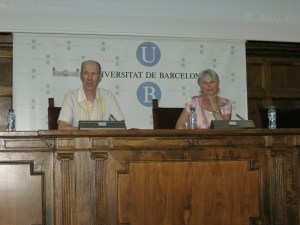
My friend and colleague, Dr Maarten Renes from Universitat de Barcelona, is guest columnist this week with this intriguing piece on the Catalonian struggle for autonomy as it is played out on the football fields of Spain.

Martin and Jennifer, Universitat de Barcelona

Barcelona has turned into an attractive holiday destination for many Australians: its generally good weather, cultural amenities (Gaudí architecture, Picasso and Miró museums, Roman remains etc.), gastronomic wealth and intense beach and night life have forged its reputation as a hospitable town.

Many know that Barcelona is the second-largest city of Spain, but how many realise it is also the capital of Catalonia, a so-called ‘autonomous community’ or quasi-federal region within the larger political framework of the Spanish state?

To understand what is at stake in the war of politico-legal definitions surrounding the term, one only has to observe the intensely lived competition between the two major Spanish football teams, Real Madrid and FC Barcelona, which neatly delineates the amount of feeling invested in state and regional nationalism—or ‘central’ and ‘marginal’ nationalism, españolismo and catalanisme, as they like to say here. At present, the score Madrid-Barcelona is five-nil in the political, but the reverse where football is concerned.

Indeed, Barça coach Pep Guardiola is the most popular expression of fer país or ‘making country’, an apt phrase denoting the forging of local identity coined by the conservative regional-nationalist and ex-president of the Catalan government, Jordi Pujol.

Guardiola’s project perfects the seeds sown by former Dutch international Johan Cruyff, who has made Catalonia his home and used to play for and later coach the Barça team which boosted Guardiola himself as an excellent midfield player.

Whereas Real Madrid spends huge amounts of money buying the best players on the market, creating some sort of a mercenary army unit (but no unity), Guardiola draws on the club’s young, upcoming players to build a competitive, synergetic team of ‘local lads’ who have imbued the club’s collective philosophy of playing football from an early age on.

To highlight the regional-nationalist importance of this, a similar strategy has been quite successfully followed by several professional Basque football clubs playing in the Spanish liga or premier league. That this strategy has been very effective in the case of Barça is shown in the team’s results and international recognition.

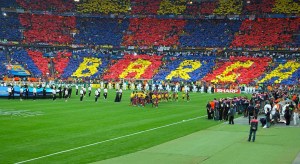
Barca fans by atomicShed via flickr

Pep Guardiola forges a sense of ‘country’ by appealing to solidarity, hard work and modesty as he likes to proclaim himself, and has come to represent a role model for current Catalan self-perception. As such, Barça articulates a claim for the political significance of the city (and region/country/nation) that hosts it, and is of capital importance in the economic, political, legal and cultural conflict that the town has been engaged in with Madrid ever since the advent of democracy in 1978.

Should it surprise anyone that when Barça’s last president, Joan Laporta, stepped down last year after serving his two statutory mandates, he took charge of a new independence party, Solidaritat, in the last Catalan elections, managed to obtain several seats in the Catalan parliament, and now considers running for mayor in Barcelona?

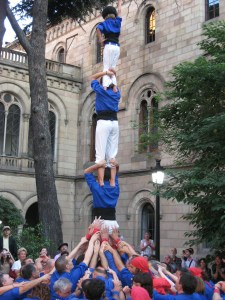
Traditional Castell, Barcelona by Jane Bronotte

The Spanish Constitution of 1978 laid down the rules to play the political game in Spanish state territory, and attempted to accommodate the ‘historical nationalities’ of Galicia, The Basque Country, Navarra and Catalonia in a quasi-federal structure of ‘autonomous communities’ in which all Spanish regions were incorporated as equals—an arrangement now often disparagingly referred to as ‘café para todos’ or ‘coffee for all’, that is, all regions would be ‘served’ the same.

The historical nationalities’ distribution on the map actually reflects the way Christians organised themselves into kingdoms in the north of medieval Spain to fight back the Moorish occupants of the peninsula. Whereas Portugal remained its independency on the Atlantic fringe, all other regions were eventually brought under the control of the Castilian kings, although the other former kingdoms from the north of Spain would retain some rights of old and strong regional identities, despite the fragmentation of their territories under Spanish and French rule in modern times.

The most belligerent and successful of the historical nationalities has been The Basque Country, both because of its fully-recognised historical rights and its still-active terrorist movement ETA, which was actually founded in the Basque-speaking northern fringe of Navarra. Catalonia has played a slightly more accommodating role towards the central government; hampered by a more limited interpretation of its historical rights, it insistently complains about the lack of ‘completion’ of the 1978 Statute of Autonomy. It claims that the legal possibilities for Catalan self-government and self-management have still not been exhausted and need further filling out to reach a full-fledged federal make-up, comparable to the German Länder or the Australian states for that matter.

Voices for complete independence from Spain are also increasingly heard and represented in the Catalan Parliament.

The struggle for self-government ties in with wider objectives of economic reactivation and cultural survival. On the one hand it is often felt that there is a serious financial and economic drain-off towards Madrid, held in place by state control and plunging Catalonia back into ‘underdevelopment’. No doubt Catalonia, once a rich area of strong industrial development whose republican aspirations were thwarted by the fascist outcome of the Spanish Civil War (1936-1939), pays comparatively more taxes than most other autonomous regions and receives less money back from the central government.

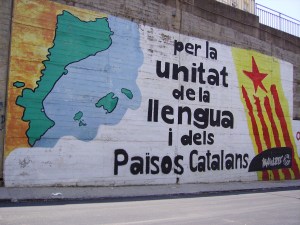
Mural: Catalonian Independence Movement via Wikimedia

Many Catalans feel this has been going on too long and has led to an unjustifiable disequilibrium with the rest of Spain—and especially Madrid, which has enjoyed spectacular economic growth hand in hand with the (post)Franco accumulation of political power.

On the other hand, cultural survival focuses on the Catalan language, theoretically spoken by six to seven million people but under constant threat by the legal and demographic pressure of Spanish, co-official and spoken by 46 million people in the peninsula alone and 500 millions worldwide. In Barcelona capital, with four million inhabitants if one includes its area of metropolitan influence, the languages often mix, and most immigrants, formerly from the south and west of Spain but nowadays often South-American, prefer to learn and/or speak Spanish over Catalan for reasons of convenience.

Although the vehicle language in official contexts, Catalan remains a minority language which also suffers from the onslaught of artificial fragmentation by its renaming in adjoining territories where local varieties are spoken. Thus, in Valencia people speak Spanish and ‘Valencian’, which is clearly distinguishable as a dialectal variant of Catalan but officially defined by its neo-con government as a different language.

The Balearic Islands (Mallorca, Menorca etc.) are proud of their ‘Balearic’, a similar case in question. Neither should one forget the two varieties spoken in the Pyrenean valleys of Andorra and Aran, which also boast their linguistic ‘difference’. Last but not least, the presence of Catalan in the old Catalunya Nord, the area around Perpignan in the South of France, is more and more anecdotic and ‘folkloric’ everyday.

Tango Dancers in Las Ramblas Barcelona. by Carlos Lorenzo via flickr

Unlike Canberra, which in theory is a physical and political space beyond local strife, Barcelona is capital territory in many other senses. It is (a) capital to visit as one of the major tourist towns in Europe—or at least of the Mediterranean—because of its attractive combination of good weather, a accessible beaches, attractive architecture, historical and cultural amenities going back 2,000 years, and round-the-clock bar, club and restaurant scene.

It is also the capital of the historical nationality of Catalonia, and offers a myriad of possibilities to get to know this culture forged as of the Middle Ages, both in town as well as outside—whether you go to other major cities such as Tarragona, Lleida or Girona; to the mountain resorts of Montserrat, Montseny or the Pyrenees; or the beach resorts of the Costa Daurada or the Costa Brava.

It is, next, a capital postcolonial space in which the ongoing politico-economic conflict between the centre and the margins is played out and marketed as antagonising nationalisms, and whose outcome remains unwritten, even more so in times of economic slump and general conservative European backlash against the celebration of cultural difference. It is, in this sense, one of the capital locations in the Old Continent where the configuration of a new Europeanness is torn between the narrow-mindedly provincial or broadmindedly cosmopolitan. It is, last but not least, a capital which I, though not from here, would like to keep calling my home.

Dr Maarten Renes

Maarten Renes is an expatriate Dutchman who has lived and worked in Bacelona since 1987. He holds a PhD in English by the University of Barcelona and is assistant lecturer for the literature section of its Department of English. He is vice-director of the University of Barcelona’s interdisciplinary Observatory: Australian Studies Centre.

Debating the religious right

9 Mar

First up, don’t, if you can help it.

by Medusa's Lover via flickr

One might as well get in a fight with a three year old about the existence and purpose of the tooth fairy. Rigidly faith based positions founded on moral absolutes are not debatable This is but one of the things inherently wrong with them.

The female face of the Australian religious right

Reluctant as I am to make any of this about Melinda Tankard Reist, she is undoubtedly the public face of the religious right in their attitudes to female sexuality, and the influences of popular culture on boys and men.

I don’t know of anyone else in this country commenting as loudly and as frequently on this topic, and topics related to it from that perspective. Having positioned herself thus, I have little choice but to acknowledge her primary role.

The religious right believe that to succeed, a society must operate within a framework of common assumptions. Dissent is divisive and must be smothered. It therefore makes sense that censorship through protest is a cornerstone of what some describe as a dominionist sexually and socially ultra conservative theocracy.

Tankard’s Reist’s practice is to resort first to censorship. In this she has adopted the tactics of the American religious right, and Tea Party luminaries such as Sarah Palin herself described as a dominionist, though this is contested.

Research confirming close ties between the Tea Party and the religious right is here

The narratives of propaganda

Religious campaigners are not required to provide any evidence that the object of their disapproval is what they say it is. They simply have to use florid rhetorical propaganda to inflame and frighten enough petitioners so that corporations will be equally frightened, and for the sake of peace and unwanted attention, pull the offending material.

If at all possible, they make at times extremely tenuous links to the welfare of children. The threat of being promoted as acting against the interests of children will cause just about anybody to fall to their knees, begging the Christian conservatives for mercy.

Again, they are not required to provide any evidence for their claims, though they do sometimes offer the opinions of a like-minded individual, preferably one with some experience in a relevant field. For example, this quote from sexual assault counsellor Alison Grundy quoted on MTR’s website:

“Now we have thirty years of research to show that the sexualized and violent messages of popular music, media and video games do shape and provoke male aggressive and sexualized violence. I wonder how long it will be before songs like this are seen as inciting crimes under the criminal code?

Any research that directly links any part of popular culture to the increased abuse of women’s and children’s human rights is important. MTR and her fellow travelers argue that popular culture causes an increase in violence and sexual offenses against women. Research supporting this claim, is, one would imagine, foundational to the religious right argument.

However, the reader isn’t told what the research is, who conducted it, when, and where, and how, and we are not provided with any links. This is not unusual, as those forum commenters who’ve attempted to find links to another survey quoted by Reist in her article New song from Delta’s man (Delta’s man? He has no name?) feeds rape myth, have discovered. Despite many requests, the sources have not been supplied.

On her website, Tankard Reist provides share buttons under the French Vogue photo shoot of sexualized five-year-old girls so that visitors can boost their circulation on the Internet. This on-going exploitation of the little girls is justified as raising awareness.

However, sourced research that supports serious claims against popular culture and female sexuality is entirely absent.

The Australian religious right don’t feel the need to interview males about their reactions to popular music and video clips before agitating for censorship on the grounds that they provoke violence of all kinds. Collecting and collating data, reaching informed conclusions as to the effects these things actually have on the demographic, well, why go to all that trouble when God is in the house telling you everything you need to know?

Fox News by Justin via flickr

The US neo cons, Tea Party supporters and the religious right long since perfected the art of moral panic by rhetorical floridity. They are enabled in their endeavours by such luminaries as Rupert Murdoch, and his Fox News media slaves Bill O’Reilly, the recent Mormon convert Glenn Beck, and Megyn Kelly. Fox News is apparently the trusted news source for a majority of Tea Party followers, more than twice as high as in the general population

It’s all relative, isn’t it?

John Malkovich, in the character of hapless CIA operative Osbourne Cox in the Coen Brothers’ movie Burn after Reading (2008) is confronted about his drinking by an aggrieved co-worker.

“You’re a Mormon,” he snarls back, “everbody’s a f*cking alcoholic to you.”

In the same spirit, (acknowledging the blatant use of stereotypes) when your bottom line for the expression of female sexuality is that it should be confined to the marriage bed, everybody’s sexually licentious. If Victoria’s Secret underwear is pornographic to you, everybody’s a pornographer.

Incidentally, it’s likely that only in a wealthy Western liberal democracy could women’s underwear be co-opted as a symbol of the abuse of women’s human rights. Women in many other countries can’t afford it, are earning five cents a day making it, or are distracted by mass rapes, genital mutilation, hunger, and sexual slavery.

Even in this country we have our distractions. A report on the economics of Domestic violence released by researchers at UNSW on March 7 revealed it costs Australia 13 billion dollars a year. Abuse of children, and sexual assault continue at alarming rates but strangely, the most vocal advocate for women and girls in this country has selected underwear and bad songwriters as her symbols of injustice in her tilt against the abuse of women’s human rights.

To be fair, I notice there is a piece on the website about the bustling streets of Mumbai in honour of International Women’s Day.

Disclosure rocks

Here I need to take a personal moment. Another of the shared religious right/Tea Party/ neo con tactics (taken to new heights by Sarah Palin’s Got you in the cross hairs campaign against Democrats who voted for healthcare reform) is to discredit anyone who disagrees with them by launching a personal attack either on their private life and/or their knowledge base. This tactic is also used by feminists of all persuasions, including Christian.

I’ll disclose my credentials in the area of women’s human rights, in the vain hope of forestalling more “feminist” tirades against my ignorant “anti feminist” bent.

By the way, is anti feminist the same as un Australian, only specially for women?

I’ve just completed a chapter for a forthcoming book on human rights titled Intimate Violence as Human Rights Abuse: Re-Framing Intra-Familial Violence against Women and Children.

I’ve published nationally and internationally on this topic, as well as presenting at conferences around the world. I’ve also written extensively on the failure of prominent male human rights commentators to include intimate violence as human rights abuse in their publications and their thinking.

That’s enough trumpet blowing for one day. May it keep me safe from harm.

Truth claims, damned truth claims and statistics

In psychological terms, the interpretations put on the expressions and representations of female sexuality by many on the religious right are nothing more than their own projections, fed by, among other things, their faith-based beliefs about sexuality. These are then extrapolated into truth claims, and concerted efforts are made to impose them on the rest of humanity.

Truth claims such as these need to be taken out of the sphere of personal projections and religious imaginings, and backed up with hard evidence.

OMG by Skye Nicolas via Wikimedia

If Christian conservatives don’t provide evidence they should be ignored. We should learn from the US experience while we still can, that it’s not good enough for our cultural and social landscape to be determined by people who are offering nothing more than their own projections, based on their relations with imaginary friends.

If they are too lazy to get out and find hard evidence for their claims, there’s no reason why anybody should listen to them. Hard evidence is the first step on the road to addressing the problems.

Let’s trash the songwriter’s partner while we’re at it

Through laborious trawling I discovered innumerable Christian websites that instruct the Christian wife on her manifold responsibilities to her husband. Among them I found this one and a warning, turn off your sound unless you want your senses assailed by the most spectacularly awful piano rendition of Rock of Ages known to humankind, rivaled only by the pianist accompanying Elvis’s cover of Unchained Melody circa 1977. The quote is:

The wife is to reprove her husband privately and lovingly when he is in sin and point him back to the Lord.

As well as following that lead from US religious right, Tankard Reist also seems to be taking a lesson from political dictatorships in the matter of holding responsible the relatives of those who’ve offended you, as well as the original offender.

On her website you’ll find an attack on singer Delta Goodrem, songwriter Brian McFadden’s girlfriend. The Christian right apparently holds Goodrem partially responsible for the offending lyrics in his latest song, because she should have vetoed McFadden’s work. Reist suggests that Goodrem is perhaps inured to violence against women, and therefore didn’t notice it was present in the song.

She then reveals that Goodrem is a spokeswoman for Avon Voices, an organisation that works to raise awareness of violence against women. There’s also a video of Goodrem speaking on behalf of this group.

I cannot find any explanation for this flaming that is not born out of deep and incomprehensible malice. Goodrem bears no responsibility for her partner’s actions. She merely lives with the man against whom the Christian right has taken censorious action.

In what feminist universe is a woman subjected to this kind of malevolent public harassment, solely because another woman doesn’t approve of something her male partner has done?

Answer: in the co-opted feminist universe inhabited by Christian conservatives.

As L. Cohen puts it about another kind of prison:

I don’t believe you’d like it
No, you wouldn’t like it here
There’s not much entertainment
And the judgments are severe…

Becoming woman

8 Mar

by Alex Dram via flickr


On International Women’s Day it seems appropriate to reflect on feminism.

I never imagined I would find myself in agreement with anything with that terrifying Janet Albrechtson said, but last night on ABC’s qanda she declared that feminism must be a broad church, the rhetoric of the sixties and seventies means nothing to young women now, and we must move on. Or words to that effect.

She also took Western feminism to task for ignoring all others, and mother of god, I agree with everything she said.

I’ve lately fought off allegations of being anti feminist, a victim blaming apologist for rapists, an exploiter of sexually assaulted women (because I once worked in clinical practice as a psychotherapist) not to mention being a “man fondler,”  a term of abuse I’m not familiar with, but don’t hold back, girls.

All this as a consequence of having had the temerity to suggest women have to take responsibility for our safety and well being, because nobody else is going to do it for us.

Anybody who bases their identity on an ideology is asking for trouble, in my opinion. Having held that opinion for some time now, I wasn’t unduly upset when some women started telling me I was anti feminist, pro male, and had a prick in my head. But what this torrent of female abuse did cause me to do was reflect on what it is women can do to other women in the name of feminism, and what a scary thing that can be.

There is no such animal as  universal feminism. Like it or not, it it’s already a broad church and always has been, even if there’s been a dominating voice from time to time.

Like any ideology, cliques and factions within feminism stake out claims and marginalize those who don’t comply. Feminism is as cruel, prejudiced and contemptuous of difference as any ideology. It always has been.

As ferocious as it can be to men, it is capable of equal ferocity to women who do not comply with the factional rules. That’s the nature of ideology. If you add an imaginary transcendental exteriority, you’ve got religion.

I know young women who are vibrant feminists, contemptuously dismissed by some older women as “fashionistas”  who shouldn’t be referring to themselves as “chicks” and “babes.” “Is the word woman too fat for them?” somebody’s asked. But young feminists have to do it their way. From this fresh perspective and energy, something new will emerge for women, even if as yet it is unformed.

Those of us who are their female mentors need first of all to respect their ascendency. Enough already with the moralistic prescriptives!

Get out of the new way if you can’t lend a hand, for the times they are….

There are young women who want to take responsibility for themselves, they see it as a badge of honour. Not for them the jaded diatribes of victimology.

This morning I heard a story of three generations of women together in a house with a man who was husband, father and grandfather to them. For years it had been his practice to drink, come home, and beat up his wife. On this occasion his forty year old daughter hid away as she always had, When the beating was over, the fourteen year old granddaughter took her grandmother aside and told her she didn’t have to live like this any longer. She took her grandmother to a refuge. They got help for her and eventually a place to live.

The young woman had learned about domestic violence and knew what to do. She’d been educated. She took charge, and her grandmother’s life was changed.

Who cares if she also likes to wear lacy panties and short skirts?

So  I’m giving the finger this International Women’s Day to any woman who tells me or anybody else how to be a proper feminist, after telling us that we’re not.

Rotate, honey. I like me just the way I am.

Peddling fiction as fact: whose nightmare is it really?

5 Mar

Don't tell me I'm gonna be a monster, lady.


“Expect to hear boys singing along to it soon. This is the message they are imbibing: Women are slaves and bitches who can service a man’s sexual needs, even in death. Men are brutal and dominant, and have no empathy for women. Men enjoy dead women as sex and entertainment. The female body is to be devoured, reduced to the same status as meat. Female bodies should be displayed before men as a great feast for their consumption.”

This is an extract from Melinda Tankard Reist’s Drum article on the controversial KanYe West 30 second video clip.

I’m not going to discuss the clip, that’s been done to death, except to say I don’t agree that is the message of the clip. And this is part of the point – we don’t all see through the same lens, so it becomes very important to know just what lens public opinion makers are looking through, and that ought to be disclosed.

Reist expresses great fear that all boys will like the song, and all boys will sing along to it. She then claims that as a consequence of this, all boys will “imbibe” the perception of all women as “slaves and bitches,” all boys will think that all men “are brutal and dominant, have no empathy for women, and enjoy dead women as sex and entertainment.” All boys will think that all female bodies are to be devoured like meat. And so on.

This is the message Reist imagines all boys are imbibing.

But this message comes entirely from Reist’s own mind.

In psychological terms, the messages she claims all boys are imbibing are entirely Reist’s projections.

She hasn’t consulted with KanYe West about what his vision and intentions are. She hasn’t done any  research to ascertain other interpretations of the clip, or if she has, she’s not talking about it in this article. She has no evidence at all of how boys respond to the clip, or if she has she’s keeping to herself.

She’s made it all up.

In other words she hasn’t taken a reality check. She’s constructed a fictional narrative founded on personal fears that she then peddles across the media as truth.

The logical conclusion of Reist’s made up truth: all boys and all men are monsters or are in the process of becoming monsters.

Truth claims such as these need to be taken out of the sphere of personal projections and imaginings, and backed up with evidence.

If there is no evidence they should not be made because they are dehumanizing claims, and in this case, they are dehumanizing all boys and all men.

This is absolutely unacceptable.

Reist does not allow that boys have agency. She portrays them as passive and indiscriminate receptors that can only be acted upon. (Just as she portrays “sexified” women.)

She does not allow that boys experience any other influences, such as parent, schools, extended family, ethical and moral systems.

Reist’s perception of boys and men as revealed in her imaginings is more terrifying than KanYe West’s video clip could ever be, because in her imagination, they are robotic, without human feeling, and murderous.

If she expressed these same perceptions and imaginings about others, say Muslims, a group currently subjected to discrimination and irrational public fear, she wouldn’t be published.

If she claimed that Muslims were “imbibing” information that would inevitably lead to them engaging in necrophilia and all the rest of her floridly imagined consequences there’d be an uproar. If she implied that Muslims have no agency and are empty vessels waiting to be filled by the most vile knowledge she can imagine, that they might then act upon, would the ABC publish that?

But she can do this with impunity to all men and boys?

Hell, imagine if some man made all that conjecture about women?