Archive | Society RSS feed for this section

Hysteria: Phreudian phallusy or what?

5 Jan

In the latest issue of The King’s Tribune there’s an article by one of the editors, Justin Shaw, titled “Porn is Bad.” It’s a must read for anyone with an interest in the politics (poetics?)of porn from the perspective of an articulate and honest male consumer, rather than that of anti porn activists, or academics arguing against them.

I was delighted to read the piece, as its long been my complaint that voices such as Shaw’s are not  included in the debate. Though I hesitate to use that word, seeing as the anti porn activists brook no debate. You’re either with them or against them in their war on the producers, actors, and consumers who in their view form the pornographic axis of evil.

In the second paragraph of the piece you’ll find this comment: “Gail Dines gave a series of hysterical screeches when she visited Australia last year…” An accurate and unremarkable assessment of Dines’ performance I would have thought, but no. This innocuous observation provoked a surge of outrage on Twitter, with tweeps complaining the comment was misogynist. Everybody knows or should know, they argued, that the term “hysterical” has been used to denigrate and discredit women, especially feminists, for decades, and Shaw was allegedly perpetuating that abuse in his description of Dines.

You’ll get no argument from me that “hysterical” has indeed been used to discredit women. I just wonder though what we will be left with if we demand the discontinuation of all terms that can be used to discredit women, and for that matter, men. I have on more than one occasion used the word “hysterical”to describe the behaviours of certain male politicians, and I think I might have once unkindly attached it to Clive Hamilton after reading one of his more florid anti porn rants. Colloquially, the word is used to mean emotional excess, mental agitation, and loss of self-control.

The term “mass hysteria” is not gender specific, and is used to describe the behaviours of groups containing men, women, transgendered and un-gendered people. In sociology the more frequently used term for mass hysteria, is “moral panic.” I rest my case.

So what is the (potted) history of “hysteria?”

It was apparently Hippocrates who first used it to define “disturbances of the uterus” thought to cause all manner of ailments peculiar to women (“hystera” meaning womb) though there are arguments about that explanation of its origins.

In the mid to late nineteen hundreds the many and varied symptoms of hysteria were attributed to sexual dissatisfaction, and physicians treated their female patients with “pelvic massage”, that is, clitoral stimulation to orgasm. In order to spare physicians this arduous task, women were eventually dispatched to midwives for treatment, and then offered vibrators.

An aside: I can attest to the value of midwife administered orgasms. My second child was born in a bean bag at home, and I was attended by a midwife. At some point in my labourings, she tenderly applied an herbal cream to my lady bits and in the process, brought me to a spectacular orgasm. As I was groaning anyway, none of the assembled spectators were any the wiser. I strongly recommend this practice as an aid to delivery.

Back to hysteria. French neurologist Jean-Martin Charcot became fascinated by inexplicable paralysis in some of his female patients. As there appeared to be no organic reason for their troubles, he decided psychological factors were to blame. To this end he hypnotised them, in an effort to discover the repressed traumas he suspected were being expressed physically.

And then came Freud. Fascinated by Charcot’s theories, Freud gave the world his brilliant (if not always accepted) theories of repression and conversion disorder. Initially he confided to his colleague and friend Wilhelm Fliess (a man with bizarre opinions about the purpose of the human nose, but that’s another story) his belief that much of the hysteria he found in his female patients originated in premature and abusive sexual experiences during their childhoods in middle class families. This was perpetrated on them by relatives, or nannies. With no means of expressing their trauma, or even acknowledging it, Freud’s female patients converted their distress into any number of psychological and physical symptoms that were, in his terms, hysterical. That is, without apparent organic cause, sexual in origin, and particular to women.

Unsurprisingly, Freud’s insights into middle class family life did him no good in the climate of the times, and it’s alleged that he dropped them in order to save his reputation. He then came up with his Oedipus Theory, and there’s debate as to whether that did him a lot of good either, but that’s also another story.

The problem is the symptoms of hysteria are still inevitably defined as female, yet we know this is a nonsense. As Freud well knew men are also sexually abused, and can suffer after effects every bit as “hysterical” as those endured by women. Freud would have done us all a favour if he’d coined a non-gendered term to describe the symptoms he observed in both male and female patients as a consequence of repressed trauma, but alas, he did not, and here we are in 2012 still fighting about hysteria.

In defense of Shaw, his sentence doesn’t read to me like a misogynist use of the term: I can think of no other that so accurately describes Dines’ performances and her intention to inspire moral panic (mass hysteria) in her audiences.

And she almost succeeded for this viewer when she used the acronym ATM to describe a sexual practice that I do not find inspirational. In the elegant words of @ruminski this concerns [redacted lower body orifice] to [redacted upper body orifice]. It has nothing to do with cash dispensers, except if you’re paying for it.

Following Meatloaf, I will do anything for love, yes I will do anything for love, I will do anything for love, but I won’t do that. No, I won’t do that.

Let’s not throw the baby out with the bath water and attempt to rid ourselves of all language that can be used to denigrate somebody. Intention is everything. In my view, Ms Dines speaks hysterically on the topic of pornography, with the intention of provoking moral panic. I can only hope that the outrage provoked by Shaw’s use of the term does not blind readers to the importance of his observations. I wish he’d publish them on the Drum as well.


Same old msm misogyny, all politicians are liars, and only if I’m water boarded

3 Jan

I don’t know if this is just an attack of ennui after the holiday festivities, but all I can find to say about the new year is blah blah blah.

Same old politics politicking on.  Same old fights between right and left. Same old controversies, increasingly bereft of impact due to over-exposure. Same old msm misogyny against the PM. Yes, it’s taken me a long time to come round to acknowledging that. I have my disagreements with Ms Gillard, and I didn’t want legitimate arguments against her to be obfuscated by allegations of misogyny. It was bad enough when the feminists went wild at her ascension, conveniently ignoring the context in which it took place.

But I have to admit that there can be no other reason for the msm’s unceasing attacks on her, their unwavering support of that grotesque ferret Tony Abbott, and their wilful ignoring of Gillard’s considerable achievements. To collapse into primitive binaries: Abbott’s a man. Gillard’s a woman. The msm can’t deal with it. They are profoundly misogynist. They would see us delivered unto the mad monk rather than have a woman in the Lodge.

Gillard is undoubtedly a woman of strong character and great political talent, and I think she’s growing into her prime ministerial role. That said, she’s a politician. I feel no compunction about embarking on a stereotyping frenzy when it comes to them. They are liars. They are hypocrites. They are self-seeking, ego-driven megalomaniacs and they are quite likely psychopathic as well. However, within these parameters, some are not as bad as others. Gender makes no difference whatsoever, except, perhaps, in the way in which these dangerous dysfunctions are expressed. That said, I bet all my xmas presents that Gillard would have taken us into the illegal Iraq invasion, just like Howard. Then there’s her stand on the Australian citizen in big trouble overseas, Julian Assange. Her government’s implied preferencing of Chopper Reid over David Hicks in the matter of proceeds of crime. The mess she’s made of asylum seeker policies. Oh, here I go again re-visiting the same old fights. But what else can one do? Fall silent?

Anyway, if we are going to be critical of our PM, let’s not allow misogyny to muddy the waters. We don’t need it.

Then there’s the same old windbags on commercial TV and the same old botoxed, artificially bosomed, tarted up bottle blonde anchors and presenters. Except when they’re bottled brunettes. I guess that’s some kind of variation.

It’s freaking me out how so many TV women are starting to look exactly the same, with the tortured hair, and bloated lips through which they deliver their version of the day’s news and (ahem) analysis in breathless girly voices. They’re modeling themselves on the Fox News girls, aren’t they?

Reminder to self: now @RupertMurdoch is on Twitter give him a serve about his anchors. And champion pie-stopper @Wendi_Deng also has a verified account, making a husband and wife team rivalled only by David and Kristen Willamson, who I am coming to below this image of an ideal Fox anchor:

A brief respite yesterday when someone on Twitter directed me to this blog, a site wherein Bob Ellis and David and Kristen Williamson recreate for readers a blog version of the Jerry Springer Show. Transfixed by the same awful fascination with which I have in times of self-destructive boredom watched adults self-mutilate on Springer’s show for the emotionally challenged,  I read this mutual exchange of abuse and recrimination, much of it overtly and covertly sexual, and laughed my head off. The Williamsons struggle with silly attempts to defend themselves against the irrational onslaughts of Ellis in outraged linguistic flight. Everybody knows Ellis can outdo anyone in a public brawl because unlike most of us, he has no boundaries. He will say anything.  And he does.

Against this floridity, David and Kristen splutter the kind of middle class indignation that can only be mocked, because of its mediocrity, and its utter failure to see beyond itself.  Far too much of it in some of his plays, unkind people may mutter, and not always satirical?

All in all I’d rather read Ellis than either of the Williamson’s, but only if I was water boarded into making a choice in the first place.

Things may look up. Then again they may not. I am waiting for the Rapture. I am steadfast. I have faith.

Bob Ellis: Oh, why can’t a woman be more like a man?

31 Dec

Bob Ellis is a very good writer. Like Christopher Hitchens, with whom Ellis enjoyed drinking privileges, one may not always agree with his content but his form is generally erudite and entertaining. Ellis’s review of the new film about Margaret Thatcher, “The Iron Lady”, published here at ABC The Drum, is no exception. Written with Bob’s unquenchable passion for language, it’s an eloquent review.

Unfortunately it also contains more than Ellis’s usual quota of reactionary misogynist crap, as do several of the comments he makes in response to his readers. Ellis manages to turn his review of a biopic which he feels should have been a political back room drama, into a thinking(?) bloke’s cri de couer that women ruined this movie. First of all by writing it, and second of all by not having the capacity for creating political back room drama to anything like the standard of that created by men.

While Ellis may have a point here, and political back room dramas (not always good ones) do indeed flow more easily from keyboards operated by male fingers, his explanation for this discrepancy is nothing short of insane. According to Bob, it’s because we’re female. That’s it. Our cunts govern our brains, to our everlasting detriment, and because we bleed we are “less good at disagreeing with ourselves” than are those of you who are possessed of hairy balls and pricks that produce semen (and political back room dramas) in glorious milky fountains. Sometimes.

The fact that women have not been allowed to participate in political back room life to anything like the extent and for anything like the period of time afforded to men, seems to have escaped Mr Ellis’s notice.

What is actually FAR more remarkable is that given the male domination of politics of all kinds, not just back room, there is such a paucity of good political drama available.I mean really, Ellis and those who agree with him, you’ve had centuries of experience and opportunity denied to us, in fact its only been in the last two that women have had any real input at all.

In spite of your total blokey domination of the political scene for all of human history, hardly any of you, comparatively speaking, have come up with political dramas that anyone will bother to remember. I could probably count them on my fingers and toes, plus another woman’s, and that doesn’t say much for thousands of years of male political domination, now does it?

Maybe there aren’t too many of you either who can “disagree with themselves” to the extent required for good back room political drama. Comparatively speaking. There’s a lot of male dross out there.

“The male impulse to power” Ellis claims, “is better understood, as a rule, by men.” I call bullshit, Ellis. There’s nobody understands the male impulse to power better than those whose lives are governed by it, whether they’re male or female. The male impulse to power is tragically generally NOT understood by the men who exercise it, understanding being of far less importance to such men than action, regardless of consequences. Indeed, understanding weakens this hegemonic masculinity.

The female impulse to power could be claimed to be equally misunderstood by men, usually because of the terror they experience when confronted by it. This impulse is increasingly channelled into hegemonic masculinity as more women take up influential political roles. None of this has anything to do with our cunts, and everything to do with the narrow biological imperatives imposed on us solely because we have them.

Ellis unforgivably imputes a creative intention to the writers of “The Iron Lady,” an intention that is in fact entirely his own, or would be if he’d been writing the script. Which he wasn’t. Maybe nobody asked him. How slack of them, considering he knew Maggie for three days, really really liked her legs, and was seduced by her breathless flirtatiousness. Ellis assumes it was the writers’ intention to create a back room political drama, in what could only ever be an imitative attempt to keep up with back room initiates like him. He then trashes the result, because in his book the attempt failed. He then extrapolates the trashing to the entire female sex, and says we can’t do it like they can. Because we’re women.

The more serious question here is why Ellis is compelled to frame so many of his arguments as gender wars, and more than usually stupid ones at that. A movie is not what he expects, or what he would have liked. Suddenly this is a statement about the inferiority of women, based entirely on our sex, without any context at all, political or otherwise.

Replace “women” with “Jews” or “Palestinians” or “Chinese” or “Germans.” Yes. It’s not pretty, is it.

Home

28 Dec

I’m looking for a
Home- where the wheels are turning
Home- why I keep returning
Home- where my world is breaking in two. Brian Eno & David Byrne, “Home”

The house protects the dreamer, the house allows one to dream in peace…the house is a large cradle…it maintains him [sic] through the storms of the heavens and those of life. Gaston Bachelard, “The Poetics of Space”

Because it’s Xmas I’ve been thinking about home, and the devastating effects of not having one.

Homelessness takes several forms. There’s hard-core dispossession, when people literally have no roof over their heads and live on the streets. Sometimes they find a bed at a shelter for a few nights. There’s couch surfing homelessness when people move round friends and relatives’ homes in an effort to stay off the streets. There are families and single people living in cars.

There’s the homelessness of asylum seekers, dislodged from their belonging by circumstances outside of their control, seeking somewhere on earth where they can safely settle.

Then there’s living in places where you just don’t belong, such as institutions, where you are only there because you have no choice. That was my kind of homelessness from the age of fifteen.

My kind of homelessness was middle class. I had a roof over my head. The roof was that of the boarding school I’d been attending. The family I’d lived in up to that point consisted of my mother, her second husband, my stepfather, and my two little half sisters. My mother married her second husband when I was seven, and he brought us to Australia from England.

Up to that point I’d been raised by my grandparents in what seems now an almost idyllic situation. We were cash strapped – Granddad was a retired coal miner, and working as a night watchman at the gasworks. I was much-loved by him and Eleanor, my grandmother, even though they’d raised three children of their own. We had food, clothes, shelter, entertainment, and Granddad’s corgi dog. I had an uncle, and an aunt who kindly painted my tiny toenails for me by the kitchen fire when she was attending to her own. I idolized my uncle. I was safe, treasured, and kindly disciplined. I had what every child needs – a bevy of adults to take a loving interest in her. There was always someone to listen, and there was always someone to play with.  It worked for the adults as well: nobody was overburdened with sole responsibility for my well-being.

I hardly remember my mother during this time. She lived in the same house but must have been largely absent from my child’s world, as the impression she left was negligible. It didn’t matter.

It must therefore have been a great shock to me to be wrenched from that cosy world into the uncertain future offered by my stepfather and mother, both of whom were practically strangers to me, and transported to the other side of the world. Such a shock that to this day I have absolutely no memory of the parting. While she was alive, my grandmother revisited this trauma endlessly whenever we saw each other, which was rarely as we were now worlds apart, in every possible way.

My mother made an upwardly mobile marriage – her second husband was a doctor. Her first, my father, to whom she was married till I was three months old, played drums in a band. I know almost nothing about this man.I did go through a period of trying to find out, without success, and eventually I thought what the hell, the man obviously didn’t care about me and do I really want to find someone who didn’t care about me? No, I decided, and finally let it go.

The marriage took my mother out of the North Yorkshire mining town and working-class culture she loathed, to a new country and the rich possibilities of middle class professional life.

Unfortunately, her new husband was violent, abusive in every way possible, and had an eye for her seven-year old daughter. Suffice to say the next seven years of my life were a kind of hell into which I felt I had fallen through some fault of my own. Children do this. They assume responsibility for the most enormous adult events and if no one tells them otherwise, they labour under the burden for years.

The contrast between those seven years and the seven that preceded them was absolute.

At the age of almost fifteen, I revealed to one of the nuns at my Anglican boarding school just exactly what was going on in my home. Astonishingly, these intelligent, compassionate women believed me. I’d explained for them their bewilderment at my lack of scholastic progress when I clearly wasn’t stupid, my inability to sleep, my habit when I did sleep of walking and falling down the stairs, my inability to eat and thus to thrive, and my constant illnesses. Within days they had taken action. They consulted the Bishop, the Dean, and their lawyers. They summoned my mother and stepfather to the school, having first hidden me in a safe house so neither of them could see me. Lawyers, nuns, the Bishop and Dean confronted my parents, who made no attempt to deny my account of events in our house.

A deal was done. I was to be handed over to the guardianship of the nuns. I was never to go home again. My mother would be allowed to visit with me, but my stepfather must agree to never attempt to see me again, otherwise they would call in the police.

I was safe.

I was ambivalent about these arrangements. My family was appalling, at the same time it was the only one I had. My home was a place of great danger, at the same time, it was the only one I had.  I was relieved and grateful to have been rescued, but at the same time, I had no home. A boarding school is not a home, no matter how kind they are to you. I was supposed to go to various friends’ homes for holidays, which I did for a while, until the mortification of being unable to reciprocate their hospitality became too much for me. I would hide on the last day of school, and not reveal myself until they’d all gone. Then I’d be allowed to stay with the nuns in the great big empty boarding house, until term started again.

The nuns were good to me. They were beyond good to me. They did everything they could to make up for my losses. I wasn’t always grateful. When I played the piano in a competition where everyone else’s mothers and fathers showed up to support and admire, I wept after my performance that the nuns who’d come with me weren’t my parents, and I was the only girl there without anyone. My final act of ingratitude was to repudiate their religion.

The humiliation of living as an emotional beggar in an atmosphere of comfortable middle class families stayed with me for years. It will probably never entirely leave me. Where I live, though I’ve been here for years, still feels disturbingly temporary. Every time I try to think of it as home, I baulk.I can’t go there. Such is the power of a word. I don’t believe I won’t lose  home again, and a real home is not supposed to be a thing you can lose.  No amount of rational thinking and concrete experience convinces me otherwise. I remain, on this topic, seven years old, and dumbfounded at the turn my fortunes have taken literally overnight.

The legacies of that time have been many and I’d be hard pressed to decide which was the worst. However, this is a piece about home, so I’ll focus on that one. I have never been able to get my head around the concept of home. It’s not about bricks and mortar. It’s a magical name for a yearned for and unattainable state, full of meaning, feeling and emotion that I’m unable to let myself experience. Why? Because first I’d have to rage and grieve over having home snatched out from under me all those years ago, and that’s a dark place I can only very infrequently visit. To survive I’ve held those feelings at bay. I hop over them as I hop over hot sand on a blistering summer day, never letting my feet settle long enough to suffer anything more than slight discomfort. And only when I’ve forgotten my thongs.

The price I pay for acquiring these skills of avoidance and denial is never being able to feel I’m at home, or even that I have a home. The pay off is survival. We’re urged to confront that which disturbed us, rather than allowing it to fester and thrive and taint our daily lives.  While that is necessary, timing is all. Premature confrontation brings down the defenses that have been our friends, and allowed us function in the world. After all these years, my instinct tells me it’s time to let them go, and I couldn’t have done it a moment sooner.

For our house is our corner of the world, Bachelard writes,…it is our first universe, a real cosmos in every sense of the word. 

What then, of the child whose cosmos consists of abuse and exploitation? What, then, of the child whose topoanalysis reveals primarily sites of torment and terror?

The truth for me is that I can’t let myself feel home in the present until I grieve for the loss of that first one. I can’t imagine doing that grieving, and surviving the experience. Emotional cowardice provokes childish, self-berating dialogue: I can’t do it! Yes you can, you have to! No I don’t, you can’t make me! Well, if you don’t you’ll stay homeless forever! I won’t! I will not! You can’t say that stuff to me!

In a more adult state I realise I have to lay these matters to rest. I don’t want to leave this life carrying so much ancient sorrow into whatever comes next, even into nothingness. I want to leave with the cleanest possible emotional slate, grievings grieved, angers soothed, losses accepted, insult and injuries forgiven, both those I inflicted and those I suffered, at peace, as much as is possible, with the hand I was dealt. I want to have used my potential for surviving that hand to my fullest extent, and I want to leave satisfied that I achieved that.

In other words, I want to go home.

So this is my New Year’s resolution. I will do whatever needs to be done to assuage the loss of home. And then, with any luck, I’ll be able to feel home again, as I did when I was born, as I did as a little girl, as I did till I was seven. I think this will not only make life better for me, I’ll probably be a more pleasant person all round, having relinquished one more source of post traumatic stress that shuts me off from others whom I care for, and who care for me. The misery buck has to stop somewhere in a family. Let it stop with me.

Heaven knows- what keeps mankind alive
Every hand- goes searching for its partner
In crime- under chairs and behind tables
Connecting- to places we have known

Two blogs to read. And thank you, and happy holidays!

24 Dec

I’ve just read two blogs that remind me just how classy Australian blogs can be.

First, in the spirit of the season David Horton takes a good look at those whining reactionaries such as Barnaby Joyce who always get on their soapboxes at this time of the year and complain about the de-Xmassing of Xmas. The Watermelon Man’s posts invariably contain little gems of information that both delight and embiggen the brain, and this one is no exception. While you’re there, have a look at some of the other posts because Horton has one of the most unique and interesting voices in the blogosphere.

Then there’s this one, by Carey Moore. It’s a timely reminder that no matter how bizarre one might believe Tony Abbott to be, this is no time to get complacent about his chances of being the next PM. Titled “Busting a few Tony Abbott myths,” Carey unpacks five common assumptions made by Abbott haters that speak to the unlikely prospect that he’ll become our nation’s leader, and shows just how dangerous they could become if we allowed ourselves to be lulled by them.

One of the things I like about this time of the year is the enforced holiday. I like it that the country slows down for a couple of weeks, and that gives me permission to do the same. What the hell, it’s Xmas, I don’t have to…. fill in the blanks. For the next couple of weeks we can loaf about, kayak as much as we want to, sleep in, read crime novels, watch the Sopranos again from the very first series, listen to as much music as we want and slop around in our bathers and sarongs all day. Friends and family will come and go over the next few weeks, and the house has been made ready for easy hospitality.

So I may or may not put stuff up on Sheep!

Thank you so very much for visiting here, reading the blogs, commenting, and engaging with me. No Place for Sheep is approaching its first anniversary in a few days. We’ve had over 43,000 visits this year, and the National Library of Australia has suggested adding us to its digital archives, an honour indeed.

I’ve discovered I was born to blog, and I’ll be forever grateful to have lived in an era when this powerful means of self-expression is so readily available.

If you can, spare a thought for people doing it rough for whatever reason. Those of us free to enjoy this time of the year are among the earth’s most privileged inhabitants.

Be safe, be well, and love one another.

Wilson and Dines: together at the ABC Religion and Ethics website

21 Dec

It seems my review of Big Porn Inc annoyed the world’s foremost anti pornography campaigner, Gail Dines. She’s written this piece in response and Scott Stephens, editor of the ABC’s Religion and Ethics online, has put my review up as well, in the interests of balance.

If you look at the list of relevant articles beside my piece, you’ll see mine is the only one apart from Professor Alan McKee offering an alternative point of view, so they’re probable going to have to publish quite a few more before balance is attained.

Hitchens, Iraq and the writer’s voice

19 Dec

The late Christopher Hitchens was a brilliant writer. Even when you loathed his content, his form was reliably superb.

Everyone is entitled to at least one bizarre position on something in their lifetime, and for Hitchens his outstanding peculiarity  was his support of the invasion of Iraq.

Hitch envisioned a “short war,” one in which Saddam Hussein would be overthrown with a minimum of destruction. He vigorously supported George Bush, and when it became obvious to even the most ardent supporter that there were no weapons of mass destruction stockpiled in Iraq, he claimed that given that was the case the invasion was even more necessary, as it could be undertaken without fear of a nuclear or chemical response. The man was, on the subject of Iraq, crazed.

His loathing of Hussein was profound. He was right that Hussein and his “crime family” maintained “private ownership of Iraq” that ought not to be allowed to continue. However, the same could be said for several dictators, Mugabe, for example, who are left in place. The Bush-led invasion was not preemptive, in Hitchen’s view, but a natural historical consequence of US interest in Iraq’s affairs since 1968, including CIA involvement in bringing Hussein to power.

The post 9/11 timing of the war made sense, he claimed, as the terrorist attacks on the US homeland were an example of “fascism with an Islamic face.” This generalized justification allowed Hitchens to gloss over the reality that the terrorists involved had nothing to do with Iraq, but were mainly from Saudi Arabia. They were the “face of Islam” to him, regardless of their nationality.

So convinced of his rightness was Hitchens, that he titled his 2003 book  “The Postponed Invasion of Iraq.” His view will be, he declared, on the right side of history, while those who oppose both the war and his take on it will find themselves left behind.

Anything is possible of course and if conservatives rule the world in the future Hitch will be proved right, given that the victor writes  history. However, as Foucault argued there is no power without subversion, so in the event of  conservative global dominance, there will be dissenting voices arguing that Hitchens, Bush, Howard and Blair were wickedly wrong.

It’s all very well to predict the right and wrong side of history, but that depends entirely on who’s in charge of writing it.

For me, one of the most powerful pieces of Hitchen’s recent work came in this short essay for Vanity Fair titled “Unspoken Truths.” In it, Hitch gives us a glimpse of the state of stunning vulnerability all humans enter when we have to live with knowledge of our approaching death from terminal illness.

The cancer treatment he was receiving damaged Hitch’s vocal chords, causing him to fear the loss of his voice on both a real and metaphysical level. For a writer, the voice is all, and Hitchens movingly describes his sense of shocked  defeat upon encountering this unanticipated indignity. The essay is also a resonant meditation on the writer’s voice. It was a Hitch maxim that if you can talk well you can write, so for him, to lose the ability to talk well threatened his very identity. “So this above all,” he exorted his students, “find your own voice.”

And as he revealingly notes in the final paragraph of the Vanity Fair essay, quoting W.H. Auden: “All I have is a voice.”

What is also interesting in the piece is how this renowned atheist seems to be embarking on a flirtation with an un-named transcendental exteriority. For example, he quotes the Leonard Cohen song:

If it be your will,
That I speak no more:
And my voice be still,
As it was before …

which leads the reader to speculate who Hitchens imagines he is addressing. We know for the poet Cohen it’s God, but it’s a bridge too far to ascribe that sentiment to Hitch. Contrarian he was, but steadfast in his disbelief.

Hitchens also quotes T.S Eliot “The Love Song of J. Alfred Prufrock.”

I have seen the moment of my greatness flicker,
And I have seen the eternal Footman hold my coat, and snicker,
And in short, I was afraid.

Hitchens had a voice that could enthrall, whether you were listening to his articulate, mellifluous presentation, or reading his sustained adjectival abuse of those he regarded with contempt. His position on Iraq is to me a terrifying aberration, one that I will never understand, and one that I believe added unjustified gravitas in the eyes of many to what was a vile and unethical war.

Hitchens was as large in his faults as he was in his brilliance. He was a figure of immense complexity, and this is what drew me so powerfully to his work. Our culture doesn’t  encourage complexity, indeed, more often than not it is pathologized. Now and again a figure appears in fiction or reality who embodies our potential and reveals our possibilities, for better and for worse. In other words, humanity’s full gamut. Hitchens was just such a figure, and I am sorry he is gone.

Vale, Christopher Hitchens.

Zip it, homophobes

14 Dec

Congratulations to Senator Penny Wong and partner Sophie Allouache, who are delighted parents to new baby Alexandra.

This brilliant photo is from the Mamamia website.

Let’s have no bad fairies ill-wishing this family. Zip it, homophobes.

Big Porn Inc: a review

10 Dec

CAUTION: IF YOU READ BIG PORN INC DON’T MAKE THE MISTAKE I DID AND TRUST THEIR SOURCES: eg ‘SPANKWIRE’ IS NOT GENITAL MUTILATION AS CLAIMED BY ROBI  SONDEREGGER, BUT A WEBSITE

There’s a chapter in Big Porn Inc titled “Neurotica: Modern Day Sexual Repression” by Dr Robi Sonderegger, clinical psychologist, expert trauma consultant, and Chief Executive of Family Challenge Australia. The chapter includes a chart of online pornographic sub-genres which lists Google generated Webpages and total monthly searches (derived from Google Adwords) for 2010.

Top of the list is teen sex (actual post-pubescent adolescents) with 81,700,000 Web pages. Because the AdWords search is publicly restricted in this sub-genre, it isn’t possible to assess the number of monthly searches. However, Google Trends reports that juvenile sex terms were the most popular of all requests in 2010.

Second on the list is animal sex, with 50,300,00 Web pages and 6,120,000 monthly searches. Bondage, involving sadism and masochism has a total of 29.5 million pages with 5 million monthly hits.

Spankwire, a sexual practice involving the violent mutilation of reproductive organs comes in with 16,600,000 Web pages and 7,480,000 monthly searches.

Rape sex, involving real or portrayed forced unconsensual sex chalks up 2,770,000 Web pages and 550,000 monthly hits, while Snuff sex involving actual death of participants, consenting or otherwise, has a total of 1,280,000 Web pages and 6,600 monthly searches. There are no figures cited for the number of consenting participants who died during the production of snuff porn.

World population is currently around 7 billion, so some 0.1% of us are searching for violent mutilating porn on the internet, with slightly less searching for animal sex and bondage. Very few of us are seeking rape sex, rough sex and snuff sex, and there are only 480 searches a month for Guro sex, which involves blood, gore, disfiguration, mutilation, urine or feces.

There is no category in the chart that covers amateur porn, a genre that is apparently the most accessed in Australia and does not involve extreme acts. Neither is this genre mentioned anywhere at all in the book as being by far the most accessed in this country.

One of the claims made by some contributors to Big Porn Inc is that we are witnessing an unprecedented explosion in the production of pornography  that is seriously interfering with the ability of many human beings to conduct satisfactory sex lives with actual partners, as well as involving more people than ever before in its allegedly damaging production.

Unfortunately, it’s difficult to prove these claims as we have little historical statistical data with which to compare current trends. There are many more people in the world and there are a vast array of technologies available that allow production and distribution to a degree previously unheard of. But does this necessarily mean a larger percentage of us are involved as producers and consumers? Is there really a new epidemic of porn, or has what was previously covert become highly visible?

While the Big Porn contributors assume that porn consumption damages and even destroys the ability to enjoy actual sex, I would suggest that in situations where this appears to be the case it’s worth considering that sexual and/or relationship difficulties already exist, and porn is a symptom rather than a cause.

This needs to be more fully researched before it can be definitively claimed that porn causes sexual dysfunction.The confusion of symptoms with cause is a common one in discussions of addiction, whether we’re talking about drugs, alcohol, gambling or pornography. Addictions are usually a destructive form of self-medication and self-soothing that bring relief from emotional tension with the temporary pleasures they offer. Pornography can offer this relief to those who are seeking it. However, porn is also a subject of curiousity  and pleasure for some consumers and has nothing to do with addictive behaviour.

That human beings have a dark side is not news. I doubt there is one sexual practice in Dr Sonderegger’s chart that hasn’t been around throughout our history, albeit in less technologically sophisticated modes. With the advent of the internet, dissemination of images has become globally simple,  granting unprecedented access to consumers and making voyeurism more possible than ever before.

However, if there is a larger percentage of us emerging as chronically sexually disturbed as a consequence of this availability, it is difficult to determine. The fact that people are more likely to admit to sexual dysfunction (and to the use of pornography) than say, thirty years ago, does not mean there is necessarily a higher percentage of us in either category than there used to be.

There’s a chapter in Big Porn Inc titled “Sexting and Peer-to-Peer Porn” by Nina Funnell, in which the role of children as “active producers of pornography” is discussed. Unfortunately, some of the examples the author offers of the disastrous effects of sexting and peer-to-peer porn concern 18-year-old women, thus creating a confusing conflation of children and adults. The two are entirely separate categories and should be investigated as such.

Funnell goes on to discuss the theft and publication of private video tapes of adult “celebrities” such as Pamela Anderson and Paris Hilton having sex, (not with each other, I hasten to add in case I’m sued) under the heading “Captured girls in popular culture.” Neither woman can be described as a “girl.” This conflation of children and adult women is a common one in anti pornography literature, and as well as being offensive and un-rigorous, serves to undermine the credibility of activists’ claims.

In the US medical journal of Pediatrics on December 5 2011, there’s an article revealing research that shows the panic about children sexting is unwarranted. The survey is one of the largest ever to investigate the prevalence of sexting among minors, and researchers have concluded from their results that previous reports claiming large numbers of children are sending texts that could be viewed as pornographic are overblown.  One of the researchers observed: “This [children’s sexting] has been reported as if it were something that everyone was doing, not just in the teen population, but in the young adult population. It’s really not the case.”

In previous studies into minors sexting, young adults aged 18 and 19 were included as “children.” In a bizarre way, anti pornographers are guilty of committing a similar offense as that of which they accuse pornographers, albeit for different reasons: they both blur the boundaries of childhood and adulthood to achieve their desired outcomes.

I am offended by the judgement prevalent in the book that any one who does not  uncritically accept anti porn activist rhetoric is supportive of the exploitation  and harming of  women and children. Activist Catharine MacKinnon goes so far as to suggest that women who do not support her claims (“academic women who breathlessly defend pornography…”) do so solely in order to curry favour with men. The charge is also made that those who oppose the activists’ positions are seeking the thrill of unconventionality, and to present themselves as sexier than the anti porn collective. It is notable than disagreement with the activists’ point of view is met by them with ad hominem responses rather than considered debate.

It has never been my habit to uncritically accept any rhetoric, and I see no reason to abandon that rigour under pressure from bullies who describe me as having a prick in my head if I disagree with some of their opinions. I am no more in favour of human beings being damaged for the gratification of other human beings than are activists such as MacKinnon, Dines, Bray and Tankard Reist. Their condemnatory judgment of women who do not wholly agree with them is an indicator of their emotional immaturity, as they attack like adolescents in a playground gang.

For example, in a chapter by Helen Pringle titled : A Studied Indifference to Harm: Defending Pornography in The Porn Report” the author conducts a sustained and personal attack on academics Alan McKee, Catharine Lumby and Katherine Albury who in 2008 published the first piece of serious research on the state of pornography in Australia. In a scathing final paragraph, Pringle states: “Like many academic defenses of pornography, The Porn Report delights in its supposed unconventionality. In fact, its arguments are tired and outdated…The fact that pornography users are, like McKee himself. “intellectually competent individuals”…does not excuse the project’s studied indifference to the harm enacted in and by the sexual subordination and cruelty that defines modern pornography.”

I would argue that in certain pornographic genres ” sexual subordination and cruelty” have always been a mainstay, and there’s nothing “modern” about that at all. Perhaps Ms Pringle is unaware of anything earlier than the 1980’s, as she also mocks the authors’ references to sexual repression in the 50’s and 60’s. It would seem to me that a historical perspective on pornography is both useful and interesting. However, such a perspective may cause a re-evaluation of claims of a current apocalyptic epidemic.

Big Porn Inc is not a pleasant read, as much for the way in which the majority of the book is written, as well as disturbing explicit content. As I forged my way through it, I repeatedly asked myself, who has this book been written for? What is it’s imagined readership?

The last articles in the book consist of descriptions of various organisations set up to combat the production and distribution of porn, listed in a section titled “Resisting Big Porn Inc.” Included is the “Quit Porn Manifesto” written by the book’s publisher, Susan Hawthorne of Spinifex Press. Hawthorne likens the consumption of pornography to smoking in its insidious effects on users. She then offers some  basic strategies designed to help a user quit porn, and asks: “Who do you support? The profiteers and purveyors of violence? Or those harmed by pornography? Porn is bad for you. It’s time to quit porn.”

There are no grey areas in the world views expressed in this collection. All porn is very, very bad. This is not a position with which I am in agreement. It is a totalitarian position, and for that reason alone, the reader should be extremely wary, while at the same time taking from the collection some of the thought-provoking information it also contains. Unlike the authors, readers need not throw out the baby with the bath water.

Big Porn Inc. Melinda Tankard Reist, Abigail Bray (eds) 2011. Spinifex Press, Melbourne.

Real or hyperreal: can we still distinguish?

7 Dec

There’s a piece in The Drum this week by Clementine Ford titled “We’re all real women…” My first thought was, is that like in the “real” Julia Gillard, or what? Since the PM adopted that manner of self-description the word “real” appears to have entered a state of extreme fluidity, and I don’t really know what it means anymore.

This is disconcerting because “real” was one of the words in our language that one used to be able to rely on through consensus. The term “unreal”is also clear when used as praise, and we can’t really apply it to describe what women are when they aren’t “real.”

I almost wrote “being real” just then. But I don’t think we should go there this morning. One step at a time.

There are millions of words that are totally unreliable and change meaning at the drop of a hat, often appropriated by politicians to obscure rather than reveal. “Real” was not, until the PM co-opted it, one of those words, at least not in the sense of being used to reassure the populace that the subject of enunciation was now entering a novel phase of authenticity.

No politician in my living memory has ever risked admitting they’d previously been false, before Julia Gillard did it.

What her claim to have suddenly become “real” signified was that prior to her announcement, the PM had apparently been inhabiting a hyperreal universe in which, according to French theorist Jean Baudrillard, human consciousness is tricked into detaching from real emotional engagement, opting instead for simulation and endless reproduction of fundamentally empty experience from which it is compelled to continually move forward.

This is the equivalent of emotionally experiencing theme parks such as Disneyland as real suburban living, and  Las Vegas casinos such as the Paris and the Venetian as real cities. That is, reality has been replaced with signs and symbols, making it ultimately irrelevant. I can testify to this. I haven’t been to Venice, but I have been to the Venetian in Las Vegas. Watching a program on television filmed in Venice I found myself thinking, that’s just like the Venetian in Vegas. This is but a small example of Baudrillard’s theory, and I am appalled at myself.

However, in comparison with the Las Vegas Venetian and Disneyland other places seem very real, and this is the purpose of it all. The hyperreal conceals the fact that the real is no longer real, by making the no-longer-real look real when one leaves the hyperreal and re-enters the “real” world.

Who is responsible for this mind-fucking post modern conspiracy I cannot say, except to suggest that the media and capitalism play a pivotal role.

Then there is the question of what value one attaches to the “real.” In the case of women, if anti pornography campaigner Gail Dines and her ilk are to be believed, the hyperreal destroys all value in the real, and men who inhabit the hyperrealistic world of pornography either attempt to persuade “real” women into imitating the simulacra (now there’s a mind-boggling concept), or they become incapable of interaction with the “real” because she isn’t exciting enough.

In the case of Ford’s article, I think “real” signifies women who feel themselves to be whole without the trappings of fashion, considerations of weight and size, and male approval. Whereas in Ms Gillard’s case I believe she was referring to a political presentation that apparently went from not real to real in a nano second, though given the magazine cover above, I’m inclined to think there was also a physical dimension to her claims.

I myself personally have never seen much difference between what the PM considered not real about herself, and what is apparently the genuine article. This is almost certainly my own fault, an unfortunate inability to detect subtle nuance for which I should be punished.

So, if both the PM and Ms Ford find it necessary to assert the “realness” of women, albeit in differing ways, is this an attempt to reclaim us from a hyperreal existence in which we cannot  distinguish reality from fantasy? A frantic effort to rescue us from the consequences of struggling to maintain our sanity in a world teeming with simulacra?

The news in Jezebel today that Swedish fashion house  H&M have stopped airbrushing human beings and instead have replaced them with computer-generated virtual bodies with “real” female human heads digitally imposed, would suggest this is the case.  Such a move does confirm that as Baudrillard suggested, simulacra work to obliterate the notion that reality is in any way relevant to our understanding of our lives. If Jezebel hadn’t outed them, we  would have assumed we were looking at human beings (albeit enhanced) rather than cyborg hybrids.

The question is, what does all that mean?

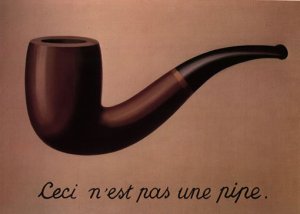
Well, absolutely sod all according to Baudrillard, who claims that all meaning is rendered meaningless by being infinitely mutable. Which brings me back to the meaning of “real.” Along with Clementine Ford and the PM I was labouring under the illusion that “real” meant something. It doesn’t. It’s a crock. It’s as mutable as any other word. There is nothing to hold on to, we are drowning in fluidity, and this is not a pipe.