Archive | Society RSS feed for this section

Class, gambling & pornography

6 Jun

Class

Yesterday, author and playwright Van Badham wrote this piece in The Guardian titled “The moral case for gambling,” in which she considers the role class plays in the current campaign to curtail gambling opportunities through legislation. Van Badham writes:

Given the popularity of gambling in this country, I wonder if the public shaming of Australian gamblers has more to do with bourgeois loathing of working-class habits than any genuine moral crusade for public good. It must be very confusing for those who base their social self-esteem on the accumulation of money to witness a pastime that involves the happy sacrifice of it.

I do recommend reading the piece. It’s caused some controversy, and raises points worth considering.

In 2011 I wrote this piece for The Drum, titled “Pornography, the Internet and class”. I’m republishing it here in full, because it seems to me many of the questions I pose are compatible with the current prevailing attitude to gambling. I’m not suggesting the two are interchangeable, however I agree with Van Badham that class does indeed play a significant role in determining prevalent attitudes, and this is a factor we probably need to be aware of when considering legislation.

Pornography, the Internet and class. The Drum, September 8 2011

It seems reasonable when faced with strident action against social mores to require those opposing them to put forward their preferred alternative.

In the case of anti-pornography activists, it’s apparently impossible to persuade them to offer a framework of how they think sexuality ought to be expressed. Like Opposition Leader Tony Abbott they just say no, without proffering any other policies. 

Viewed in the best light, anti-porn activism is a cri de coeur for the protection of women who some activists believe are exploited and degraded by the very existence of pornography; for the protection of children who may access internet content they are emotionally ill-equipped to process, and for the prevention of possible individual psycho-sexual harm that might interpolate itself into the fabric of society. 

At its worst anti-porn activism is an attempt to control and shape the culture to fit particular religious, ideological and/or moral agendas. The moral entrepreneurs who are at the vanguard of the anti-porn movement are overwhelmingly middle class, and it is from a middle class platform that they launch campaigns that express the horror, disgust and outrage evoked in them by pornography, as well as what they believe to be its ruinous effects on sexual relations. 

All pornography is positioned by activists as deviant, regardless of the content. It’s extremely difficult to ascertain just what their range of “normal” sexuality includes. One activist, Professor Clive Hamilton, refuses to use the word “vagina” when attempting to describe close-ups of “well, I don’t know what” in early editions of Playboy, for example. Many would find this male squeamishness towards female genitalia offensive. Are we to regress to such euphemisms as “down there?” 

Those who produce, create and consume pornography are perceived as deviants who must be rescued, punished when appropriate, and hopefully redeemed to participate in non-pornographic sex. Global eradication of anything other than “normal” is the goal, without ever stating just what that “normal” might be. 

Accounts written by activists of what they have seen in their forays into the netherworld of porn are like dispatches from Dante’s second circle of Hell:

The new porn zeitgeist is hard-core sadism. Hard-core porn turns misogyny into sexual fascism and sells it as freedom. There are countless “18 and abused” sites showing young girls being gang-banged while crying, drunk, vomiting, with guns and knives to their heads. Incest porn with girls being bashed about sexually by fathers, grandfathers, uncles, brothers. There is bestiality porn with dogs, horses, with eels. Torture porn, where young women are tied up and strangled, defecated on. There is Nazi fetish porn, lots of racist porn.

Feminised gay men being beaten and anally raped by hyper-macho gangs. Granny porn where older women are subjected to the now compulsory triple penetration and spat on for being old. There is even “retarded asian porn”, “retarded and horny”, “full on retard porn . . . legless sluts being triple penetrated”, amputee porn, dwarf porn, anorexia porn. 

In this account of internet porn by academic Dr Abigail Bray the porn world is entirely comprised of victims. Young girls, women, grandmothers, feminised men, and animals are subjected to horrific violence, and all of it done to them by men.

I haven’t viewed any of these sites. Taking Dr Bray’s descriptions at face value and imagining myself part of such a world feels unspeakably awful, but that’s my personal reaction, not a universal absolute. Pornography is an expression of the vast and sometimes very frightening range of human sexuality, whether I like it or not.

It isn’t made clear if the victims (other than children and animals) have been forced to participate in these acts, but it is an assumption with which the reader initially co-operates. The description asserts “countless sites” depicting such pornography, so there must be correspondingly “countless” numbers of adult human beings engaging in its production, either by choice or under severe duress.

Who are these human beings and how did they arrive in the Second Circle? As yet there’s no comprehensive answer to those questions. Women who work in hardcore porn are, unsurprisingly, resistant to inquiries by outsiders.

Women who have consented to interviews disassociate themselves from the kind of porn Dr Bray describes. They also express considerable aggravation with anti-porn activists, who they feel are insulting and patronising. They accuse anti-porn activists of making life more difficult for them by portraying them as psychologically sick, morally bad, victimised, and in need of rescue. In so doing, the women claim, activists are in fact supporting porn producers in their opinion of the women they hire as disturbed, and highly exploitable. They also feel unfairly lumped in with women who endure more extreme hardcore violations. In the pecking order of the porn world, some women are proud of the choices they make and resentful of those who see them as part of a homogenous victimised mass.

Activists put forward hypotheticals in an effort to explain why women participate in violent and degrading porn. For example, they claim they are frequently women who were sexually abused as children. They are women who have developed high levels of tolerance for abuse, and have “abnormal” attitudes that permit them to accept degradation and violence others would find abhorrent. They are women who can’t or believe they can’t obtain employment in any other field. They are poor women, uneducated women, ignorant women. They are women who have sustained such damage that the question of choice doesn’t even arise: they don’t know that they are suffering because they have lost or never had the ability to recognise abuse.

There is little research available to confirm or deny these assumptions. The hypotheticals originate from middle-class sexual morality and values, and/or religious beliefs about women and sexuality. There is often little attention paid to the social and political contexts in which the alleged early life abuses take place, or the economic systems that cause female poverty. This lack of analysis could lead to accusations of attempting to treat the symptoms while ignoring the cause, always an exercise in futility.

Assumptions about women who perform in porn need to be investigated through empirical research before they can be evaluated, rather than accepting classist, moralistic and religious prejudices as a basis for public policy. As things stand, a deviant underclass is constructed by anti-porn activists, against which the moral values of middle classes voices raised in protestations of “isn’t it awful” and “what about our children” can be reassuringly measured. This is not helpful.

Very little hardcore porn is currently produced in Australia. There is not much home-grown activists can do to rescue women in sovereign nations that do produce it, and many of those countries already have legislation against some if not all the violence that is acted out.

However, activists are concerned that hardcore porn is easily accessed on the internet and is inserting itself into everyday Australian life. It’s claimed that a degradation of sexual values inevitably occurs, particularly amongst young people, many of whom are allegedly taking their sexual education from sites such as those described by Dr Bray, and enacting loveless, violent and genital-focused sex that uses women as objects for male gratification, and not as equal participants in a mutually satisfying act.

Anti-porn activist and academic Gail Dines claims that 11-year-old boys are viewing violent porn that “deforms their minds,” though she offers no research to substantiate this claim. If 11-year-old boys are accessing hardcore internet porn, the responsibility for that must rest with their parents, who also bear the responsibility for offering their children intelligent sex education. Presumably middle-class parents are considered more likely to do this, so are Dines and her followers referring to lower status families who apparently can’t be trusted to do the right thing? Where do Dines’ porn-consuming 11-year-olds come from? She doesn’t reveal the demographic.

Many activists such as Clive Hamilton see the problems presented by the internet as a matter for the state. They want internet censorship. In other words, the state must assume the role of disseminator of middle-class religious and ideological sexual values, by imposing a ban on anything that class considers deviant and polluting. The activists apparently do not trust parents, or at least parents of a lower socio-economic class to monitor their children’s internet adventures, for example with software that will filter content on the home computer. They argue that this responsibility belongs with government, and they seem to be entirely oblivious to the dangers of giving any government control over what its citizens may and may not view in the privacy of their own homes.

An Australian internet filter will do nothing to assist women who are unwillingly enslaved by pornography producers. It quite likely will exclude innocent sites, or be easily bypassed. The proposed list of banned sites is itself banned from public scrutiny, and that restriction alone should give us serious cause for alarm. As the link also reveals, there are already strict if somewhat mysterious classification laws in place in Australia.

But activists need to justify their existence, to show effectiveness, and to win respect from their peers. In this situation, the only possible measure of their “success” will be an internet filter. Their message is: you can have a sexual life like ours if you follow our sexual rules, (though we have yet to be told what they are) and our Government will help you do that by forbidding you access to anything else. This places the Government’s authority above God’s: at least God apparently permits free will, and the right to go to hell any way one chooses.

As the late Susan Sontag, American author, feminist, literary theorist and political activist, put it in her 1967 essay The Pornographic Imagination:

If so many are teetering on the verge of murder, dehumanisation, sexual deformity and despair, and we were to act on that thought, then censorship much more radical than the indignant foes of pornography ever envisage seems in order. For if that’s the case, not only pornography but all forms of serious art and knowledge – in other words, all forms of truth – are suspect and dangerous.

“Hate is just a failure of imagination.” On racism.

3 Jun

WhitePrivilege

I’m guessing just about everyone is familiar with the recent events surrounding Sydney Swans player Adam Goodes, a young girl who insulted him with a racist slur, the subsequent involvement of Eddie McGuire, and the public debate on racism that has dominated media and social media ever since.

The following are some writings on the topic I found worth reading.

Helen Razer’s piece in Crikey, titled “I am racist and so are you” in which she alleges that anyone white in this country is racist and ought to own it.

Jeff Sparrow’s piece in Overland, an interesting rebuttal to the claim “we’re all racist.”

Blogger Dragonista’s piece “Entitlement should not disqualify me” and the follow-up. It’s important to read the comments as Dragonista engages with Luke Pearson, who explains why Indigenous people can become very weary of explaining their situation to white fellas.

Luke Pearson’s blog in response to Dragonista and others who share her position.

David Horton’s piece “Bone of Contention” in which he recalls some background relevant to the present.

There are of course hundreds of other pieces throughout both social and mainstream media.

A few days ago I wrote aboutprivilege and imagination, in which I argued that the current passion for “checking your privilege” could be more usefully replaced by using one’s imagination, and walking a few steps in the shoes of the other to see how that feels. Checking my privilege rather keeps it all about me, while using my imagination to envisage another’s experience makes it all about them.

I’m of the view that race is a social construct, yet another of the many ways in which some human beings categorize other human beings in order to dehumanise them, to the degree that they don’t have to be considered as equals and worthy of the same considerations as the dominant group. Racism has much in common with sexism. Both allow the dominant group to maintain a sense of superiority by measuring themselves against the perceived failings and allegedly inherent weaknesses of the others. Both allow the dominant group to maintain a sense of entitlement and privilege, because they feel superior to the others.

In both cases, the dominant group  will be extremely reluctant to either examine or relinquish any of its entitlements and privileges.

It struck me as I ploughed through the at times strident, accusatory, smug, ignorant, enlightened, sorrowful, angry, bored, pissed off, exasperated, exhausted and exhausting commentary of the last week, that the discussion of racism itself had quickly evolved into a battlefield on which combatants fought for the high moral ground, casting opponents as “racists,” “privileged,” “entitled,” or in some instances, just plain “white,” the latter used as a racial insult, if we stick to the strict definition of that term.

It’s quite a thing, to besmirch another as a “racist.” It probably isn’t something that ought to be done lightly. I’ve wondered how hurling around that word as a contemptuous insult furthers the debate at all. It’s not likely to make anyone stop and think about their views, quite the opposite, it’s likely to cause anger, resentment and a hardening of the heart.

Again, I believe the answer is imagination:

When you visualised a man or a woman carefully…when you saw the lines at the corners of the eyes, the shape of the mouth, how the hair grew, it was impossible to hate. Hate was just a failure of  imagination. Grahame Greene

Greene echoes philosopher Emmanuel Levinas’ beliefs about the power of the face, and the ethical responsibility we all have to honour the face of the Other, no matter how different from one’s own.  The responsibility we have to recognise and respect our common vulnerability as human beings, and to refrain from exploiting that vulnerability. To look fully at another’s face, to really see it, immediately places one in a more respectful relation to the other than the cursory, unseeing glance.

I ended the week feeling a great deal of admiration for the man at the centre of the storm, Adam Goodes. I’m not in the least interested in football, but as the rest of my household watched the Swans game I couldn’t help but observe Goodes rise above the slings and arrows of his week and immerse himself, fully focused, in his task.

This debate on the othering of some groups by more powerful groups is perhaps the most important debate there is. Racism, sexism, homophobia, hatred: discrimination of any kind, is a failure of imagination.

How do we teach that?

George Pell. “These people.” Language. Yet Again.

28 May

This admission may not make me popular, however, as I watched Cardinal George Pell front the Victorian government inquiry into child sexual abuse yesterday, I felt an increasing pity for the man.

Pell can be found seriously wanting on any number of his attitudes and statements. It’s clear he has a minimum understanding of, or empathy with, those who’ve endured sexual abuse. The most that can be said for him is that he tries to the best of his extraordinarily limited ability, and that is damning him with very weak praise indeed. One would hope for more humanity, imagination and sincere regret from the country’s most senior member of the Catholic church.

However, it was a very simple phrase Pell used that provoked my deepest and most contemptuous reaction to the man. When speaking of survivors of rape and molestation by his priests, he more than once referred to them as “These people…” He even, at one particularly low point, suggested that “these people” were not always innocent of blame in the situation.

“These people” means people who are not like me, or us. Once again, as I pointed out in this piece on Clementine Ford’s use of “we” and “our” when discussing survivors of sexual and domestic abuse, language is (unconsciously) employed to manufacture a divide between those who have suffered and those who have not, casting the former as “other” who are, because of our experiences, linguistically excluded from the discourse of power and belonging, except as objects of sympathy or, in some instances, derision.

This attitude, widely held I believe towards victims and survivors of all kinds of situations, is what I think of as a vertical system of human relations, rather than a horizontal, or side by side system. Simply by virtue of finding oneself a victim of another, one is in some way made less equal to those who are without that experience. One is assumed to be weakened, and therefore lessened, by the experience of being injured.

Being injured is among many other things, a humiliating experience. It brings into stark relief our vulnerability and powerlessness. It makes obvious how easily our will can be overwhelmed by the will of another, leaving us impotent, weakened and ashamed, whether we’re adults or children when the injuries occur.

It occurs to me that one of the reasons some of the uninjured need to distance themselves from the injured, is that we frighten them. We confront them with the awful reality of the human vulnerability we share. This could have been, could still be,   you. The only way to avoid that reality is to make the injured different. Certain kinds of injuries only happen to “these people.”  Not to “we” or “ours.”

We also see this manifest in our treatment of asylum seekers.

It’s interesting, and rather disheartening, that two people with such disparate views as Clementine Ford and George Pell choose vertical language when speaking of victims/survivors of sexual assaults.

I felt surprisingly little anger as I watched George Pell deliver his inadequate responses to the Victorian government inquiry. I felt extremely weary. I thought I could see, not for the first time, the entire dysfunctional hierarchical system that allows this man, and others like him, to construct a narrative that is corrupt to its core. I don’t only refer to the Catholic church. I’m talking about the corrupt system of human relations that is based on the othering  of one group of human beings to separate them from another, no matter what the grounds. As is demonstrated in our language, this othering is endemic, even in the most apparently well-intentioned.

I’ll have to leave it to others to rage against Pell. I see a crippling, piteous ignorance that will imprison this man for the rest of his life. That this should be so publicly displayed is, to my mind, only to the good. We need to see the characters of men and women who wield power over us, of those who control our discourse and construct our realities. Victims and survivors, most of all, need to see that these emperors have no clothes.


Voluntary euthanasia & the religious right

22 May

Tomorrow, May 23rd, the Rights of the Terminally Ill Bill introduced on May 2nd by Greens MP Cate Faehrmann, will be debated in the NSW Parliament. Ms Faehrmann’s Bill is similar to the Death with Dignity Act which has seen physician assisted dying operate safely and successfully in Oregon since 1997.

Chrys Stevenson, speaker, blogger and advocate for voluntary euthanasia, has written this piece on the extraordinary infiltration of Faehrmann’s private briefing on the Bill by Sydney GP, Catholic and committed anti-euthanasia campaigner, Dr Catherine Lennon.

Dr Lennon also has history with the RU486 controversy, in which she referred to the drug as “human pesticide.”

To find out how Lennon managed this gatecrash, and just how extreme her views are, do read Stevenson’s excellent unpacking of the bizarre events, and find out who is Lennon’s political relative by marriage.

What Stevenson importantly  demonstrates is the lengths to which the religious right will go in order to impose their fundamentalist ambitions on the entire community. This is something we probably all need to be aware of, if we aren’t already.

The religious right’s impudent meddling in the most intimate  and private of human affairs, from decisions about reproduction and contraception, sexual morality throughout life, and then death, never ceases to offend me. I have a terminal illness which has been in remission for some time now. I have, more than once, been very close to death. What I fear is not dying, but being forced to live in circumstances that are intolerable to me. Nobody else can decide what those circumstances are. Surely no other person has more right than I do to determine the hour of my death, if I am in a position to do that, let alone religious fanatics who are complete strangers to me in every possible way.

We need more conversations in our society about dying, and how we can prepare ourselves for that inevitability. This piece in the Canberra Times by journalist Jenna Price is a start, although I do question the notion of a “good death,” which can place unrealistic demands on the dying and their loved ones. There are many reasons why a death can’t be “good”, depending on one’s interpretation of that word.

In the meantime, it seems to me that the enemies of any kind of chosen “good death” are the zealous religious right, who apparently feel their god prefers to watch us suffer than to mercifully die. This makes no sense to me. If in dying we go to god, as they would have it, why aren’t we all throwing ourselves off the cliffs like lemmings, the sooner to attain the promised better life with god in the sweet hereafter?

The Good Feminist: Anarchic and slightly deranged

21 May

feminist


Helen Razer wrote this about feminism today.

In response, Clementine Ford wrote this about what Helen Razer wrote about feminism today.

Make of these differing view points what you will, that’s not my goal. What did catch my attention was Ford’s use of the words “anarchic and slightly deranged” to describe what she calls Razer’s “moments of incisive clarity” [on feminism today]

It seems Ford is using the term “anarchic” in a pejorative sense, which is interesting, as I’ve never thought of anarchic as a bad look for a woman, especially a feminist, to adopt.  It is a surely part of our job to do our best to transgress the hierarchical, patriarchal systems that repress and oppress us. Quite how one does that without a bit of anarchy, I don’t know.

“Deranged,” even slightly, is another kettle of fish. This is to do with insanity, psychosis, loss of contact with reality, a disturbed “normality.” It’s no different from calling a woman crazy, and we all know the power of that descriptor to hurt, intimidate, and silence when applied by the orthodoxy to the words of women it does not want to hear, or wishes to discredit.

Personally, I have no time for words such as “deranged” in a feminist vocabulary. They belong to the Law of the Father, as Cixous would have it. They are the consequence of a social process whose product is, among other things, concepts such as “sanity” and “madness.”  Part of our feminist task is, as Foucault would have it though he was not speaking specifically to feminism,  that we must disrupt discursive practices which establish meaning. Perhaps there is little more important than disrupting those established practices that create a narrative of derangement that has long been used to contain and oppress mouthy, disruptive, revolutionary women.

Has feminism now become so tamed that words such as “deranged” are required to invalidate commentary because its content may not be immediately accessible and its form extraordinary?  Strategies of excess can be used most effectively to challenge the binaries of patriarchal thought, but has feminism become so tamed it must now regard such strategies as “deranged?”

Women today would not have a fraction of the privileges we have were it not for radical, anarchic women who were frequently described as “crazy.” No successful political movement ever existed without radicals to initially break through the barriers.

There is practically no one influential in Western feminism today who can be described as radical. I wonder how much this is due to so many feminists becoming so much a part of the bourgeoisie with its safe, bourgeois values that radical voices are now inevitably named as “deranged,” and thus ridiculed, or silenced.

Naming is a political activity.  “…all expression is always indirectly political.” Cixous.

Privilege and imagination

17 May

Yesterday the word “privilege” was used a great deal in social media, mostly with regard to this post by Mia Freedman, in which she defends Delta Goodrem against charges of racism following an incident involving a white man dressing up as Seal by painting himself black.

I used the word myself in my last blog, though it isn’t one of my favourites. It has a good deal of currency at the moment, with people requesting other people to first consider their privilege before expressing opinions, making judgements, behaving in certain ways, prescribing and proscribing. It’s not a bad idea, but many of those amongst us who are most privileged find it tedious, silly, and that crowning insult, it’s political correctness, usually “gone mad.”

So if I were to say, as did Mia Freedman, that using blackface in this instance is not racist, not intended to be racist, and people who are offended need to get a sense of humour, I’d do well to consider the privileged position from which I am speaking before I open my mouth. As a middle class white woman who has never experienced racism, I am the least equipped to judge whether or not blackface is a racial insult. If I then tell brown people to get a sense of humour about it, I’m skating on very thin ice indeed.

It seems to me that the easiest way to avoid offence is to first exercise the imagination.  How would I feel…

If, as Clementine Ford acknowledged in her article on violence and sexual violence against women, the situation one is about to discuss is beyond one’s imagining, then one might do well to refrain from expressing opinions about it. I haven’t yet understood how it is possible to hold an informed opinion about something one cannot begin to imagine, or refuses to imagine, beyond the initial opinion that one finds it unimaginable.

Of course it’s possible to observe how awful a situation is, but that is not particularly insightful or helpful. With imagination the complexities and nuances become evident, and in situations as complex as racism, and domestic violence, the devil is in the detail.

For example, as I’ve noted many times, the simplistic gendering of domestic violence by some feminists and governments has done nothing to prevent any of it, and obfuscates the complexities of intimate relationships that turn very bad. I don’t know how it’s in the least helpful to frame this violence and our attempts at management in terms of gender, and until someone writes policy with a bit more imagination and a lot less ideology, nothing is going to improve.

I think that our primary responsibility to others is to use our imaginations about their circumstances. If we (and I mean anyone) are unwilling or unable to do this, the problem is ours, not theirs.

“Examining your privilege” might be better thought of as “using your imagination.” This latter opens up the possibility of stepping into the other’s shoes for a while, and seeing how it feels.  This is probably one of the most powerful expressions of respect one human being can offer to another. It acknowledges our common humanity, and the vulnerability we all share in our embodiment. It is impossible to perform this respectful act without engaging the imagination.

When individuals and groups fail to use their imagination about the circumstances of those who are in some way different from themselves, bad things start to happen, such as excising the entire country from the Migration Act and incarcerating others for indefinite periods in far from acceptable circumstances. If we (and by we I mean everybody) don’t imagine others as human beings with whom we have much in common, and perhaps add, there but for the grace of the gods we might be, then we can’t feel as badly as we should about how we treat them.

If we don’t use our imaginations about another’s suffering, we end up feeling little more than pity, although we might call it compassion and empathy. Without imagination, it is only pity. Pity allows us to distance ourselves from the other, while compassion and empathy demand we walk with her or him, figuratively speaking.

The most compassionate people I’ve known have not suffered in ways I have, yet have never made me feel different, less than them, or pitied. I doubt any one of them ever “examined their privilege.” They are all, however, possessed of powerful imaginations. They have no difficulty putting themselves in another’s place. They may not understand some things, but they accept and respect another’s right to her or his subjective experience. They don’t “take your voice and leave you howling at the moon.”

Imagination. That is all.

Dear Clementine Ford. How I feel when you talk about me.

15 May


us-them


The following are extracts from Clementine Ford‘s recent article “What Cleveland tells us about the cycle of abuse,” on the kidnapping and imprisonment of three women and a child in Cleveland, Ohio.

There’s no doubt that the facts of the case are horrific, both those known and those yet to be revealed to the authorities required to know them. (Despite our general fascination with salacious details, even those we find emotionally difficult to bear, this is not our story; the women involved are at last able to shield themselves from invasion, and that includes protecting themselves if they so choose from the world knowing to what depths the humiliation was that they suffered.)

What happened in Cleveland is horrifying, yes. It’s incomprehensible. To imagine the reality of those 10 years would cause too much distress, so we hover around its dark edges, not quite daring to look beyond the borders with anything other than quick glimpses in case our eyes lock on something we can’t unsee. But we should resist the temptation to consider it different somehow to the violence expressed on a daily basis in homes on similar suburban streets occupied by similarly “normal” people, domestic matters in which we imagine we have no obligation to get involved. 

What I am questioning in this piece is Ford’s use of the words “our” and “we.” For whom does she speak? Who is the “we” on behalf of whom, and to whom Ford enunciates? When Ford writes “our,” with what audience does she imagine she is engaging?

As a woman who survived childhood sexual and physical abuse on a scale that I still, and always will find “emotionally difficult” to bear, I do not feel included in Ford’s “we” and “ours.”

For example. I do not share our “general fascination with salacious details.”  Such details would plunge me into places I do not wish to go, because I have lived many of them. Having lived them, I am immediately framed as “not our,” and “not we” in Ford’s narrative, whose point of view, it seems to me, is entirely that of a “we” and “ours” who have not endured monstrous events.

There is, of course, nothing wrong with this perspective. Not everybody has to suffer torment. But there is something terribly wrong when it is presented as the perspective, excluding those of us who have a very different experience of life, while simultaneously  making us the centre of the discussion. This inevitably creates a binary of us and them. It positions women like me outside of the centre, as represented by mainstream writing and reporting.

Women such as myself are absent in this piece of writing that is also absolutely about us. Without us, this text would not exist, yet our voices are silenced by Ford’s appropriation of our lived experience , an appropriation in which there is no place for our presence. We can be talked about. We cannot speak.

We are made the object of Ford’s, and her readers’ gaze, no matter how sympathetic and empathic that gaze may be. We are positioned outside the social order, as represented by Ford’s use of “we” and “ours.” Women such as myself cannot possibly envisage ourselves as belonging in, and to this “we” and “ours.” It is against this “we” and “ours” that women such as myself must struggle to find a place for ourselves in a culture that through no fault of our own, casts us as outside its linguistic parameters of belonging.

There is a barrier between those who’ve known violence and those who haven’t. Because of this barrier, we are forever outsiders. Our secrets set us apart. Dark knowledge taints us. We’re sullied, dirtied, spoiled by our knowledge and we struggle to rid ourselves of this legacy. We are not the “we” and “ours” who fear seeing what we can’t unsee. We have seen the unseeable. We have lived the unlivable. We are the aporia, we are that which cannot be contained within the structures and logics of texts such as Ford’s. We are, by our experiences, made other, and we are further othered by hegemonic writings that exclude us, except as objects of the sympathetic gaze.

Feminist thinker  and writer Hélène Cixous suggests that we should not think of women such as myself as “victims,” but rather as “subjects of suffering.” …human beings, she continues, try to live through the worst sufferings. To make humanity of them. To distil them, to understand their lesson. We do this, those of us who can. Many of us can’t. Many of us die. Many of us live lives of unimaginable difficulty. Most of us never have a voice. We must put up with hearing about ourselves and our experiences from others, who shudder at the horror we’ve endured. This serves only to further marginalise us. This makes us spectacle.

What happened in Cleveland is not “incomprehensible” to me, as it is to the “we” Ford addresses. It is all too comprehensible.

Unlike the “we” Ford addresses, there is no temptation for me to consider what happened in Cleveland as “different” from what happened for years in my outwardly “normal” home on an ordinary street, except in some of the specifics.

The call for the “community” to take action to prevent such ruptures as the Cleveland events, or indeed my own sufferings, seems extraordinarily naive to me. How are we to depend on a “community” whose prominent feminist spokespeople see us as other, however empathetically, and exclude us from their discourse?

To imagine the reality of those 10 years would cause too much distress, so we hover around its dark edges, not quite daring to look beyond the borders with anything other than quick glimpses in case our eyes lock on something we can’t unsee.

These are the words of the privileged, who can choose to avoid the distress, who can hover, salaciously, around the dark edges, lacking the courage to cross the borders and walk with those of us who’ve had no choice in the matter, and who can never fully return from that dark country to the land of “we” and “ours.”

Those of us “subjects of suffering” who have survived enough to speak have much to offer, weighted with the authority given to us by our lived experience. We could tell you, for example, that there is a universe of difference between sexual harassment, and the violence we have endured. You may not care to hear that, but we can tell you that is so.

Given the horrific statistics for violence and sexual violence against women in this country, there must be many of our number among Ford’s readers. Yet writing such as this excludes us all. There must be many others who, like me, read this piece and think, I am not of this ‘we.” I am not of this “ours.”  This is not written for and to a woman with a life such as mine has been. It is written about women like me, but it is not written with me. It does not walk with me. It does not take my hand. It does not acknowledge me as an equal. It is writing that distances itself from me, and me from it.

If we are to intervene in the cycles of violence that bring abject horror to the lives of so many of us, we are first going to need a new discourse with which to do it. That discourse will  not create a barrier between those of us who have suffered and those of us who have not. There will be no excluding “we” and “ours.”  We do not need sympathy. We do not need to be isolated in our suffering. We need those who will walk beside us, equals in our shared humanity, no matter how varied our experiences.

If feminism cannot do this for women, it is a failed project.

This is how I feel when you talk about me.


On sexual harassment: Revisiting Helen Garner’s ‘The First Stone’

14 May

Helen Garner The First Stone

Published in 1995, Helen Garner’s account of the scandal surrounding the then Master of Melbourne University’s Ormond College, Dr Colin Shepherd, after allegations of sexual harassment were made against him by two female students, is agonisingly current all these years later, and ought to be read and re-read by anyone interested in feminism, sexual harassment, and power in human relationships.

The book opens with the transcript of Dr Shepherd’s first police interview, after the women lodged complaints of indecent assault against him. Ultimately, the charges against him were dismissed, it being concluded that it was a question of “oath against oath.”  Shepherd subsequently lost his job, became “too hot” for anyone to employ, and his wife and children suffered appallingly as a consequence of the media circus.

Throughout the book, Garner asks the question, why did the women take this matter to the police as a first resort?  Melbourne University did at that time have procedures in place to address complaints of sexual harassment. Garner interviews the outgoing Women’s Officer of the Student Union:

“I asked her my forlorn but crucial question: how and why did the police get involved in this case? She answered me with a firm statement.

‘The procedures here didn’t lead to justice…The procedures at the moment,’ she said, ‘are structured so that you get an apology and you get the behaviour to stop – and that’s all.’

‘Isn’t that already quite a lot?’

She looked at me narrowly. ‘I’m against people having to go through conciliation before there can be retribution.’

‘Retribution?’ The Old Testament word took my breath away. 

‘If you want some form of justice,’ she went on, ‘for the harasser to be punished, you’re seen as asking too much. You’re being “nasty.”‘

‘What sort of punishment would you envisage?’

‘In the industrial award for academics,’ she said, ‘there’s a clause that deals with serious misconduct. Dismissal is appropriate if the charge is found to be proven – and if it’s harassment that constitutes an assault.’

‘Assault?’ I repeated, confused. ‘Dismissal.’

The Women’s Officer, Christine G-, explains “icily” to Garner that young women don’t have the knowledge or power to control exchanges between themselves and harassing lecturers and tutors.

‘As you get older,’ [says Garner] you begin to understand that a lot of men in harassment situations are weak. You realise that behind what you saw as a force, all those years, there’s actually a sort of terrible pathos. Blokes who come onto girls are putting themselves out on a limb – their self is at risk. You start to learn that women have got a particular power of their own, if only they knew it.’

‘A girl in her first tute,’ she [Christine G] said stubbornly, ‘doesn’t know that.’

‘That’s true – but our job as feminists is to teach them this, surely. To a woman of my age, blokes who behave as Colin Shepherd was accused of doing aren’t scary, or powerful. They’re just poor bastards.

She bristled. ‘They may be “just poor bastards”, but they’ve abused their power. Sexual harassment is ultimately not about sex. It’s about power.’

Of course these problems are real, Garner writes. Every woman knows it. But this constant stress on passivity and weakness – this creation of a political position based on the virtue of helplessness – I hate it.”

Garner incurred great feminist wrath on the publication of her book. She encountered great feminist wrath throughout its writing: doors were slammed in her face by women close to the situation, and she was never able to interview the two women at the heart of the matter. As Garner makes clear many times, she wanted to understand the experiences of the two complainants. She wanted to hear their side of the story, and why they had acted as they did, for example, refusing to take the matter to the Equal Opportunity Commission until after it had been dealt with in the courts and dismissed, rather than before. At every turn, she is met with hostility, rage and icy dismissal. She writes:

“What sort of feminists were these, what sort of intellectuals, who expected automatic allegiance from women to a cause they were not even prepared to argue?”

During the writing of the book, Garner takes a job with Time Australia, reporting the trial of a man accused of having murdered his girlfriend’s two-year-old son. She writes:

“The horrors I heard in the Supreme Court each day threw the Ormond story into merciless perspective…it seemed the site of an absurd, hysterical tantrum, a privileged kids’ paddy.”

Garner is unable to obtain an answer to her question as to why the complainants:

“…charged past conciliation into the traditional masculine style of problem-solving: call in the cops, split off the nuances of character and relevant context, and hire a cowboy to slug it out for you in the main street at noon, with all the citizenry watching.”

Garner’s book sprang into my mind yesterday, after thinking about how the matter of the offensive tweets I posted yesterday was handled, and after reading commenters’ responses to that post. The situations hold different positions on a continuum: Dr Shepherd was charged with indecent assault after allegedly fondling a young woman’s breast. Garner reports that the young woman:

“…told the court that Dr Shepherd had got down on his knees before her. Which of them does the word humiliated apply to, here?”

Perhaps what needs to be said today was said by Garner at the end of her book, in 1995:

“…I know that between ‘being made to feel uncomfortable’ and ‘violence against women’ lies a vast range of male and female behaviours. If we deny this, we enfeeble language and drain it of its meaning. We insult the suffering of women who have met real violence, and we distort the subtleties of human interaction into caricatures that can serve only as propaganda for war. And it infuriates me that any woman who insists on drawing these crucial distinctions should be called a traitor to her sex.”

You don’t get peace by hating war: the theory of emotions

25 Apr

Some years ago I recall the Dalai Lama observing that hating war isn’t the way to find peace.

From this I took it that he meant personally entering into the territory of hatred and fear, the same emotions that fuel war, is not the most useful way to change a paradigm. I liked the Dalai Lama’s theory: that in order to effect wider change one must first start with the self. Every time we manage to overcome a negative emotion, he said, and allow it to dissipate without acting on it, we have achieved a miracle.

There’s nothing exclusive about the idea. There was a rich Greco-Roman tradition of shaping the self through commitment to self-improvement that involved, among other things, a theory of emotions and the necessity to understand them for the betterment of the self and the community. The Stoic philosopher and writer, Seneca, was an advocate of this culture of the self, later interpreted by Foucault as technologies of the self, designed to shape the subject through a set of practices that position one in critical relationship to oneself, with the goal of improvement not just for the self, but for society.

Currently, I am deep in Martha Nussbaum’s “Upheavals of Thought: the intelligence of emotions.” Nussbaum makes a powerful argument that there can be no adequate ethical theory without an adequate theory of the emotions. Emotions, far from being messy, sticky and yes, let’s not pretend otherwise, characteristically female hindrances to clear thinking, are suffused with intelligence and discernment. They are a powerful source of information, awareness and understanding.

On ANZAC Day, I feel sorrow for those who are sent to die by the State, and for those who lose the ones they love. I also feel a profound contempt for the State that slaughters its young, and the young of its enemies. I wish that what we were encouraged to remember on ANZAC Day, as well as those who died, is the vileness of war, and the tremendous responsibility we have to refrain from engagement, except in the most dire of circumstances.

However, hard as it is, I will attempt not to hate war, in the hope that any individual who manages, even for a short time, to refuse to enter the energy of hate, makes her own tiny contribution to changing the world.

Join me, anyone?

Marriage, equality, and the sentimental

20 Apr

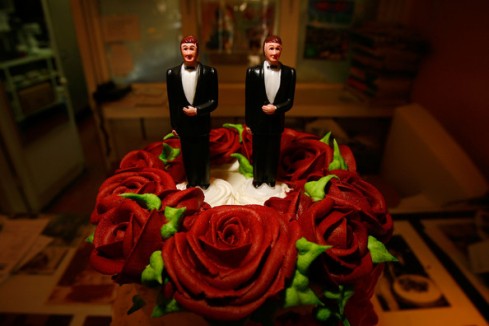
DO YOU KNOW WHAT I HATE MORE THAN RAINBOWS IT IS PICTURES OF TWO WHITE PLASTIC MEN ON TOP OF A FUCKING CAKE. Helen Razer, April 19 2013.

Gay wedding cake

Razer’s tweet caused me to reflect on sentimentality, what it is, and just how much it has to do with our society’s attachment to getting married. It seems to me that rainbows, and cakes such as the above, symbolise easily accessible emotions and contribute to a wider cultural inclination to substitute such emotions for critical thinking and reason. This isn’t peculiar to same-sex weddings: there seems to me to be a strong element of the sentimental in the very nature of weddings, no matter how “tasteful.” Which, of course, can be half the fun, but just how much does that aspect blind us to the faults of the institution?

“Sentimental” is in current usage a pejorative term, though it was not always thus. The sentimental is considered shallow, excessive, spurious, dishonest, false, and mawkish. It is emotion devoid of reason and critical judgement, indeed the sentimental stands accused of privileging diluted and short-lived emotional experience over logic to such a degree, that ethical and intellectual judgements that ought to be applied to a situation are abandoned in favour of the thrill of a temporarily heightened state.

In a sense, the sentimental has served to obfuscate the debate we have to have, which is about the institution of marriage itself, and redirected our attention and energies to the question of marriage equality. I don’t think anyone can deny the presence of the sentimental in this dispute, and perhaps the wonderfully excessive Maori wedding song sung by that joyous group in the New Zealand parliament the other day is an indicator of the rush of heightened emotion associated with all weddings, but especially so when those weddings have been forbidden and are now sanctioned. We don’t think about the failings of the institution, and how it functions in society, so carried away are we by the uncomplicated thrillingness of the romance of it.

I have to say here that as long as we have marriage in our culture and remain in its thrall, there is no question but that it ought to be available to everyone who desires it and is of an age to consent. Forbidding a group of people what they very much want to have  while it is freely available to everyone else, simply on the grounds that they have the same genitalia, is absolutely wrong, and counter productive. The marriage equality debate brilliantly demonstrates how we are distracted from arguing the deeper considerations of the ethics of the institution itself.

No one who wants to marry and is prevented by our laws from doing so, is going to want to start questioning the institution from which they are unfairly excluded, because the exclusion and the desire to be admitted will take precedence. I don’t believe we will be in any position to seriously challenge marriage until it is available to everyone, and the dust of the fight for equality has settled.

Rainbows, hearts, and plastic gay or heterosexual couples on excessive confectionery, can be read as symbols of the sentimental, signifying  a dominant aesthetic of sentimentality that obscures the deeper questions and feelings, and quite rightly thoroughly aggravates observers such as Razer who rail against our collective willingness to settle for the sentimental, and allow it to dull our judgement and reason. Judgement and reason ought to cause us to first think critically about this institution we are celebrating: sentimentality seduces us into settling for the heightened emotion that inevitably surrounds the desire of two people to commit themselves to lifelong state-sanctioned monogamy. Sentimentality is strongly present in that desire: the desire is, I would argue, not born of logic and reason, and it is perhaps not particularly ethical either, unless qualified as an intention, rather than a vow.

I recall a wedding a few years ago, non-religious, colourful and casual, pretty much your north coast upmarket hippy event, and a lot of fun. After the couple exchanged their vows, a friend standing next to me said in a voice that was much louder than she’d intended, owing to a sudden lull in the celebrations, “Well, it’s all down hill from here.” The bride and groom looked aghast. I dug her hard in the ribs with my elbow. “Well, it’s true,” she hissed at me defensively. “I know, but you don’t have to bloody well say it,” I hissed back.

All the weddings I’ve attended have been joyful, including both of my own. But there has been a great deal of sentimentality associated with them and more, with the idea of them. Personally I’m very taken with the love and hope that cause two people to throw their lot in together for life. I suppose that’s why I’ve done it twice and would probably do it again, because third time lucky and anyway I’m closer to death than I was the first two times.

The impulse to fidelity and mutual trust seems to me a worthy one, however I think I would add “To the best of my ability” or “I’ll do my very best” next time, because one never knows what’s ahead, and reason and logic suggest vows are sentimental in their very nature, and therefore untrustworthy.

Then there is the question of the regulation of the expression of emotion. It makes people very happy to marry one another at the time, and on the whole. It usually, one hopes, makes their friends and relations happy as well. Who has any right to deny others this happiness, even if the aesthetics and politics of it are not to one’s taste?

Yes, the institution may be a flawed foundation stone of a conservative agenda. Yes, conservatives love marriage because they love what they consider family. There is actually nothing in the least bit wrong with loving family, it is the traditional conservative notion of what a family consists of that is at fault here.

That the state has no business deciding who may or may not marry is a given. The fact that our Prime Minister does not approve of marriage equality ought to be of no consequence to anyone other than Ms Gillard herself. Nobody will make her marry another girl. It is remarkable to me that Ms Gillard, herself living in a de facto relationship, continues to take this obstructionist stand against marriage equality. Apparently marriage is not an institution she values for herself, yet she is perfectly willing to deny it to others on the spurious grounds that it is supposed to take place only between a man and a woman.

It is not so very long ago that Ms Gillard’s de facto relationship would have made her  occupation of the Lodge an impossibility. The Prime Minister has much to be grateful for. Society’s changes have worked to her great advantage. Why then, does Ms Gillard persist in denying these same advantages to others? I’m certain her stand has little or nothing to do with the sentimental.

rainbowA very sentimental rainbow but at least there is no unicorn