Archive | Society RSS feed for this section

Save the last dance for me

1 Dec

When a performer has reached the age of  seventy-nine one can be forgiven for fearing every appearance might be his last, and it was clear at Leonard Cohen’s concert in Brisbane last night that thought has also crossed his mind.

Though he is enviably fit (he drops to his knees with strength of feeling, and there’s not a catch in his voice when he rises again without even putting his hands on the floor) and his voice has thrillingly deepened since I saw him last some three years ago, he is an old man and I have prepared myself for last night to be the final time I see him.

Well my friends are gone and my hair is grey 
I ache in the places where I used to play 
And I’m crazy for love but I’m not coming on 
I’m just paying my rent every day 
Oh in the Tower of Song

The man was on stage for well over three hours, finally remarking that he really wouldn’t mind if we all decided to go home, but nobody wanted to go home, nobody wanted to leave him,  and we stamped and clapped and yelled “More please, more please,” like two-year-olds presenting our empty bowls for refills.

And refill them he did. Perhaps it’s to do with his sojourn in a Buddhist monastery, but Cohen has a talent for living in the moment that allows him to sing every song as if it’s the first performance, with a freshness and passion that lets the audience hear the lyrics anew, even though some of us can recite them in our sleep. He’s surrounded himself with musicians who can do exactly the same thing, performers for whom Cohen expresses the most gracious respect, granting them time and space to shine as he steps quietly away, his hat doffed, his head bowed in deference to artists such as Javier Mas, the “sublime” Webb Sisters, and long-time collaborator Sharon Robinson, whose breathtaking interpretation of Cohen’s “Alexandra Leaving” I present here for your pleasure.

Music is, of course, from and for the emotions, but it takes a rare talent in any genre to convey the kind of feeling that deeply moves the heart, mind, body and spirit. Cohen and his fellows share the ability to imperceptibly nudge their audience out of the everyday into the realms of poetry, that is, to evoke meaning over and above the prosaic, the obvious. Cohen stirs the emotional imagination, the man can’t help it, a brief account of his journey through the Brisbane tunnels on his way to the Entertainment Centre becomes a metaphor for life. The tunnels were therapeutic, he says. He entered them feeling not so well but by the time he emerged he was feeling splendid. Through darkness into light: there is a crack, a crack in everything, that’s how the light gets in.

Although Buddhism became a significant part of Cohen’s life, like Bob Dylan he is also fascinated by Christian imagery, and often references the traditions of that faith, especially in his latest album, “Old Ideas.”

I have to add here that there’s not much else Dylan & Cohen have in common attitudinally. Cohen assumes everybody likes him and won’t hold it against them if they don’t. Dylan assumes everybody is his enemy and especially hates them if they like him. I could write a thesis comparing the two, and I might well one day.

“Old Ideas” has the feeling of a man preparing for the end of his life, especially the quite lovely “Come Healing:” Behold the gates of mercy in arbitrary space, and none of us deserving the cruelty or the grace…

Yet it is a measure of Cohen’s astounding talent that he can imbue the 1960’s Drifters classic “Save the Last Dance for Me,” recorded by, among many, Dolly Parton, the appalling Michael Buble, Ike & Tina Turner, Harry Nilsson, Emmylou Harris et al, with such poignancy, as he performs it as his last song of the evening (no matter how much we shout and plead he’s skipped off stage, yes, he skips, and he won’t come back) and the familiar song takes on the quality of a farewell to the audience that he loves, but knows he must finally leave, and he wants us not to forget him, he wants us to save our last dance for him cos he loves us, oh so much.

Ah, Leonard. Right back at ya.

On being unfaithful

10 Nov

cheating spouse

My husband, whom I’ll call Bill, was unfaithful on two occasions that I know about and there were likely more, though it does the heart no good to dwell on possibilities.

I became aware of the first infidelity when Bill’s lover, whom I’ll call Emma, came to me in something of a state, and confessed. I knew Emma a little, we had both been Bill’s students, however, what I hadn’t known was that she’d been in love with Bill all through university, and had for the years since nurtured a deep loathing for me, provoked by our marriage. Which she had attended at Bill’s invitation, and on the day of the confession I remembered, as one remembers the most unlikely things when trapped in situations of intensity, noticing odd hand contact between them at our wedding party. Bill, when I asked him about it later, shamefacedly admitted it  involved passing between them a bag of weed, the smoking of which was apparently a ritual they shared in his office from time to time, and one he could not share with me because it made me chuck and weep.

Some months later, after our US honeymoon, in itself an extraordinary experience during which I was welcomed into a large Jewish Russian Polish American family whose matriarch liked to tell people in front of me that I was “just a doll of a girl, even if he has married out,” postcards began arriving for Bill from Emma, who was now in Italy on her honeymoon. “Caro,” the postcards began, which can be dear, beloved or darling, but Italian always sounds deliciously sensual and intimate, and I did ask why she was addressing him thus from her brand new nuptial bed. I don’t know, Bill said, I wish she wouldn’t, it’s embarrassing. After that, I forgot about Emma for years, and if anyone had asked me, would have said I presumed she’d forgotten about us.

It turned out that Emma’s marriage was not successful, hardly surprising since she said she’d never stopped loving Bill. They had been meeting for coffee & cake at the Gelato Bar at Bondi Beach for several months after her marriage collapsed, but as Bill and I had friendships that didn’t necessarily include the other, and he was always meeting with students anyway, their encounters never got a mention, and I conducted my life in blissful ignorance of what was building.

I should say here that Bill loved women, and women loved Bill. He was the smartest man I’d ever met, he was very funny, he had a way of speaking to others as if they were the only people of significance in his universe, and he was very seductive, though he swore he wasn’t on purpose and I think that was probably true. He could have had just about anyone, indeed, I once overheard a successful author wail at a gathering, “I offered myself on a platter and he turned me down.” When he asked me to marry him it went to my head, even though he said he only wanted us to get married so I would have his superannuation. Marriage as a thing in itself was politically and emotionally problematic for both of us, we’d both done it before, unsuccessfully, but him caring about my future without him (he was much older than me) won me over, so we did it.

Emma, it turned out, had sought out Bill after her marriage collapsed for comfort, which he would have given, initially anyway, in the most innocent of ways, because that was another thing about Bill, his empathy with the more difficult experiences of the human condition was legendary, and people sought him out when they needed someone to unconditionally accept them and their personal chaos. This sometimes led to us extending hospitality to characters you could think of as a little unsavoury, if you were feeling judgemental. It also meant having various former girlfriends to stay when they were passing through Sydney, and just wanted to have “a bit of his mind,” as one put it to me.

I don’t know how things escalated from comforting Emma to getting into bed with her, or at least, that isn’t true, I can imagine exactly how that progressed, but even these many years later I don’t want to talk about it, except to say that when one discovers a spouse has been intimately involved with someone else whilst conducting their ordinary life with you, it’s as if that period of time no longer has validity, it is not what you had thought it to be, you believed it to be what it absolutely was not, and that is something like the feeling of clinging desperately to a stair rail on the fortieth floor of a swaying building in a Tokyo earthquake.

The affair went on for several months, until Bill decided he had to end it. He told me he felt too guilty to continue, to which I rather scathingly responded that it had taken quite some time for that guilt to kick in, hadn’t it? Later he admitted he just didn’t desire her anymore and had found himself in the ridiculous situation of desiring his wife more than he desired his lover. In fact he always had, he continued, he’d just been so moved by the powerful combination of her distress and her unflagging long-term desire for him that he’d capitulated to her need. Desire begets desire. Don’t enhance it, I told him. A mercy fuck is a mercy fuck.

And then, because some of us are incapable of protecting ourselves and seek to know what can only cause our hearts to bleed half to death, I asked “Were you very passionate with her?”

There was a long silence.

“What else would you have me be?” he finally answered.

I was breathless at the audacity of his reply, at the excruciating hurt it caused me, and finally, at the truth of it. I would not have had him be a man who dithered about these things. If it is to be done, it ought to be done with feeling, holding nothing back. The man I loved was incapable of acting without passion in all things, and no, I would not have had him be less than passionate about his infidelity either.

However.

I was a that time involved in a family court matter with my first husband to do with property and child maintenance and all the detritus of a broken-down marriage. I had a lawyer. This lawyer made it obvious to me, by rubbing his leg against mine under the table as we sat in front of a magistrate hammering out details of the settlement, and with various other attentions I hadn’t known were included in his fees and that I ignored, that he fancied me as a potential sexual partner. I was about as uninterested as anyone can be, my preferred mode of relationship being serial monogamy, and being as deeply in love with my husband as it’s possible to get.  Sam didn’t stand a chance. But after Emma’s confession, everything changed. My hurt was a constant dark companion that made me feel quite maddened. I’d smashed up the kitchen, broken every thing I could break, started smoking, and in the most bizarre expression of grief I can ever recall in my life, shaved my head. All my long blonde hair, so loved by Bill, lay in a tangled slippery mess on the bathroom floor, and I refused to clean it up. Every time he brushed his teeth he tried to avoid treading in it but would always come to bed with strands  of my hair between his toes.

“I can’t believe you’ve done this,” he moaned the first night, and tried to stroke and kiss my head, but I swatted him away in a fury and removed myself to sleep in my study.

My newly bald look did not deter the lawyer. This was before the time bald immediately made everyone think of chemotherapy, when it was still exotic. I made up my mind. I would fuck the lawyer. If Bill could do it, so could I.

I cared not a fig for the lawyer, the sex was terrible, I cried the whole time and then I did it again. The affair was brief, over a couple of weeks, and I told Bill straight away, otherwise what would have been the point of it? This caused an explosion I could never have foreseen. It was, apparently, one thing for Bill to fuck around, but quite another if I did it. He didn’t smash anything because there was nothing left to smash, but he did insist on meeting with Sam to “discuss” the “situation.” They met at the Gelato Bar.  Sam’s contact lens fell out into his coffee, he said Bill was better looking than him, and he felt at a disadvantage. They agreed if I wanted both of them, they would learn to share me with as little acrimony as possible.

I heard that news from both parties initially with bemusement, and then rage. I could not believe the arrogance and stupidity of men. And Emma wouldn’t leave me alone.

Bill had, it turned out, made promises. He’d led her to believe he was in something with her for the long haul. She had offered him what she called an “unconventional” relationship, in which she would be his mistress, she accepted that he would stay with me, and he had agreed to the arrangement. I said I couldn’t think of anything more conventional than being some man’s mistress, and I let them both know I very much did not appreciate finding myself in such a fucking cliché.

“She isn’t going to let this go,” Bill told me, trembling, after another long, fraught phone call.

“Why should she? You gave her your word. You let her think it was a long-term thing. Is she now to think that either she’s a fool, or you’re an opportunistic liar? You knew she’d been in love with you forever. What do you expect?”

“I changed my mind, surely a man can be allowed to change his mind?”

“You really have to be careful about “changing your mind” when it involves relations with another human heart. Did you think she’d say OK, and thanks for all the fish?”

I’ve since noticed, listening to others describe their affairs with married men, that there seems to be an assumption on the part of those men that the words they say to their mistresses don’t carry the same weight and gravitas as the words they say to anyone else. In general, these men are amazed when their lover protests, but you said…and repeats back to them the undertakings they have made. There seems to be an assumption on almost everyone’s part except the women involved, that married men are not to be held to anything they say when they are involved in an extra marital affair. The woman, it’s generally thought, is a fool to believe them, and ought to behave graciously when he wants to return to the safety of his marriage, and should not remind him of what have become for him embarrassing promises and declarations of love.

This has never seemed quite right to me. I felt a certain sympathy for Emma. I felt furious with Bill for behaving like any other boring stupid married man who thought for a while he could have a wife and a mistress and then when it got complicated ditch the mistress, and then have the temerity to complain when she didn’t shut up and go away and instead held him to his words, and let her messy broken heart bleed all over his life. I didn’t care how much trouble she caused him. Bring it on, was what I thought. I never got annoyed if I answered the phone and it was Emma asking for Bill, even in the middle of the night. Of course, I’d say, he’s right here. Then I would sit, glowering at him, listening to his uncomfortable side of the conversation  while he made helpless shrugging gestures at me, as if to say, I can’t get away, she won’t shut up. Good, I’d mouth. Serves you fucking well right.

Eventually, Emma did give up and I have no idea what became of her.

I count myself as fortunate to have loved and desired Bill to the degree that I never wanted anyone else, so I didn’t have to struggle with what is, in Western culture, forbidden desire. Though I never managed it, I would like to have been able to deal with his infidelities with more equilibrium, because I don’t think there is anything wrong with desire, and I think  it’s probably much better to act on it than to attempt to repress and deny it. I tend to agree with William Blake:

Those who restrain desire, do so because theirs is weak enough to be restrained; and the restrainer or reason usurps its place & governs the unwilling.
And being restrain’d it by degrees becomes passive till it is only the shadow of desire.

He who desires but acts not, breeds pestilence

When Bill asked me, in response to my tortured question about his passion with Emma, “What else would you have me be?” I understood that a human being can never be enslaved by another, and though his infidelity was like death to me at the time, I could not have wished him to do it in any other way.

I don’t think Blake is suggesting I act on every whim, like a rude child selfishly doing whatever I want with no thought for anyone else. But desire isn’t whim. I think Blake is saying that desire is a powerful force, and to be reckoned with, that it is transgressive, that it will break down all my boundaries and lead me into the unknown, and if I turn away, if I refuse desire, I will be the lesser for it in the end. Desire is perhaps incompatible with convention and fidelity. Perhaps this is why cultures are so anxious to restrain it, and the infidelity that so frequently accompanies it, whenever it so subversively appears.

Blake- Marriage of Heaven & Hell

Dark vision: the world of Melinda Tankard Reist

24 Sep

Last night’s Australian Story on ABCTV invited its audience into the world of the remarkable photographer Poli Papapetrou and her family, in particular that of her daughter, Olympia.

When Olympia was six, Poli took a portrait of her naked in a re-creation of a much earlier image made by Lewis Carroll, known as the author of Alice in Wonderland, as well as for his photographic studies of young girls.

Poli’s photograph caused expressions of outrage from Kevin Rudd, Bravehearts founder and child advocate Hetty Johnston, and of course my old nemesis, Melinda Tankard Reist, all of whom found Olympia’s image highly offensive and her mother even more so for making it.

Olympia, now sixteen,  has become interested in what’s known as “selfies” which for the uninitiated are self-portraits, usually taken by teenage girls in various stages of undress, and posted on the internet. Her critique of this practice can be read here.

Australian Story  invited Melinda Tankard Reist to comment on selfies, and the manner in which we gaze upon young girls in our culture. Tankard Reist declared that because our vision is so tainted by pornography thanks to the pornified, sexualised atmosphere in which we dwell, it has become impossible for us to innocently view images of girls, whether they be those made by Poli Papapetrou of her daughter, the notorious photographs of Bill Henson, or selfies.

My damn spell check will not accept selfies as a word and insists on changing it. That means something, doesn’t it.

The sudden appearance of Ms Tankard Reist in the middle of what had, up till then, been an engrossing  portrait of a loved-filled, creative family life complete with what I suspect were rescued greyhounds, was something akin to the shocking effects felt at the  manifestation of a bad fairy at a joyous christening. Dark, forbidding, increasingly grim-lipped, Tankard Reist described to us of our loss of innocence, our inability to ever see a naked child as anything other than sexual fodder, thanks to the porn saturated universe we have wilfully allowed to engulf us.

We have, whether we realise it or not, had our capacity to gaze innocently upon the young stolen from us by pedophiles. In some abominable alchemical exchange, that gaze has been replaced with their dark and evil vision, and most of us do not even know what we have lost. Obviously, it is up to Melinda to tell us.

I don’t know about everybody else, but when I see a naked child the last thing that comes to mind is sex. I don’t think, oh my, that child is sexualised!Heavens, I even take photos of my grandsons with their willies out and their gorgeous naked buttocks that I could just kiss and kiss!

Set against the backdrop of Olympia and her family, Tankard Reist’s message has never sounded so insanely deviant. Of course there are situations in which girls are exploited and abused. But to lose the ability to tell one thing from another is a dangerous tragedy. Most of us retain that ability. Tankard Reist does not. In warning us of the loss of the innocent gaze, she reveals only that hers is lost. Mine is not and no matter how many pornographic images I’m bombarded with, it will never be lost.

Olympia’s family are an excellent example of how to combat pornographic assaults on the gaze, and raise children capable of distinguishing between art and beauty, and exploitation and abuse. Tankard Reist’s dark vision has no place in this world, and indeed, brings only destruction.

Politics, Melancholia & Vulva Vulva Vulva.

23 Aug

I don’t know if it’s a consequence of my recent encounter with melancholia, but I can’t recall a time when I’ve been less engaged with politics around an election period.

The word melancholia reminds me of the 2011 Lars von Trier movie of the same name, an apocalyptic tale of planetary collision, inspired by the director’s post-depression insight that those of us stricken with this disorder behave with far more calm than do others when subjected to stress.

Why this is a surprise to anyone is beyond me.  We aren’t calm. We just don’t care enough to get excited. I don’t know how von Trier missed that difference.

When I consider the current political scene I do so with low levels of enthusiasm, and a good deal of despondency. David Horton articulates some of my ennui here, in describing our choices as between the lesser of two evils, that is,  an ideological extremist on the one hand, and a man lacking all belief (other than in himself) on the other.  In this faux presidential race, we have little to compare beyond the personalities of two white middle-aged men, both of whom, to me anyway, have all the appeal of a three-day-old boarfish.

I have no idea where they got the notion that repeating a word three times imbues that word with magical magical magical qualities qualities qualities.

I feel some sympathy for those obliged to earn their living autopsying  seemingly off-the-cuff comments made by one candidate or the other, in a desperate effort to manufacture meaning. At the same time I am fed up to the back teeth with the hours of “analysis” of one sentence, usually Tony Abbott’s. I am of the belief that everything he says is determined by the focus group du jour and that there are no “gaffes.” If he is sexist, that is because he is dog whistling sexists. Which is not to say it should not be remarked upon, of course it should. It is a sad situation, when in order to win an election a candidate must resort to sexism and xenophobia, but what is even more alarming is the willingness of potential leaders to capitulate to what is least desirable in the human.

Fed up with it all, my interest was briefly aroused by a kerfuffle at Sydney University over featuring female genitalia on the cover of Honi Soit.  Just because I can,  I’m going to link you to the Mamamia  account of how university educated women don’t know their vulvas from their vaginas. As will be clear to anyone who looks at the uncensored collection, these are vulvas on display, not vaginas, though the women involved set up a Twitter hashtag to deal with the fall out that read: #vaginasoit.

They’re following on from our globally acclaimed Convoy of Cleavage, I thought, momentarily emerging from my lugubrious state  mildly pleased to have been an inspiration to women.

It is alarming, though, that so many among us do not know the correct names for the female genitalia, adding weight to the women’s claims that we need to be more upfront about our bits. Who would ever call a penis testicles, or vice versa? Add to that the opinion of the university’s vice-chancellor that the cover of vulvas is “demeaning to women” and we have, in one  fleeting moment, been granted a view into the abyss to which female sexuality is cast by, erm, the patriarchy. An abyss of ignorance, contempt and desperate desire.

In their defence, the women cited an occasion on which Honi Soit featured a flaccid penis on its cover and nobody gave a toss. So to speak. Fair enough. Radical women must not be subdued by social conventions that insist a flaccid penis makes a more acceptable magazine cover than a series of resting vulvas.

Lars von Trier used Wagner’s (much-loved by Hitler) Tristan und Isolde prelude as the soundtrack for Melancholia. In his post screening interview in Cannes, von Trier lost his head and claimed to be a Nazi as a joke, he later protested, a joke that saw him banned from screenings for a period and roundly castigated for his sense of humour. Like the Honi Soit women, he crossed a line.

In politics, the masters and mistresses of spin have co-opted the innocent (if at times stupid) crossing of lines, and turned it into strategy. When Abbott is sexist, when either man is xenophobic, they are crossing lines and offending many of us, just as many were offended by von Trier’s Nazi references, and the sight of vulvas.  However, politicians cross the lines because research has told them that below those lines dwell the voters for whom there are no lines beyond their own self-interest. There is no innocence or even stupidity left in such border crossings. It is cold and it is calculated. It cares not what havoc it might wreak. It wants only power.

Politics. Melancholia. And, vulva vulva vulva. It’s magic.

In our post-moral politics, something “works” when it gets politicians elected

22 Jul

There’s much discussion about whether or not Kevin Rudd’s “PNG solution” will “work,” discussion that has led me to speculate on what the definition of “work” is in these circumstances.

One way in which it may not “work” is for the well-being and peace of the citizens of PNG. The potential problems of resettling refugees in that country are clearly articulated in this piece. I recommend it to anyone interested in the complex realities of Rudd’s grand plan.

Of course, it could be that Rudd is depending on asylum seekers deciding that the persecution, torture and death many of them face in the countries they are fleeing are, on balance, a whole lot better than being resettled in PNG, and therefore they will change their minds about getting on boats in the first place. The contempt this implies for Australia’s former colony is breathtaking. We are transporting “illegals” to that now independent country, as if we are still its colonial masters.

The plan might “work” in the sense of reducing or preventing asylum seeker attempts to escape their circumstances by boat. Work for the government, that is, and for those among us who apparently live in fear of invasion, the imposition of Sharia law, and people from other cultures who look different and don’t speak English properly and will not queue. It won’t “work” for the asylum seekers, who will still be stuck with lives that are so tenuous they are willing to risk them on dangerous journeys rather than stay where they are.

That we have contributed to the turmoil in some of the source countries is incontestable. Our slavish capitulation to US invasion and subsequent destruction of source countries leaves us bearing certain responsibilities to their citizens. In the same way, our colonisation and exploitation of PNG (see this piece in the Guardian on our vulture capitalist practices in that country) ought to cause us to think carefully before using PNG once more for our own gain, with a cavalier disregard for the effects that will have on its population.

I can attest to some of the ruination inflicted on that country, having spent several years living on Bougainville Island watching the myriad consequences of copper mining there.

The plan might “work” to get the ALP re-elected, much as John Howard’s infamous exploitation of the Tampa and the tragedy of 9/11 “worked” to return government to the LNP when everyone thought they were done for. Howard cleverly whipped up the nation’s fears of terrorists, conflating asylum seekers with those who wrought havoc in the US. Rudd’s narrative of evil is ostensibly aimed at people smugglers, however those who will be most severely affected by his PNG solution are the human cargo, whom Rudd will traffic to PNG in exchange for aid to that country. Rudd’s narrative is also one of invasion by importunate undesirables, implying that we are under such acute threat from asylum seekers we must abandon all moral principles and do whatever it takes to keep them out. Or else, catastrophe.

Quite what form that catastrophe might take is unclear. I am waiting for a politician to spell out the actual dangers with which refugees threaten us, because I can’t think of any. The existential whine about losing our national identity leaves me baffled, as does the irrational fear of a ruptured sovereignty. Both are constructs, reified for political gain.

The xenophobic panic is arrant nonsense, but Rudd is not an arrant fool. He has, however, re-calibrated his moral compass since the days he lectured us on the necessity to behave with kindness towards the stranger at our gate, and espoused in essays his love for Dietrich Bonhoeffer. It would be an interesting entertainment, if one had the inclination, to chart Rudd’s moral decline in the last six or so years.

Apparently in our post moral politics something “works” when it gets politicians re-elected. There is no place in the narrative for moral and ethical considerations.Our political and media elite have attempted to fill this gaping moral abyss with faux concern  for those who drown on the boat journey, especially babies. I say “faux” concern because they have no concern at all for the lives of these people before or after their perilous journeys. If they survive they will be locked up in indefinite detention, some of them even if they are found to be refugees. Babies, children and women are subjected to this treatment, with well-documented evidence of the psychological disasters this inhumane incarceration causes, particularly in the young. The refugees released into the community come to us not only traumatised by their experiences in the source country, but additionally and entirely unnecessarily traumatised by the treatment afforded them by Australian governments. Yet these same politicians will apparently move heaven and earth to prevent the drowning death of a baby. It is, I suppose,  sheer coincidence that this will likely persuade many people to vote for them.

There are times in the lives of nations and individuals when circumstances are so dire, moral and ethical considerations become a luxury that cannot be afforded in the desperate effort to survive. This is likely the situation of many boat-borne asylum seekers later found to be refugees. The concept of waiting in line for one’s turn can be a luxury only the comfortable can observe. Terror, desperation and the impulse to survive will override manners, and if you don’t understand that you’ve never been very afraid, and you suffer from a failure of imagination.

In no sense can Australians claim to be in such a state of terror and desperation at the prospect of asylum seekers arriving by boat, yet our politicians and those who support them have utterly abandoned moral and ethical considerations, just as if we are fighting for our survival.

Whether or not a solution is “workable” is not measured by how it best serves the needs of all stakeholders. It is not measured in terms of human suffering, in terms of decency, in terms of our obligation as human beings to treat our most vulnerable fellows with compassion and care.  It “works” if it is politically successful. That is all.

Love. That is all.

20 Jul

A few months ago I wrote here about spending time with my seriously ill husband, and my experience of coming to terms with the end of a love that had been everything to me.

It took years to accept that love was over, and what I eventually took from that lonely, arid time was painful instruction on the power of human attachment.

When I visited A last year,  desperately ill after a massive stroke, unable to speak coherently and only intermittently recognising me, our life together did indeed parade itself before my eyes, and I laid many things to rest as I sat for weeks beside his bed, holding his hands while he struggled to tell me he loved me and always would.

The miracle was, that after everything that went wrong we did still love each other. I wasn’t altogether surprised to find that in me, because I am very bad at endings. The life may no longer be a shared one, but something in me, deep in my belly, refuses to entirely let go of the love. I don’t know if this is a good or a bad thing, it just is. So I can look at someone I loved years ago and think  oh, yes, I loved you and oh yes, the ending was hard and I hated you for a while, and oh yes, though I don’t want to do anything about it and my life has changed, still there is tenderness, and gratitude for what we knew together.

Grief is an altered state. It can take you by surprise, long after you think you’ve done with it. It becomes less wild, less consuming as time passes. It can take on a sorrowful tenderness that for all its softness, still wrenches the heart. Grief can be triggered unexpectedly, long after you think you’re done with it, and you find yourself needing to hide away while you work out what has suddenly gone wrong with your breathing, and why out of nowhere you badly want to cry.

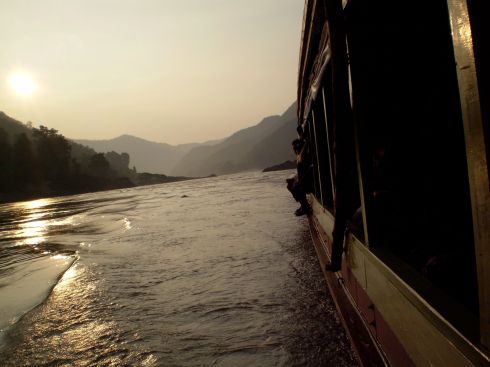
For example, I walked into a room today where someone was playing Mendelssohn’s Sonata for Cello and Piano, #2 in D Major. I listened to this Sonata, along with the Brahms #1 in F, during a very rough period in my marriage, during the last of many journeys A and I made together, down the Mekong, through Laos. I’ve heard both many times since, of course, but never without some emotion, the power of which has lessened over time. Yet today, for reasons I can’t explain, I heard the familiar first movement as if I was back on that long boat, sitting on my backpack beside A, both of us silenced by the misery of knowing it was too late for this journey or any other journey together, and neither of us able to end it.

OLYMPUS DIGITAL CAMERA

I don’t have a list of things I want to do before I die. At times I think, vaguely, of travelling to places I’ve never been because it would be excellent to leave the earth having seen as much of it as possible. At times I think I want to go back to the place where I was born one more time, because every time I return to that North Yorkshire country I feel a primitive and powerful sense of belonging that I have never felt anywhere else.

But lately I’ve been thinking that these things come a poor second to love, in all its frequently unexpected and varied manifestations, and it’s likely love that tops my bucket list.

Today my friend said, there’s no such thing as a perfect relationship is there?  There is, I said, after a while. The perfect relationship is the one where you care enough to bother struggling through the shitty bits and find you still want to stay in it. The perfect relationship is the one where you don’t want to struggle through the shit, and you have the decency and the courage to leave before you cause anymore damage to yourself and the other. Love is required for both. Isn’t it?

OLYMPUS DIGITAL CAMERA

Today I re-learned that nothing ends when you think it has. This annoys me, because I don’t live easily with loose ends. Somewhere along the way I’ve got it into my head that one must have “closure,” resolution, well-defined endings in order to move onto anything new. But actually, I’m coming to think that’s crap. My life is a chaos of ongoing love of varying kinds and depths, and I can’t think how to tidy up any of it. Perhaps I don’t have to? Perhaps instead I must learn to live with the disorder of a functioning human heart? Perhaps for years to come I will unexpectedly feel grief for my husband, for my dead mother, for my friend, for everyone I’ve  loved and will love, with various degrees of complexity and difficulty, success and failure.

There is a human being. There is love. That is all.


Why we want bad people to have horns like the devil

19 Jul

Well, I haven’t been here much lately, owing to family responsibilities, ill health, & various other matters like writer’s block and such.

This Rolling Stone cover of alleged Boston bomber Tsarnaev and the outrage it provoked in some quarters captured my attention. Some readers claimed the image was “glamourising terrorism,” “making martyrs out of terrorists,” and portraying Tsarnaev as a rock star, and they cancelled their subscriptions in protest.

One of the shocking realities about those among us who commit horrendous acts, is that they usually look much like everybody else and sometimes, like Tsarnaev, are prettier than average. This seems to arouse a frightened indignation in many people: how dare these offenders exist in the world without some visible sign of their dark hearts and black intentions? The serial killer who looks just like the bloke next door ruptures the imagined and desired order of things. There’s a sense of unfairness, of being duped: how can someone who looks so good turn out to be so bad?

It wouldn’t be easy to transform Tsarnaev, for example, into a physical representation of his thoughts and deeds without resorting to caricature. His alleged deeds are thought of as “monstrous,” implying that they do not belong in the human but in a biological aberration, physically malformed and psychologically hideous. As author of his deeds, Tsarnaev is accorded the descriptor “monster” without possessing any physically monstrous attributes. Judging by the offence taken by some Rolling Stones readers, there is a strong need in the human population for a book to look exactly like its cover, in spite of all our experience to the contrary.

Representing Tsarnaev in caricature as monstrous and evil would resolve the dissonance between appearance and action, but in so doing, would in fact deflect from the appalling nature of his alleged actions. It would satisfy the childlike demand for congruence: the baddy must look the part. But it would obfuscate the complexities of human evil: it is not monsters who perform these acts. It is human beings. Evil doesn’t come from outside the human: it is securely embedded within.

The need to portray Tsarnaev as monstrous, the need to deny his prettiness, his human-ness, springs from the desire to distance ourselves from his alleged acts: if he is human, and has done such things, what does that mean for the rest of us? Can we comfortably admit to belonging to the same species as a mass murderer? It would seem not. We have to differentiate between our selves and unimaginable evil: to acknowledge that evil as part of humanity is far too confronting.

Yet in creating that distance, we reduce the magnitude of the horror, which is not that these acts were perpetrated by a monster, but that they were perpetrated by a human being. We are a dangerous, deadly species. Look around you. How much more proof of that do we need?


On being stoned by feminists, thank you Bob

22 Jun

They’ll stone you when you’re trying to be so good
They’ll stone you just like they said they would
They’ll stone you when you’re trying to go home
They’ll stone you when you’re there all alone
But I would not feel so all alone
Everybody must get stoned

They’ll stone you when you’re walking on the street
They’ll stone you when you’re trying to keep your seat
They’ll stone you when your walking on the floor
They’ll stone you when your walking to the door
But I would not feel so all alone
Everybody must get stoned

They’ll stone you when you’re at the breakfast table
They’ll stone you when you are young and able
They’ll stone you when you’re trying to make a buck
They’ll stone you and then they’ll say good luck
But I would not feel so all alone
Everybody must get stoned

Well They’ll stone you and say that it’s the end
They’ll stone you and then they’ll come back again
They’ll stone you when you’re riding in your car
They’ll stone you when you’re playing you guitar
Yes But I would not feel so all alone
Everybody must get stoned
Alright

Well They’ll stone you when you are all alone
They’ll stone you when you are walking home
They’ll stone you and then say they’re all brave
They’ll stone you when you’re send down in your grave
But I would not feel so all alone
Everybody must get stoned

Rainy Day Woman. Bob Dylan. 

So our Convoy wasn’t feminist? Bite me, baby.

20 Jun

See here, Convoy critics. I will do whatever I like with my breasts. If I want them in a montage of cleavage, I will put them there. I don’t care if you think this is an ineffective feminist action, or that I am not a feminist if I make it. Who are you to tell me what to do with my body?  Who are you to decide if I’m a feminist or not?

I don’t care if you think our convoy of cleavage was an ineffective protest. I never framed it as a protest. I said it was a frivolity that would achieve nothing. You imposed your own values on it, and then complained because it didn’t meet them.

We had no obligation to fulfil your expectations. Get off your arse and do it the way you want, instead of bitching and moaning that we didn’t do it for you.

I don’t care if you are angry because looking at our breasts will give guys a hard on. If you are angry about guys getting hard ons, take it up with them. Don’t tell me I can’t do what I like with my breasts because it will disturb “men.” Don’t tell me I can’t do what I like with my breasts because I’m playing into the hands of the patriarchy. Don’t tell me I don’t know what I’m doing cos brainwashed by the menz.

Actually, I think it’s the other way round. You are buying into patriarchy’s fear of women, and the myth of the power of our bodies to make men uncontrollably wild.

Personally, I have no problem with heterosexual men enjoying images of the female body. It seems pretty damn natural to me.

Years of patriarchy telling me what to do with my body, now Grace Collier and the feminists as well?

You find it sad that I can’t make a political point without using the “money [ie cum] shot?” It was my cleavage. I didn’t post an image of a man ejaculating on my face. Check this blog. See how many political points I can make. Wanna read my doctoral thesis and see how many political points I made in that? How about I send you any one of the many international conference papers I’ve presented, all of which make political points? Book chapters? Lectures? Articles? How very patriarchal of you to judge me by one shot of my cleavage, not my body of work.

I don’t know why you want to put me and all the other women involved down, for an innocuous display of our cleavage. I don’t care really, though I am an analyst  & I could give you a few theories. Suffice to say that your need to do this is your problem, not ours, and we’re not carrying it for you.

The Convoy of Cleavage was initiated and executed with an enormous amount of good will, joy, friendship, co-operation and laughter. A bunch of women, many of whom have never met, had a damn good time together, and made a point about sexism. It was a moment. It was never intended to be anything else.

UPDATE: WE ARE NOW IN THE HUFFINGTON POST WORLD SECTION.

Also in the UK Telegraph.

The Convoy featured in the UK Daily Mail, a Dutch paper and the Indian Deccan Chronicle.  Yes, we went global, and we find that very satisfying. Because of us, the sexist attacks on PM Gillard, and all women, got international coverage as part of our story. That was the icing on the cake for us.

We didn’t do it in a manner that met with your feminist approval?

Tough titty.

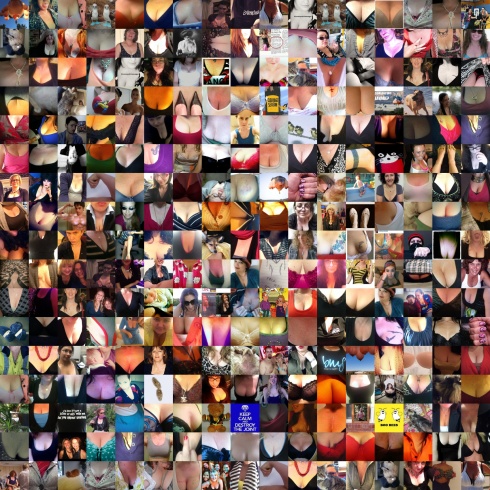
Convoy of Cleavage

This montage of images sent in by Twitter women who formed the Convoy of Cleavage was created and distributed by Destroy the Joint

Men who hate women are everybody’s problem.

13 Jun

It’s no surprise that there dwell among us packs of males, whose feelings about women are so conflicted that while outwardly conducting apparently reasonable relationships with females close to them, they display the most base hostility to women they perceive as different, and in some way dangerous.

It also comes as no surprise that this hostility is expressed in sexual terms. Our breasts and our genitals serve as a focus for the fear and hatred felt towards us by some men, all of whom have mothers, some of whom have wives and female lovers, many of whom have daughters and sisters. Our body shapes and our faces are also the focus for this hatred, and our physical characteristics are almost always the first object of complaint when such a man feels himself provoked by something we have or have not done.

What ought to really terrify us, apart from the frequently repressed fear of going about our daily lives amongst these marauding packs, fear we must repress or we’ll never get out of our front doors, is that some of them will likely soon form the government of this country.

The Prime Minister, Julia Gillard, has served as a lightening rod for woman hatred , but anyone who thinks it’s only about her needs to think again. Any one of us who crosses any one of those men will be treated in exactly the same way, because that is what they do. They have no idea how to do anything else, and they don’t care to find out.

These men, and the women who support them, will have control over an array of legislation that directly affects women in terms of our reproductive health, and child care, for example. If the ALP defeat is as catastrophic as is forecast, there will be little in place to curb their enthusiasm for controlling our lives. We must not have men who hate us and the women who support them, wielding such power over us. Read this piece, by Lenore Taylor, on the possibilities.

This is Tony Abbott’s statement on abortion

If the last few days of ugliness have shown us anything, it’s that there are men who hate women and women who will make excuses for them, fast heading into a situation where they will have an alarming degree of control over our bodies and our lives.

I know there are men who are disgusted and repulsed by the attitudes and actions of some of their fellows. You have to speak up. This is not just a problem for women. Anything you can do and say. Whenever you can do and say it.

It is a bizarre and isolating feeling, to live in a body that can be so vilified simply because it is female. The slurs may be directed against Ms Gillard in these latest instances, but they threaten every woman. Everyone needs to take a stand against those men who need to belittle women, in order to feel good about themselves. It isn’t fun. It isn’t just a joke. It’s a sick and perverted masculinity.