Archive | Society RSS feed for this section

Hollingworth’s cowardice on display again

10 Nov

Hollingworth


Last week, barrister Caroline Kirton QC approached the solicitor for BSG, a survivor of childhood sexual abuse and witness at the child sex abuse royal commission, to change his testimony to remove all references to her client, former Governor-General Peter Hollingworth.

Kirton’s request that BSG alter his statement would “amount to having removed every reference to the name Hollingworth from my statement and she requested that I do that and submit that as my amended statement” BSG told the royal commission.

Peter Hollingworth was Anglican Archbishop of Brisbane, Australian of the Year and a Governor-General appointed by former LNP Prime Minister John Howard. Hollingworth resigned as Governor-General after accusations that he failed to act on child sexual abuse crimes in his diocese, and claims that he had sexually assaulted a woman in the 1960’s.

Phillip Aspinall, Hollingworth’s successor as archbishop, ordered an inquiry, which concluded that in 1993, Hollingworth had allowed a known paedophile to continue working as a priest.

It’s a tribute to the courage and fortitude of survivor and witness BSG that he wasn’t intimidated by Kirton’s approach, instead revealing to the royal commission her attempts to persuade him to change his statement to protect her client from further public scrutiny.

Kirton clearly underestimated BSG, or she wouldn’t have made the approach in the first place. Rather than hosing things down for Hollingworth, this act of cowardice only serves to strengthen the perception of the former archbishop as weak, and interested in protecting himself and his church, before the children in its charge.

Hollingworth was in a position to protect victims of sexual assault from predators on his watch. He failed to do that. Yet he now feels entitled to request protection from the shame further public scrutiny of his failure will cause him and his family, and he feels he is entitled to request this protection from a survivor of his failures.

If only Hollingworth and many others like him in positions of power in various churches and other institutions that offered paedophiles a safe haven, had even a fraction of the courage and strength of BSG and other witnesses and survivors, thousands of children could have been spared the ordeal of sexual assault and the devastating consequences of those assaults on their lives. Many who have died might still be alive. This is the responsibility Hollingworth bears, of having the power to protect children, and failing to exercise it.

If the ordeal of shame, humiliation and disgraced resignation have been difficult for Hollingworth to bear, to the degree that he needs to attempt to silence a survivor’s testimony to protect him from any further exposure, he might spare a thought for the suffering of the young who were abused by the paedophile he allowed to continue on his path of violence and destruction, when he could have acted quite differently, and spared them.


On hating men

7 Nov

Hating men


Yesterday, feminist author and journalist Clementine Ford started the Twitter hashtag How can I hate men.

It was, of course, a question both rhetorical and bitterly sarcastic, driven by an anger and loathing we can all feel over attacks such as this:

Clementine Ford ‏@clementine_ford 12h12 hours ago
#HowCanIHateMen they never go out in packs and abduct 14 year old girls from parks to rape them.

Most tweets dealt with lesser evils such as mansplaining, objectification, misogyny expressed in many and varied ways, and efforts to control women’s bodies.

While I agreed with much of the material contained in the 140 character communications, I baulked at using the hashtag. The truth is, I don’t hate men.

There’s only one man I’ve hated in my adult life and I still hate him. I’m taking hate to mean, in this instance, that I wouldn’t piss on him if he was on fire in the gutter and if I heard he’d died, I think, good, about time, and move on.

I can make sense of this hate, as a reaction to extreme personal damage done to me that remains unacknowledged, and that almost cost me my life. But I can’t extrapolate any of that to men in general, and I don’t see why I should.

In the same way, I can’t agree with Senator David Leyonhjelm’s comment that all cops are bastards. There’s no doubt some cops are bastards but the two male officers I’ve had dealings with over the last few months have been outstanding people who’ve done me a great deal of good, so I’m not about to condemn the entire police force as practitioners of bastardry.

I don’t know what is achieved by generalised hatred, be it aimed at a gender, a particular profession, religion, ethnic group or any human grouping, some members of which have caused offence and committed crimes, great and small. For mine, hate is as profoundly personal as love, and often as binding, and I don’t love men in general either.

That old insult, fuck you and everybody who looks like you is telling, and what it tells is how hurt can provoke a general hatred of anyone who might remind you of the one who did you harm. At its most extreme it’s a driver for serial killers, but there’s a continuum.

I guess the question is, do I really want to spend my life hating everyone with a penis because someone with a penis did me awful damage? Someone with a penis did good things for me, someone else with a penis was the love of my life so how can I, without employing a vast amount of cognitive dissonance, hate men, and why would I do that to myself?

I’m as angry as the next feminist at the violence and injustice inflicted on women, largely by men. Each and every one of those men ought to be made accountable, by other men as well as women.

But I’m damned if I can, in good faith, use that hash tag, and I can’t help but wonder how it would be received if the word “men” was replaced by, say, Muslims, gays, atheists, or, god forbid, women?


Sexual assault: ask the right questions or you’re part of the problem

6 Nov

victim-blaming


There was a brief spat on Twitter this morning with a couple of men who thought the question to ask about the fourteen-year-old girl raped in a Geelong Park at 4 a.m. was, what we her parents thinking, letting her out at that time in the morning?

The attitude persists that girls and women must restrict our lives to protect ourselves from sexual assault, rather than the obvious solution, which is that men must not rape us.

The one good thing to emerge so far from this awful event are the words of Detective Senior Sergeant Jason Walsh, from Victoria Police’s Sexual Crime Squad, who expressed regret and amazement that people feel free to question a sexual assault victim’s actions, when what ought to be under scrutiny are the actions of perpetrators.

I find it amazing, he said, without getting into politics, that we question girls and we question their behaviour when we don’t even ask, ‘what’s four blokes out doing, allegedly sexually assaulting a young girl?’
“You know, that’s my take on that sort of question, and I’ve been in this sexual assault field for many years, and I find it amazing that people straight away question females for their actions, and they’re not questioning the males. I mean, what are four males doing allegedly sexually assaulting a young girl? That’s a question I’d ask.”

The self-serving myth that women “ask for it” one way or another is still pervasive, an estimated 70% of sexual assaults are not reported, of those that are reported only a minuscule number actually make it to court and even less result in convictions. The court process can be so horrendous for the victim that it’s frequently described as “being raped again,” and I recently read this paper written by Kylie Weston-Scheuber, Supervising Lawyer, Sexual Offences Unit, Office of the DPP (ACT) in which she states that should she find herself a victim of sexual assault, there are days she has doubts about whether she’d subject herself to the trauma of court proceedings.

Ms Weston-Scheuber also comments on the popular notion that women make this stuff up, by pointing out that the court process is so gruelling, in itself it ought to be evidence that the woman has suffered sexual assault because nobody would subject themselves to the trauma without extremely good reason:

…the trauma and indignity of giving evidence in a sexual assault trial is the strongest disincentive imaginable to continuing with a fabricated sexual assault allegation. However, the law precludes the prosecution from even raising the spectre of this feature of a witness’s evidence, which might be thought to be strongly corroborative.

Of course, the reality that many complaints don’t go to court doesn’t mean a victim wasn’t sexually assaulted, and it doesn’t mean the alleged perpetrator is innocent. While the victim doesn’t have her chance at justice, however traumatising that chance can be, neither does the alleged perpetrator have the chance to clear his name. He remains, for the rest of his life, an alleged perpetrator of sexual assault. Insufficient evidence, or the victim withdrawing out of fear of ongoing traumatisation, does not equate to exoneration of guilt.

There is something terribly awry with a system that causes sexual assault victims to be further traumatised in their fight for justice. However, it is within such a system that questioning the victim’s responsibility for the suffering inflicted on her by the perpetrator is still regarded by some as legitimate. So if you do ask why she was in the park, drunk, wearing a short dress or whatever victim-blaming inquiry you come up with, perhaps you need to ask yourself, why am I blaming her?


Like a natural woman

2 Nov

Murphy Brown


Anybody who watched television between 1988 and 1998 may remember the series Murphy Brown, starring Candice Bergen as a forty-something recovering alcoholic news hound who shattered glass ceilings in spite of all obstacles, and became something of a feminist icon for a short while.

However. Bergen’s character was acclaimed for her portrayal of the many possibilities for women other than marriage and motherhood and maybe even paid work, but not so as it would interfere with a woman’s primary obligations towards marriage and motherhood. So when Murphy found herself pregnant and the show’s musical director chose Carole King’s “You make me feel like a natural woman” to accompany the soft-focus birthing scene, many second wave feminists were outraged.

I’ve linked to the lyrics if you want to see why. I could write a thesis on those lyrics but for now I’ll simply say they’re an outstanding example of patriarchal elephant excrement.

In that single scene the show appeared to undo all the good things by implying that what made Murphy Brown a real woman, a natural woman, was giving birth and embarking on motherhood. Everything preceding those events was less than natural,  the scene suggested, and prior to motherhood Brown was an incomplete and unreal, albeit successful woman.

This message ran counter to everything second wave feminism fought for, and landed us right back in the biology is destiny narrative but wait, there’s more, it then set us on the having it all highway, as Brown struggled to juggle demanding career and demanding infant as a single mother. But at least she was now a natural woman.

Memories of Murphy Brown have resurfaced after a couple of days in the fraught world of uneasy and at times violent interactions between biological women and trans women, and the men who support trans women by threatening biological women, as my three previous posts explain. It isn’t unusual to hear from both sides rhetoric about natural/biological women, feeling like one, being one or not, wanting to be one, living like one if you weren’t born that way, resentment if you were born that way and someone who wasn’t  claims they’re no different from you.

I suppose what I’d like to ask biological women and trans women is what do you mean when you say you feel like a real/natural woman? Because in my experience there’s no such thing. Contrary to patriarchal propaganda, women aren’t homogenous, so do you feel like a woman who got beaten up last night by her male partner? Do you feel like a woman who is CEO of an international corporation? Do you feel like a woman police officer struggling to survive in a male dominated and at times misogynistic environment? Do you feel like a married woman with a couple of kids who gave up her dreams of becoming a doctor to type her husband’s PhD? Do you feel like a homeless woman? Do you feel like a female sex worker? Do you feel like a lesbian academic? Do you feel like a refugee woman on Nauru? Do you feel like Hilary Clinton? A woman in the back streets of New Delhi? A woman living with female genital mutilation? A crown prosecutor? A hippie vegan on a north coast commune? A state or federal politician? An artist? A musician? A catwalk model?

Please tell me, when you say you feel like a woman, and if you say you’ve always felt like a woman, what kind of woman is it you’ve always felt like, and what do you actually mean? Because it seems to me that perhaps the most insulting, demeaning and degrading thing anyone can say is, I feel like I’m really a woman.

What is this thing that makes a woman “real?” And most importantly, who gets to define it?  And what is this assumption that women have something in common other than biology that makes us really women?

This is one of the things I’d like to ask Germaine Greer, as well as some trans activists. Both parties, it seems to me, are operating from the entirely false premise that there is such a thing as a real woman and for mine, in assuming that premise, both parties are contributing to the oppressive stereotypes feminists have been challenging for decades.

Come at me, sisters. Make me feel like a natural woman.


No, sir, you go fuck yourself

1 Nov

Rude space cloud


Unusually, I found myself in a Twitter brawl this morning that ended with the male involved telling me I was a moron, that I am everything that is wrong with feminism, a trans hater and an Abbott clone, and he wound it up by telling me to get fucked. He then engaged in this thing you can do on Twitter whereby you can continue to publicly abuse someone, but block them so they can’t respond.

A man telling me to get fucked feels like a sexual threat, and I was somewhat unsettled by his animosity: mostly I tell people to go fuck themselves, which doesn’t require the hostile bodily interference of another. Or fuck off, which actually has nothing to do with sex at all.

Also, given the current state of feminism I usually refrain from identifying myself with that ideology, so if I’m everything that’s wrong with it that can only be a good thing for me, so taa.

Then he told me I was no different from Clementine Ford and that really pissed me off when I got around to thinking about it.

The fight was about bloody Germaine Greer. I was in conversation with a trans woman called Aoifa, who hosts this excellent blog, and a trans woman called Miranda, who hosts this excellent blog. Aoifa had been expressing her disgust with her community for its lack of protest about death threats made against Greer, and Miranda was part of our convo. Suddenly, out of nowhere, this man appeared and told me I was no better than Tony Abbott, and that expecting trans women to protest other trans women threatening Greer with death was no different from Abbott saying Muslims should speak out about minority radicalisation. He is sick, he says, of the way rad fems treat trans women so he thought it would make everything better if he abused me.

He didn’t say anything to the trans women. Only me.

To express hope that communities will speak out when their members issue death threats, his argument apparently goes, is to imply that everyone in the community is in fact responsible for the actions of a minority.

I strongly disagree with this notion. Coming from the position that evil thrives when good people say nothing, I know that were I in the Catholic community I would never shut up about child sexual abuse by priests, not because I am in any way responsible for their ghastly actions, but because my silence on the subject would enable, and implicitly condone those actions.

Likewise, I am a member of a language group that constantly threatens war and genocide for its own gain and I vigorously criticise Western leaders who wage wars, without me taking personal responsibility for their warmongering.  Speaking out against injustice does not equate to me accepting responsibility for that injustice. However, keeping silent, in my opinion, might very well  contribute to my responsibility for injustice.

From this perspective, I can see nothing wrong with wondering why transgender people and their supporters have on the whole been silent about the death threats against Greer that have come from their ranks. If I would ask these questions of my community and every other community, why should I not ask them of the transgender community?

Because, the argument goes, the trans gender community is a persecuted minority and shouldn’t be expected to speak up against death threats. There’s no doubt an excessive amount of violence and hatred is directed towards trans women. There is also no doubt that an excessive amount of violence is directed towards biological women, with two of us dying each week at the hands of intimate partners or family members, and hundreds of us hospitalised every day as a consequence of domestic violence.

Women are a persecuted majority in a patriarchy, and while the reasons for persecuting trans women and biological women are no doubt different, and require separate analysis, the fact of violence against us and the repercussion of that violence are not conducive to hierarchical evaluation, in itself a patriarchal practice  Rather, we have in common a terrifying vulnerability to the violence of violent males.

Hoping for protest against the efforts to silence dissent through fear and death threats does not equate to transphobia. And debate ought not to equate to world war three. You people who tell others you want them to die, you’re going to kill them for expressing opinions that don’t make you feel good? There’s something terribly wrong with you, and I don’t care what community you belong to.

I’ve spoken at length about my own experiences of male physical violence, child sexual abuse, and sexual assault. I will with my whole heart support any woman, trans and biological, in her experiences, whether she talks about them or not. But I will fucking well not be abused and insulted by some fucking male dropkick who has decided he knows what feminism is and what being a woman, biological and trans, is like in this hierarchical patriarchy of which he is a most unedifying example. So, go fuck yourself sir, with an implement of your choice, because I would not wish rape even on you.


Paedophilia and hyper-sexualisation: girls will be attacked because of what they’re wearing, right?

30 Oct

Bikini Barbie


A few days ago I read this piece in New Matilda by philosopher Dr Mark Manolopoulos on the coexistence of an accepted hyper-sexualistion of children, and strongly condemned paedophilia. The fact that the former is condoned while the latter is condemned suggests a societal hypocrisy that is shameful, is the crux of his argument.

Although Dr Manolopoulos stresses that he makes no correlation between the two, the fact that he situates their coexistence in the realm of the hypocritical and shameful strongly suggests that he assumes a connection of some kind. Without a connection there is no hypocrisy, and there isn’t any shame either.

The first question is one we’ve been debating on Sheep for a few years now: are children hyper-sexualised?

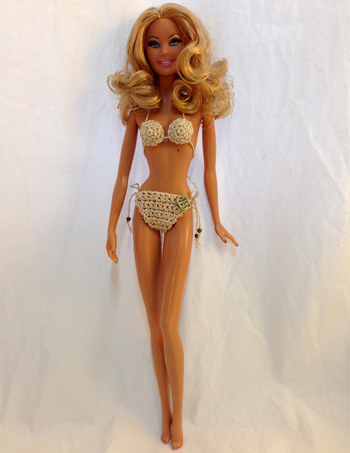
There is only one, extremely narrow representation of female sexuality that is imposed on young girls. The grotesque image heading this text is an example of an ideal of physical sexuality that promises gratification to any male who is attracted in spite of, or because of, its lack of subtlety.

It’s a mainstream wet dream. Consequently, many women strive to emulate the impossible plasticity of the Barbie doll, and some women inflict the same struggle on their daughters in a ghastly mother-daughter bonding that to this observer, does not speak of hyper-sexualisation as much as it does of a desperate desire to be desired, and for the daughters to vicariously gratify the adult woman’s need.

A man or a woman who looks at a child in “sexy” adult clothing and make up and thinks, gawd, she’s so sexy, has something terribly awry with their perceptions and desires. The child is still a child, albeit a dressed-up child, and the adult who cannot tell the difference between dress-ups and the real is sexualising the child rather than seeing the child, and needs urgent assistance.

Can anyone in their right mind really look at a dressed-up child and see her as a sex object?

How many mothers who dress their daughters “sexily” are actually pimping them out to paedophiles? Practically none, I’d guess.

There is no proven correlation between the manner in which young girls are dressed, and their vulnerability to paedophiles. If there was, Dr Manolopoulos might have an argument, but there isn’t, and he doesn’t. Quite apart from the fact that many victims of child sexual assault are boys, who aren’t dressed in anything other than ordinary clothes.

The implication of the doctor’s thesis is the same old same old: girls and women will be attacked because of what we’re wearing. Paedophiles aren’t responsible for their crimes: little girls looking “sexy” provoked them, they couldn’t resist, and their mothers are to blame.

His remedy is, yes you guessed it, ban things.

Personally, I wouldn’t choose to dress my daughter, if I had one, in a manner that is Barbie sexual, but then I don’t dress myself like that either, except once I was in a burlesque show and that was fun.

Blaming paedophilia, or any sexual assault at all on the so-called “hyper- sexualisation” of the victim is yet again shifting the responsibility from the perpetrator, where it belongs, to the victim, where it doesn’t. This is the most shameful hypocrisy society urgently needs to address, but how much easier to demand the banning of clothing and music videos.

We don’t get raped because we wiggle our hips, no matter what our age. We get raped because rapists rape us. How about society tells rapists not to do that, and leaves us to dress ourselves and our daughters however we wish, without having to fear for our safety?

I don’t like this so ban it for me.

27 Oct

nospeech_fullsize


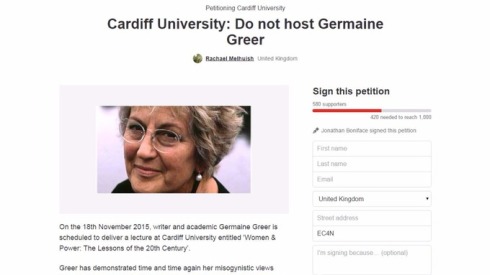
I don’t know how it came to this, but my post defending Germaine Greer’s proposed lecture at Cardiff University has caused me to be described as transphobic.

Given the current circumstances of my life I am strangely unmoved by this accusation, however what does cause me some annoyance is that it seems to have become increasingly difficult to say, I do not agree with this person’s views on a subject but I do support his or her right to express them, and I welcome the ensuing debate.

As I understand it, Greer wasn’t intending to speak about transgender people. However, because she has spoken negatively on this topic there is a view that she is not, apparently, permitted to speak on any topic at all.

The list of topics on which Greer has spoken negatively and with abrasion is very very long. It is this characteristic and dare I name it, talent, that provoked a revolution amongst women decades ago, and were it not for Greer, among other equally provocative feminists, we wouldn’t be getting our own mortgages and living as fluidly as we are, even though we have still a very long way to go.

With thanks to Jo Tamar, I’m linking to this explanatory post on the complexities of changing gender. I was vastly irritated by the tone, but if you can get past that it’s worth a look.

And this post, Who’s afraid of Germaine Greer, is also worthy of a read.

Accusations of transphobia, like all name-calling, serve to distract from the essence of my argument, which is that banning speech rarely results in a positive outcome, whilst engaging in debate can be creative and productive. It ought to go without saying that I don’t include hate and inflammatory speech, but I know it won’t go without saying so I’m saying it.

Students at Cardiff University wanted the authorities to ban Greer’s lecture. The University refused to do this, to its credit. Students could have, and should have, taken responsibility for expressing their disagreement and displeasure with Greer in any number of ways: boycotting, back-turning, protesting, writing, and speaking, however, demanding that authorities do their oppositional work for them was both idle and cowardly. I don’t like this so ban it for me. Well, ok, but don’t complain when you find yourself in a fascist state.


In defence of Germaine

25 Oct

Greer


Germaine Greer.  Now banned from speaking on a university campus because her views on transgender women are perceived as hostile, and transphobic.

What Greer says is that she doesn’t believe a man who is surgically and hormonally transformed into a female, is as much of a woman as are those of us born with female genitalia.

If you think, as do I, that gender is a social construct, Greer’s argument is “problematic.” If you’re born with a vagina, a certain set of protocols come into play. Likewise if you’re born with a penis. The concept of “woman” is a social construct, and gender is a performance.

Be that as it may, where Greer is right is that the experience of being constructed as a woman is entirely different from the experience of being constructed as a man. In that sense, a male who undertakes sexual reassignment in adulthood has not been raised as a female construct, and so is lacking in that experience.

Where Greer is wrong is in claiming there is such a thing as being really a woman, or really a man: it is impossible to separate the sex from the gender bias in our current social arrangements, and conclude that we are really anything.

For some reason I can’t fathom, Glamour magazine decided to award Caitlin Jenner (formerly Bruce) its woman of the year accolade, a move that has further provoked Greer and caused her to escalate her irritation of transgender people. This may yet lead to the cancellation of more speaking engagements.

And for mine, this is the most scandalous thing of all. Not that a man might believe sexual reassignment makes him a woman. Not that a woman may disagree with his perspective. But that people believe it is acceptable to ban Greer from speaking because she has a particular point of view on this.

If your position cannot tolerate dissent, it is a very weak position. Greer is not advocating violence against transgender people. Greer is not marginalising transgender people. She is expressing her opinion, and there’s a huge difference between expressing an opinion, and advocating violence.

I think her opinion is based on a false premise, nonetheless she has every right to hold it, and anybody has the right, and even the responsibility, to challenge her. When debate is shut down we’re all the worse off, and the notion that we have no right to speak if we don’t agree with a particular perspective is completely abhorrent.


Elite feminism. Enough, already.

24 Oct

feminism_small-003


Ever since I read this piece by Clementine Ford on this venture by Roxane Gay, I’ve been struggling with the reaction both posts have provoked in me.

Gay is calling for submissions for a collection of essays she’s pulling together written by women who have experienced sexual harassment, assault and abuse. The aim of the collection is to expose the way women are often told it’s not that bad after we’ve experienced one or all of the above, using the survivors’ own words. As Gay puts it:

Not That Bad is an opportunity for those whose voices were stolen from them, to reclaim and tell their stories. This anthology will explore what it is like to navigate rape culture as shaped by the identities we inhabit.

Contributing to this anthology is a chance to own your own narrative with all of the complexity of reality without shame or condescension. Because too many of us have lived this truth, there is no one way to tell this story.

Being told, it’s not that bad after sexual violation of any kind is a way for the culture to minimise the experience, and it’s also, I believe, a way in which others attempt to comfort us, albeit misguided. As a comforter, it’s not that bad is worse than useless, really.

However, my first thought on reading both posts was, this is a very exclusive offer to a relatively small demographic, and will exclude many survivors who aren’t academics or academically inclined.

Here’s a list of suggested topics:

Potential Topics (a brief list, not a prescription)

Testimonies of what “not that bad” looks like
Critical examinations of rape culture
What it’s like to negotiate rape culture as a man
How women diminish the sexual violence and aggression they experience and the effects of doing so
What “not that bad” looks like in popular culture—film, television, and music
Resisting rape culture
Combating sexual harassment, street harassment and cat-calling
How sexual harassment and violence erode women’s privacy

I’m an academic, and used a great deal of my experience of childhood sexual abuse as the basis for an interrogation  of violence and power in my PhD. So I’m not complaining about being excluded from the project by its frames of reference and the language in which they are couched. I’m also very aware of the potential helpfulness of a theoretical framework through which a survivor can view her experience, if she is so inclined.

So why is my reaction to this proposal exasperation and anger?

The women whose essays will be chosen for this anthology are not likely to be women without a voice. Indeed, a woman will need to have found a voice, and an educated one, in order to qualify for inclusion. There is nothing innately wrong with this: women with educated voices suffer sexual violations of all kinds, and there is no argument for silencing us.

Yet I want a qualifier on this anthology. It isn’t simply an opportunity for women whose voices were stolen to reclaim them. It’s an opportunity for a very select group of women, who have voices that fulfil the editor’s criteria, to publicly own their narratives. It ought to be owned as such.

My irritation is with a feminism that speaks of “women” when what is actually meant is a certain category of women, to the inevitable exclusion of others. This feminism, far from challenging the culture actually props it up, in its embrace of social hierarchies rather than its contestation.  So we measure the advancement of women by the number of us who sit on boards, achieve the status of CEO, and succeed in a patriarchal system.

Feminism, for me, is about contesting that system. A feminism that addresses itself to a particular category of women and does not own that, is a feminism that is patriarchal in its performance. It’s based on an assumption that other categories of women aren’t as significant, or that all women are the same.

There’s nothing wrong with Gay’s project in itself. The problem is with its claim to offer “women” a voice and an opportunity for ownership of our narratives. It doesn’t. It offers women who can intellectualise our violations, and write about them, the opportunity to be heard.

When I was sexually assaulted last year I saw a counsellor, and one of the things I said to her repeatedly was that I didn’t understand my reaction to this event, as I had dealt with so much as a consequence of childhood sexual abuse, to the extent that I’d based a PhD on the topic. I expected myself to know what was going on in me, and deal with it far better than I am.

Ah, she said. It’s one thing to understand events intellectually. But your body remembers. Dealing with it intellectually isn’t all there is to do to own the experience. Traumatic memories, ancient and modern, are not seen off by the intellect. It’s but one aspect of the situation.

So, while I could write a piece that would probably qualify for Gay’s anthology on navigating rape culture as shaped by the identity I inhabit (except that I’ve written this and likely disqualified myself) something in me, as a recently raped woman, baulks at this language and this framing.

I think feminists who practise elite feminism ought to expect resistance, because they are likely not respecting the existence of all women. It is, really, quite unacceptable to use the term “women” in such an unqualified manner when what you truthfully mean is: only women who meet the criteria need apply.


Hockey, Lawler, Jackson: the self aggrandisement of the the mediocre

22 Oct

Folie a deux


On Monday’s episode of Four Corners, we witnessed the destructive power of excessive self-belief as expressed in the folie à deux performed for us by Kathy Jackson and Michael Lawler.

I don’t think it’s  all that unusual for some couples to bond on the basis of the beliefs of one or another of them. I’ve known several whose raison d’être is one party’s (usually in heterosexual relationships the man’s) perceived talents, ambitions, goals and characteristics, all of which are fiercely supported by their partner, to the exclusion of clarity of mind and thought. Shared delusions form the basis of many a partnership.

The Lawler/Jackson combo is an exception to the usual, given that in their case, the man has almost entirely capitulated to the female’s fantasy of herself as noble, self-sacrificial and as a consequence, persecuted. Indeed, Lawler admitted that others may view him as “cunt struck,” a term with which I was entirely unfamiliar before Monday evening, but one which I am as taken with as I was when I first heard the term “rat fucker” from the moist and fleshy lips of former PM and excessive self-believer, Kevin Rudd.

I personally don’t give a rat’s rooted arse what happens to either Lawler or Jackson, and if any man or woman fawned over me as did Lawler over Jackson, I’d tell them to fuck off and get out of my face, but there you are, I’m ungrateful and like my boundaries.

What is most disturbing about the Four Corners intimate expose of the couple is that two such banal and emotionally immature individuals can bring so much chaos and grief to so many others. I mean, if you’re going to be done over by someone, at least let that someone have a bit of class. To be done over by people entirely lacking in any kind of calibre adds insult to injury, for mine.

Which brings me nicely to Joe Hockey’s valedictory speech. Talk about self-belief, or rather self-aggrandisement. The man is convinced, like his former boss Tony Abbott, that he leaves behind him a significant and worthwhile legacy. Colour me smashed Italian marble table.

All in all, I weep for the mediocrity of those who would be our leaders. We deserve better. Or perhaps we don’t. Perhaps we are all in a bubble of self-delusion, thinking ourselves greater than we can ever be. Perhaps our leaders accurately reflect the self-importance and entitlement of a nation that increasingly considers itself above the trials and tribulations of the rest of the world, for no reason other than it just is.