Archive | Society RSS feed for this section

On Family.

15 Dec
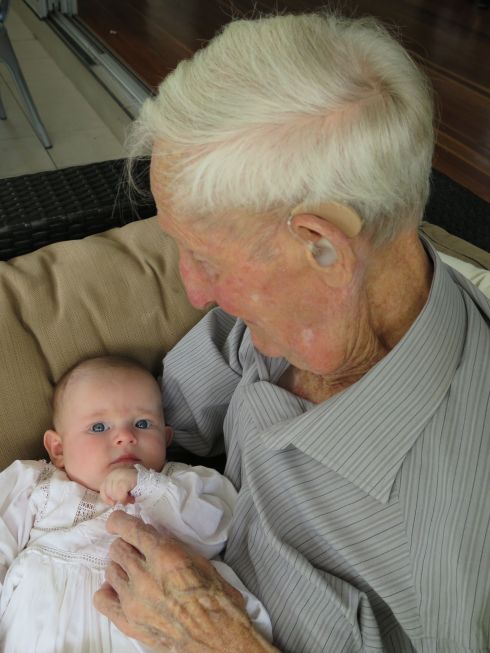
Mabel Jane with her Great Step Grandfather

Mabel Jane with her Step Great Grandfather


The next little while is set to be somewhat frenetic in our household, as in many others, as we prepare for an early Christmas with my family’s little ones, and then a Christmas at the other end of life’s cycle with Mrs Chook’s ninety-year-old Mum and family.

Mrs Chook didn’t have kids and I don’t have a Mum, so we share.

There won’t be much on Sheep, except maybe some bleating about four-year-old Archie’s snoring, sleep talking and aggravated assault of his Giddy after he’s padded his way down the stairs from his bedroom to mine in the middle of the night  and in a stage whisper said “Giddy, can I get in your bed I promise I won’t pee.”

Well, he doesn’t pee, but he does thrash about and hit me in the eye.

A woman called Vicki once said to me, family is everything. I know she was talking about traditional heterosexual families. But for mine, that is a very narrow concept of family, and the fact that it’s heterosexual and traditional is no guarantee of it being any good.

It doesn’t matter how family is constituted: if there’s a group of people who love each other and share their lives, that’s a family. It’s about time this privileging of traditional heterosexual families came to an end.

My extended and blended family recently came together for the naming of our youngest babies, Mabel Jane, called after her late great-grandmother, and her cousin, Audrey Mae.

Mabel Jane & Audrey Mae on their naming day

Audrey Mae & Mabel Jane on their naming day

Mabel Jane brings the total number of grandchildren in this family to twenty. There are second marriages and ex partners and new partners and we all turn up for every wedding and naming and we all get on, regardless of our sometimes chequered histories, and we even get on when we’re pissed, so that’s some indication of how our family is everything to us.


Ted at his sister's naming day

Ted at his sister’s naming day


What astonishes me is the elasticity of the human heart, as it expands itself to make room for yet one more individual, adult or child, who through birth or commitment enters this family and becomes a member. We may not always like each other all of the time, and some of us wouldn’t want to spend our lives with some of us, but I doubt there’s any one of us who’d turn their back if someone  else was in trouble.

This is not to say some families aren’t shit. My family of origin was unspeakable, so there’s a dark side to the “family is everything” mantra: family can be everything in the worst possible way, haunting you for the rest of your life, and under those circumstances, Christmas is no fun.

If it’s awful I hope with all my heart that it passes quickly for you.

And no matter what combination constitutes your family, however big or small it may be, love one another the best you can, and put the all sharp implements in the high cupboards.

Archie at the party

Archie at the party


Reist, porn and sexualisation.

11 Dec

Porn-Its-Cheaper-than-dating


For a long time now, I’ve wondered how Melinda Tankard Reist is able to conduct her extensive and lengthy campaign against the “sexualisation” of girls, without addressing the sexual abuse of children.

I can think of no more powerfully destructive act of “sexualisation” than childhood sexual abuse, and yet Ms Reist goes nowhere near it, choosing instead to shame various outlets into withdrawing whatever product she currently believes is causing the “sexualisation” of children.

As the Royal Commission into CSA continues to demonstrate, the sexual abuse (and inevitable real sexualisation) of children was occurring long before there was an Internet, long before there was anything like the licentious climate Reist claims exists today, and long before the creation and availability of any of the clothing, toys, music clips and magazines that she currently holds responsible for “sexualisation.” What child victims wear had and has no bearing on a paedophile’s decision to molest her or him.

I continue to maintain that if an adult sees a child dressed in a “sexual” manner and assumes an invitation, there is something seriously awry with that adult’s perceptions. A dressed-up child is still a child, not a sexualised being, “sexualised” implying that the child’s purpose has become to provide sex by virtue of her appearance. Only a dangerously perverted thinker would make such an assumption.

Popular sexual culture is like the hydra: as soon as Ms Reist chops off one head another one grows. Which will, of course, guarantee her a career and an income. Popular sexual culture might be a symptom, but is never a cause, and sexuality is always a reliable source of fuel for moral indignation and the impulse to ideological control.

However, what has brought Tankard Reist to mind is her appearance on an ABC 2 program on pornography the other evening. In anticipation of the program, activist and academic Caroline Norma published a piece on ABC Ethics and Religion, castigating the ABC for giving a platform to the dirty business of pornography. You see the common motif: porn is dirty, and morally wrong like “sexualising” clothes and raunchy music videos, and shame on aunty for giving it airtime because we know how well repression, censorship and prohibition work for us.

One of the things that disturbs me about Reist’s opposition to porn is her definition of that genre. She and her followers are wont to wax eloquent about “true intimacy,” and “real loving relationships” etc, which to me suggests Reist considers she has somehow acquired the right to define what is “true” and “real” in sexual relations and is compelled to foist her definitions on the rest of us.

“True’ and “real” seem, in this context, to require marriage, or at the very least long-term commitment, with the qualifier that it only applies to heterosexuals.

Another aspect that disturbs me is Reist’s penchant for lumping together all kinds of porn, from snuff movies to amateur and everything in between, as being equally destructive and harmful to health, well-being, and intimate relationships. It’s like saying all food is harmful because Macca’s burgers don’t get the Heart Foundation tick of approval.

There must be no porn of any kind, and we must not have sex with anyone unless we are willing to commit our lives to them.

Personally, I would not enjoy being fucked to camera by some dude whose only asset worthy of note was a long schlong. The reasons why women engage in the manufacture of porn are many and varied, and how much choice or freedom is involved is as variable. I can’t for the life of me see how any of these variables can be addressed and redressed by forcing Coles to withdraw a Zoo magazine.

I have no doubt, however, that Ms Reist and her followers get a lovely warm glow when they do force the withdrawal or banning of one thing or another. While they are glowing, sex trafficking continues unabated. Child sexual abuse continues unabated. Sexual assault continues unabated. They are, as my first husband would say, pissing against the wind.

There are very real and very frightening and certainly criminal acts of sexual expression in which there is no consent, that no society ought to tolerate. If we are raising boys who believe they have the right to demand from girls sexual acts girls do not wish to perform, then we are raising misogynistic male supremacists, and Zoo magazine is an expression of that culture, not the cause. You can burn all the lads mags you want: it won’t stop those particular lads wanting to forcibly sexually subjugate girls.

“Sexualisation” and “pornification” take place within a context: the context of the inequalities of patriarchy, the demands of capitalism, and religious notions of what is and isn’t sexually moral. It’s only by tackling these impositions on humanity that we’ll ever make inroads into exploitative and non consensual sexual practices.

But hey, if it’s band aids you want, Reist’s website provides you with a long list of what not to buy for Christmas, and where not to buy it. But there are other ways to get a nice warm glow…


New Matilda furore dangerously misses the point

10 Dec

Victim blaming


The point of the Jack Kilbride article published in New Matilda earlier this week, is that women are responsible for adjusting our behaviours so that we do not incite male aggression and violence against us.

The website has since published three reactions to Kilbride’s piece, one supporting him, one attacking him, and one likening Clementine Ford’s experience to that of Adam Goodes.

Obviously nobody has read this Guardian piece, titled Victim-blaming rampant in Australians’ attitudes towards violence against women – study.

Read it. Read it and don’t even bother talking to me if you haven’t read it, because when you’ve read it you will see everything that is wrong with Kilbride’s piece, and any opinion that supports his position.

Overwhelmingly, according to the study, in Australia women and girls are blamed for male aggression and violence towards us. Our tone, our appearance, our failure to pay attention to a male, our attitude, our provocation: we must have done something or not done something to make him do it.

It is sickening to read the attitudes of apparently “ordinary normal” people to women who dare to report and protest violence against us. If you’ve experienced these attitudes you’ll know it’s like being violated all over again. The accusatory questions addressed to victims of violence: why did you/didn’t you? You should have/you shouldn’t have. All making the victim the focus of reprimand and disapproval, placing the onus on her, and not the perpetrator.

What these victim-blaming attitudes do is enable violence against women in all its forms. In shifting the responsibility from perpetrators to victims, the former are relieved of the necessity and the responsibility of owning their violence, instead taking comfort in the erroneous assumption that they were provoked in some way or other into acting aggressively towards us.

Until these attitudes change, there will be no lessening of violence against women. The depth to which these attitudes inform our society is painfully apparent in Kilbride’s piece. I have no doubt he is a nice, well-meaning bloke who wants a better world. Victim blamers aren’t necessarily overtly hostile. Indeed, women who complain about their frustration with victims complaining are engaging in yet another form of victim blaming.

The question that most urgently needs to be asked and answered is, why do we find it so necessary to blame a victim?


On what Clementine did

8 Dec

Online Abuse


I’ve read two opinion pieces today on how Clementine Ford handled the online aggression and threats against her by  naming and shaming the individual responsible, and publishing a compilation of the obscenities fired her way over a period of several months.

There’s this one by Helen Razer in the Daily Review, and this one by Jack Kilbride in New Matilda.

Razer argues that the significance of public commentary is lately at risk of being measured by the amount of hate the author is subjected to, rather than the work the author produces.

Kilbride argues that if women only handled it better the nasty trolls would stop trolling, which is roughly the linguistic equivalent of telling us not to dress provocatively because if we do we’re asking for it, and I can’t be bothered with the man just now.

Razer’s perspective on publicly revealing personal trauma is an interesting one. Her piece is titled, Why violent threats don’t make you an important commentator, so obviously she’s working from the premise that there’s an audience daft enough to measure the significance of one’s work by the amounts of threats one receives, and their degree of severity. This makes me absolutely negligible, as I receive practically no threats, and barely any abuse, except I did for a while cop a fair bit of upsetting reprimand, public and private, from Razer.

Razer writes:

The idea is not important. The trauma victim becomes important. The claim that “Clementine Ford is important for women” should be made about the growing body of this writer’s work and not about the threats she has received. The violent attention of barely literate misogynists has become the register of a good thinker. 

Good thinkers have always been the targets of abuse, and injury, and not infrequently death, since long before there were internet trolls. Online attacks are merely the most recent manifestation of hatred for good thinking: with the Internet haters have discovered an opportunity they’ve never had before to globally spew their bile, and so of course there are more visible victims.

Being the target of abuse doesn’t make anyone an important commentator or a good thinker: Andrew Bolt and Miranda Devine cop their fair share of threats and abuse and nobody capable of thinking straight could call either of them good, or important, or even really thinkers, to be honest.

Razer links to this interview with Yasmin Nair, titled The Ideal Neoliberal Subject is the Subject of Trauma, in which Nair makes the claim that everyone must identify as a trauma victim to be considered a legitimate subject:

It just seems like trauma has become a requirement. I’ve been writing recently about how I am sick of being on panels where everybody starts to confess to their rape, or to their sexual trauma, and I just want to walk out on them! I just want to say “if you cannot think about critiquing policies and the state without having to assert how and why you have been a victim, then let’s end this conversation. Does everybody have to be a victim in order to gain sympathy, first of all? And what does it mean to have to constantly reconstitute yourself as a subject of trauma? What happens to people who don’t do it? Are they to be seen as traitors?

There’s this weird kind of culture of confession which is also something I write about: this constant imperative to confess, and this imperative to reveal oneself as the wounded subject, that I find very disturbing…There’s a kind of demand for authenticity in all of this that I find particularly vexing. And I know for a fact that many people who have a critique of trauma and of violence and of the state may well have been sexually abused, but just don’t talk about it. And does that make them less authentic?

Is the narrative of personal trauma obfuscating the bigger discussion of context, policies, and the state? Or are the two narratives  more compatible than Nair (and Razer) argue?  And after thousands of years of silence on the subject of our trauma, who, after a mere couple of decades of public discussion, has the right to suggest that the traumatised are silencing another, more important conversation? Hasn’t this always been said to women?

Does revealing personal trauma make one more authentic? Or does keeping silent about personal trauma add to one’s authenticity? Does revealing personal trauma detract from the value of one’s work? Or add to it because experience complements abstract knowledge?

I am more interested in the fact of those questions than I am in any answers. In speaking and writing about my own traumatic experiences, I’ve never once thought to ask myself, will I seem more authentic if I say this, or if I don’t say it? This could well be a grievous oversight on my part, however, I’m not in the habit of wondering whether or not I seem authentic, and it seems to me a tortuous thing to have to ask oneself before writing and speaking, the kind of core self-doubt that can do little other than reduce me to quivering silence.

Why should a woman have to ask herself before she writes, will writing this make me more or less authentic?

In her piece on Ford, Razer links to this earlier post, written in 2014, in which she writes at length about her own experiences of being stalked, threatened, and extremely frightened, and the long-term effects these experiences have had on her life. It hurt me, I think irreparably, she writes. I don’t think any the less of Razer’s body of work because she reveals this about herself.

Indeed, she has apparently written a book on the subject, and I don’t think any less of her intellect because she’s written a book on her personal trauma. I am, however, more than a little irritated by the apparent double standard at work here. Razer has confessed her suffering and revealed herself as a wounded subject, yet seems to be arguing that others should not.

Thinkers are at times simultaneously wounded subjects. It seems to me an admirable goal to enable us wounded subjects to contextualise our experiences of wounding in terms of the systems and regimes that govern our lives. If we do not speak about our trauma in the first place, we have no hope of contextualising it for ourselves and others.

If you are exasperated by the sheer number of victims using their voices, perhaps it is wiser not to blame them for your exasperation, but rather go to the source, and hold the source accountable. As I noted earlier, women have been silenced for thousands of years, and it is only in the last three decades we have begun to speak. It would seem a little early for exasperation.

As far as I’m aware, there is no guide-book for how a woman should react to trauma. Each of us does it in our own way and nobody has the authority to police that. Ford does it her way, as does Razer, as do I.

Each one of us who confesses herself as a wounded subject does it in a way that can have significance for somebody else, because there is no one way, and there is no right way, and there is no time limit.

The idea is important. The trauma victim is important. It isn’t either or.

This is authenticity.


Naming and shaming

3 Dec

Naming and shaming


I don’t always agree with feminist writer and activist Clementine Ford. I disliked her “Fuck Abbott” t-shirts and wouldn’t be caught dead in one. I disliked even more her “I hate men” hashtag on Twitter.

But Clem Ford has taken on men who are abusive and threatening to women online, and one Michael Nolan has lost his job because the company he works for won’t have its employees publicly abusing women.

Of course Ford has received bucket loads of abuse for complaining about Nolan to his employer because, as she notes, the worst thing you can possibly do is make a man accountable for his actions.

In other words, a male who is so inclined may visit all kinds of abuse upon a woman, but this is secondary to the offence she commits by insisting that he be held accountable for his actions.

Well, fuck that for a joke.

When a man abuses a woman he loses his right to privacy. If he has a family, he also destroys their right to privacy.

Give me one good reason why any woman abused by a man is obliged to remain silent about that abuse in order to protect him, his reputation, his job or his family. He should have thought about all those aspects of his life before he perpetrated the abuse. Maybe if he does think about all those aspects of his life, he will think twice about perpetrating the abuse. And if he doesn’t respect his own life and others in it, why on earth should a woman he’s abused be expected to do it for him?

Actions have consequences. Suck it up, dudes. The shame’s going where it belongs.

If women stay silent about the abuses visited upon us because we’ll be perceived as vengeful bitches if we speak out and the perpetrator loses his reputation, his job, his family, then women are saying to men, abuse me, I won’t say anything because your job, reputation, family are more important than me. It’s ok, abuse me, and I’ll sacrifice my well-being for yours.

Well, fuck that for a joke as well.

I don’t know what else we can do about violence against women, no matter what form it takes. Name the bastards. If that’s what it’s going to take to make them think about what they’re doing, name the bastards, because the consequences of that naming and shaming are down to them, not the women they abuse.

The days of male entitlement are, albeit at a glacial rate, coming to a close. Men who abuse and exploit women are accountable for their actions, and the choices and decisions they make and the risks they take in the making.

It’s not our shame that we name them. It’s their shame that they have to be named.

And for the women in their lives who are collateral damage: take a step back and a good look at the kind of man you’re spending your life with and ask yourself, do I really have to set the bar this low?

We don’t have to stay silent so abusive and exploitative men can stay comfortable.

Fuck that for a joke.


After White Ribbon Day: put your money where your oath is.

28 Nov
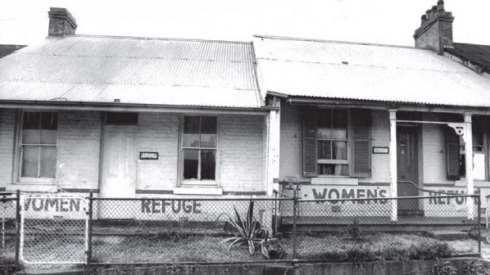
Elsie. Australia's first women's refuge.

Elsie. Australia’s first women’s refuge.


November 25th is the International Day of Elimination of Violence against Women, known as White Ribbon Day after the organisation that works to prevent male violence against women, an organisation led by men with the aim of supporting women, and calling violent men on their behaviours as well as assisting them with change. Men are required to take an oath that they will protest violence against women, and the wearing of a white ribbon signifies that they’ve taken that oath.

FACT: Destroy the Joint’s Counting Dead Women Project keeps a record of the names, lives and circumstances of all women in Australia who have died in incidents of violence against women in 2015. The total so far: seventy-eight.

FACT: Every three hours, somewhere in Australia, a woman is hospitalised because of injuries inflicted on her by her intimate partner. These partners are overwhelmingly male.

FACT: Every week, three women injured by an intimate partner in Australia suffer a debilitating brain injury.

FACT: Prime Minister Malcolm Turnbull announced a $101.1 million Women’s Safety Package designed to prevent and eliminate violence against women. This went some small way to replacing the $300 million in cuts inflicted on the frontline domestic violence service sector by the previously Abbott-led government.

This sector provides refuges, support and trauma counselling for women and children fleeing violence, and community legal centres where woman can obtain assistance with intervention orders, and the legal processes involved in obtaining protection from violent partners. Then Minister for Women Tony Abbott’s cuts seriously crippled the ability of these already overstretched services to cope with the increasing numbers of women and children attempting to escape violent domestic situations.

Less than 5% of Turnbull’s $100 million “restoration” of that Abbott- withdrawn funding will go towards the provision of those frontline crisis services

In spite of the White Ribbon Day hoo haa (which included, bafflingly, a fighter jet fly past over Canberra because nothing says let’s end violence like fighter jets) the Turnbull government has done practically nothing to restore frontline crisis services that will help save women’s lives, and help prevent injuries to women and children by actually giving them somewhere to go when a violent man violently erupts in their homes, and they have no choice but to flee.

While education, the raising of awareness, the provision of special phones, alarms and all the other measures the $101.1 million will fund are absolutely necessary, there is nothing, absolutely nothing as urgently vital as actually giving women and children somewhere to go in that terrible moment when they have to get out of their home. Yet this life-threatening urgency appears to be beyond the imaginative comprehension of politicians, both federal and state.

FACT: In NSW there used to be seventy-eight women’s refuges. Since the reforms of the LNP Baird government, some of which were necessitated by the federal funding cuts to states, there are now only fourteen specialist women’s refuges, the rest having been converted to “generalist” refuges under the umbrella of “homelessness.” This means women and children fleeing domestic violence can find themselves sharing a refuge with homeless men. It means that previously women-only refuges now must agree to accept homeless men in order to keep their funding.

FACT: Since the Baird reforms only half of the refuges in NSW have 24/7 contact and accessibility facilities, so make sure you get bashed between nine and five. If you go to the police in a crisis outside of these hours, there is nowhere for the police to take you.This does not help the police, apart from anything else.

After tweeting relentlessly on White Ribbon Day about the destructive “reform” of categorising those fleeing domestic violence as “homeless” (they aren’t: they have a home, they just can’t stay in it because of a violent co-habitant) I was contacted by Brad Hazzard, NSW Minister for Family and Community Services and Social Housing, who referred me to his media release on the topic.

This release tells me nothing I don’t already know about the Baird “reforms.” These “reforms” have led to many highly experienced refuge workers finding themselves ousted by faith-based organisation such as the Salvation Army, who, when the tendering process for DV funding was changed to the provision of “homelessness” services, were experienced in that field as specialist DV and trauma workers are not, and so neatly fitted the tendering criteria.

In case you don’t know and I didn’t, there are criteria for tendering so apparently it’s necessary to tender for the right to tender.

A study commissioned by the World Bank and published in the American Political Science Review — conducted over four decades and in 70 countries — details the context of violence against women. Its core finding: the mobilization of local grassroots feminist movements is more important for positive change than the wealth of nations, left-wing political parties, or the number of women politicians. 

Local grassroots feminist movements first introduced women’s refugees in this country. Local grassroots feminist movements developed a model for the assistance and protection of women and children escaping violent men with whom they shared their homes. Decades of training, experience and specialist knowledge informed the provision of frontline specialist crisis services by feminists and others who followed the feminist model. The model has its faults, as do all models. But it unfailingly prioritised the needs and rights of women and children fleeing violence.

There was never enough funding. There were never enough refuges. There were never enough adequately funded community legal centres.

After White Ribbon Day 2015, the situation for women and children fleeing domestic violence is more parlous and tenuous than it has been for decades. At the same time, there are more and more women attempting to flee violent situations, only to find fewer and fewer services able to assist them.

To Prime Minister Turnbull, to NSW Premier Mike Baird, to the White Ribbon organisation and all it supporters: look at the facts, and put your money where your oath is. Because as long as you wear that white ribbon AND refuse us the crisis services we so desperately need to save us from injury and death, you have no credibility at all.

What will it take for politicians to grasp the urgency of the situation? Turnbull and many others have articulated what it will take: a cultural change.

That cultural change begins with acknowledging that all women and all children share equal rights to a safe environment, and when that is not our own home due to male violence against us in that home, it is a government’s absolute responsibility to provide an option, until such time as we  are enabled to provide our own.

If the law can be changed overnight  when a handful of men are king hit on a public street, yet women’s crisis services are not available and adequately funded, despite the appalling statistics that tell us of the intolerable violence visited upon us, this tells me everything about this culture and how it does not equally value me, and it does not equally value everyone else of my sex. It tells me that there is not the political will to change the culture, and therefore it is unlikely to be changed.

Change the culture: Put your money where your oath is. Then you can wear your white ribbon, knowing that every night and every tomorrow, somewhere in Australia a woman will escape injury and death, and a child will escape injury and death because they have somewhere to go, and all the assistance they need to begin a new life in which they can be safe. Then you will send the signal to all men that violence against women will not be tolerated.

If you can’t do that you will not even begin to achieve cultural change, and your shiny white ribbon will be forever stained with our spilled blood.

It’s not complicated.


The Beautiful Lie. Tolstoy, Anna and Foucault.

24 Nov

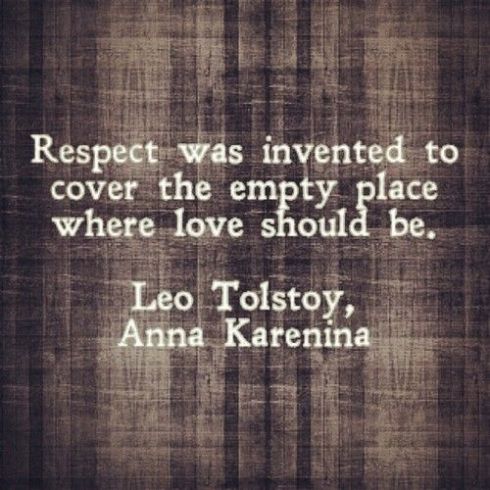
Tolstoy Quote


Warning: Long read, don’t moan at me, contains Foucault.

In a sense, I am a moralist, insofar as I believe that one of the tasks, one of the meanings of human existence—the source of human freedom—is never to accept anything as definitive, untouchable, obvious, or immobile. No aspect of reality should be allowed to become a definitive and inhuman law for us. We have to rise up against all forms of power—but not just power in the narrow sense of the word, referring to the power of a government or of one social group over another: these are only a few particular instances of power. Power is anything that tends to render immobile and untouchable those things that are offered to us as real, as true, as good
― Michel Foucault

The Beautiful Lie, ABC TV’s Sunday night serial for the past few weeks, is a reimagining  of Leo Tolstoy’s novel, Anna Karenina, set in the present day and with the Russian aristocracy transmogrified into Australian sporting elites, wealthy inner-city suburban parents, spendthrift and drunken relatives, and of course, landowners.

It’s an imperfect but nonetheless impressive production: a complex story of infidelity, betrayal, heartlessness and social shunning of yes, you guessed it, Anna the adulteress.

Tolstoy, like all the very best writers, is in the Foucauldian sense a moralist, and doesn’t accept anything as untouchable, definitive or immobile, or beyond his authorial remit. Anna Karenina is a forensic examination of the hegemonic myths of the reality, truth and goodness of family, and of love outside the social confines that are reified as normal, love which is inevitably perceived as transgressive and in the case of Anna, infinitely punishable, primarily by exclusion from her tribe.

All happy families are alike; each unhappy family is unhappy in its own way, is how Tolstoy opens his narrative, giving some indication of the trajectory of his lengthy imaginings.

Anna’s brother, Kingsley in the ABC production, is also an adulterer yet the consequences of his crimes of the heart are as nothing, compared to those visited upon Anna after she falls recklessly in love with Skeet, who is engaged to Kitty, the younger sister of Kingsley’s wife, Dolly.

Anna initially resists Skeet’s advances, but then leaves her controlling husband and young son to live with him, and bear their daughter. She is heartbroken by the loss of her son, who, with his father’s encouragement, refuses to see her. She becomes increasingly concerned that Skeet is philandering, yet every time she confronts him he denies this. In the last episode we and Anna see that he is indeed betraying her, in his mother’s house and with his mother’s knowledge.

The reimagining remains faithful to Tolstoy’s story and what is striking is the realisation that over time, cultures, and continents societal attitudes to marriage and adultery remain, in the middle class at least, largely unchanged and unexamined. The contemporary characters in this unfolding drama unthinkingly assume married love and lifelong coupling as of inherently moral value, against which Anna’s actions are cast as bankrupt, threatening their concept of themselves and the perceived inherent goodness of their life choices.

Anna’s tribe is, to use Foucault’s analysis, rendered powerless and immobile, their values untouchable as they unquestioningly accept the orthodoxy’s definition of what is real, true and good. Anna is torn between her own conditioning, and the disruptive nature of her desires, a power struggle that together with the unendurable ostracism of her tribe, is ultimately unresolvable for her.

In Foucauldian terms, Anna undergoes what he identifies as a “limit experience,” an unanticipated opportunity to challenge the power of the imposed boundaries of her life. The limit experience is the experience of extremes, which can release powerful creative forces and produce intense joy. The limit experience is the opportunity to liberate oneself, by transgressing  limits so set in stone as to appear “natural.”  The limit experience can take an infinite number of forms and in Anna’s case, it takes the form of sexual desire and the overpowering impulses of passionate love that crash through her values like a wrecking ball, causing all the chaos one would expect in a violent boundary rupture.

This is precisely what I love and have always loved about Anna. Unlike anyone else in her tribe, she has the yearning and the courage to blow her deadly safe life to bits. Inspired by desire, she refuses to accept the restrictive governance of peer constraints, and this impulse is as much of a shock to her as it is to anyone else. Nevertheless, shocked and awed, she remains true to the tumultuous experiencing of disruption, understanding that her life before Skeet was unfulfilled, and that there is no possibility of her resuming it.

What goes horribly wrong for her is that the man she chooses as her partner in the limit experience is not anywhere near her match, but more of that later.

The viewer isn’t called upon to question the authenticity of the protagonists’ behaviours and their consequences: they are as emotionally and psychologically representative of the present day as they were in Tolstoy’s. The woman who transgresses dies, either figuratively or literally, while the male transgressors lose very little, and are only temporarily shunned, if at all. There was no need to costume this drama: its themes and the manner in which their morality is upheld, transcend the passage of time.

Though Anna deeply loves Skeet, he doesn’t appear to have the character or capacity to meet her on the same level, something I think she understands quite early in their relationship but can’t bring herself to acknowledge. This is where her loneliness and sense of isolation begin: the man for whom she’s given up everything doesn’t know her, cannot meet her, and never will. Her isolation is exacerbated by the rejection of everyone around her, all of whom feel she’s stolen Kitty’s fiancée, abandoned a perfectly good husband and fretting child, and pretty much deserves whatever she gets.

When Anna turns up uninvited at Kitty’s wedding to landowner Peter, she’s wearing a scarlet dress. Everyone else is, at Kitty’s request, clothed in white. Everyone other than Anna is represented as pure and belonging, even the men who’ve betrayed their wives, including her brother. It is Anna who bears the brunt of the tribe’s fear and disapproval. It is Anna who is cast out, in order that the tribe might bond, their animosity towards her and fear that she will embarrass herself and them, becoming the bonding agent. She is the scarlet woman, the bright red blood that stains the virginal white. She is, quite literally, the rupture. They get rid of her as quickly as they can.

At first blush, it seems that Tolstoy is warning against illicit passion, his intention being to demonstrate that no good can come of it, and it will end, inevitably, in tears. The love may be real but the circumstances forbid its expression and to attempt to thwart those circumstances will cause only terrible grief and destruction. No more than in Tolstoy’s time do we currently appreciate the necessity of destruction as a pre-requisite for creation: the courage to disrupt, to permit limit experiences is framed in our times, as in Tolstoy’s, as madness and badness, and deserving of infinite punishment, never as much as when that courage is displayed by a woman, and expressed in a woman’s sexual and passionate desires.

But for mine, the core problem is that the lovers are mismatched: Skeet/Vronsky has nothing that comes close to the emotional depths Anna is capable of, and this is the heart of the tragedy. Anna’s desire for the limit experience is her desire for proof of life, however, her choice of lover is tragically misjudged. She has indeed lost everything, and for what?

When Anna kneels down on the train tracks, her expression as she awaits the oncoming locomotive is almost beatific. It is a weakness in the production, for mine, that Anna is portrayed as mentally unstable and under the influence of drugs as she begins her descent into suicide and the drug-fuelled instability is, it is implied, the cause of her almost orgasmic anticipation of death.

This representation feeds into the narrative that one must necessarily be of unsound mind if one wishes to die, implying that the only sane impulse we are permitted is the fight to stay alive. But should we ever accept any notion as definitive, untouchable, obvious, or immobile, including the notion of how and when we should die?

That the desire to die indicates a pathological unsoundness of mind is as much of an apparently immutable “truth” as is the glorification of life-long coupling as a high moral ideal. It makes perfect sense to me that for Anna release comes in death, suicide, as Foucault would have it, being the ultimate limit experience. It is the ultimate act of agency, the ultimate rejection of external power-over, the breaking of the last possible boundary that holds us in place in this existence we call life.

Anna’s expression, as the train’s lights loom, is one almost of bliss: the end of her suffering is in sight and it is a thing entirely in her control. Everything else is lost to her, against her will and her wishes, but her life’s end is the one thing over which no one else has domination. They have abandoned and ostracised her: but Anna will ultimately be the one who abandons them in the most permanent of ways, and one from which there is no possibility of return and reconciliation.

In death Anna reclaims her autonomy, and for her, this is the only means available. The tribe will never fully re-admit her. She is not of them. She is the scapegoat against whom they measure their commendable morality. She has torn great rents in the fabric in which is wrapped the sanctity of family, and has failed to  redeem herself by repairing it with another, lasting coupling.

Anna remains, for everyone who encounters her, a tormented symbol of the clash of incompatible powers: the deadening powers of the institutions that govern our social arrangements, versus the life-giving powers of desire. Civilisation and its discontents. The sacrifice of desire that is deemed necessary to ensure ongoing orthodox social order. How telling that the symbol of this enduring battle should be a woman, and how telling that the resolution for the upholders of the definitive and inhuman laws  is that the woman must die.

I don’t understand him, complained a baffled Noam Chomsky after an encounter with Michel Foucault. It’s as if he belongs to another species.

Her peers did not understand Anna, either, wishing that she could be of a species other than theirs, and she has been misunderstood for generations since. Heck, I doubt her creator even understood her, but that he loved her there is little doubt. His exquisite and agonising observations of her every momentary mood convey his passion and obsession. As that other author of  the cautionary tale of an infamous adulteress who takes her own life, Gustave Flaubert, remarked of his creation: Madame Bovary c’est moi, so Anna is Tolstoy. The two women are very different, and for mine, Emma Bovary has none of the courage and fascination of Anna, yet the architectonics of both novels chart the traditional course of inevitable female ruination as a consequence of acting on illicit desire.

Were I to reimagine Anna Karenina, I would have her as a warrior. I would have her confront her tribe, and the useless Skeet, with her courage and her insight and her contempt for their comfortable acceptance of the comfortable orthodoxy. I would have her say no, the lie is not mine, it is yours, and there is little beautiful about it. I would have her choose life, and if necessary, dwell alone with her children until such time as she met a lover who would know her, and meet her, and be worthy of her.

Such an ending was likely impossible for Tolstoy to imagine, or at any rate, write, and his objective was not to create a warrior woman, but rather the victim of a cult of love, who would be held responsible for her own victimhood. Had Tolstoy known Foucault, he might well have written a different story, a story that challenged received notions as to the ways things are, always have been and always must be.

Yet in some sense, this is exactly what Tolstoy has achieved, by accident rather than design, and for this, I for one am grateful.


Why Waleed is both right and wrong

23 Nov

This passionate plea from television personality and academic Waleed Ali, made in response to the recent terrorist attacks in Paris, begins with the statement: ISIL is weak.

This is true. ISIL, like any other organisation, institution and individual that resorts to violence, intimidation and slaughter, is weak. There is no strength in terror. There is only moral, intellectual, psychological and emotional weakness. To use violence is to admit defeat on all levels, though rarely will any organisation, institution or individual recognise and acknowledge that psychological truth.

The problem is, however, that weakness does not equate to harmlessness. The morally, intellectually, psychologically and emotionally weak have been responsible for the worst atrocities this world has witnessed and endured, and they have come from the east and the west, from most religions you can name, and from the secular.

It’s counter-intuitive to correlate weakness with terrorists. Terrorists terrorise, causing unfathomable anguish and disruption, disabling cities, bringing down aircraft, destroying families, creating bloodied havoc, leaving in their wake a sense of powerlessness, helplessness, rage and grief that have little possibility of resolution: why would we imagine these people as weak?

Waleed Ali is correct to call them weak in the moral, intellectual, psychological and emotional sense. But they are dangerous, and they remain dangerous, because weak does not equal harmless.

Today the city of Brussels is in lockdown in fear of a terrorist attack. ISIL are weak, but they can lock down cities. Imagine the fear and apprehension felt by residents of that city today, yesterday and tomorrow, as they wait for the next attack. And if it doesn’t come, they won’t easily stop fearing. ISIL are weak, but they are also controlling a city, manipulating its citizens through terror, and the threat of terror.

The weak are the most dangerous people on earth, because their weakness is so often expressed as brutality. To describe ISIL as weak is both true and misleading, the latter because the term “weak” is synonymous with harmless, pathetic, contemptible,vulnerable, but never with dangerous, murderous and brutal.

We can think of ISIL as weak, as Ali urges, but only in the understanding of what weakness means in this context. They are weak and they are dangerous. This danger can’t be underestimated because they are weak.


Turnbull v Abbott: PM in an age of terror

17 Nov

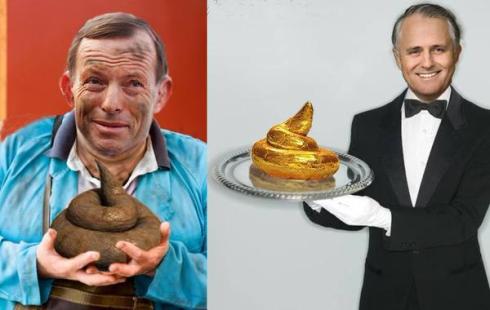
Abbott v Turnbull


Insofar as personality is a signifier of leadership ability (and like it or not, it is probably the most important characteristic as far as the voting public is concerned) Prime Minister Malcolm Turnbull was visited by the good fairy in his cradle while ex PM Tony Abbott was imbued with a Dickensian gloom by the bad one, who apparently took a set against him and threw in more than a dash of dark pugility as well.

Turnbull is a happy man who will likely smother us into an uneasy, baffled silence with his unrelenting affability and charm. Abbott is one of the more miserable public figures I can recall, who seems to feel it’s his duty to hector, lecture and create division amongst us, till we are choked by a miasma of exhausted despair.

However, Turnbull’s intelligence, good nature and charm works well for him internationally: sophisticated, urbane, accomplished, personable and wealthy, people take to him (if they don’t have to put up with him all the time, as do we) and likely open to him in ways it is impossible to open to Abbott, who never quite seems to get past the influences of the seminary, and his belief that he’s been chosen to bring us Truth.

If there is one thing we don’t need as we gird ourselves to deal with terrorist attacks at home and abroad, it’s a leader who believes he is the bearer of existential truths, and who sees the world in black and white with no inclination at all to investigate the grey zone.

Abbott has all the characteristics of the religious zealot, and since the Paris attacks has found various platforms from which to peddle his hatred of other religious zealots because their zealotry threatens his. This will get us nowhere, or rather, it will see us in a whole lot of serious domestic turmoil as tribe turns against tribe, ignorant prejudices fuelled by Abbott and his nemesis Pauline Hanson, whom he landed in jail because she threatened his claim to the title of Australia’s Leading Incitor of Fear.

Turnbull, on the other hand, will appear as a voice of reason, though he lost it somewhat when he first heard about the Paris attacks, stating that though the killers claimed to have acted in the name of God, they were actually perpetrating the work of the devil. Such rhetoric is entirely unnecessary. There’s nothing in the least supernatural about terrorism: it’s perpetrated by humans upon humans. The ability to terrorise is one of our more undesirable characteristics.

The PM’s relentless charm and good will is likely just what we need at this time to keep us steady: he is unlikely to threaten anyone with a damn good shirt fronting, and while he’ll be criticised mercilessly as a pussy by those who would see us engage in world war three, at least he won’t be whipping up ill will and fear. For this relief, much thanks.

I am of the opinion that it is the intention of Daesh to turn us against one another, and have those of us they don’t slaughter permanently weakened by fear, mistrust and hatred. Abbott’s trajectory, and that of those who support him, will lead us to precisely the same place: severely weakened by fear, mistrust and hatred, bitterly divided against one another. Daesh could not find more suitable allies than Abbott, Hanson, the usual shock jocks, religious fundamentalists and those who in some way, material and egotistical, profit from war.

Turnbull’s biggest challenge will be to control those within his own party who thrive on fear and repression. They are supported by many media voices, and their platforms are assured.

There is little that can be done to control Daesh at the moment. The only certainty is that for communities to turn against one another will be to give Daesh what they desire. I am not in the least enamoured of Turnbull or his style, but I can’t help thinking he is a marginally better leader in these times, in terms of the terrorist threat, than his ousted predecessor.

As far as domestic issues are concerned, the image at the top of the post says everything. Polish it up all you want, it’s still what it is.


Solidarity

16 Nov
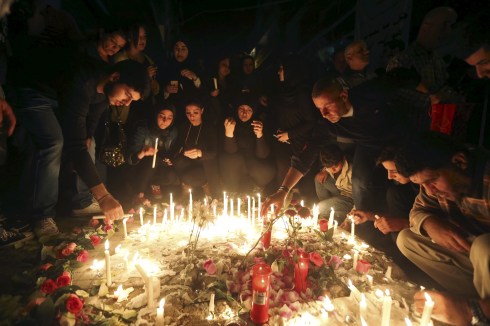
People light candles during a vigil at the site of the two explosions that occurred on Thursday in the southern suburbs of the Lebanese capital Beirut, November 13, 2015. REUTERS/Hasan Shaaban - RTS6U96

People light candles during a vigil at the site of the two explosions that occurred on Thursday in the southern suburbs of the Lebanese capital Beirut, November 13, 2015. REUTERS/Hasan Shaaban – RTS6U96


I’ve read all I can read for now from genuine experts, armchair experts, bigots, racists, xenophobes, politicians, atheists, religious persons, and trouble mongers, on the Paris terrorist attacks.

I don’t have the knowledge, the expertise, the wisdom to add to the thousands of words already written.

This woman, journalist Ruby Hamad, born to a Lebanese father and a Syrian mother, says, for mine, the most important things that need to be said. In her article titled Paris attacks: Is solidarity for white terror victims only ? Ms Hamad, without hatred, rancour or the desire for vengeance, says what needs to be said about who is and who is not considered fully human, what it feels like to not make the grade, and who gets to decide.

Please read her piece.