Archive | Politics RSS feed for this section

How to “lovingly” expel a homosexual student, or, God is in the house.

20 Feb

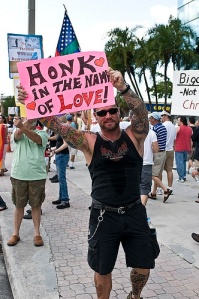
God hates fags.com via flickr


Brigadier Jim Wallace of the Australian Christian Lobby believes that a church school should have the right to expel any openly gay student.

“But I would expect any church that found itself in that situation to do that in the most loving way…I think it’s a loving response,” he says.

It’s legal for religious institutions in NSW to expel homosexual students, and Attorney-General John Hatzistergos, supports that law. While there are churches that oppose it, Jim Wallace gives it his whole-hearted support.

It’s difficult to know where to begin addressing the offensiveness of Wallace’s comments, but perhaps from a human rights point of view, it is most shocking in its reduction of the identity of a young human being solely to their sexual preference.

Nothing else about these students has any apparent value for Wallace, other than their sexuality. The intrinsic worth of the student is reduced to his or her sexual orientation. If the young person is brilliant, gifted, a high achiever – and gay, the Christian school should expel him or her, according to the well known Christian, Wallace.

“Lovingly,” of course.

Would this be another version of “tough love” perhaps?

How does one “lovingly” expel a young person from their school community because of their sexual orientation? Please explain.

Reducing a human being to one aspect of their character is a dehumanising tool used in all propaganda. When we can’t see another’s humanity, we’re far more likely to treat them badly.  It requires a leap of the imagination to make an identification with people who’ve been reduced to stereotypes, and many of us don’t want to/can’t be bothered with that imaginative exercise.

Propaganda ensures that certain lives (homosexual in this case) are not considered lives at all in the fullest sense. Reduced to the issue of sexual preference, and on the sole grounds that they are not heterosexual, gay students are punished by expulsion from their community, their lives stigmatized as deviant by their churches.

Failure to see young people as individuals in their own right leads to serious repercussions for them, and for society. Homophobic religious imperatives are determining the course of some students’ lives, with the support of politicians whose first concern is not the welfare of young people, but winning the religious vote.

Belief systems with discriminatory attitudes are putting young people at risk, and governments are supporting the process. This is described by Hatzistergos as maintaining “…the sometimes delicate balance between protecting individuals from unlawful discrimination while allowing people to practice their beliefs.”

Since he admits homophobia is “unlawful discrimination,” Hatzistergos’ position is that what the rest of the community has declared illegal is acceptable if it occurs within a belief system.  That church schools are granted permission to behave illegally makes a mockery of anti discrimination laws.

If a behaviour is illegal, it is illegal.

Religions in this country should be abiding by the laws of this country.

Around Australia, churches are exempt from anti discrimination legislation that prevents others from dismissing gay, lesbian, and trans gendered people, solely because of their sexual orientation.

Culturally salient beliefs normalize these problematic practices. One of these beliefs is that religious freedom trumps the anti discrimination culture.

But only some religious freedom, otherwise we’d be condoning genital mutilation and the polygamous and forced marriages of ten year old girls.

We’re selective about which religious freedoms we uphold.

Religious beliefs are fluid. Values change, often quite radically. There’s disagreement within religious circles about the expulsion of gay students.  It isn’t the government’s role to legalise these vacillating values, or to give legal validity to one point of view within the churches at the expense of another.

As our law declares discrimination illegal, the government’s role is to support and validate the country’s law.

Religions in this country should abide by the laws of this country. We require this of non Judeo Christians, especially those most recently arrived here. State and federal governments must require it of all religions in Australia, and particularly of all schools.

GOD IS IN THE HOUSE,  Nick Cave and the Bad Seeds

Nick Cave, by Ben Houdijk via flickr


Homos roaming the streets in packs,
queer bashers with tyre-jacks
Lesbian counter-attacks
That stuff is for the big cities
Our town is very pretty
We have a pretty little square
We have a woman for a mayor
Our policy is firm but fair
Now that God is in the house
God is in the house
Any day now he’ll come out
God is in the house.


How to stop the boats

18 Feb

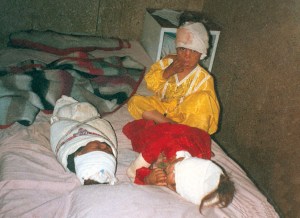
Three children wounded by US bombs in Nangrahar Province, Afghanistan


I‘ve said it before and brought down a load of trouble on myself, but I’ll say it again.

Australia is entirely responsible for boat arrivals. Doesn’t matter which political party’s in ascendency.

Because we are signatories to the UN refugee convention, we are known in  the world as a country that accepts asylum seekers for refugee assessment and resettlement.

Domestic law supports  the Convention. Australia invites anyone anywhere to claim asylum here, and seek refugee status.

No one who does this is acting illegally, no matter how they arrive, and whether they have papers or not.

Therefore, they come. Of course they do. Wouldn’t you in their place?

They have done nothing more than accept our invitation.

God help them.

Reading the comments on various articles the last few days, I’m pretty sickened by the overwhelming number of callous posts, blaming the asylum seekers for coming here in the first place, and blaming the government for not stopping the boats.

The answer is simple. We withdraw from the Convention, which we are not upholding anyway, and we change domestic law.

We then cease to be a country known for accepting asylum seekers, and asylum seekers will not endanger their lives trying to get here.

To continue to issue the invitation, and then to treat  those who accept it as sub humans, reveals a worrying sadistic streak in the Australian psyche. Clearly, we are not in the least hospitable towards those arriving in boats, yet we keep on inviting them.

Why?

If we aren’t prepared to withdraw from the Convention and change domestic law, then we obviously are  prepared to keep on extending the invitation.

Basic rules of human decency require that we treat those we’ve invited with hospitality and respect. We’re inviting them into our home.

What kind of host holds the guests in mandatory detention?

If nothing else, can we at least be honest about what we’re doing? Can we at least come clean about our two faced duplicitous position? Can we at least own up to the fact that we’re solely responsible for the situation, and not the asylum seekers?

They don’t know we don’t mean what we say.

It’s time to make a decision. It’s not rocket science. Get in or get out. But stop pissing about complaining, and tormenting our invited guests while we’re at it.

Of course, then we’d have to find somebody else to despise.

Lover, lover, lover – burying the dead, Scott Morrison, and L. Cohen

16 Feb

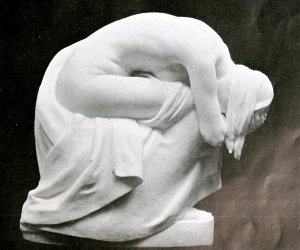
Grief. Edgar Bertram Mackennal via Commons Wikimedia

One thing the Shadow Minister for Immigration reminded me of yesterday is that whatever qualities may be required for the practice of politics, the possession of emotional intelligence is not one of them.

Morrison’s race to the bottom whine about misuse of taxpayer dollars to bring bereaved asylums seekers from Christmas Island to Sydney  has brought down buckets of approbation down on his head, and deservedly so.

Jonathan Green’s piece also reveals the morally bereft position of the government on the issue.

Morrison’s complaint was that Australians have to reach into their own pockets to attend the gravesides of loved ones, but asylum seekers don’t.

I did for a moment have a wild fantasy that this was a bit of theatre. Well, it gave Joe Hockey the opportunity to parade his compassion, and he is trying to get somebody from the government to go on Sunrise with him to lift his profile. And if there’s to be a tilt at leadership, given that Abbott’s apparently in roughly the same place as was Rudd when he got the axe, then Hockey’s a likely candidate. What better way to pitch him than as the mature voice of emotional reason, with Morrison’s forces-of-darkness gibberish as the foil?

But as LP’s Mistress Kimbrella (oh, lover,lover,lover, come back to me…) and Ken Parish reminded me, I have the capacity to think like a loony conspiracy theorist if I’m not vigilant.

BTW, friends, I was proved right about the OLO strife being provoked by more than one person, IBM stating it was the article that offended employees in their offices as well as their advertising agency, and it being revealed that Gregory’s call to the ANZ didn’t get a mention anywhere. I guess someone will apologise sometime? Just kidding.

I notice that LP’s supporters are still busily defending over at the Drum, including one commenter who writes, mysteriously,Christopher Pearson has every right to his vile hate-speech.

A generous friend gave me Leonard Cohen’s On the Road DVD and CD for Christmas. Listening to Cohen, and watching him, (not to mention the spectacular Javier Mas) is a great antidote to the inevitable and profound spiritual exhaustion provoked by politicians using the funerals of babies to let everybody know how tough they are.

I thought of politicians when Cohen sang:

I asked my father
I said, “Father change my name”
The one I’m using now it’s covered up
With fear and filth and cowardice and shame

Vale little babies, mothers, wives, husbands, uncles, brothers, sisters, aunts, daughters, sons, cousins, lovers and friends, drowned at Christmas Island. Vale.


Reclaiming marriage from the great big Christian hijack

10 Feb

This essay was first published by Graham Young in On Line Opinion, December 2010

In view of the scare tactics employed by the Australian Christian Lobby in their new petition to prevent the legalisation of gay marriage, it seems timely to publish it again.

by Danny Hammontree via flickr


Judging from the flurry of articles that have appeared recently written by Christians against same sex marriage (as well as same sex adoption, in which many similar religious justifications are invoked) one can be forgiven for thinking that many Christians believe their god invented the institution.

This could not be further from the truth. Marriage has existed a whole lot longer than Christianity. The Chinese philosopher Confucius, born in 551 BC, offered this delightful definition: “Marriage is the union of two different surnames, in friendship and in love.”

Indeed, there is considerable historical evidence that in Greece, Rome, China and Europe same-sex marriages were celebrated along with the heterosexual unions deemed necessary either for economic purposes, or for men to ensure (they hoped) the parentage of children.

For a period in our history marriage had little to do with romance and love, and much to do with economic and physical survival. The spiritual and emotional dimensions of marriage that many Westerners feel are at its core are relatively recent developments.

Christians imposed their beliefs on an institution that was already long in place, and called this fallacy god’s will. Instead of acknowledging that Christian marriage is but one example of that institution, they appear to deny validity to any other and thus attempt to reify their singular take on the concept.

So successful has this reification been that there are people who want to marry in churches, even though they never set foot in them before or after the ceremony. Many people feel an understandable desire for their marriage to be “blessed,” and there’s no doubt the Christian ritual can be quite beautiful.

I’ve no wish to throw the baby out with the bathwater.

But people marry for all kinds of reasons. For example, it’s estimated that some 200,000 marriages per year take place in the United States expressly for the purpose of obtaining a Green Card for the spouse who is not a US citizen. There are marriages made in Australia for the same pragmatic reason. These unions apparently disrespect the Christian god’s purpose for marriage, and ought to cause offence to believers. However, they don’t appear to be anywhere near as offensive to Christians as are same sex marriages, chosen on the basis of love, and the desire for commitment and family.

On the other hand, marriage between blacks and white in the US southern states (miscegenation) was illegal until 1967. Not only did the Christian god demand that marriage only take place between a man and a woman at that time, apparently he needed them to be the same skin colour as well.

It took that country’s Christians some 276 years to overthrow that particular racist injustice.

Christian beliefs about marriage change, as the above example demonstrates. Presumably, this is as a consequence of god changing his mind, and somehow relaying that change to the faithful who then update the law.

But what a truly intolerable state of affairs, that the lives and futures of many same sex couples are at the mercy of the arbitrary decisions of a transcendental exteriority that many citizens don’t believe exists at all, or not in the form touted by Christians.

This state of affairs is undemocratic. It breaches the human right to have freedom from religion as well as to have freedom of religion.

As some 60% of Australians are in favour of same sex marriage, it is puzzling that the two major parties continue to believe they can afford to ignore this majority. One can only conclude their mutual fear of offending the religious vote is stronger than their fear of offending the 60%, who they probably assume will not rate this issue highly on their wish lists of what they want governments to change.

One person’s god is another person’s superstition. Christians are not renowned for their democratic principles when it comes to the many varieties of spiritual practice at work in the world. Who can forget the scary tale of Mother Theresa baptising dying Hindus who were too ill to protest?  An act of spiritual terrorism by stealth if ever there was one.

The problem with many believers (not just Christians) is that their belief prevents them from respecting another person’s point of view. Non- believers are dismissed as simply wrong headed. They’re on their way to hell in a handcart, and they will be sorry when they get there that they didn’t listen when they had the chance.

There’s no reasoning with this mindset. Once you come up against the tunnel vision of implacable belief (often known as “faith”) you’ve come to the end of the discussion, and all that’s left to do is to walk away.

Then there’s the question of Christian credibility. The churches currently have a very bad reputation to overcome. The appalling incidence of sexual, physical and emotional abuse of children in their care, and the equally appalling attempts to cover up and deny these abuses, have gone a long way to undermining the churches’ credibility in any thinking person’s mind.

It was Jesus who said “It were better for him that a millstone were hanged about his neck, and he be cast into the sea, than that he should offend one of these little ones.”

Yet while ordinary Christians are more than willing to speak out against same sex marriage and same sex adoption, among many other issues of which they disapprove, they are bone-chillingly silent when it comes to protesting the evils perpetrated in their own back yards. Has there ever been a better illustration of Burke’s maxim “All it takes for evil to flourish is for good men [sic] to remain silent?”

Perhaps what is required from Christians these days is a little humility. An acknowledgement that they haven’t got everything right, indeed there are things they have got horrifically wrong, and that there is a collective as well as an individual responsibility for this that must be addressed before they can legitimately turn their rigorous attention to the maintenance of a broader human morality.

If I were imagining a god, she/he would care a whole lot more about believers destroying the bodies, hearts and souls of children than about preventing same sex marriage, and same sex adoption. If my god was going to smite anybody, I hope she/he would be smiting the perpetrators of those crimes against children, and those who enabled and protected those perpetrators and denied their crimes. I hope she/he would take positive action to enlighten those who would deprive children of love and legal security, solely because these people are unable to personally deal with the concept of love between same sex partners.

My god would teach that loving one another is the only thing that matters, and from that all else will grow.

She/he would also be smart enough to admit that loving one another is the hardest thing we’ll ever have to do on this planet.

“Love one another. As I have loved you, so you must love one another,” said Christ.

“We must love one another, or die,” said the poet, W.H. Auden.

“If I speak with the tongues of men and of angels, but do not have love, I have become a noisy gong or a clanging cymbal,” warned St Paul.

It’s time to reclaim marriage from the Christians. They can’t claim it as their own. It belongs to everybody. Marriage in Australia in 2010 is about loving one another, whatever gender the other happens to be. It is about hope, and deeply good intentions. It’s about wanting to be the best a human being can be. It’s about wanting to create a living, breathing mystery, day by day, with the person you love and who loves you.

It doesn’t always work. Hearts get terribly broken. We dust ourselves off, and sometimes have another crack at it, because we are very brave, and we are full of hope, and we have a vision of enduring love that keeps us going, no matter what form our marriages take, or even if they end.

We do this whether we are Christians or not. We do it because we are human beings who at our best are capable of living out these wonders regardless of gender, and oftentimes in spite of the difficulties gender can create for us.

I’m perfectly happy to let Christians conduct their marriage ceremonies according to their beliefs. And every other religious group as well. They don’t have to celebrate same sex marriage in their own places of worship if they don’t want to. This is one of the freedoms our democracy guarantees. I don’t wish to take that freedom away from Christians or any other religious group.

But what no democratic government should tolerate is Christians, or any other religious group, defining marriage and dictating its practices in this country. Government decisions must not be based on religious belief in our pluralist society. They must be based on what is fair, what is just, and what is non-discriminatory. Democracy is inclusive. Christianity, sadly, increasingly demonstrates that it is not.

Same sex marriage and same sex adoption are not dangers from which governments need to protect us. But the tyranny of religions destroying anybody’s democratic rights to these things, most certainly is.

Linda Burney’s punitive stand on surrogacy.

6 Feb
Dibujo del perfil de Nicole Kidman

Image via Wikipedia

If Nicole Kidman and Keith Urban had hired an overseas surrogate to carry baby Faith Margaret while living in any of their NSW homes, and then returned with their baby,they would be subject to fines and jail sentences, under the terms of  the amendment to surrogacy legislation introduced by NSW Minister for Community Services, Linda Burney.

On March 1 2011 NSW legislation on surrogacy will pass into law, making commercial surrogacy illegal in the State.

Linda Burney has added an extra territorial amendment to the original surrogacy bill, extending the criminalisation of commercial surrogacy to those who employ overseas surrogates.

The penalties for using an overseas surrogate will be a fine of some $110,000, and/or two years jail.

As well, the child parents bring home will have no legal rights and protection, as do all other children in NSW, regardless of the method of their conception.

Parents may apply for parentage orders for their children, however in doing so will run the risk of criminal prosecution, with fines and possible jail terms.

This would seem a powerful disincentive to applying for appropriate orders, leaving the children in a right-less and unprotected limbo.

As well, Burney’s amendment assumes that all those seeking overseas surrogacy arrangements will look for underprivileged women who need the money.

There are many commercial surrogates overseas who are middle class women, and who make an informed choice to carry a child for another woman.

The Minister’s justifications

Minister Burney’s justification for the extra territorial clause is that she wishes to, in her language, punish those who “take advantage of women who hire out their bodies because they are poor.” Criminalizing those who have been unable to find altruistic surrogates in NSW and turn instead to women overseas is the realisation of Burney’s desire to punish.

It is unrealistic in the extreme to expect this criminalizing of a minority group of NSW citizens will make any dent at all in the exploitation of women in countries where commercial surrogacy is legal. One might as well criminalize everyone who buys a t-shirt made in a Bangkok sweatshop by six year old children who are paid 20 cents a day for their labours.

Or what about the Australian citizens who travel overseas for say, a kidney transplant to a country where the traffic in human organs is unregulated and people sell the parts they can live without for an income? Are we going to criminalize those citizens and prosecute them when they come home with their new illegal part on board?

A divisive issue

Commercial surrogacy is a morally divisive issue. Those against it argue that it results in the depersonalisation of pregnancy and childbirth, and that it treats both women and children as commodities. Wealthy couples can “rent a womb” from financially vulnerable women, and this, in the eyes of some, is exploitation of the worst kind.

Commercial surrogacy is felt by some to be degrading to both women and children. It is perceived as morally offensive, and as treating other human beings merely as a means to an end.

There are potential emotional difficulties on all sides, including that of the child.

The argument for (briefly)

Those who argue for commercial surrogacy point out that it is a matter of personal autonomy for all the adults involved. If a woman wishes to act as a surrogate that is her business, they argue, and she is entitled to remuneration for her time and work.

If commercial surrogacy is permitted and regulated in NSW, then it will lessen the need for couples to go overseas and into situations of possible exploitation, they claim.

To proscribe commercial surrogacy on the grounds that it’s harmful to those undertaking it is interference by the State in personal matters that are not the State’s business, and that belong in the realm of the private conscience, some argue. It is not acceptable, this argument continues, for the State to impose and enforce one moral aspect against private actions that do not harm others.

What is Burney’s amendment good for?

It seems highly unlikely that Burney’s amendment will prevent couples seeking commercial surrogacy overseas. What it will most certainly achieve is the legal alienation of the resulting children in this State. It will cause parents to conceal their activities, perhaps even from their own families, for fear of prosecution.

It will cast an unacceptable and permanent cloud over such families and their children. It will drive those having no option but commercial surrogacy, underground.

And for what?

To satisfy Burney’s need to take a moral stand against the laws of other countries.

Moral stands are often good and necessary things, but only when they’re realistically weighed up against their usefulness, and their consequences. In this case the usefulness of such a moral stand would seem to be minimal. The consequences, on the other hand, are horrible and permanent for the families concerned.

The reality is that couples needing the services of a surrogate are going to find one, somehow, somewhere.  Those of us, who like Ms Burney have not needed to take this drastic action in order to create our families, need to be especially careful when prescribing for and judging those less fortunate in that respect.

It is an especially weighty responsibility for Burney, as she is in a privileged position. She has the power to create a situation in which those less fortunate than herself are criminalized, and their children cast into a legal limbo.

Burney’s extra territorial amendment could well be seen by some as an abuse of her power. Perhaps it isn’t a politician’s role to punish those he or she disagrees with, on moral grounds that are far from unanimous in the community.

Perhaps it is especially distasteful when a politician acts on a personal desire to punish constituents who are already struggling with the fraught issue of creating their family.

Surrogacy in NSW Law Reform Commission Discussion paper

Bleeding heart and bloody proud of it

17 Jan

Bleeding Hearts by Darren Bannister via flickr

Fed up with defending my position after an article I wrote for On Line Opinion last week about asylum seekers was greeted with the usual scorn, disparagement, ridicule and personal abuse , I spat the dummy.

I addressed the dummy spit to a particular poster, who, unlike me, remains anonymous and therefore free to say anything at no personal risk. Very brave.

But my break out was aimed at all the like-minded.

No Shadow Minister, you’re wrong.

The “single defining weakness of my argument” is that it is based on my visceral and moral objection to causing suffering and death to asylum seekers who are doing nothing more than accepting the invitation we have extended to seek refuge here.

My argument doesn’t have, in your terms, just one “single defining weakness.” It has many: (and here I listed as many of my “weaknesses as I could think of in a state of  rage)

1. It’s based in observing the spirit, as well as the black letter (as you recommend) of domestic law and the UNHCR Convention.

2. It is based on my abhorrence for the deceitful duplicity that leads my country to spend unacceptable amounts of money finding its way around laws it has voluntarily implemented, rather than having the courage and the honesty to admit these laws apparently no longer work for the country, and start addressing them.

3. It’s based on my profound disgust at my country’s willingness to use the death of asylum seekers, and the suffering of survivors incarcerated indefinitely in detention centres, as an example to other asylum seekers not to come here.  (Definite “weakness.”)

4. It is based in my belief that people of the world share a common humanity, and asylum seekers who arrive by boat (at our invitation) are as entitled to humane treatment as is any body else.  And we all know how “weak” it’s considered to hold that belief.

5. It’s based on my belief that to cause suffering in one person in order to teach another person a lesson is a very dubious moral position, and is abhorrent to me. (How “weak” is that?)

In my world, the governing maxim is “ First, do no harm.”

I probably hardly ever achieve that goal, but it is my goal.

I understand that you consider that position, and all my other positions, to be “weakness.”

Because of suffering in my own life, I’m not able to advocate inflicting it on anyone else. This reluctance is often interpreted as a weakness.

We  live by our values. If mine are considered “weak” by some, I can’t say that either surprises or upsets me.

Shadow Minister replied that I am being “emotional” and that an emotional position on refugees will end up like the pink batts did.

Oooo-eeer! Emotion! How scary is that!!!

Shadow Minister also said that my do no harm philosophy is what drowned people at Christmas Island.

And I thought it was a storm.

This exchange at On Line Opinion has sorely tempted me to ditch my personal philosophy for a while.

Somebody besides her mum loves Julia Gillard

2 Jan

Little Miss Piggy in the middle. By Leonard John Matthews. flickr

Julia Gillard: a breath of fresh air for Aussies

Australia’s PM rises above the usual rough and tumble of federal politics – and her mother will stop her becoming a Thatcher

by Dorothy Rowe, in the Guardian,December 20 2010

My hero is Julia Gillard, Australia’s prime minister. Her predecessor, Kevin Rudd, has many great qualities but knowing how to be a leader is not one of them. His party forced him to resign and Gillard, until then his deputy, took his place. Australian federal politics is rough, loud and often vicious. Gillard knew this well and she had developed a way of speaking that is slow, clear and determined. Her wit is sharp, intelligent and funny, and often surprises and silences her critics. She is well versed in conducting a long-running, rational and informed debate. Michael O’Connor of the Construction, Forestry, Mining and Energy Union, who knew her well, warned: “You didn’t really want to be arguing a point of view against her if you could avoid an argument with her. She was very serious about winning it.

A debate with someone who holds opposing views but is well informed and rational is difficult, but it can be both productive and clarifying. However, the leader of the opposition, Tony Abbott, aka the mad monk, scorns both rationality and facts. He provides the soundbites that the media loves, so he grabs the headlines and creates confusion and much misinformation. Gillard has the task of maintaining, not just for herself but for her audience, clarity of purpose. She must not sink to the level of mere abuse, as is popular in Australian politics, but must continue to present herself as being imperturbable. A knife under the ribs rather than a bludgeon over the head.

All too often in my life I have welcomed a particular leader as a hero, only to see him or her ignore Lord Acton’s warning: “All power corrupts. Absolute power corrupts absolutely.” I was worried that, as a successful Labor leader, Gillard would be corrupted by power until I read that her mother, on learning that Julia had become PM, said that her daughter would be “the best [prime minister] there is”, adding: “So long as she doesn’t turn into Maggie Thatcher.”

With a wise mother like that Julia Gillard might yet become the rarest of leaders, one who is not corrupted by power.

*

No Place for Sheep replied, in its usually restrained manner:

Dorothy Rowe – where are you getting this information?

We don’t like Julia Gillard.
Her voice makes us want to throw ourselves out of windows.
She IS Thatcher, but in a faux velvet glove
She is a robot produced by the ALP party machine with all humanity leached out of her.
Moving forward! Moving Forward! she shrieks at us like a demented darlik.

It is estimated that she is losing 120 votes per hour for the ALP.
She has no backbone, no spine and no moral compass.
She looks NOTHING like your photograph of her.
I cannot begin to tell you how little respect this woman has in this country and it’s getting less and less every day.

Did her mum pay you to write this twaddle?
UK people, please listen! Our PM is really, really, really the worst PM we have ever had and that is saying a lot because we have not been blessed in this regard.

I think your article is a total disgrace, Ms Rowe.You sooo do not know what you are talking about and you shouldn’t be peddling this un-researched twaddle.

PS The photo you used is an airbrushed one by the Women’s Weekly.

guardian.co.uk © Guardian News and Media Limited 2011

PPS: People have remonstrated with me about these comments, saying that I have been unkind to Ranga. Haven’t they read any Comments sections lately? They are not for the faint-hearted, and these are quite mild compared to some responses to this article.

Be that as it may, I don’t wish to be unkind, even if I am talking about a once highly trusted deputy prime minister, given enormous power and prestige by the boss who had nothing but faith in her abilities and loyalty, only to find her dagger lodged in his heart.

As Ghandi said, an eye for an eye leaves the whole world blind and I shouldn’t be vengeful. It’s not like I was that happy with Ruddy. It’s just the principle.