Archive | Politics RSS feed for this section

Australia: a country of vengeful malcontents

24 Jan


wall-of-hate

In this piece titled “Manus Island: what will it take to shock us?” Julian Burnside, barrister and refugee advocate, gives a powerful synopsis of the cruelty the Australian public is prepared to tolerate its governments inflicting on asylum seekers, in the crazed collective desire to “stop the boats” and protect the country’s “sovereign borders.”

The answer to Mr Burnside’s question is, of course, that the only thing that will shock anyone at this point is a government that is prepared to cease and desist from using asylum seekers as human fodder in election campaigns. We have reached the stage in this matter where the only possibility for provoking shock is decent behaviour.

The contempt in which the Australian public holds asylum seekers who arrive here by boat is sickening. As has been noted on other occasions, we treat people who are far more threatening to us individually and collectively much better than we treat unarmed people seeking sanctuary who travel here by boat. The unexamined hatred, prejudice, loathing and contempt directed towards asylum seekers, chillingly orchestrated by political leaders of both major parties, is mind numbing, and it has numbed the minds of the Australian public in general to the degree that many believe we aren’t harsh enough. 60% of Australians, according to a poll conducted in September 2014, (see link) believe we are not treating waterborne asylum seekers badly enough.

From a psychological perspective, this leads me to believe that we are a nation of desperately unhappy, dissatisfied people who for many reasons, some of them undeniably sound, live with a sense of profound grievance that has to negatively express itself towards somebody and something. I draw this conclusion because people who are living lives in which they find satisfaction and enjoyment at least some of the time, are not inclined to desire the persecution of others, let alone bay for blood like rabid wolves because a few thousand stateless persons have turned up looking for sanctuary.

Regrettably, it would seem that these miserably vengeful Australians are in the majority, and one has to ask, why is this so? What has gone so awry in this lucky country that so many of us need to take out our apparently endemic discontent on the helpless and the vulnerable? Because it is not only asylum seekers towards whom this loathing is directed, although they are the extreme example of its concrete manifestation at this moment in time. In reality, any individual and group that can be defined as less than what the miserable majority  consider the “norm” are targeted for persecution in some way, and our politicians lead the ranting, bloodthirsty, vengeful pack.

“Fair go” is a principle inherent in the Australian “character?” My arse it is. My arse it ever has been. If it was, we would not have politicians who seek election and re-election on the backs of the most vulnerable in the first place, because it wouldn’t win them votes.

What will it take for us to be shocked? Common sense and decency in our political leaders. That’s what it will take to shock us. Don’t hold your breath. Neither of those things is coming to a marketplace near you anytime soon.

This blog on The Monthly on conditions on Manus as reported by workers there is well worth a read. Thanks to Robyn here for the link.


Tony Abbott, horses mid stream and musical chairs

23 Jan

Changing horses mid stream


I’m most interested to see what the LNP do with Prime Minister Tony Abbott come the next federal election. He’s been conspicuously absent in recent state election campaigns, presumably because nobody thinks he can do them any kind of good with his presence. So what on earth will his party do with its leader when we troop off to vote for our country’s next government?

Abbott subjected himself to some self-harm yesterday as he argued his case for the dangers involved in changing leaders during a government’s first term. Citing the epic game of musical chairs played by the ALP government during the Julia Gillard – Kevin Rudd leadership saga, Abbott expressed the opinion that it’s certain death to switch horses mid-stream. His party has the sense to know this, he believes, and so his leadership is secure. The country can go to the dogs and the less well-off can struggle and starve, but hey, I’m secure in my job, folks.

I know I’ve mixed metaphors, but I sort of like the image of chairs, music, dogs, streams and horses in the middle of them. It makes as much sense as anything else in our politics.

It’s hard to imagine that changing leaders could do the LNP government any more harm than staying with the one they’ve got. I suspect many people would be hugely relieved and congratulate them on their common sense if they took that step.

The dangers of succumbing to the idée fixe that because it was so damaging for the ALP to change leaders it will be equally damaging for the LNP, are many. They include an ignorance of the significance of context: the two situations are quite different in the broad perspective, the  perspective that is most apparent to voters. Rudd was an extremely popular leader who was to all appearances ousted unjustly and in a manner that outraged much of the electorate. Practically everyone has some grievance against Abbott, and many just hate him because he is.

There may be similarities in the in-house view, the view apparent to political tragics rather than more broadly, of party discontent with a leader who is perceived as out of touch and chaotic, and perhaps even a tad despotic, if leaks of discontent are anything to go by. There’s an enlightening piece on these matters by Paula Matthewson here.

What we see at the moment is a leader who appears increasingly weakened by strife, both endogenous and exogenous. Tony Abbott never seems less than strained. As we used to say when we lived on Bougainville Island, we have two seasons, wet and wetter and so it is with Abbott, he is strained and more strained, but I don’t believe I’ve seen the man comfortable with himself since his days in opposition when he raged across the table at the Labor government.

For mine, they should let him keep his job. The ALP needs all the help it can get, and Tony Abbott has to be one of the opposition’s best helpers.

If Abbott gave a stuff about anyone other than himself, he’d step down, citing ill -health or some other face-saving gibberish, and give his party a better chance at a second term. Otherwise, come the next election campaign they’re going to have to lock him in a cellar till it’s over, because the man mostly nauseates everyone, as far as I can tell.


Cruelty is the worst policy

20 Jan


Amnesty Poster


In general, it’s always seemed to me that when governments or individuals take an increasingly hard, harsh and inhumane stand on an issue it’s a clear signal that they’ve actually lost the battle, and are on their way to losing the war.

In a political sense, I’m thinking of the current situation in detention facilities on Manus Island. New Immigration Minister Peter Dutton is promising to maintain Scott Morrison’s “hard-line” against asylum seekers who have resorted to self-harm and protest, methods which are, in reality, their only means of expression, as the Australian government has virtually denied them access to legal process and natural justice.

This hard-line against asylum seekers protesting their fate began in Woomera and Baxter detention centres in 1999, at the instigation of the Howard LNP government. It was maintained by the ALP governments led by Julia Gillard and Kevin Rudd. Sixteen years of both major parties taking a hard-line against waterborne asylum seekers has achieved absolutely nothing any of us can be proud of, and it won’t.

Similarly, the hard-line threatened by the Abbott government against the young unemployed that will see them starving and homeless as they are denied benefits for six months will achieve nothing any of us can be proud of, and will ruin lives for a very long time and likely permanently.

Taking a hard-line is very rarely necessary, and very rarely useful. A hard-line shouldn’t be the default position. Instead negotiation, mediation, conversation, and communication are civilised and humane methods of approaching difficulties. When all else fails, by all means try the hard-line, but to do this first is cruel and inhumane, and shows a lack of intelligence, imagination and skill.

Human beings have a tremendous capacity for good will and understanding. It’s a great shame our leaders don’t value this capacity, and instead believe our strength lies in brutality. It doesn’t. It never has and it never will. All cruelty springs from weakness, as the philosopher Seneca noted.

If governments and individuals are too weak and cowardly to sit across a table from other human beings in an effort to resolve difference and difficulty, they will inevitably resort to cruelty of one kind or another. Ignoring another human being in need is just as cruel as taking direct and punitive action against him or her. There are countless stories of asylum seekers achieving success and making considerable contributions to Australian society when they are given the opportunity. Instead we destroy them because our governments believe the destruction of human lives and human potential demonstrates political strength and determination.

Peter Dutton may well congratulate himself for emulating Scott Morrison’s abhorrent tactics against those legally seeking asylum in Australia. But emulating a bully is no great achievement. Australian governments have for sixteen years now proved themselves to be capable only of bullying behaviour towards human beings in the greatest distress and need, be they asylum seekers or their own citizens. Cruelty is not a strength. It is the most appalling, base and destructive weakness.

The arbiters of taste: who will control society?

14 Jan

security-vs-liberty


In his blog for The Monthly on the Charlie Hebdo massacre, Mungo McCallum concludes his Readers’ Digest argument that laughter is the best medicine by observing that even those wielding automatic weapons can’t fire them if they’re doubled over with mirth.  “After all,” he writes, “even the most rabid fanatic would find it hard to aim a Kalashnikov while guffawing.”

McCallum’s piece is about the lines that are or should be drawn between satire, humour, and offence, but what he fails to address is who exactly is to determine those limits, and what criteria they are to employ in order to arrive at their judgement.

This is another aspect of the battle for societal control so relentlessly fought by groups such as Collective Shout and individuals such as Melinda Tankard Reist, with whom I have locked horns on more than one occasion. See the Category Defamation Threats on this blog if you want to know just how hard these people will go after you in an effort to shut you up and impose their views.

I know people who find Seinfeld cruel and unfunny. I know others who find The Simpsons offensive to their sacred notions of family. I’ve heard arguments that the HBO series Breaking Bad, in which a regular high school chemistry teacher morphs into a drug lord after learning he has terminal cancer, has led to an epidemic in the manufacturing of methamphetamines. I find McCallum’s line quoted above offensive in its casual dismissal of the profound seriousness of rabid fanaticism. I don’t find it satirical or humorous, and I suspect it could only have been written by someone who has little first-hand knowledge of any kind of terror.

The point is, something will always offend someone. There are those who are outraged because every cliff top in the country is not fenced off to protect us from falling over it and sustaining injury, or death. There are those who want to kill every shark in the ocean because now and then one of them eats someone. There are those who believe being hurt and offended is so great an injury laws can and should be passed to prevent their emotional distress.

There are those who take out their Kalashnikovs because they believe being insulted and offended are justifications for murder. There’s very little that can be done about someone with that particular mindset, and if all other provocations are denied them through censorship of potentially provocative commentary they will still kill, on the spurious grounds that an entire mode of existence is offensive to them and it’s their right to eradicate it.

The fight for the power to wield societal control is constant, and it takes a myriad of forms. In general, our liberal democracy is controlled by the values of the bourgeoisie who are, also in general, obsessed with issues of law and order, affronted by graffiti, entirely precious about their right not to be offended, insulted or otherwise emotionally ruffled, and consumed by notions of decency and what they determine to be appropriate. Look at our politicians if you don’t believe me.

There is no doubt that words can damage. Vilification of any kind causes hurt and damage and destruction. Rather than impose legislation that seeks to prevent and punish the utterance of damaging and destructive words, satirical commentary, unfair criticism, racial and religious abuse, I would prefer that we instead focus our attention and resources on education and remediation. I think this because largely legislation has no effect at all in everyday situations, and in many instances can make resentment against the other, whoever the other happens to be at any particular time, even worse.

In my opinion, legalisation that seeks to control who can say what, when and where is driven by bourgeois desires to exercise social control and create a perceived utopian culture in which proponents of bourgeois ideology feel most “comfortable.” While the bourgeoisie have not yet resorted to firearms with which to impose their vision of the world, they have instead demanded a level of surveillance and state control over language and how it may and may not be used that is astounding.

While I do not agree with Attorney-General George Brandis that everyone has the “right” (whatever “right” means in his context) to be a bigot, it seems to me that legislation attempting to prevent the expression of bigotry is doomed to fail, except in very rare high-profile situations.

The battle for societal control will not be won by silencing. It is a wrong-headed and prejudicial battle in the first place. We cannot, for example, silence the Murdoch press and even if Andrew Bolt came a cropper with his racist views what was gained in the larger sense by his stumble? He hasn’t shut up, he’s just as offensive, if not more so, and he gained an inordinate amount of support and sympathy. In general, his name is remembered as a consequence of those events, and not the names of those vilified and insulted, or the nature of the vilification and insult.

I know from my own experience of being threatened with legal action if I didn’t retract and shut up that it only made me more determined to express views I believed to be worthy of expression and that I had the right to express, because why shouldn’t I? My views were extremely offensive and insulting to some. So what? Theirs were equally offensive and insulting to me. Neither of us should have been silenced, and only one party (not me) had the financial wherewithal to threaten the other with silence or ruin.

What we need to do is think about is what can be done that will actually achieve fundamental change, instead of focusing on window dressing and  band aids that at best do nothing and at worst incite those who are silenced by legislation to even more devious expressions and behaviours.

McCallum is wrong, laughter is certainly not the best medicine when faced with a Kalashnikov, or being otherwise silenced by punitive measures employed by the state at the behest of the hegemonic bourgeoisie.

The best medicine is to resist and refuse efforts to silence, to be subversive, to transgress, to contest, to challenge, to protest, to be civilly disobedient, to refuse to be shut up by those who are “uncomfortable” with certain forms of expression. Your discomfort is not my problem, tell them. It’s yours. I’m sorry you feel it, but there are ways you can deal with it if you have the courage, and silencing me is not one of them.

I laughed my head off, said someone taken hostage by murderous ideologues never.


Freedom to speak. Section 18C and terrorism

13 Jan


voltaire-quote1


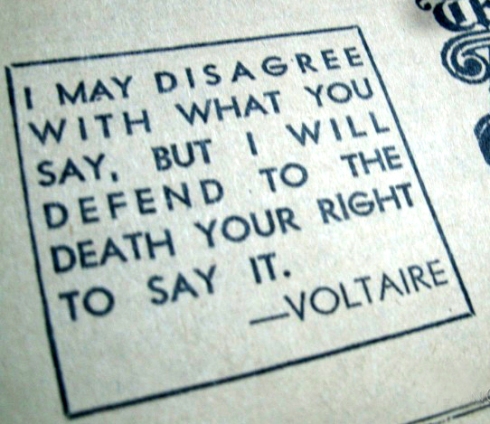
I find myself in a familiar turmoil over the issue of free speech, raised again most recently by the Charlie Hebdo massacres. Those lives were not lost because of the exercise of freedom of speech. They were lost because violent, brutal ideologues murdered them. The lives lost in the 9/11 attacks had nothing to do with the exercise of free speech. Thousands upon thousands upon thousands  of civilian lives lost in wars waged by western powers were not lost because the victims were exercising freedom of speech.

While I abhor the dehumanising stereotyping that is at the heart of hate speech and racial vilification, murderers are responsible for murdering and those ideologues determined to murder will do so, and they will find any reason to justify their thirst for destruction. It is ludicrous to claim that offence and insult are provocation enough to incite them, and that attempting to restrict offence and insult will do anything at all to restrain their murderous impulses.

Race is a construct, used to justify ill-treatment and dehumanisation of those not in the dominant tribe. Religion is a construct, also used to justify ill-treatment and dehumanisation of those not of the dominant belief system. Race and religion are equally illusionary, that is, they are human constructs that have come to be reified as monolithic truths for which people are willing to kill and to die. Section 18c of The Racial Discrimination Act will not affect these monolithic truths, and the willingness of their adherents to murder and die for them.

The human species has not yet evolved out of its need to gather in tribes of one kind or another, and take arms against those they define as not of them. Restricting free speech does nothing to address these fundamental problems.  In many situations it serves to exacerbate division, for example in defamation legislation that inevitably favours those with wealth and power over those with none.

There have always been and will always be extremists and radicals. We can no more expect to live free of the threat of terrorism than we can expect to live without the air that we breathe.

In the end, nothing will be as effective against terrorism as the freedom to speak, even if that speech is offensive and insulting. Those of us who aren’t murderous extremists must learn to deal with speech that insults and offends us because the option, a mass silencing,a mass surveillance of thought, word and deed is far too horrific to contemplate. There is no human right not to be offended. A life without insult is a sheltered life indeed. It is a serious loss to Australian society that a magazine such as Charlie Hebdo could not be published in this country. If you don’t like it, don’t read it, but to make it illegal is unacceptable.

What is wrong with us is that we do not regularly mobilise as did the French in Paris yesterday, visibly united against terrorist attacks. What is wrong with us is that we have become too precious, too willing to allow governments to take responsibility for us in legislation that is and can be little more than a band-aid. Over-protection weakens and infantilises us, and causes us to give up our power to those who would control us, whether they are elected governments or murderous extremists.

Terrorism, and political and governmental reaction to it is spectacle, and it is the same, shared spectacle. It is bad theatre. It is full of sound and fury, signifying nothing and it will not save us from death and destruction, metaphorical and literal, by those who would silence us.


Update: This is the piece on Charlie Hebdo being published in Australia, to which I attempted to link in The Australian and was initially foiled. Suck it up, Rupert.


Being Charlie — with 18c in place, Australia says ‘non’


Charlie Hebdo from October 2014.

SATIRICAL French publication Charlie Hebdo could not be printed in Australia under existing restrictions on free speech, despite its cartoons being embraced across the world as a symbol of Western liberties after the massacre at its offices.

Human Rights Commissioner Tim Wilson told The Australian the restrictions contained in section 18c of the Racial Discrimin­ation Act would “ensure it would be shut down”; he was supported in this position by media law ­experts.

The carnage in Paris has also encouraged two Liberal MPs to publicly call for the debate about changes to section 18c to be re-opened after the government last year unceremoniously dropped its planned reforms following a fierce public backlash.

Mr Wilson, dubbed the “freedom commissioner”, has taken aim at opponents of the 18c changes who are now rhetorically embracing free speech, warning that words needed to be backed up with concrete action.

Failure to do so would be seen as hypocritical, he said.

“The Charlie Hebdo attack is a wake-up call for a lot of people who rhetorically support free speech but when it comes to the nub would choose political ­advantage over sensible reform,” he said.

“This is where they have an opportunity to rise to the challenge, like the leaders of Europe are now doing, rather than being held out as hypocrites.”

In The Australian today, the chairman of the parliamentary joint committee on human rights, West Australian senator Dean Smith, challenges Tony Abbott and Bill Shorten to support a private senator’s bill proposing a middle pathway forward on an 18c overhaul.

The Opposition Leader yesterday indicated he remained unmoved on 18c.

“You don’t give the green light to hate speech when in fact it’s hate which is what we’re all ­united against,” he said.

Mr Shorten said it was distasteful to turn the events in Paris into a domestic political issue. “It is an inappropriate stretch … to see government MPs trying to use what happened in Paris to justify divisive debates.”

The government has formally ruled out any changes to 18c, saying they are “off the table”.

While Mr Wilson argued that many of the religiously themed cartoons in Charlie Hebdo would not fall foul of the discrimination act, he said that racial stereo­typing of Jews and other ethnic groups would create too many legal issues for such a publication to continue in an Australian context.

“18c only covers issues of race and ethnic origin, which would cover some of the material but not all of it,” he said. “It would cover Jews and ethnic representations, but it wouldn’t cover Muslims and other bits. In the end, the legal problems would essentially ensure it would be shut down.

“I think there are lots of different avenues for reform, but I think there are more issues than just 18c that need to be considered.”

Senator Smith threw his support behind Mr Wilson, but urged for a renewed focus on 18c. He is urging both sides of politics to back a private senator’s bill he has co-sponsored with Family First senator Bob Day, Liberal Democrat David Leyonhjelm and Liberal colleague Cory Bernardi.

Senator Smith says the bill could form a “legislative monument to the human price paid by France” and would simply remove the words “offend” and “insult” in a finetuning of 18c.

“By agreeing (to the bill) … Tony Abbott and Bill Shorten will have kept the protections against ­‘humiliate’ and ‘intimidate’,” he writes. “Our leaders have read the mood with precision and Tony Abbott is right to remind us to be prepared to ‘speak up for our ­beliefs’ and ‘call things as we see them’. It is now time to crown our words of vigilance with a deed.”

Senator Bernardi said he absolutely supported the passage of the bill.

Simon Breheny, the director of the legal rights project at the Institute of Public Affairs, told The Australian that Charlie Hebdo’s cartoons certainly “would have been caught in Australia by section 18c of the Racial Discrimin­ation Act”.

“Even if it wasn’t caught by section 18c, there is no doubt they would have fallen foul of restrictive state racial and religious vilification laws. This is one of the possible explanations as to why we don’t have any kind of publi­cations in Australia quite like it, because our laws restricting freedom of speech are so severe.”

Legal experts also united to suggest that Charlie Hebdo would be unlikely to meet the existing tests enshrined in current Australian law, pointing out that satirical cartoons do not occupy the same status in Australian culture.

“You would have a complaint if those sorts of cartoons were to run here,” said Minter Ellison Partner and Fairfax media lawyer in Victoria Peter Bartlett.

“I think they would certainly, run up against 18c and we would receive complaints and we would then need to deal with those ­complaints.”

Mr Bartlett also warned that there was already “some evidence of self-censoring”, given the ­caution around the existing racial discrimination laws.

Justin Quill, a media lawyer used by The Australian, said the publication would have “serious difficulties” and would constantly need to justify its actions. “If someone took action against them — probably more than once — it ultimately would mean that it would be difficult to survive and it could mean it had to be shut down,” he said.

“I can easily say I think there would be occasions where it would lose an 18c argument.

“It’s easy for those who support 18c to say ‘I think they wouldn’t’. What is clear is that the publication would have to successfully bear the onus of proof in proving their defence.”

Charlie Hebdo cover depicting Jesus on the cross.


And now Morrison (yes him again) denies us our history

5 Jan

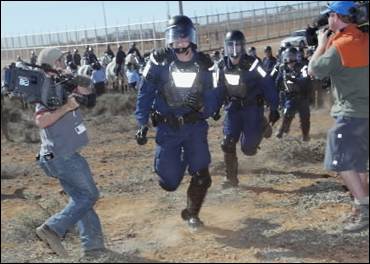
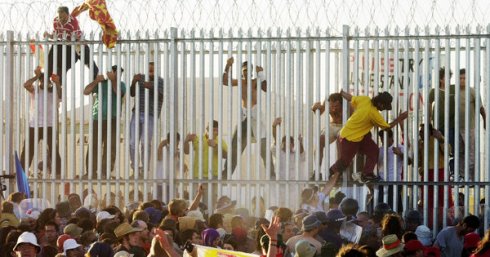
Woomera Detention Centre Riot SMH


Author Peter FitzSimons recently completed a documentary on the history of race riots in Australia. The first episode of “The Great Australian Race Riot” aired on SBS on January 4th.

FitzSimons wanted to include the 2001 riot at the Woomera Detention Centre. However, then Minister for Immigration and Border Protection, Scott Morrison (yes, him again) refused FitzSimons access to the long-closed facility, and demanded the crew not film within 150 metres of the site.

“That furiously annoyed me,” says FitzSimons. “We couldn’t shoot in Woomera itself, which staggered us. We were attempting to take a serious look at a sometimes difficult multicultural society.”

This is a deliberate attempt by the Abbott government to control a historical record of racial unrest in Australia.

The 2001 Woomera riot took place on the Howard LNP government watch. It is a period steeped in turmoil over asylum seekers arriving here by boat. It was at this time the notorious Tampa stand-off took place,causing an international incident between Australia and Norway as well as profound domestic political unrest as then Prime Minister John Howard made his infamous declaration: “We will decide who comes to this country and the manner in which they come.”

Howard exploited populist xenophobic fears incited by Pauline Hanson, then leader of right-wing One Nation, a conservative, anti multicultural political party. Co-opting Hanson’s xenophobic policies, Howard attracted her voter base and went on to win the 2001 federal election.

Woomera Detention Centre was central to the combination of circumstances that elevated the exploitation and incitement of xenophobia and racism to the central platform they remain for both the LNP and the ALP to this day. That period began what has become an increasingly isolationist and inhumane Australian response to the global problem of stateless persons.

The treatment of asylum seekers imprisoned in the Woomera and Baxter detention centres marked the beginning of increasing public acceptance of the state’s dehumanisation of those fleeing persecution, and laid the ground for popular acceptance of Morrison’s narrative of border protection. Morrison’s alleged “war” against waterborne asylum seekers has been used to justify the ludicrous and sinister secrecy in which the Department of Immigration and Border Protection is now irrevocably steeped.

It is astounding that the Abbott government has in this instance successfully engineered the recording of Australian history to exclude any reference to the Woomera riot. Fortunately many records of these events exist. Morrison and Abbott are fighting a losing battle if they believe the voices of this period of our history can be silenced. Indeed, their attempts to control information appear increasingly desperate and naive, as they consistently fail to recognise that what one attempts to omit from the narrative eventually becomes the narrative, and all they are left with are increasingly sullied reputations drenched to the bone in lies, secrets and guilty silence. History eventually will judge Morrison and Abbott, and the Australian Labor Party, and find them all excruciatingly wanting.


Woomera Riots Two


It’s MY prerogative: Morrison’s last despotic act as Immigration Minister.

4 Jan

One of the last despotic acts of former Immigration Minister Scott Morrison was to threaten to revoke the power of Moreland City Council Mayor, Meghan Hopper, to perform citizenship ceremonies unless she agreed to read out his ministerial message during the ceremonies.

Moreland Council has a policy of welcoming refugees into the shire.

Ms Hopper stated: “I do not feel comfortable acting as a spokesperson when it comes to personal messages from the minister. I feel that the reading of a message from the minister in fact politicises what should be an apolitical occasion, as does threatening to remove Moreland’s ability to confer citizenship.”

The Australian Government Department of Immigration and Border Protection Australian Citizenship Ceremonies Code:  Citizenship ceremonies are non-commercial, apolitical, bipartisan and secular.They must not be used as forums for political, partisan or religious expression or for the distribution of material which could be perceived to be of a commercial, political or religious nature.

More from the SMH article: According to the Department of Immigration and Border Protection, the reading of the minister’s message is not compulsory under legislation.

Despite that, Mr Morrison said in his letter to Ms Hopper that it was his “prerogative” that the message be read aloud, as it is an “integral part of the ceremony”.

As part of his response, Mr Morrison included a one-page “letter of agreement” for Ms Hopper to sign, stating that she will include the message as part of Moreland’s ceremony.

“If you fail to comply with this request by January 10 2015, I will withdraw your authority, and that of the deputy mayor and general manager, to preside at Australian citizenship ceremonies,” he said in the letter.

It is difficult to see this behaviour by Morrison as anything more than petty revenge against a Mayor and council who oppose the Abbott government’s refugee policies.

No one should be surprised at Morrison’s efforts at petty revenge. Such efforts are the hallmark of a government that has spent the majority of its time so far in office deliberately trashing previous ALP policies for no reason other than that they were ALP policies.

There is no legislation that requires any official performing citizenship ceremonies to read out a ministerial message. Regardless of the law, Morrison employed intimidatory bullying tactics to demand his speech be read in the future. This is, he claims, his “prerogative.” Note that legislation is irrelevant to this minister of the crown. What counts here is his personal “prerogative.”

As Morrison is now Minister for Social Services we can expect an ongoing disregard for legislation, and a lot more bullying on the grounds of his personal prerogatives.

A minister of the crown must uphold legislation or seek to change it. Deliberately ignoring legislation and instead attempting to impose one’s personal prerogative over and above it, is not acceptable ministerial behaviour. Ministers of the crown have a particular responsibility to respect our laws.

Morrison’s former department, when seeking extended powers for him, argued thus: The DIBA submission to a Senate committee argues that an elected member of parliament and minister of the Crown has gained a particular insight into the community’s standards and values. 

The rest of us are expected to observe the laws that govern community standards and values. If an elected member of parliament and minister of the crown so conspicuously fails to do this, and instead threatens and bullies others on the sole grounds of his personal prerogative, we do not have a democratic government, we have a burgeoning dictatorship.

And this comment from @ForrestGumpp:

Forrest Gumpp (@ForrestGumpp)
January 4, 2015 at 8:32 am Edit #
By what authority does a Federal government Minister get to directly require anything of a Local Government Authority? The question as to the recognition of local government within the Constitution was rejected at referendum in September 1988 resoundingly with one of the lowest ‘Yes’ votes since federation. Surely the federal Immigration Minister would have to work through the appropriate State Minister and legislation to make such demands?


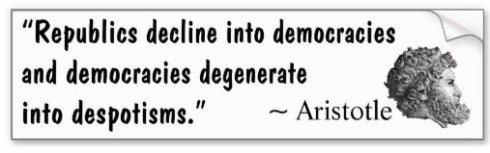
despotism-aristotle

Gavin King, LNP MP, blames women for being raped.

3 Jan

Just look what this clod Gavin King, Queensland Liberal member for Cairns and Assistant Tourism Minister thinks:


The unexamined and ignorant assumptions of some male LNP MPs, state and federal, on the matter of violence against women is beyond belief. They are led by the example set by our Minister for Women and Prime Minister Tony Abbott, who believes the best thing he’s done for us all year is scrap the carbon tax without uttering a word that addresses or even acknowledges  the epidemic proportions of domestic violence perpetrated against us. The LNP at all levels of government continues to excel itself in its arrogant, entitled, privileged and Neanderthal assumptions about who is responsible for violence against women. Without fail, without fail, they consistently manage to come up with some way of blaming us for violent acts perpetrated upon us.

I am absolutely fucking fed up with women being held responsible for violence we suffer, whether its because we’re “irresistible” or drunk, or whatever excuse some arsehat comes up with to justify his own lack of human decency and perverted thought processes.

There is no excuse, there is no fucking excuse for any man to hold onto the belief that in some way, any way, a woman is partly to blame for violent acts inflicted upon her by a man.

Holy feckin mother of god when will it bloody end?


CONTACT GAVIN KING HERE

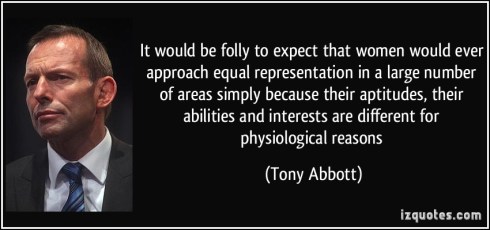
Abbott on inequality


Akerman turns on Abbott again, and where is the quirk?

29 Dec
Trouble in Paradise?

Trouble in Paradise?


Well, the Daily Tele is just the gift that keeps on giving.

Sitting in a cafe in Jindabyne yesterday Mrs Chook was leafing through the rag when she came across this gem by Piers Akerman titled “PM Tony Abbott’s obstinance is protecting chief of staff Peta Credlin”

I’m unable to contain my delight at the ongoing Murdoch press displeasure with its chosen Prime Minister, Tony Abbott, and this piece by the odious Piers had me cackling like a Shakespearean witch. It’s not a good look for the Prime Minister to refer to Chief of Staff Credlin as “the boss” in public, thunders Piers, and if he can’t control his own office how can he control the country? “It is clear that Abbott has developed an almost unhealthy reliance on Credlin’s advice,” roars Piers, and even though that may please feminists it doesn’t please anybody else, he adds. He also takes a swipe at perceived ABC bias, there’s no doubt about Piers, he gets his all favourite prejudices into his copy seamlessly.

In a more general vein, why is it that we can no longer have politicians with any personality? Since when did it become de rigueur that anyone with ambition to political office must first be stripped of individual human characteristics? Why do our elected members have no quirk? Where has the quirk gone? Why can’t we have it anymore? Who said, no more quirk?

And why, when the occasional quirk slips through the quirk police, is the individual concerned pilloried for not knowing how to play the game?

Tony Abbott is the price we pay for eradicating quirk from our political character. Apart from all his other faults, and they are many, the man has absolutely no quirk. He is a bland mouther of hideously outdated sermonising platitudes. He is, like a dust bunny in a dark corner, entirely without substance. Every move he makes screams “Look at me making this move! Look at me being Prime Minister! Look at me threatening Putin! Look at me finding lost aeroplanes! Look at me Peta, look at me!”

And we all look, baffled, and afraid for our country.

Unless we’re in the hot tub


Hot Tub

Samantha the Maiden, Abbott, and the supernatural powers of marriage

27 Dec

Sitting in a cafe in Cooma the other day with nothing to read I flicked through the Sunday Telegraph of December 21. Always a mistake looking at the Tele, but my judgement about everything has been off for months, so what’s one more error.

There I came upon a piece by Samantha Maiden on Senator Jacqui Lambie titled “I’m addicted to my Botox.”

I didn’t have a great deal of interest in that revelation but what did catch my eye was Ms Maiden’s description of the Senator “admitting she’s been single for more than a decade” and later in the paragraph “Ms Lambie admits she’s been single since her thirties.”

Admit is a tricky little word. It’s usually understood to mean confess, as in the offender admits. I’m at a loss to understand why a woman has to admit she’s single, or why Ms Maiden poses the suggestion that Ms Lambie has committed an offence against society by using that word to describe the woman’s relationship status.

Then a few days later came this opinion piece in the Age, questioning Prime Minster Tony Abbott’s references for new Social Services Minister Scott Morrison.  He is a decent human being and is married with two little children, the PM declared, ergo the man has learned a depth of compassion the unmarried without children cannot possibly have achieved that more than qualifies him for his new portfolio.

There are echoes here of claims made by Morrison’s previous area of responsibility, the Department for Immigration and Border Protection that simply by being an elected member and Minister of the Crown, Morrison has a unique and profound insight into community standards and values that qualify him to exert unprecedented powers while remaining absolutely unaccountable to anyone.

I have to say here that I disagree with the author of the Age piece when he claims that not having children If anything … strengthens your sense of understanding and empathy for others. That’s just as silly as the claims he’s disputing.  Understanding and empathy aren’t dependent on one’s relationship status or parenthood, and it’s just as possible to argue that both situations can lead to all kinds of negative behaviours that aren’t in the least understanding and empathic.

Having spent Christmas time with seriously feral toddlers I can attest to that. The youngest, who has just learned to say “No” and “Mine” spent much of his time snatching his brother’s presents off him then trailing round the house, overwhelmed by the noisy stupidity of it all, alternately chanting and whining  “No No No” and “Mine mine mine” at nothing and no one while his brother yowled hideously at the injustice of it all. Tested beyond endurance by our little ones, the adults took to drink. That we all got through it and still love each other is no testament to our compassionate natures but rather to the quality of the champagne.

Anyways, what both Maiden and Abbott’s comments emphasise is the ideology subscribed to by public representatives of the orthodox political and social class whose beliefs continue to dominate Australian society. All one has to do is demonstrate one has a relationship and children to be accepted. How one actually behaves within the family unit is beside the point as long as one is seen to inhabit one.

And this brings me to Richard Flanagan’s Booker prize-winning novel, The Narrow Road to the Deep North. Unfortunately I am far from home in the Snowy Mountains and don’t have my copy with me so can’t directly quote. At one point Flanagan lists the horrors of a long marriage in which neither partner has ever really known the other while one has been chronically unfaithful, and the stunting effects on the offspring of such a union. He ends this lengthy account of unexamined misery with two words: A family.

It’s chilling.

Here are some mountain wild flowers  to cheer you up.

Wildflowers