Archive | Non Fiction RSS feed for this section

In response to questions: disclosing where I’m coming from

19 Jan

I’ve noticed on a few blogs that comments have been left about me not revealing my religious/non religious beliefs. Some have speculated that I’ve had a bad experience in my life that has caused me to turn against Christians.

It’s fair enough to expect me to reveal my position. I actually sort of did that in this piece here  titled “Home” just a few days ago, but of course only the blogs regulars will know that.

In fact it was Anglican nuns who saved my life, literally, when I was fifteen. They took me into their care when I was no longer able to stay at home in an extremely dangerous family situation. These women treated me with extraordinary love, concern and compassion, as did the male church members who were involved in the legalities of ensuring my ongoing protection from my family until I was old enough to be independent.

So no, I have had no bad experiences with religious people. Quite the opposite. I feel a gratitude so profound to those nuns that I’m unable to find language to adequately express it.

I don’t  hold any religious beliefs. I’m not drawn to membership of any institutional religion. I am not affiliated in any way with any religion.

I love many of the words attributed to Jesus, and I see him as a man who had much of interest and importance to say. I don’t need to see him as a god, anymore than I need to see anyone else who says wise and interesting things as a deity. I take my nourishment where I can find it, and I range wide.

I don’t believe in any god as described by Christianity, not even the god of my nuns. I do believe in how those nuns looked after me.

This is what makes me angry. Christians who control our laws so that they are exempt from actions that would see anyone else prosecuted. Such as discrimination against gays and lesbians in the workplace. Christian churches can refuse to employ human beings solely on the grounds of their sexual preference. This makes me angry.

Christians who seek overtly or covertly to impose their beliefs on others. This is tyranny. If it’s done covertly, it’s deceitful and duplicitous tyranny. Christians who insist that there is only one way to live, and that’s their way. Christians who are so enslaved to their ideology that they will do anything to impose it on others.

There are plenty of Christians who are generous, accepting, and as appalled by some of their fellows as am I. To them I’d say, you need to stand up and be counted. You need to challenge those within your communities who will see human beings destroyed, in their efforts to persuade them to their way of thinking. You have this responsibility more than anyone else.

Where are the ordinary Christians roaring in outrage at the churches’ abuses of children, for example? Where are you? How do you remain so silent? Why should I respect you when you don’t protest the vileness in your churches, and keep on protesting it, loudly, over and over?

∫ 

I like the words of the Leonard Cohen song, Lover, Lover Lover. It’s a dialogue between a man and his god. Here is god responding to the troubled questioner:

“I never turned aside,” he said,
“I never walked away.
It was you who built the temple,
it was you who covered up my face.

Oh lover, lover, lover lover come back to me…”

I’d say this to some Christians: you have built the temple. You have covered up his face.

God, I would venture to suggest, like love, is action. God, like love, is a practice.

I don’t believe that anyone indoctrinated into institutional religious belief and holding to that belief, can make moral decisions separate from that belief. If they do, then they are denying their faith, because one of the commands of religious faith is that follower’s life is lived in accordance with its tenets.

And why should I listen to anything told to me by someone who is denying their faith by claiming it doesn’t affect their moral views?

It’s the denial that tells me who they are.

∫ 

I’m a woman whose life was saved by Christian men and women. And perhaps because of that, perhaps because of my love for those Christians, I am enraged when I see their faith betrayed.


And now for something completely different…

16 Jan

Later today I’m putting up a brilliant short story by a friend of mine, that will take our minds right away from this distasteful legal twaddle.

In the meantime, I have to moderate all your comments before I publish them, as I’ve been advised that Melinda Tankard Reist’s lawyers are monitoring the blog and twitter for any “vilification” of the lady. If any such thing appears in comments on my blog I cop another legal threat, and it will be added to the list of my crimes against MTR. On twitter, well, I guess it’s every human for him or herself.

Also, I’m not always on the blog so if I don’t moderate you for a few hours please don’t get pissed off at me.

It may be all piss and wind, but does anybody really want the hassle?

I’m also told that it is ALLEGED that MTR is backed by seriously wealthy Christian fundamentalist lawyers, and that money may not be a problem for her as it is for most of us.

Now I am going to get out of the PJ’s that I’ve been wearing for the last two days for  emotional and physical comfort, and take the dog out.

Fortunately I was given a superb kimono for Xmas so I’ve been able to throw that over the PJ’s. The kimono along with my scarlet painted toenails has allowed me to keep up my usual sartorial standards despite the legal twaddle. It is so important to keep oneself looking as good as one can, no matter how demanding the circumstances in which one finds oneself.

I feel an incipient hysteria. That is, if I’m allowed to describe myself as hysterical, without incurring the awful wrath of the language police that was visited upon Justin Shaw, and to a lesser extent myself, just last week. It is amazing how many people there are in the world who want to control every word that comes out of someone else’s mouth. To be set upon by two wildly differing feminist factions within the space of three days because of what one has said, is indeed a novel experience

So far the year has been full of excitement and controversy. Pass me the gin and the chocolates.

Home

28 Dec

I’m looking for a
Home- where the wheels are turning
Home- why I keep returning
Home- where my world is breaking in two. Brian Eno & David Byrne, “Home”

The house protects the dreamer, the house allows one to dream in peace…the house is a large cradle…it maintains him [sic] through the storms of the heavens and those of life. Gaston Bachelard, “The Poetics of Space”

Because it’s Xmas I’ve been thinking about home, and the devastating effects of not having one.

Homelessness takes several forms. There’s hard-core dispossession, when people literally have no roof over their heads and live on the streets. Sometimes they find a bed at a shelter for a few nights. There’s couch surfing homelessness when people move round friends and relatives’ homes in an effort to stay off the streets. There are families and single people living in cars.

There’s the homelessness of asylum seekers, dislodged from their belonging by circumstances outside of their control, seeking somewhere on earth where they can safely settle.

Then there’s living in places where you just don’t belong, such as institutions, where you are only there because you have no choice. That was my kind of homelessness from the age of fifteen.

My kind of homelessness was middle class. I had a roof over my head. The roof was that of the boarding school I’d been attending. The family I’d lived in up to that point consisted of my mother, her second husband, my stepfather, and my two little half sisters. My mother married her second husband when I was seven, and he brought us to Australia from England.

Up to that point I’d been raised by my grandparents in what seems now an almost idyllic situation. We were cash strapped – Granddad was a retired coal miner, and working as a night watchman at the gasworks. I was much-loved by him and Eleanor, my grandmother, even though they’d raised three children of their own. We had food, clothes, shelter, entertainment, and Granddad’s corgi dog. I had an uncle, and an aunt who kindly painted my tiny toenails for me by the kitchen fire when she was attending to her own. I idolized my uncle. I was safe, treasured, and kindly disciplined. I had what every child needs – a bevy of adults to take a loving interest in her. There was always someone to listen, and there was always someone to play with.  It worked for the adults as well: nobody was overburdened with sole responsibility for my well-being.

I hardly remember my mother during this time. She lived in the same house but must have been largely absent from my child’s world, as the impression she left was negligible. It didn’t matter.

It must therefore have been a great shock to me to be wrenched from that cosy world into the uncertain future offered by my stepfather and mother, both of whom were practically strangers to me, and transported to the other side of the world. Such a shock that to this day I have absolutely no memory of the parting. While she was alive, my grandmother revisited this trauma endlessly whenever we saw each other, which was rarely as we were now worlds apart, in every possible way.

My mother made an upwardly mobile marriage – her second husband was a doctor. Her first, my father, to whom she was married till I was three months old, played drums in a band. I know almost nothing about this man.I did go through a period of trying to find out, without success, and eventually I thought what the hell, the man obviously didn’t care about me and do I really want to find someone who didn’t care about me? No, I decided, and finally let it go.

The marriage took my mother out of the North Yorkshire mining town and working-class culture she loathed, to a new country and the rich possibilities of middle class professional life.

Unfortunately, her new husband was violent, abusive in every way possible, and had an eye for her seven-year old daughter. Suffice to say the next seven years of my life were a kind of hell into which I felt I had fallen through some fault of my own. Children do this. They assume responsibility for the most enormous adult events and if no one tells them otherwise, they labour under the burden for years.

The contrast between those seven years and the seven that preceded them was absolute.

At the age of almost fifteen, I revealed to one of the nuns at my Anglican boarding school just exactly what was going on in my home. Astonishingly, these intelligent, compassionate women believed me. I’d explained for them their bewilderment at my lack of scholastic progress when I clearly wasn’t stupid, my inability to sleep, my habit when I did sleep of walking and falling down the stairs, my inability to eat and thus to thrive, and my constant illnesses. Within days they had taken action. They consulted the Bishop, the Dean, and their lawyers. They summoned my mother and stepfather to the school, having first hidden me in a safe house so neither of them could see me. Lawyers, nuns, the Bishop and Dean confronted my parents, who made no attempt to deny my account of events in our house.

A deal was done. I was to be handed over to the guardianship of the nuns. I was never to go home again. My mother would be allowed to visit with me, but my stepfather must agree to never attempt to see me again, otherwise they would call in the police.

I was safe.

I was ambivalent about these arrangements. My family was appalling, at the same time it was the only one I had. My home was a place of great danger, at the same time, it was the only one I had.  I was relieved and grateful to have been rescued, but at the same time, I had no home. A boarding school is not a home, no matter how kind they are to you. I was supposed to go to various friends’ homes for holidays, which I did for a while, until the mortification of being unable to reciprocate their hospitality became too much for me. I would hide on the last day of school, and not reveal myself until they’d all gone. Then I’d be allowed to stay with the nuns in the great big empty boarding house, until term started again.

The nuns were good to me. They were beyond good to me. They did everything they could to make up for my losses. I wasn’t always grateful. When I played the piano in a competition where everyone else’s mothers and fathers showed up to support and admire, I wept after my performance that the nuns who’d come with me weren’t my parents, and I was the only girl there without anyone. My final act of ingratitude was to repudiate their religion.

The humiliation of living as an emotional beggar in an atmosphere of comfortable middle class families stayed with me for years. It will probably never entirely leave me. Where I live, though I’ve been here for years, still feels disturbingly temporary. Every time I try to think of it as home, I baulk.I can’t go there. Such is the power of a word. I don’t believe I won’t lose  home again, and a real home is not supposed to be a thing you can lose.  No amount of rational thinking and concrete experience convinces me otherwise. I remain, on this topic, seven years old, and dumbfounded at the turn my fortunes have taken literally overnight.

The legacies of that time have been many and I’d be hard pressed to decide which was the worst. However, this is a piece about home, so I’ll focus on that one. I have never been able to get my head around the concept of home. It’s not about bricks and mortar. It’s a magical name for a yearned for and unattainable state, full of meaning, feeling and emotion that I’m unable to let myself experience. Why? Because first I’d have to rage and grieve over having home snatched out from under me all those years ago, and that’s a dark place I can only very infrequently visit. To survive I’ve held those feelings at bay. I hop over them as I hop over hot sand on a blistering summer day, never letting my feet settle long enough to suffer anything more than slight discomfort. And only when I’ve forgotten my thongs.

The price I pay for acquiring these skills of avoidance and denial is never being able to feel I’m at home, or even that I have a home. The pay off is survival. We’re urged to confront that which disturbed us, rather than allowing it to fester and thrive and taint our daily lives.  While that is necessary, timing is all. Premature confrontation brings down the defenses that have been our friends, and allowed us function in the world. After all these years, my instinct tells me it’s time to let them go, and I couldn’t have done it a moment sooner.

For our house is our corner of the world, Bachelard writes,…it is our first universe, a real cosmos in every sense of the word. 

What then, of the child whose cosmos consists of abuse and exploitation? What, then, of the child whose topoanalysis reveals primarily sites of torment and terror?

The truth for me is that I can’t let myself feel home in the present until I grieve for the loss of that first one. I can’t imagine doing that grieving, and surviving the experience. Emotional cowardice provokes childish, self-berating dialogue: I can’t do it! Yes you can, you have to! No I don’t, you can’t make me! Well, if you don’t you’ll stay homeless forever! I won’t! I will not! You can’t say that stuff to me!

In a more adult state I realise I have to lay these matters to rest. I don’t want to leave this life carrying so much ancient sorrow into whatever comes next, even into nothingness. I want to leave with the cleanest possible emotional slate, grievings grieved, angers soothed, losses accepted, insult and injuries forgiven, both those I inflicted and those I suffered, at peace, as much as is possible, with the hand I was dealt. I want to have used my potential for surviving that hand to my fullest extent, and I want to leave satisfied that I achieved that.

In other words, I want to go home.

So this is my New Year’s resolution. I will do whatever needs to be done to assuage the loss of home. And then, with any luck, I’ll be able to feel home again, as I did when I was born, as I did as a little girl, as I did till I was seven. I think this will not only make life better for me, I’ll probably be a more pleasant person all round, having relinquished one more source of post traumatic stress that shuts me off from others whom I care for, and who care for me. The misery buck has to stop somewhere in a family. Let it stop with me.

Heaven knows- what keeps mankind alive
Every hand- goes searching for its partner
In crime- under chairs and behind tables
Connecting- to places we have known

The healing properties of the Dog, the moon and the stars

29 Jul

Last night I took a late walk with the Dog. Where I live it’s still possible to do that in safety.

Though there’s a world heritage-listed littoral rainforest between me and the ocean, the seas must have been rough because I could hear a roar like an approaching tsunami from an ocean that generally offers a comforting background susurration to lull me to sleep.

The night sky was clear and it was cold. Dog trotted happily but slowly beside me as he’s old, and has a bad back leg.

Earlier in the evening I’d avoided my usual news fix. For the last couple days I’ve felt overdosed, satiated to the point of disgust by the self-regarding so-called cultural warriors who’s reaction to the Norwegian massacre has been to point ideological fingers and crow at one another as the terrorist Breivik’s influences were revealed in his manifesto as including various Australians.

This, combined with the mind-numbing repetitive exchange of insults between politicians that passes for serious debate on vital issues that have been stripped of any pretense to moral or ethical consideration, has left me feeling sickened and in urgent need of the healing properties of dogs, trees, stars, moon, beaches and the sea.

The Dog was taken in hand by one of our household very early in his life, and trained to refrain from chasing all living creatures, with the exception of cats. This household member, whom I will not name for all kinds of reasons, is outraged that cats in our little settlement are allowed by some irresponsible owners to run free at night, un-belled and murderous.

The problem is they kill the birds. We’ve gone to great lengths to plant native trees that feed birds, and mornings and evenings at our place are wonderfully cacophonous. It’s the first thing I miss when I’m away from home, the unrestrained brawls between the raucous parrots who manage to slander one another even as they hang upside down stuffing their beaks. Bit like politicians, really but far more beautiful and entertaining than that unimaginative rabble.

So Dog will merely twitch and stiffen if he encounters native animals, but when he comes across a cat, it’s on. Miraculously, he forgets his arthritic leg and takes off like a teenager after the same felines every night. He never gets anywhere near them of course, and that is not his intention. It’s the chase.

Dog knows he’s no match for a cat. Indeed, when he was young he was severely mauled by a ginger tom called Gilbert, who tore his nose to shreds and would have had his eyes out if the cat’s owner hadn’t scooped him up, yowling and flailing, and locked him in the laundry for the rest of the afternoon. Surprisingly, Dog didn’t suffer any obvious post traumatic stress after this beating, instead it apparently inspired him.

A brief listen to the news this morning is sufficient to tell me that nothing has improved overnight. The braying hysteria of Sarah Palin made my stomach lurch, so I turned it off and ate my toast and drank my tea in silence, except for the battle of the birds. Later I will take the Dog to Terry the Vet as he’s got a bizarre swelling on his ear that might be a tick. The Dog loves Terry and Terry loves him. He consistently refuses to charge me for anything like the services he provides. I asked him why he won’t let me pay him what he deserves?

“Because he’s a ripper dog,” Terry told me. “Ripper.”

I don’t know about anybody else, but for me unrelieved exposure to the political scene brings about kind of spiritual starvation, and I have to stop, withdraw, and reconnect with all my other dimensions. The political discourse is so pitifully reduced – where is the inspirational rhetoric, the moral vision, the desire to bring something good into the world rather than to just win an election?

The political discourse does not nourish us, indeed it frequently shames us, with its one-dimensional narrative that takes no account of complexity, and the human heart. One has to get away from time to time, or else become dulled and shriveled, forgetful of any other story. Like the ideologues who see in the Norwegian massacre primarily how it personally affects them and their ideology. They couldn’t even wait until all the bodies have been found, before making it all about them.

Ah well. There’s a moral in that for all of us. Go look at the stars, even if you’re lying in the gutter.


Fools for love

19 Jun

In love, the person is always the fool, emptied of prudence, his (sic) desires evident to the world, his transgressions revealed to all, especially to himself. Thomas Moore

Fools for Love is a collection of stories about love that went wrong.

Practically everyone has a break-up story, or knows someone who has. Break-ups are commonplace, but the individual experience of a break-up is unique. Even though everyone going through it describes similar emotions, one of the characteristics of an ending is that it feels as if this is the first time any human being has suffered in quite this way. Just like it felt when we fell in love.

Here is Bernard’s story in his own words, minimally edited for continuity. Names have been changed.

Well, we were married for thirteen years, fourteen years probably because our daughter Josie was about 13 when we separated.

She’s my oldest, then there’s the boys. It was always hard work but I just assumed that with six kids that we’d always be together.

I expected that to happen. Being Catholic made it a bit more “that’s the way it is.” If you’re unhappy you put up with it and Marianne was Catholic too.

Anyhow, we had some bad times, hard times because my ex wife’s a really, really bad spender. I’d think we owed no money and we owed ten thousand dollars or five thousand dollars and we wouldn’t have it to pay. Credit cards and blah blah blah, so we were always under pressure financially, always looking for something better and more money. There was non-stop pressure.

So we’d hit a brick wall and then she’d say “Well, you go and have a couple of days at your brother’s place,” or something like that. “That will give you time to think,” she’d say. So I’d do that.

One night when she’d said to do that (my brother lived not too far down the road) I was sleeping on his lounge and a client rang and said he needed some information that I kept at home. I said, “OK, well I’ll go and get it.” So I rang home and got my daughter and said along the lines of, I said “Where’s mum?” And she said (she was about 12 or 13), “Oh she’s gone out with a girlfriend.” So I said, “Well, tell your Mum that I’ll come home and pick up John’s file ‘cos he wants something out of the file.” She said all right and then she went to bed. Well, when I got home my wife was in bed with another bloke.

So. I was. I was out of the house to help pay off, help our problems and she just had a boyfriend and that shattered me.

I stayed awake all night.

She told me to go, he was in the bed with her. He was a guy called Martin, and I was just devastated so I went back to my brother’s. I couldn’t sleep. First thing in the morning my sister in law Claire gets up and I started to talk. I said, “I had to go home last night to pick up something and Marianne was in bed with a bloke.” And she said “Well, obviously she’s got a boyfriend.” I hadn’t thought of that, I just thought we were having a bad time so everyone sort of knew bar me that I was a mug.

So I rang Marianne’s mum and dad up and said, “Well, I’m going back home I’m throwing her out of the house. Bugger this.” And then they stepped in and said, “Well these things happen,” blah blah blah and Marianne put on the tears so I moved back home and let her stay.

Anyhow that was the beginning of the end of the marriage and I don’t know how long it had been going on before that. Obviously for some time cos it wouldn’t have been the first time she’d organised me to get out of the house because she’d had this bloke lined up again. Instead of her going to his place he came to my place.

All the kids were there, but they were little so they were in bed. So a few months later she did the same sort of thing again. She said, “I’m going to stay with my girlfriend.”

I always believed her, yeah. I only found it out to be lies later. If she’d catch herself out she’d just tell lies. It was so obvious. She’d forget how many lies she told. It was easy ‘cos I believed her but it wouldn’t have been so easy for her to get away with it if I’d been the third party looking in instead of being the injured party.

So a few months later don’t know how many to tell you the truth, might have been three or four she said, “I’m going to my girlfriend’s to spend some time with her.” They were all people she used to play golf with and I got a phone call and I answered the phone and they said, “Is that Martin?” I said, “Oh, no.”

It was my phone.

It was a travel agent and then the people on the other end sort of twigged and got a bit evasive so they didn’t say much but it just made no sense it was a travel agent on the other side of town and I said to my friend who had access then to information he shouldn’t have, but it happens, and he checked for me.

I thought something’s not right, Marianne’s supposed to be at a girlfriend’s. He checked the aircraft departures and she’d taken off  with some bloke again for a week’s holiday and told me she was at a girlfriend’s.

So that was the sort of thing and then she’d come back and say, “I’m leaving you,” and I still tried to get her not to leave. But that was how she left me, then she moved out and we had no money. I had a small income, a reasonable income, but with six kids we had no money and her spending would make sure anything we had had to pay the debts and so she moved out but she rented a place for three or four hundred dollars a week and she just didn’t have it. I used to help her out and go round there and give her money and try to get her to come back home.

A big house, a lovely house and then she said to her bloke, I don’t know for sure, I’m surmising, “I’m free now.” And she took Kyle with her who was then two and a half or three he’s now nineteen or twenty so that’s seventeen years ago, and the girl she used as the babysitter and as soon as she was available all the time the guy shot through.

I don’t know what happened there. All I know is from the time she walked out on me for this bloke he was hardly around. They broke up almost straight away cos why would you want a woman with six kids? It was all right as a bit on the side but no value when she’s available as a full time partner so that hardly lasted and then there’s this old bloke called Bob that Kyle used to talk about who was on the dole

I asked Kyle “Who’s Bob?” and he said, “Oh, he’s an old bloke that’s helping around the house comes and does a few things around the house.

Bob turned out to be another swimmer she was screwing who she ended up marrying because she got him on the rebound. Bob was somebody else’s. She told another set of stories about here’s Bob doing this and this, helping me out.

Bob had a partner I don’t think he’d broken up with his other girlfriend. Bob was a swimmer but he’d left swimming as well, cranky old bastard. He was a schoolteacher and once Mark left Marianne Bob was on the scene.

So next thing you know she got kicked out cos she didn’t pay the rent for all this time. Next thing you know she had to let go of the house so she did a runner and moved in with Bob.

I didn’t have Kyle he was with his mother. My daughter was staying with my sister in law and I had the other four boys who were like 7, 9, 11, and 12. I was looking after the boys and working.

 Yeah. And when Marianne said she was moving out I said, “Well, take what you need out of the house because you’re moving.” So she took everything. All we had left in the house was an esky with some milk and a broken down toaster and three beds for five people. I just slept with the boys. Nothing else in the house. Oh, and the dryer, no, the dishwasher, not the dishwasher, the dryer and the washing machine. There wasn’t any room on the truck to take them so she come back and I said, “You can’t have them I need them to wash the kids clothes.” So we had a fight about the washing machine and the dryer so I had a washing machine and a dryer and a foam esky to put some milk in and a broken down radio. TV and all the furniture in the whole house was gone. A few broken cups and saucers that’s all we had. Very interesting time.

Oh, I don’t know.

I was distressed and then she moved in with Bob. I found out about Bob because what did she do, she did something, oh yes she embezzled money from a company she was working at. She was writing cheques and taking the money and the police come looking for her and this detective rings me up and says, “Blah blah blah,” and I said she wasn’t with me she left seven months ago to live with her girlfriend and the cop said they were looking for her and I said, “Well she’s living with her girlfriend,” cos she’d told me that in Hampton or Fernleigh or somewhere and he said, “Well she’s not living with her girlfriend she’s living with her boyfriend in Kingston.”

I said, “That can’t be right.”

He said, “Mate, I’m telling you.”

So that’s how I found out where she was living. So I was dropping her off to go to her girlfriend’s and she was just walking round to Bob’s place but I didn’t know that for a month or so. Till the police told me. So she ended up getting arrested for embezzlement. I don’t know how she got out of that. Cried poormouth, her Mum and Dad did something about it, but she was guilty of stealing checks and cashing them.

So then she moves in with Bob. Next thing you know she’s pregnant to Bob and she didn’t tell me she was pregnant my brother in law told me. I’ve got no sense of time here but it was five or six months after she moved out. I’d lost my job I had no money, I’d no work I’d sold the house because the house had such a mortgage on it that we had no money at all. Rented a little dump and I mean a dump, a little timber cottage with the boys and I had no source of income cos I’d lost my job. So I had a few clients, about a hundred clients or so and I was working at the dogs as a bookmaker’s clerk and anything else I could get just to a bit of work. One of my cousins worked at this shipping company and he gave me a few hours work doing this and that so that was my source of income. Nothing consistent.

I’d drop the boys off at school and because I didn’t have a job, oh I had a job for a little while and I put them into day care at first go to work then pick the boys up at five and go home. Then I couldn’t get another job cos everyone wanted me to work stupid hours and I had to get the boys to school and pick them up. So I made sure I had no appointments at two o clock or finish at two o clock make some tea for them and maybe go and see someone else in the evening or whatever so I just worked around what had to be done.  Brendan was the only one in high school the others were in primary school and my brother in law then who’s also divorced from Marianne’s sister now said to me, “Oh Marianne’s pregnant.” I said, “No, she can’t be pregnant.” I said, “Everyone knows except me, she hasn’t told me she’s pregnant.” He said, “Oh sorry I didn’t know maybe I shouldn’t speak.”

So I was talking to her Mum and they all knew and I said something along the lines, “Oh now that Marianne’s pregnant.” So she was, it came up when I saw her mother and she said, “Oh you now these things happen.” Again. It’s always when it’s their kids these things happen, when it’s you you’re the worst one in the world, that was the really funny part about it. When Ed and Tania broke up Ed was the biggest bastard in the world because Tania gave him a bad time and he found a girlfriend and got a second job because he was trying to keep things going and it was impossible and Ed was the biggest bastard they’d ever met because he did that to Tania. When Marianne did that to me “These things just happen”.

So it was good to see how the rules changed for people. Anyhow so I was never going to get divorced, never believed in divorce but then when that happened I rang my lawyer and I said, “Look, Marianne’s pregnant, just file for divorce. This is stupid. I don’t believe in divorce but this is ridiculous. She’s pregnant to somebody else, just file for divorce.” I filed for divorce she didn’t bother to come to the court. We put in an application to the judge to say I’d had the kids all the time, this is what I do.

Marianne never refuted anything cos she was busy getting on with her new life with Bob. She had Kyle, and then when she got pregnant, my daughter  went to live with her for a while. That didn’t last long because of her and Bob and we set it out, there was nothing to refute in the Family Law Court I got the kids and the judge said, “Well, can you do that?” and sort of laughed so I got the kids. Course I only had the kids as long as she’d let me have them the father can’t take the kids if the mother says she should come back and look after the kids you just lose them.

Well, she said she was going to come back but she didn’t. She never wanted the kids anyhow she just said she wanted them. So I got the kids and then every six months I’d make them go and see their mother because she’d never take any time to come and see them. So I’d take them over to her place and go and see mates while I dropped them off for a few hours. If I didn’t do that she virtually never came near us.

In all that time I was working on getting her back all the time. She’d sort of leave the door ajar to make sure she could manipulate me. I still loved her. Yeah, I’d say so. Yeah. Um, I really didn’t but I thought I did because she’s my wife and so on and this took about five or six years.

Well I thought it was love. But I looking back now, if we’d have stayed together she would have destroyed us. The best thing she ever did to me was leave me. It just took me seven years to realise it.

And we had tos and fros and she’d manipulate me any number of times, she needed money, she need this and I’d help her out I’d do that and she’d just manipulate the situation.

After about two or they years they moved. They bought a bakery. Bob couldn’t boil water let alone be a baker so it was a recipe for disaster but they had the bakery. Plus Marianne had no head for business.  Michael, who’s now 22 was about 8 or 9, they’d had him for a couple of years she’d talked him into coming up for a holiday with them then she talked him into staying with her so I lost Michael then, so she had Michael and Kyle and I had the other three boys and my daughter was in Sydney. So I didn’t see much of them, the kids would come down for a holiday now and then I just had the three boys and the others were with her for two years but any time she still manipulated me when she needed something.

The business failed and they came back.

I hadn’t given up hope because I was still trying to get her to come back. I wasn’t seeing anybody else as I had the kids I didn’t have much time for anybody else and I had no money then, renting, kids were at school I cooked and washed and blah blah blah so my life revolved around the kids really but I had to still leave them to earn a living so I’d feed them of a night and then say to Michael who was about 12 or 13, mind the kids I’ll be back in two hours. I’d go out and see a client and come back. Course my boys got a bit wild in that time because they didn’t have dad around and they took advantage of it you know what teenagers are like, 11, 12 year olds are like.

I still had my dream of getting her back and having our family again. Yeah.

Anyhow this went on for about six or seven years. And what happened was, I met Christine she used to do massage at the squash club. Christine and I have been together about well it’ll be eight years in December. I’d known Christine from squash so I knew her fairly well but she was married to Morgan then who she came back from overseas with, but then she separated from Morgan and she had the children. We had a Christmas party at the Ram’s Head hotel and she’d been single twelve months or so and we were just together and we were all at a table talking and I don’t know, we just got together chatting and I asked her out the week before Christmas and Marianne was coming back to live nearby, she said and then she didn’t come back again. Her and Bob were just separating then some domestic violence from what I understand.

At that time Morgan was about to be posted overseas, they were separated so it was a bit awkward cos he’d moved out of the place he was renting and was staying with her before he moved cos they got on fine, he’s a nice bloke. So we went out and then she said, “We can’t go out for a while, Morgan’s here till the end of January.” I used to still get massages from Christine because I was already doing that every fortnight sore from squash and everything else and that was her job. So we started going out and then we only went out two or three times and I was very hesitant. I liked her and she was a good sort and she said to me one night, “Well I’ve got something to say to you.” We were out for dinner and I though ah well, here we go nobody’s going to stay with you that long you’ve got these kids. I thought oh well, it looks like I’m getting the flick here.

That’s all right, I was going out with someone else I knew, I was just dating it wasn’t that serious and we’d been out two or three times. Christine says, “Oh, well what do you want to do with us?” I said, “I don’t know what you mean?” She said, “Well I don’t want to muck around, what do you want to do?” I said, “Well I like you, I want to keep going out with you OK?” So we didn’t muck around and we started going out together and then, barely after that, Marianne rings up and she says to me, “I’m coming back to live you’ll have to give me a hand.”

So I said, “I’ll help you set up and live near the boys.” I thought that’d be good if their mother came back and lived near the boys cos she had two young kids to Bob, so it’d be good for the boys if she lived somewhere near us and they could see their Mum. Which never eventuated. She said, “Well I need you to give me a hand to get started,” and I said, “Well its no good anymore, I can’t do that I’m going out with somebody I’m with someone, I’m sorry its just not right now I can’t do it.” And she blew up. “Go on,” she said, “ignore your children and your family and kids and worry about your girlfriend.” I thought that was a good call, she’d left me for two or three blokes had two more kids, remarried had another boyfriend in the meantime and was coming back and I was the one who did the wrong thing.

So she abused me. So then I didn’t hear from her. I was seeing Christine, I’d go over there we’d go out, but I’d always come home. Christine didn’t like that much. I just wouldn’t move in. I did my own washing, even though we were together I’d been single than for six or seven years and the boys were fairly young then compared to now, teenagers so we just gradually stayed together longer and the boys got older blah blah blah.

That was the first time I said no to Marianne. Yeah. I suppose it was a relief yeah.

I’d never been interested in anybody else before Christine I went out with a few people but I wasn’t interested it was more like friends, and I’d also decided never to get married again. I’d been married, I wasn’t going to get married again. And Christine’s the only other person I would say, that would have had me, I think, decide to get married again. So then we just started as a couple and by the time I was fifty we were a couple. But I wouldn’t leave anything at her place she had the shits about that. I didn’t take the kids to her place either. We had our house where they stayed they were older now so I’d go back everyday and be there in the morning and everything else, watch the boys, do everything.

Marianne never said anything about Christine. Not about our relationship, I don’t know what she said to the kids but we’ve had a couple of words about some of my boys. We’ve sat down and she goes into tears and carries on. My ex wife’s still going on 17 and she’s fifty this year I think.

I don’t think she’s with anyone now. No, not that I know of She’s been re partnered a couple of times but after Bob there was a guy called Jim, she was with him for some time, she’s bad with relationships because she’s such an air head she’s so manipulative that people just walk. You can’t defend Bob, he belted her I’m sure I don’t think there’s any doubt about that, you can’t defend it but I can understand why, she pushes you to the limit all the time. She was of those people that does push you to the limit. She told Kyle he ruined her relationship with Bob and then he was ruining it with this new bloke so Kyle rang up and said can I come home to live with the others, and I said course you can.

But Christine said he’s too young to live with his brothers he has to come and live with us cos we’d finally moved in together. So she was really good. So he did and that strained our relationship for a few years. It took a long time for Kyle and Christine to get on. They get on good now, but it took a long time so she took that on. He was in all sorts of strife at school, smart arse.  Kicked out of school but we got him in another school and that was fantastic for him, turned him around.

So that’s pretty much the story and I’m good now life’s good now with me and Christine and all the kids are grown up doing their own thing and business is good. I never hear anything from Marianne the boys go see her sometimes. It wasn’t easy but I never want to go through any of that again.

Ξ

The fool and the lover are inseparable, so much so that if a person doesn’t behave at least a little foolishly, perhaps they aren’t really in love.  

In love people rediscover the fool’s childlike innocence. In love, that innocence is expressed as trust. It’s frequently one of the things people take themselves to task for when love goes awry. Then we can feel like the worst of fools. Naïve, stupid, childish and humiliated to have believed we could trust someone who’s betrayed us.


Revenge, or an eye for an eye leaves the whole world blind

25 May

There’s probably hardly anyone who hasn’t at some time nursed the desire for revenge against someone they feel has harmed them. Feeling those desires and acting on them are very different things, but even feeling without action can have its consequences: a life consumed by unhealthy imaginings; the destructive effects of living with vengeful longings that can’t be satisfied. Being injured is sometimes only the beginning: long after the incident is over difficult emotions can continue to disturb a victim/survivor’s equilibrium.

In such circumstances an injured party can find themselves confronted by what American academic and philosopher Judith Butler calls “the moral predicament that emerges as a consequence of being injured.”

This moral predicament is comprised of the natural desire for retribution, and the conflicting need to avoid exchanging the role of victim for that of perpetrator by acting on that retributive desire.  As Butler observes, the desire for retribution can be overwhelming, and thoroughly understandable, however, as the Mahatma also observed, an eye for an eye leaves the whole world blind. Another way of dealing with the consequences of harm must be found if a cycle of retributive injury is to be broken, on a personal and political level.

To accomplish revenge the victim has no choice but to view the perpetrator as a means to an end, the end in this case being the satisfaction and gratification of the victim’s desire for revenge. This morally dubious reduction of a human being to merely a means to an end is unfortunately what has allowed the original injury to be inflicted. What is gained, then, by further dehumanization?

Butler’s moral predicament is the conflict and tension between the desire for commensurate retribution on the one hand, and the moral need not to become a perpetrator of injury on the other. If you take revenge, are you any better than the one who’s harmed you? Are you morally worse because you’ve chosen to return injury with injury, when you had the opportunity to end the cycle of violence into which you’ve unwittingly been drawn by the actions of another?

Breaking a cycle of violence, personally and politically, is probably another of the great moral challenges of our time. We need a secular framework for this challenge, one that is embodied in the human for those of us unwilling to leave it in the hands of an imagined divine. The Christian advice to “turn the other cheek” has for me anyway, undertones of masochism: I don’t see how offering an abuser the opportunity to abuse me again is helping anyone.

It’s more difficult, as philosophers such as Martha Nussbaum and Emmanuel Levinas have observed, to inflict injury on the other if we recognize the common vulnerability and humanity we share as embodied beings, rather than seeing a stereotype. Once we see the enemy as human it’s harder to deliberately hurt them. This is what competent propagandists know – showing the human face of the enemy doesn’t encourage violence against them. The enemy has to be dehumanized. The act of dehumanization is always immoral, as it requires reducing the other to what we want them to be, and ignoring the complexity of what they are. It’s always a failure of the imagination, worse, perhaps, dehumanization demands that we turn away from imagination, that we consciously don’t allow the stereotype to be fully human in our imagination.

Combatants trained to perceive the enemy as less than human often find it difficult to see any one, even those they love, as fully human. This is a contributing factor to stress suffered by those who’ve fought a war, and their families.

There are also people who are extremely adept at separating others into human and less than human categories: usually those with whom they can make a cultural and societal identification are regarded as real. Those of different appearance and from other cultures are perceived as less than real, and therefore easier to hurt.

Butler’s moral predicament reveals itself to be complex and challenging for a victim. As well as being harmed in the first place, the victim now has these ethical and moral matters to consider if an on-going cycle of violence is to be avoided.

The urge to act and the urge to refrain from acting create a disturbing conflict. This tension creates a site of great intensity. Butler calls this site “the region of the un-willed.”  Injury has been done to me against my will and as a result I’ve been thrust into the “region of the un-willed.” But from this traumatic and unpromising site Butler argues that what she calls “…a model of ethical capaciousness…” can emerge. This ethical capaciousness, she continues: “…understands the pull of the claim, and resists the pull at the same time, providing a certain ambivalent gesture as the action of ethics itself.”

This “gesture of ethics itself” I understand to mean the capacity to simultaneously hold within the mind two widely diverse impulses, without giving in to either. This creates in most people a sense of discomfort and anxiety from which one seeks the relief of coming to a decision, one way or the other. On the one hand we are experiencing the suffering that comes as a consequence of being harmed, and on the other, we are experiencing the desire to avenge ourselves, compounded by the reluctance to become a perpetrator, or as some people put it, an unwillingness to sink to the level of our attacker.

Butler’s “ethical capaciousness” is the ability to resist the desire to escape anxiety through decision, and instead to tolerate the discomfort of ambivalence until the ethical decision to refrain from revenge can be taken.

The experience of injury is always traumatic to some degree. It’s an experience that catapults one out of the everyday, an experience that ruptures the every day, breaking boundaries that have, up to the point of the trauma, been assumed to be inviolable, if indeed they have ever considered at all. In serious trauma, people often describe a sense of suddenly becoming different, accompanied by a sense of loss of the self they knew prior to the injury. Even a sense of being diminished by what has happened to us: the ignominy of being made a victim. This is the case whether the injury is physical, emotional or both. A normal reaction to such loss and humiliation is anger, and the wish to punish those who are responsible.

Society sometimes offers retribution in the form of the law. Often it doesn’t, or what it does offer feels inadequate compensation for the suffering.

Butler suggests that “…it may be that the very way we respond to injury offers the chance we have to become human.” That is, it is in the region of the un-willed harm that we suffer that we might discover our humanity. Perhaps our humanity resides in how we resolve the moral predicament that faces us as a consequence of being injured. Perhaps in discovering the ethical capaciousness that allows us to refuse to become retributive perpetrators, we make an ethical choice that contributes to a better world.

It wasn’t uncommon for those who suffered injury or lost loved ones through the events of 9/11, and the Bali bombing, to say when interviewed that they did not wish to take revenge against the perpetrators, that the horror must stop. They wanted them brought to justice through the systems that are available, but they had no interest in retributive actions. Perhaps in making this choice they validated Butler’s theory that the experience of injury can indeed catapult one into an entirely other level of consciousness from which a new ethical capaciousness may emerge.

This isn’t to recommend trauma. It’s to observe that in our current evolution, trauma would seem to be the prime entry point into an intensified ethical consciousness, one that is desperately needed in the world, personally and politically. It seems that collectively we daily become less and less capable of acknowledging the humanity of those who are unlike us, and those we feel or fear are hurting us. We become more isolationist and insular.

Just reading the immense amount of emotional material generated by the arrival of asylum seekers in boats, for example, is enough to alarm anybody who wants ethical and moral considerations to be included in our debates. Because someone allegedly “jumps a queue” are they less human than the rest of us? It’s as if in “jumping the queue” boat arrivals have committed a grave offence against us, and our subsequent treatment of them is our retribution.

The focus of the asylum seeker debate is unsatisfactory and dominated by those who deny the boat arrivals’ humanity. The asylum seekers are reduced to a set of stereotypes that occlude their human complexity. In itself, this is morally and ethically unacceptable, yet the debate is almost entirely built on this denial, and those who want to introduce an ethical dimension are derided and mocked. When did we cease to care about the ethics of our actions?

I imagine a time when our first consideration will be the humanity of the other. People will always have to be punished for offences against others, but if we first acknowledge that we’re punishing human beings who are of equal value, then the form the punishments take will be useful and possibly redemptive.

Butler’s identification of the moral predicament we face as a consequence of being injured is like a wake up call. How can we continue to treat others so badly, in our own families and in the wider world?

“Peace must be my peace, in a relation that starts from an I and goes to the other, in desire and goodness…” writes Levinas. From this I understand that peace begins in the individual human heart and from that heart moves into the wider world. This seems to be a very slow learning process. Just when I’ve let go of one lot of uncaring impulses, another lot turn up. It’s a slog, but what else is there to do? Go out and blind everybody?

Judith Butler, Giving an Account of Oneself. The Spinoza Lectures; Precarious Life: the Powers of Mourning and Violence.


Jane and Jennifer go to Woomera with the dog – part two

15 Mar

The Dog


(Part One can be found in Pages)

We went to the Woomera Detention Centre ten years ago.

ABC Radio National’s Background Briefing, Sunday March 13th, reveals that little has changed over a decade, despite another government. Societal attitudes have hardened, as exemplified by the horrific 2GB competition Guess how many asylum seekers are being buried today?

The next day, Jane and Jennifer present themselves at the detention centre gates, as instructed at nine o’clock, and are admitted after the anticipated hassle about the right papers and the proper permissions. Two nice if misguided middle class ladies, in the eyes of the guards.

On the strength of their niceness, and their endearing oddness in carting a large dog to Woomera with them, some errors in their paperwork are overlooked. Fletcher is allowed to lie on a mat in the air-conditioned outer office while Jane and Jennifer go through the formal searches, leave their backpacks in lockers, and are escorted through the final portals into the depths of the prison.

Jennifer thinks that somehow this journey wouldn’t have been possible without the dog. This is rationally inexplicable. She looks back at Fletcher. He’s watching them go, on full alert, ears up, head raised, sniffing the air. Then they pass through security and are gone, out of his sight to the other side.

From where they sit in the Visitor’s Centre, silenced by their miserable surroundings, she can see through the open door another compound fenced in with barbed wire. Inside this compound are several dongas in which the detainees live.

The windows of the Visitor’s Centre are barred with steel; plastic chairs and tables are spread haphazardly round; there is no air-conditioning. Ceiling fans barely stir the air. There’s little if any insulation in the tin roof; they sit in an oven.

The women haven’t spoken to each other since the guards left them. Jennifer’s busy trying to assimilate everything: her notebook has been taken off her and she can’t write anything down. She’s also unnerved, not because she fears anything untoward happening to them, but because the ambience here is tense and edgy; the physical outlook is unrelentingly grim.

Jennifer’s known much in her life, but not institutional violence, state approved violence, publicly sanctioned violence against other human beings. She knows enough about the nature of fear to recognise its presence outside the familial setting. Now she’s now struggling to grasp that the darkness she’d imagined was confined to the family, abroad in the wider world is different, yet the same.

Institutions, in her case the school, were places of safety, places of protection from the private practices of adults who were not to be trusted for a minute. Those adults were the ones you knew best, in your own home, not strangers behind a razor wire fence. She was prepared for the conditions here in the abstract: the reality is something else altogether. There are ways in which Jennifer has lived a charmed and sheltered life.
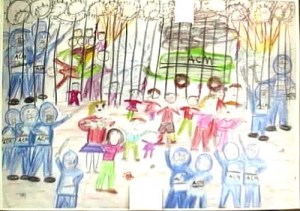
Woomera child's drawing. by Karen Elliot via flickr

There is no grass for the children to play on, or for the babies to practice their walking. She watches three small children scuffing aimlessly about in the red dust at the steps of their donga; a Muslim girl of about twelve in her headscarf, lifted from her shoulders by the hot wind; a boy of about eight in shorts and bare feet. The sand is hot. Doesn’t it burn him?

Between them they help the smallest child, who is still tottering on his uncertain baby legs. A woman in a black burqa sits on the top step of the donga with her head in her hands. Outside the administration block, they noticed when they arrived, there’s a garden of emerald green grass, young trees, and beds of brilliant flowers. The garden isn’t visible from these dongas. Later they’re told it’s tended by some of the inmates.

As she watches, a man emerges from another donga in the compound. He runs down the steps and across the red dust, screaming in a language that is unintelligible to her, but his despair needs no translation. He flings himself repeatedly at the wire that keeps him contained, like an animal in a zoo maddened by its confinement. He shakes the wire back and forth while the children watch in frightened silence. The eldest girl puts her arms round the younger ones. The man’s screams rouse the woman in the burqa: she raises her head and briefly stares at him, then returns to her own private despair.

‘Oh, Christ,’ says one of the guards standing outside the door of the Visitor’s Centre,

Razor Wire 101. by Amy Leonard via flickr

‘what’s wrong with bloody Mustafa now?’

Jennifer is sitting very still. She’s been holding her breath, and now she’s feeling dizzy and sick. Her body is warning her that this is not a sight she should witness, but she’s here now, there’s nothing she can do.

Mustafa isn’t trying to attack anyone other than himself: it’s the sight of an adult man completely out of control of himself, a woman watching from a distance and returning to her self-absorbed despair; three children silently witnessing this scene. Are these scenes here in the detention centre, these scenes and many more like them and worse, are they making intolerable memories for these children? Will these children, in their middle age, sweat when they recall these events?

It’s getting hotter as the day moves on towards noon. The dongas shimmer like mirages. She’s been afraid ever since they crossed the threshold into the prison, ever since they drove down the bitumen road from the caravan park in the Woomera township towards prison surrounded by gibber desert and saltbush. She’s been afraid of the detention officers, and the blue water cannon positioned at the gate and the high, intimidating security lights that promise to illuminate everything without mercy, no crevice left untouched, no places left to hide.

She’s way out of her comfort zone, and anyway, fear is her Achilles heel.

Everybody’s got their personal weakness: greed, grief, free-floating anxiety, lust, anger, despair. Hers is fear. It can bring her undone in a nanosecond. This is a new kind of fear, she’s only dreamed this kind of fear, in nightmares when she’s been pursued by soldiers, unable to find a hiding place in a napalmed landscape. All their journey so far, through the drought and the death stench and the tormented landscapes, past the sun-bleached bones of animals dead from starvation, picked clean by buzzards and eagles, all this has finally brought them to this place.

The journey has been a fitting preparation.

The women saw the interrogatory lights cutting through the dark sky when they made a furtive reconnoitre the night before. Having arrived too late in the day to visit the centre, they set up camp, tied up the dog in the back of the truck and crawled without headlights as close to the prison parameters as they dared.

‘Shit,’ Jane whispered.

‘What?’

‘It’s just like bloody South Africa. I can’t believe it. What country am I in?’

‘God’s own,’ Jennifer told her.

They saw headlights approaching.

‘Get going!’

‘Shut up!’

Jane threw the truck into reverse.

In retrospect they’re hard-pressed to explain their panic. Jane was worried that if they were caught hanging round, their visits the next day would be jeopardised and this was a realistic apprehension. Oppression works swiftly. The guards were completely in control. If the women offended them, they’d find some way of refusing them entry. Driving round the perimeters of the detention centre at night could be construed by the guards as suspicious.

This is how the people inside have to think every day. If I do this I won’t be allowed to do that. About the smallest, most insignificant things.

‘We aren’t doing anything wrong,’ Jennifer whispered. ‘We’re on a public road.’

‘We’re hanging round. We’re looking. That’s wrong enough for these people.’

‘Christ,’ Jennifer said disgustedly, ‘we’re still in Australia.’

‘And this is what Australia is these days,’ Jane said and they fell silent, contemplating the state of their country. God’s own be buggered.

‘Why are we whispering?’ Jennifer asked finally.

‘Dunno. We’re out of our depth aren’t we? Two white ladies from out of state. We’re out of our depth, the landscape, the Detention Centre, Woomera, which I think is a very strange town, by the way. Did you notice those parks full of planes and bombs and rockets? And how green the grass is, where do they get the bloody water from? And those empty, smashed-up apartment blocks with the doors hanging off their hinges and banging in the wind and all their windows broken? Like a post nuclear movie.’

Jane drove them back to the park. A high wind had sprung up, rocking their caravan. It was cold. Large spots of rain fell on them as they moved from the truck to the van. The park was almost empty. No one came here anymore the manager told them, owing to that fucking Detention Centre. Everyone’s afraid there’ll be a break out and they’ll get caught up in it.

‘Used to be a busy, thriving park,’ he said. ‘Now fucking look at it.’

They didn’t tell him the reason for their visit. Just passing through, they said, on their way to somewhere else. They had no wish to get into a fight with him about the detainees. They were closing down, husbanding their resources.

There was only one other van parked for the night. The park was asphalt with squares cut out of it in which frail saplings tried to grub a life for themselves out of the red dirt. They could see the lights of the Detention Centre. They made tea and climbed into their beds. Fletcher settled down on the floor in between them.

Human Rights. by Hugo via flickr


Though the guards complain to each other about Mustafa’s on-going expressions of despair, nobody goes to help him, or even to tell him to shut up, or whatever they do with people in there in extremis. Which seems to be very little. Mustafa’s frantic screaming subsides into sobs. He wraps his arms round himself and rocks back and forth in that movement typical of human beings, adults and children, who have given up on any hope of comfort other than what they can provide for themselves. Then he leaps up again and grabs at the wire.

Earlier the guards had spoken to the women about their feelings towards the detainees.

‘They’ve got everything,’ two guards, a man and a woman, told them as they deposited their bags in the lockers and waited to be searched.

‘They’ve got TVs, clothes, videos, everything.’

‘We have not got our freedom!’ shouted an inmate, overhearing the guards’ account of things as he swept and mopped the office floors.

‘That’s relative, mate!’ the male guard shouted back. ‘Freedom’s relative. I’m not free either, you know. I’ve got to show up for work here every day, can’t sit around on my arse watching TV like you. Can’t even afford a bloody TV like they’ve got,’ he told the women. ‘Working my butt off and I can’t afford what they’ve got for nothing. Then they trash it! Bloody trash TVs, DVDs, computers! You wouldn’t believe it.’

He shook his head and swore softly under his breath.

Jennifer reflects on this exchange as they sit in the Visitors’ Centre waiting for the asylum seekers they’ve arranged to meet with. The irony of the situation doesn’t escape her. The guards, poorly paid and in one of the worst work places in the country, measure their success in life by the things they can buy with their wages. This is a widespread marker of success in Western culture, the guards are no different from most other people in their material ambitions.

All the things they see the detainees getting ‘for nothing’ and then ‘trashing’ when there’s a riot, are things they’re busting their guts in this god-awful place to earn the means to obtain. The guard doesn’t feel free, because of this, and he’s in no frame of mind to start measuring his degree of freedom against that of the detainees. He’s not about to argue degrees of freedom and personal choice. He feels powerless, except in his right to exercise power over the detainees.

It’s easy enough to say the guards don’t have to be there. And they don’t, nobody’s forcing them. But as violent as they reputedly are, as racist and resentful as they clearly are, to tell them that they don’t have to do this doesn’t seem to be the answer. They think they do.

The noon temperature is forty-two degrees Celsius. There’s a hot wind roaring
Iraqi refugee child. by Catholic Relief Services via flickr

across the plain. Mustafa has stopped crying and sits quietly in the dust, his head resting against the wire. The children walk towards him. The girl’s scarf whips round her head in the wind. She holds the baby’s hand.

They all stare at the visitors. Jane and Jennifer smile. Nobody smiles back. They aren’t allowed to approach the children or talk to them. Jennifer knows she will remember this scene for the rest of her life, the three solemn children, the damaged, broken man, the woman silent on the step, her head buried in her hands.

It’s as if they’ve reproduced, in the middle of their democratic country, conditions that bear an eerie similarity to those that caused the people to flee their homelands in the first place.

‘If they’ll bother to get up,’ the guard is saying to Jane.

‘What?’ Jennifer asks.

‘It’s Ramadan. Your detainees might be late. They pray all night and sleep all day. Weird, eh?’

The guard is wired for every kind of sound. He’s got technical aids every which way. He looks at Jennifer as if he wants her to form an alliance with him against this ‘weirdness’ he has to endure on a daily basis. She thinks she might have pretended to something of the kind before she actually got into the place. Getting in was tricky, touch and go, they knew they had to play things very straight. But once in, the guards could go to buggery. Like the bloody country.

‘So why are they lazy, lying in bed all day if they’ve been praying all night?’ she asks, hostile. ‘It’s an important thing, Ramadan, like Christians have important things. Isn’t it? Anyway, it’s not as if they’ve anything to get up for, you don’t let them do anything.’

The guard looks truculent.

‘I guess this is a pretty awful job,’ Jane intervenes, deciding on diplomacy.

He softens.

‘Mate, it’s the bloody pits. Nobody knows. Nobody hears our side of the story. We’re just the bastards. You know,’ he went on, settling in for a rare opportunity to whinge to a member of the public, ‘I daren’t tell anyone I work here. You imagine that? Having to lie about where you work?’

‘Why’s that?’

‘Because the place’s got such a bad name nobody else’ll employ me after I’ve been working here.’

He leans back in his chair. They can see the tension bristling through his body. His face is congested, his beer gut large, his uniform too tight.  He’s on the edge, as are many other guards they meet on their way through the system.

‘I don’t even tell me mates what I do. I tell ‘em I work in Woomera for the Government and it’s secret, what I do. Never mention the Detention Centre. No way.’

Jane reflects on the difficulties and stresses such daily deceits must bring to a life.

‘That’s bad,’ she tells him. ‘That’s a hard thing to do.’

‘My oath. Then you get these bastards in here smashing everything up they get given. Bloody mad. Don’t make sense.’

His radio squawks. He listens and then speaks into it rapidly.

‘Well there’s three of the ones you asked to visit on their way.’

‘Three? We arranged to meet with twelve.’

‘Th’other nine aren’t allowed visitors. They’ve being playin’ up, lost their privileges.’

‘What? All nine of them?’ Jane protests.

‘Well, except Parvin, she’s too sick.’

‘She was fine a couple of days ago.’

‘Yeah, well now she’s too sick. So do you want to see these blokes or not?’

‘Yes, yes of course we do.’

He speaks into his radio.

The three young men follow the guards into the Visitors’ Centre. They introduce themselves, awkwardly. The women have corresponded with the young men, so they know something of each other’s lives, but in the face-to-face encounter they are all shy, hesitant.

Nasrim, Ali and Mohammed sit across the table from Jane and Jennifer and they look at one another in silence. The young men all have olive-skin, with bloodshot mahogany eyes under full brows, and black hair cut short as if there is only one style permitted inside the prison. Ali, who looks to be the youngest, has a round face with soft features. His expression is open though baffled, permanently so, Jane thinks. His eyes are huge, like dark, full moons and they glisten. He is plump, the soft plumpness of a young man who hasn’t yet grown into his adult body.

Nasrim has an athletic build, lean and supple. His cheekbones are well-defined, his eyes shift rapidly, checking out the women, his surroundings, his friends, noting where the guards have settled. He drums his fingertips on the table, waiting for someone to speak.

The third man, Mohammed, wears an untidy beard, beginning to show premature flecks of grey and when he smiles his lips are rosy and his teeth white, framed by the dark hair. He is heavy and muscular. He drops heavily into an orange plastic chair and drops his hands on his thighs.

‘Welcome,’ he says to the women. ‘Welcome to our palace in the desert!’

Nasrim has a packet of biscuits in his hand and Ali and Mohammed carry water, orange cordial and paper cups.

‘There is a good guard, a kind man,’ Nasrim says, ‘he gives us these things for us to give to our visitors. He understands that at home, in our country, it is very wrong to greet the visitor with an empty hand and so he lets us have these things for you.’

Mohammed breaks open the biscuits. Jane and Jennifer take one. It crumbles in Jennifer’s dry mouth and she thinks she’s going to choke. Conversation is difficult.

‘You all speak good English,’ she offers, ‘ did you learn that here?’

‘We have been in detention for ten months in Port Hedland, nineteen months in the Woomera,’ Mohammed tells us. ‘We are Hazara from Afghanistan but the Immigration, they say we are from Pakistan and are not refugees. This is not the truth.’

‘How old are you?’ Jane asks.

‘I am twenty-four, he is twenty-two and he is nineteen,’ Nasrim points to Mohammed and Ali as he speaks. ‘We learn the English here but we learned some in our country. We have left our country because the Taliban they kill Hazara, they have fatwah on Hazara. My father, my mother they are killed in our village, the Taliban destroy our village, I see my family, my sisters they are killed.’

Nasrim’s eyes fill with tears and he looks away, out of the door and into the compound where the three children still stand at the fence, staring. He yells at them in their shared language. The children stay where they are and stare at him.

‘I told them: “Go to your mother!”’ he translates. ‘These little children, they see a crazy man, made crazy here, they watch him cut himself with razor all over, blood splash out on children.’

‘The little ones saw this? They were splashed with his blood?’

‘Yes, yes, they see everything. Children here see everything, very bad thing I think.’

‘Is that their mother, sitting on the steps?’ Jane asks him.

‘Yes, that is their mother. She is sick, very sick, they give her no medicine, she does not look after them because she is sick.’

‘Where is their father?’

‘He is gone. He is given temporary visa, he is gone.’

‘His wife and children left behind here?’ Jane asks, incredulous.

‘Missus,’ says Mohammed, ‘this is happening very often here. Many families. Maybe thirty, fifty, in this place. The father, brothers, on temporary visas, the women children kept in the Woomera.’

‘The women gets sick,’ Nasrim tells them,’ without the husbands, the men the womens get sick and nobody cares for the children. This is bad place,’ he continues and looks at the ground. ‘Very bad place, much bad things happen.’

‘You mean the Immigration gives the men the visas and keeps the rest of the family in detention?’ Jane now remembers now that someone has told her this happens.

‘Yes, that is so.’

‘Why do they think you’re from Pakistan?’

‘One day, we have interviews with officer from DIMIA, she say our language is from Pakistan, she say she is expert at knowing this,’ Nasrim says. He throws his hands up in disgust. ‘She knows nothing of our language!’

The young men wear an assortment of trainers, T-shirts, shorts and track pants. Nasrim is edgy, he fidgets, picks at his fingers, runs his hands through his short hair. Ali in contrast is still: he sits calmly, gazing out the door. Mohammed rests his elbows on the table and puts his head in his hands. These young men are close in age to Jennifer’s sons. She imagines Harry and Samuel living this life. It is an intolerable imagining. She looks out of the door into the compound. A wedge-tailed eagle rises from the roof of a donga and moves upwards in slow circles out of her line of sight.

‘Ali makes the garden,’ says Mohammed.

‘The garden at the administration building?’ Jane asks.

‘Yes, I like it, I like it to do the garden, ‘I keep garden clean, plant things, empty rubbish, I have life here, job, it is not so bad.’ He has a slow, wide smile. He eats another biscuit.

‘Idiot!’ scoffs Nasrim. ‘You should dream of leaving here.’

Ali smiles again. He seems institutionalised, Jane thinks, he doesn’t have the fierce dreams of leaving detention that clearly fuel Nasrim. And what of the events they suffered before fetching up in detention centres, she wonders. What is the aftermath of those traumas?

They all met, it turns out, on the boat from Indonesia sailed by people smugglers, a journey that landed them at Ashmore Reef. None of them has any other family in Australia. All of them have come to the end of their appeals for visas to stay. What will happen to them now? Jane asks. Ali shrugs and doesn’t answer.

‘The Australian Government they give us money to go back to Afghanistan, everybody says so,’ Nasrim tells us. ‘I will go, I think.’

‘But what will happen to you? Will you be safe? Have you any family left there?’

‘I have uncle. Our village is destroyed. The Taliban is not so big anymore. Maybe I work for the Americans. It cannot be worse than this.’

He waves his hand at their surroundings.

‘I would rather die man than animal. If I die let it be for being Hazara in Taliban fatwah, not here in black hole of hell in Australia like pig.’

He stands abruptly, then paces the small room with his hands in his pockets. Ali shakes his head at us.

‘Would you go back, Ali?’ Jane asks.

‘I don’t know, Missus. I am afraid of soldiers. They try to make me killed. I don’t know if I will go back. Maybe I stay here, grow garden.’

Mohammed has his head in his hands and doesn’t speak. Outside Mustafa has begun screaming again. Nasrim flings himself back into his plastic chair and bites at his fingers.

Jennifer thinks to herself that there was a long and venerable democratic tradition that once existed in the world, a tradition that recognised the right of the stranger to seek sanctuary and to ask for help. There was a corresponding duty to oblige and offer assistance. What has happened to this tradition? Or was it just a dream?

‘Why is Mustafa crying like that?’ Jane asks.

Ali and Nasrim shrug.

‘He’s crazy, his wife, his children they died in his country and he is made crazy.’

Nasrim makes the motions of putting a needle through his lips.

‘Very bad,’ he says, ‘the children, some of them too do this.’

The guards are not in the room but they are by the door in the next room, keeping an eye on things, talking among themselves, laughing, their radios squawking intermittently. Jennifer gets up and goes over to them, leaving Jane talking to the three men.

‘We were invited to visit some of the women here,’ she says. ‘Are we going to able to do that?’

‘There’s nobody else on your list,’ the guard tells her, checking his clipboard.

‘I have the letters here that the women sent, asking us to visit them.’

She takes them out of her shirt pocket and shows him. He gives them a cursory glance and looks away. He’s in his thirties, clean-shaven, medium build with a crew cut. He works out: she can see the muscles under his tight blue shirt. He’s a rock. Nothing she says will persuade him to let them see anybody else.

‘Well, I don’t know, they’re not on your list, except Parvin and she’s too sick.’

‘Parvin had Federal Court a couple of weeks ago. Did she get a visa?’

‘Can’t tell you that I’m afraid. Confidential.’

‘So we won’t be able to visit with the women?’

‘Nope, they’re not on your list. Anyway a whole bunch of them have lost privileges for playing up.’

‘The women?’

‘Not just the women but some of them are women.’

‘What did they do?’

‘Can’t tell you. Confidential.’

‘What if we come back tomorrow?’

‘You’ve only got this one list, that won’t change tomorrow.’

‘Who made up our list?’

‘We have officers who do that.’

‘Can I see one of them?’

‘They’re not here at the moment.’

‘Thanks.’

Jennifer returns to her plastic chair. Nasrim pushes the biscuit packet across. Vanilla creams.

‘Thanks, Nasrim. What happened here, why have so many of you lost your privileges?’

‘There was fighting, somebody broke computers, people screaming, women throw chair, very bad.’

‘One month ago a big fire light in our detention centre,’ Mohammed suddenly speaks without lifting his head from his hands. ‘I working in kitchen with Ali. Everybody lose privilege. No visitors.’

‘How long do they lose privileges for?’

‘I do not know. Maybe days, maybe longer.’

Nasrim casts furtive looks at the guards in the next room. Jane looks over at Jennifer. Jennifer feels as if great weights are tied to her ankles and wrists, preventing her from movement, a sense of overwhelming oppression and helplessness. Jane’s eyes are glazed behind her glasses, her features dulled with heat, shock, Jennifer doesn’t know.

‘We do not have mothers,’ Mohammed lifts his head from his hands and says this quietly but with feeling.

‘We do not have mothers, his is killed, mine is lost, Ali, nobody knows of Ali’s mother. You have sons, missus?’ he directs his question to Jennifer.

‘Yes, two sons,’ she tells him.

He takes a drink of orange cordial. Cottee’s Cordial?

My dad picks the fruit
that makes the cordial that I like best.

‘They are free, they work, have girls, go out, they are in city?’

‘Yes, they do all those things. Harry works for the United Nations in a refugee camp in Tanzania. He teaches the children how to play football. Samuel is a chef, in Stockholm.’

‘Ah!’ Ali cries. ‘I too am cook! I cook here sometimes, in kitchens.’

‘Do you like cooking?’ Jane asks him.

‘Oh yes, very much. Good job. Plenty to eat!’ he chuckles.

‘In our country,’ Nasrim, glowering, says,’ when visitor come we make feast, much food, goat, chicken, rice, here we have only these biscuits and this drink!’ He sweeps the pile of plastic cups off the table.

‘Even when little food always we share with visitor! This,’ he gestures at the biscuits and the cordial, ‘this is…’

His English leaves him and he flings his hands in the air. He says something in his own tongue. The others look at him. A guard enters, curious about the noise.

‘Not playing up, are we, Nasrim?’ he asks.

Nasrim replies again in his own language.

‘Time’s over, anyway,’ says the guard.

‘Can we have a bit longer,’ Jane asks,’ we promised to take a list of things the men need with us so we can send them.’

‘They’ve got everything they need. But okay.’

They have to ask the guards for pencils and paper as all their things are in their backpacks in the lockers. Jennifer can’t believe those children are still out there in the broiling sun. The little baby is sitting down now in the red dust with the older children. Mustafa has vanished, as has the children’s mother. She can’t see any other adults. How long the days must seem in here.

‘Jennifer,’ Jane says as they drive back along the bitumen road to the caravan park, ‘how is it that they’re denied visas because the immigration people don’t believe they come from Afghanistan, yet they’re offered money to go back there?’

‘I don’t know, I don’t understand that. I don’t understand why they release the men and keep women and kids in there either.’

Jennifer saw some film footage on the news before they left, of an Afghan man who’d returned to his bombed-out village. He was scraping blindly at the earth where his home used to be with a teaspoon. It was one of the saddest images she’d ever seen. Is that what’s awaiting Nasrim, she wonders.

As they leave the three men, Mohammed thrusts a piece of paper into Jane’s hand.

‘Read this,’ he tells her. ‘My friend he is at Baxter now, he write this, is good, good writing. Maybe you put in paper in book for him but you not use his name, he is afraid of people knowing.’

They look at the poem as they sit in the truck in the Detention Centre car park. They’ve retrieved the dog and their personal belongings, thanked the guards, walked out to the truck on trembling legs, exhausted. Jennifer’s now trying to take photos of the centre through the windscreen without drawing the attention of the guards. She wants a picture of the water cannon at the gates. The guards are in their towers with binoculars, and patrol cars pass by every few minutes. Nevertheless, she manages a few badly-focussed images.

What kind of stupid incompetent terrorists would try to infiltrate the country via people smugglers and end up imprisoned here for years, Jennifer wonders, recalling a politician’s claims about the asylum seekers true purposes.

Down the road a bit, they stop and look back at the steel compound topped with razor wire. It has a beauty that comes from its simple proportions, the satisfying alignments of all its angles, the sun glinting off its shadowless surfaces. It is simultaneously incongruous and perfectly placed in the wilderness that surrounds it; a savage stronghold, impossible to ignore. Its designers have succeeded in eclipsing the drama of the arid landscape: the eye is drawn in awful fascination: one cannot look away.

‘Christ,’ says Jane.

It isn’t until a week later, camped by a flowing Victorian river in a field knee-deep with poplar seeds like balls of ripe cotton and a herd of roaming Jersey cows rubbing up against their caravan, that they both break down. It was awful, they agree, to have to leave the men behind in that place (Surrounded by peoples with no love,as the poet wrote) to have to say goodbye and walk away. And those children.

They know bad things happen in that desert place; they’re in its atmosphere. Later they will discover just how bad when the conditions are gradually revealed to the public by people who’ve worked there and decided to spill the beans.There are raped children behind the razor wire, beaten women and crazed men.

A common suffering. A common humanity. The women are full of admiration for the visitors who live close by, who go there every couple of weeks, month after month, offering support and companionship.

Their journey home is long and much of it passes in silence. What has confounded them both is that these things are happening in their own country. They are ashamed, and very angry.

‘Not in my name,’ growls Jane. ‘Not in my bloody name.’

One Silent Night
The wind is blowing to one side
Here it touches my body
I feel like just in heaven
Suddenly I open my eyes and look around
Oh God I am behind the fences
Still filled with unhappiness
I would like to fly just like a bird
But I know I can not
God created this world for everyone
But some people try to destroy it
And some people try to keep it for their own way
Why do they keep on behaving like that
I need a new world to live
I want different skies every day
Can I live with out fear of war and terror
Could my dreams come true one day
In my childhood I thought
I was the luckiest person in the world
Because my life was secure
Now I think I am the unluckiest person in the world
Surrounded by peoples with no love.
By………
Baxter IDF.

Lavartus Prodeo nights.

14 Feb

by Linus Ekenstam via flickr

It wasn’t my intention to visit the Lavartus Prodeo blog. I was on my way to somewhere else when an enticing little link popped up and before I knew it I was right in the middle of the Lavartus Prodeo On Line Opinion thread.

My first post was an alternative perspective on moderating from that dominant in the thread. This brought an immediate response, to the effect that those with enough wit are capable of composing comments that don’t require the intervention of a moderator, and the witless were deleted and dispatched elsewhere. LP is a cyber club, the post continued, and if I didn’t like the rules of the cyber club I should also move elsewhere.

I was a little taken aback at this reaction to what, after all, had only been a personal observation on alternative moderating.

Later on, another commenter told me that I’d announced my alternative opinion in a way that was too challenging and provocative, and I shouldn’t go onto blogs for the first time telling everybody I had a different opinion, because that immediately got them all off side.

In spite of the uninviting nature of the initial reaction, or because of it, my curiosity was aroused. Many people would have run a mile and never returned, but I have a compulsion to continue even when, or especially when, someone tells me right off I don’t belong.

I think it’s a consequence of experiencing severe marginalisation as a child. Freud’s repetition compulsion. I’m still trying to resolve the original trauma of not being allowed to belong, so I compulsively take on anybody who tries to shut me out. Daft, but a compulsion is a compulsion.

As well, I had my own strong opinions about the OLO controversy, and didn’t mind expressing a few of them at LP. I’d go for it, I decided, and girded up.

My decision to subject myself to the experience was also influenced in no small part by the effects of large doses of painkillers I was taking after surgery. These gave me an exaggerated sense of my own capabilities, and made some things seem funny that probably weren’t.

Choosing the best hat for the occasion

Some years ago I read an account of the psychoanalyst Bruno Bettelheim’s experiences in a concentration camp. He’d survived, he felt, because he had been able to observe and record the experience through the framework of his training. He’d used it as an opportunity to observe human behaviour under extreme conditions. He’d learned a great deal, and given himself a purpose that kept him going. The result was some fascinating insights into the human animal under intolerable stress, and his survival.

I’m not suggesting for a moment that visiting LP was anything like Bettelheim’s ordeal, but since I read how he survived, I’ve often employed his methods when I’ve found myself in testing situations.

I also got a bit of encouragement in this direction from Foucault, who’s mission it was to always find the back story – “My problem is essentially the definition of the implicit systems in which we find ourselves prisoners.” Well, that.

To add to all that, being curious about nationalism, border protection and sovereignty in all its forms, even when manifested on a blog, I sensed there would be a great deal there for me if I took the time to engage in a few encounters.

I also spent years as a clinician, a lot of that time running groups. That specialised interest is probably also a consequence of being chucked out of my original group at an early age.

The past does indeed determine the present, and the future.

This is not the first time I have done this

One more disclosure. I have conducted this experiment (being the only disputing voice and seeing what happens) on a Melinda Tankard Reist comments thread. Though in that case I was quickly joined by others, and the burden of sole dissent was removed from my shoulders. LP is the only blog where I’ve been absolutely alone.

Don’t talk about the PhD

Many of the insults directed at me by MTR’s followers were repeated at LP, especially, strangely, insults about my academic qualifications. I would have thought that both places, the one Christian feminist, the other apparently catering to the educated, would have taken them in their stride, and found them unremarkable, but not at all. I was roundly ridiculed in both places for having mentioned my PhD.

Even though in the MTR case someone had demanded to know what my qualifications were, and I obligingly told them.

And in the LP case Mark Bahnisch corrected me when I addressed him as Mr, saying that he was in fact Dr. So I signed my very next post as Dr, seeing as it seemed to matter.

And brought down on my head an outpouring of mirth from what seemed like a zillion commenters, some of whom revealed their own academic credentials, (no doctorates) and others who made a few up.

Dr Bahnisch was having a joke, it seems, and in signing myself Dr, I apparently responded too seriously. I know him very well, someone posted, and you’ve got him all wrong.

Well, as I’ve never met him, and heard of him only vaguely for reasons I can’t recall, I can’t think of one reason why I’d be expected to know him, much less be au fait with his sense of humour.

God, it’s hard when you don’t know the group norms!

Eric Sykes then showed great insight when he commented that perhaps the blog was not for me.

Somebody then expressed the hope that I would go away.

I took another pain killer. It was time.

Starved of radical dissent

I posted a few times about the OLO situation, and my thoughts that in attempting to close OLO down, an attack was being launched on free speech, among many other things. What did I mean by free speech, Dr Bahnisch demanded. Was I referring to John Stuart Mills? Was I making claims about OLO and the Socratic dialogue? OLO and the principles of the Enlightenment?

By now there were numerous LP commenters attacking me like starving feral cats will set upon a bowl of food left out by a kindly human. I began to think that these people probably didn’t often have the opportunity to talk to someone who completely disagreed with them. They were starved of radical dissent, desperate for someone other than themselves against whom to test their brute intellectual strength, and I was it.

Whoa people! I wrote. You are many and I am but one!

Yes, someone called Fine replied. You might be feeling overwhelmed but if you would only argue properly instead of using rhetoric!

I move blogs

Later that day I meandered over to Club Troppo where I left a comment about the OLO situation. Only to have Mistress Kimbrella (one of the made up qualifications) from LP pursue me like one of the furies.

Well, hello there, Dr Wilson, she wrote. Sorry you didn’t make any friends and influence people at LP.

Really, Mistress whatsit, I admonished as the drugs kicked in, I have given you a day and much of the night. Are you not satisfied? I never said I was interested in commitment. Are you going to demand my attention on the flimsiest of excuses?

The Mistress then reminded me that she had been at Club Troppo and LP for many years. Her point apparently being that I, on the other hand, had only just arrived.

Oh, you mean I’ve landed illegally in a leaky boat without my proper papers, in sovereign territory where I was not invited? I wrote.

What was it again? Oh yes: “We will decide who comes to this blog and the manner in which they come!”

And they’d better assimilate straight away, having first been suitably humble, or they can go right back where they came from.

By now it was becoming clear to me that these people were not fans of Levinas’ theories of radical hospitality.

Group dynamics

Anyone with superficial knowledge of how a group works, knows that one of the basic bonding rituals used to strengthen and reinforce the group is for its members to unite against an outsider. The herd mentality does not have the capacity to embrace the other. It is entirely dedicated to preserving its sovereignty.

The outsider offers a perfect opportunity for a closed group to reinvigorate itself. Members who may feel themselves on the outer for some reason are given the opportunity to return to the fold, as they unite with their fellows against the stranger.

This process is essential from time to time, as the closed group inevitably becomes incestuous when deprived of external contact, turning on one another and splintering into factions. The appearance of a stranger can cause the group to temporarily abandon its dysfunction, re-bond, and celebrate its strengths.

Or as Costas Douzinas puts it “The foreigner is the political precondition of the nation state…”

Getting a good kicking

I have to say LP was much, much worse than MTR. MTR does welcome very opposing commentary. Some of her followers will give you a good kicking, but they don’t tell you to find another blog because you don’t fit in. They thrive on dissent. In this I can only admire them, though many of their views are, in my view, bordering on the insane.

Finally, I accept that I’m not wanted.

I have taken the advice of the LP commenters, and removed myself from their site, probably never to return, unless I have more surgery requiring pain relief.

I probably won’t go back to Club Troppo either, as Ken Parish told me metaphorically to bugger off because my arguments are relentless. I was only trying to rebut statements and opinions he’d attributed to me that were not mine. But I was a foreigner there, too, and perhaps foreigners aren’t supposed to get so uppity right off. Even if they do feel they’re being misrepresented. Maybe foreigners are supposed to just suck it up till they’ve been initiated and accepted? I don’t know.

The last word I give to Derrida:

“For hospitality is not some region of ethics…it is ethicity itself, the whole principle of ethics…”

There’s a lesson in that for all of us.

Complaint to Press Council

7 Jan

Further to the post: The propaganda and collusion at the heart of “Stop the boats.”

Today we sent a complaint to the Australian Press Council claiming that the article by Paul SheehanSydney Morning Herald January 3 2011, titled Cast adrift from reality, the slick spruikers of ‘our’ shame, breaches Principles 1,2,3 and 6 of the Council’s Statement of Principles.

These Principles address misrepresentation of groups and individuals; suppression of available facts; deliberate misinformation through omission or commission, and fairness and balance.

We claim that these principles were breached by the use of the terms “illegal” and “without proper papers” when referring to asylum seekers arriving by boat.