Archive | February, 2015

Mansplaining shrink gets the flick, or the death of the author

17 Feb

Of all the things for which one could acquire a tainted reputation, chronic plagiarism must be one of the most ignominious.

Psychiatrist and columnist Dr Tanveer Ahmed, winner of the inaugural No Place for Sheep Order of Arrogant Ignorance for his mansplaining article on domestic violence, has just been “let go” by The Australian for plagiarising great chunks of the ill-informed drivel he claimed to have written for that newspaper in his role as a White Ribbon Ambassador. This here link tells you what that organisation thought about it. I gather they planned to send him to re-education camp.

The very notion of The Oz letting one of its people go for plagiarising had me ROFLMAO. (That’s rolling on the floor laughing my arse off, if you don’t do Twitter). What, they’ve suddenly acquired some integrity over there? They fire people for plagiarism? Lies, distortion and right-wing propaganda are fine, but Rupert won’t have plagiarism at The Oz?

Ahmed was sacked by the Sydney Morning Herald a while back for the same offence.

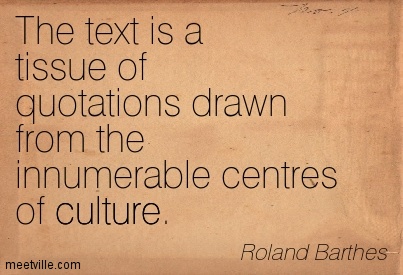
Obviously he’s a post-structuralist. He believes in the death of the author, that every text is a tissue of all other texts, that there is no single authorial voice, that one does not need to know the author’s identity to distill meaning from the text.  It’s a post-modern pastiche, a bit of cut and paste with intimate violence for its theme.

I once taught with someone who asked me to give a lecture for them when they were ill. I read the lecture the night before I was due to deliver it. Every word lifted. Every single bloody word. What aggravated me most about that, I have to confess, is that my senior colleague thought I’d be too ill-read to recognise the work. That, and having to write another lecture at the eleventh hour.

The fact that Ahmed plagiarised is not as important as the dangerous misinformation he plagiarised and peddled about. Fortunately, there won’t be any mainstream media willing to employ him again, I don’t imagine, so we’ve one less ignorant arrogant mansplaining voice to put up with.

Actually, I think Roland Barthes is nifty. And I don’t know that he ever recommended non-attribution.

Roland Barthes Death of the Author


The government you have when you don’t have a government

16 Feb

I woke up this morning thinking that I don’t feel as if we actually have a real government, or a real Prime Minster.

Tony Abbott seems to be increasingly decompensating under the stress of discovering he’s so unpopular with his party he had to face the prospect of a spill motion without even a challenger for his leadership, and that must be a rare political event just about anywhere.

(Decompensation, psychology: the inability to maintain defense mechanisms in response to stress, resulting in personality disturbance or psychological imbalance.)

After the acute trauma of the spill motion passed, everyone involved needed a little time to collect themselves, pass around the talking stick, and begin the process of healing. Instead, Abbott went right out and sacked Philip Ruddock as his Chief Government Whip, on the grounds that Ruddock had not adequately warned him of growing backbench discontent.

This is amazing. The rest of us knew all about it, but the PM’s office didn’t?

I’ve had doubts about the efficiency of this office for quite some time, after all, they’re supposed to be there for Tony yet every day since he took office things for him have traveled increasingly south. At first blush, it appears the PM’s staff are incompetent on a Monty Python scale.

Perhaps their secret agenda is to ruin him, or I have been watching too much In the thick of it. Either way he should sack somebody in that office and hire Malcolm Tucker, but instead he went after Ruddock.

I don’t care much what happens to Ruddock: I will never forget his days as Immigration Minister in the Howard government during which he instigated a powerfully successful campaign to demonise and criminalise asylum seekers arriving by boat, largely through the use of language he adopted from Nazi anti semitic propaganda of the 1930’s. Without Ruddock we would have no Morrison. He might look like a hurt old man, but I’m not fooled.

Then there were Abbott’s belligerent attacks on President of the Human Rights Commission, Professor Gillian Triggs, after the Commission’s report on children in detention was tabled in Parliament on Wednesday. In a typical conservative shoot the messenger and make so much noise that everybody will forget the message tactic, Abbott railed long and hard about Professor Triggs, while entirely disregarding the appalling findings of her report.

With the stubborn determination of the utterly cloth-eared stupid, Abbott keeps the three-word slogans hiccoughing off his far too evident, lizard-like tongue: boats, mining tax, carbon tax, boats, carbon tax, mining tax; we are open for business but not for boats, carbon tax, mining tax. I wonder to myself, does he or anyone in his office really think there are still people out here even listening to this drivel?

It is a measure of the collective desperation of Abbott and his staff that they continue to cling to this cringe-worthy robotic recitation: they have totally failed to come up with anything new, for all the millions of tax payer dollars we’ve spent on them.

The zeitgeist as far as I can tell is one of trembling, panicked uncertainty: what will their leader say next, how much longer can this go on, how can they make it better without looking like the ALP. This latter possibility seems to be the very worst thing they fear could happen to them.

It isn’t, though. Worse things are happening every time their leader opens his mouth and puts both feet in it. But hey, it’s good for the ALP.

There’s been a cute white rabbit appearing in our garden for the last few days, and like Alice in the wonderland, I’m thinking of drinking the potion to make me oh so tiny, then I can follow White Rabbit down his hole.

But wait! I’m already there!

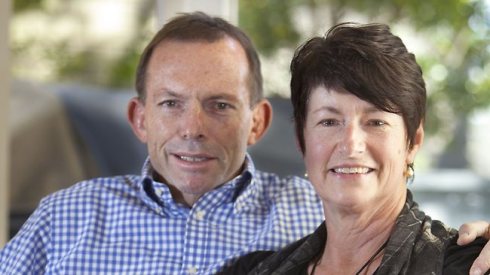
The final straw is the sudden wheeling out of Margie. You know he’s a dead man walking when he rolls out the wife.

Tony & Margie Abbott


Regulating desire: 50 shades of mind your own business

15 Feb

Keep calm & spank me


I haven’t seen the film Fifty Shades of Grey. I’ve read perhaps three pages of the first book which was far more than I needed to tell me it wasn’t going to cause any quivers in my nethers, and it would be self-abuse to persist in reading the excruciatingly awful writing for absolutely no reward.

The narrative centres around the relationship between an “ordinary” young woman and a wealthy man in which she is his submissive, and he controls her life. They practice consensual bondage, domination, sadism and masochism.

I was interested in what some others were saying about the movie so I read the erudite scorn of Razer, the feminist outrage of Tyler, and the, well, I don’t know quite how to describe Mia Freedman’s take in which she claims that reading all three books brings both knowledge and understanding to the film, a brand new angle on the concept of a lord of the rings trilogy which seems to endow Fifty Shades with far more intellectual and imaginative gravitas than it can possible deserve.

Tyler’s piece in the Conversation launches a full frontal attack on the practices of bondage, domination, sadism and masochism, which she claims are only ever abusive, even when engaged in by consenting adults. Adults are never capable of “individual” consent, the argument goes, because all of our actions take place within the context of a culture that constructs our desires, so  people only think they want BDSM because they’ve been taught to be dominant or submissive by the patriarchy. BDSM eroticises domination and subordination and this is wrong, she writes, when we consider how many women are subjected to violence and abuse to which they do not consent.

This argument is a little like saying that nobody should be allowed to eat hot chips because some people are dangerously obese.

The conflation of intimate violence with consensual BDSM offends me mightily. I haven’t explored all the potential of BDSM yet in my life, but I do know the erotic delight of yielding and submission, and the equally erotic delight of dominating in sexual games played in an atmosphere of trust and exploration. I’m not that interested in hurting and being hurt, so I’d be a very low-level kind of BDSM person in that it doesn’t take a lot to transport me to the altered state where complex emotions and sensations are aroused by submitting, and by dominating. And this is surely what BDSM is about – people want the feels and will do what it takes to get them, and who is to say they shouldn’t and when the physical performance is abusive, excepting those involved?

Yes, there are times when BDSM goes wrong. There are times when practically everything you can think of goes wrong: we inhabit a Manichean universe of dark and light, and oftentimes the distance between the two is narrower than a bee’s dick. Of late, this universe seems to be increasingly populated by those who wish to prevent anything ever going wrong, an impossible task that can only result in nobody being allowed to do anything at all, in case it goes wrong.

I have experienced family violence and childhood sexual abuse, and there is absolutely no comparison between those experiences  and consensual BDSM, and it is dishonest in every way for anybody to claim they are inevitably the same. They may well become the same if wishes aren’t respected in BDSM encounters, just as ordinary old heterosexual sex can go wrong if wishes aren’t respected. What is wrong in both instances in the disrespect of wishes, not the practices.

To be honest, I’ve had it with pearl-clutching repressives who want to vanilla the world, and try to achieve that by shaming others about their sexual desires and practices. They are far more of a menace than Fifty Shades can ever be.

In a period of our evolution in which we are supposedly increasingly free from sexual oppression and repression, merely by virtue of being allowed to speak of sex in ways that were unthinkable fifty years ago, it seems to me that this freedom has brought with it a focus of concentration on the morality or otherwise of how we perform sex, rather than on the more important matter of respecting another’s wishes in sexual encounters of all kinds.

If I want to be spanked, I’ll get spanked, and problems will only arise for me if I’m spanked when I don’t want to be. Then I’ve been assaulted and there are already laws in place to address that.

But I can’t see anything in the least coherent in telling me I can’t have a spanking because others are being subjected to intimate violence. Conflation is one of the scourges of our times.


Advice to women. Not.

14 Feb

createordie-neon


Were I ever to give advice to women which I wouldn’t because I continue to learn that the ways in which I can be stupid are infinitely more numerous than the ways in which I can be smart and to give advice to anyone it ought to be the other way around, but if, stupidly, I disregarded that little spark of self-knowledge and went ahead anyway, I would say, a woman in a family must resist the domination of the managerial if she wants her creativity to survive.

By the “managerial” I mean that aspect of ourselves so competent, so deft, so practical, so capable it could run a global corporation with one hand tied behind its back, and blindfolded. In my life as a partner and mother, and in the lives of many women I know, this aspect became so dominant it stole the oxygen from every other. This occurred as much because it suited everyone else that I manage the family’s daily affairs as it did because I thought I was supposed to.

Virginia Woolf grappled with  the problem the managerial can present to women, describing its pernicious influence as “The Angel in the House”  with irony and humour, but with deadly seriousness as well:

You who come of a younger and happier generation may not have heard of her — you may not know what I mean by the Angel in the House. I will describe her as shortly as I can. She was intensely sympathetic. She was immensely charming. She was utterly unselfish. She excelled in the difficult arts of family life. She sacrificed herself daily. If there was chicken, she took the leg; if there was a draught she sat in it — in short she was so constituted that she never had a mind or a wish of her own, but preferred to sympathize always with the minds and wishes of others…

I now record the one act for which I take some credit to myself… I turned upon her and caught her by the throat. I did my best to kill her. My excuse, if I were to be had up in a court of law, would be that I acted in self-defence. Had I not killed her she would have killed me. She would have plucked the heart out of my writing. For, as I found, directly I put pen to paper, you cannot review even a novel without having a mind of your own, without expressing what you think to be the truth about human relations, morality, sex. And all these questions, according to the Angel of the House, cannot be dealt with freely and openly by women; they must charm, they must conciliate, they must — to put it bluntly — tell lies if they are to succeed. Thus, whenever I felt the shadow of her wing or the radiance of her halo upon my page, I took up the inkpot and flung it at her. She died hard. Her fictitious nature was of great assistance to her. It is far harder to kill a phantom than a reality. She was always creeping back when I thought I had despatched her…

For me, it wasn’t entirely about reviewing male writers and depending on charm to get me by, although the spectre of disapproval, the fear of offending and as a consequence being despatched to the margins also has to be regularly fought off if I’m going to write what I truly want to write. My recent foray into erotica, for example, was a frightening experience of voluntary vulnerability, as is any self-revelation, but if we are to write about what it is to be human, that writing will always provoke anxiety in its author, and likely at times in its readers.

As unlike Woolf we had no household staff, for me the managerial was about knowing where everybody’s socks were, remembering the washing and the shopping and the cooking and the lunches and the driving and the.. look, I can’t even bear to go back there, you all know what I mean. I lost myself. I became The Manager, and worst of all, I found it almost impossible to turn her off in my head. I came to hate her. She was like the strangler fig parasitically stealing the life of the rainforest tree.

This suited everybody in the family, but it didn’t suit me.

One of the wisest pieces of advice any woman ever gave me was to cultivate absent-mindedness. For example, when people asked me where their socks were I would gaze thoughtfully at them for much longer than necessary. I would assume a puzzled expression and tug at my lip. Oh, darling, I would say finally, I know I saw them somewhere but I can’t think where…

I had to strictly discipline myself  in order to be able to do this. My every conditioned impulse urged me to take responsibility for everything in our household’s daily life, and this conditioning had to be constantly and consistently resisted. Family members do not easily relinquish their dependencies, and tend to passively and aggressively fight changes in a wife and mother with every bone in their bodies. I think it was harder than giving up smoking, and there were no quit lines to help me.

It took quite some time, but eventually I noticed they weren’t asking me to manage their entire lives for them quite as often as they used to. Then one morning I overheard one child saying to another, I’ll ask Mum. She won’t know, replied the other, she’ll just look at you as if she doesn’t know what you’re talking about, she never knows where anything is, we’ll have to find it ourselves.

And I knew I’d done it.

This proved to me that you can’t change anybody but yourself and if you do change yourself there is a good chance that  people who really love you will eventually learn put up with it, and change as well.

There are many advantages in being thought a muppet by your family. Muppets are not renowned for their managerial abilities, and nobody expects it of them.

Sometimes, it’s the only way the creative woman survives.

Many thanks for the inspiration for this post to the lovely M, who sends me a poem to wake up to every morning. The two words “managerial mess” in this poem by Jennifer Strauss, What Women Want  summed up an entire period of my life. 


Is domestic violence gender-based violence? Two

11 Feb

language-matters-85837543Yesterday’s post on whether or not domestic violence should be framed as gender based violence caused some discussion, which is excellent, these discussions must be had, disagreement and all, if we are to ever find ways to deal with the awful cost of intimate violence.

One tweet that particularly impressed itself on me is this one from Margaret Foley:

It refers to the “king hitting” of one brother by another, in a public place. As is pointed out, this is not described  as family violence or domestic violence, but why not?

I also received some tweets from a man who thought I was suggesting that the LGBTI community consists of people without gender, a reading of the blog I find bizarre on a number of fronts. Gender is a role, a performance, and it is the aim of some in the community to challenge the performance of traditional gender roles, for example Norrie, who succeeded in having a non-gender specific category legalised for use on official forms. Assuming that same-sex couples emulate heterosexual gender role stereotypes is homophobic.

My fear, shared by others, is that using the terms domestic and gender with regard to violence may actually work against women, because of the perception those terms immediately create about the nature and seriousness, or lack thereof, of violence perpetrated against us. I am willing to relinquish the right to have violence against me described as gendered and domestic, if it will go some way towards changing perceptions about that violence so that it is regarded as just as serious and criminal as any other form of violence, such as a bro king hitting a bro.

I speak with some authority on this matter. I survived horrific violence in my family of origin, violence of the kind that has left me with life-long post traumatic stress disorder. I do not want that violence diminished by language. The violence I experienced was violence in the home, perpetrated by a man against a woman and her child. The cultural connotations of both domestic and gender-based diminish what happened to me, and I have yet to see an argument that convinces me that they don’t. They shouldn’t, but they do.

We can either struggle to change society’s perception of these terms, or we can struggle to have violence recognised as criminal no matter what the circumstances in which it is perpetrated. At this point I would choose the latter, as the situation is far too grave to wait for public perceptions around the domestic and the gender-based to change. It is violence. It is a crime. When you are a victim and a survivor of violent crime, any language that diminishes your experience is not a language you want to use and hear used, even though it is theoretically accurate.


Is domestic violence gender-based violence?

11 Feb

Domestic Violence


Domestic violence is usually included in the umbrella term gender-based violence, that is, violence that is directed against a person because of her gender, and violence that reflects inequalities between men and women.

Domestic violence, intimate partner violence, (IPV) and family violence are defined in Australian federal and state government policy released in 2011 as gender crimes, committed overwhelmingly by men against women and their children.

As the majority of domestic arrangements in our culture are heterosexual, that seems an obvious conclusion to draw. However, look at any one of a number of world-wide studies on domestic violence between same-sex partners and you’ll find the similarity to heterosexual couple violence, not only in occurrence, but also in performance.

Domestic violence is about power and control between men and women, women and women, and men and men. If we lived in a culture in which same-sex couples were as prevalent as heterosexual couples, it’s safe to assume the incidence of domestic violence would hardly vary.

My point is that to define domestic violence as gender-based is inaccurate and unhelpful, particularly to those in the LGBTI community whom it excludes. Many researchers suspect a current under-reporting of same-sex couple violence, perhaps in part due to that definition. The proportionally equal rates of domestic violence in hetero and LGTBI communities suggest the violence is not gender-based, but an outcome of couplings in which one party exerts control over another using violence, regardless of gender.

Framing domestic violence as a gender-based problem does little to help combat the issue, as decades of failure to reduce the figures suggests.

It’s sometimes argued that LGBTI couplings mimic the heterosexual and the abused party in LGBTI relationships is “feminised” by virtue of being abused, therefore the abuse is still in that sense gender-based. This argument has a ring of making the evidence fit that leaves me unconvinced.

Our problem is that the need to exert power and control over others is endemic in our culture and manifests itself in a multitude of ways, from school bullies to violent intimate partners. My concern is that in making gender the focus in domestic violence we’re allowing ourselves to be distracted from the core problem, and as long as we do that we are unlikely to find workable solutions.

As long as our dominant couplings are heterosexual, there’s no reason to think women will not continue to bear the brunt of domestic violence inflicted on them by male partners. But does that make intimate couple violence gender-based, and ought we to be addressing it solely from that perspective?

We need to have adequate protections in place for people needing refuge from violent domestic situations, and our Minister for Women, Tony Abbott, has cut funding to women’s services that will in the next couple of weeks severely curtail these protections. It is not always to our advantage to have domestic crimes against us defined as gender-based.

Mansplaining domestic violence. The 2015 Award.

10 Feb

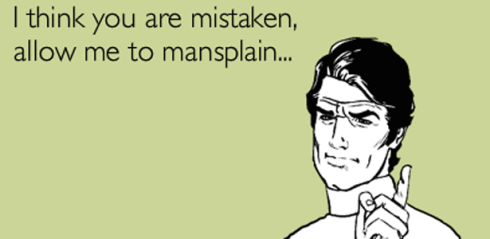
Mansplaining


It’s very early in the new year to be handing out awards for anything, however this piece by psychiatrist and White Ribbon ambassador Tanveer Ahmed on domestic violence earns the author the 2015 No Place for Sheep Order of Arrogant Ignorance for mansplaining violent domestic crimes against women and children perpetrated on them by the men in their lives.

Mansplaining, if you aren’t sure what it is, is defined in this timely piece in The Conversation by Monash academic Howard Manns.

I know. I know.

“Mansplain” has been declared the word of the year by the Macquarie Dictionary:

verb (t) Colloquial (humorous) (of a man) to explain (something) to a woman, in a way that is patronising because it assumes that a woman will be ignorant of the subject matter. MAN + (EX)PLAIN with s inserted to create a pronunciation link with explain.

Admittedly, Dr Ahmed was explaining his theories on domestic violence to everyone who reads the Australian and that’s not just women, nevertheless, in this writer’s opinion, he is still deserving of the Order.

Owing to the Murdoch press paywall which is sometimes by-passable and sometimes not, I’ve copied Dr Ahmed’s piece and you can read it at the end of this post.

Basically, Ahmed is claiming that “male disempowerment” caused by 1970’s radical feminism has led to a power inequality between the genders. One way some men address this imbalance is by beating the women and children in their lives, sometimes to death, or murdering them by other means.

In reaction to this male violence against them, women have formed a “cult of victimhood” that has so skewed society’s perceptions of male behaviour that beating women and children in acts of intimate violence and sometimes murdering them has led to a “psycho-prejudice…in which what men and boys do is seen as socially disruptive.”

If men and boys beat and murder anyone outside their families it is certainly seen as “socially disruptive.” Think king hits.

But that’s not all: “The growing social and economic disempowerment of men is increasingly the driver of family-based violence…[working class male work] has become “feminised.”

In other words, domestic violence occurs entirely in the working classes, “newly arrived ethnic groups,” and fatherless sons of single mothers are apparently particularly prone, says Ahmed.

This is drivel deserving of a hundred Orders of Arrogant Ignorance. It is well-estabished that domestic violence occurs in every demographic, and I can personally attest to that, the perpetrator in my family of origin being, like Ahmed, a doctor, and not at all economically disempowered, or disempowered in any other way either.

While it is true that there are male victims of domestic violence and they shouldn’t be neglected, drivel such as this is of no help to them or anybody else.

It’s also true that a particular view of gender relations can at times be less than helpful. However, domestic violence and murder are crimes, and those who perpetrate the crimes are criminals. Gender relations do not a beater and a murderer make, and men like Ahmed need to grasp that.

With mansplainers like White Ribbon Ambassador Ahmed as our “friend,” who needs enemies?


Men forgotten in violence debate

TANVEER AHMED

THE AUSTRALIAN FEBRUARY 09, 2015 12:00am

THERE is too little acknowledgment of the importance of male disempowerment in debates surrounding domestic violence. Gender relations have changed dramatically in the past few decades, but discussions about family violence are stuck in the mindset of 1970s radical feminism.

This emphasises power inequality in gender interactions and on perceived societal mess­ages that sanction a male’s use of violence and aggression. The focus is on male villainy, denial of biologically based sex differences and a cult of victimhood. This is part of a broader movement that defines normal maleness as a ­risible kind of fatuous and reactionary behaviour. As US anthropologist and masculinity expert Lionel Tiger, who coined the term “male bonding”, says: “We have a psycho-prejudice, in which the norm is the female norm and what boys (and men) do is seen as ­socially disruptive.”

The Prime Minister’s move to acknowledge the Australian of the Year award to Rosie Batty and community outpouring on domestic violence through a COAG committee is worthy, but it risks becoming dominated by ­radical feminists and a worldview around the powerlessness of women.

Just as women are now more likely than ever to enter university, be breadwinners and have affairs, they are also more likely to commit family violence against partners, children or relatives. But the anti-feminists who focus on female perpetrators of family violence, such as Michael Woods from male advocacy group Men’s Health Australia, forget the growing social and economic disempowerment of men is increasingly the driver of family based violence. Woods is a strong critic of what he says is a domestic violence industry and diluted measures of what constitutes violence.

The focus on female disempowerment alone will not achieve an improved existence, since they are often surrounded by disempowered men. Men for whom the security of unionised labour in the manufacturing industries is becoming a distant memory are experiencing a huge displacement from modern economic trends. It’s been replaced by casualised, service-oriented work with relatively low wages. In essence, their work has been feminised.

British social researcher Paul Thomas questioned British youths of different backgrounds for a study in 2010. He found white, working-class men feel they are the real outsiders and disenfranchised from opportunity.

Likewise, family violence within newly arrived ethnic groups is often related to the sudden dilution of traditional masculinity, leaving men lost and isolated, particularly as females enjoy greater autonomy and expectations. This is primarily positive, but a greater acknowledgment of the huge displacement such men endure from the cleavage of the institutions of family, clan and tradition in less than a generation may help alleviate their sense of humiliation.

Despite the cries of domestic violence being an epidemic, we should also consider that fatherlessness could fit such a category, with 40 per cent of Australian teenagers living without their biological fathers. It was Margaret Mead who said fatherhood was essentially a social invention. But as the Left increasingly dilutes the notion of biological differences in sex, amusingly illustrated by Greens senator Larissa Waters imploring parents not to buy gender-specific toys for Christmas, we are downplaying the notion that fathers are even desirable.

Statistics don’t lie. It is true one woman a week dies at the hands of a partner, current or former. As part of a broadbased strategy, it is critical that improving arrest and prosecution rates, establishing shelters and abuse hotlines, pushing for state provisions against stalking, and creating protections for immigrants all have the goal of getting victims out of abusive ­relationships.

But the broader movement that has long fought against violence towards women remains stuck in a view of gender relations from decades past, which will limit its effectiveness in stemming the problem in an inclusive way.

Tanveer Ahmed is a psychiatrist and White Ribbon Day ambassador.


Dear Mr Abbott. Unlike god, the people are not infinitely forgiving

9 Feb


Good Government


“Good government starts today,” promised Prime Minister Tony Abbott, fresh from his party’s first failed spill motion this morning in which 39 members of his team turned against him, and one of them cast an informal vote. We are moving on, the difficulties are now behind us, is the vein in which he continued.

All of which begs the question, what kind of government does he think we’ve we been enduring since the LNP won power in September 2013?  Many of us already sensed it wasn’t a good one, and it’s reassuring to have this view validated by our PM, who is, after all, responsible for its lack of substance and quality.

These last seventeen months, as Bill Shorten remarked in a splendidly energetic display during Question Time this afternoon, are seventeen months of the nation’s life it will never get back, and what has it been good for?

Abbott’s determination to put all this behind him and make a fresh start reminded me that he is a Catholic, and so is very used to making fresh starts and putting awkward things behind him.

This is one of the many things I fail to understand about the Christian god. He is, apparently, infinitely forgiving and that to my mind is just plain stupid. Generous human beings will forgive much, but we have the sense to know when forgiveness is a waste of time and the offender has no intention of changing his or her behaviour.

One of the many problems in believing in a god who will forgive infinitely is that it can make you morally sluggish. It doesn’t actually matter what you do, you can count on being forgiven. We’ve seen this played out a million times in the Catholic priest pedophilia scandal, for example. Those priests surely confessed their crimes against children and were forgiven every time, then went right out and did it again, because why not?

And didn’t Abbott give one of them a reference once?

The concept of putting things behind one has much to be said for it, on the proviso that one has learned the lessons to be learned first. To be honest, I don’t have much trust in a government that admits it’s only starting good governance today, seventeen months after it took office. That’s a little long to stay on the training wheels, and they weren’t actually out of office long enough to forget how to govern.

I am also becoming more than a little aggravated with mainstream media commentators who are busily writing a new narrative about volatile, over-sensitive voters causing leaders to crash and governments to fall. This is codswallop. With the advent of social media and the twenty-four hour news cycle, voters are more engaged and more vocal than at any time in our history and we often do not like what we see. Politicians are more scrutinised than ever before, and we all too often and with very good reason take a set against what our scrutiny reveals.

The problem lies not with an hysterical (and therefore feminised, don’t you love it) electorate, but with the lack of substance and integrity of many of those who seek high office. The Abbott government (and the Newman government in Queensland) attempted to inflict its pathological ideology of inequality on a nation whose general ethos is still, miraculously, the fair go. We’ve turned on them. We’ve done this because we are largely a decent people who don’t believe those at the bottom  of the food chain should be ground even further into misery, while those at the top profit obscenely. We haven’t done it because we are volatile, over-sensitive and hysterical.

Politicians and mainstream media can find democracy a struggle.

Abbott is on notice, from his party and from the electorate. Not only does he have 39 home-grown dissidents to contend with, his personal polling figures are abysmal. I have no idea what the PM’s idea of “good government” might be, but I do think it is an admission of grotesque failure that he is promising the electorate good government from today, when he’s been in office all this time and only now because of a revolt and attempted coup. In other words, Abbott has been forced to consider “good government.” It hasn’t come to him naturally.

Prime Minister Abbott might well be about to learn the hard way that unlike god, we the voters are not infinitely forgiving, and he’s likely had his one and only shot at reforming himself and his ideologically driven party.

A song for the changed Tony Abbott: Bruno Mars and Today my Life Begins 

“I will leave the past behind me…”

Abbott’s future: lose-lose

7 Feb

Pragmatic480w


Prime Minister Tony Abbott, former Oxford boxing blue, is up against the ropes in the biggest fight of his political life, a fight he can only lose.

He could of course do as John Gorton did, vote against himself and run for the deputy leadership, but Abbott does not strike me as a man capable of voting against himself.

Should his party dump him as leader on Tuesday his losses are obvious, and all that remains to be seen is what he does with them.  Retire from politics? Stay as a back bencher? If so, what kind of back bencher: obstructionist and vengeful, supportive and calm?

Given his powerful desire to stay where he is, any of these options are humiliating smacks in the face over a prolonged period with the equivalent of dozens of stinky wet fish. Quite a come down for the bloke who threatened to shirtfront Putin.

Should he retain his position it will be as a mortally wounded leader who can only limp, bleeding and bandaged though the rest of his term.

To a great extent Abbott has set himself up for this latter option, by haranguing colleagues and backbenchers as to the need for the LNP not to become the ALP and strand the country in similar chaos and angry bewilderment by changing leaders in their first term. This is a spurious argument. The two situations are entirely different, as I’ve argued here. It is an indication of the limitations of the conservative hive mind that nobody seems willing or able to differentiate between the Rudd/Gillard leadership woes, and the current LNP leadership woes, and it may well be their undoing that they can’t.

The false dilemma functions as a powerful argument for Abbott, and some would claim the only one he has.

The chances are few MPs will genuinely embrace retaining Abbott, but the majority may well embrace the desire not to be seen as resembling the ALP.  They will also be concerned at the prospect of the ongoing difficulty of dealing with the buckets of mockery and scorn they poured on the ALP being thrown right back at them, particularly in an election campaign. The threat of members losing their seats may not yet be great enough for them to throw Abbott out, and they may be inclined to give him another chance in an effort to avoid the appearance of Labor-like dysfunction.

The vote will not be for Abbott, but against the appalling prospect of being seen as like the ALP, mirroring the sentiments of the electorate who gave the Abbott government power in the first place as a reaction to its enraged disappointment with the Rudd/Gillard shenanigans.

If Abbott stays on as a wounded leader, this will not work in the government’s favour as far as the electorate is concerned. We do not want a wounded leader. We want a strong, competent, active, engaged, visionary leader. Abbott has so far shown no signs of being such a leader, either to the electorate or to his party. The leadership challenge in itself damages an already seriously damaged Prime Minister, and the LNP will have to weigh up the costs to them of keeping him, as opposed to the costs of cutting him loose.

Either way Abbott will have to personally bear the brunt of the consequences, and this may well be the only act of real leadership the man ever performs, albeit entirely involuntarily.


How to use women to get you out of the deep excrement other women got you into.

6 Feb

Good woman:bad woman


Deconstructing a Paul Sheehan piece can be like shoving bamboo splinters under your toenails and watching them bleed. Fortunately I have pain killers.

Sheehan has, remarkably even for him, reduced the entire Abbott government leadership crisis into that good old patriarchal standby, the good woman/bad woman trope.

In yesterday’s Sydney Morning Herald Sheehan makes this claim: Tony Abbott’s new order: An invisible Peta Credlin and a visible Margie Abbott is the new template. Better late than never.

The new template? Template for what? The template for how, when all else fails, to use women to get you out of the trouble you think other women have got you into?

Margie Abbott is apparently at one with Sheehan on this strategy, calling for LNP “wives and partners” to get behind her man, a move Robyn Oyeniyi analyses succinctly in her piece on the topic.

Does Sheehan actually believe voters are so gullible as to be swayed by Tony Abbott wheeling out his wife in his time of sorrow, while tucking away controversial Chief of Staff Peta Credlin in a cupboard, presumably till things get back to normal for him, at which time he’ll pop Margie away again and let Peta out, because he can’t do without her?

Reading between Sheehan’s lines, which are so far apart you have to be careful not to fall into the abyss between them,  he’s claiming something as simplistic as Peta Credlin got Abbott into this, and now Margie will get him out.

In an extraordinary own goal of unintended irony, Sheehan writes:

Mrs Abbott has never sought publicity but at the height of then prime minister Julia Gillard’s “misogyny” diversionary campaign in 2012 (amid several scandals) she famously intervened in defence of her husband:  “Do you want to know how God turns a man into a feminist? He gives him three daughters … I believe a disservice is being done to women when the gender card is played to shut down debate about policy.”

Presumably, Sheehan and Mrs Abbott think they aren’t “playing the gender card to shut down debate about policy.” Really? Because it seems to me that’s exactly what they are doing.

In a desperate attempt to avoid the substantive issue, which is that some Abbott government policies have profoundly offended so many Australians the Prime Minister has been haemorrhaging political capital practically since the day he took office, Sheehan looks to a change of the woman behind the man to obscure this harsh reality, and save the government’s sorry bum.

Then there’s Mrs Abbott’s remark that God turns a man into a feminist by giving him daughters. And they say we should have god in schools. This is what happens when you let god in schools. Women grow up thinking we’re vessels for god to give men daughters to make them feminist. I can’t even….

Next we have this from Sheehan:

She has since endured attacks on one of their daughters over a college scholarship, with information accessed illegally and leaked to the media to embarrass the Abbott family.

No, Paulie, the Australian people had the right to know that while the Abbott government was intent on making higher degrees excruciatingly expensive for everyone else, the Prime Minister’s daughter was awarded a once-off scholarship to see her through her tertiary education. If this knowledge becoming public embarrassed the Abbott family, so it should. Though I doubt it did. Annoyed them, maybe, but embarrassed them? I doubt it.

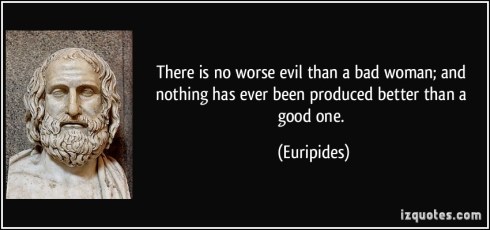
The reason some men love the good woman/bad woman trope so dearly is because it removes all responsibility and accountability from the man. He is helpless as a babe in the face of the influence of a good or bad woman. Sheehan is an unreconstructed idiot, peddling this ignorant, venomous trash. It no more serves a woman to be put on a pedestal than it does to be despatched to the gutter. One can make allowances for Euripides, given his times, but Sheehan has no excuses.