
Archive | October, 2011

Review of Gail Dines’ “Pornland”

18 Oct
Pornography-400-x-300
Many thanks to Leslie Cannold for tweeting this review.
Pornography’s Effects: The Need for Solid Evidence
A Review Essay of Everyday Pornography, edited by Karen Boyle (New York: Routledge, 2010) and Pornland: How Porn Has Hijacked Our Sexuality, by Gail Dines (Boston: Beacon, 2010)

by Ronald Weitzer

In an earlier article in this journal, I critiqued a particular theoretical approach to prostitution, what I call the “oppression paradigm” (Weitzer, 2005; see also Weitzer, 2010). The present review extends this critique to some recent books on pornography, both of which are grounded in the oppression paradigm—a perspective that depicts all types of sex work as exploitative, violent, and perpetuating gender inequality. This paradigm does not hold that exploitation and violence are variables—present in varying degrees or absent in some kinds of sexual commerce—but are instead constants central to the very definition of pros- titution, pornography, and stripping. I have argued that those who adopt the oppression paradigm substitute ideology for rigorous empirical analysis and that their one-dimensional arguments are contradicted by a wealth of social science data that shows sex work to be much more variegated structurally and experientially (Weitzer, 2009).

The books under review make no pretense of being fair and balanced analyses of pornography. Several of the authors are self-described antiporn activists and, given their strong political views on the subject, it is no surprise that they are critical of pornography, say nothing positive about it, and offer sweeping generalizations to condemn it….

Gail Dines is an academic and well-known antiporn activist. For her, pornography is dangerous and has far-reaching effects on society: “As long as we have porn, [women] will never be seen as full human beings deserving of all the rights that men have” (p. 165). Her book, Pornland, echoes much of Boyle’s book in its arguments. What are Dines’ core claims?

1. Porn is becoming steadily mainstreamed, “infiltrating” the wider culture. This has happened to such an extent that we are now living in the midst of a “porn culture.” “Porn is now so deeply embedded in our culture that it has become synonymous with sex” (p. x). Dines’ examples of this mainstreaming include young girls’ sexy attire, women’s genital waxing (which began in porn), magazines such as Cosmopolitan and Maxim, music videos adorned with scantily clad women, shows such as Sex in the City, websites such as Girls Gone Wild, and “hookup sex” between young people which “is a lot like porn sex” (p. 114). There is no doubt that Western culture has grown increasingly sexualized in the past 20 years (Attwood, 2006). But it is a separate question (a) whether this trend is a bad thing, as Dines thinks it is, and (b) the extent to which pornography is responsible for this broader sexual- ization, a claim that is only sketchily documented in the book.

2. Dines imagines that there is a distinct category of “porn sex.” Porn sex is “debased, dehumanized, formulaic, and generic” (p. x). It differs from proper sex, which she defines as involving “empathy, tenderness, caring, affection” and “love, respect, or connection to another human being” (pp. xxiv, xi).

3. Porn is almost universally “degrading,” “dehumanizing,” and violent, with women as victims and men as perpetrators. “In porn the man makes hate to the woman, as each sex act is designed to deliver the maximum amount of degradation” (p. xxiv). Women in porn do not experience pleasure, “rarely” receive oral sex, lack agency, and are simply vehicles for men’s satisfaction (p. xxiii).

4. Pornography itself has become increasingly extreme: “what used to be considered hard-core is now mainstream pornography” (p. xvii). “Body-punishing” sex is now the norm, meaning that it typically involves very rough sex harmful to women’s bodies.

5. The slippery slope: Men who watch porn become “desensitized” and seek ever more extreme porn to satisfy themselves. Dines declares that “users need to eventually seek out more extreme acts as a way to keep them interested and stimulated . . . heightening the level of degradation is what keeps men interested in and aroused by porn” (p. 68). Inevitably, it seems, men “end up masturbating to images that had previously disgusted them,” including bondage, violence, and child porn (pp. 93, 94).

6. Porn has strong, unequivocal effects on viewers: Viewers are passive recipients who do not actively engage with and interpret messages and meanings. Porn “leaves little room for multiple interpretations” (p. 86), something media scholars would find outlandish. Dines rejects the notion that viewers are “sophisticated consumers who enjoy porn for the playful fantasy it is” (p. 82). This is a fiction created by the porn industry. It is “fantastical thinking that men can masturbate to porn images and walk away from them untouched by the misogyny” (p. 78). “The stories seep into the very core of their sexual identity” (p. xxii); “the ability to keep porn women separate from the women they date is eroded” (p. 67); men are “trained by the porn culture to see sex as disconnected from intimacy” (p. 92); and “porn trains men to become desensitized to women’s pain” (p. 74). The porn industry is depicted as “predatory,” preying on men and “hijacking” their sexuality (pp. xi, xii).

The Evidence

To evaluate these claims, it is crucial to ask if there is supporting evidence. Like Boyle’s book, Dines’ is evidence-thin. Although Dines cites a handful of academic studies, vir- tually the entire book is based on anecdotal information: (a) quotations from some men and women who attend Dines’ lectures; (b) her descriptions of some porn websites; (c) statements from a handful of actors and producers whom Dines met at the annual Adult Expo convention in Las Vegas; and (d) her accounts of selected scenes in porno- graphic videos. How does Dines use this impressionistic material and what alternative sources would be superior?

First, Dines did not conduct a systematic and rigorous review of porn websites or scenes, nor does she cite studies that do so. Neither are readers told how many websites or scenes she examined, nor how they were selected. Did she view 20 scenes or 2,000? She claims that they were representative—“these images are all too representative of what is out there on the Internet and in mass-produced movies” (p. xxi)—but we have no basis for believing that they were. With so much porn available today on the Internet and elsewhere, how could we ever construct a random sample from this universe to reach generalizable conclusions?

Older content analyses found that most pornography in videos and magazines was nonviolent (Scott & Cuvelier, 1987, 1993), and that the most sexually explicit or hard- core videos contained the least violence and the most reciprocal, egalitarian behavior between the actors (Palys, 1986). It is an open question how much violence exists in con- temporary, Internet porn, but there is no doubt that today’s porn is much more varied than what Dines claims.

Second, grand generalizations are made throughout the book. Dines frequently refers to “men,” “women,” the “porn industry,” “fans,” and “performers” as monolithic categories. Also troubling is the jarring use of terms such as “never,” always,” “usually,” and “most.” Similarly, nowhere does she define some frequently used terms: “degrading,” “dehuman- izing,” or “empathy.” She does give examples of acts that she considers inherently degrad- ing; these include anal sex, ejaculation on a woman’s body, two or more men having sex with one woman, and multiorifice intercourse. Whether these acts are indeed perceived as degrading by viewers and actors does not figure into Dines’ argument. They are simply defined as perverted by fiat.

Third, nothing is said about gay male porn, lesbian porn, alternative porn, porn made by women—which, together, constitute a sizeable share of the market. A small but growing literature on these genres shatters Dines’ sweeping claims about “porn” (see Bakehorn, 2010; Collins, 1998; DeVoss, 2002; Stychin, 1992; Thomas, 2010; Tucker, 1991). The prolifera- tion of alternative genres renders any generalizations about “porn” ludicrous. But even if we ignore these genres and focus exclusively on mainstream, heterosexual porn, most of Dines’ claims ring hollow. Some of the most popular sites (xvideos.com, redtube.com, porntube.com, youporn.com) contain a very wide range of content and are by no means restricted to the images that Dines claims are the norm. A cursory examination of these sites shows that it is quite common for men to provide oral sex to women (contradicting Dines). To claim that “we never see any kissing or touching in porn” (64) is simply false. To claim that all or most women in porn are devoid of agency, that they derive no plea- sure during the sex acts, and that “body-punishing” sex is pervasive in porn are simply unsupported assertions.

Fourth, Dines acknowledges that there is very little data on actual porn consumers— those who watch porn in the real world (vs. in laboratory experiments)—but then proceeds to make many far-reaching claims about them. She writes that the “men who speak to me are not that different from the general population of men who use pornography,” but her source for the latter is another antiporn writer, journalist Pamela Paul (p. 89). Dines did not conduct a survey or in-depth interviews with a sample (let alone a representative sample) of consumers. A particularly troubling aspect of the book is her quotations from men and women who have spoken to her during and after her lectures. Blocks of sentences are quoted verbatim, bracketed by quotation marks, without indicating how these statements were recorded. How can readers have confidence that these statements were actually made by individuals with whom she had conversations? Was Dines somehow able to remember verbatim student statements consisting of two to four sentences at a time?

Few researchers have investigated the uses and meanings of pornography for consum- ers in the real world. The neglect of actual consumers (as opposed to lab participants) is remarkable in light of the sweeping claims about pornography’s impact on them. Still, a handful of studies has shown that men and women decode and engage with sexually explicit materials in a wide variety of ways, which is exactly what media experts would predict. McKee (2006) found that some viewers prefer to see idealized bodies whereas others favor realistic bodies; some like plots and genuine “chemistry” between the actors whereas others want unadulterated sex (“gonzo”); some believe women hold the power in porn sex whereas others take the opposite view.

Compared to men, women are less likely to seek out pornography, consume less of it, are attracted to a smaller range of representations, and are more critical of porn. Many women dislike the portrayal of women in porn and are concerned that men might compare them unfavorably to models and actors (Boynton, 1999), yet other women find pornogra- phy to be entertaining, educational, or sexually stimulating (Attwood, 2005; Ciclitira, 2002). It is certainly not unusual for female consumers to view porn positively, and this is more likely for younger adults than older generations. In a unique survey of 688 Danish women and men aged 18-30, men reported significantly more positive effects of porn consumption
than women, but few women and men reported negative effects. Most perceived positive effects on their sex lives, attitudes toward sex, sexual knowledge, and the overall quality of their lives. Moreover, for both men and women, the higher amount of pornography consumed, the greater the perceived positive effects of exposure to porn (Hald & Malamuth, 2008). If these self-perceptions are valid, the researchers suggest that “pornography’s impact is relatively positive and that media and popular books’ reports of highly negative effects on consumers are exaggerated or unfounded” (Hald & Malamuth, 2008, p. 622).

For some men, there is no question that exposure reinforces callous or sexist views of women, whereas others interpret and experience it in an opposite way. A major study, based on in-depth interviews with 150 men, found that most of them understood porn as being about fun, beauty, women’s pleasure, and female assertiveness and power (Loftus, 2002). They did not like depictions of domination or aggression against women and were “specifically turned off by such behavior on the rare occasions they see it in pornography, and most haven’t even seen any” (Loftus, 2002, p. xii). Loftus concluded that it is “impor- tant to male viewers that the women really do seem to be enjoying themselves, that they are utterly involved in the sex for their own pleasure too, and not just serving the interests of the male actors and onlookers” (Loftus, 2002, p. 249). They also recognized porn as a fantasy world quite different from the real world in terms of people’s behavior and appear- ance (Loftus, 2002, pp. 137-147). Rather than emulating the men in pornography, the men interviewed by Loftus “usually did not like the men they saw in porn” and saw them as “unsuitable models for behavior” (Loftus, 2002, p. 61). And in stark contrast to the slippery slope argument, these men “have not sought ever more vivid, kinky, and violent pornogra- phy, but have either stuck with what they liked from the first, investigated wilder content and returned to what they preferred, or lost interest altogether” (Loftus, 2002, p. xii). Most of these men did not gravitate toward increasingly extreme representations. The men in the Loftus sample were largely contacted via the Internet and thus may be unrepresentative of the larger population, but the findings are consistent with some other inquiries (Klein, 2006; McKee, 2006). In short, the existing empirical evidence on real-world consumers contradicts Dines’ sweeping generalizations about them.

For readers of this journal, the question of whether porn contributes to violence against women is particularly salient. The books under review generally take the position that porn does lead to both attitudes supportive of aggression and actual violence, although they occasionally acknowledge that the matter is complicated. Several authors in the Boyle col- lection agree with Dines that “there is a link between porn consumption and violence against women” (p. 95). This is a long-standing debate that includes other media as well (e.g., rap music, video games). In laboratory experiments, the most consistent finding is that exposure to violent images, whether pornographic or not, tends to increase partici- pants’ levels of aggression, whereas nonviolent porn does not have this effect (Bauserman, 1996; Donnerstein, Linz, & Penrod, 1987). But there are serious problems with such stud- ies because they rely on small, convenience samples of volunteers instead of representative samples and because of the artificiality of the (laboratory) settings in which they are con- ducted, quite unlike the viewers’ natural environment. Therefore, the “poor analogues provided by laboratory research may tell us little or nothing about the relation of pornography and aggression in the real world” (Fisher & Barak, 1991, p. 77).

Similar evidentiary problems bedevil macrolevel, quantitative studies that purport to measure porn’s effects on the real-world treatment of women. These studies examine whether the availability of porn in a particular geographic area correlates with rates of violence against women—that is, (a) whether places with high availability of pornography (magazines, adult theaters, video rentals) have higher rates of sex crime than places where pornography is less available, or (b) whether increased availability over time in a particular region increases rates of sexual offenses. A comprehensive review of the literature con- cluded that macrolevel associations between pornography and sexual aggression were mixed: Some studies find a relationship between availability and reported sex offending, whereas other research documents a decline in sexual offenses with increased availability of pornography (Bauserman, 1996). But all such studies are inherently problematic because of their inability to control for all potentially relevant influences on male behavior. There is simply no way to confidently conclude that pornography is responsible for rates of vio- lence, particularly when it is unknown whether those who commit violence have viewed porn and, even if they have done so, whether porn or some other factor is the cause.

The larger point is that it is virtually impossible to isolate the effects of the media in the context of other influences, including individuals’ demographic backgrounds and per- sonality characteristics, socialization by family and peer groups, wider cultural influences, and so forth. A comprehensive literature review concluded that research has not demon- strated a link between media images—of any kind—and audience behavior. At best, media effects are “weak and affect only a small percentage of viewers” (Felson, 1996, p. 123). What matters most is whether a person is socially predisposed to act, or “primed,” in a certain way—with preexisting views reinforced by or resonating with new stimuli (Donnerstern & Linz, 1995). Moreover, the causal direction may be the opposite of the one typically asserted (i.e., exposure to porn leads to aggression), as indicated in research that finds that men who score high on sexual aggression are more likely to seek out sexu- ally violent media and, in turn, to have their preexisting views reinforced by the latter (Bogaert, Woodard, & Hafer, 1999; Malamuth & Check, 1983). In short, media scholars would find the far-reaching claims of Dines and some of the contributors to Boyle’s book quite astounding.

Conclusion

Whatever one’s personal views of porn, for those who wish to know more about its content and the experiences of viewers and performers alike, the books under review offer little useful, evidence-based information. Overall, these books present an extremely biased picture of pornography that stands in stark contrast to sound scholarly research.

Declaration of Conflicting Interests
The author declared no potential conflicts of interest with respect to the research, authorship, and/or publication of this article.

Funding
The author received no financial support for the research, authorship, and/or publication of this article.

Excerpts downloaded from vaw.sagepub.com at CAL STATE UNIV LOS ANGELES on May 19, 2011
674 Violence Against Women 17(5)

References
Abbott, S. (2010). Motivations for pursuing a career in pornography. In R. Weitzer (Ed.), Sex for sale: Prostitution, pornography, and the sex industry (pp. 47-66). New York: Routledge.
Attwood, F. (2005). What do people do with porn? Sexuality and Culture, 9, 65-86. Attwood, F. (2006). Sexed up: Theorizing the sexualization of culture. Sexualities, 9, 77-94. Bakehorn, J. (2010). Women-made pornography. In R. Weitzer (Ed.), Sex for sale: Prostitution,
pornography, and the sex industry (pp. 91-111). New York: Routledge. Barron, M., & Kimmel, M. (2000). Sexual violence in three pornographic media. Journal of Sex
Research, 37, 161-168. Bauserman, R. (1996). Sexual aggression and pornography: A review of correlational research.
Basic and Applied Social Psychology, 18, 405-427. Bogaert, A., Woodard, U., & Hafer, C. (1999). Intellectual ability and reactions to pornography.
Journal of Sex Research, 36, 283-291. Boynton, P. (1999). “Is that supposed to be sexy?” Women discuss women in top shelf maga-
zines. Journal of Community and Applied Social Psychology, 9, 91-105. Ciclitira, K. (2002). Researching pornography and sexual bodies. Psychologist, 15, 191-194. Collins, D. (1998), Lesbian pornographic production: Creating social/cultural space for subvert-
ing representations of sexuality. Berkeley Journal of Sociology, 43, 31-62. Comella, L. (2010). Remaking the sex industry: The Adult Expo as a microcosm. In R. Weitzer (Ed.), Sex for sale: Prostitution, pornography, and the sex industry (pp. 285-306). New York:
Routledge. DeVoss, D. (2002), Women’s porn sites. Sexuality and Culture, 6, 75-94. Donnerstein, E., & Linz, D. (1995). The media. In J. Wilson & J. Petersilia (Eds.), Crime
(pp. 237-264). San Francisco, CA: ICS. Donnerstein, E., Linz, D., & Penrod, S. (1987). The question of pornography: Research findings
and policy implications. New York: Free Press. Felson, R. (1996). Mass media effects on violent behavior. Annual Review of Sociology, 22,
102-128. Fisher, W., & Barak, A. (1991). Pornography, erotica, and behavior: More questions than
answers. International Journal of law and Psychiatry, 14, 65-83. Hald, G., & Malamuth, N. (2008). Self-perceived effects of pornography consumption. Archives
of Sexual Behavior, 37, 614-625. Hubbell, R. (2009). Book review of Jensen, Getting Off. Men & Masculinities, 11, 497-499. Jensen, R. (1996). Knowing pornography. Violence Against Women, 2, 82-102. Jensen, R. (1997). Introduction. In G. Dines, R. Jensen, & A. Russo (Eds.), Pornography: The
production and consumption of inequality (pp.1-8). New York: Routledge. Klein, M. (2006). Pornography: What men see when they watch. In P. Lehman (Ed.), Pornogra-
phy: Film and culture (pp. 244-257). New Brunswick, NJ: Rutgers University Press.
Downloaded from vaw.sagepub.com at CAL STATE UNIV LOS ANGELES on May 19, 2011
Weitzer 675
Loftus, D. (2002). Watching sex: How men really respond to pornography. New York: Thunder’s Mouth.
Malamuth, N., & Check, J. (1983). Sexual arousal to rape depictions. Journal of Abnormal Psychology, 92, 55-67.
McKee, A. (2006). The aesthetics of pornography: The insights of consumers. Continuum: Journal of Media and Cultural Studies, 20, 523-539.
Palys, T. (1986). Testing the common wisdom: The social content of video pornography. Canadian Psychology, 27, 22-35
Scott, J., & Cuvelier, S. (1987). Sexual violence in Playboy magazine: A longitudinal content analysis. Journal of Sex Research, 25, 534-539;
Scott, J., & Cuvelier, S. (1993). Violence and sexual violence in pornography. Archives of Sexual Behavior, 22, 357-371.
Stychin, C. (1992). Exploring the limits: Feminism and the legal regulation of gay male pornogra- phy. Vermont Law Review, 16, 857-900.
Thomas, J. (2010). Gay male pornography since Stonewall. In R Weitzer (Ed.), Sex for sale: Prostitution, pornography, and the sex industry (pp. 67-89). New York: Routledge.
Tibbals, C. (2011). Sex work, office work: Women working behind the scenes in the US adult film industry. Gender, Work, and Organization. doi:10.1111/j.1468-0432.2010.00552.x Tucker, S. (1991). Radical feminism and gay male porn. In M. Kimmel (Ed.), Men confront
pornography (pp. 263-276). New York: Meridian. Weitzer, R. (2005) Flawed theory and method in studies of prostitution. Violence Against
Women, 11, 934-949. Weitzer, R. (2009). Sociology of sex work. Annual Review of Sociology, 35, 213-234. Weitzer, R. (2010). The mythology of prostitution: Advocacy research and public policy. Sexuality
Research and Social Policy, 7, 15-29. Bio
Ronald Weitzer is a professor of sociology at George Washington University. He has published extensively on the sex industry, including a new book, Legalizing Prostitution: From Illicit Vice to Lawful Business (NYU Press, 2011).
Downloaded from vaw.sagepub.com at CAL STATE UNIV LOS ANGELES on May 19, 2011

Pornify this revisited

17 Oct

“The new porn zeitgeist is hard-core sadism. Hard-core porn turns misogyny into sexual fascism and sells it as freedom. There are countless “18 and abused” sites showing young girls being gang-banged while crying, drunk, vomiting, with guns and knives to their heads. Incest porn with girls being bashed about sexually by fathers, grandfathers, uncles, brothers. There is bestiality porn with dogs, horses, with eels. Torture porn, where young women are tied up and strangled, defecated on. There is Nazi fetish porn, lots of racist porn.

Feminised gay men being beaten and anally raped by hyper-macho gangs. Granny porn where older women are subjected to the now compulsory triple penetration and spat on for being old. There is even “retarded asian porn”, “retarded and horny”, “full on retard porn . . . legless sluts being triple penetrated”, amputee porn, dwarf porn, anorexia porn.” 

This is an extract from a piece written by Dr Abigail Bray in the Sydney Morning Herald last week on the dangers of pornography. Dr Bray is co-author with Melinda Tankard Reist of the latest Australian collection of anti pornography stories.

On reading this piece I was immediately reminded of a series of articles on the Drum written by Tankard Reist to which I responded with a contrary point of view. Given the publication of their book, and the spate of extracts from it recently, it seems timely to put up my Drum piece again.

One of the big problems I have with many anti porn activists is their apparent inability to distinguish between the rage they feel at the sight of an actor’s cleavage and the rage they feel at violent porn. If you happen to be someone who doesn’t care much about people showing cleavage and do care about violent criminal porn they can’t hear your point of view. It’s all or nothing with them. Problem is, when they get apoplectic about pole dancing and knickers, they’ve undermined their credibility when they come to protest the hard-core sadistic stuff that I’m sure is out there.

Pornify this

The recent Drum articles by Christian sexual conservative Melinda Tankard Reist are based on appeals to presumed universal truths and values. Melinda is in the business of creating totalising cultural narratives, rather than finding solutions to concrete issues women face.

Totalising narratives quite rightly arouse the healthy ire of thinking people, even more so when they are sexually proscriptive. Faced with these attempts to legitimise as universal the limited authority of one particular perspective, a thinking woman has to lodge her protest. So, Melinda, pornify this.

Censor and ban, ban and censor

It seems there is little in popular cultural representations of female sexuality that escapes Melinda’s disapproval. Even, I see on her website the US underwear company Victoria’s Secret,and twenty something TV star Lea Michele appearing on the cover of Cosmopolitan magazine showing cleavage, offends her conservative values.

The latter incurs wrath because Michele is, in Melinda’s terms, “sexifying” herself, and in so doing setting a bad example to the teenagers who watch Glee in which she plays a considerably younger character.

Christian sexual conservatives seem to have embarked on a mission to pathologise the entire world, rather than realistically deal with inevitable and at times large pockets of dysfunction. Their solution? Censor and ban.

The problem with the censor and ban approach is that it addresses the symptoms while completely ignoring the cause. It’s the easy way out. Just have the offending song, video, advertisement removed from the public gaze, and then pretend the forces that led to its creation don’t exist anymore.

They do. They’ll erupt again. Repressing them will not make them go away. We have always known this.

The Patriarchy did it

Tankard Reist is about to surpass Derrida in her creative use of neologisms such as sexification, adultification, childification, and pornification, all terms she uses to describe what men are doing wrong to women, and what women are letting men do wrong to them.

Infantalizing women (a psychological action, as opposed to childifying us, which is sartorial) is part of the sexual conservative’s strategy. Women are acted upon. Even when we think we’re exercising agency we aren’t really, because our actions are predetermined by the overwhelming influence of the patriarchy.

This is where Christian sexual conservatism intersects with radical feminism, resulting in, dear God, I don’t know what. Every act of heterosexual intercourse is an act of rape unless it results in a baby girl?

If we follow this infantalizing to its logical conclusion, women aren’t responsible for anything. The only other human beings not required to take responsibility for themselves are babies, and those without the capacity.

Of course, women are also responsible for everything, which makes us goddesses. There’s no middle ground in these metanarratives.

Sexified, pornified women allegedly aren’t politically sophisticated or intelligent enough to recognise their collusion in their own process of -ification. Only unsexified women know what’s really going on. The process of sexifying yourself destroys your brain.

As with all lies that work, there is some truth in it. I recall occasions when I’ve severed contact with my mind and made decisions from another part of my anatomy entirely. But I fought my way back, and I can’t remember what I was wearing.

This attitude puts MTR in bizarre alliance with factions that hold beliefs such as: blondes are brainless. You can’t be a pole dancer and have a PhD. You’re being exploited and you’re only happy in your thong because you’re too ignorant know you’re being exploited. Female sexual power is an illusion, and the notion that it is an expression of assertiveness is false.

Well, if it is such an illusion, why the struggle to keep it in chains?

That which we most fear becomes our obsession, observed Hélène Cixous.

How to pornify yourself

A woman doesn’t have to do much to sexify and pornify herself in the world of MTR. Just wear lacy panties and an uplift corset from Victoria’s Secret, and you’re in.

If childification is more your thing, pull on a pair of white knee socks and suck on a lollipop while tugging at your t-shirt. You can also sit on a bench and show your panties. Either of these looks (and many others shown on her website) will incur MTR’s pity, and her undisguised contempt.

You may like these looks, or you may find them silly, but are they really part of an orchestrated patriarchal attack on women’s human rights? Think about the real attacks on women’s human rights round the globe, rarely mentioned by MTR, by the way, and only when they comply with her ideology as an anti choice feminist, and then answer that question.

The beast in them

The message I am taking from these articles is that for MTR there is no acceptable public representation and expression of female sexuality.

In holding a belief shared by, among others, the Taliban, she seems to feel that public (I don’t know why, but I hardly ever type “public” without leaving out the l) displays of female flesh lead inevitably to a culture of exploitation and rape, turning sane men into the beasts they all secretly are.

The beast in me, is caged by frail and fragile bonds…

Ergo, women must not reveal their flesh, or not the bits that could be seen as erotic. That’s pretty much everything, if you’re imaginative.

All those KanYe West and Brian McFadden lyrics churning round in men’s animal minds, causing them to lose what little sense of decency they might just have been born with, if they were lucky, and then, dammit, a woman in a sparkly thong hoves into view, and she’s not wearing it on her foot, either.

In the world the conservatives inhabit, not only are all women too stupid to know if they’re being exploited, all men are too base to think about a woman as anything more than a root, a drunken root if possible, or if it’s KanYe West we’re talking about, a dead root.

The discourse of sexual conservatism, like that of radical feminism, depends on stereotypes and generalisations. Without them, they both implode.

The contempt these attitudes reveal for humanity in general is disturbing. Add to that the conservatives’ insistence that young men in particular have no capacity to distinguish between fantasy and reality, learning from the lyrics of pop songs and videos to behave very badly towards women, and the sexual conservatives are unmasked as religious and anti modern fascists.

As a mother of young men who negotiate popular culture and emerge with loving and generous hearts, I find their attitude offensive.

So, tell us the right way to show off our tits

If I’m doing you sexual conservatives wrong, just tell us what kind of public (oops, that wretched l again) representation and expression of female sexuality you do approve of. Show us a picture. You’ve shown us plenty of pictures of what you don’t like. Now show us a picture of something that fits your criteria. If you have a positive vision of how a woman can express her sexuality, now’s the time to share it.

This is important because it isn’t enough to tell young women what they shouldn’t emulate. You need to be able to offer a positive alternative model. So far, all we’ve heard is unrelenting negativity, and the ongoing, indiscriminate blaming of all men.

Are your husbands, sons, brothers, dads, uncles, cousins, boyfriends, lovers and friends included in the generic “men,” by the way? Or are you lucky enough to have scored the only good ones on the planet, and the rest of us copped the duds?

Some women want to show their bodies, and I can’t see a single thing wrong with that. The human body can be glorious. Breasts can be wondrous. Read the Song of Solomon. In itself the body is always wholly innocent, and tainted only by the perceptions and judgments we inscribe upon it. Prove me wrong.

Decades of feminist rage against men and the patriarchy has not solved our problems with each other. Rather than continuing to rage about what men shouldn’t do and should be, can we focus instead on what women can do and can be, and leave perceived male failings aside for a while?

It will take the whole village, rather than an individual sarcastically demolishing a hapless male writer of really stupid songs. But such a redirection of energy might just lead to empowerment in a way that victimology, complaint, ideology and blame never can.

This piece resulted in some 472 comments, the majority of which were in whole or partial agreement, except for someone hiding behind the screen of anonymity who pursued me round the blogosphere for weeks, and I finally figured out just who she is. Ha ha!

Abbott determines government’s asylum seeker policy and Cabinet’s in a leaky boat.

16 Oct

Is this the face of the next Prime Minister?

Somewhere in the never-ending and increasingly despicable contest between the government and the opposition over asylum seekers and on-shore processing, the human beings around whom this furore rages ceased to matter altogether.

If you doubt that statement have a look at this article by Peter Hartcher in Saturday’s Sydney Morning Herald. Hartcher unpacks the politics that led to the Gillard government withdrawing its proposed Migration Act amendments last week and defaulting to on-shore processing, at least for the forseeable future.

Every aspect under discussion in Cabinet revolves around what Abbott might or might not do in reaction. And who’s the plank that said Bob Brown’s the real PM?

It’s patently clear that Tony Abbott is running this part of the show. The government reveals itself to be incapable of making any decision at all about boat arrivals without first considering what Abbott might do in response. There’s no mention of how best to design a policy that will prevent asylum seekers drowning, an endlessly cited core concern that actually looks as if it’s just trotted out for the media by both parties with the intention of applying a veneer of humanitarian concern to their self-interest.

That fake concern also has the added benefit of supplying ammunition for both sides to sneer at their opposition: “Don’t you care about what happened at Christmas Island,” followed by “Wanna see that happen again do ya, what are ya then?”

Immigration Minister Chris Bowen came up with the option of extending the Malaysian “solution” to include PNG and Nauru. This would give Abbott what he wants and cut his arguments off at the knees, Bowen claimed. If Abbott continues to protest, Bowen argues, he’ll be shown up for the malicious nay saying blood-oathing troll that he is.

Plus, argued Bowen,  if an extended Malaysia “solution” acted as a deterrent to boat arrivals we could up our humanitarian intake, thus making application through the proper channels more appealing to asylum seekers than getting on a leaky boat. Bowen seems to think that would work, without going into details about where our increased humanitarian intake is to be sourced. It could well pass boat arrivals right by, and there’d still be people taking dangerous journeys because they still can’t apply for a life here any other way.

But, but, Greg Combet spluttered, not Nauru! There’s some 10 years of TV footage of Julia Gillard bagging Nauru! Imagine what would happen if Abbott decided to trot a few years worth of that out, especially considering what Abbott’s done with footage of Gillard declaring there’ll be no carbon tax on her watch!  Ooooh Aaaah! It doesn’t bear imagining!

At the end of the day Gillard herself decided Nauru was off the table, presumably not wanting to look as if she doesn’t know what she’s doing on this issue yet another time because Abbott will slaughter her with it yet another time.

See? I told you. All about Abbott. Human beings? What are they and why are they relevant? Please stay on topic, we’ve got a lot to get through before Abbott starts up again.

Because of this politicking we may end up with decent on-shore processing options that are some way to the left of the options the Gillard government has been so rabidly pursuing, so for this Tony Abbott, much thanks. However, if Abbott wins the next election of course he will do a great big dismantling of everything, and having crawled laboriously up the ladder to comparative decency we’ll again be thrust back down amongst the venomous snakes of fear, self-interest, and xenophobia.

Now I ask you Mr Abbott, catholic ex-seminarian, what would Jesus do about asylum seekers? Turn back the boats? Indefinitely imprison them and their children?

At least Julia Gillard doesn’t pretend to have Christian values, well, mostly she doesn’t, only when the Australian Christian Lobby makes her.

Then there’s the curious question of who in Cabinet is leaking like an Indonesian fishing boat and why?

For another good read on the current parlous state of our political affairs as constructed by the media have a look at this piece  over at the Watermelon Blog:  Time to start again, and the whole cycle is repeated with new leader, the political party discovering, belatedly, that changing leader doesn’t stop instability (a media creation in fact), the instability having nothing to do with who the actual leader is, but merely being the signal for the media to begin a new round of destabilisation, writes David Horton.

Selling our old crap

14 Oct

Tomorrow, our place, garage sale.

Last one we sold the Subaru to some bad bastards with dirty beards and violent pink-eyed dogs tied up on the back of their ute. They looked at the car then went away and came back hours later with a paper bag full of $100 notes, some with traces of white powder on them, which they exchanged for the Subaru. It seemed fair.

I didn’t mind the cash. I was on my way to Mexico and it came in handy. We hadn’t meant to sell the Subaru. It just happened to be there and then they turned up and asked for it.

I’m not allowed to have any of the proceeds from tomorrow’s garage sale because I haven’t helped. I’ve just bitched and moaned about refusing to waste hours of my life putting stickers on crap when I could be tweeting. You should have heard them scoff at that, but tweeting sharpens the brain and hones writing skills while sorting through crap is just depressing.

In a minute I’m sneaking into the garage and getting back stuff I might want, and then I’m going through friends’ stuff they’ve left us to sell for them while they go for a ferry ride and lunch by the river, thank you very much, to see if there’s anything I might want. I have to do this surreptitiously. Last night I tried to do something surreptitious and I trod on the Dog’s squeaky toys that he’d left all over the garage floor despite being warned time and time again that there’d be consequences. I was caught red-handed in the act of retrieving a fondue pot circa 1976.

However, as the Dog was diagnosed just yesterday with some kind of canine emphysema (I told him to stay off the cigs but would he listen) I can’t be too hard on him. He still has a cauliflower ear. He wouldn’t stop boxing either though he knows what I think of that brutal activity.

No wonder I blog. Nobody listens to me in my own home.

On top of all this my brand new iPhone arrived today, after Telstra kept sending me emails that said “Your iPhone has left the warehouse.” Eventually I got fed up with these communications, sent one back asking if they’d delivered it to Gracelands, and whined that I was lonesome tonight. But now it’s arrived I have no time to play with it till the bloody garage sale is over and cleaned up and all the rubbish hauled to the tip.

Have a good weekend.

On-shore processing rules so suck it up and play nice

14 Oct

It was a grim-faced PM who held a press conference yesterday evening to announce her decision to withdraw proposed amendments to the Migration Act that would enable the government to send asylum seekers to Malaysia.

Since the High Court re- interpreted our understanding of the Migration Act, a surly and humiliated PM declared, and until Opposition Leader Tony Abbott comes to his senses (if he’s got any) and throws his support behind the bill, the government is forced to continue with on-shore processing and there’ll be boats. There will be boats! And every boat will be on Tony Abbott’s sense-less head!

Though of course, Abbott insists it’s all Gillard’s fault and any increase in boat arrivals is entirely down to her.

That a good result comes from such prolonged bitching, moaning, carping and politicking with the lives of human beings by both major parties is something to give us all hope. No matter how hard they’ve tried, neither party has been able to reintroduce off-shore processing, and to add icing to the cake, they’ve nobody to blame but themselves.

Not that I’m complaining. It’s been a circuitous journey, expensive, cruel, duplicitous and xenophobic and it’s ended in a much more decent outcome than either leader ever wanted. The dark side lost the battle all by itself.

This ought to be another valuable lesson to both Abbott and Gillard on the futility of allowing politics and personal animosity to dominate policy. There’s no explanation for Gillard persisting with the bill, given it had no hope of passing the Senate, unless she saw it as a tactical victory over Abbott if the bill was passed in the Lower House. Another thwarted miscalculation inspired by personal feeling?

In the event that more asylum seekers arrive than we have room for in detention centres, the overflow will be given community detention with work privileges. Surely now it is only a matter of time before mandatory detention of practical necessity is restricted, and we join other countries in humanely allowing asylum seekers to live in the community while their claims are assessed. The cost benefit is enormous: it costs us 90 per cent less to have refugees in the community than it does to keep them in detention.

Gillard’s attempt to snatch right-wing asylum seeker policies away from the Coalition is a spectacular failure. It’s given the Opposition the opportunity to paint themselves humane, and Gillard as lacking in compassion and heart. It’s incensed many Labor supporters who’ve had to watch as the party’s moved further and further away from their platform on refugees. Gillard made a fool of herself from the outset with the very silly and alarmingly premature East Timor proposition, and it’s gone down hill from there.

The PM is now faced with enacting a policy that is more lenient and humane than it was before she negotiated the doomed Malaysia “solution.” The 4,000 refugees we agreed to accept from Malaysia in return for the 800 we planned to send there, will be absorbed into our usual humanitarian intake. If the Gillard government wants to give more people a better chance of a good life in Australia, they could start by increasing that intake.

A regional processing centre is still a realistic goal, not hurriedly cobbled together in a politically-driven “Malaysian solution” that was at best short term, but a centre created in conjunction with others in the region and the UN.

Gillard and Abbott have been dragged kicking and screaming into maintaining on-shore processing. No doubt if we ever see an Abbott-led government the whole thing will start again and he’ll bring back Nauru, but for one brief shining moment we have something of a respite in this running, ulcerated sore that is Australia’s asylum seeker policy. The sustained collision of dark with dark resulted in a large crack, and the light got in. For this relief, much thanks.

Bloody oath, there’ll be blood on the tracks by bedtime

13 Oct

Not so very long ago Opposition Leader Tony Abbott offered to sell his arse if he had to, if that’s what it would take to be Prime Minister. He made this offer to Tony Windsor,who as far as I’m aware would be entirely uninterested in buying or even renting Australia’s best known budgie-smuggler butt, especially after viewing images of the butt’s owner emerging from the waves at Manly (Manly??Manly?) virginity renewed just like Aphrodite but unlike the goddess, blatantly exhibiting steroid-like shrinkage.

I mean, that’s not much of a package in return for the highest political office in the land. Is it?

Now Budgie-butt has taken to swearing blood oaths. Which you probably have to do if you want to restore a smidgen of credibility after telling everybody not to believe anything you’ve said unless it’s written down. He keeps raising the stakes, while others would rather see him impaled on one. Through the heart then add plenty of garlic.

The blood oath has a colourful and eclectic history. For example, in the Church of the Latter Day Saints, participants in “endowment” ceremonies are required to swear a blood oath that they will never reveal the procedures required to prepare the chosen to become kings, queens and priests in the afterlife.  Budgie-butt believes in the afterlife, wanted to be a priest before he wanted to be PM, and given his willingness to sell his arse, may be more than passingly interested in queens.

“Blood Oath” is also the title of the sixth album by death metal band Suffocation. This album contains a track called “Marital Decimation” recorded on their previous album “Breeding the Spawn.” The phrase “breeding the spawn” generally refers to an activity engaged in by the Devil and cruelly perpetrated upon sleeping women who wake up covered in bloody scratches and go on to give birth to something too awful to show onscreen. Budgie-butt believes in the Devil and his implacable anti-abortion stance would not permit even the Devil’s spawn to be terminated. Another connection! Yeah!

Moving forward. Blood Oath is also the title of the 39th episode of Star Trek: Deep Space Nine. In this episode three legendary Klingon warriors meet with Dax prior to embarking on a vengeance crusade. Now vengeance crusades have a long Christian history with which the Opposition Leader must have at least a passing acquaintance. As well, Mr Abbott is possessed of a pair of ears that bear a strong resemblance to those of Dr Spock, and I’m not talking about the great late authority on bringing up baby.

Finally, a blood oath can be taken between real brothers, or men who are unrelated but nevertheless feel strongly bonded in a common cause. In this ceremony, an incision is made in the flesh and blood from both parties mingles, signifying life-long commitment.

It has been argued that this last blood oath ritual is an unconscious displacement of homosexual desire. It would be unsavoury of me to pursue this notion, given the selling arse matter I referred to earlier, and bearing in mind the pickle fledgling tweeper Julian Burnside  found himself in with regard to his ill-considered tweet.

Anyways, it’s likely Freud who made this observation, and we all know how he liked to mess with people’s minds.

Now the only question that remains is which is worse: to call Julia Gillard a “scrag” or Tony Abbott “Budgie-butt?” The former is sexist. The latter is offensive to little tweety birds and the question is rhetorical.

Great Danes

12 Oct

  Guest post today by Gerard Oosterman, farmer, artist and blogger who asks why didn’t Tony Abbott get a fat tax up when he had the chance? Well?

Don’t let fat stand in the way of Neo-liberalism and the Markets.

Here we go again. I am hardly up and hoisting on my morning coat, and what do I see on opening The Australian (art and TV section) but a largish article expanding on last week’s news about the Danish Fat Tax (DFT), and giving some rather interesting snippets of insight into a country that likes to prevent trouble rather than react afterwards.

The Australian waxes lyrically on about how Finland and Romania are also going to implement this tax. Now, the curious but very enlightening part of this article is how those Nordic countries seem to govern. It’s heart-warming again, isn’t it? First let us reflect that Denmark has taken a turn to the left with a female leader  Ms Helle Thorning-Schmidt, who, nota bene, happens to be the daughter-in-law of the former British Labour leader Neil Kinnock…

Ms Thorning-Schmidt came to power last month promising to increase taxes on banks and high earners to pay for more spending on health and schools. Eyes agog please! She got into power promising to increase taxes! The fat tax had already been attempted by the outgoing conservative government, to no avail. Their promise to increase taxation wasn’t big enough and the practical Danes booted them out. Can this tale get any better? Yes, it can.

Denmark has a low obesity rate of 10% with a special tax on high sugar content foods such as soft drinks and sweets having been in place for some years. It is the highest taxed developed country with a VAT of 25% on top of everything else. With these taxes one would have thought there would be riots and blood on the streets daily, but no, nothing like that on the news. On the contrary, I don’t get the impression the Danes are particularly unhappy with their lot.

England is generally known as being loath to take action of any kind too rapidly with their fondness for ‘order, order’ instead, but are slowly considering a fat tax as well. Previously, like here in Australia, they preferred to nudge people into better food and eating habits. Any form of tax to force things along is traditionally thought of as forming corrupting ‘Nanny State’ habits, implying that the UK is some kind of dream socially equal paradise already.

With a wild guess that Australia might have had a much lower obesity rate some years ago, it would not be all that unreasonable to assume that our world reputation as the fattest on earth could have been nipped in the bud by none other than…our intrepid potentially disastrous future leader, the honourable…., I give you……. Tony Abbott…. order, order,… some years ago.

Yep, that’s right, wasn’t he a health minister, health and ageing some 10 years ago? Before that there were other Liberal Health ministers. While obesity started to impact on general health with a blowing out of associated diseases, nothing was done. Not even the banning of TV advertisements of bad foods during children’s programmes. Nothing must impede the “markets”. (Wasn’t it lovely to read Andrew (Twiggy) Forrest doubled his salary and collected a handy $48 million in dividends from his company in just the one year, FMG?) Now there is the  market working for you.

With our fondness for Neo-Liberalism and letting Markets do the walking for us we now seem to have reaped a nasty fat bug. That’s of course apart from homelessness, our miserable state of mental health, the aboriginal disaster, old age care, hosts of other collapsing societal benefits including our hostile and unfriendly manner of dealing with a few thousand boat people. Yes, indeed, a more prosperous and freer society but not a more equal society. A bit of a looming lemon really. Oh, for just a bit of Denmark.

To markets, to markets to buy a fat pig…Home again, home again…

Gerard blogs at  Oosterman Treats Blog

This kiss this kiss – unstoppable!

12 Oct

I don’t want another heartbreak
I don’t need another turn to cry
I don’t want to learn the hard way
Baby, hello, oh, no, goodbye
But you got me like a rocket
Shooting straight across the sky

It’s the way you love me
It’s a feeling like this
It’s centrifugal motion
It’s perpetual bliss

It’s that pivotal moment
It’s impossible
This kiss, this kiss (Unstoppable)
This kiss, this kiss

Cinderella said to Snow White
How does love get so off course
All I wanted was a white knight
With a good heart, soft touch, fast horse

Ride me off into the sunset
Baby, I’m forever yours

It’s the way you love me
It’s a feeling like this
It’s centrifugal motion
It’s perpetual bliss

It’s that pivotal moment
It’s unthinkable
This kiss, this kiss (Unsinkable)
This kiss, this kiss

You can kiss me in the moonlight
On the rooftop under the sky
You can kiss me with the windows open
While the rain comes pouring inside
Kiss me in sweet slow motion
Let’s let every thing slide
You got me floating, you got me flying

It’s the way you love me
It’s a feeling like this
It’s centrifugal motion
It’s perpetual bliss

It’s that pivotal moment
It’s subliminal
This kiss, this kiss (It’s Criminal)
This kiss, this kiss

Faith Hill

What Scipione should have said

11 Oct

Bloody hell but things have come to a pretty pass when people can’t tell the difference between being advised to take care of themselves, and being blamed for anything that might happen to them. The distinction between blame and responsibility is crucial and frequently misunderstood, the former usually an angry moral judgement, the latter a necessary character trait.

The fault doesn’t lie all on one side, let me hasten to add. There is a certain type of opprobrium that is all too often applied to victims of all kinds of insult and injury, as if the very fact that an offense was committed against them indicates a moral weakness on their part.

My mother was good at that: if anything happened to you it was undoubtedly your fault, and then it was even more your fault if you inconvenienced everybody by complaining about it. Anybody who’s grown up in that kind of atmosphere can be understandably touchy about being told you have to take responsibility for yourself or you’ll get what you deserve.

But these are in fact two entirely different messages. 1.It is essential to take care of yourself.  2. Being injured by another is what you deserve, because you obviously haven’t taken care of yourself like you were told in the first place.

The all too common conflation of these two vastly different pieces of information leads to trouble for people such as Andrew Scipione. Scipione recommended that young women organise a buddy system when they go out for a big night on the piss, and in particular, let a friend know if they’re planning to have sex so if they’re seen wandering off with a stranger their friends will know whether it’s by choice, or their drink’s been spiked and they’re about to enter a danger zone.

I can see problems inherent in the last bit of advice, and if the girlfriends get the vibe wrong, all sorts of trouble might ensue.

Be that as it may, many women reacted to Scipione’s recommendations with outrage, reading them as a blame the victim ploy. In other words if you get too drunk to know what you’re doing and get raped, it’s your own fault.

Personally, I don’t agree that was Scipione’s message. I understood him as saying that in certain situations there’s nobody to protect us but ourselves, and as no law enforcement agency on the planet has as yet managed to prevent rape, the reality is we have to take precautions against it. Taking all the precautions in the world might still not guarantee our safety, but we owe it to ourselves to minimise the risks.

This is entirely different from telling us it’s our fault, or that we deserve it if we haven’t taken proper care of ourselves like we were told.

The two messages come from different places in the human psyche. “Take care of yourself” is an expression of concern and care, a hope that no harm will befall you and that you will do what you can to keep yourself and others safe.

“It’s your own fault if you don’t and something happens to you” is an expression of anger, hatred, and desire to punish a victim. Usually the person expressing this point of view has serious difficulties managing their own vulnerability. Seeing vulnerability in others freaks them out, enrages them, and makes them want to inflict punishment for what they perceive as a contemptible weakness. Only the weak and stupid are victims, is the guiding principle in this attitude. I didn’t pick up that attitude in Scipione’s advice.

Nobody is ever to blame for another person’s violent and abusive actions. Perhaps public figures making pronouncements such as Scipione’s need to say this as well. Perhaps if Scipione had added that a woman is never, ever to blame if someone rapes her, that rapists are always entirely responsible for their own actions, his message might not have gone quite so askew.

The fact that he didn’t say this does indicate the presence of a deeply ingrained and largely unacknowledged cultural belief that women are expected to be more responsible than are men. That women are expected to be more in control of situations than are men, especially sexual situations. That men can’t be relied upon to behave properly so women have to do it for them.

But sexual assault is a crime, not a category of blokey irresponsible behaviour, and has to be identified as such in public discourse. By all means advise women to take care of ourselves and minimize risk. But never, ever do it without clearly acknowledging that women are not responsible for the risk of sexual assault we all have to negotiate all our lives, and that those who threaten and harm us are entirely responsible for everything they do.


The godification of children; the bizarre marriage of anti raunch feminism with the religious right.

10 Oct

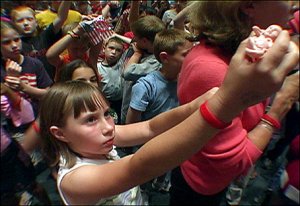
Evangelical Christian children’s pastor Becky Fischer takes several hundred children aged from around six to early teenage, and some of their parents, to a fundamentalist boot camp at Devil’s Lake, North Dakota for a weekend of indoctrination into the principles of  evangelical Christianity (ABC 2, Sunday October 9, “Jesus Camp”)

One of these principles is founded on the belief that there’s a dire need for the merging of church and state in the USA, to be achieved through what she describes as a war to reclaim America for Jesus. This war is a just war, founded in the truth because they know The Truth,the pastor claims, and everyone else is lost to God.

Pastor Becky is taking a leaf out of the Muslims’ book, she reveals. If they can train kids to be suicide bombers for the sake of their God, why can’t she train kids to give their lives for the one true God, albeit metaphorically. She just needs them before they turn seven, she adds.

One extremely articulate and intelligent little girl tells us that some people do die for God and they are MARTYRS. Like, wow!

There’s a cardboard cutout of George W. Bush, role model for the successful integration of the two powers. There’s emotion-driven prayer meetings where little kids fall sobbing, wailing and shaking on the floor. The poor little buggers, by now in a state of frightening emotional extremity, cry out their sinfulness, thrash their arms and legs about, and beg Jesus to forgive them. The adults howl praise the Lord as the little ones noisily repent.

Once cleansed by a few drops of water out of a plastic bottle administered by Pastor Becky, the kids are declared born again, welcomed into the Lord’s army, and instruction on their mission as soldiers in the fight to get America back on the path of righteousness begins.

One of the most important battles they’ll face, they’re told, is the battle to stop abortion. They must pray to God to end all abortive procedures, a very creepy man in blue jeans and scarlet tee-shirt with “Life” printed on it in large black letters, tells them. The future of millions of unborn babies is in their young hands. They have the opportunity to make the difference between unborn babies living, or dying before they even get a chance to breathe. Jesus wants them to save the babies.

There’s not a dry eye in the house. The children are whipped up into a state of febrile fanaticism. The adults have no apparent compunction about involving young children in abortion issues, a form of child sexualization that is truly disgraceful, and never mentioned by activists as harmful.

The man in the red shirt  shows the kids little plastic models of a foetus through the stages of gestation. Kids start screaming, swaying, and speaking in tongues. Heavy metal Christian rock music gets them and keeps them in the zone. “We’re kickin’ it for Christ!” the children scream.

The man in the red shirt tapes tiny plastic babies to the palms of the kids’ hands with red duct tape. He next places the red duct tape across the children’s mouths, silencing them. Written on the tape is the word “Life.”

Then he takes the children to Washington to demonstrate against abortion on Capitol Hill.

Meantime, Pastor Becky tells them they must not read Harry Potter, for Potter is a warlock and God hates warlocks and witchcraft. Harry Potter would have been put to death in the Old Testament, she tells them. One child is bewildered and a little unnerved when later at lunch, other kids at his table tell him he looks a lot like Harry. Will he be metaphorically put to death? Maybe he needs to change his glasses?

In their ordinary lives the kids make no moves without first asking if God would like what they’re considering doing. They have no life outside of their religion. Many of them are home-schooled in creationism, and taught that global warming is irrelevant, given that we are on earth for such a short time before ascending to heaven so why worry? In fact some 75 per cent of home-schooled children in the US come from evangelical families, of which there are some 80 million.

In Australia, right-wing Christian conservative and pro lifer Melinda Tankard Reist, editor of the recently released Big Porn Inc, a collection of anti pornography writings, is also an anti free choice advocate. This is a link to an article Tankard Reist wrote for the Canberra Times in 1997, that has recently been posted on anti abortion website  “Abortion Concern.”

In the article Tankard Reist argues that the pro-choice rhetoric ignores the situations of women who’ve had bad abortion experiences.  She calls for the re-examination of the “pro-choice orthodoxy”, citing testimonials she’s collected for her book on the reactions some women suffer after an abortion.

Tankard Reist’s conclusion is that because there are women who suffer as a consequence of abortion, the procedure ought not to be allowed. Which is a little like arguing that because some women suffer adverse reactions as a consequence of marriage, all marriage should be banned. It’s the all or nothing, you’re with us or against us, George Bush fundamentalist mentality that is the hallmark of politically right-wing evangelical Christianity, and Tankard Reist is right in that zone.

Tankard Reist’s lesser known co-editor, academic Abigail Bray, is reputedly a left-wing feminist whom one would expect to be soundly pro-choice, ideologically, emotionally and intellectually opposed to Tankard Reist’s entrenched anti choice and right-wing religious position. Nevertheless the two women have managed to overcome their differences in the production of Big Porn Inc. This union of left wing and sometimes radical feminism, and right-wing Christian evangelical conservatism is an uneasy marriage, one would think, in which both parties are called upon to seriously compromise core beliefs in order to achieve a supposedly greater good, that of preventing pornography and what both parties perceive as the pornification and sexualisation of the young.

As I mentioned in an earlier post, Big Porn Inc has received a good deal of promotion from the ABC, and indeed, will be launched in Brisbane later this week by the ABC’s online Religion and Ethics editor, Scott Stephens.

Tankard Reist has been described by UNSW academic Zora Simic in her 2011 paper Anti-raunch Feminism: An Australian Case Study, which can be found on her website and is a very good read for anyone interested in feminism in Australia today, as Australia’s most public feminist voice, dethroning such long time luminaries as Eva Cox of the Women’s Electoral Lobby.

Anti-raunch feminism is a feminist protest against what is perceived as a dominant cultural hypersexualization of women and girls, in which so-called “raunchy” behaviour (pole dancing, for example) clothing, make up, music etc is thought to dehumanize, “pornify” and “sexualize”  women and girls, creating a false sense of empowerment from behaviour that in reality, the protesters believe, is degrading and objectifying.

Zimic informatively unpacks Tankard Reist’s evolution from Senator Brian Harradine’s bioethics advisor during the period when Harradine managed to prevent Australian aid to developing countries from including reproductive education, and also managed to ban Australian women’s access to the “morning after” pill, RU-486.

Tankard Reist went on to found the conservative pro-life Women’s Forum Australia, an organisation supported by then Prime Minister John Howard, Pentecostal Family First Senator Stephen Fielding, and Catholic Opposition Leader and former Coalition Health Minister Tony Abbott. In 2004, Abbott called for a debate on what he termed the “epidemic of abortion” in Australia. Kevin Rudd also endorsed WFA when he was ever so briefly PM and favoured doorstop interviews on Sundays as he came out of church.

As Simic writes, it appears that Tankard Reist, with the assistance of feminists such as Bray and Nina Funnell, has managed to blend an anti-abortion platform with the anti raunch culture some feminists despise and see as a backward step for women. Both parties have apparently decoupled from their traditional women’s reproductive concerns, and neither side is at present anyway, making any reference to the other’s opposing views on abortion, or pursuing their own.

Tankard Reist is currently keeping very quiet about her pro-life beliefs and her connections to the conservative Christian Right. For example on her website where she publishes testimonials from organisations who’ve hired her as a speaker, the Australian Christian Lobby is conspicuously absent, though she has been engaged by them several times.

The marriage of convenience between anti raunch feminism and right-wing religious conservatism is to say the least bizarre. When you lie down with dogs you get up with fleas is a maxim that could be employed by either party about the other. Have the anti raunch feminists turned their backs on pro-choice, sacrificing it to some perceived greater good? Have the Christian conservatives temporarily agreed to silence their rabid anti choice rhetoric in pursuit of more mainstream and easily attained goals, such as whipping up outrage about the sexualization of children?  How long can their differences be papered over, given the great big elephants in both their rooms? Is it possible to trust any of them? Do they all have hidden agendas? Are any of them what they seem?

At least with Pastor Becky Fischer, what you see is what you get.