Archive | July, 2011

It’s all about Julia. Nostalgia, trust and fear

15 Jul

There’s a member of our household we affectionately call Mrs Chook, for reasons none of us now remember. Mrs Chook is central to everybody’s emotional well being as she is generally unfailingly just and fair, and takes a reasoned position on matters some of us might get rather too het up about. She’s also broadly supportive of the Carbon Tax, and is gently critical of my attitude to Julia Gillard.

So imagine my astonishment when last night watching the ABC news clip of Julia’s speech at the Press Club, the bit where she got all choked up, Mrs Chook yelled: “For God’s sake, it’s not all about you!”

We have two dogs visiting while their humans are overseas. These dogs leapt up from their fireside spots in anger and fear at the tone in her voice, as did the Dog who lives here all the time. I stared at Mrs Chook until I could manage a feeble “What?”

“I’m sick of it,” she yelled, getting up off the couch with great energy, and striding into the kitchen.

“Sick of what? Sick of what, tell me, tell me,” I begged as a scurried after her, my world rocked.

“Haven’t you ever noticed? She always says ‘I.’ I have done this, I have done that I will do this, I will do that! Right back when she took over what did she say then?”

I opened my mouth but Mrs Chook wasn’t interested.

“She said ‘I have taken over,’ I I I. What about the bloody government? What about everybody else, all those people, some of them actually good, who do so much bloody hard work and it’s always I! She isn’t a bloody President! What has she got against saying ‘we?’  Or ‘The government?’ Why is it always about her?”

I take this outburst as a bad omen for the government. If someone as fair and rational as Mrs Chook gets this fed up, anything can happen.

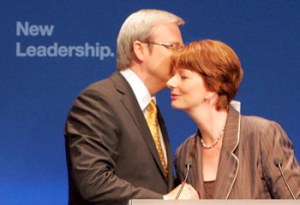
Julia became nostalgic at the Press Club for where she came from, the school she attended, and her first win when working at the law firm Slater and Gordon. I’ve noticed that when things in the present are difficult and testing it’s a fairly normal human reaction to become nostalgic, and yearn for a time that in retrospect, and compared with the shit field one is currently attempting to negotiate, looks rosy and comforting and is one to which one longs to return.

The ABC rather cruelly titled their clip “Real Julia.” However, we did get a glimpse of the real Julia in that emotional slip. Unfortunately, and this is what so aggravated Mrs Chook it seems, the emotion was all about her.

Tony Abbott is very good at manufacturing fear, he learnt it from John Howard who learnt it from Goebbels. Yo! Godwin’s Law already!

Abbott has fertile ground – in general Australians have become (have always been?) a fearful people, controlled by catastrophic expectations that create a free floating and irrational anxiety about what could happen to us if…

This fear of catastrophe is apparently unassailable. Reason and logic stand no chance against it. It dominates the public and private  imagination, and people look to governments to protect them and assuage their fears.

The public doesn’t want governments offering challenging vision and the excitement of change.  The public wants things safe and ordinary.

In general we live in a mindset of scarcity, rather than abundance. No matter how good things are for us in comparison with the rest of the world,  we worry that it might get worse soon. This causes an inability to empathise with anyone who is not in our immediate circle of concern. That circle can be very small, and as fear takes hold it will inevitably shrink further.

We live in a culture of constructed vulnerability and this creates a diminished sense of agency. There are experts in every aspect of human life, telling us what we should do and how we should do it. Even the most common sense matters must be subjected to expert research in order to be validated, in fact common sense has been so thoroughly discredited as a human value it barely counts any more.

As a consequence we increasingly perceive ourselves as passive subjects who must be protected from walking too close to the edge of a cliff as we are incapable of judging for ourselves when we’re in danger. Somebody in authority has to tell us and put up a fence. This constructed powerlessness makes us angry, frustrated and incompetent. We can’t trust ourselves, the dominant culture tells us. We must be regulated for our own good not to take risks.

Enter the LNP. Only too happy to tell us the danger we are in, and only too happy to offer us the solutions. Abbott and his cronies are whipping up a perfect storm. The government’s popularity is in the death zone. Gillard has a major trust issue with the public, and has ever since she took over the leadership. Abbott would not be nearly so successful if the ALP had a leader the public trusted a good deal more than it trusts Gillard. In this sense, the ALP did the groundwork for Abbott, and he’s used classic propaganda techniques to run with it. The public is ready and waiting, prepped by learned helplessness to follow the one who apparently offers security and freedom from fear.

“It is not propaganda’s task to be intelligent, its task is to lead to success,” Goebbels wrote, and Howard, with his propaganda war on asylum seekers that led to his re-election, brilliantly demonstrated this. Abbott watched and learned.

This is not the time for the PM to get personal with us about herself. That moment is long gone. Mrs Chook has a point. There is an entire government there. We need to be hearing from many more members of it. Gillard will do herself no favours getting emotional about her personal history at this point. Abbott is conducting a vigorous propaganda campaign against her and against the government, and he’s succeeding. While it’s two years till the next election, there could be a by election at any time. The government doesn’t have the luxury of thinking it’s got time on its side. The threat of an Abbott-led government is constant.

Now there’s a catastrophic expectation, if anybody’s looking for one.

“From where Winston stood it was just possible to read, picked out on its white face in elegant lettering, the three slogans of the Party:
WAR IS PEACE
FREEDOM IS SLAVERY
IGNORANCE IS STRENGTH.”

Would you buy a carbon tax from this woman?

12 Jul

Back when we were friends

With a primary vote of 27% in today’s Newspoll, the ALP with Julia Gillard at the helm is sinking faster than a leaky SIEV. The poll was taken before the carbon tax roadshow began in earnest on Sunday, and we have yet to discover whether that will make things better or worse.

Gillard’s promise to keep on  explaining for as long as it takes struck terror into my heart, but when I remembered that I’m still the boss of the remote I felt better.

A new tax must be the hardest thing for any government to sell to the electorate, but when you’re a government with figures in the death zone, you’re well and truly up against it.

I watched a little of Q&A last night, with Gillard as the sole panelist. I did note that the PM appears to have taken some criticisms of her vocal style to heart: the trademark drone seemed less likely to induce narcolepsy in the listener, and that unfortunate habit of repeating a few words over and over and over and over and over and over…well, that wasn’t quite as in evidence, though I admit I only watched for ten minutes or so.

So with those improvements why did I still switch off?

There’s no logical answer to that. It’s visceral. I cannot listen to or watch this woman, anymore than I could listen to and watch that rabid anti pornographer Gail Dines, albeit for different reasons. Gillard come to us with a dark history, one that does not necessarily reflect on the substance of the current carbon tax, but one that seriously reflects on the morality (or lack of it) that has dogged this debate within the ALP. Then there’s the wider circumstances of Gillard’s ascension to the leadership.

Just how much this bloody history will interfere with Gillard’s selling of the carbon tax remains to be seen, but it’s not looking good. In what sounded a little too much like desperation, Bob Brown the other day acknowledged that the PM is a “brilliant negotiater.” This may well be so, but those skills are not evident in public, so aren’t going to do her much good. Selling is not negotiating, and requires a different skill set if it’s going to be successful.

Gillard hasn’t successfully sold herself as a credible leader. Her party didn’t manage a mandate. What she apparently does have in spades is a blind determination to keep going no matter what. This is not always a positive attribute. As the wise ones tells us, real wisdom is knowing when to fight and when to lay down arms and accept that it’s over. There is little more pathetic than someone who does not recognise when their time is up. John Howard is a good example of overstaying one’s welcome, when at the end of his reign he just would not go, no matter who begged him to bugger off.

Granted, for the ALP to change leaders again at this point would seem on the face of it suicidal. But perhaps it could just work, if Gillard co-operated and graciously stood down and no blood was spilt. What have they got to lose, one wonders? Gillard signifies nothing positive or good. And that’s the problem. What she signifies cannot be overcome by any amount of negotiating talent or selling skills.

All political parties should take note: short term measures that seem like a good idea at the time, such as dumping the PM overnight without warning anybody, can have long term and disastrous effects.

It is an elementary fallacy that to conclude that because in a democracy politicians represent the people therefore politicians are representative people. The closed-off life of the typical politician is much like life in a military caste, or in the Mafia, or in Kurosawa’s bandit gangs. One commences one’s career at the bottom of the ladder, running errands and spying; when one has proved one’s loyalty and obedience and readiness to endure ritual humiliations, one is blooded into the gang proper; thereafter one’s first duty is to the gang leader. J.M.Coetzee, Diary of a Bad Year.

Gillard is a politician and nothing else. She doesn’t represent anything non-politicians can identify with. We can’t connect with her in any real human way. This isn’t to say she isn’t human and humane, but those aspects of her character are obliterated by her carefully contrived  political persona. Hence the “real” Julia campaign, doomed to failure from the start because anyone who says they’re being real now when they weren’t before has a profound credibility problem that isn’t going to go away.

Gillard’s had a “closed-off life,” and she isn’t representative of anyone outside of the political arena. But where she so dramatically breaks away from Coetzee’s depressing assessment of politicians is that she abandoned her first duty to her gang leader and overthrew him. The combination of the closed-off life and treachery at that level is a killer. The childish wish to put those unfortunate events behind her and move forward has not been granted. No matter what else she does, she will always be remembered first for the night she took down Kevin Rudd.

For Gillard, like so many of our politicians on all sides,it’s all about them and it’s all about their party allegiances. It’s not about us. It’s not about the people they’re elected to represent. Coetzee’s right. Representative democracy is an elementary fallacy, and nobody demonstrates that as well as Julia Gillard.


Leaky boats and marshmallow pies

10 Jul

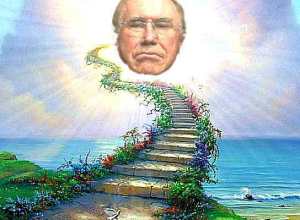
Johnny in the sky with rainbows

It was with a sense of “did this really happen” that I watched Leaky Boat on ABC TV on July 7. On ABCTV blog you’ll find a timeline of the events of 2001 from the “Tampa” to the “Children Overboard” affairs covered by this documentary, in case you’ve been on Mars for the last ten years, or overseas where they don’t have meltdowns over a few asylum seekers like we do.

Immediately following the doco there was a Q&A “leaky boat” special, with the usual suspects holding their usual positions. Because I’m bored witless by listening to the same old same old from absolutely everybody on this topic, I decided to pretend I was an intergalactic traveller who’d fetched up in Australia just in time to watch these programs. Of course I had an intergalactic knowingness that allowed me to immediately cotton on to what most of it was about. When I got bogged down, I asked the dog. If he told me without detectable bias I let him lie in front of the fire.

My task was to objectively observe the human talking heads and because I was extra terrestrial, I had no difficulty at all being objective.

I tuned in to everybody’s vibes before I tuned into their words. I have to say straight up that I didn’t take to anybody on an energy level. My antennae (disguised so no human could see them) vibrated something shocking when they picked up the mutual animosity, ill will, one-upmanship and totally negative emotion fairly radiating through the television screen. I found it intensely upsetting to be in the presence of such bad feeling, especially when Raye Coleby (of SBS Go Back to Where you Came From fame) started in on a couple of re-settled Muslim refugees about how they didn’t deserve to be safe in Australia because thousands upon thousands of other asylum seekers are trapped in hellish camps, especially in Africa, without the financial means some lucky Muslims have to get themselves out.

Apparently, the dog explained when I murmured a question into his silky ear, this argument is what’s known as the queue question, and the boat arrivals keep jumping it which everybody knows is bloody bad manners and apparently not a good start in a country where good manners are more important than anything else at all. (Really? Is that really true? Is the dog dissing me?)

The fact that a queue is also a Chinese pigtail is of absolutely no relevance here at all, the dog said when I asked.

Wait a minute, I thought, as I watched Coleby become more and more emotional over her Africans, and more and more aggressive towards the Muslims around her.  There’s no queue to get into Australia, not as we understand queues where I come from. A queue that isn’t a Chinese pigtail is when everybody lines up in an orderly fashion to get something somebody else is distributing. That never happens in refugee camps in Africa or anywhere else. People make an application, Australia chooses who it wants. That’s not a queue it’s a lottery. Doesn’t matter how well mannered you are in a lottery.

So what’s Coleby on about?

Then the dog showed me how to send a tweet. My tweet said: “Is that the “real” Scott Morrison?”  because I thought he might be an extra terrestrial like me, standing in for a human. Well, not like me because I come from a peaceful people and he got right in David Marr’s personal space and embarked on an offensive interrogatory attack that a lesser man than Marr might have clocked him for.

Why nobody threw their shoes at Scott is a mystery to me.

My tweet didn’t appear on the screen and for that I blame the dog who should have told me to say something more intelligent like the other tweeters did.

I have since checked my Twitter account and found that I have ten followers, including one who wrote about me in my human form: “She is a woman of strong opinions with a sparse Twitter following.” The dog just shrugged about that. It’s my own fault, he gave me to understand. You have to nurture your Twitter account, feed it, give it time and attention: it doesn’t just happen all by itself.

But I digress. From my lofty alien perspective I find the public arguments over boat arrivals have become so predictable as to be meaningless. I know exactly who is going to say what, and the tone in which they will say it. It’s like saying a word, any word, over and over again to yourself until it becomes incomprehensible. Both sides of the debate carry great burdens of animosity towards one another. Emotions are high, indeed the entire debate has been so appropriated by high emotion that there’s hardly anything else left in it. Anybody who tries to be rational and reasonable is outside of the parameters and won’t get a look in.

I don’t know what can be done about this, because  from the galactic perspective it looks like it’s becoming a kind of mutual masturbatory opportunity for sado-masochists to hurl and receive nasties, and is achieving nothing at all for people who arrive by boat.

It is, however, a sign of our extraordinary privilege that we can expend so much emotion abusing one another about a situation that is not likely to affect any of us. Who in the ABC’s audience at home and in the studio is likely to suffer even a smidgin of disadvantage from a few thousand boat arrivals being re-settled in this country?

Personally, being an intrepid cosmic traveller, I’m always interested to hear another traveller’s tales. I don’t get nearly as bored watching refugees tell their stories as I’m starting to get watching talking heads of all persuasions talking about refugee’s stories. I realise there’s a whole pro and anti boat people industry out there and my perspective will not be popular but I don’t care. I found Leaky Boat fascinating. It was good to see Arne Rinnan again. I found Go Back to Where you Came From fascinating because it humanized everybody involved.

But the talking heads, whether I agree with them or not, I’m over them. Let the people speak. Then I’ll hear.

Picture yourself in a boat on a river, the dog whispered in the firelight, with tangerine trees and marmalade skies…

Newspaper taxis appear on the shore, waiting to take you away,

Climb in the back with your head in the clouds and you’re gone…

That dog. He’s a bloody poet.

Really though, in all honesty I have to admit that when I’m back on earth in my usual form, minus antennae and universal perspective, I will probably just get stuck back into the brawl like I always have. I will jeer and sneer and give the finger with the best of them. I will gasp in outraged horror at something else Scott Morrison says, and I will continue to berate the Gillard government for it’s moral decline into unspeakably horrible plans to transport everybody to Malaysia where they may well be caned without first being stunned.

And why? Because I have to. Because even when it gets tiring and bogged down and you think it’s going nowhere you can’t stop. Because people who arrive in boats are my fellow humans and from that comes everything else, and when I can’t remember that any longer, I might as well sew up my lips,stuff up my ears, and close my kaleidescope eyes.

Ellis and Nietzsche: let them sniff chairs

6 Jul

That ageing provocateur Bob Ellis, pictured here showing what Coke can really do to you, wrote a truly awful piece on the Drum yesterday to which on principle I will not link, basically arguing that feminism is responsible for the downfall by sex of many famous men from Oscar Wilde (???) to Dominique Strauss Kahn.

Heck, I have to link, it isn’t fair to talk about it otherwise.

The piece was almost universally howled down, and the ABC shut off the comments option at around three hundred and something, only the day after it was published.

What Ellis’s pleas for a more understanding and forgiving attitude to male desire did make me ponder, is how easily male public figures are brought down by their sexual activities, whether they’re caught playing away, sniffing chairs, exiting gay bars or cavorting in their underpants when one would wish them to be fully dressed. Though for Ellis to claim this has much to do with feminism is contestable, as there weren’t a lot of feminists braying for Oscar Wilde’s scalp, for example.

Usually these public figures are brought down by their male enemies who might very well employ some appropriate feminist rhetoric to make them look good and properly concerned about the women allegedly injured in the blokes’ peccadilloes (except in the case of Oscar Wilde and any other man brought undone by participation in gay sex or rumours of gay sex.)

What this says is that as a society we are apparently very uptight about the morals of influential men, or more likely there are forces at work who want us to think we are.

If a man is unfaithful to his wife, how does this affect his professional performance? The answer is we don’t know. Nobody’s done the studies. We make an assumption, based on current moral values about sex, fidelity and monogamy that if he’s deceiving his wife, he’s likely deceiving everybody else. This seems to me to be a slightly insane deduction. We all know how human beings can and do categorize, especially when sexual desire is at work in them.

Was Bill Clinton’s presidential performance changed for the worse as a consequence of letting Monica puff on his cigar, for example? (No, she didn’t inhale. They found the smoke on her frock.) Do we have the  right to judge a man’s whole life (or a woman’s for that matter, but sexual disgrace doesn’t seem to befall influential women to anything like the same extent) on the strength of his sexual behaviour?

Of course I’m only talking about non criminal situations. If  an influential man is found to have acted criminally in sexual matters, then that needs to be viewed as would any other criminal behaviour.

Ellis claims that a lot of good men are cut off at the balls because feminist wowsers can’t deal with their expression of their sexuality. Men have always been at the mercy of their desires, he claims, and everybody needs to cut them some slack if they Fall. High levels of testosterone go hand in hand with high levels of achievement, so there’s bound to be trouble.

There isn’t much to take away form Bob’s rave, except that it does remind me that the society in which we live seems to have a dominant moral view of sex as at best naughty, and at worst, really scary and requiring all kinds of societal controls, including marriage and monogamy. Repression is the price we pay for civilization. Give adolescents condoms and they’ll be at it in the aisles at school.

Any public figure who transgresses the dominant sexual morality runs the risk of being terminally banished, not because they’re particularly evil, or even a little bit bad, but because they’ve given their opponents a brilliant excuse to run them out of the game, under the guise of upholding society’s moral values.

While straying from one’s chosen partner is going to cause a lot of grief, does that make it immoral? If a man in a powerful position engages in a consensual sexual encounter with a woman with less power, is that an immoral act? Who is determining our moral values at this point in our history, how are they determining them, and to what purpose?

Or is there truth in Nietzsche’s claim that:

There are systems of morals which are meant to justify their author in the eyes of other people; other systems of morals are meant to tranquilize him, and make him self-satisfied; with other systems he wants to crucify and humble himself, with others he wishes to take revenge, with others to conceal himself, with others to glorify himself and gain superiority and distinction,–this system of morals helps its author to forget, that system makes him, or something of him, forgotten, many a moralist would like to exercise power and creative arbitrariness over mankind, many another, perhaps, Kant especially, gives us to understand by his morals that “what is estimable in me, is that I know how to obey–and with you it SHALL not be otherwise than with me!” In short, systems of morals are only a sign language of the emotions.”

Whatever the answer, it’s a pretty safe bet that it’s got very little to do with feminism, or even wowser feminism. Sorry, Bob. You blokes are on your own with this one.

Gillard government guidelines say women don’t commit domestic violence: in On Line Opinion today.

5 Jul

In On Line Opinion this morning, I press on with my solitary mission to bring some reality into the Gillard government’s National Plan to reduce Violence against women and their children.

It’s a dark and lonely job but someone has to do it.

Every time I take this on, especially on the Drum, I’m called anti feminist (that’s an insult these days?) an apologist for rapists, a”man fondler” who is determined to attack feminism any way I can; of having a prick in my head and various other slings and arrows shot at me by women who call themselves feminists.

Yet I remain strangely unaffected.

Foreign ownership or boat arrivals – which is most likely to invade and conquer?

4 Jul

On the Watermelon Blog on Saturday, David Horton notes that when a recent Greens’ survey revealed that 83% of mining companies in Australian are owned overseas there was, in his words, “a swift and predictable response from one of the egregious right wing think tanks whose role is to protect corporations from criticism.” Foreign investment is good for Australia, they brayed, and we have plenty of land to sell. They then called up the spectre of xenophobia, more commonly hauled out in “don’t stop till blood is spilt and maybe not even then” arguments over asylum seekers arriving by boat.

Horton raises the crucial matter of where we should draw the line at foreign ownership, and what assets are we willing to relinquish to foreign control. “What happens,” he asks, “when push comes to shove in a financial crisis or a raw material crisis?” We would be naïve indeed to imagine that foreign corporations give a toss about our welfare and wellbeing. Heck, even our own corporations aren’t overly concerned about any of that soft stuff.

‘So how many asylum seekers do YOU think we should allow?” is the question frequently and usually aggressively hurled at supporters by the anti boat people faction, who express deep fears of being overtaken, of losing our culture and Australian way of life, and of losing control of our boundaries and sovereignty if we open the gates and let the refugees in.

The arguments used by corporate interests against those who oppose unbridled foreign ownership, and those used by the anti boat arrival faction against those who support their re-settlement, are ironically similar. In the absence of reliably specific demographic evidence, I’ll make an assumptive  leap that there may well be those amongst the anti boat arrival group who would regard expanding foreign ownership as good for our country, while simultaneously railing about the catastrophic dangers posed to us by a few thousand boat arrivals. I have no proof of this – it’s a good subject for a poll.

In essence, it’s the same argument employed for very different purposes and by very different interests.

Wealthy foreigners in suits arriving first class by plane and bearing papers won’t want to live next door, and they won’t be a drain on the welfare system. That they might well be in a process of asset stripping the country is such an intangible that it can’t be seriously be raised to the level of a threat. As is frequently the case, the danger lies not in the obvious, and one doesn’t see it coming.

Those who struggle to bring the hidden danger into collective awareness are usually dismissed as a bunch of Cassandras, after the mythical woman blessed with foresight then doomed by Appollo  to be mocked and disbelieved when she revealed her predictions.

The conflation of the topics of boat arrivals and foreign ownership usefully highlights where the danger to this country’s future really lies. It’s not in the few thousand foreign asylum seekers fetching up in boats on our shores. It’s a pretty safe bet that none of them are going to own the rights to our water in the future. We probably don’t need to worry that any of them are going to buy up our prime farming land for mining, leaving us more dependent on imported food supplies when we can’t produce our own. It’s not very likely that any re-settled boat person is going to end up owning our energy companies, our transport companies, our stock exchange, or any of the other assets Horton lists as at possible risk.

In spite of the Greens raising the issue of the dangers of foreign ownership for our future and ultimately our sovereignty there will not be, I predict, anything like the furore over foreign investment that there is over boat arrivals.

Other than what spews forth from the corporations who stand to benefit enormously, of course, and we can likely prepare ourselves for billion dollar advertising campaigns as soon as any serious rumbling starts up.

It’s undoubtedly in the interests of corporations and governments that xenophobic fears (apparently endemic in some human communities) of being invaded and conquered are channeled away from the issue of foreign ownership, and into something as petty as a couple of thousand boat arrivals.

“Illegal immigrants” Press Council ruling: Why is Paul Sheehan is allowed to say it while Greg Sheridan is not?

3 Jul

Imagine my astonishment when I came across this post describing how in June 2011 the Australian Press Council upheld complaints against the Australian‘s Greg Sheridan alleging that he had wrongly described boat arrivals as “illegal immigrants” not once, but three times.

On January 7 2011 I put the following post up on  No Place for Sheep:

Today we sent a complaint to the Australian Press Council claiming that the article by Paul SheehanSydney Morning Herald January 3 2011, titled Cast adrift from reality, the slick spruikers of ‘our’ shame, breaches Principles 1,2,3 and 6 of the Council’s Statement of Principles.

These Principles address misrepresentation of groups and individuals; suppression of available facts; deliberate misinformation through omission or commission, and fairness and balance.

We claim that these principles were breached by the use of the terms “illegal” and “without proper papers” when referring to asylum seekers arriving by boat.

This is the post I put up on January 13 2011, announcing the APC’s dismissal of my complaint against Sheehan:



I received the following email from the Australian Press Council today:

Dear Dr Wilson,

The Council has received a complaint from you, in which you raise a concern with terminology used by a bylined opinion columnist in The Sydney Morning Herald.

For your information, a copy of the Council’s principles and practices can be found on the Council’s website http://www.presscouncil.org.au.Therein are set out the standards of journalistic ethics that the Council upholds and the procedures it uses to deal with complaints alleging breaches of those standards.

Attached, for your information, is a copy of the Council’s Guideline No 288 on the issue of asylum seekers.

The Council believes that columns such as Sheehan’s should be given a reasonably wide licence to express a point of view. They are the clear expression of a viewpoint of the individual writing them and are commentary upon the news.

The terminology you complain of talks of  “illegal boats”. Since the boats can be seized and their crew tried before the courts, there is good reason to suggest that the arrival of the boats is in fact “illegal”.

Have you submitted a letter to the Sydney Morning Herald for publication in response to the published column? The Council has consistently said that the best response to a disagreement with such material is the submission of a contrary view for publication. I therefore urge you to take the matter up direct with the newspaper in the first instance, if you have not already. I will write to the newspaper urging it give due consideration to any submitted letter as a way of dealing with your concern.

I will bring your concern to the attention of the newspaper but believe that the best settlement of your concern, in this case, is through the letters to the editor column.

Yours sincerely,

Deb Kirkman, Acting Executive Secretary, Australian Press Council

To which I replied as follows:

Dear Ms Kirkman,
I have indeed twice written to the SMH letters on this matter, as I stated on my complaint form, and neither letter has been acknowledged.

To reiterate, the terminology I complained of is as follows:

1. Illegal boat arrivals. If Sheehan was referring only to the arrival of SIEVs, or to the crew of SIEVs, then these references makes no sense at all in the context of his paragraph.

It is rather disingenuous to suggest that Sheehan was referring to the vessels and their crew, given that the crews are arrested and the vessels are impounded, therefore the problem is addressed immediately at the source and offers no basis for Sheehan’s on-going angst.

Sheehan then goes on to comment on the “relatively small number of people who arrive by boat,” thus clearly confirming that he is indeed referring to the passengers who are seeking asylum, and not to the SIEVs and their crew.

2. Those who arrive by illegal means,and those who arrive without proper papers.

The UN Refugee Convention, to which Australia is signatory, recognises that refugees have a lawful right to enter a country for the purposes of seeking asylum. The Convention stipulates that what would usually be considered an illegal action, eg entering a country without a visa, should not be treated as illegal if a person is seeking asylum.Australian law, in line with the Convention, also permits unauthorised entry for the purposes of seeking asylum.

Therefore, under Australian law, and under the terms of the Convention we have signed, a person who is seeking asylum has the legal right to enter this country without papers, and by any method of transport, even SIEVs, and has the legal right to remain in this country, until his or her refugee status is established through the proper legal processes, to which, as asylum seekers, they are legally entitled.

Their mode of transport does not render asylum seekers “illegal,” as suggested by Sheehan.

This was re-affirmed by the High Court of Australia in November 2010.

Again, my complaints  relate to numbers 1, 2, 3, and 6 of your Statement of Principles.

Sheehan has misrepresented the facts of this situation – asylum seekers are not illegal, even if they enter the country on SIEVs.

Sheehan has suppressed facts that are available to him, i.e. the facts that under domestic law and by international agreement, Australia does not consider those requesting asylum to be illegal in any way, no matter how they arrived in this country, including if they arrived “without proper papers.”

The illegality of their mode of transport is a separate issue, as the law recognises, and is dealt with as a separate issue. Asylum seekers are not held responsible for the legality or otherwise of their mode of transport.

Sheehan has misinformed and misled the SMH readership by conflating the two, and in so doing, ignores Australian law and the UNHCRConvention.

Since when has it been acceptable that even an opinion writer has the license to misinform their readers about Australian law, and the legal status of a particular group of people?

Sheehan has not presented his readers with the facts, and his opinions are not based on the facts. Sheehan has acted irresponsibly in putting forward an uninformed point of view as his opinion. The facts are readily available to him. Surely even opinion pieces are supposed to have some basis in reality?

I have requested that the SMH correct Sheehan’s inaccuracies and conflations. I have received no response

Yours sincerely,

Jennifer Wilson.

Australian Press Council Guideline 288 in regard to Asylum seekers.

Guideline No. 288 Describing “asylum seekers”

Issued: October 30, 2009

For immediate release

The Australian Press Council has updated its guideline on “asylum seekers”, replacing General Press Release 262 with the attached guide. The Council issues guidelines from time to time. These are, in essence, amplifications on particular issues arising from the Council’s Statement of Principles. The guidelines apply the Principles to the practice of reporting and are intended to guide the press on how it should report certain matters. These guidelines are not intended to be prescriptive instructions to the press but act as a series of advisories on the application of the Principles that the Council seeks the co-operation of editors in maintaining. A list of the extant guidelines (and links to them) can be found on the Council’s website athttp://www.presscouncil.org.au/pcsite/activities/gprguide.html.

The Council has from time to time received complaints about the terminology used to describe people who arrive in Australia through means other than regulated immigration and visa transit processes. They are often referred to by the press and others as “illegal immigrants”, “illegal boatpeople” and so on –  or simply as  “illegals”. The descriptor “illegal(s)” is very often inaccurate and typically connotes criminality.

The press has, by and large, abided by the Council’s 2004 Guideline about the use of inaccurate and derogatory terminology to describe such people.

Having considered the matter further, the Council believes that the term “asylum seeker” is a widely understood descriptor, generally a fair and a sufficiently accurate one, and one which avoids the kinds of difficulties outlined above. The Council recommends its use as the default terminology in relevant headlines and reports both by the press and others.

The Australian Press Council comprises representatives of the public and of the industry and acts to preserve the freedom, and the responsibility, of the Australian press. It was founded in July 1976 and has been in continuous operation for over 30 years.

End of Guideline 288

What are we to make of this disparity in the Press Council’s judgement?

 Is the APC favouring the Sydney Morning Herald, while holding the Australian to a different set of standards? Is it more personal than that, ie can Sheehan do what Sheridan cannot and if so, why?


Strauss Kahn rape case in doubt – who’s got the most credibility?

1 Jul

Excellent analysis of the issues here

Prosecutors are re-considering their position in the case against former IMF Managing Director Dominique Strauss Kahn, accused of the sexual assault of a hotel housekeeper in New York.

According to the New York Times, investigators have discovered “major holes” in the credibility of the woman who alleged DSK forced her to perform a sexual act against her will.

The “major holes” are apparently issues involving her asylum application; the possibility of her links to criminal activities, and a phone conversation with her fiance in which they discussed the benefits of pursuing charges against DSK. Her fiance has drug convictions, and allegedly paid some $100,00 into her bank account.

As well, investigators discovered that the information on the woman’s asylum application was not consistent with what she told them.

Strauss Kahn’s lawyers have never denied that a sexual act took place, but claim it was consensual, and that they would discredit the housekeeper’s version of events. There has been no mention of DSK offering money for the woman’s sexual services.

None of the “major holes” in the woman’s account of herself prove that her version of events in DSK’s hotel room is wrong. The case has always been about a “he said-she said” situation. Since his arrest, several other women have come forward to give details of unpleasant encounters with DSK, and his private reputation as a sexual predator has been made public.

Yet this history doesn’t seem to affect his credibility when it comes to the events of that morning.

In a he said-she said situation, it all comes down to a battle for credibility.

The power dynamics are interesting: while at first blush one could see DSK as having all the power on his side even if the sex was consensual, the consequences have been catastrophic for him, as he lost his job, and quite possibly his future as a possible French president.

Against this, the housekeeper was possibly forced into a sexual act she did not seek or want, she may also have lost her job, and her application for asylum is under serious scrutiny. In the context of her life, the consequences for her are as catastrophic as for DSK.

But he’s still wealthy.

It looks as if no one will come out of this situation unscathed including the NYPD, who are now accused by some of rushing to premature judgement.

So the morals of this he said-she said story are? If you can’t be sure it’s safe do us all a favour and keep it in your pants, chaps.

And if you’re a woman with any history, you’ve likely got little or no credibility, no matter what the truth is.

In a little footnote to these events, Strauss-Kahn’s replacement at the IMF, Christine Lagarde, commented: “In my interview at the IMF with all the 24 administrators, there was not one single woman. So while I was being questioned for three hours by 24 men, I thought it’s good that things are changing a little.”