Archive | January, 2011

Whistleblowing: a chilling account

6 Jan

Robina Cosser is a guest author, and an expert on whistle blowing.

By tiganatoo via flickr

Blowing the whistle into an empty room

By Robina Cosser

So …

You become aware that something is “going on” in The Department. And you decide that you must do something about the situation. You decide that you must “blow the whistle” – you must tell somebody who will do something about the situation.

So you struggle over the wording of your disclosure for several days, or even weeks, trying to explain your disclosure as clearly as possible. And you collect lots and lots of supporting documentation.

Then you mail your disclosure and the supporting documentation to a person that you think cannot possibly be corrupt. The Director-General of The Department, maybe.

But you don’t realise that you are doing battle with the public service. And that no public servant in The Department wants to be held responsible for hearing you blow the whistle. And that The Department’s public servants have generations of experience in “not hearing”, “not understanding”, “not knowing” and “not finding any evidence of”.

And so your disclosure is “lost”. Or the supporting documents are “lost”. Or your disclosure is reduced to gibberish – the cover letter and the first page of your disclosure are saved, the next eight pages are “lost” and the remaining pages of your disclosure are sent to another office, in another city, and jumbled up with lots of other documents.

Or every alternate page of your disclosure is “lost”. Or two pages of your disclosure are recorded, two are “lost”, two are recorded, two are “lost”, etc. Or your disclosure is reduced to half-size and turned around and printed sideways on the page, so that it is very difficult to read.

And The Department do nothing about your disclosure.

So, after waiting for some time, you decide that you have to make your disclosure to another government department, one that is not corrupt. The Crime and Misconduct Commission, maybe.

So you ring the CMC. And you make your disclosure very, very clearly to the CMC officer.

And the CMC officer writes down her own gibberish version of your disclosure. And she makes a note that, having spoken with you, she has doubts about your credibility. And she puts these notes on your file.

You have a suspicion that the CMC officer was reluctant to record your disclosure. Something in her tone of voice. And so you send her an email, making your disclosure very, very clear to her. So that she cannot pretend to misunderstand.

But the CMC officer does not open your email. She simply records that you have sent her yet another pesky email. And the CMC officer “devolves” your disclosure – she sends it back to The Department, The department that you are complaining about.

And so the CMC have no record of your disclosure, just a record of their own gibberish version of your disclosure. And The Department’s investigation into your disclosure is based on the gibberish version of your disclosure.

And The Department’s investigation is not really an investigation; it is a “review”. And the rules of the “review” are that you are not allowed to speak to the reviewer. And the reviewer is not allowed to ask any questions. So you have no way of finding out that your disclosure has been reduced to gibberish.

A few days before or after the “review” begins, Freedom of Information documents are released to you by The Department. And you realise that your official records have been extensively falsified. So you email the Director-General. And you tell him that your official records have been extensively falsified.

He emails back.

Lots of times.

With lots of promises and re-assurances.

And you email the Director of Ethical Conduct. You tell him that your official records have been extensively falsified. And he emails back. Lots of times. With lots of promises and re-assurances.

Then, a few days before a copy of the review is released to you under “Freedom of Information”, the CMC and The Department each “accept” the review – the review based on the gibberish version of your disclosure and the falsified records – and they each declare your case “closed”.

So that when you write and protest that the review has been based on a gibberish version of your disclosure and on a huge mass of falsified “official records”, no public servant reads your letters. No public servant “knows”. Because your case has been declared “closed”.

And when you ask, under freedom of Information, what the Director-General and the Director of Ethical Conduct actually did in response to your emails, you are advised that there was a computer problem in The Department. And all of your emails to and from the Director-General and the Director of Human Resources over several months were “lost”. And so there is no official record of your complaint to them that your “official records” have been extensively falsified. And there is no official record of any of their promises and the re-assurances.

So you decide to phone another government department, one that is not corrupt. And you explain your disclosure again, very clearly. You notice a slight whining noise as you are speaking. When you have finished making your disclosure the Public Servant asks you if, “besides that”, anything else is bothering you. And so you struggle to give him some other examples of corruption. And you notice that the whining noise has now stopped. And later you wonder if the Public Servant could have been pausing his tape recorder while you were explaining your disclosure.

So you visit the Head Office of The Department. And you take your own tape recorder. And you place it on the table.

And the Head Office Public Servant places his own tape recorder on the table, beside yours. And, while you are speaking about a particular group of the falsified records, the Head Office Public Servant fiddles anxiously with his tape recorder. Twice. And, later, when you listen to your own recording, you notice that there is a loud straining noise on your own tape while you were explaining that a witness has told you that this particular group of “official records” are entirely falsified.

And you wonder if the Head Office Public Servant could have paused his tape recorder while you were talking about these particular “official records”.

The Department eventually appoint an “independent investigator”.

And the Head Office Public Servant whose behaviour you have complained about to the CMC is given control of the “independent investigation”. The Head Office Public Servant tells the “independent investigator” that he is only allowed to “consider” the falsified documents that you have discovered on your official records. He is not allowed to consider your evidence that these “records” are extensively falsified. Nor is he allowed to consider the many “official records” that are still being refused to you under Freedom of Information.

He is only allowed to “consider” the falsified documents.

Again.

And, one year before the CMC receive a copy of the “external investigation” report, they declare your case “closed”.

And two years before fragments of the “external investigation” report are released to you under Freedom of Information, The Department “accept” the investigation report and write to you, declaring your case “closed”.

And, when you receive fragments of the Investigation Report under Freedom of Information, you realise that your disclosure has still not been investigated. And, when you write more protest letters, no public servant reads your protest letters because your case has been declared “closed”.

Again.

So you decide that you have to send your disclosure to somebody that you think really cannot be corrupt. The State Premier, maybe.

And the Premier’s office do nothing. For months.

And so you write again. Did they receive your disclosure?

And again the Premier’s office do nothing. For months.

And so you write again.

You give more information. But you do not repeat your disclosure – because you have already “disclosed” to them twice. And this third letter triggers a response. A “Briefing Note for the Premier” is prepared by a senior public servant.

The Premier is advised that you keep on writing pesky letters. But no mention is made of the disclosure in your first two letters. And the Premier is advised not to reply to your pesky letters.

And the Premier agrees not to reply to your letters. He signs the “Briefing Note” with a big, swirly signature. And all of his senior public servants also agree not to respond to your pesky letters.

And so all of your letters to the Premier from that date onwards are simply filed by a machine, without being read.

And no public servant “knows”.

And eventually you realise that you are whistling into an empty room.

This article was first published in On Line Opinion, December 14 2010

Robina Cosser edits the  Teachers Are Blowing Their Whistles and Whistleblowing Women. She is Schools Contact Person and a Vice-President of Whistleblowers Australia.

America and the little wild bouquet

4 Jan

New York Times columnist Nicholas Kristof , in an article titled: Inequality is eating away at America’s soul January 4 2011 writes:

The gap between rich and poor in the US is vast and it’s growing.

John Steinbeck observed that ”a sad soul can kill you quicker, far quicker, than a germ”.

That insight, now confirmed by epidemiological studies, is worth bearing in mind at a time of such polarising inequality that the wealthiest 1 per cent of Americans possess a greater collective net worth than the bottom 90 per cent.

There’s growing evidence that the toll of this stunning inequality is not just economic but also is a melancholy of the soul……Among rich countries, those that are more unequal appear to have more mental illness, infant mortality, obesity, high school dropouts, teenage births, homicides, and so on. 

They find the same thing is true among the 50 American states. More unequal states, such as Mississippi and Louisiana, do poorly by these social measures. More equal states, such as New Hampshire and Minnesota, do far better.

So why is inequality so harmful? The Spirit Level suggests that inequality undermines social trust and community life, corroding societies as a whole. It also suggests that humans, as social beings, become stressed when they find themselves at the bottom of a hierarchy…continued at SMH January 4 2011.

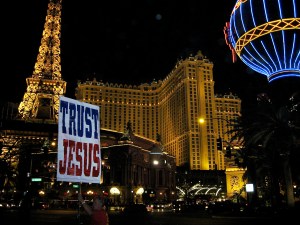
Las Vegas Strip on a Saturday night.

Las Vegas Strip on a Saturday night. By Jane Bronotte

Or as L. Cohen so hopefully puts it in Democracy:
I’m sentimental, if you know what I mean
I love the country but I can’t stand the scene.
And I’m neither left or right
I’m just staying home tonight,
getting lost in that hopeless little screen.
But I’m stubborn as those garbage bags
that Time cannot decay,
I’m junk but I’m still holding up
this little wild bouquet:
Democracy is coming to the U.S.A.

The propaganda and collusion at the heart of “Stop the boats.”

3 Jan

January 8 2011: No Place for Sheep lodged a complaint with the Australian Press Council, claiming that Sheehan’s article breaches principles 1,2 3 and 6 of the Statement of Principles.

No Place for Sheep earlier sent the following letter to the Editor at the Sydney Morning Herald:

In the last paragraph of his article of January 4th, Mr Sheehan refers to “illegal boat arrivals” and arrivals “without proper papers.”

Will Mr Sheehan kindly explain his complete disregard for the Australian law that permits those seeking asylum to arrive in any manner, and without documentation?

It used to be that journalists were required to get their facts right.
This would seem to be an example of either woeful ignorance on the part of Mr Sheehan, or deliberate obfuscation in order to promote political propaganda.
Would the SMH please explain Sheehan’s campaign of disinformation?
This was not published.


In the Brisbane Courier Mail on December 20 2010, Opposition leader Tony Abbott called for: an “urgent” return to temporary protection visas, the reopening of the Nauru detention centre and turning the boats around.

“We stopped the boats before, we can stop the boats again if we put the right policies in place,” he said.

It’s not clear just where Abbott intends to “stop the boats” and “turn them around.” Presumably before they enter Australian waters. Nobody has yet requested that the Opposition Leader clarify his proposals.

Will he use the navy, and will they fire on vessels that disregard instructions, risking death and injury to asylum seekers and their children? In international waters?

Will he kill and maim them rather than let them apply for asylum?

Why is nobody in the mainstream media asking him these questions?

Instead, on January 4 2011, Sydney Morning Herald senior journalist Paul Sheehan yet again resorts to using the completely wrong term “illegal boat arrivals” and yet again makes the completely irrelevant characterisation of boat arrivals as people “without proper papers.”

The Coalition mantra of “Stop the Boats” disregards Australia’s international obligations, incurred as a consequence of signing the UNHCR 1951 Refugee Convention. Asylum seekers who arrive by boat, even without papers, are entitled to apply for refugee status in Australia, according to both our domestic and international law.

For the last few years, politicians from both major parties have sought to find ways around our obligations to those seeking asylum, rather than ways to responsibly fulfill our undertakings.

One of the major tactics used is the propagandist description of boat arrivals as “illegal.” The mainstream media in general support and promote this propaganda. The justification is that boat arrivals have breached our sovereignty, and our right to protect our borders.

What’s not acknowledged is our domestic and international legal obligation to accept asylum seekers no matter how they arrive. Those seeking asylum are not illegal immigrants breaching border security. Their pursuit of asylum legally removes them from that category.

In July 2010 both Adrienne Millbank of the Age and Greg Sheridan of the Australian, launched calls in their respective newspapers for Australia to withdraw from the Refugee Convention, claiming that 1951 Convention is no longer appropriate for world conditions. These calls continue in the blogosphere, and in the mainstream press.

In fact, Australia revisited our agreement to the original Convention and subsequent updates and additions as recently as 2008, so the Convention has not exactly languished unexamined for almost sixty years.

There may well be reasons why the Convention needs re-assessment. However, until such time as it is revisited, the facts remain that Australia did not add a rider to the Convention limiting the manner in which asylum seekers could arrive in this country. Australia did not specify that those seeking asylum must have a certain amount of money, or no money. Australia did not say we would accept asylum seekers only from specific countries. Australia did not add a clause specifying only people in queues.

At the heart of “Stop the Boats” is a profound dishonesty and immorality. Those promoting this position are making a mockery of UN Conventions, and domestic law.

They are advocating the behaviours and attitudes of a rogue state, while in an act of two-faced political bastardry, continuing to apparently support the principles of the Convention, by virtue of making no move to withdraw from it or change it.

If we don’t intend to abide by our obligations we should withdraw from the Convention, and change domestic law. As it is, we are inviting asylum seekers to seek sanctuary in Australia, then incarcerating, criminalizing or refusing them entry when they accept our invitation.

We are subjecting them to indefinite mandatory detention when they have done nothing more than recognize Australia as a democratic country that has signed the Refugee Convention, and therefore as a safe place for them to seek asylum.

This is a despicable act of duplicity, of which our nation should be thoroughly ashamed.

On December 6 2010, Amnesty International launched a campaign they titled Stopping the spin on “the boats.” Amnesty’s research found that hostility towards asylum seekers originates not in racism, but is primarily caused by myths and misinformation, for example their portrayal by politicians and some mainstream commentators as “illegals without papers.” This framing implies to the community that boat arrivals are committing a criminal act by attempting to force their way into the country ahead of a mythical queue comprised of those who do not arrive by boat. This offends a strong community sense of the fair go, and provokes antipathy and outrage, and is entirely inaccurate.

It’s a brilliant example of the power of propaganda when applied by both politicians and colluding media.

In November last year, a High Court ruling put all asylum seekers on an equal footing under Australian law, regardless of their mode of travel. (Sydney Morning Herald November 11 2010. Court casts doubt over legality of processing off-shore asylum seekers.) In spite of this re-affirmation of our domestic law by the High Court, Abbott and many media commentators still continue to use the term “illegals.”

Assertions that asylum seekers want to come here because they know they will receive welfare payments etc makes little psychological sense. 

People with the drive, ingenuity and courage to undertake journeys such as theirs, are not usually people who easily accept welfare as a life-style.

However, when people with these strengths are incarcerated for indefinite periods and/or issued with temporary protection visas (TPVs) whose long term uncertainty has alarming effects on their well being, they are damaged in ways they have not been damaged in the countries they fled, and may well be much reduced in their extraordinary strengths, and their will to survive and prosper. Their spirits can be broken.

Australian governments manage to achieve what the Taliban could not.

As a nation, we cannot continue to behave in this duplicitous manner, giving lie to the international commitments we voluntarily undertake, as well as to our own domestic laws.

Politicians must be forced to acknowledge our international responsibilities, along with our domestic laws and concerns. Politicians must not be allowed to toss our international obligations, and our corresponding domestic laws out the window, in order to win an election.

Whenever one of them starts up about stopping the boats, somebody needs to ask, what about the Refugee Convention we’ve signed? What about our own laws?

When will the mainstream media abandon its role of political apologist, and ask these questions?

Bush, Blair and Howard ignored the UN and its weapons inspectors, and took us to war in Iraq. It isn’t difficult to ignore the UN, very little if anything happens as a consequence.

But is that the point? Isn’t the point rather about being a country that cares about the morality and ethics of its way of being in the world? A country with the common decency to abide by its commitments?

Does our word as a country mean so piteously little that we are under no compunction to abide by it?

Are we happy to be a country whose signature on an international UN Convention is worth less than the paper it’s written on?

The questions need to be asked of all politicians engaging in the refugee debate. We should be demanding straight answers, and refusing to accept this ongoing campaign of disinformation.

Asylum seekers are not the problem, but they are an easy target.  The real problem is politicians with no moral compass, and not much interest in anything more than winning the next election.

The problem is politicians who have decided to exploit asylum seekers, even to their deaths, for their own political gain.

The problem is a tame media, who lack the courage to confront political inaccuracies and lies.

We have a responsibility to instigate a reassessment of the Convention if it is no longer to our liking. Until then, we are obliged to fulfill our commitments. Just as with any domestic law, we cannot decide to ignore it because it no longer seems appropriate.

Somebody besides her mum loves Julia Gillard

2 Jan

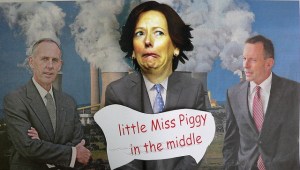
Little Miss Piggy in the middle. By Leonard John Matthews. flickr

Julia Gillard: a breath of fresh air for Aussies

Australia’s PM rises above the usual rough and tumble of federal politics – and her mother will stop her becoming a Thatcher

by Dorothy Rowe, in the Guardian,December 20 2010

My hero is Julia Gillard, Australia’s prime minister. Her predecessor, Kevin Rudd, has many great qualities but knowing how to be a leader is not one of them. His party forced him to resign and Gillard, until then his deputy, took his place. Australian federal politics is rough, loud and often vicious. Gillard knew this well and she had developed a way of speaking that is slow, clear and determined. Her wit is sharp, intelligent and funny, and often surprises and silences her critics. She is well versed in conducting a long-running, rational and informed debate. Michael O’Connor of the Construction, Forestry, Mining and Energy Union, who knew her well, warned: “You didn’t really want to be arguing a point of view against her if you could avoid an argument with her. She was very serious about winning it.

A debate with someone who holds opposing views but is well informed and rational is difficult, but it can be both productive and clarifying. However, the leader of the opposition, Tony Abbott, aka the mad monk, scorns both rationality and facts. He provides the soundbites that the media loves, so he grabs the headlines and creates confusion and much misinformation. Gillard has the task of maintaining, not just for herself but for her audience, clarity of purpose. She must not sink to the level of mere abuse, as is popular in Australian politics, but must continue to present herself as being imperturbable. A knife under the ribs rather than a bludgeon over the head.

All too often in my life I have welcomed a particular leader as a hero, only to see him or her ignore Lord Acton’s warning: “All power corrupts. Absolute power corrupts absolutely.” I was worried that, as a successful Labor leader, Gillard would be corrupted by power until I read that her mother, on learning that Julia had become PM, said that her daughter would be “the best [prime minister] there is”, adding: “So long as she doesn’t turn into Maggie Thatcher.”

With a wise mother like that Julia Gillard might yet become the rarest of leaders, one who is not corrupted by power.

*

No Place for Sheep replied, in its usually restrained manner:

Dorothy Rowe – where are you getting this information?

We don’t like Julia Gillard.
Her voice makes us want to throw ourselves out of windows.
She IS Thatcher, but in a faux velvet glove
She is a robot produced by the ALP party machine with all humanity leached out of her.
Moving forward! Moving Forward! she shrieks at us like a demented darlik.

It is estimated that she is losing 120 votes per hour for the ALP.
She has no backbone, no spine and no moral compass.
She looks NOTHING like your photograph of her.
I cannot begin to tell you how little respect this woman has in this country and it’s getting less and less every day.

Did her mum pay you to write this twaddle?
UK people, please listen! Our PM is really, really, really the worst PM we have ever had and that is saying a lot because we have not been blessed in this regard.

I think your article is a total disgrace, Ms Rowe.You sooo do not know what you are talking about and you shouldn’t be peddling this un-researched twaddle.

PS The photo you used is an airbrushed one by the Women’s Weekly.

guardian.co.uk © Guardian News and Media Limited 2011

PPS: People have remonstrated with me about these comments, saying that I have been unkind to Ranga. Haven’t they read any Comments sections lately? They are not for the faint-hearted, and these are quite mild compared to some responses to this article.

Be that as it may, I don’t wish to be unkind, even if I am talking about a once highly trusted deputy prime minister, given enormous power and prestige by the boss who had nothing but faith in her abilities and loyalty, only to find her dagger lodged in his heart.

As Ghandi said, an eye for an eye leaves the whole world blind and I shouldn’t be vengeful. It’s not like I was that happy with Ruddy. It’s just the principle.