Tag Archives: asylum seekers

Chris Bowen outdoes Philip Ruddock: who would have thought?

3 Jun

The opposition is quite within its rights to call for marching in the streets as a reaction to the Gillard government’s deal in progress with Malaysia to send boat arrivals to camps in that country.

What we know, however, is that the opposition doesn’t give anymore of a stuff about the well-being of boat arrivals than does the government. It’s just an opportunity to score points. The calls for demonstrations against the Malaysia plans are hollow and hypocritical. I can’t imagine why any one of the opposition would think the punters actually believe they care, except perhaps those who’ve forgotten the children overboard saga, and Woomera, and the sinking of the Siev X.

I’m not sure how much more sickening this whole thing can get. The human capacity for vile behaviour never ceases to amaze me, and that’s probably more a comment on my inability to to acknowledge that the triumph of hope over experience is far more common than the other way round.

What has to be accepted, it seems, is the reality that fear and xenophobia are setting the political agenda in this country. Emotion and irrationality have won the day.

Emotion and irrationality are never a good foundation for deciding anything. Yet the whole asylum seeker debate is driven and dominated by nothing more substantial than the xenophobic emotions of focus groups. People who’ve never seen an asylum seeker  and likely never will, are in charge of making refugee policy.

When they’ve managed to stop the boats, these people will begin to notice that their lives are no better for it. It wasn’t the asylum seekers that were causing their misery after all. Their misery comes from the inside, and nothing is going to make it go away.

Focus Groups

The policies of both major parties are held hostage by a demographic that lift its leg and pisses on the UN Conventions to which we are signatory. This demographic doesn’t give  a flying f**ck about Australia as part of a global community, and the responsibilities that come with that. They have no awareness of the origins of white settlement in this country and could care less, or of how our presence here counts for less than a nanosecond in deep time. They just don’t want boat people here. They just don’t like them.

It would have been quite something to have a government that was capable of standing up to these bullies,  instead taking a principled stand on boat arrivals in keeping with the Conventions to which we are signatories, and our domestic laws. But that ship has long since sailed.

It remains to be seen how much Chris Bowen will capitulate to Malaysian demands. We are quite likely already the laughing stock in our region. Our neighbours must be enjoying having us by the short and curlies. Rudd’s farcical “solution” with Indonesia and the Oceanic Viking. Gillard’s premature announcement of her plans for a detention centre in East Timor. Nauru just begging us to come back. And now, Malaysia having us dance to their tune. If we aren’t ashamed of the government’s treatment of asylum seekers, we ought to be cringing at how demeaned we are by our humiliating begging for someone, anyone (except Nauru) to make this all go away.

Gillard’s gamble, and the Glenn Gould Prize

30 May

The Gillard government’s decision to negotiate a one-off deal with Malaysia to trade the next 800 asylum seekers to arrive in boats for 4,000 refugees currently languishing in camps in that country, may or may not lead to a decrease in boat arrivals in Australia. It’s a gamble. If it pays off the rewards are a de-fanged opposition, and the cauterization of a decade old abscess that’s poisoned our political process to its core.

If it doesn’t pay off and boats continue to arrive, will Gillard attempt another negotiation with the Malaysians who may well up the ante, say from ten to one instead of the current five to one?

Or since East Timor gave her the flick will she use more taxpayers millions to persuade PNG or the Solomons to make it all go away?

The plan is that word will get around to potential boat arrivals that they’ll be sent to Malaysia, and this will be enough to persuade them not to undertake the journey in the first place. The deal with Malaysia has not yet come into effect, and the estimated 100 asylum seekers, including children, who’ve arrived since the announcement of the arrangement in progress are being held in detention, awaiting transfer to Malaysia.

Even if asylum seekers continue to take their chances the opposition are seriously de-fanged, as Gillard goes a step further than even they contemplated in the efforts to rid us of responsibility for those who arrive by boat.

They can now seize the high moral ground with the argument that they didn’t send anybody to be caned and mistreated in a third country.

Those who arrive by plane, on the other hand, will continue to do that without fear of being despatched to a Malaysian camp where they can expect to be flogged, fed pig swill, sent to the back of the queue, and otherwise abused.

What is immediately apparent is the government’s complete inability to maintain a credible position on boat arrivals. Not so long ago, Gillard steadfastly refused any possibility of re-opening Nauru, because that country is not a signatory to the UN Refugee Convention. Well, neither is Malaysia.

The government also seems to be labouring under the illusion that Australia can somehow exert control over the treatment of asylum seekers we send to the Malaysian camps. This is what’s known as magical thinking if they really believe it, or cynical expediency if they don’t. It’s difficult to see how even the Malaysian government can protect a handful of asylum seekers among some 90,000 from being badly treated. Are they building special quarters with kinder guards?

As former Human Rights Commissioner  Sev Ozdowski points out, re-opening Nauru is preferable to dispatching boat arrivals to Malaysia. At least we control the conditions in Nauru. On the other hand we also have to pay for that privilege. Once asylum seekers are in Malaysia, our financial obligations are at an end.

We do assume financial responsibility for the well being of the potential 4,000 refugees, the majority of whom are thought to be Burmese, for as long as they need us to do that.

The estimated cost of this  trade in displaced humanity is some $300 million over the next 4 years.

A commenter at Club Troppo made this observation on the post “In Praise of Gillard’s Malaysia solution:”

As for Burmese refugees, I welcome them. I think they are Burmese minority peoples like Shan people, persecuted by the Burmese military. As far as I know, the Burmese are Buddhist worshipping, peace loving people, and won’t hate other religions, or commit terrorist bombings killing innocent people.

Of course, boat arrivals are all Muslim terrorists, aren’t they?

The other matter that has been apparent for some time, especially internationally, is Australia’s adolescent unwillingness to accept responsibility for our own problems. Those who arrive by boat are doing nothing more than responding to our open invitation, which we continue to extend as long as we are signatories to the UN Refugee Convention. We are responsible for continuing to issue that open invitation, and for hospitably dealing with those who accept it.

Instead, like irresponsible teenagers, we bitch and moan that we don’t want those guests, we only want the other guests, so somebody else has to take those guests off our hands and give us the ones we want. The nice Buddhists not the nasty Muslims, that is.

Anybody who thinks this tacky and likely racist manipulation has anything at all to do with preventing loss of life by discouraging boat arrivals is, as they say, dreamin’.

As long as we continue to issue an open invitation, we can’t simultaneously complain about mythical queues being jumped, not if we want any credibility in the grown up world.

But I don’t think Gillard is all that interested in being a grown up, or in leading our country into adult land. After all, it’s adolescents who swan around angsting over whether or not they’re being the “real” me. It’s the immature who’ll go to any lengths and pay any disproportionate price to avoid acknowledging, and then accepting full responsibility for their actions.

The reality that we won’t process those who arrive by boat but will send them to a third, non-signatory country makes our open invitation morally foul. This is the real abscess we urgently need to cauterize. This is the abscess that will keep on poisoning us long after the last asylum seeker’s been settled in a Malaysian camp. We are not true to our word. We’re making promises we don’t keep. Or as the man cautions:

Through the days of shame that are coming 
Through the nights of wild distress 
Though your promise count for nothing 
You must keep it nonetheless…

(L Cohen, Heart With No Companion)

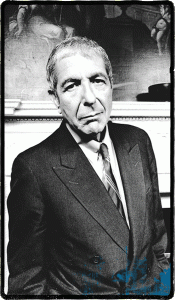
Leonard Cohen was in April awarded the Ninth Glenn Gould Prize for enriching the human condition through the arts, so he knows what he’s on about. Gillard is notoriously uninterested the arts, and quite likely has no idea that they can have any influence on the human condition. And what’s the human condition,anyway and do boat arrivals have one?  Does enriching the human condition through the arts count as hard work?

Maybe Gillard should give Leonard a whirl. At least she doesn’t have any grounds to complain about his voice.

Julia Gillard: our First Hollow Woman.

3 Apr

by Debbi Long via flickr

I’ve been in denial about Julia Gillard‘s prime ministership since her first day on the job. I’ve only just decided I’d better examine this unhealthy emotional defense, and my resistance to doing even that is strong.

The most common form my denial takes is whenever I see or hear Gillard I struggle to block her right out of my awareness. I don’t just “switch off,” I wish it was that easy, no, I have to actively deny her entry into my consciousness, rather like a metaphysical turning of not just my back, but my whole being.

If I’m not quick enough, and she gets in despite my lack of hospitality, I find myself swearing without either finesse or coherence, as well as making the medieval hand gesture used to ward off the devil, that one like the “call me” sign but with the first and pinky fingers and facing the other way, usually directed towards the enemy’s third eye.

I used this against John Howard as well, I’m not partisan.

The thought that generally accompanies this bit of theatre is “She’s not really our Prime Minister, someone else is, she’s just a pretend one till the real one comes along, so I don’t need to listen to anything she says, she’s a usurper.”

It isn’t just  question of not believing a word she says. I didn’t like how she acquired the top job. I didn’t like the maternalistic undercurrents revealed in what she told us when she took over, along the lines of: “the government has lost it’s way and I’m here now to get it back on track.” Tickets on herself, is what I thought, an understandable assessment when we recall that hardly anybody in the general population knew what was going on in federal Labor at the time.

I didn’t like her rush to placate the Australian Christian Lobby‘s fears that gay marriage might be legalized. I didn’t like her rush to console xenophobic focus groups with promises of off shore asylum seeker processing in East Timor. These very early comments, when most of us were still in shock and had other things on our minds, signaled that her primary concern was pleasing interest groups the ALP perceived as pivotal to them staying in power, rather than any wider concern for the country.

I didn’t like the “real and realler” Julia idiocy, and instinctively felt that anyone who has to tell the world they’re going to be real now when they weren’t before is probably permanently untrustworthy, and terminally lacking in credibility. I wonder to this day how any self-respecting woman could think it was OK to make such coyly precious announcements about herself, while simultaneously appearing in an airbrushed and highly glamourised state in the Women’s Weekly. I wonder as well, what it says about that woman if she secretly thought the real/unreal Julia thing was crap, but did it anyway because the faceless men told her she should.

I railed vigorously about this at the time and some of my friends told me to shut TF up, anything was allowed because we had to stop Tony Abbott. I didn’t talk to them for a while, on account of what looked to me like their dodgy means to an end morality.

I still can’t get a sense of the “real” Julia. I don’t know who she is or what she stands for, and if she has any wisdom and vision, it’s not apparent to me. Julia Gillard is, as far as I can tell, entirely a product of the ALP machine, and she will do whatever it takes to keep that machine functioning and in power, like all good middle managers should.

It isn’t the country she cares about. It’s the ALP running the country that is her primary concern. In this, Julia Gillard is our First Hollow Woman.

I thought this morning that my emotions on this matter (as opposed to my rational thoughts) are rather like those of the adolescent who suddenly acquires a step-parent. The individual concerned has been around for a while as Mum or Dad’s love interest, and you’ve coped with them because they haven’t actually moved in. But suddenly there’s a marriage, or a move into de facto status, and they’re in the family, taking the place of the real parent who left or died.

You hate the interloper. You can’t help it, they’re not who you want to be there and they wield power you feel they have no right to have. Your life’s mission becomes getting rid of them. In your opinion, they have no authority, moral or otherwise. They got the position because they either pushed the real parent out, or leapt in when there was a sudden vacancy you didn’t have any control over. It’s not fair, you aren’t going to accept it, and anybody who thinks you’ll eventually come round has rocks in their head.

Which is not to say I’m pining for Kevin, because I’m not. I just want somebody I can look up to: it’s lonely when there’s no one at the top to admire.

Gillard is only PM because of those pesky Independents, she doesn’t have a mandate. It is extremely unfair, in my opinion, that we should have been faced with a choice between her and Tony Abbott, no country deserves that fate, although there are those who argue that we get the governments and leaders we deserve.

Taking a step back from my adolescent-like prejudices against the PM, and looking at it woman to woman, I find I still don’t see Gillard as having wisdom and vision. Were I to encounter her in the workplace I would watch my back, keep my distance, and never go for an after work drink with her because she’s not the type who’d consider anything off the record, and watching my mouth when I’m trying to relax is counter productive. She’s a political woman through and through, and she’d give them her life and yours.

To be fair, wisdom is a quality that is sadly lacking across the board in our politics. It seems to have become negatively associated with the ageing process, although some claim to find wisdom in the eyes of the newborn. Either way, it doesn’t have much attraction for the masters and mistresses of our political universe. Wisdom is unfashionable. A choice was made between wisdom and focus groups and the latter won hands down. Common sense was collateral damage.

As for their vision, well, that seems to be entirely restricted to their vision of their own potential power. That has quite possibly always been the case with politicians. I’m scared to posit a past when leaders were really leaders, and the people who elected them were far more deserving of quality and wisdom than are we.

Rioting and deaths in detention: anyone could see that coming so why don’t the politicians?

30 Mar
A bunch of Razor Wire atop a chain link fence

Image via Wikipedia

Guest blog today by Dr Stewart Hase

A Refugee Crisis in the Camps: Now Who Could Have Predicted That?

The media treat it as something of a surprise that the ungrateful inmates of our refugee camps are rioting and committing suicide. But it does make for great headlines and, let’s face it, that’s mainstream journalism these days: the ‘gotcha’ rather than real investigation. Well, it is no surprise to psychologists who, had government taken the time to seek some good advice, could have easily predicted these events. In fact, if a research psychologist had wanted to design an experiment confirming the negative impact of incarcerating people, they could have done no better than the politicians and bureaucrats with the fiasco they have invented. The experiment has it all: desperate people; close confinement; razor wire; remote locations; removal of dignity an extended but variable process that engenders hopelessness; an unnatural existence; and overcrowding.

It has been long known in psychology that even relatively innocuous forms of incarceration cause psychological problems: an abnormal situation creates abnormal behaviour in and of itself. We know that guards become abusive towards inmates when they are in this unique position of power. The abuse of the powerless is not restricted to psychopaths or other similarly inadequate personalities. Mr and Mrs Average are quite capable of abnormal cruelty when given the opportunity. We see this in wartime, concentration camps, prisons and the now defunct (thankfully) psychiatric hospitals of the first half of the twentieth-century.

Any first year psychology student knows that you cannot expect people to behave normally when they are placed in abnormal situations. And we could expect people to riot when they are placed in a threatening situation. We can expect people to kill themselves or develop psychoses when their disbelief turns to despair turns to hopelessness. We can expect to see children rapidly wither on the vine when normality is stripped from them: they have few defences to protect themselves.

Successive Australian governments have failed the compassion test, as have we, the Australian people for not urging a humanitarian approach to this problem. This does not mean allowing illegal entry to our country. It does not mean opening our doors. But it does mean having a process for dealing with the problem that is in keeping with the mores of a twenty-first century civil society rather than those of the dark ages: a society that bases its decisions on evidence rather than false and convenient belief. I wonder if we are ready yet and is there a politician out there that is prepared to rise above the sorcery that is popularism?


Dr Stewart Hase


Dr Stewart Hase is a registered psychologist and has a doctorate in organisational behaviour as well as a BA, Diploma ofPsychology, and a Master of Arts (Hons) in psychology.

Stewart blogs at http://stewarthase.blogspot.com/

On Christmas Island

21 Mar
Topographic map in French of Christmas Island ...

Christmas Island

Imagine what it’s like living on Christmas Island right now.

In a matter of days, the picturesque tropical island community has gone from a peaceful piece of paradise where nobody bothered much about locking their cars and doors, to a place where police are advising locals to lock their houses and make sure they take the keys out of the ignition.

Some Christmas Island residents are afraid of the 10 – 20 asylum seekers who are unaccounted for after the days of riots at the Detention Centre. Others are disturbed by the situation, but aren’t as concerned for their personal safety.

Locals have been warning the government that trouble was ahead for months, after the crowded Detention Centre continued to accept new boat arrivals. The Centre now houses some three times more asylum seekers than it was designed to contain.

Christmas Island residents called on the government to reduce the numbers before things went pear-shaped. They wrote letters predicting riots. They’ve been trying to get the government to listen to them for nearly two years.

All to no avail.

In a tribute to the Australian spirit of the fair go, many members of the Christmas Island community express on-going support and sympathy for asylum seekers. This was particularly apparent last December with the tragic boat sinking and loss of life on the island’s coast, when locals tied to drag asylum seekers out of the water, and had to watch as many, including children and babies, were lost.

Hatred and antipathy towards asylum seekers really does seem to originate in places where nobody’s ever seen one, bearing out the belief that once we see the human face of the refugee, we are less likely to have sneering rejection as our default position.

Listening to Christmas Island locals, it’s clear many of them blame the government, not the asylum seekers. They understand the stupidity of over crowding young men, giving them nothing to do with their days, and keeping them in indefinite uncertainty about their future.

This is what the Howard government did at Woomera Detention Centre and look what happened. Riots, water cannon, self harm, even by children, and a legacy of post traumatic stress for detainees and many of the staff who worked there.

They did it at Baxter Detention Centre and look what happened. Exactly the same, without the water cannon.

Now at Christmas Island we’re using tear gas and something called “bean bag” bullets. “Bean bag” bullets? Is that a cuddly name designed to make them sound better?

This Labor government has learned nothing from the consequences of the Howard government’s policies. They’ve gone right ahead and done exactly the same things in their management of Detention Centres.

Nobody wins. Not the asylum seekers, not the residents of Christmas Island, not the workers at the centres, nobody. Especially not the government because  everybody gets to see how incapable they are of handling what should not be such a challenging situation if approached with a bit of common sense.

Perhaps those shock jocks like Chris Smith,of the guess how many dead asylum seekers fame get a retributory thrill, and the perhaps the voters who’ve never met a refugee but despise them anyway and want them anywhere but here, even at the bottom of the sea, feel gratified.

And of course the Opposition’s Scott Morrison has more ammunition, because that’s all refugees are to him.

On Christmas Island, locals who helped as best they could when the boat sank and the people drowned, are working hard to keep their lives and their children’s lives as normal as possible in the circumstances. There’ll be some of them who’ll be left traumatised by what they’ve seen on their island home. Their tourism figures are probably going to drop as well.

But do Julia Gillard and Chris Bowen give a stuff about any of this?

It’s an island, Gillard says. There’s nowhere for escaped asylum seekers to go.

Well, hello, PM – there’s actually a community on that island. It isn’t terra nullius.

Local resident Patsy Pine broke down in tears when interviewed. ‘The government doesn’t give a damn about us.” she said.

And who can argue with that sentiment?

Jane and Jennifer go to Woomera with the dog – part two

15 Mar

The Dog


(Part One can be found in Pages)

We went to the Woomera Detention Centre ten years ago.

ABC Radio National’s Background Briefing, Sunday March 13th, reveals that little has changed over a decade, despite another government. Societal attitudes have hardened, as exemplified by the horrific 2GB competition Guess how many asylum seekers are being buried today?

The next day, Jane and Jennifer present themselves at the detention centre gates, as instructed at nine o’clock, and are admitted after the anticipated hassle about the right papers and the proper permissions. Two nice if misguided middle class ladies, in the eyes of the guards.

On the strength of their niceness, and their endearing oddness in carting a large dog to Woomera with them, some errors in their paperwork are overlooked. Fletcher is allowed to lie on a mat in the air-conditioned outer office while Jane and Jennifer go through the formal searches, leave their backpacks in lockers, and are escorted through the final portals into the depths of the prison.

Jennifer thinks that somehow this journey wouldn’t have been possible without the dog. This is rationally inexplicable. She looks back at Fletcher. He’s watching them go, on full alert, ears up, head raised, sniffing the air. Then they pass through security and are gone, out of his sight to the other side.

From where they sit in the Visitor’s Centre, silenced by their miserable surroundings, she can see through the open door another compound fenced in with barbed wire. Inside this compound are several dongas in which the detainees live.

The windows of the Visitor’s Centre are barred with steel; plastic chairs and tables are spread haphazardly round; there is no air-conditioning. Ceiling fans barely stir the air. There’s little if any insulation in the tin roof; they sit in an oven.

The women haven’t spoken to each other since the guards left them. Jennifer’s busy trying to assimilate everything: her notebook has been taken off her and she can’t write anything down. She’s also unnerved, not because she fears anything untoward happening to them, but because the ambience here is tense and edgy; the physical outlook is unrelentingly grim.

Jennifer’s known much in her life, but not institutional violence, state approved violence, publicly sanctioned violence against other human beings. She knows enough about the nature of fear to recognise its presence outside the familial setting. Now she’s now struggling to grasp that the darkness she’d imagined was confined to the family, abroad in the wider world is different, yet the same.

Institutions, in her case the school, were places of safety, places of protection from the private practices of adults who were not to be trusted for a minute. Those adults were the ones you knew best, in your own home, not strangers behind a razor wire fence. She was prepared for the conditions here in the abstract: the reality is something else altogether. There are ways in which Jennifer has lived a charmed and sheltered life.
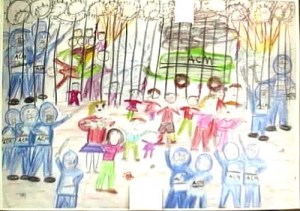
Woomera child's drawing. by Karen Elliot via flickr

There is no grass for the children to play on, or for the babies to practice their walking. She watches three small children scuffing aimlessly about in the red dust at the steps of their donga; a Muslim girl of about twelve in her headscarf, lifted from her shoulders by the hot wind; a boy of about eight in shorts and bare feet. The sand is hot. Doesn’t it burn him?

Between them they help the smallest child, who is still tottering on his uncertain baby legs. A woman in a black burqa sits on the top step of the donga with her head in her hands. Outside the administration block, they noticed when they arrived, there’s a garden of emerald green grass, young trees, and beds of brilliant flowers. The garden isn’t visible from these dongas. Later they’re told it’s tended by some of the inmates.

As she watches, a man emerges from another donga in the compound. He runs down the steps and across the red dust, screaming in a language that is unintelligible to her, but his despair needs no translation. He flings himself repeatedly at the wire that keeps him contained, like an animal in a zoo maddened by its confinement. He shakes the wire back and forth while the children watch in frightened silence. The eldest girl puts her arms round the younger ones. The man’s screams rouse the woman in the burqa: she raises her head and briefly stares at him, then returns to her own private despair.

‘Oh, Christ,’ says one of the guards standing outside the door of the Visitor’s Centre,

Razor Wire 101. by Amy Leonard via flickr

‘what’s wrong with bloody Mustafa now?’

Jennifer is sitting very still. She’s been holding her breath, and now she’s feeling dizzy and sick. Her body is warning her that this is not a sight she should witness, but she’s here now, there’s nothing she can do.

Mustafa isn’t trying to attack anyone other than himself: it’s the sight of an adult man completely out of control of himself, a woman watching from a distance and returning to her self-absorbed despair; three children silently witnessing this scene. Are these scenes here in the detention centre, these scenes and many more like them and worse, are they making intolerable memories for these children? Will these children, in their middle age, sweat when they recall these events?

It’s getting hotter as the day moves on towards noon. The dongas shimmer like mirages. She’s been afraid ever since they crossed the threshold into the prison, ever since they drove down the bitumen road from the caravan park in the Woomera township towards prison surrounded by gibber desert and saltbush. She’s been afraid of the detention officers, and the blue water cannon positioned at the gate and the high, intimidating security lights that promise to illuminate everything without mercy, no crevice left untouched, no places left to hide.

She’s way out of her comfort zone, and anyway, fear is her Achilles heel.

Everybody’s got their personal weakness: greed, grief, free-floating anxiety, lust, anger, despair. Hers is fear. It can bring her undone in a nanosecond. This is a new kind of fear, she’s only dreamed this kind of fear, in nightmares when she’s been pursued by soldiers, unable to find a hiding place in a napalmed landscape. All their journey so far, through the drought and the death stench and the tormented landscapes, past the sun-bleached bones of animals dead from starvation, picked clean by buzzards and eagles, all this has finally brought them to this place.

The journey has been a fitting preparation.

The women saw the interrogatory lights cutting through the dark sky when they made a furtive reconnoitre the night before. Having arrived too late in the day to visit the centre, they set up camp, tied up the dog in the back of the truck and crawled without headlights as close to the prison parameters as they dared.

‘Shit,’ Jane whispered.

‘What?’

‘It’s just like bloody South Africa. I can’t believe it. What country am I in?’

‘God’s own,’ Jennifer told her.

They saw headlights approaching.

‘Get going!’

‘Shut up!’

Jane threw the truck into reverse.

In retrospect they’re hard-pressed to explain their panic. Jane was worried that if they were caught hanging round, their visits the next day would be jeopardised and this was a realistic apprehension. Oppression works swiftly. The guards were completely in control. If the women offended them, they’d find some way of refusing them entry. Driving round the perimeters of the detention centre at night could be construed by the guards as suspicious.

This is how the people inside have to think every day. If I do this I won’t be allowed to do that. About the smallest, most insignificant things.

‘We aren’t doing anything wrong,’ Jennifer whispered. ‘We’re on a public road.’

‘We’re hanging round. We’re looking. That’s wrong enough for these people.’

‘Christ,’ Jennifer said disgustedly, ‘we’re still in Australia.’

‘And this is what Australia is these days,’ Jane said and they fell silent, contemplating the state of their country. God’s own be buggered.

‘Why are we whispering?’ Jennifer asked finally.

‘Dunno. We’re out of our depth aren’t we? Two white ladies from out of state. We’re out of our depth, the landscape, the Detention Centre, Woomera, which I think is a very strange town, by the way. Did you notice those parks full of planes and bombs and rockets? And how green the grass is, where do they get the bloody water from? And those empty, smashed-up apartment blocks with the doors hanging off their hinges and banging in the wind and all their windows broken? Like a post nuclear movie.’

Jane drove them back to the park. A high wind had sprung up, rocking their caravan. It was cold. Large spots of rain fell on them as they moved from the truck to the van. The park was almost empty. No one came here anymore the manager told them, owing to that fucking Detention Centre. Everyone’s afraid there’ll be a break out and they’ll get caught up in it.

‘Used to be a busy, thriving park,’ he said. ‘Now fucking look at it.’

They didn’t tell him the reason for their visit. Just passing through, they said, on their way to somewhere else. They had no wish to get into a fight with him about the detainees. They were closing down, husbanding their resources.

There was only one other van parked for the night. The park was asphalt with squares cut out of it in which frail saplings tried to grub a life for themselves out of the red dirt. They could see the lights of the Detention Centre. They made tea and climbed into their beds. Fletcher settled down on the floor in between them.

Human Rights. by Hugo via flickr


Though the guards complain to each other about Mustafa’s on-going expressions of despair, nobody goes to help him, or even to tell him to shut up, or whatever they do with people in there in extremis. Which seems to be very little. Mustafa’s frantic screaming subsides into sobs. He wraps his arms round himself and rocks back and forth in that movement typical of human beings, adults and children, who have given up on any hope of comfort other than what they can provide for themselves. Then he leaps up again and grabs at the wire.

Earlier the guards had spoken to the women about their feelings towards the detainees.

‘They’ve got everything,’ two guards, a man and a woman, told them as they deposited their bags in the lockers and waited to be searched.

‘They’ve got TVs, clothes, videos, everything.’

‘We have not got our freedom!’ shouted an inmate, overhearing the guards’ account of things as he swept and mopped the office floors.

‘That’s relative, mate!’ the male guard shouted back. ‘Freedom’s relative. I’m not free either, you know. I’ve got to show up for work here every day, can’t sit around on my arse watching TV like you. Can’t even afford a bloody TV like they’ve got,’ he told the women. ‘Working my butt off and I can’t afford what they’ve got for nothing. Then they trash it! Bloody trash TVs, DVDs, computers! You wouldn’t believe it.’

He shook his head and swore softly under his breath.

Jennifer reflects on this exchange as they sit in the Visitors’ Centre waiting for the asylum seekers they’ve arranged to meet with. The irony of the situation doesn’t escape her. The guards, poorly paid and in one of the worst work places in the country, measure their success in life by the things they can buy with their wages. This is a widespread marker of success in Western culture, the guards are no different from most other people in their material ambitions.

All the things they see the detainees getting ‘for nothing’ and then ‘trashing’ when there’s a riot, are things they’re busting their guts in this god-awful place to earn the means to obtain. The guard doesn’t feel free, because of this, and he’s in no frame of mind to start measuring his degree of freedom against that of the detainees. He’s not about to argue degrees of freedom and personal choice. He feels powerless, except in his right to exercise power over the detainees.

It’s easy enough to say the guards don’t have to be there. And they don’t, nobody’s forcing them. But as violent as they reputedly are, as racist and resentful as they clearly are, to tell them that they don’t have to do this doesn’t seem to be the answer. They think they do.

The noon temperature is forty-two degrees Celsius. There’s a hot wind roaring
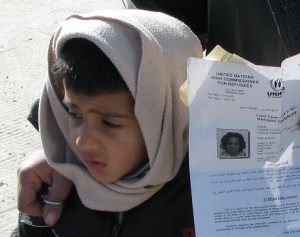
Iraqi refugee child. by Catholic Relief Services via flickr

across the plain. Mustafa has stopped crying and sits quietly in the dust, his head resting against the wire. The children walk towards him. The girl’s scarf whips round her head in the wind. She holds the baby’s hand.

They all stare at the visitors. Jane and Jennifer smile. Nobody smiles back. They aren’t allowed to approach the children or talk to them. Jennifer knows she will remember this scene for the rest of her life, the three solemn children, the damaged, broken man, the woman silent on the step, her head buried in her hands.

It’s as if they’ve reproduced, in the middle of their democratic country, conditions that bear an eerie similarity to those that caused the people to flee their homelands in the first place.

‘If they’ll bother to get up,’ the guard is saying to Jane.

‘What?’ Jennifer asks.

‘It’s Ramadan. Your detainees might be late. They pray all night and sleep all day. Weird, eh?’

The guard is wired for every kind of sound. He’s got technical aids every which way. He looks at Jennifer as if he wants her to form an alliance with him against this ‘weirdness’ he has to endure on a daily basis. She thinks she might have pretended to something of the kind before she actually got into the place. Getting in was tricky, touch and go, they knew they had to play things very straight. But once in, the guards could go to buggery. Like the bloody country.

‘So why are they lazy, lying in bed all day if they’ve been praying all night?’ she asks, hostile. ‘It’s an important thing, Ramadan, like Christians have important things. Isn’t it? Anyway, it’s not as if they’ve anything to get up for, you don’t let them do anything.’

The guard looks truculent.

‘I guess this is a pretty awful job,’ Jane intervenes, deciding on diplomacy.

He softens.

‘Mate, it’s the bloody pits. Nobody knows. Nobody hears our side of the story. We’re just the bastards. You know,’ he went on, settling in for a rare opportunity to whinge to a member of the public, ‘I daren’t tell anyone I work here. You imagine that? Having to lie about where you work?’

‘Why’s that?’

‘Because the place’s got such a bad name nobody else’ll employ me after I’ve been working here.’

He leans back in his chair. They can see the tension bristling through his body. His face is congested, his beer gut large, his uniform too tight.  He’s on the edge, as are many other guards they meet on their way through the system.

‘I don’t even tell me mates what I do. I tell ‘em I work in Woomera for the Government and it’s secret, what I do. Never mention the Detention Centre. No way.’

Jane reflects on the difficulties and stresses such daily deceits must bring to a life.

‘That’s bad,’ she tells him. ‘That’s a hard thing to do.’

‘My oath. Then you get these bastards in here smashing everything up they get given. Bloody mad. Don’t make sense.’

His radio squawks. He listens and then speaks into it rapidly.

‘Well there’s three of the ones you asked to visit on their way.’

‘Three? We arranged to meet with twelve.’

‘Th’other nine aren’t allowed visitors. They’ve being playin’ up, lost their privileges.’

‘What? All nine of them?’ Jane protests.

‘Well, except Parvin, she’s too sick.’

‘She was fine a couple of days ago.’

‘Yeah, well now she’s too sick. So do you want to see these blokes or not?’

‘Yes, yes of course we do.’

He speaks into his radio.

The three young men follow the guards into the Visitors’ Centre. They introduce themselves, awkwardly. The women have corresponded with the young men, so they know something of each other’s lives, but in the face-to-face encounter they are all shy, hesitant.

Nasrim, Ali and Mohammed sit across the table from Jane and Jennifer and they look at one another in silence. The young men all have olive-skin, with bloodshot mahogany eyes under full brows, and black hair cut short as if there is only one style permitted inside the prison. Ali, who looks to be the youngest, has a round face with soft features. His expression is open though baffled, permanently so, Jane thinks. His eyes are huge, like dark, full moons and they glisten. He is plump, the soft plumpness of a young man who hasn’t yet grown into his adult body.

Nasrim has an athletic build, lean and supple. His cheekbones are well-defined, his eyes shift rapidly, checking out the women, his surroundings, his friends, noting where the guards have settled. He drums his fingertips on the table, waiting for someone to speak.

The third man, Mohammed, wears an untidy beard, beginning to show premature flecks of grey and when he smiles his lips are rosy and his teeth white, framed by the dark hair. He is heavy and muscular. He drops heavily into an orange plastic chair and drops his hands on his thighs.

‘Welcome,’ he says to the women. ‘Welcome to our palace in the desert!’

Nasrim has a packet of biscuits in his hand and Ali and Mohammed carry water, orange cordial and paper cups.

‘There is a good guard, a kind man,’ Nasrim says, ‘he gives us these things for us to give to our visitors. He understands that at home, in our country, it is very wrong to greet the visitor with an empty hand and so he lets us have these things for you.’

Mohammed breaks open the biscuits. Jane and Jennifer take one. It crumbles in Jennifer’s dry mouth and she thinks she’s going to choke. Conversation is difficult.

‘You all speak good English,’ she offers, ‘ did you learn that here?’

‘We have been in detention for ten months in Port Hedland, nineteen months in the Woomera,’ Mohammed tells us. ‘We are Hazara from Afghanistan but the Immigration, they say we are from Pakistan and are not refugees. This is not the truth.’

‘How old are you?’ Jane asks.

‘I am twenty-four, he is twenty-two and he is nineteen,’ Nasrim points to Mohammed and Ali as he speaks. ‘We learn the English here but we learned some in our country. We have left our country because the Taliban they kill Hazara, they have fatwah on Hazara. My father, my mother they are killed in our village, the Taliban destroy our village, I see my family, my sisters they are killed.’

Nasrim’s eyes fill with tears and he looks away, out of the door and into the compound where the three children still stand at the fence, staring. He yells at them in their shared language. The children stay where they are and stare at him.

‘I told them: “Go to your mother!”’ he translates. ‘These little children, they see a crazy man, made crazy here, they watch him cut himself with razor all over, blood splash out on children.’

‘The little ones saw this? They were splashed with his blood?’

‘Yes, yes, they see everything. Children here see everything, very bad thing I think.’

‘Is that their mother, sitting on the steps?’ Jane asks him.

‘Yes, that is their mother. She is sick, very sick, they give her no medicine, she does not look after them because she is sick.’

‘Where is their father?’

‘He is gone. He is given temporary visa, he is gone.’

‘His wife and children left behind here?’ Jane asks, incredulous.

‘Missus,’ says Mohammed, ‘this is happening very often here. Many families. Maybe thirty, fifty, in this place. The father, brothers, on temporary visas, the women children kept in the Woomera.’

‘The women gets sick,’ Nasrim tells them,’ without the husbands, the men the womens get sick and nobody cares for the children. This is bad place,’ he continues and looks at the ground. ‘Very bad place, much bad things happen.’

‘You mean the Immigration gives the men the visas and keeps the rest of the family in detention?’ Jane now remembers now that someone has told her this happens.

‘Yes, that is so.’

‘Why do they think you’re from Pakistan?’

‘One day, we have interviews with officer from DIMIA, she say our language is from Pakistan, she say she is expert at knowing this,’ Nasrim says. He throws his hands up in disgust. ‘She knows nothing of our language!’

The young men wear an assortment of trainers, T-shirts, shorts and track pants. Nasrim is edgy, he fidgets, picks at his fingers, runs his hands through his short hair. Ali in contrast is still: he sits calmly, gazing out the door. Mohammed rests his elbows on the table and puts his head in his hands. These young men are close in age to Jennifer’s sons. She imagines Harry and Samuel living this life. It is an intolerable imagining. She looks out of the door into the compound. A wedge-tailed eagle rises from the roof of a donga and moves upwards in slow circles out of her line of sight.

‘Ali makes the garden,’ says Mohammed.

‘The garden at the administration building?’ Jane asks.

‘Yes, I like it, I like it to do the garden, ‘I keep garden clean, plant things, empty rubbish, I have life here, job, it is not so bad.’ He has a slow, wide smile. He eats another biscuit.

‘Idiot!’ scoffs Nasrim. ‘You should dream of leaving here.’

Ali smiles again. He seems institutionalised, Jane thinks, he doesn’t have the fierce dreams of leaving detention that clearly fuel Nasrim. And what of the events they suffered before fetching up in detention centres, she wonders. What is the aftermath of those traumas?

They all met, it turns out, on the boat from Indonesia sailed by people smugglers, a journey that landed them at Ashmore Reef. None of them has any other family in Australia. All of them have come to the end of their appeals for visas to stay. What will happen to them now? Jane asks. Ali shrugs and doesn’t answer.

‘The Australian Government they give us money to go back to Afghanistan, everybody says so,’ Nasrim tells us. ‘I will go, I think.’

‘But what will happen to you? Will you be safe? Have you any family left there?’

‘I have uncle. Our village is destroyed. The Taliban is not so big anymore. Maybe I work for the Americans. It cannot be worse than this.’

He waves his hand at their surroundings.

‘I would rather die man than animal. If I die let it be for being Hazara in Taliban fatwah, not here in black hole of hell in Australia like pig.’

He stands abruptly, then paces the small room with his hands in his pockets. Ali shakes his head at us.

‘Would you go back, Ali?’ Jane asks.

‘I don’t know, Missus. I am afraid of soldiers. They try to make me killed. I don’t know if I will go back. Maybe I stay here, grow garden.’

Mohammed has his head in his hands and doesn’t speak. Outside Mustafa has begun screaming again. Nasrim flings himself back into his plastic chair and bites at his fingers.

Jennifer thinks to herself that there was a long and venerable democratic tradition that once existed in the world, a tradition that recognised the right of the stranger to seek sanctuary and to ask for help. There was a corresponding duty to oblige and offer assistance. What has happened to this tradition? Or was it just a dream?

‘Why is Mustafa crying like that?’ Jane asks.

Ali and Nasrim shrug.

‘He’s crazy, his wife, his children they died in his country and he is made crazy.’

Nasrim makes the motions of putting a needle through his lips.

‘Very bad,’ he says, ‘the children, some of them too do this.’

The guards are not in the room but they are by the door in the next room, keeping an eye on things, talking among themselves, laughing, their radios squawking intermittently. Jennifer gets up and goes over to them, leaving Jane talking to the three men.

‘We were invited to visit some of the women here,’ she says. ‘Are we going to able to do that?’

‘There’s nobody else on your list,’ the guard tells her, checking his clipboard.

‘I have the letters here that the women sent, asking us to visit them.’

She takes them out of her shirt pocket and shows him. He gives them a cursory glance and looks away. He’s in his thirties, clean-shaven, medium build with a crew cut. He works out: she can see the muscles under his tight blue shirt. He’s a rock. Nothing she says will persuade him to let them see anybody else.

‘Well, I don’t know, they’re not on your list, except Parvin and she’s too sick.’

‘Parvin had Federal Court a couple of weeks ago. Did she get a visa?’

‘Can’t tell you that I’m afraid. Confidential.’

‘So we won’t be able to visit with the women?’

‘Nope, they’re not on your list. Anyway a whole bunch of them have lost privileges for playing up.’

‘The women?’

‘Not just the women but some of them are women.’

‘What did they do?’

‘Can’t tell you. Confidential.’

‘What if we come back tomorrow?’

‘You’ve only got this one list, that won’t change tomorrow.’

‘Who made up our list?’

‘We have officers who do that.’

‘Can I see one of them?’

‘They’re not here at the moment.’

‘Thanks.’

Jennifer returns to her plastic chair. Nasrim pushes the biscuit packet across. Vanilla creams.

‘Thanks, Nasrim. What happened here, why have so many of you lost your privileges?’

‘There was fighting, somebody broke computers, people screaming, women throw chair, very bad.’

‘One month ago a big fire light in our detention centre,’ Mohammed suddenly speaks without lifting his head from his hands. ‘I working in kitchen with Ali. Everybody lose privilege. No visitors.’

‘How long do they lose privileges for?’

‘I do not know. Maybe days, maybe longer.’

Nasrim casts furtive looks at the guards in the next room. Jane looks over at Jennifer. Jennifer feels as if great weights are tied to her ankles and wrists, preventing her from movement, a sense of overwhelming oppression and helplessness. Jane’s eyes are glazed behind her glasses, her features dulled with heat, shock, Jennifer doesn’t know.

‘We do not have mothers,’ Mohammed lifts his head from his hands and says this quietly but with feeling.

‘We do not have mothers, his is killed, mine is lost, Ali, nobody knows of Ali’s mother. You have sons, missus?’ he directs his question to Jennifer.

‘Yes, two sons,’ she tells him.

He takes a drink of orange cordial. Cottee’s Cordial?

My dad picks the fruit
that makes the cordial that I like best.

‘They are free, they work, have girls, go out, they are in city?’

‘Yes, they do all those things. Harry works for the United Nations in a refugee camp in Tanzania. He teaches the children how to play football. Samuel is a chef, in Stockholm.’

‘Ah!’ Ali cries. ‘I too am cook! I cook here sometimes, in kitchens.’

‘Do you like cooking?’ Jane asks him.

‘Oh yes, very much. Good job. Plenty to eat!’ he chuckles.

‘In our country,’ Nasrim, glowering, says,’ when visitor come we make feast, much food, goat, chicken, rice, here we have only these biscuits and this drink!’ He sweeps the pile of plastic cups off the table.

‘Even when little food always we share with visitor! This,’ he gestures at the biscuits and the cordial, ‘this is…’

His English leaves him and he flings his hands in the air. He says something in his own tongue. The others look at him. A guard enters, curious about the noise.

‘Not playing up, are we, Nasrim?’ he asks.

Nasrim replies again in his own language.

‘Time’s over, anyway,’ says the guard.

‘Can we have a bit longer,’ Jane asks,’ we promised to take a list of things the men need with us so we can send them.’

‘They’ve got everything they need. But okay.’

They have to ask the guards for pencils and paper as all their things are in their backpacks in the lockers. Jennifer can’t believe those children are still out there in the broiling sun. The little baby is sitting down now in the red dust with the older children. Mustafa has vanished, as has the children’s mother. She can’t see any other adults. How long the days must seem in here.

‘Jennifer,’ Jane says as they drive back along the bitumen road to the caravan park, ‘how is it that they’re denied visas because the immigration people don’t believe they come from Afghanistan, yet they’re offered money to go back there?’

‘I don’t know, I don’t understand that. I don’t understand why they release the men and keep women and kids in there either.’

Jennifer saw some film footage on the news before they left, of an Afghan man who’d returned to his bombed-out village. He was scraping blindly at the earth where his home used to be with a teaspoon. It was one of the saddest images she’d ever seen. Is that what’s awaiting Nasrim, she wonders.

As they leave the three men, Mohammed thrusts a piece of paper into Jane’s hand.

‘Read this,’ he tells her. ‘My friend he is at Baxter now, he write this, is good, good writing. Maybe you put in paper in book for him but you not use his name, he is afraid of people knowing.’

They look at the poem as they sit in the truck in the Detention Centre car park. They’ve retrieved the dog and their personal belongings, thanked the guards, walked out to the truck on trembling legs, exhausted. Jennifer’s now trying to take photos of the centre through the windscreen without drawing the attention of the guards. She wants a picture of the water cannon at the gates. The guards are in their towers with binoculars, and patrol cars pass by every few minutes. Nevertheless, she manages a few badly-focussed images.

What kind of stupid incompetent terrorists would try to infiltrate the country via people smugglers and end up imprisoned here for years, Jennifer wonders, recalling a politician’s claims about the asylum seekers true purposes.

Down the road a bit, they stop and look back at the steel compound topped with razor wire. It has a beauty that comes from its simple proportions, the satisfying alignments of all its angles, the sun glinting off its shadowless surfaces. It is simultaneously incongruous and perfectly placed in the wilderness that surrounds it; a savage stronghold, impossible to ignore. Its designers have succeeded in eclipsing the drama of the arid landscape: the eye is drawn in awful fascination: one cannot look away.

‘Christ,’ says Jane.

It isn’t until a week later, camped by a flowing Victorian river in a field knee-deep with poplar seeds like balls of ripe cotton and a herd of roaming Jersey cows rubbing up against their caravan, that they both break down. It was awful, they agree, to have to leave the men behind in that place (Surrounded by peoples with no love,as the poet wrote) to have to say goodbye and walk away. And those children.

They know bad things happen in that desert place; they’re in its atmosphere. Later they will discover just how bad when the conditions are gradually revealed to the public by people who’ve worked there and decided to spill the beans.There are raped children behind the razor wire, beaten women and crazed men.

A common suffering. A common humanity. The women are full of admiration for the visitors who live close by, who go there every couple of weeks, month after month, offering support and companionship.

Their journey home is long and much of it passes in silence. What has confounded them both is that these things are happening in their own country. They are ashamed, and very angry.

‘Not in my name,’ growls Jane. ‘Not in my bloody name.’

One Silent Night
The wind is blowing to one side
Here it touches my body
I feel like just in heaven
Suddenly I open my eyes and look around
Oh God I am behind the fences
Still filled with unhappiness
I would like to fly just like a bird
But I know I can not
God created this world for everyone
But some people try to destroy it
And some people try to keep it for their own way
Why do they keep on behaving like that
I need a new world to live
I want different skies every day
Can I live with out fear of war and terror
Could my dreams come true one day
In my childhood I thought
I was the luckiest person in the world
Because my life was secure
Now I think I am the unluckiest person in the world
Surrounded by peoples with no love.
By………
Baxter IDF.

How to stop the boats

18 Feb

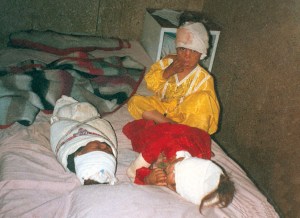
Three children wounded by US bombs in Nangrahar Province, Afghanistan


I‘ve said it before and brought down a load of trouble on myself, but I’ll say it again.

Australia is entirely responsible for boat arrivals. Doesn’t matter which political party’s in ascendency.

Because we are signatories to the UN refugee convention, we are known in  the world as a country that accepts asylum seekers for refugee assessment and resettlement.

Domestic law supports  the Convention. Australia invites anyone anywhere to claim asylum here, and seek refugee status.

No one who does this is acting illegally, no matter how they arrive, and whether they have papers or not.

Therefore, they come. Of course they do. Wouldn’t you in their place?

They have done nothing more than accept our invitation.

God help them.

Reading the comments on various articles the last few days, I’m pretty sickened by the overwhelming number of callous posts, blaming the asylum seekers for coming here in the first place, and blaming the government for not stopping the boats.

The answer is simple. We withdraw from the Convention, which we are not upholding anyway, and we change domestic law.

We then cease to be a country known for accepting asylum seekers, and asylum seekers will not endanger their lives trying to get here.

To continue to issue the invitation, and then to treat  those who accept it as sub humans, reveals a worrying sadistic streak in the Australian psyche. Clearly, we are not in the least hospitable towards those arriving in boats, yet we keep on inviting them.

Why?

If we aren’t prepared to withdraw from the Convention and change domestic law, then we obviously are  prepared to keep on extending the invitation.

Basic rules of human decency require that we treat those we’ve invited with hospitality and respect. We’re inviting them into our home.

What kind of host holds the guests in mandatory detention?

If nothing else, can we at least be honest about what we’re doing? Can we at least come clean about our two faced duplicitous position? Can we at least own up to the fact that we’re solely responsible for the situation, and not the asylum seekers?

They don’t know we don’t mean what we say.

It’s time to make a decision. It’s not rocket science. Get in or get out. But stop pissing about complaining, and tormenting our invited guests while we’re at it.

Of course, then we’d have to find somebody else to despise.

Bleeding heart and bloody proud of it

17 Jan

Bleeding Hearts by Darren Bannister via flickr

Fed up with defending my position after an article I wrote for On Line Opinion last week about asylum seekers was greeted with the usual scorn, disparagement, ridicule and personal abuse , I spat the dummy.

I addressed the dummy spit to a particular poster, who, unlike me, remains anonymous and therefore free to say anything at no personal risk. Very brave.

But my break out was aimed at all the like-minded.

No Shadow Minister, you’re wrong.

The “single defining weakness of my argument” is that it is based on my visceral and moral objection to causing suffering and death to asylum seekers who are doing nothing more than accepting the invitation we have extended to seek refuge here.

My argument doesn’t have, in your terms, just one “single defining weakness.” It has many: (and here I listed as many of my “weaknesses as I could think of in a state of  rage)

1. It’s based in observing the spirit, as well as the black letter (as you recommend) of domestic law and the UNHCR Convention.

2. It is based on my abhorrence for the deceitful duplicity that leads my country to spend unacceptable amounts of money finding its way around laws it has voluntarily implemented, rather than having the courage and the honesty to admit these laws apparently no longer work for the country, and start addressing them.

3. It’s based on my profound disgust at my country’s willingness to use the death of asylum seekers, and the suffering of survivors incarcerated indefinitely in detention centres, as an example to other asylum seekers not to come here.  (Definite “weakness.”)

4. It is based in my belief that people of the world share a common humanity, and asylum seekers who arrive by boat (at our invitation) are as entitled to humane treatment as is any body else.  And we all know how “weak” it’s considered to hold that belief.

5. It’s based on my belief that to cause suffering in one person in order to teach another person a lesson is a very dubious moral position, and is abhorrent to me. (How “weak” is that?)

In my world, the governing maxim is “ First, do no harm.”

I probably hardly ever achieve that goal, but it is my goal.

I understand that you consider that position, and all my other positions, to be “weakness.”

Because of suffering in my own life, I’m not able to advocate inflicting it on anyone else. This reluctance is often interpreted as a weakness.

We  live by our values. If mine are considered “weak” by some, I can’t say that either surprises or upsets me.

Shadow Minister replied that I am being “emotional” and that an emotional position on refugees will end up like the pink batts did.

Oooo-eeer! Emotion! How scary is that!!!

Shadow Minister also said that my do no harm philosophy is what drowned people at Christmas Island.

And I thought it was a storm.

This exchange at On Line Opinion has sorely tempted me to ditch my personal philosophy for a while.

Press council replies to complaint against SMH

13 Jan

United Nations High Commissioner for Refugees

Image via Wikipedia

Further to the post of January 7 2011: “Today we sent a complaint to the Australian Press Council claiming that the article by Paul SheehanSydney Morning Herald January 3 2011, titled Cast adrift from reality, the slick spruikers of ‘our’ shame, breaches Principles 1,2,3 and 6 of the Council’s Statement of Principles.

I received the following email from the Australian Press Council today:

Dear Dr Wilson,

The Council has received a complaint from you, in which you raise a concern with terminology used by a bylined opinion columnist in The Sydney Morning Herald.

For your information, a copy of the Council’s principles and practices can be found on the Council’s website http://www.presscouncil.org.au. Therein are set out the standards of journalistic ethics that the Council upholds and the procedures it uses to deal with complaints alleging breaches of those standards.

Attached, for your information, is a copy of the Council’s Guideline No 288 on the issue of asylum seekers.

The Council believes that columns such as Sheehan’s should be given a reasonably wide licence to express a point of view. They are the clear expression of a viewpoint of the individual writing them and are commentary upon the news.

The terminology you complain of talks of  “illegal boats”. Since the boats can be seized and their crew tried before the courts, there is good reason to suggest that the arrival of the boats is in fact “illegal”.

Have you submitted a letter to the Sydney Morning Herald for publication in response to the published column? The Council has consistently said that the best response to a disagreement with such material is the submission of a contrary view for publication. I therefore urge you to take the matter up direct with the newspaper in the first instance, if you have not already. I will write to the newspaper urging it give due consideration to any submitted letter as a way of dealing with your concern.

I will bring your concern to the attention of the newspaper but believe that the best settlement of your concern, in this case, is through the letters to the editor column.

Yours sincerely,

Deb Kirkman, Acting Executive Secretary, Australian Press Council

To which I replied as follows:

Dear Ms Kirkman,
I have indeed twice written to the SMH letters on this matter, as I stated on my complaint form, and neither letter has been acknowledged.

To reiterate, the terminology I complained of is as follows:

1. Illegal boat arrivals. If Sheehan was referring only to the arrival of SIEVs, or to the crew of SIEVs, then these references makes no sense at all in the context of his paragraph.

It is rather disingenuous to suggest that Sheehan was referring to the vessels and their crew, given that the crews are arrested and the vessels are impounded, therefore the problem is addressed immediately at the source and offers no basis for Sheehan’s on-going angst.

Sheehan then goes on to comment on the “relatively small number of people who arrive by boat,” thus clearly confirming that he is indeed referring to the passengers who are seeking asylum, and not to the SIEVs and their crew.

2. Those who arrive by illegal means,and those who arrive without proper papers.

The UN Refugee Convention, to which Australia is signatory, recognises that refugees have a lawful right to enter a country for the purposes of seeking asylum.  

The Convention stipulates that what would usually be considered an illegal action, eg entering a country without a visa, should not be treated as illegal if a person is seeking asylum.

Australian law, in line with the Convention, also permits unauthorised entry for the purposes of seeking asylum.

Therefore, under Australian law, and under the terms of the Convention we have signed, a person who is seeking asylum has the legal right to enter this country without papers, and by any method of transport, even SIEVs, and has the legal right to remain in this country, until his or her refugee status is established through the proper legal processes, to which, as asylum seekers, they are legally entitled.

Their mode of transport does not render asylum seekers “illegal,” as suggested by Sheehan.

This was re-affirmed by the High Court of Australia in November 2010.

Again, my complaints  relate to numbers 1, 2, 3, and 6 of your Statement of Principles.

Sheehan has misrepresented the facts of this situation – asylum seekers are not illegal, even if they enter the country on SIEVs.

Sheehan has suppressed facts that are available to him, i.e. the facts that under domestic law and by international agreement, Australia does not consider those requesting asylum to be illegal in any way, no matter how they arrived in this country, including if they arrived “without proper papers.”

The illegality of their mode of transport is a separate issue, as the law recognises, and is dealt with as a separate issue. Asylum seekers are not held responsible for the legality or otherwise of their mode of transport.

Sheehan has misinformed and misled the SMH readership by conflating the two, and in so doing, ignores Australian law and the UNHCR Convention.

Since when has it been acceptable that even an opinion writer has the license to misinform their readers about Australian law, and the legal status of a particular group of people?

Sheehan has not presented his readers with the facts, and his opinions are not based on the facts. Sheehan has acted irresponsibly in putting forward an uninformed point of view as his opinion. The facts are readily available to him. Surely even opinion pieces are supposed to have some basis in reality?

I have requested that the SMH correct Sheehan’s inaccuracies and conflations. I have received no response

Yours sincerely,

Jennifer Wilson.

Australian Press Council Guideline 288 in regard to Asylum seekers.

Guideline No. 288

Describing “asylum seekers”

Issued: October 30, 2009

For immediate release

The Australian Press Council has updated its guideline on “asylum seekers”, replacing General Press Release 262 with the attached guide. The Council issues guidelines from time to time. These are, in essence, amplifications on particular issues arising from the Council’s Statement of Principles. The guidelines apply the Principles to the practice of reporting and are intended to guide the press on how it should report certain matters. These guidelines are not intended to be prescriptive instructions to the press but act as a series of advisories on the application of the Principles that the Council seeks the co-operation of editors in maintaining. A list of the extant guidelines (and links to them) can be found on the Council’s website athttp://www.presscouncil.org.au/pcsite/activities/gprguide.html.

The Council has from time to time received complaints about the terminology used to describe people who arrive in Australia through means other than regulated immigration and visa transit processes. They are often referred to by the press and others as “illegal immigrants”, “illegal boatpeople” and so on –  or simply as  “illegals”. The descriptor “illegal(s)” is very often inaccurate and typically connotes criminality.

The press has, by and large, abided by the Council’s 2004 Guideline about the use of inaccurate and derogatory terminology to describe such people.

Having considered the matter further, the Council believes that the term “asylum seeker” is a widely understood descriptor, generally a fair and a sufficiently accurate one, and one which avoids the kinds of difficulties outlined above. The Council recommends its use as the default terminology in relevant headlines and reports both by the press and others.

The Australian Press Council comprises representatives of the public and of the industry and acts to preserve the freedom, and the responsibility, of the Australian press. It was founded in July 1976 and has been in continuous operation for over 30 years.

End of Guideline 288