Whistleblowing: a chilling account

6 Jan

Robina Cosser is a guest author, and an expert on whistle blowing.

By tiganatoo via flickr

Blowing the whistle into an empty room

By Robina Cosser

So …

You become aware that something is “going on” in The Department. And you decide that you must do something about the situation. You decide that you must “blow the whistle” – you must tell somebody who will do something about the situation.

So you struggle over the wording of your disclosure for several days, or even weeks, trying to explain your disclosure as clearly as possible. And you collect lots and lots of supporting documentation.

Then you mail your disclosure and the supporting documentation to a person that you think cannot possibly be corrupt. The Director-General of The Department, maybe.

But you don’t realise that you are doing battle with the public service. And that no public servant in The Department wants to be held responsible for hearing you blow the whistle. And that The Department’s public servants have generations of experience in “not hearing”, “not understanding”, “not knowing” and “not finding any evidence of”.

And so your disclosure is “lost”. Or the supporting documents are “lost”. Or your disclosure is reduced to gibberish – the cover letter and the first page of your disclosure are saved, the next eight pages are “lost” and the remaining pages of your disclosure are sent to another office, in another city, and jumbled up with lots of other documents.

Or every alternate page of your disclosure is “lost”. Or two pages of your disclosure are recorded, two are “lost”, two are recorded, two are “lost”, etc. Or your disclosure is reduced to half-size and turned around and printed sideways on the page, so that it is very difficult to read.

And The Department do nothing about your disclosure.

So, after waiting for some time, you decide that you have to make your disclosure to another government department, one that is not corrupt. The Crime and Misconduct Commission, maybe.

So you ring the CMC. And you make your disclosure very, very clearly to the CMC officer.

And the CMC officer writes down her own gibberish version of your disclosure. And she makes a note that, having spoken with you, she has doubts about your credibility. And she puts these notes on your file.

You have a suspicion that the CMC officer was reluctant to record your disclosure. Something in her tone of voice. And so you send her an email, making your disclosure very, very clear to her. So that she cannot pretend to misunderstand.

But the CMC officer does not open your email. She simply records that you have sent her yet another pesky email. And the CMC officer “devolves” your disclosure – she sends it back to The Department, The department that you are complaining about.

And so the CMC have no record of your disclosure, just a record of their own gibberish version of your disclosure. And The Department’s investigation into your disclosure is based on the gibberish version of your disclosure.

And The Department’s investigation is not really an investigation; it is a “review”. And the rules of the “review” are that you are not allowed to speak to the reviewer. And the reviewer is not allowed to ask any questions. So you have no way of finding out that your disclosure has been reduced to gibberish.

A few days before or after the “review” begins, Freedom of Information documents are released to you by The Department. And you realise that your official records have been extensively falsified. So you email the Director-General. And you tell him that your official records have been extensively falsified.

He emails back.

Lots of times.

With lots of promises and re-assurances.

And you email the Director of Ethical Conduct. You tell him that your official records have been extensively falsified. And he emails back. Lots of times. With lots of promises and re-assurances.

Then, a few days before a copy of the review is released to you under “Freedom of Information”, the CMC and The Department each “accept” the review – the review based on the gibberish version of your disclosure and the falsified records – and they each declare your case “closed”.

So that when you write and protest that the review has been based on a gibberish version of your disclosure and on a huge mass of falsified “official records”, no public servant reads your letters. No public servant “knows”. Because your case has been declared “closed”.

And when you ask, under freedom of Information, what the Director-General and the Director of Ethical Conduct actually did in response to your emails, you are advised that there was a computer problem in The Department. And all of your emails to and from the Director-General and the Director of Human Resources over several months were “lost”. And so there is no official record of your complaint to them that your “official records” have been extensively falsified. And there is no official record of any of their promises and the re-assurances.

So you decide to phone another government department, one that is not corrupt. And you explain your disclosure again, very clearly. You notice a slight whining noise as you are speaking. When you have finished making your disclosure the Public Servant asks you if, “besides that”, anything else is bothering you. And so you struggle to give him some other examples of corruption. And you notice that the whining noise has now stopped. And later you wonder if the Public Servant could have been pausing his tape recorder while you were explaining your disclosure.

So you visit the Head Office of The Department. And you take your own tape recorder. And you place it on the table.

And the Head Office Public Servant places his own tape recorder on the table, beside yours. And, while you are speaking about a particular group of the falsified records, the Head Office Public Servant fiddles anxiously with his tape recorder. Twice. And, later, when you listen to your own recording, you notice that there is a loud straining noise on your own tape while you were explaining that a witness has told you that this particular group of “official records” are entirely falsified.

And you wonder if the Head Office Public Servant could have paused his tape recorder while you were talking about these particular “official records”.

The Department eventually appoint an “independent investigator”.

And the Head Office Public Servant whose behaviour you have complained about to the CMC is given control of the “independent investigation”. The Head Office Public Servant tells the “independent investigator” that he is only allowed to “consider” the falsified documents that you have discovered on your official records. He is not allowed to consider your evidence that these “records” are extensively falsified. Nor is he allowed to consider the many “official records” that are still being refused to you under Freedom of Information.

He is only allowed to “consider” the falsified documents.

Again.

And, one year before the CMC receive a copy of the “external investigation” report, they declare your case “closed”.

And two years before fragments of the “external investigation” report are released to you under Freedom of Information, The Department “accept” the investigation report and write to you, declaring your case “closed”.

And, when you receive fragments of the Investigation Report under Freedom of Information, you realise that your disclosure has still not been investigated. And, when you write more protest letters, no public servant reads your protest letters because your case has been declared “closed”.

Again.

So you decide that you have to send your disclosure to somebody that you think really cannot be corrupt. The State Premier, maybe.

And the Premier’s office do nothing. For months.

And so you write again. Did they receive your disclosure?

And again the Premier’s office do nothing. For months.

And so you write again.

You give more information. But you do not repeat your disclosure – because you have already “disclosed” to them twice. And this third letter triggers a response. A “Briefing Note for the Premier” is prepared by a senior public servant.

The Premier is advised that you keep on writing pesky letters. But no mention is made of the disclosure in your first two letters. And the Premier is advised not to reply to your pesky letters.

And the Premier agrees not to reply to your letters. He signs the “Briefing Note” with a big, swirly signature. And all of his senior public servants also agree not to respond to your pesky letters.

And so all of your letters to the Premier from that date onwards are simply filed by a machine, without being read.

And no public servant “knows”.

And eventually you realise that you are whistling into an empty room.

This article was first published in On Line Opinion, December 14 2010

Robina Cosser edits the  Teachers Are Blowing Their Whistles and Whistleblowing Women. She is Schools Contact Person and a Vice-President of Whistleblowers Australia.

America and the little wild bouquet

4 Jan

New York Times columnist Nicholas Kristof , in an article titled: Inequality is eating away at America’s soul January 4 2011 writes:

The gap between rich and poor in the US is vast and it’s growing.

John Steinbeck observed that ”a sad soul can kill you quicker, far quicker, than a germ”.

That insight, now confirmed by epidemiological studies, is worth bearing in mind at a time of such polarising inequality that the wealthiest 1 per cent of Americans possess a greater collective net worth than the bottom 90 per cent.

There’s growing evidence that the toll of this stunning inequality is not just economic but also is a melancholy of the soul……Among rich countries, those that are more unequal appear to have more mental illness, infant mortality, obesity, high school dropouts, teenage births, homicides, and so on. 

They find the same thing is true among the 50 American states. More unequal states, such as Mississippi and Louisiana, do poorly by these social measures. More equal states, such as New Hampshire and Minnesota, do far better.

So why is inequality so harmful? The Spirit Level suggests that inequality undermines social trust and community life, corroding societies as a whole. It also suggests that humans, as social beings, become stressed when they find themselves at the bottom of a hierarchy…continued at SMH January 4 2011.

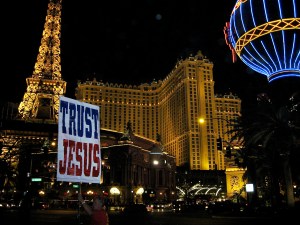
Las Vegas Strip on a Saturday night.

Las Vegas Strip on a Saturday night. By Jane Bronotte

Or as L. Cohen so hopefully puts it in Democracy:
I’m sentimental, if you know what I mean
I love the country but I can’t stand the scene.
And I’m neither left or right
I’m just staying home tonight,
getting lost in that hopeless little screen.
But I’m stubborn as those garbage bags
that Time cannot decay,
I’m junk but I’m still holding up
this little wild bouquet:
Democracy is coming to the U.S.A.

The propaganda and collusion at the heart of “Stop the boats.”

3 Jan

January 8 2011: No Place for Sheep lodged a complaint with the Australian Press Council, claiming that Sheehan’s article breaches principles 1,2 3 and 6 of the Statement of Principles.

No Place for Sheep earlier sent the following letter to the Editor at the Sydney Morning Herald:

In the last paragraph of his article of January 4th, Mr Sheehan refers to “illegal boat arrivals” and arrivals “without proper papers.”

Will Mr Sheehan kindly explain his complete disregard for the Australian law that permits those seeking asylum to arrive in any manner, and without documentation?

It used to be that journalists were required to get their facts right.
This would seem to be an example of either woeful ignorance on the part of Mr Sheehan, or deliberate obfuscation in order to promote political propaganda.
Would the SMH please explain Sheehan’s campaign of disinformation?
This was not published.


In the Brisbane Courier Mail on December 20 2010, Opposition leader Tony Abbott called for: an “urgent” return to temporary protection visas, the reopening of the Nauru detention centre and turning the boats around.

“We stopped the boats before, we can stop the boats again if we put the right policies in place,” he said.

It’s not clear just where Abbott intends to “stop the boats” and “turn them around.” Presumably before they enter Australian waters. Nobody has yet requested that the Opposition Leader clarify his proposals.

Will he use the navy, and will they fire on vessels that disregard instructions, risking death and injury to asylum seekers and their children? In international waters?

Will he kill and maim them rather than let them apply for asylum?

Why is nobody in the mainstream media asking him these questions?

Instead, on January 4 2011, Sydney Morning Herald senior journalist Paul Sheehan yet again resorts to using the completely wrong term “illegal boat arrivals” and yet again makes the completely irrelevant characterisation of boat arrivals as people “without proper papers.”

The Coalition mantra of “Stop the Boats” disregards Australia’s international obligations, incurred as a consequence of signing the UNHCR 1951 Refugee Convention. Asylum seekers who arrive by boat, even without papers, are entitled to apply for refugee status in Australia, according to both our domestic and international law.

For the last few years, politicians from both major parties have sought to find ways around our obligations to those seeking asylum, rather than ways to responsibly fulfill our undertakings.

One of the major tactics used is the propagandist description of boat arrivals as “illegal.” The mainstream media in general support and promote this propaganda. The justification is that boat arrivals have breached our sovereignty, and our right to protect our borders.

What’s not acknowledged is our domestic and international legal obligation to accept asylum seekers no matter how they arrive. Those seeking asylum are not illegal immigrants breaching border security. Their pursuit of asylum legally removes them from that category.

In July 2010 both Adrienne Millbank of the Age and Greg Sheridan of the Australian, launched calls in their respective newspapers for Australia to withdraw from the Refugee Convention, claiming that 1951 Convention is no longer appropriate for world conditions. These calls continue in the blogosphere, and in the mainstream press.

In fact, Australia revisited our agreement to the original Convention and subsequent updates and additions as recently as 2008, so the Convention has not exactly languished unexamined for almost sixty years.

There may well be reasons why the Convention needs re-assessment. However, until such time as it is revisited, the facts remain that Australia did not add a rider to the Convention limiting the manner in which asylum seekers could arrive in this country. Australia did not specify that those seeking asylum must have a certain amount of money, or no money. Australia did not say we would accept asylum seekers only from specific countries. Australia did not add a clause specifying only people in queues.

At the heart of “Stop the Boats” is a profound dishonesty and immorality. Those promoting this position are making a mockery of UN Conventions, and domestic law.

They are advocating the behaviours and attitudes of a rogue state, while in an act of two-faced political bastardry, continuing to apparently support the principles of the Convention, by virtue of making no move to withdraw from it or change it.

If we don’t intend to abide by our obligations we should withdraw from the Convention, and change domestic law. As it is, we are inviting asylum seekers to seek sanctuary in Australia, then incarcerating, criminalizing or refusing them entry when they accept our invitation.

We are subjecting them to indefinite mandatory detention when they have done nothing more than recognize Australia as a democratic country that has signed the Refugee Convention, and therefore as a safe place for them to seek asylum.

This is a despicable act of duplicity, of which our nation should be thoroughly ashamed.

On December 6 2010, Amnesty International launched a campaign they titled Stopping the spin on “the boats.” Amnesty’s research found that hostility towards asylum seekers originates not in racism, but is primarily caused by myths and misinformation, for example their portrayal by politicians and some mainstream commentators as “illegals without papers.” This framing implies to the community that boat arrivals are committing a criminal act by attempting to force their way into the country ahead of a mythical queue comprised of those who do not arrive by boat. This offends a strong community sense of the fair go, and provokes antipathy and outrage, and is entirely inaccurate.

It’s a brilliant example of the power of propaganda when applied by both politicians and colluding media.

In November last year, a High Court ruling put all asylum seekers on an equal footing under Australian law, regardless of their mode of travel. (Sydney Morning Herald November 11 2010. Court casts doubt over legality of processing off-shore asylum seekers.) In spite of this re-affirmation of our domestic law by the High Court, Abbott and many media commentators still continue to use the term “illegals.”

Assertions that asylum seekers want to come here because they know they will receive welfare payments etc makes little psychological sense. 

People with the drive, ingenuity and courage to undertake journeys such as theirs, are not usually people who easily accept welfare as a life-style.

However, when people with these strengths are incarcerated for indefinite periods and/or issued with temporary protection visas (TPVs) whose long term uncertainty has alarming effects on their well being, they are damaged in ways they have not been damaged in the countries they fled, and may well be much reduced in their extraordinary strengths, and their will to survive and prosper. Their spirits can be broken.

Australian governments manage to achieve what the Taliban could not.

As a nation, we cannot continue to behave in this duplicitous manner, giving lie to the international commitments we voluntarily undertake, as well as to our own domestic laws.

Politicians must be forced to acknowledge our international responsibilities, along with our domestic laws and concerns. Politicians must not be allowed to toss our international obligations, and our corresponding domestic laws out the window, in order to win an election.

Whenever one of them starts up about stopping the boats, somebody needs to ask, what about the Refugee Convention we’ve signed? What about our own laws?

When will the mainstream media abandon its role of political apologist, and ask these questions?

Bush, Blair and Howard ignored the UN and its weapons inspectors, and took us to war in Iraq. It isn’t difficult to ignore the UN, very little if anything happens as a consequence.

But is that the point? Isn’t the point rather about being a country that cares about the morality and ethics of its way of being in the world? A country with the common decency to abide by its commitments?

Does our word as a country mean so piteously little that we are under no compunction to abide by it?

Are we happy to be a country whose signature on an international UN Convention is worth less than the paper it’s written on?

The questions need to be asked of all politicians engaging in the refugee debate. We should be demanding straight answers, and refusing to accept this ongoing campaign of disinformation.

Asylum seekers are not the problem, but they are an easy target.  The real problem is politicians with no moral compass, and not much interest in anything more than winning the next election.

The problem is politicians who have decided to exploit asylum seekers, even to their deaths, for their own political gain.

The problem is a tame media, who lack the courage to confront political inaccuracies and lies.

We have a responsibility to instigate a reassessment of the Convention if it is no longer to our liking. Until then, we are obliged to fulfill our commitments. Just as with any domestic law, we cannot decide to ignore it because it no longer seems appropriate.

Somebody besides her mum loves Julia Gillard

2 Jan

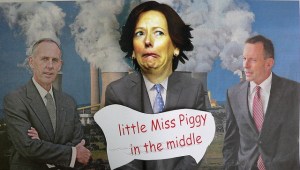
Little Miss Piggy in the middle. By Leonard John Matthews. flickr

Julia Gillard: a breath of fresh air for Aussies

Australia’s PM rises above the usual rough and tumble of federal politics – and her mother will stop her becoming a Thatcher

by Dorothy Rowe, in the Guardian,December 20 2010

My hero is Julia Gillard, Australia’s prime minister. Her predecessor, Kevin Rudd, has many great qualities but knowing how to be a leader is not one of them. His party forced him to resign and Gillard, until then his deputy, took his place. Australian federal politics is rough, loud and often vicious. Gillard knew this well and she had developed a way of speaking that is slow, clear and determined. Her wit is sharp, intelligent and funny, and often surprises and silences her critics. She is well versed in conducting a long-running, rational and informed debate. Michael O’Connor of the Construction, Forestry, Mining and Energy Union, who knew her well, warned: “You didn’t really want to be arguing a point of view against her if you could avoid an argument with her. She was very serious about winning it.

A debate with someone who holds opposing views but is well informed and rational is difficult, but it can be both productive and clarifying. However, the leader of the opposition, Tony Abbott, aka the mad monk, scorns both rationality and facts. He provides the soundbites that the media loves, so he grabs the headlines and creates confusion and much misinformation. Gillard has the task of maintaining, not just for herself but for her audience, clarity of purpose. She must not sink to the level of mere abuse, as is popular in Australian politics, but must continue to present herself as being imperturbable. A knife under the ribs rather than a bludgeon over the head.

All too often in my life I have welcomed a particular leader as a hero, only to see him or her ignore Lord Acton’s warning: “All power corrupts. Absolute power corrupts absolutely.” I was worried that, as a successful Labor leader, Gillard would be corrupted by power until I read that her mother, on learning that Julia had become PM, said that her daughter would be “the best [prime minister] there is”, adding: “So long as she doesn’t turn into Maggie Thatcher.”

With a wise mother like that Julia Gillard might yet become the rarest of leaders, one who is not corrupted by power.

*

No Place for Sheep replied, in its usually restrained manner:

Dorothy Rowe – where are you getting this information?

We don’t like Julia Gillard.
Her voice makes us want to throw ourselves out of windows.
She IS Thatcher, but in a faux velvet glove
She is a robot produced by the ALP party machine with all humanity leached out of her.
Moving forward! Moving Forward! she shrieks at us like a demented darlik.

It is estimated that she is losing 120 votes per hour for the ALP.
She has no backbone, no spine and no moral compass.
She looks NOTHING like your photograph of her.
I cannot begin to tell you how little respect this woman has in this country and it’s getting less and less every day.

Did her mum pay you to write this twaddle?
UK people, please listen! Our PM is really, really, really the worst PM we have ever had and that is saying a lot because we have not been blessed in this regard.

I think your article is a total disgrace, Ms Rowe.You sooo do not know what you are talking about and you shouldn’t be peddling this un-researched twaddle.

PS The photo you used is an airbrushed one by the Women’s Weekly.

guardian.co.uk © Guardian News and Media Limited 2011

PPS: People have remonstrated with me about these comments, saying that I have been unkind to Ranga. Haven’t they read any Comments sections lately? They are not for the faint-hearted, and these are quite mild compared to some responses to this article.

Be that as it may, I don’t wish to be unkind, even if I am talking about a once highly trusted deputy prime minister, given enormous power and prestige by the boss who had nothing but faith in her abilities and loyalty, only to find her dagger lodged in his heart.

As Ghandi said, an eye for an eye leaves the whole world blind and I shouldn’t be vengeful. It’s not like I was that happy with Ruddy. It’s just the principle.

Cosmetic surgery, the gender revolution, and J.M. Coetzee.

30 Dec

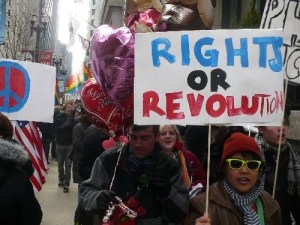
Rights or Revolution. By Gay Liberation Network. flickr

The last few weeks have been interesting. First up, I was bored and channel surfing and I came across the ABC’s Hungry Beast at the beginning of a report of cosmetic surgery on female genitals. This is apparently becoming popular in Australia. It’s performed by plastic surgeons on women who think their genitals need a bit of a tidy. As I come from the generation who thought it revolutionary to crouch over the mirror and have a look, I was immediately engrossed in this report. I thought it might tell me how far we’d come.

How do you actually know your genitals need tidying, I wondered idly, as my revolution didn’t consist of a wide-scale comparative survey of loads of others. And this is where it really got scary.

The soft porn industry in Australia is allowed to publish images of female genitalia. However, these images may not be too explicit. You can’t show too many bits. So the photographs are airbrushed, with the result that the women in these magazines are portrayed as having genitals that are more likely to belong to a pre-pubescent girl.

In a wonderful example of a Baudrillardian nightmare in which the virtual not the actual has come to define what is ‘normal’, I learned that women and oftentimes their partners are taking these airbrushed models as guides to the way women’s genitals should be. The mature genitalia with their wrinkly bits and pieces are now perceived as imperfect. We can, and some think we should, get our genitals surgically deconstructed and reconstructed to look like we looked when we were ten.

The processing of photographs was described by porn industry air brushers as altering the appearance of the “vagina.” This confused me greatly for a while, being as the vagina is the inside bit. It seemed even more frightening than slicing up external bits. But to my relief the reporter explained that the industry prefers to use the term “vagina” rather than the term “labia,” due no doubt to some bizarre desire not to offend by being explicit.

I then watched in anguished disbelief as we were taken into the operating rooms of a plastic surgeon who was in the process of injecting anaesthetic into the genital area of an attractive young woman. After a bit of chat, and then getting down to some business we couldn’t see as he was filmed with his back to the camera, the surgeon emerged triumphant from his flurry under the blue sheets, holding aloft a piece of bloodied skin that immediately put me in mind of Van Gogh’s severed ear. It was, in fact, a good-sized chunk of one of the young woman’s labium.

Barely recovered from this, I next encountered the appalling treatment of Norrie by the NSW government. Norrie was registered as male at birth. Norrie began hormone treatment at 23 and then had surgery to become a woman. Norrie has since stopped taking hormones and identifies as neither sex. Norrie had become the first person in the state to be legally recognised as without gender.

When I heard this news, I was delighted. This is a great step forward for our society, I thought. At last we have matured enough to acknowledge difference, and to free ourselves from the cultural brainwashing that would have us imprisoned for life in limiting binary gender categories, and their at times crushing roles.

People like Norrie are, in my view, heroic vanguards of the better world that is there for us if we can only liberate ourselves from these entirely constructed (frequently by religions, then supported by the State) concepts of what is “normal” and what is “natural.”

But my pleasure was short lived. In a disgraceful turnaround, Norrie was stripped by the NSW government of the right to be legally recognised as genderless on the grounds of some obscure twaddle dragged out of some obscure twaddle book, specifically for the purpose of calming the fears of red-necked twaddlers everywhere who couldn’t get their heads around Norrie’s circumstances and just wanted it all stopped. The NSW government capitulated to these fear-ridden, angst-ridden, deeply threatened voters, and stopped it.

One step forward. Ten steps back. Norrie has vowed to fight on.

Finally, J.M. Coetzee. Who is one of my favourite authors and who is currently reading his novel “Youth” on ABC Radio National’s Book Show. I will state right now that it is not acceptable for the views of narrators and characters in a novel to be attributed by the reader to the novel’s author.

The narrator of Coetzee’s novel is describing the character’s first homosexual encounter. A shabby, impersonal encounter with a stranger that leaves the character feeling isolated and unsatisfied.

Prior to this encounter, the character wonders if he is homosexual and if that were the case, would this “explain his woes from beginning to end?”

After the encounter the character decides that homosexuality is a “puny activity…a game for people afraid of the big league…a game for losers.”

I first mused that some heterosexual encounters could be described as puny. The lack of connection and sense of distaste after engaging in impersonal and furtive sex is not confined to homosexual activity. The lack of interest in a partner as anything more than a means to achieving gratification as quickly as possible then let’s zip up and clear off is an un-gendered state of mind. Women do it too. The uncomfortable emotions it can lead to (but aren’t inevitable if you haven’t been looking for anything more) are un-gendered. While we have different bits, men and women and un-gendered people do share human emotions, many of which appear to be similar in certain situations.

So I decided that Coetzee’s character was on the wrong track – it wasn’t the homosexuality of the encounter that was puny it was the nature of the encounter itself. As long any character doesn’t grasp that, that character is doomed to reproduce the grotty experience regardless of their partner’s gender or if the partner has no gender at all. This isn’t an issue of sexual preference. It’s just sad sex.

I then thought that this characterisation of homosexual sex as something for people who can’t manage heterosexual sex, or who are losers, is very much alive and well and abroad in the world.  Homosexual sex often isn’t thought of as “real” sex, heterosexual sex is held up as the “real” mature expression of sexual love. “Real” blokes have sex with women, and if you tell a bloke to “man up” the last thing you mean is go have gay sex.

In the same way that Norrie’s lack of gender is now not legally recognised, gay marriage is still not permissible in this country, and probably for some similar reasons. Marriage can only take place between a man and a woman, trumpet those who oppose, and it will be devalued if gays and lesbians and un-gendered people are allowed to do it too.

De-valued? De gays and de lesbians and de no-gendered people will strip the institution of marriage of a mysterious value that is only brought to it, that can only be brought to it, by heterosexuals?

What, one wonders, can that value possibly be?

Have these objectors ever stopped to consider that we live in a world in chronic need of all the love it can get, I wonder.  So perhaps we have a sacred (in the sense of not to be disrespected) responsibility to celebrate love, including sexual love, wherever it appears, between men and men, women and women, un-gendered people, or women and men.

Apart from anything else, the refusal to recognise Norrie’s situation, and that of gays and lesbians who wish to marry, contravenes the human rights of all parties involved.

But not to worry. As long as we can still get our genitals sculpted we can be justifiably proud of the democracy in which we live.

I have wondered if this surgical procedure is available for men, and how many are taking it up. But which bits are considered the untidy bits?

I once had a fellowship at a writers’ retreat. There were several other writers present and after a hard week’s work, we took ourselves down to the pub. Everyone had a few margueritas and on the last round, a woman among us who had been very quiet in social situations up to that point, suddenly became raucous. She wanted to propose a toast, she said, to the best crowd of women she’d come across in a long time.

“Up yer flaps, girls!” she roared, and all the men at the bar turned round to stare. “Yair, that’s right mate,’ she sang out again, lifting her glass and her middle finger in their direction. “Up yer flaps!”

This article was first published in On Line Opinion, 26.03.2010

Flesh eating coffins and women in masks

28 Dec

by Rochus Wolff, flickr

Seeking respite from the Assange material last week, I opened an article in ABC’s The Drum irresistibly titled “Who says female corpses aren’t sexy?” written by Melinda Tankard Reist.

The article turned out to be the author’s objections to a 30 second video clip teaser of rapper Kanye West’s latest song. The author describes the video clip as “gendered violence”, and claims it is fetishizing “female pain, female passivity, female suffering and female silence.”

Tankard-Reist continues:

Expect to hear boys singing along to it soon. This is the message they are imbibing:

Women are slaves and bitches who can service a man’s sexual needs, even in death. Men are brutal and dominant, and have no empathy for women. Men enjoy dead women as sex and entertainment. The female body is to be devoured, reduced to the same status as meat. Female bodies should be displayed before men as a great feast for their consumption.

That was quite a lot to glean from a 30 second video clip, I thought admiringly.

But then it turned peculiar. I read: Then there’s these lines: “I put the p-ssy in the sarcophagus” (which, in case you’re wondering, is a flesh eating coffin) …”

What? I shouted, though I was alone except for the dog.  A flesh-eating coffin? How can that be?

And anyway, what about all those pharaohs buried in sarcophagi who when disinterred still had their flesh?

Dried, maybe, but certainly not eaten.

I then made my next mistake. I got onto the Comments. I used a pen name I’m not stupid enough to let these people know who I am. Quite quickly I became an embattled defender fighting off a full frontal feminist attack. (They said they were feminists but they aren’t like any feminists I know and love).

You’re pro male, they told me. Why aren’t you pro woman?

I’m actually pro human I replied. And there’s no such thing as flesh eating coffins, I added. You aren’t doing your credibility any good adding in rubbish stuff like that for effect, I told them.

You need to read Susan Faludi, they said.

I’d rather have needles in my eyes than RE-read Susan Faludi, I replied.

She writes about people like you, they said, she says you pro male collaborators in the gender wars are Uncle Toms.

Really, I replied. A few years back radical feminists used to say a “pro male” woman had a pr**k in her head. That was far more picturesque, I said. Dali-esque, in fact.

But the moderator didn’t publish that. They seem to have inconsistent moderating rules at The Drum. I can’t work them out. They let someone make nasty remarks about my “corrupted” children, and a few people got told they were sleazy pornographers who should crawl under stones and all that was published.

You people aren’t a feminist’s bootlace, I finally told the pro Melindas. Where are your manners?

(I refer to them as the pro Melindas because their posts included:

Melinda could be said to be awakening others to the suffering of women, and many have pilloried Melinda for her point of view, and Go Melinda! Many of us love and applaud you!)

Then someone posted the following:

What you need to know about this author:

1. She believes in god

2. She believes in flesh eating coffins

3. She’s up close with the Australian Christian Lobby.


Well. It was on then. Not a stone was left unturned. Derrida, Barthes, Picasso, Christians, lions, ethics, necrophilia, disclosure of religious affiliations, domestic violence, grandmothers, sex of all kinds, censorship, children, science, and the un dead; Madonna, archaic patriarchal religion, PhDs, Finns dancing, Finns singing, accusations of racism about Finns doing stuff; 70’s music, Tropic Thunder, Russian politics before the end of the cold war, corpses and raw meat. Oh, there was no stopping us. For four days and four nights we kept at it, we barely ate or slept. The ABC should award us with something.

The increasingly hostile exchanges between a pro Melinda poster and someone called Amazonia ended thus:

Pro Melinda Person: Those in favour of the video under discussion are getting fanatic. Now I’ll turn my thoughts to the homeless in our society and their extra plight with extreme temperatures about to begin.

Amazonia: I hope somebody warns them you’re coming.

The day before I succumbed to all that madness I had to go to the dentist. Uneasy in the waiting room, I picked up the October Cosmopolitan magazine as a distraction from what might be going to happen to me. I found that Cosmo are conducting a competition for the year’s most influential woman. The contestants were displayed in a three-page photo shoot. They were all young. Almost all of them wore killer stilettos, some with slave girl ankle bands. Most skirts were high on the thighs. The women wore masks, as if they were going to a masquerade ball or something much darker, and I think some of them were armed.

I studied these pages for a long time. It seemed to me that in order to be considered as eligible for this competition you first had to satisfy another set of criteria that has no obvious link to your ability to be influential and mentor young women.

I continued to think this through as the dentist apparently drilled into my brain. God moves in mysterious ways, and blessed distraction comes from the most unexpected places.

Now, I have nothing against killer heels, except when you watch someone trying to walk in them they inevitably lack grace, tilted as they are at an unmanageable degree from the earth. From behind, it’s not a good look. Wear them, darling, by all means. Just don’t try to walk in them. Maybe one of those nice men will carry you.

And I really am the last person on earth to tell anybody what she should or shouldn’t wear for any reason other than the aesthetic, and mostly not even then unless I know them very well.

But I do deeply object to the demand that before she can be considered to be influential, a woman must fit a certain physical profile.

This is the message sent to women who read Cosmopolitan. You can be as influential as you like. You can be an outstanding mentor to younger women. But if you don’t have the look, forget it. Whatever skills you’re offering, we aren’t buying.

I thought this was a pretty good example of mainstream objectification and denigration of women.

So, because I can be thick sometimes and not see what’s coming at me, I brought it up in the comments about the flesh eating coffin and the video clip.

Who are you to tell a woman what she can or can’t wear? The hostile forces howled back at me.

I suppose you want everybody to go round in a burka? They spat.

Stunned at how quickly I had become cast in the role of the clothes police, ousting the pro Melindas to whom it seemed quite naturally to belong, I didn’t reply for a few hours. I ate dinner, took the dog out, watched TV and thought that I really didn’t have to bother with these people any more. This last was encouraged by my household, which by now was heartily sick of me lurching obsessively from Assange to Melinda, and just wanted me to focus on buying their Christmas presents.

At bedtime, I couldn’t hold out any longer. I sat down and I wrote:

Well, I wasn’t saying what women should wear. I was just pointing out an example of sexism in a very popular women’s magazine. I thought it would be of interest to you as your goal is to eradicate sexism and the objectification of women. (Eradicate was their word, not mine. I objected to it on the grounds that it sounds like pest control).

You really need to stop lecturing people, replied one of the pro Melindas, and who wants to be in Cosmopolitan anyway?

What? I yelled at the dog, seeing as nobody else would talk to me about it.

Aren’t they supposed to be campaigning against sexism in the media?

Then I wrote: Well, if you’re going to be like that, who wants to be in a cruddy rap video, anyway either? Huh? And BTW does being pro male just mean you don’t want to kill them?

It’s been quite a year. Many of us are very tired.

P.S. It’s not over yet! Now a male poster has hit back: Just look at all the magazines in the supermarket talking about orgasms, he typed. Whose orgasms? Well, come on, whose orgasms? Women’s, he crowed triumphantly. Not men’s, oh no not men’s! All women’s!

Oooo-eeer!

This article first appeared in On Line Opinion, December 23 2010


And the ABC’s Drum beats: shoot the messenger

28 Dec

by Darryl Yeoh, flickr

On December 6, I wrote an article in On Line Opinion, also published on this blog titled The death threats, the media, and the government’s sycophantic pursuit of Julian Assange.

I was, among other things, critical of the way in which the Wikileaks story was handled by a panel on the ABC’s Drum on December 2.

On December 8 there was another panel hosted by Steve Cannane, with guests Alan Anderson, a former advisor to Peter Costello; Scott Stephens, ABC Online Editor of Religion and Ethics, and actor Rhys Muldoon. I’ll elaborate on this panel later. But first:

The art of silencing a whistleblower

There are three basic methods of discrediting a whistleblower used by those who wish to shut him or her up.

There is demonisation, as exemplified by certain figures in the USA likening Assange to Al Qaeda and the Taliban, and calling for his assassination as a terrorist and a “treasonist.”

There is the technique of criminalizing the whistleblower, as exemplified by Julia Gillard’s ignorant description of Assange’s activities as “illegal,” and the comments to be found everywhere that claim he is guilty of alleged sexual offences before he has been charged and tried.

The third method is to pathologise the whistleblower, as did John Howard when he announced that whistleblower Andrew Wilkie was “emotionally unstable.”

There are sub-headings under these categories, such as minimising and discrediting the messenger in order to minimise and discredit the message. As exemplified by Annabel Crabb and Leigh Sales on the previous week’s panel. This is best done by focusing on real or imagined negative characteristics of the messenger’s personality, instead of on the message that’s being delivered.

It is the pathologising method that held sway in the December 8 panel on The Drum. Assange was described (and I’m afraid I cannot recall which panellist made which accusation, other than that Mr Muldoon was not much involved) as a megalomaniac, a narcissist, and an anarchist. This last perhaps fits the category of criminalizing as well as pathologising.

Deconstructing the denigrations

  • Assange is an anarchist.

A quick look in the dictionary will reveal that Assange is anything but an anarchist. He does not envisage a world bereft of all government and cast into unregulated chaos. His interest is in maintaining governments, but making them transparent and honest.

  • Assange is a megalomaniac

Megalomania is psychiatric disorder in which the patient experiences delusions of great power and importance. Mr Assange may well consider himself to be powerful and important, as far as I know nobody has asked him about this. But there is no doubt that “powerful and important” accurately and realistically describes his position in the world at this time. He is not suffering from a psychiatric disorder if he holds this opinion of himself.

It is difficult to imagine anyone who has achieved anything on a global scale, for better or worse, who did not have immense confidence, faith and belief in their ability to bring their vision to fruition. This mind set only becomes a disorder when the assessment is unrealistic, and the visionary delusional about his or her capacities.

  • Assange is a narcissist

Narcissism is a personality disorder characterised by the patient’s overestimation of his or her appearance and abilities. The patient also has an excessive need for admiration, and is extremely self-centred. Never having met Assange (and I suspect the panellists haven’t either) or anyone who knows him, this is not a diagnosis I would care to make, and I am trained to make such diagnoses. No one on the panel has the expertise to do this, as far as I know. If they do, they didn’t reveal it.

All three terms are commonly used abusively, to denigrate, discredit, ridicule and otherwise do harm. People generally resort to the use of such abuse when they are unable, incapable, or too lazy to present an intelligent argument against another’s position. As with most abuse, they reveal far more about the abuser that they do about the abused.

The Twelve Leaks of Christmas

On December 10 there were several serious articles on Wikileaks in The Drum, and one very silly poem by Ms Crabb. This consists of  the Wikileaks events rendered into verse and titled TheTwelve Leaks of Christmas. This would not matter, one could cheerfully ignore it, except for the fact that Ms Crabb is The Drum’s Chief Online Political Reporter. She sets the tone, as it were. Stumbling across her doggerel is rather like watching the ABC television news and suddenly being confronted with Chris Uhlmann lying on the roof of Parliament House in his underpants swigging vodka and belting out a globally significant news event to the tune of Up the Old Red Rooster.

It would be fun at a party, but if you want to know what’s going on in the most intriguing, and quite possibly the most revolutionary story on the planet at the moment, doggerel just doesn’t cut it. Not from the CPR.

If there’d been any serious, insightful in-depth commentary and analysis from the Chief Online Political Reporter on Wikileaks, the silly poem wouldn’t matter so much. But there hasn’t. Why not? What is The Drum up to?

Loewenstein strikes again

In his article published in The Drum on December 10, titled Wikileaks challenges journalism – politics partnership, Antony Loewenstein again challenges the media’s cosiness with politicians and diplomats. This cosiness continues to be most annoyingly evidenced whenever a journalist tells us there’s nothing in the cables that everybody doesn’t already know.

Which “everybody” would that be? Because there’s a very, very large “everybody” who don’t earn their living as politicians, journalists and diplomats, and practically nobody in that cohort knows anything much at all about the cables. Last I looked, it was the media’s job to inform us especially the publicly funded media, and quite frankly, I’ve had it with hearing that because they know all about them that means the cables aren’t interesting.

As Loewenstein observes: The cosiness between these players (media, politicians and diplomats) is exactly what WikiLeaks is aiming to challenge.

He continues: Why do journalists allow themselves to be romanced without revealing the kinds of agendas they’re pushing? It’s obvious why; being close to top officials and politicians makes them feel connected and important. Being an insider is many reporters’ ideal position. Independence is secondary to receiving sanctioned links and elevated status in a globalised world.

The WikiLeaks documents challenge the entire corrupted relationship between media and political elites. Founder Julian Assange is an outsider and doesn’t attend exclusive and secret meetings where the furthering of US foreign policy goals are on the cards. He aims to disrupt that dynamic. Many in the media resent not being leaked the information themselves and are jealous. Others simply dislike a lone-wolf citizen with remarkable tech-savvy to challenge their viability.

Could any of this explain the denigration of Assange and Wikileaks by some panelists and some journos on The Drum? The abusive descriptions of him? The silly poem? The refusal to take either Assange or the Wikileaks dump seriously enough to consider the complex and manifold implications of his activities? Because the way it’s shaping up, The Drum’s chief online political reporter is going to be one of the last journos on the planet to get her head around what the dump means and might mean for the future, including the future of her own profession.

Mark Scott, please explain

My questions to our public broadcaster are, why are some of the ABC’s employees using these classic methods to shoot the messenger in their reporting on Wikileaks? Because I do not wish to financially support the ABC if its policy is to shoot messengers, even just a little bit, and they are currently doing it quite a lot.

Are some ABC journos doing the government’s bidding in this matter? Are some of the reporters far too close to politicians and diplomats, and therefore unwilling to treat the Wikileaks story with the seriousness that the public deserves, and finances?

Is The Drum’s television panel really about informed commentary and analysis, or are the hosts going to continue to permit these personal attacks on Assange? Because if they do, I hope he instructs that battery of lawyers he’s got on board to go for their jugulars.

It is extremely important that the ABC presents points of view that disagree with and argue against those who support Wikileaks and Assange. Everyone I know is very willing to read other perspectives on this story. But the ABC producers and editors, for the television panel and articles, need to remind their contributors that personal denigration is not intelligent opposition or robust debate.

Salacious speculation as to the nature and circumstances of the alleged sexual offences and the guilt or otherwise of any of the parties involved is extremely unfair, both to Assange and to the complainants. Speculation such as this is neither intelligent opposition nor robust debate.

For example, on December 10, The Drum published a piece by Marion Dalton in which the author implied that Assange might have infected his partners with two different sexually transmitted diseases. (This article was also published on OLO on December 9). Calling upon spin and innuendo to carry her unsavoury message, Dalton weaves what she describes as a “hypothetical” case of sexual assault in with the real accounts of the allegations of sexual assault against Assange.

Does The Drum or OLO really believe its readers are too stupid to notice this deliberate conflation of the “hypothetical” with the actual?

There were an overwhelming number of negative comments on this article on both sites. Will The Drum and OLO get this message?

The ABC spins

“DavidPerth” posted the following on the comments for Loewenstein’s article:  I just heard on ABC news that several hundred FANATICS had gathered to protest in Australian cities.

 Come on, what is going on here with the ABC?

I heard on the ABC news on December 10 that “disciples” of Assange had gathered in Sydney to protest against the treatment of Assange and Wikilekas.

“Disciples” are devoted followers of a spiritual leader. The word is frequently used to describe those entrapped by a charismatic cult. It is often used in a derogatory, belittling manner.

Those protesting are neither fanatics nor disciples. They are citizens in a democracy, exercising their democratic right to express their discontent with their government’s actions, and the treatment of Assange.

Exactly what narrative is the ABC working to produce about Wikileaks, and about those who support the organisation and Assange?

This bias really must stop. Until it does, it’s reasonable to assume that the ABC, at least in parts, is consciously or unconsciously in collusion with the global efforts to shoot this messenger, in an attempt to distract from and discredit his message. Shooting messengers is a tawdry and unintelligent occupation. Many people today are far too sophisticated and engaged to be taken in by a tactic that has long since reached its used by date, even if they aren’t employed as journalists, diplomats or politicians.

But the most interesting question is, what is ABC’s agenda and who is driving it?

This article first appeared in On Line Opinion, December 14  20102

The death threats, the media, and the government’s sycophantic pursuit of Julian Assange

26 Dec

By Raymond Salvatore Harman via flickr

I’m indebted to Antony Loewenstein for his article of December 2 in The Drum titled Where’s the media’s backbone over Wikileaks?

In his article, Loewenstein takes the Australian media to task for its collective inadequacy in the reporting of the 250,000 US cables dumped by Wikileaks.

One aspect he singles out for attention is the series of calls for the assassination of Assange, the demands that he be tried as a terrorist and condemned to death, and the demands for him to be killed without benefit of a trial at all.

These reactions, or more accurately, these incitements to murder, came from senior political and media figures in the USA and Canada, individuals with a wide ranging public voice, and plenty of influence. Their calls for Assange’s death were reported globally.

Demands have also been made for Assange’s arrest by the US, on as yet unspecified, even nebulous charges. Australian Attorney General Robert McClelland has offered to assist the US in its pursuit of Assange, and together with Prime Minister Gillard is exploring the possibility of bringing criminal charges against him in this country.

Julia Gillard has, with no substantial grounds at all, repeatedly referred to Wikileaks and Assange’s activities as “illegal.” Whether or not the Wikileaks dump is “illegal” is far from certain. Even in the US, who is the primary victim if indeed any crime has been committed by Assange, the legality or otherwise of his actions remains unclear.

Australia has not been sinned against in the dump, but irrespective of that, in their desperation to assuage the USA Gillard and McClelland are casting about to find an offence, any offence, with which to charge Assange.

Julian Assange is an Australian citizen. Our Attorney General and our Prime Minister have publicly committed to doing everything they can to assist the US in its pursuit of one of our citizens, a citizen who has now been threatened with death several times by several different figures, in that country.

This is really quite remarkable. Our government is supposed to protect its citizens, as it protects US citizens, from threats of death. After all, didn’t we just go to great lengths to ensure that American Gabe Watson, convicted of manslaughter, would not be returned to his homeland unless they first agreed not to kill him? Yet we’ll hunt down one of our citizens who has not been charged with, let alone convicted of anything, and offer him up for assassination apparently without a qualm.

What a very special relationship indeed we have with the USA.

But what is breathtakingly alarming is that nobody in the mainstream media, and in government, seems to find it at all necessary to remark upon the fact that Assange’s activities are considered by influential and senior figures in the USA and Canada to be deserving of death.

If you ring up your ex and say, “if you don’t stop telling everybody I’m a tosser I’ll kill you,” on the message bank, you’re in big trouble. But if you’re a powerful figure in the media and politics in the USA you can volunteer anybody for slaughter for any reason, and nobody will hold you to account for it.

And if you’re the Australian government and it’s one of your citizens being subjected to that threat, you can offer to help find him and nobody in the mainstream media will question your sanity and your ethics.

It seems that in Australia we’ve now sunk to such a level of moral turpitude that we are not at all ruffled by the notion of a whistleblower in a democracy being murdered for his activities.

Silence implies complicity. Silence implies approval. Silence implies that it is fine by us to incite the assassination of someone who has caused bother and embarrassment to important people.

Embarrass important people? Of course you’ll be killed!

Loewenstein appeared on The Drum on ABC TV December 2, to discuss his perspective on the media’s coverage of the Wikileaks dump. The panel consisted of Annabel Crabbe, Leigh Sales (both senior ABC journalists) and Joe Hildebrand of the Daily Telegraph. It very quickly proved impossible to persuade any of these three panellists to seriously address the media’s coverage of the Wikileaks affair, or indeed the affair itself. They would not address the contents of the cables, or the death threats. Not even the implications for free speech and dissent if the US does declare Wikileaks a terrorist organisation (as has been suggested by the US Administration and others) could tempt them into a more thoughtful state of mind.

In fact, the panel illustrated exactly what Loewenstein is complaining about. Amid much giggling, Crabbe remarked that Assange had thrown a “tantie” about a New York Times article, and asked what did that tell you about the man. Well, not a lot, really. He can spit the dummy. And this matters because?

Sales insisted that Assange is a journalist and not, as Loewenstein suggests, a whistle blower, on the grounds that he releases his material through the mainstream newspapers. Therefore he ought to be playing by journalists’ rules, which apparently don’t cover dumping 250,000 cables in the manner in which he has dumped them.

Mercifully, I cannot recall Hildebrande’s contribution, other than that it involved a lot of noisy laughter.

These comments from Al Jazeera reporter, Mike Hanna, give an indication of the information that is now available to us, thanks to Wikileaks. Hanna is referring to allegations that US Secretary of State Hilary Clinton ordered US diplomatic staff to steal the personal data (credit card, frequent flyer information) of highly placed United Nations officials:

Even the most cursory read (of the leaked cables) makes clear diplomatic staff is being asked to conduct a massive intelligence gathering exercise – involving, to put it bluntly, the theft of personal data. This, on the face of it, is a document asking diplomats to carry out activities that are not only against all accepted protocols, but are illegal in terms of US or international law.

To repeat, it is couched as an order, an instruction, not a request.

In other words, there was plenty for The Drum panel to have an opinion about, and intelligently discuss.

The panel’s attitude to the Wikileaks story was, and remains, inexplicable.

And why host Steve Cannane didn’t rein them in and give them some direction also remains inexplicable.

Assange has scooped every mainstream journo on the planet. He’s rewritten the rules of investigative journalism with his massive dump, and he’s not even a journalist. Reporters have to go to the secondary source because Assange controls the primary. He’s not one of them. He’s an outsider. He plays by his own rules. And he pays the price.

Loewenstein suggested that envy and jealous rivalry might be a contributing factor in the Australian mainstream media’s apparent determination to give the Wikileaks story as little in depth attention as possible. This the only explanation I can find, unless they’re in cahoots with the Gillard government to give the matter the minimum amount of credence, as authorised by the PM, and instead to distract us by focusing on Assange’s hair colour, temperament, and how he should list his occupation on his CV.

Wait a minute. Isn’t that what they did all through the election campaign? Gillard’s earlobes? Abbott’s swimmers? Devastating dearth of substantial policy discussion? Buried us instead under great mounds of twaddle till we couldn’t bear to listen to the news one more time.  Could that also have been a conspiracy between media and politicians to keep the punters deep concerns repressed, and thus less troublesome?

Fortunately, outlets such as the Guardian, the New York Times, Al Jazeera, and many other international mainstream media have had the sense and the integrity to set their egos aside and report fully on what Wikileaks continues to dump. Perhaps these media organizations are not as afraid of the US as are the Australians?

Lowenstein also suggests that some Australian media are far too cosy with centres of power, and far too impressed by them. They are thus rendered incapable of comprehensively analysing an attack such as Wikileaks has made on that centre. He gives the example of the ABC’s World Today Eleanor Hall, of whom he comments: “It was painful on Monday listening to ABC radio’s The World Today grilling a New York Times journalist about his paper’s decision to publish some of the revelations. Virtually every question asked by host Eleanor Hall could have come from the State Department. The contents and implications of the cables were mostly ignored.”

This is scary stuff. Is it now becoming the media’s role to shoot down the messenger and ignore the message? To ask questions on behalf of a government? To put obstacles in the way of the public dissemination of subversive material?

Thank you, Antony Loewenstein for sticking your neck out on this matter. I hope they’ll still give you gigs on The Drum.

And thank you, Julian Assange. Better not stick your neck out for while though mate.

And thank you bloggers, On Line Opinion, overseas news outlets and other online sites where a person can find still something with a bit of grit and substance to get her teeth into.

This article was first published in On Line Opinion 6.12.2010 http://www.onlineopinion.com.au/