Ellis and Nietzsche: let them sniff chairs

6 Jul

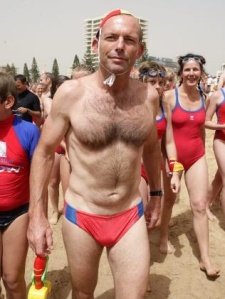
That ageing provocateur Bob Ellis, pictured here showing what Coke can really do to you, wrote a truly awful piece on the Drum yesterday to which on principle I will not link, basically arguing that feminism is responsible for the downfall by sex of many famous men from Oscar Wilde (???) to Dominique Strauss Kahn.

Heck, I have to link, it isn’t fair to talk about it otherwise.

The piece was almost universally howled down, and the ABC shut off the comments option at around three hundred and something, only the day after it was published.

What Ellis’s pleas for a more understanding and forgiving attitude to male desire did make me ponder, is how easily male public figures are brought down by their sexual activities, whether they’re caught playing away, sniffing chairs, exiting gay bars or cavorting in their underpants when one would wish them to be fully dressed. Though for Ellis to claim this has much to do with feminism is contestable, as there weren’t a lot of feminists braying for Oscar Wilde’s scalp, for example.

Usually these public figures are brought down by their male enemies who might very well employ some appropriate feminist rhetoric to make them look good and properly concerned about the women allegedly injured in the blokes’ peccadilloes (except in the case of Oscar Wilde and any other man brought undone by participation in gay sex or rumours of gay sex.)

What this says is that as a society we are apparently very uptight about the morals of influential men, or more likely there are forces at work who want us to think we are.

If a man is unfaithful to his wife, how does this affect his professional performance? The answer is we don’t know. Nobody’s done the studies. We make an assumption, based on current moral values about sex, fidelity and monogamy that if he’s deceiving his wife, he’s likely deceiving everybody else. This seems to me to be a slightly insane deduction. We all know how human beings can and do categorize, especially when sexual desire is at work in them.

Was Bill Clinton’s presidential performance changed for the worse as a consequence of letting Monica puff on his cigar, for example? (No, she didn’t inhale. They found the smoke on her frock.) Do we have the  right to judge a man’s whole life (or a woman’s for that matter, but sexual disgrace doesn’t seem to befall influential women to anything like the same extent) on the strength of his sexual behaviour?

Of course I’m only talking about non criminal situations. If  an influential man is found to have acted criminally in sexual matters, then that needs to be viewed as would any other criminal behaviour.

Ellis claims that a lot of good men are cut off at the balls because feminist wowsers can’t deal with their expression of their sexuality. Men have always been at the mercy of their desires, he claims, and everybody needs to cut them some slack if they Fall. High levels of testosterone go hand in hand with high levels of achievement, so there’s bound to be trouble.

There isn’t much to take away form Bob’s rave, except that it does remind me that the society in which we live seems to have a dominant moral view of sex as at best naughty, and at worst, really scary and requiring all kinds of societal controls, including marriage and monogamy. Repression is the price we pay for civilization. Give adolescents condoms and they’ll be at it in the aisles at school.

Any public figure who transgresses the dominant sexual morality runs the risk of being terminally banished, not because they’re particularly evil, or even a little bit bad, but because they’ve given their opponents a brilliant excuse to run them out of the game, under the guise of upholding society’s moral values.

While straying from one’s chosen partner is going to cause a lot of grief, does that make it immoral? If a man in a powerful position engages in a consensual sexual encounter with a woman with less power, is that an immoral act? Who is determining our moral values at this point in our history, how are they determining them, and to what purpose?

Or is there truth in Nietzsche’s claim that:

There are systems of morals which are meant to justify their author in the eyes of other people; other systems of morals are meant to tranquilize him, and make him self-satisfied; with other systems he wants to crucify and humble himself, with others he wishes to take revenge, with others to conceal himself, with others to glorify himself and gain superiority and distinction,–this system of morals helps its author to forget, that system makes him, or something of him, forgotten, many a moralist would like to exercise power and creative arbitrariness over mankind, many another, perhaps, Kant especially, gives us to understand by his morals that “what is estimable in me, is that I know how to obey–and with you it SHALL not be otherwise than with me!” In short, systems of morals are only a sign language of the emotions.”

Whatever the answer, it’s a pretty safe bet that it’s got very little to do with feminism, or even wowser feminism. Sorry, Bob. You blokes are on your own with this one.

Gillard government guidelines say women don’t commit domestic violence: in On Line Opinion today.

5 Jul

In On Line Opinion this morning, I press on with my solitary mission to bring some reality into the Gillard government’s National Plan to reduce Violence against women and their children.

It’s a dark and lonely job but someone has to do it.

Every time I take this on, especially on the Drum, I’m called anti feminist (that’s an insult these days?) an apologist for rapists, a”man fondler” who is determined to attack feminism any way I can; of having a prick in my head and various other slings and arrows shot at me by women who call themselves feminists.

Yet I remain strangely unaffected.

Foreign ownership or boat arrivals – which is most likely to invade and conquer?

4 Jul

On the Watermelon Blog on Saturday, David Horton notes that when a recent Greens’ survey revealed that 83% of mining companies in Australian are owned overseas there was, in his words, “a swift and predictable response from one of the egregious right wing think tanks whose role is to protect corporations from criticism.” Foreign investment is good for Australia, they brayed, and we have plenty of land to sell. They then called up the spectre of xenophobia, more commonly hauled out in “don’t stop till blood is spilt and maybe not even then” arguments over asylum seekers arriving by boat.

Horton raises the crucial matter of where we should draw the line at foreign ownership, and what assets are we willing to relinquish to foreign control. “What happens,” he asks, “when push comes to shove in a financial crisis or a raw material crisis?” We would be naïve indeed to imagine that foreign corporations give a toss about our welfare and wellbeing. Heck, even our own corporations aren’t overly concerned about any of that soft stuff.

‘So how many asylum seekers do YOU think we should allow?” is the question frequently and usually aggressively hurled at supporters by the anti boat people faction, who express deep fears of being overtaken, of losing our culture and Australian way of life, and of losing control of our boundaries and sovereignty if we open the gates and let the refugees in.

The arguments used by corporate interests against those who oppose unbridled foreign ownership, and those used by the anti boat arrival faction against those who support their re-settlement, are ironically similar. In the absence of reliably specific demographic evidence, I’ll make an assumptive  leap that there may well be those amongst the anti boat arrival group who would regard expanding foreign ownership as good for our country, while simultaneously railing about the catastrophic dangers posed to us by a few thousand boat arrivals. I have no proof of this – it’s a good subject for a poll.

In essence, it’s the same argument employed for very different purposes and by very different interests.

Wealthy foreigners in suits arriving first class by plane and bearing papers won’t want to live next door, and they won’t be a drain on the welfare system. That they might well be in a process of asset stripping the country is such an intangible that it can’t be seriously be raised to the level of a threat. As is frequently the case, the danger lies not in the obvious, and one doesn’t see it coming.

Those who struggle to bring the hidden danger into collective awareness are usually dismissed as a bunch of Cassandras, after the mythical woman blessed with foresight then doomed by Appollo  to be mocked and disbelieved when she revealed her predictions.

The conflation of the topics of boat arrivals and foreign ownership usefully highlights where the danger to this country’s future really lies. It’s not in the few thousand foreign asylum seekers fetching up in boats on our shores. It’s a pretty safe bet that none of them are going to own the rights to our water in the future. We probably don’t need to worry that any of them are going to buy up our prime farming land for mining, leaving us more dependent on imported food supplies when we can’t produce our own. It’s not very likely that any re-settled boat person is going to end up owning our energy companies, our transport companies, our stock exchange, or any of the other assets Horton lists as at possible risk.

In spite of the Greens raising the issue of the dangers of foreign ownership for our future and ultimately our sovereignty there will not be, I predict, anything like the furore over foreign investment that there is over boat arrivals.

Other than what spews forth from the corporations who stand to benefit enormously, of course, and we can likely prepare ourselves for billion dollar advertising campaigns as soon as any serious rumbling starts up.

It’s undoubtedly in the interests of corporations and governments that xenophobic fears (apparently endemic in some human communities) of being invaded and conquered are channeled away from the issue of foreign ownership, and into something as petty as a couple of thousand boat arrivals.

“Illegal immigrants” Press Council ruling: Why is Paul Sheehan is allowed to say it while Greg Sheridan is not?

3 Jul

Imagine my astonishment when I came across this post describing how in June 2011 the Australian Press Council upheld complaints against the Australian‘s Greg Sheridan alleging that he had wrongly described boat arrivals as “illegal immigrants” not once, but three times.

On January 7 2011 I put the following post up on  No Place for Sheep:

Today we sent a complaint to the Australian Press Council claiming that the article by Paul SheehanSydney Morning Herald January 3 2011, titled Cast adrift from reality, the slick spruikers of ‘our’ shame, breaches Principles 1,2,3 and 6 of the Council’s Statement of Principles.

These Principles address misrepresentation of groups and individuals; suppression of available facts; deliberate misinformation through omission or commission, and fairness and balance.

We claim that these principles were breached by the use of the terms “illegal” and “without proper papers” when referring to asylum seekers arriving by boat.

This is the post I put up on January 13 2011, announcing the APC’s dismissal of my complaint against Sheehan:


I received the following email from the Australian Press Council today:

Dear Dr Wilson,

The Council has received a complaint from you, in which you raise a concern with terminology used by a bylined opinion columnist in The Sydney Morning Herald.

For your information, a copy of the Council’s principles and practices can be found on the Council’s website http://www.presscouncil.org.au.Therein are set out the standards of journalistic ethics that the Council upholds and the procedures it uses to deal with complaints alleging breaches of those standards.

Attached, for your information, is a copy of the Council’s Guideline No 288 on the issue of asylum seekers.

The Council believes that columns such as Sheehan’s should be given a reasonably wide licence to express a point of view. They are the clear expression of a viewpoint of the individual writing them and are commentary upon the news.

The terminology you complain of talks of  “illegal boats”. Since the boats can be seized and their crew tried before the courts, there is good reason to suggest that the arrival of the boats is in fact “illegal”.

Have you submitted a letter to the Sydney Morning Herald for publication in response to the published column? The Council has consistently said that the best response to a disagreement with such material is the submission of a contrary view for publication. I therefore urge you to take the matter up direct with the newspaper in the first instance, if you have not already. I will write to the newspaper urging it give due consideration to any submitted letter as a way of dealing with your concern.

I will bring your concern to the attention of the newspaper but believe that the best settlement of your concern, in this case, is through the letters to the editor column.

Yours sincerely,

Deb Kirkman, Acting Executive Secretary, Australian Press Council

To which I replied as follows:

Dear Ms Kirkman,
I have indeed twice written to the SMH letters on this matter, as I stated on my complaint form, and neither letter has been acknowledged.

To reiterate, the terminology I complained of is as follows:

1. Illegal boat arrivals. If Sheehan was referring only to the arrival of SIEVs, or to the crew of SIEVs, then these references makes no sense at all in the context of his paragraph.

It is rather disingenuous to suggest that Sheehan was referring to the vessels and their crew, given that the crews are arrested and the vessels are impounded, therefore the problem is addressed immediately at the source and offers no basis for Sheehan’s on-going angst.

Sheehan then goes on to comment on the “relatively small number of people who arrive by boat,” thus clearly confirming that he is indeed referring to the passengers who are seeking asylum, and not to the SIEVs and their crew.

2. Those who arrive by illegal means,and those who arrive without proper papers.

The UN Refugee Convention, to which Australia is signatory, recognises that refugees have a lawful right to enter a country for the purposes of seeking asylum. The Convention stipulates that what would usually be considered an illegal action, eg entering a country without a visa, should not be treated as illegal if a person is seeking asylum.Australian law, in line with the Convention, also permits unauthorised entry for the purposes of seeking asylum.

Therefore, under Australian law, and under the terms of the Convention we have signed, a person who is seeking asylum has the legal right to enter this country without papers, and by any method of transport, even SIEVs, and has the legal right to remain in this country, until his or her refugee status is established through the proper legal processes, to which, as asylum seekers, they are legally entitled.

Their mode of transport does not render asylum seekers “illegal,” as suggested by Sheehan.

This was re-affirmed by the High Court of Australia in November 2010.

Again, my complaints  relate to numbers 1, 2, 3, and 6 of your Statement of Principles.

Sheehan has misrepresented the facts of this situation – asylum seekers are not illegal, even if they enter the country on SIEVs.

Sheehan has suppressed facts that are available to him, i.e. the facts that under domestic law and by international agreement, Australia does not consider those requesting asylum to be illegal in any way, no matter how they arrived in this country, including if they arrived “without proper papers.”

The illegality of their mode of transport is a separate issue, as the law recognises, and is dealt with as a separate issue. Asylum seekers are not held responsible for the legality or otherwise of their mode of transport.

Sheehan has misinformed and misled the SMH readership by conflating the two, and in so doing, ignores Australian law and the UNHCRConvention.

Since when has it been acceptable that even an opinion writer has the license to misinform their readers about Australian law, and the legal status of a particular group of people?

Sheehan has not presented his readers with the facts, and his opinions are not based on the facts. Sheehan has acted irresponsibly in putting forward an uninformed point of view as his opinion. The facts are readily available to him. Surely even opinion pieces are supposed to have some basis in reality?

I have requested that the SMH correct Sheehan’s inaccuracies and conflations. I have received no response

Yours sincerely,

Jennifer Wilson.

Australian Press Council Guideline 288 in regard to Asylum seekers.

Guideline No. 288 Describing “asylum seekers”

Issued: October 30, 2009

For immediate release

The Australian Press Council has updated its guideline on “asylum seekers”, replacing General Press Release 262 with the attached guide. The Council issues guidelines from time to time. These are, in essence, amplifications on particular issues arising from the Council’s Statement of Principles. The guidelines apply the Principles to the practice of reporting and are intended to guide the press on how it should report certain matters. These guidelines are not intended to be prescriptive instructions to the press but act as a series of advisories on the application of the Principles that the Council seeks the co-operation of editors in maintaining. A list of the extant guidelines (and links to them) can be found on the Council’s website athttp://www.presscouncil.org.au/pcsite/activities/gprguide.html.

The Council has from time to time received complaints about the terminology used to describe people who arrive in Australia through means other than regulated immigration and visa transit processes. They are often referred to by the press and others as “illegal immigrants”, “illegal boatpeople” and so on –  or simply as  “illegals”. The descriptor “illegal(s)” is very often inaccurate and typically connotes criminality.

The press has, by and large, abided by the Council’s 2004 Guideline about the use of inaccurate and derogatory terminology to describe such people.

Having considered the matter further, the Council believes that the term “asylum seeker” is a widely understood descriptor, generally a fair and a sufficiently accurate one, and one which avoids the kinds of difficulties outlined above. The Council recommends its use as the default terminology in relevant headlines and reports both by the press and others.

The Australian Press Council comprises representatives of the public and of the industry and acts to preserve the freedom, and the responsibility, of the Australian press. It was founded in July 1976 and has been in continuous operation for over 30 years.

End of Guideline 288

What are we to make of this disparity in the Press Council’s judgement?

 Is the APC favouring the Sydney Morning Herald, while holding the Australian to a different set of standards? Is it more personal than that, ie can Sheehan do what Sheridan cannot and if so, why?


Strauss Kahn rape case in doubt – who’s got the most credibility?

1 Jul

Excellent analysis of the issues here

Prosecutors are re-considering their position in the case against former IMF Managing Director Dominique Strauss Kahn, accused of the sexual assault of a hotel housekeeper in New York.

According to the New York Times, investigators have discovered “major holes” in the credibility of the woman who alleged DSK forced her to perform a sexual act against her will.

The “major holes” are apparently issues involving her asylum application; the possibility of her links to criminal activities, and a phone conversation with her fiance in which they discussed the benefits of pursuing charges against DSK. Her fiance has drug convictions, and allegedly paid some $100,00 into her bank account.

As well, investigators discovered that the information on the woman’s asylum application was not consistent with what she told them.

Strauss Kahn’s lawyers have never denied that a sexual act took place, but claim it was consensual, and that they would discredit the housekeeper’s version of events. There has been no mention of DSK offering money for the woman’s sexual services.

None of the “major holes” in the woman’s account of herself prove that her version of events in DSK’s hotel room is wrong. The case has always been about a “he said-she said” situation. Since his arrest, several other women have come forward to give details of unpleasant encounters with DSK, and his private reputation as a sexual predator has been made public.

Yet this history doesn’t seem to affect his credibility when it comes to the events of that morning.

In a he said-she said situation, it all comes down to a battle for credibility.

The power dynamics are interesting: while at first blush one could see DSK as having all the power on his side even if the sex was consensual, the consequences have been catastrophic for him, as he lost his job, and quite possibly his future as a possible French president.

Against this, the housekeeper was possibly forced into a sexual act she did not seek or want, she may also have lost her job, and her application for asylum is under serious scrutiny. In the context of her life, the consequences for her are as catastrophic as for DSK.

But he’s still wealthy.

It looks as if no one will come out of this situation unscathed including the NYPD, who are now accused by some of rushing to premature judgement.

So the morals of this he said-she said story are? If you can’t be sure it’s safe do us all a favour and keep it in your pants, chaps.

And if you’re a woman with any history, you’ve likely got little or no credibility, no matter what the truth is.

In a little footnote to these events, Strauss-Kahn’s replacement at the IMF, Christine Lagarde, commented: “In my interview at the IMF with all the 24 administrators, there was not one single woman. So while I was being questioned for three hours by 24 men, I thought it’s good that things are changing a little.”

Scott Morrison’s epiphany. And you thought Raquel’s was amazing! Plus a QC on invasions.

29 Jun

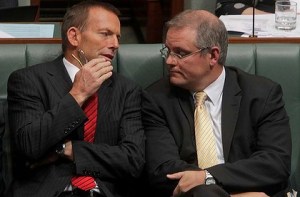
Scott and Tony share a private moment

Forget the series of real epiphanies experienced by the participants in the SBS seriesGo Back Where You Came From, marvellous as they were to witness, though the misanthropic Paul Sheehan, seemingly incapable of recognising genuine feeling when it bites him in the arse, continues to accuse the producers of emotionally manipulating both cast and audience.

Far more demanding of our attention is the miraculous appearance of what we can only conclude is the “real” Scott Morrison, after months of us having to listen to his cruel evil twin. Morrison has apparently gone through a dark night of the soul, during which he wrangled with his bad side and overcame it, to emerge cleansed, and with a new concern for humanity.

The fake Scott Morrison who whined disgracefully about the cost to Australian taxpayers of flying the bereaved from Christmas Island to the funerals of loved ones drowned in the boat tragedy has vanished, to be replaced by a caring, compassionate, emotional human being, appalled by the Gillard government’s inhumane plan to send 800 asylum seekers to the hell of life as a refugee in Malaysia. They are human beings! By God!

The “real” Scott Morrison puts forward a passionate argument for the re-opening of the Nauru detention centre where, unlike in Malaysia, asylum seeker children will be allowed to go school; medical assistance will be available when needed, everybody will be properly fed, and nobody need fear the cane. A bucolic idyll, by comparison.

It looks like the Gillard government has won the race to the bottom, just as Kevin predicted they would.

Meanwhile, back at the Sydney City Council, they’ve decided to use the term “invasion” in their corporate plan preamble to describe European settlement.

Predictably this has aroused the ire of many, who argue that the term refers solely to military acts, and is thus completely inappropriate because the arrival of the settlers was nothing of the kind.

We will decide who comes to this country and the manner in which they come!

However, No Place For Sheep can reveal that use of the term “invasion” was legitimized by no less a figure than the Solicitor General for Australia, David Bennett QC, when he defended the Howard government’s excision and migration laws in the High Court back in the early 2000’s as follows:

Today, invasions don’t have to be military … they can be of diseases, they can be of unwanted migrants….

So suck that up, all you invasion deniers. You’ve been told.


Become a school chaplain: no qualifications needed, just believe in God

28 Jun

Here is the description of the School Chaplaincy Program taken from website of the Department of Education,Employment and Workplace Relations:
This voluntary program assists schools and their communities to support the spiritual wellbeing of students. This may include support and guidance about ethics, values, relationships, spirituality and religious issues, the provision of pastoral care and enhanced engagement with the broader community.

School chaplains are not required to have any qualifications at all, in any field. Yet they are charged with the responsibility of “guiding” students through the minefields of relationships, ethics, values and spirituality.

It’s intolerably negligent of the government, and schools participating in this program,  to permit any one in a school community to “provide guidance” to school students in the complex and sensitive areas of ethics, values, relationships, and spirituality, without any training at all in these areas, or any other for that matter.

The provision of these unqualified “support” chaplains in our schools is costing us $165 million over three years.

Do we have unqualified nursing assistants in hospitals? Do we have unqualified teachers’ aides in schools?

The program overview continues:

While recognising that an individual chaplain will in good faith express his or her belief and articulate values consistent with his or her denomination or religious belief, a chaplain should not take advantage of his or her privileged position to proselytise for that denomination or religious belief.

I read this with utter incredulity. The chaplain is not required to have any qualifications, but the chaplain is permitted to articulate beliefs and values consistent with his or her denomination or religious beliefs.

As the school chaplains have no qualifications in the areas in which they are supposed to provide “guidance” for students,one can safely assume the the government doesn’t really expect them to do that. Or if the government does expect them to do that, this is a bigger scandal than that of the unqualified installers of pink batts.

Scripture Union of Queensland is a prominent supplier of school chaplains.From their website:

Working alongside other caring professionals, SU QLD Chaplains care for young people’s spiritual and emotional needs through pastoral care, activity programs, community outreach and adventure-based learning.

Most importantly, SU QLD Chaplains provide a personal point of Christian contact, care and support for students, teachers and their families within their schools.

And there we have it. School chaplains are in public schools to promote Christianity. That’s the only thing they are “qualified” to do. All the job requires is a belief in the Christian god.

It’s dangerously negligent for the government and schools to let  untrained chaplains loose in schools, giving them an entirely unearned privileged position advising students on relationships, ethics, values and spirituality. The only thing they can possibly do is advise students from a Christian perspective. In the wider world, we have a choice about who we go to for guidance and advice. Nobody forces us to go to the Christians or any other religious group. Yet in our public schools students have as their source of guidance the unqualified religious?

What happens to, say, a student struggling with their sexual identity who thinks they might be gay? Given the dominant Christian perspective on homosexuals as articulated by the Australian Christian Lobby’s Jim Wallace, which is to lovingly expel them.

The questions for Minister Peter Garrett are: why isn’t this money being used to provide more qualified counsellors in schools? Why is the government financially supporting religious activity in public schools? Why is the Minister putting children at risk by offering them guidance from people who are totally unqualified to give it?

This is a completely unacceptable situation from every perspective. Our students are entitled to qualified non-religious counselling when they’re in difficulties. To offer them religious proselytising instead is despicable.


Mentioning the war – on the Watermelon Blog

26 Jun
WikiWorld comic based on the articles "Go...

Image via Wikipedia

Have a read of Mentioning the war on the Watermelon Blog. David Horton reclaims THAT word from the climate change deniers who call Godwin’s Law!

Go back part three: Don’t call me a leftie!

24 Jun

Abbott you've been dickrolled. by David Jackmanson via flickr

Go back where you came from: Part Three

I was amused to see Roderick, vice president of  a branch of the Young Liberals, appear again in last night’s episode sporting the tee shirt with Tony Abbott in a lifeguard’s bonnet and budgie smugglers on the front. Unfortunately I couldn’t read the slogan.

Later he showed up in Congo wearing Julia Gillard as a lemon on his chest. Roderick is to be commended for his commitment to furthering his goal, stated at the beginning of the series, that he did not intend to allow anyone to cast him as a leftie. He simultaneously pushed domestic political propaganda for the home audience, and I’m certain he is to be watched as a future politician.

I’m struggling with on-going ambivalence about this show. On the one hand, it’s a remarkable achievement. I mean, imagine the logistics involved in pulling it all together. Give credit where it’s due, I say.

The fusion of documentary and reality TV genres was inspired: while I found the Big Brother style narration a little irritating it certainly allows the program to speak to a broader audience than a straight doco. It was a clever marketing decision, and also  allowed the participants an on-going and authentic emotional engagement that would not have been as easy in a doco.

However, I’m unable to shake a sense of voyeurism and exploitation. I think this could have easily been avoided by including footage of whatever negotiations took place between the producers and the asylum seekers and refugees who took part in the program. We get very little sense of their agency: they are portrayed as largely without any.

While they obviously have severely restricted agency in determining the course of their lives, I think it would have been respectful and humanizing to at least show the audience how they were invited to take part, and how they accepted the invitation.

Instead, we are left with an impression that they passively exist for our consumption, while the agency of the white participants is taken for granted. Raquel, for example, was given a choice about visiting Congo and she declined.

At the same time, the face to face interactions between the Australians and the refugees worked extremely well to humanize them, counteracting the Gillard government’s on-going efforts at dehumanization by isolation.

As the philosopher Emmanuel Levinas pointed out, when we are denied interaction with the face of the other, we are denied interaction with our humanity and theirs. Go back to where you came from achieved a great deal in this regard, and this is one of it’s most powerful strengths.

Two participants did have their beliefs about boat people reinforced. Having seen the camps in which refugees languish for years awaiting resettlement, the sense of unfairness that these people should be usurped by boat arrivals was strong.

It’s probably entirely unreasonable to demand that anybody fleeing death and persecution should first consider others who may be worse off than even them. Such moral considerations are easy for those of us who are safe. Put any one of us in a war zone and we might well discard all moral niceties, and bolt to anywhere in any way we can.

Hopefully, the show will have gone some way to exposing the constellation of false assumptions that underly Australian attitudes to asylum seekers. But I’m not holding my breath.

Changing the gender paradigm: it’s women’s work

24 Jun

Changing the gender paradigm, in On Line Opinion today.

An essay on women in the workplace, baby clothes, pitfalls in the social process of gendering, and Foucault’s analysis of hegemonic manipulation. Enjoy!!!